
Quality of government
The ideal of a democracy is that the people determine what their government does. Usually, citizens elect politicians every few years. These politicians then make the decisions. Quite often, these decisions differ from what their citizens wish. The reasons may include lobbying, deal-making, party politics, and political games. Leaders may also earnestly believe that going against the will of their people is for the best. Unburdened by responsibilities, citizens may have unrealistic desires.
Democracy doesn’t guarantee high-quality decisions, so there have always been pundits questioning the merits of democracy. No form of government guarantees high-quality choices. It is helpful to distinguish between the quality of the government and its decisions and the quality of democracy. Improving governance is far more complex than improving democracy, which is relatively straightforward, and the subject of this section, which can remain relatively brief for that reason.
In a well-functioning democracy, the government acts following the will of the citizens. In this respect, one political system stands out: the Swiss system. The great thing about it is that it is a proven concept rather than a figment of a political philosopher. In Swiss democracy, authority operates from the bottom up. It is a design flaw, as the world is interconnected, so our choices have consequences for people in other parts of the world. That is why, in most states, including democracies, authority operates top-down.
Features
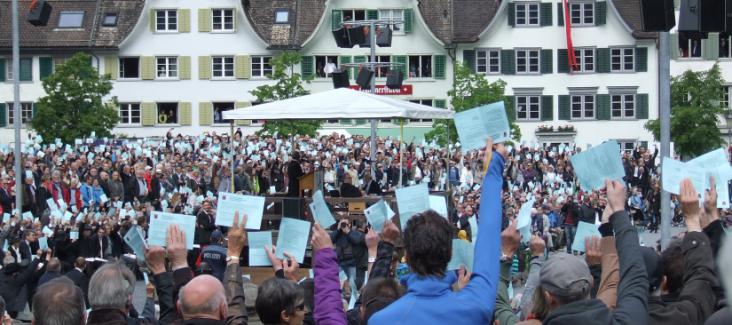
The Swiss political system features a unique combination of representative and direct democracy. The government and parliament administer the country’s daily affairs, but if citizens feel the desire to take matters into their own hands, they can demand a referendum. The government must respect its outcome.1 Switzerland has the following referendum types:
- mandatory referendums on changes in the federal constitution
- optional referendums on federal laws when a specified number of citizens ask for it
- Similar rules exist on the state and municipal levels.
Switzerland has 26 cantons, which are akin to member states, and over 2,000 municipalities that enjoy a significant degree of autonomy. The Swiss constitution promotes making decisions at the lowest possible level and delegating power to a higher level only if deemed beneficial.
The Swiss elect their National Council every four years. It has proportional representation. Citizens can vote for a political party, as well as for specific persons on the party’s candidate list. The Swiss can cast multiple votes, often one for each available seat in their constituency, allowing them to vote for several candidates and parties.
Switzerland also has a Council of States. All the Cantons have seats, for which there are also elections. Most have two, and a few smaller Cantons have one. Decisions require a majority on the national level in the National Council as well as among the Cantons in the Council of States. The Swiss citizens can overturn these decisions in referendums.
The seven-member Federal Council, elected by the National Council and Council of States together, handles the daily affairs of government. All the major political parties have seats in it. The Federal Council aims for consensus but may revert to voting if it is impossible to reach an agreement. Referendums ensure that this hardly happens.
Evaluation
Referendums have the following consequences:
- The combination of representatives and referendums keeps citizens in control while unburdening them of daily government affairs. They don’t have to vote on every single matter, but can vote on an issue if they feel it is necessary.
- Referendums are yes-or-no questions. Before crafting laws, the government consults with various interest groups and considers their concerns. That prevents laws from being voted out in referendums.
- Whatever choices are made, they are the citizens’ choices. It can breed a sense of responsibility as citizens live with the consequences of their choices. If things go wrong, they can’t blame their politicians.
- There are fewer political games, coalitions, and deals, as citizens can vote out laws they disagree with. It also promotes stability and cooperation. The largest political parties are in government and aim for consensus.
The distribution of power has the following consequences:
- There is no single decision maker with a lot of power, such as the President in the United States. The Federal Council performs the daily task of governing, and the largest political parties all have seats in it.
- Proportional representation in parliament enables multiple political parties that align with the preferences of voters. Small shifts in voter preferences have a minimal impact on the political landscape.
- The Swiss National Council represents the federation, while the Council of States represents the Cantons. A decision requires a majority in both. This provision aims to safeguard the interests of the rural cantons with smaller populations.
Considerations
Switzerland doesn’t have a Constitutional Court or a House of Parliament to ensure that the Constitution and human rights are respected. Switzerland is bound by the treaties it signed. The Swiss political system is one of the most democratic, but it tends to be conservative. Women received the right to vote only in 1971, as only men could vote.
The Swiss political system is one of the most democratic in the world. And it has safeguards that provide political stability. As referendums are yes-or-no questions, laws require careful crafting and consideration of the concerns of citizens. There are several theories about democracy, but the Swiss political system has proven to work.
In the Swiss political system, authority is decentralised. Delegation of responsibilities is bottom-up. It works from lower levels to higher ones. Most states have a top-down delegation. It flows from the higher levels to the lower ones. That is preferable as decisions in one district can affect other districts as well.
It is also the case at the global level. Switzerland is sovereign. It has been a freeloading country as Swiss banks have been a haven for criminals, tax evaders and dictators from other countries. Had the people of those countries had a say in this matter, that would not have happened. In a global democracy, every world citizen has an equal say.
Latest revision: 11 July 2025
Featured image: The assembly of the canton Glarus. Democracy International (2014). [copyright info]
1. Switzerland’s Direct Democracy. http://direct-democracy.geschichte-schweiz.ch/ [link]
 The Plan For The Future