Model Thinking

The limitations of one-dimensional thinking

The Hegelian dialectic is about argument, counterargument and resolution. It locks us up in thinking along a one-dimensional line with two opposites. Perhaps the best solution is outside that line. The debate about capitalism versus socialism dragged on for over a century and has dominated world politics. But markets and states can’t create agreeable societies on their own. Much of politics is theatre rather than reasoning and solving questions. We often think of good versus evil rather than the advantages and disadvantages of alternatives. We might find better solutions if we can meaningfully model humans and their interactions.

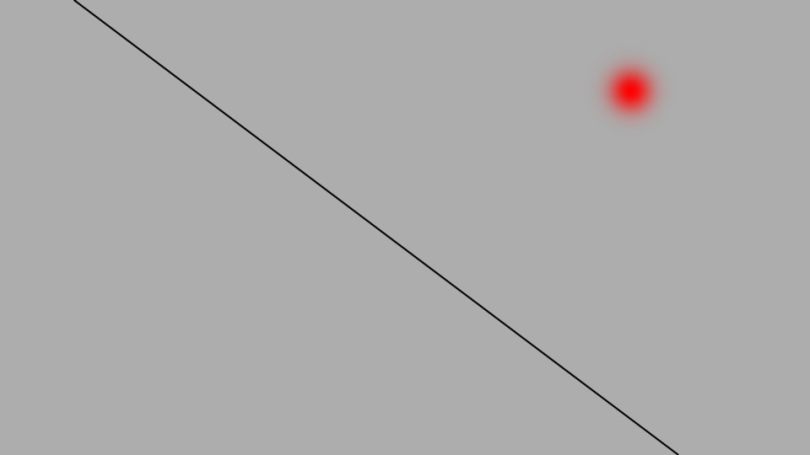
The limitations of thinking along a line like capitalism versus socialism become clear once you represent a line in a field. Suppose the grey area reflects the possible solutions, and the red dot is the optimal solution. If you reason along the black line, you only consider solutions on that line. If you design solutions by only thinking about how free markets should be and how much government interference we need, you might never consider the prevailing values in society. Your reasoning ignores human values. Thinking that markets and governments can solve society’s ailments is simplistic.

A line has one dimension. A plane has two dimensions, like the freedom of markets and shared values in society. You can represent three variables in a cube. For instance, you may add the state of technology as an additional variable. You won’t find the best solution if you think along a plane inside a cube. The number of variables can be higher. Freedom of markets and values in society are vague notions you can break down into dozens of more concrete variables. And if you have variables, you need ample data to estimate their impact. That data can be inconclusive. How do you know some other variable you didn’t think of didn’t interfere with the outcome? Despite all the models they used, central banks didn’t foresee the 2008 financial crisis. So yes, models can be wrong.

Still, models can be helpful. Our minds have constraints. We often take a perspective and reason from there. A socialist economist might tell us why capitalism fails but not what is wrong with socialism. There are economic theories that explain specific phenomena under certain conditions. And you might find additional answers in psychology, sociology, or even history. You might want to know what is wrong with your ideas before trying. You can run the idea through those theories. And that might give new insights. You can’t be sure you are right, but you can eliminate errors using models.

Natural Money is a research into an interest-free financial system. It draws from economic theories, monetary economics, banking, psychology and even history. I reviewed that idea with the help of existing theories and historical evidence to investigate how it might work in practice. During the process, issues came to light that I hadn’t thought of. Once interest rates in Europe went below zero, a resistance against negative interest rates manifested. Savers are irrational and prefer 2% interest and 10% inflation over -2% and 0% inflation.

It suggests we measure our gains and losses in our currency rather than purchasing power. And behavioural economics says we give more weight to losses than gains. The 4% loss in interest income impresses us more than the 10% reduction in inflation. These irrational emotions are human nature. It seemed pointless to try to convince savers that they were better off. Once I realised that, I could look for a fix for this awkward human feature by making negative interest rates appear as inflation.

The insights models give

Economic theories are models. Models are simplifications or abstractions. They can be loose and without numbers, like raising interest rates leads to lower economic activity. They can go into detail and include mathematics and predict that raising interest rates by 1% will slow economic growth by 0.5%. Models have limitations. Reality is much more complex than we can comprehend, so a model’s predictions are often off the mark. Still, models require us to use logic to establish which ideas might work under what circumstances by analysing an issue from different perspectives.

Proverbs can disagree with each other. Two heads are better than one, but too many cooks spoil the broth. And he who hesitates is lost while a stitch in time saves nine. Contradictory statements can’t be simultaneously correct, but both can be correct in different situations or times. Hence, we want to know which advice is best in which situation or what combination works best.

Models usually are better than uneducated guesses, and using a combination of models can lead to better outcomes than using a single model. That is why weather forecasters use up to fifty models to make a weather prediction. People who use a single model do poorly at predicting. They may be correct occasionally, just like a clock that has stopped is sometimes accurate, and endlessly tout their few successes while forgetting about their endless list of failures. These people will never learn anything from experience.

Intelligent people use several models and their judgement to determine which models best apply to the situation. Only people using multiple models together make better predictions than mere guessing, but they can be wrong. Models help us think more logically about how the world works and eliminate errors we would make otherwise. They can also give us insights into phenomena we wouldn’t get otherwise. To illustrate that, we can use models to investigate why people of the same ethnicity often live together and why revolutions are difficult to predict.

Sorting and peer effects
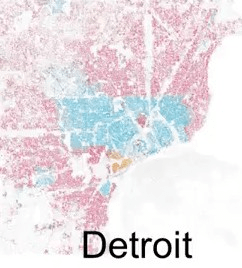
Groups of people who hang out together tend to look alike, think alike and act alike. If you look at the map of Detroit, you see people of the same ethnicity living together. Blue dots represent blacks, and red dots represent whites. We can’t change our skin colour, so if we hang around with people who look like us, that is sorting. We also adapt our behaviour to match that of others around us. When you hang around with smokers, you may start smoking too. Alternatively, if you hang out with people that don’t smoke, you might quit smoking. That is the peer effect. Both sorting and peer effects create groups of similar people who hang out with each other. Models can help us understand how these processes work. The phenomena seem straightforward, but we can model them.1

Schelling’s segregation model gives a possible explanation for how segregation works. Schelling made a model with individuals following simple rules. Suppose everyone lives in a block with eight neighbours. Red boxes represent homes where rich people live, and grey boxes are homes where poor people dwell. The blank box is an empty home. Assume now that everyone has a threshold of similar people who will make them stay.

A rich person might stay as long as at least 30% of his neighbours are rich. Assume a rich person lives at X. In this case, three out of seven or 43% of the neighbours are rich, like the person living at X. If one of the wealthy neighbours moves out, and a poor person takes that place, 29% of the neighbours will be rich, and the person living at X will move.
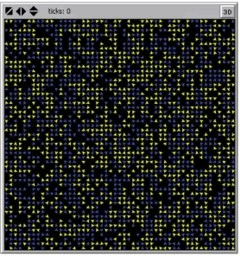
You can use a computer to simulate how that works out over time. Assume there are 2,000 people; 1,000 are poor, represented by yellow dots, and 1,000 are rich, represented by blue dots. Suppose they are distributed randomly at the start, and everyone wants to live amongst at least 30% similar people. In that case, the average is 50% alike, and only 16% are unhappy because less than 30% of their neighbours are alike. As a result, people start to move, and you will end up with a situation where the average is 72% similar and 0% unhappy.
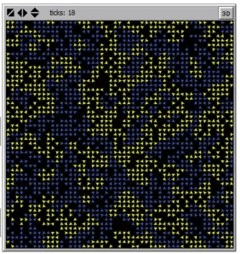
Even when everyone likes to live in a diverse neighbourhood where only 30% of their neighbours are like them, segregation occurs. Segregation may not be the intention of the individuals involved, as they might be tolerant people requiring only a minority of similar people living in their neighbourhood.1 Whether that is the case is a different question. But if it is so, and if we believe segregation is undesirable, managing the ethnic makeup of neighbourhoods makes sense.

Peer effects cause people to act alike. Contagious phenomena are peer effects. They often start suddenly, seemingly out of nowhere. In uprisings and revolutions, extremists frequently determine what happens, for example, with uprisings such as the French, Bolshevik and Maidan revolutions. In hindsight, several pundits saw it coming, but things could have proceeded differently. It is difficult to predict revolutions. Granovettor’s model gives a possible explanation as to why that is so.

Suppose there is a group of individuals. Each individual has a threshold for participating in an event like an uprising and will join if at least a specific number of others join. If your threshold is 0, you do it anyway. If your threshold is 50, you start if you see 50 participants. The outcome varies depending on the thresholds of other people that might get involved.

Suppose there are five individuals, and the behaviour is wearing a suit. One individual has a threshold of 0, one has a threshold of 1, and three have a threshold of 2. The following will happen: one individual starts wearing a suit because her threshold is 0. The second individual joins because his threshold is 1. Then, the three remaining individuals join in because their threshold is 2.

If the thresholds had been 1, 1, 1, 2, 2, nobody would have worn a suit despite the group, on average, being more open to the idea. If the thresholds had been 0, 1, 2, 3, 4, and 5, everyone would have worn a suit after five turns, even though the group, on average, was less keen on doing this. In this case, extremist suit-wearers determine the outcome.

It indicates collective action is more likely to happen with lower thresholds and more variation. The influence of variation is surprising. It might explain why it is challenging to predict whether or not something like an uprising will happen. Not only do you need to know the average level of discontent, but you must also see the spread of discontent among the population and connections between individuals and groups.1

The proof is in the pudding

Do similar people hang out together because of sorting or the peer effect? That is the identification problem. Sometimes, it is clear. Segregation by race occurs due to sorting. Other situations are less clear. Often, you can’t tell whether it is sorting or peer effect because the outcomes are the same. Happy people hang out with each other, as do unhappy people. Both sorting and peer effects may have caused this.1

Models provide new insights, like why similar people hang out together and why revolutions are difficult to predict. Other models help us investigate what might happen under which circumstances. Thus, models explore the dimensions of complex questions and help us identify the spots where the best solutions dwell. In this way, models can assist us. For instance, if we intend to make everyone contribute to a good cause, we might want to model humans to see how we can do that. But not everyone is the same.

If we see humans as rational beings with good intent, we can convince them with arguments to do the right thing. If we see humans as religious creatures, an inspiring story can make them do it. If we think humans are calculating individuals, incentives and punishments can make them do the right thing. If we see humans as status seekers driven by pride seeking recognition, we might achieve the objective by telling them how great they are. You may get the best result if you use a combined approach.

Model or myth?

You can look at a model in several ways. How well does it explain the facts? How well does the model predict future events? Is the model correct? Is the model useful for a purpose? All models come with limits. They can be simplifications that explain a particular selection of events or predict specific future events. We also have worldviews that are our models of reality. We are creative thinkers and connect the dots in different ways. Our worldviews might be fiction mixed with facts. But a model doesn’t need to be correct to be helpful. Worse, irrational beliefs might save you. Believing is about surviving, not about being right. That is why humans are religious creatures. An example can illustrate that.

The replacement theory alleges that the elites aim to replace white populations with non-whites through mass migration and lowering the birth rate of whites. That can ‘explain’ mass migration and lowering birth rates of whites, and also pro-life activists trying to ban abortion because the abortion rates of whites are lower than those of non-whites. You might even believe there is a sinister anti-white force operating behind the pro-life movement, probably Jews. It explains the facts neatly as long as you ignore evidence to the contrary. The theory is so flimsy that it is hard to believe that rational, intelligent people would think it is correct. Only the rationality of a belief is not in its correctness.

Had the Native Americans believed from the onset that whites were an evil race with nefarious inclinations, not humans, but trolls from a dark place where the Sun never shines who were planning to murder them, so that they had to eliminate these pale abominations at all costs, they might have fared better in the centuries that followed. But there was no reason to believe that when the first starving whites washed ashore. You had to be crazy to think that. And if the natives had eliminated the whites and prospered, critics might later have argued it had been unnecessarily cruel to genocide these pale faces. But in this case, an irrational belief might have saved them from disaster.

Most immigrants have no evil intent and seek a better future for themselves and their children. Business elites may need additional labour or aim for low wages. Immigration is a way to achieve that. Political elites may try to keep the peace by promoting diversity. Western countries signed humanitarian treaties to allow asylum seekers. In recent decades, policies in Europe and the United States aimed to limit immigration. However, immigration continues unabated and has led to a border crisis in the United States, and the theory gives a so-called explanation.

Renaud Camus is the intellectual father of the modern replacement theory. According to Camus, replacement comes from industrialisation, de-spiritualisation and de-culturisation. Materialistic society and globalism have created a replaceable human without national, ethnic, or cultural specificity. Camus argued that the great replacement does not need a definition, as it is not a concept but a phenomenon. Indeed, the predominant liberal ideology in the West is globalist and serves the interests of the capitalists. And if money becomes our primary measure of value, other values lose meaning.

Humans cooperate based on shared myths like religions and ideologies. The replacement theory is a shared myth. It helps bond the group members and prepare them for collective action. That might be limiting migration, sending back migrants, or even a race war. The myth needs not to be correct but helpful for its purpose. If you fear the consequences of mass migration or are living together with far-right people, it is rational to accept the myth. It can generate collective action or make you acceptable within the group.

Critics argue that the replacement theory can be an excuse for right-wing violence. In a similar vein, multiculturalism can be an excuse for left-wing violence. In both cases, there are examples, and the perpetrators often have mental health issues. In 2002, a left-wing extremist assassinated a Dutch anti-immigration politician after another had been permanently handicapped in a previous attack sixteen years earlier. In 2011, a Norwegian right-wing terrorist assassinated 77 people in a bid to prevent a ‘European cultural suicide’. Most of them were whites.

Modern multiculturalism is also a myth. Multicultural societies supposedly have people of different races, ethnicities, and nationalities living together in the same community. In multicultural communities, people retain, pass down, celebrate, and share their unique cultural ways of life, languages, art, traditions, and behaviours, or so we are told. In most cases, it is not a reality. Ethnic groups often live in separate quarters, and cultural differences can cause trouble. But the purpose of the myth is to keep the peace.

Once you accept a myth, it becomes a faith, and you start ignoring evidence to the contrary. That may be why progressives and conservatives drift apart on this issue. It is a survival mechanism. We can’t foresee the future. Maybe multicultural societies will disintegrate and descend into gang violence and civil war. Alternatively, multiculturalism may promote world peace. For both outcomes, plausible scenarios exist. Your future and that of your children are on the balance, so it is natural to have strong feelings about the matter and rally around a myth that can generate the collective action you think is needed.

Latest revision: 13 April 2024

Featured image: Line And Dot On A Grey Rectangle. The artist wishes to remain anonymous because who wants to be as famous as Piet Mondriaan?

1. Model Thinking. Scott Page. Coursera (2014). [link]

Rational debates and progress

Knowledge or wisdom?

Ancient cultures had religious traditions and wisdom. Chief Seattle’s speech reflects the beliefs of traditional peoples who live in nature as hunter-gatherers. It is an idealised version as traditional peoples like the Native Americans also drove species into extinction. They didn’t have the means to destroy nature as much as we do. Modern people may think these so-called primitives and their ways of knowing are irrational. Knowledge and rationality aren’t wisdom. It is the theme of the biblical story of The Fall. Instead of listening to God, who knew better, Eve and Adam wanted to learn the truth themselves. We would not have been in this mess today if they followed God’s command.

The Chinese have their own tradition and wisdom. Confucius was their best-known philosopher. He lived 2,500 years ago and is still influential today. His teachings comprise moral rules, correct social relationships, justice, kindness, and sincerity. Chinese tradition and beliefs like loyalty to the family, ancestor veneration, and respect for elders were the basis of Confucius’ teachings. Confucius argued that family should also be central to government policies. The Chinese Tao is the natural order of the universe. You can only grasp it intuitively. You can’t understand it with reason, let alone quantify it. The Tao path to wisdom is understanding the whole by experiencing it. One of the greatest poems ever written is the Tao Te Ching, attributed to the sage Laozi. It begins like this,

The Tao that can be told is not the eternal Tao.
The name that can be named is not the eternal name.

When you try to express the natural order in words or give it a name, you are astray already, or so says the Tao. It disconnects you from the whole of Creation. The Buddha is another source of ancient wisdom. Our desires trap us in this world of suffering, he taught. Once you have what you desire, you desire something else, so you will never be happy. You can escape that and achieve enlightenment with the help of meditation, physical labour and good behaviour. The end of craving is the end of suffering. The capitalist consumerist system aims at the opposite, which is creating new desires, and if needed for that, making us unhappy.

The Western tradition is one of expressing things in words and quantifying them. Wisdom in Greek refers to knowledge and insight and its practical application in life. In Greek philosophy, wisdom was the highest good a human could aspire to. We can develop this virtue through study, reflection and experience. The Greeks believed wisdom comes from knowledge. In hindsight, that was a mistake.

Socrates was a Greek philosopher who lived around 400 BC. He is a founder of the practice of rational debate. Socratic debates are discussions between people with different viewpoints who wish to establish the truth using reasoned arguments. In his dialogues, Socrates acted as if he was ignorant. Admitting your ignorance is the first step in acquiring knowledge. The Greek philosophers began a quest for knowledge. European philosophers and scientists continued it nearly 2,000 later.

Is there progress, or can there be?

When we think of progress, we think of things getting better. But are they getting better? One invention can cure a disease, but another can kill us. Undoubtedly, our knowledge has increased. But is that progress? And can there be progress if we are less happy than our grandparents were? So, is there such a thing as progress? And if so, can we achieve progress through rational debates and persuasion? Or does it come by force because of the competition between groups of people?

We see progress as moving towards a goal, for instance, well-being. According to science, we do not have a purpose. Some religions, like Christianity, see history moving towards God’s aim. We enter Paradise one day, and all that occurs is necessary to get there. That is a peculiar view, but it implies progress and a type of progress that eludes the understanding of mere mortals like us. Did Jesus have to die? Was the Holocaust necessary? Was there no other way?

If we have a purpose, and you can get your hands on a time machine, there is a fellow you might want to meet, Georg Wilhelm Friedrich Hegel. He believed that spirit drives history through ideas and that history progresses towards a goal. Hegel lived before Charles Darwin published On The Origin Of Species, and it shows. The evolution theory completely upset our thinking about the purpose of humanity. Most intellectuals eventually considered it silly to think we exist for a reason.

Around 1800 AD, when Hegel was alive, scientific discoveries began to affect the lives of ordinary people, and the Industrial Revolution took off. At the same time, enlightenment ideas started to affect societies. The American Revolution followed the Glorious Revolution in England. Then came the French Revolution, which ended the old aristocratic regime and mobilised the masses for the first time. A few years later, the armies of Napoleon spread enlightenment ideas over Europe.

Hegel was there to witness it, and he was impressed. He learned to see history as a struggle towards progress where more powerful ideas replace weaker ones. He made a daring attempt to explain history, and as a result, his thinking greatly affected history. Marxism and the Soviet Union would not have existed without him. The conflict between capitalism and socialism dominated global politics for most of the twentieth century. His thinking inspired others, for instance, the Neoconservatives.

Hegel’s dialectic


Hegel was a philosopher of progress. He believed things would get better and we would, one day, live in a utopia. We increase our knowledge over time. By reflecting on our thoughts, we can challenge them. Or something might happen that changes your mind. You might believe all swans are white until a black one comes along. From then on, you think most swans are white while some are black. Hegel came up with a three-stage scheme for progress in thought:

  1. You believe all swans are white. That is your thesis.
  2. There comes a shocker. You see a black swan, the antithesis.
  3. Then you think most swans are white, and some are black. It is the synthesis.

And that is progress. Hegelian dialectic is this elegant three-stage scheme with thesis, antithesis, and synthesis. You can see why people liked it so much. It is wonderfully simplistic, and it explains so much, or so it appears. The synthesis is incorrect if there are red swans, but it is better than the thesis. The prediction that the next swan I see will be black or white is more often correct than that the next swan will be white. And even though the synthesis may still be incorrect, it better predicts future events. You can also apply it to Socratic dialogues, where people with different viewpoints wish to establish the truth using reasoned arguments. Our viewpoints are imperfect, and exchanging ideas can bring progress, which we can discover using Hegel’s dialectic.

Suppose we have a time machine and fetch Adam Smith from 1770 and Karl Marx from 1870 and bring them to the present so they can meet. They first study each other’s books, and then we let them start an argument. Smith sets out the thesis. He says capitalism and free markets work best at raising the general living standard because self-interest makes people do a good job, and increases in scale improve efficiency. Then, Marx comes up with the antithesis. He argues that the living conditions for workers are miserable, and capitalism distributes its benefits unfairly as factory owners and traders are wealthy. They agree on minimum wages, as they have good intentions.


Ideas may look great in theory but usually work out differently in practice. Experiments can help to find out. There was a capitalist experiment in the United States and a communist one in the Soviet Union. Perhaps Marx would be disappointed when the time machine brought him to the Soviet Union in the 1980s. The workers in Western capitalist societies were better off. And maybe Smith will be disappointed when he sees the United States today. And both may say, ‘This is not how it is supposed to be.’ They may not blame the plan but the execution. It is always someone else’s fault. That is the standard excuse of planners who have seen their plans fail.

We play a small part in a greater whole of humanity. Hegel says our consciousnesses are part of a general consciousness called spirit. Spirit reflects the ideas in society and how they change. Our ideas about slavery are an example. Today, most people believe slavery is wrong, but in the past, most people didn’t think so. The spirit requires individual freedom of thought and the ability to be part of society with a spirit containing these ideas. In dialectic terms, the individual is the thesis, our society the antithesis, and to take part in that society is the synthesis. We have our individual thoughts and desires. But we live in a society. By engaging ourselves, we become part of that spirit.

We aren’t free and subject to outside forces, but we can cut ourselves off from the outside world, turn inward, and experience freedom of thought. That makes us unhappy because we desire unity with the eternal absolute truth, God or the universe, Hegel claims. We express this desire in religion. We feel insignificant towards that absolute and want to be part of it. Our reason is the alternative absolute. We can imagine a relationship between the particular, which are objects like cows and the universal ideas. So, a cow participates in the universal concept of cowness that all cows share. We exist in unity with the universal, and with reason, we can conquer the world. Thus, knowledge is power.

Hegel claims reason conquers the world. And now we get back at Napoleon. Hegel saw Napoleon as the embodiment of Enlightenment ideas conquering the world. Napoleon did so by military force. He was impressed by the French successes. He learned to see history as a struggle towards progress where more powerful ideas replace weaker ones. It is good to know that Hegel believed there is an absolute truth, so reasonable people might, or should, not compromise with unreasonable people and overcome them by force. And that belief has had a significant impact on history. It became the model for ideological conflict. Leaders may fight for power, but ideological conflicts are about ideas.

Hegel and history

The most well-known is the conflict between communism and capitalism. Hegel’s dialectic affected Marx’s thinking and that of the communist revolutionaries. Hegel believed the direction of human history is progress towards greater rationality. Hegel was an idealist, which means his philosophy was concerned with ideas. Marx, on the other hand, was a materialist who believed historical changes have material causes. Change doesn’t come from ideas but from circumstances in the world around us. Often, these are economic. So, Hegel might argue that slavery would end because people consider it wrong, while Marx might say slavery will stop when other forms of labour are economically more efficient.

Marx claimed we work in relations like master-slave or employer-employee, not because we want to, but because it is the most appropriate way of production in a given stage of our economic development. These relations form the structure of a society, the foundation on which a legal and political system arises, and that shapes our social consciousness. So, in a capitalist society, the legal system might centre around property rights, and labour rights might be non-existent. And it was like so in the 19th century. Not our consciousness directs our social existence, but our social existence determines our consciousness. So, serfdom in Europe didn’t end because serfs wanted to be free; it was because new forms of labour organisation had become more efficient.

Change comes from contradictions between the underlying material reality and the social superstructure. You can see that in Hegelian terms. There was serfdom in Western Europe because it suited economic conditions (thesis). It ended because serfs flocked to cities to earn more as craftspeople. It undermined the social superstructure of serfdom (antithesis). Lords of manors had to provide an attractive alternative to keep their peasants. Serfs became free (synthesis), which best suited the new conditions. Marx believed humans were free at first and lived as communists (thesis). As the economic reality changed (antithesis), societies became slave states (synthesis). In the following sequence of thesis-antithesis-synthesis, slave states developed into feudal societies. Those societies became capitalist states because of economies of scale and capital requirements. The thesis-antithesis-synthesis may seem contrived, but the status quo changes due to forces that undermine it, creating a new status quo.

Marx prophesied that in the next round of thesis-antithesis-synthesis, the working class would overthrow the capitalist states and start socialism. Marx believed it was a historical necessity. After all, the Hegelian dialectic works behind it, so communists were more advanced, reasonable people who sought to overthrow the backward capitalist order. Marx was a prophet as he prophesied what would happen and had a vision of paradise. Humans first lived in a state of nature, the simple communism of the group, Marx’s Eden and we will return to communism, Marx’s paradise. Marx called religion opium for the masses, but Marxism resembles a religion. Like Christianity, Marxists think history has a purpose and an end times in which we enter the worker’s paradise. Ideologies come with prophets and holy books. The Capital of Karl Marx was the sacred book of Marxism.

Ideas require power to change the world. Marx claimed the exploited masses, the employees, should rise against their employers because their profits come from paying workers less than they are worth. All the workers across the world had to unite in a revolution. Capitalists disagreed. They argued that wages are the market price of labour, and the capitalist sells his products at the market price. The profits and the losses are for him. An entrepreneur seeks to employ the means of production, including labour, in the most efficient way, so the market value of an employee might increase due to the capitalist production organisation. Workers in socialist countries often had lower wages than workers in Western market economies. The communists and the capitalists believed they were reasonable, that their ideas were better, and that you shouldn’t compromise with unreasonable people, causing a stand-off between two ideological blocks, the Cold War.

In a Hegelian sense, capitalism seems better because it won out. However, capitalist societies introduced reforms like minimum wages and welfare. Agreeable societies have mixed economies, a mixture of capitalist and socialist elements, thus a market economy and an active government that intervenes in markets with regulations or money transfers like welfare. That could be the synthesis of capitalism and socialism. Capitalism is now the thesis of a new Hegelian question. The antithesis is that our production and consumption are about to cause an ecological or technological catastrophe. We need a different political economy. Hegelian thinking has limitations. It stylises questions as choices between two opposites. So, it is either capitalism or socialism or a mixture of both. Experts often use models to deal with complex problems. The use of models requires expertise or even wisdom. We have to learn how the parts interact and contribute to the whole.

Featured image: Portrait of Georg Wilhelm Friedrich Hegel. Jakob Schlesinger (1831). Public Domain.

The Virtual Universe

Some religions claim that God or gods have created this world. In the Bible, God created everything by saying, ‘Be.’ That God uttered ‘Be’ and poof, there are bees, is not a particularly compelling explanation for the existence of bees. So, how could the gods have the magical powers to do that? Until recently, we had no clue, but then Nick Bostrom, known for his dry and incomprehensible employment of words, delivered us the simulation hypothesis, the most profound breakthrough in theology in nearly 2,000 years. We might exist inside a computer simulation run by an advanced humanoid civilisation. Our creators can define a class bee and instruct the computer to create instances of this class. A class has properties, allowing individual instances to be unique.

And so, Genesis might be closer to the truth than the religion sceptics think. Bostrom didn’t say whether or not that is indeed the case or how likely it is. He didn’t speculate on that issue. Otherwise, his critics might have a field day, ridiculing him for opening a back door to the paranormal and religion. That could have been the end of his career. However, it is easy to find out if you venture into areas that scientists anxiously avoid, such as paranormal incidents, religious experiences, meaningful coincidences, people’s memories of past lives, ghost phenomena, and UFO sightings.

Scientists dare not investigate these phenomena, as it could make them a laughing stock in front of their peers. That is groupthink and intellectual cowardice on a grandiose scale. On numerous occasions, multiple credible witnesses have observed events that science can’t explain. Like nearly everyone else, scientists have been proficient at ignoring evidence that contradicts their beliefs, such as unscientific ravings about spirits relaying messages from the other side during seances. Bostrom speculated that this world might be a virtual reality, but didn’t search for proof. As a philosopher, he had better things to do.

The book The Virtual Universe delves into the evidence. You can prove this universe is a virtual reality if you assume scientists have correctly established the laws of nature and that sciences like physics, chemistry and biology are correct. If events transpire that defy these laws of science, such as paranormal incidents, religious miracles, meaningful coincidences, memories of previous lives, ghost phenomena and UFO sightings, breaches in these laws occur. According to science, the Virgin Mary doing a miracle before a crowd of thousands, like in Fatima, is impossible. If science is correct, and it happens nonetheless, this world must be fake. The book The Virtual Universe puts it like this:

  1. If we live in a real universe, we can’t notice. Virtual reality can be realistic and come with authentic laws of reality.
  2. This universe may have fake properties, but we cannot notice that either because we don’t know the properties of a genuine universe.
  3. Breaching the laws of reality is unrealistic in any case. If it happens, we may have evidence of this universe being fake.

It follows from (1) and (2) that we can’t use the universe’s properties, reflected in the laws of nature, to determine whether or not this universe is real. Science can establish the laws of physics or the properties of this universe, but science can’t tell whether they are real or fake. However, if breaches occur, we have evidence suggesting this universe is bogus. The book The Virtual Universe investigates the evidence, which includes stories about paranormal incidents, religious experiences, meaningful coincidences, reincarnation stories, ghost phenomena, and UFO sightings, often with multiple credible witnesses. So yes, aliens can beam you up into their UFO because they are as fake as you are.

Advanced humanoids, often dubbed post-humans, likely share motivations with us because they evolved from humans, likely after some engineering, genetic, or otherwise. These advanced humanoids may run simulations of human civilisations for research or entertainment. Research applications could be about running what-if scenarios. Possible entertainment applications include games or dream worlds where someone’s imagination comes true. These simulations may not be realistic in some aspects, as they reflect the rules of a game or someone’s personal fantasies. In a simulation, you can let Jesus walk over water and make him think that faith alone suffices to do that.

Civilisations are complex. Small changes can derail events that would otherwise occur. Just imagine another sperm had won the race to Adolf Hitler’s mother’s egg. There were millions of sperm in that race. Guaranteeing an outcome, such as letting World War I end on a date referred to by the licence plate number of the car that drove Archduke Franz Ferdinand to his appointment with destiny, requires control over everything that happens. That doesn’t apply to games. Unpredictable developments make games more interesting. Considering how we utilise computing power, mainly for games, sexy pictures and cat videos, the number of simulations for entertainment likely vastly outstrips those run for research purposes. If we live inside a simulation, we should expect its purpose to be entertainment.

The owner or owners may use avatars to play roles in this world and appear like ordinary human beings to us. If you are familiar with computer games, you are familiar with avatars. Once you enter a game, you become a character inside that game, your avatar, and you have an existence apart from your regular life. Inside the game, you are your avatar, not yourself. Alternatively, you could start a virtual world where you are the Creator and bring your dreams to life. In this world, you also become someone else.

That is a lot of assumptions, and without evidence, they remain speculation. Even when there is evidence, it doesn’t necessarily mean the explanation is correct. Suppose you hear the noise of a car starting. That is the evidence. You may think there is an automobile starting. Perhaps a vehicle is firing up its engine. But your husband might be watching his favourite television series, Starting Engines, so you can’t be sure. Nothing you know contradicts your assumption, but you could be wrong. So, is God an individual from an advanced humanoid civilisation who uses us for amusement? It is credible, and perhaps nothing contradicts it. But who is to say it is correct?

Now comes the disagreeable part. We are instances of the class human. When the beings in the simulation think for themselves, that raises ethical questions like whether they have rights that the creators should respect. Considering how humans treat each other, it is not a given that these rights would be respected even when our creators acknowledge them. In the real world, bad things happen to people. In the case of control, the beings inside the simulation don’t think, but are mindless bots following the script. We have no independent will and are toys to our creators. God kills people at will, and a few million casualties more don’t matter. On the bright side, if God wants us to enter Paradise, where there is peace and happiness, nothing can stop that as well. Those who try will surely find themselves on the losing side. So, if the Boss makes a joke, you can better laugh. Perhaps it isn’t easy. But don’t worry. It took me fifteen years to look at the bright side of life.

Latest revision: 6 September 2025

Simulation argument II: Adding information

Will we soon create simulations of humans who act like humans and even believe they think? Will we invent a Holodeck like in Star Trek? And will we expand it to civilisation-size simulations? Nick Bostrom dares not to assess the likelihood of that. However, you don’t have to look far for answers. We are already close to doing it. Imagine a world where you can be king or queen. You can even create the world as you like and build your paradise. You can lead the life you desire. You can design the ideal spouse who fulfils your deepest romantic and sexual desires. And no one frustrates your ambitions.

Your dream can be your life. And you don’t have to wake up. It is simply too tempting for many of us to resist. Your life is not great. Your spouse is not perfect. Your job is mediocre or worse. Other people make you miserable. Your boss ignores your ideas. Your ventures fail. You think you deserve better. Likely, at least one of those options applies to you. If we could make our dreams come true, we would. We will spend a lot of time there if we ever invent something like the Holodeck from Star Trek.

You might think you won’t do it, but others would, so there will be demand for such a toy. What you have just read is information, specifically insights into human nature. We will make our dreams a reality if we can. We can also consider the advances in artificial intelligence, extrapolate them, and demonstrate that simulations of humans will be feasible at some point, likely soon. Hence, we probably live inside a simulation and are someone’s fantasy. Showing it is possible or likely, however, doesn’t prove it. So, how can we do that? It is possible with the information we have.

Scientists have established the laws of nature, which determine what is realistically possible and what is not. Simulations can be realistic in many ways, but they can also be unrealistic in some aspects. If we can establish that unrealistic events occur, thus breaching natural laws established by science, we could be living in a simulation. Instead of speculating about us living in a simulation by guessing the probability of post-humans existing and their abilities, resources, and possible motivations, we can look at what we know about our universe. That is information. We can establish that we live in a simulation as follows:

  1. When this universe is genuine, we can never be sure about it. A simulation can be realistic and feature authentic laws of reality.
  2. This universe may have fake properties, but we can’t establish this because we don’t know the properties of an authentic universe.
  3. Breaching the laws of reality is unrealistic in any case. If it happens, we may have evidence of this universe being virtual.


Science can establish the laws of reality or the properties of this universe. Only science can’t determine whether they are real or fake. Perhaps there is no gravity in a genuine world, even though we deem it unlikely. But the breaching of these laws suggests we live in a simulation. If we believe science is correct, breaching its laws proves the simulation. We have a body of evidence for the scientifically established laws of reality. These laws of reality and breaches thereof are information about our universe. Science has established, among others, the following:

  • The laws of physics always apply inside their realms. Newton’s third law of motion states that for every action, there is an equal and opposite reaction.
  • The universe started with the Big Bang. Life on this planet emerged from chemical processes, and evolution shaped it. There is no evidence of a creator.
  • We are biological organisms made of carbon and water, and our consciousnesses reside in our bodies. There is no spirit or soul.

Evidence to the contrary indicates this world is fake. Meaningful coincidences suggest there is an intelligent force directing events. The paranormal defies the laws of physics. A ghost pushing you breaches Newton’s laws of motion. Credible reincarnation stories challenge the claim that we are biological organisms. However, meaningful coincidences can materialise by chance. There may be laws of reality we don’t know. There is plenty of evidence suggesting that consciousness resides in the body, while only a few people remember a previous life. And ghosts, have you seen them? It may be time to take your pills.

Still, if a sufficient number of credible accounts of breaches of the established laws of reality exist, we can assume we live inside a simulation. We may still differ on what a sufficient number is or which accounts are credible. The proof can’t be scientific because science can’t prove we live inside a simulation. We can’t verify that we live inside a simulation by doing experiments, as breaches of natural laws are unpredictable. But we can check the accounts of violations of these laws. It remains speculation, akin to living in the dark and assuming that cows exist and make a mooing sound, even though we have never seen them, and believing that our hearing of a moo proves their existence.

Latest update: 18 July 2025

Halloween cat from Poland. User Silar.

Ghost Stories

The first thing someone told me about ghosts was that they are fake. That person was probably a schoolteacher. Before that, I hadn’t heard of spooks. Ghosts are fairy tales, the teacher said at primary school. Several years later, I went on a school trip and visited the Singraven Estate near Denekamp. The custodian told us that a spook dwelt inside the manor, upsetting things, but he added that we shouldn’t fear it. We could safely enter. It is better not to put faith in spooky stories about venues that depend on tourist income. The facts that are beyond doubt aren’t spectacular. They are lame indeed.

As a teenager, I also visited Twickel Castle in Delden, located near Denekamp, but it did not have such a spooky reputation. I recently learned that this castle also has ghostly phenomena. The castle doesn’t advertise itself as a ghostly venue, which makes the claim more believable. Only one source on the Internet mentions it. If it is true, the laws of physics went out the window, at least temporarily. The author preferred that I quote her work. She wrote,

Recently I heard a strange tale from the phlegmatic steward of Twickel Castle in Delden. An English restorer who had come to restore some antique cupboards was given permission by her to stay overnight in an attic room of the castle. After he had been there for a few days, she saw that he had put his mattress on the floor.

She asked him why he slept on the floor and not on the bedstead? He answered her unmoved that he had been pushed out of bed for three consecutive nights. To prevent it from happening again, he had decided to sleep on the floor from then on. He had not been bothered since then. The steward asked him if he didn’t find that creepy? His answer was calm and clear: ‘No, I’m from England.’1

That is what the stiff upper lip is about. You might not believe it if you haven’t witnessed similar things occurring in your own house. So that is why I am inclined to believe it. There are plenty of ghost tales that go around. Most are hearsay. On the Internet, you can find lists of ghost tales like 10 Eerie Real-Life Paranormal Encounters to Creep You Out on Listverse.com.2 The list is fact-checked, which means the stories happened unless witnesses lied and got away with it. You are about to read one story from that list. It was also on CNN. The CNN article allows paranormal investigators to share their unscientific claims about crisis apparitions. An explanation that doesn’t conflict with science is that we live inside a virtual reality. So, here is the story,

Nina De Santo was closing her New Jersey hair salon when she saw Michael, one of her customers, standing outside the shop’s window. He had become a good friend. He had been going through a tough time after his wife left him. Nina had tried to cheer him up. When she opened the door, Michael seemed happy and transformed. He smiled at her and said he wanted to thank Nina for everything she had done for him. They chatted, and each went their way. The following day, Nina received a call from one of her employees. Michael’s body had been found the previous morning, nine hours before Nina had spoken to him at the salon. He had committed suicide.2

In 2014, a couple named the Simpsons asked the regional news channel Fox43 in the United States to visit their haunted house in Hanover, York County. DeAnna Simpson, the wife, mentioned that entities were haunting the home. She and her husband had lived there for seven years. She caught ‘ghosts’ on film. They had scratched or even attacked the guests. DeAnna had invited priests, paranormal researchers, and the crew of the TV show The Dead Files into her home, who then uncovered ‘evidence’ of ‘grisly deaths’ that had occurred there.3 When the Fox43 staff came in, something invisible scratched their photographer.

In March 2018, my wife woke me up in the middle of the night. She said, ‘The bathroom door is locked, and our son is sleeping in his bed.’ You can only lock the door from the inside. The lock needs force, so this can’t happen by accident. My wife feared a burglar was hiding inside. I took a knife from the kitchen to unlock the door while she was standing behind me, holding a heavy object to smash into the head of the burglar. Only, I never believed there was a burglar. So many unusual things had happened already. And I was right. There was no burglar.

So, what to make of this? The goings-on at Twickel Castle and the Hanover house are undoubtedly peculiar. Nina De Santo’s story is mind-boggling. In my home, the laws of physics didn’t always fully apply either. It made me wonder. I have seen it happen, and so has my wife. And if there is no naturalistic explanation, is this evidence of ghosts? Not necessarily. If you believe ghosts are real, you think science is crap. And I don’t. The simulation can play into our imaginations and fears. And ghosts are as unreal as we are. There may not be more to it than that. That at least makes sense.

Latest revision: 18 July 2025

Featured image: Halloween cat from Poland. User Silar (2012). Wikimedia Commons. Public Domain.

1. Betoverd door: haunted houses. Theracoppens.nl.
2. 10 Eerie Real-Life Paranormal Encounters to Creep You Out. Listverse.com (2022).
3. A haunted Hannover home. Civilwarghosts.com. [link]
4. Why those TV ghost-hunting shows are transparently fake. Scott Craven (2019). The Republic. [link]