Perhaps You Can See the Irony of It

On a road to nowhere

After the terrorist attacks of 11 September 2001, a populist politician, Pim Fortuyn, gained popularity because traditional politicians had failed to address the growing unease of the Dutch about Muslim immigrants. Fortuyn promoted a messianic personality cult. He called himself the Son of the People of the Netherlands. About the leader the Netherlands needed, Fortuyn wrote in his book De Verweesde Samenleving (The Orphaned Society), ‘A leader of stature is Father and Mother in one. He dictates the law and oversees the herd’s cohesion. The skilful leader is the Biblical Good Shepherd.’ Fortuyn anticipated the coming of the Great Leader of the Netherlands as he wrote, ‘Towards a Father and a Mother, on the way to the Promised Land,’ and, ‘Let us prepare for his arrival so that we can receive him.’ He posed himself as the Messiah. It was one of the reasons I didn’t like him. Perhaps you can see the irony of that.

Fortuyn called Islam a backward religion and claimed that Western civilisation was superior. He valued the achievements of Western civilisation, such as the separation of church and state, LGBTQ rights and freedom of opinion. Many Muslims hold on to a medieval worldview. Still, Islam opposes interest charges on money and debts, and I believed that interest was one of the gravest threats to civilisation, so my views of Islam were more favourable. We could learn something from Islam. Even more so, out-of-control technology might end human civilisation, either through an apocalyptic event or by altering humans to the point that they cease to exist. You can’t blame Islam for that. It is Western civilisation that has brought us to the brink. And if you can only choose between doom and women wearing body covering garments and honour killings, the choice is not that difficult, for a rational individual at least. We are on a road to nowhere,

We’re on a road to nowhere
Come on inside
Taking that ride to nowhere
We’ll take that ride
I’m feeling okay this morning
And you know
We’re on the road to paradise
Here we go, here we go

Talking Heads, Road To Nowhere

The song says that the road to nowhere is to paradise. That is the duplicity of it. Everywhere Fortuyn went, there was chaos and conflict. He seemed to enjoy it. Establishment politicians didn’t like him because they feared he would undermine society. The Netherlands has had a consensus-building tradition known as the Polder model for over a century. Fortuyn broke with that tradition.

False Messiah

Fortuyn saw himself as the coming Great Leader of the Netherlands. History took an unexpected turn. On 6 May 2002, a left-wing loner assassinated him, an event that shocked the Netherlands. ‘The bullet came from the left,’ Fortuyn’s supporters claimed. Exactly 911 days later, an Islamic fanatic murdered the Dutch filmmaker Theo van Gogh. Fortuyn’s sudden popularity was closely linked to 9/11, while Theo van Gogh had just finished 06/05, a motion picture about the assassination of Fortuyn. Van Gogh was killed on 2 November 2004 (11/2 in American notation), while 112 is the European emergency services telephone number. That points to the hand of God. The Bible has warned us of false messiahs like Fortuyn. I hope you can see the irony of that as well.

Jan-Peter Balkenende

Fortuyn aspired to become Prime Minister. Instead, Jan-Peter Balkenende got that job. He looked like an apprentice from the Hogwarts School of Witchcraft and Wizardry. Harry Potter became his nickname. And that was not a coincidence, as the Netherlands was in for a massive bout of magic. Captain Decker, a song by Boudewijn de Groot, has the following lines,

Captain Decker, Flying Dutchman,
climbs above the timeless
space machine you’re living in,
starts to turn you inside out,
he needs you to know
what he was really all about

Captain Decker, Boudewijn de Groot

The timeless space machine could refer to the place where God is living. A Dutchman may need God to know what he is about. The animated picture Kroamschudd’n in Mariaparochie by Herman Finkers explores the possibility of Christ being born in Twente. My birthplace is Eibergen, just over the border in Achterhoek. In the 1980s, there were plans to create an independent province of Twente. It was to include Eibergen and Nijverdal. Finkers came from Almelo, like Ilse DeLange. DeLange’s fourth studio album, The Great Escape, plays a central role in God’s messages in pop music.

World peace

In December 2008, there were many strange incidents. One of them was that the candy vending machine at the office delivered a particular message. Often, I went there to fetch a Twix bar. This time, the machine malfunctioned and failed to produce a Twix. It repeatedly misfired. That had never happened before, and to my knowledge, no one else had trouble with the machine that day. After trying three different options, it finally worked when I chose option 22: a Nuts bar. That was nuts, even more so because 22 = 11 + 11.

It was about to get even nuttier. To me, 11:11 represents a strange coincidence with two parts. The next day, I bought a bag of potato crisps from the same machine. This time, it worked fine, but after opening the bag, I found a small piece of paper with the crisps. It was a temporary tattoo with the following Chinese text:

世界和平

One of my colleagues knew a Chinese man who translated it for me. The characters stand for world peace. No one else got a temporary tattoo with a bag of crisps. It was a production glitch. The paper had slipped into the bag, perhaps from another product line, and it ended up in my hands. Remarkably, my colleague Ronald Oorlog was absent that day. He had fallen ill. His last name, Oorlog, is the Dutch word for war. Now, that is a funny coincidence. Another colleague, Rene H, joked about the text, saying, ‘World peace is what Miss World would say she wanted after winning the prize.’

Linking it to Sneek

A nursing home in Sneek is named Nij Nazareth (New Nazareth). The nickname is The Banana because the building is banana-shaped. A former neighbour of Allard and Geke, nicknamed The Hedgehog because of his hairdo, has taken residence there. If the name New Nazareth means anything, it could mean that the Second Coming comes from this particular town, which was, by some miraculous accident, my town of residence. It could be that there were other places and buildings with the same name. And so, I used a search engine to look for them, but nothing else came up. Perhaps I was making too much of this coincidence. In the song Het Sneker Café, the unrivalled poet of the Dutch language, Drs. P mocks the making of outlandish connections to a pub in Sneek,

There once was a girl of seventeen years of age,
the only child of a wine merchant,
who sought shelter in the Jura,
because she was lost on a trip.
She found an unoccupied house at the edge of the forest,
and felt from the outset that this is not right.
She took a glance at the window and what appeared:
Inside was the skeleton of a salesman in toiletries,
who had been missing for years
and had once stayed with his uncle and aunt in Bordeaux when he was young.
And there, they had almost exactly the same type of lampshades
as a small pub in Sneek.

Drs. P, Sneker café

That is indeed scary, that skeleton being the remains of someone who once stayed at a home with lampshades almost identical to those in that particular pub in Sneek. Equally sinister is the following. Sneek is one of the Frisian cities of the famous 11 City Skating Tour. The only junction on the tour is at Bartlehiem, which loosely translates to ‘Bart’s home’ but originally meant Bethlehem. And that brings us back to New Nazareth. Drs. P’s song reveals a few more equally sinister connections to the pub and then concludes,

You see now how the pub again and again
affects the social interaction.
How here and there, and yes, even overseas
one stumbles upon this pub from Sneek.
It’s inexplicable and almost occult,
something that fills the world with trepidation.

Drs. P, Sneker café

As a prophecy, it is slightly off the mark by focusing on a pub, not on Sneek itself. Prophesies somehow tend to be off. That comes with predestination. If we knew our predestined future, it wouldn’t materialise. Yet there are inexplicable, occult connections that fill the world with trepidation. And that nursing home, New Nazareth, is not the only thing that justifies thepidation. You pronounce Sneek like ‘snake,’ and there was allegedly a serpent in Paradise. After what happened to me, there seemed to be more to it than just a coincidence. In scripted reality, there is no coincidence. And had the connection been meaningless, my noticing it would still have been part of the plan. So, behind every escape hatch hides another monster.

Pope end times prophecy

In January 2013, an Australian poster on the message board Godlikeproductions.com started a thread titled ‘112 Keeps Coming Up In The Media.’ Others joined in with their own selective biases and found many 112s popping up in the media. That same number is the European Emergency Services telephone number, and since I had lived in room 112 in that fateful dormitory, the thread caught my attention. The discussion remained active for several weeks. During that time, Pope Benedict XVI resigned on 11 February 2013, a highly unusual move. He was the first pope to step down in almost 600 years.

That became material for this thread. 11 February is also the 112 European Day, which celebrates the emergency services telephone number. 11 February is 11/2 in European notation, and 112 is the European emergency services telephone number, so that is why. You must admit the European bureaucrats have found a most peculiar occasion to throw a party. In any case, the Pope’s resignation came unexpectedly, like a bolt from the blue. And lightning struck the Vatican a few hours after the Pope had resigned.1 It made several people wonder, so the thread came back alive.

Pope Benedict XVI’s resignation on European 112 Day is also noteworthy because of the 112th Pope End Times Prophecy attributed to Saint Malachy. The prophecy alleges 112 popes would reign, starting with Celestine II, until the End of Times. Benedict XVI was the 111th Pope. His resignation prepared the way for the 112th Pope, Pope Francis, who, according to the prophecy, would become the last Pope before the End of Times and Jesus’ return. That made me curious, so I investigated the matter and discovered that Saint Malachy had died on 2 November (11/2 in American notation) 1148, and I added that noteworthy item to the thread.

The prophecy raves about the 112th Pope, ‘In the final persecution of the Holy Roman Church, there will reign Peter the Roman, who will feed his flock amid many tribulations, after which the seven-hilled city will be destroyed, and the dreadful Judge will judge the people.’ Some claim it refers to Judgement Day or the second coming of Jesus Christ. It requires quite a stretch of the imagination to make it fit Francis’s tenure, but humans are imaginative beings. Pope Francis died on Easter Monday, 21 April 2025, at the age of 88, and the 113th Pope, Leo XIV, came. My preparations weren’t yet complete, but had progressed far enough to think that the End Time could commence within a few years.

If so, that century-old prediction could be remarkably close in time, even though it doesn’t match the described events. It seems too accurate to be a coincidence, yet not entirely on the mark. The same holds for Finkers’ animated picture of Christ’s birth in Twente. My birthplace, Eibergen, is a few kilometres outside Twente. Likewise, the 9 February 2009 superstorm prediction was too accurate to be a coincidence. The date was correct, but the location was off by about 400 kilometres. Route N666 didn’t precisely end in Borssele, the location of the only remaining Dutch nuclear power plant, but in nearby Heerenhoek within the Borssele municipality. The other Dutch atomic plant, which had been closed, was in Doodewaard (Death Holm), a remarkable name. The former Doodewaard municipality had been 66.5 square kilometres in size, so close to 66.6 that it is noteworthy.


Jesus’ ministry occurred sometime between 26 and 30 AD, a period that will soon mark 2,000 years, which is worth noting. We might find out soon whether or not God finally means business this time. After 2,000 years of waiting, you wouldn’t expect that anymore, and most people live as if Judgment Day will not occur during their lifetimes. And as you might know, the hour will come as a thief in the night. The Day of the Lord will come unexpectedly, suddenly, and without warning. That is to say, if that day ever comes. Likewise, you wouldn’t expect an autistic individual like me to be the messiah. Okay, men with Asperger’s Syndrome tend to be faithful, and God might prefer a man with ‘a heart of gold’, but maybe there is more to it. So, what makes autistic people special?

Latest revision: 11 February 2026

1. Lightning strikes St Peter’s Basilica as Pope resigns. BBC (12 February 2013).
God Is Love

The Religion of Love

Christians tell us that God is love. There is something about this love that the Church Fathers found so troubling that they didn’t want us to know. Jesus’ deeds might make more sense once you know what it is. Love is a central theme in Christianity. And so this religion is known as the Religion of Love. According to the Gospel, Jesus said we should love God with all our heart, soul, mind and strength (Mark 12:30-31). Paul wrote the First Epistle to the Corinthians around 54 AD. It is one of the earliest written sources of Christianity. It contains a remarkable poem (1 Corinthians 13),

If I speak in the tongues of men or of angels, but do not have love, I am only a resounding gong or a clanging cymbal.
If I have the gift of prophecy and can fathom all mysteries and all knowledge, and if I have a faith that can move mountains, but do not have love, I am nothing.
If I give all I possess to the poor and give over my body to hardship that I may boast, but do not have love, I gain nothing.

Love is patient, love is kind. It does not envy, it does not boast, it is not proud.
It does not dishonour others, it is not self-seeking, it is not easily angered, it keeps no record of wrongs.
Love does not delight in evil but rejoices with the truth.
It always protects, always trusts, always hopes, always perseveres.

Love never fails. But where there are prophecies, they will cease; where there are tongues, they will be stilled; where there is knowledge, it will pass away.
For we know in part and we prophesy in part, but when completeness comes, what is in part disappears.
When I was a child, I talked like a child, I thought like a child, I reasoned like a child.
When I became a man, I put the ways of childhood behind me.
For now we see only a reflection as in a mirror; then we shall see face to face.
Now I know in part; then I shall know fully, even as I am fully known.

And now these three remain: faith, hope and love. But the greatest of these is love.2

Paul informed us that love is more important than faith and good works. That is quite informative, as God is love (1 John 4:8, 16). The Christian story became that God loved the world so much that He gave His one and only son so that whoever believes in him shall not perish but have eternal life (John 3:16). The author of the Gospel of John shares his views on God’s love in the First Epistle of John (1 John 4:7-10),

Dear friends, let us love one another, for love comes from God. Everyone who loves has been born of God and knows God. Whoever does not love does not know God, because God is love. This is how God showed his love among us: He sent his one and only Son into the world that we might live through him. This is love: not that we loved God, but that he loved us and sent his Son as an atoning sacrifice for our sins.

God loving us and sending His one and only son into the world to die as a sacrifice for our sins seems peculiar, outrageous even, unless you are a Christian. Christians claim that Adam sinned, so we are all cursed, but then came Jesus, who saved us by his crucifixion. Jews and Muslims don’t believe that God has a son, nor do they think that Adam’s transgression justifies this sacrifice. When God ordered Abraham to offer his son, and Abraham was about to comply, God called it off. So why did Jesus do it? The odds are that it has to do with love. Ephesians gives a possible clue (Ephesians 5:25),

Husbands, love your wives, just as Christ loved the church and gave himself up for her.

Christians believe Jesus married the Church. Only the Church didn’t exist when Jesus lived. The verse suggests that Jesus died out of love, as in a marriage. It asks husbands to love their wives just like Christ loved the Church and gave himself up for her. That was as close to the truth as the church fathers dared to venture. Jesus was married and gave himself up for his Bride. And men should do the same for their wives. This vantage also sheds new light on Jesus’ views on marriage as a bond forged by God (Matthew 19:3-9),

Some Pharisees came to him to test him. They asked, ‘Is it lawful for a man to divorce his wife for any and every reason?

‘Haven’t you read,’ he replied, “that at the beginning the Creator made them male and female, and said, ‘For this reason a man will leave his father and mother and be united to his wife, and the two will become one flesh.’ So they are no longer two, but one flesh. Therefore what God has joined together, let no one separate.’

‘Why then,’ they asked, ‘did Moses command that a man give his wife a certificate of divorce and send her away?’

Jesus replied, ‘Moses permitted you to divorce your wives because your hearts were hard. But it was not this way from the beginning. I tell you that anyone who divorces his wife, except for sexual immorality, and marries another woman commits adultery.’

Here, Jesus departed from Moses’ law, referring to the beginning, thus Eden. Jesus’ disciples argued it would be hard for men to love their wives this way. Jesus replied that not all men can do this. Concerning marriage, Jesus promoted a high standard that was untenable for many men. It would be better to live in celibacy than not to live up to it. In the Gospel of Matthew, Jesus compares the kingdom of heaven to a king who prepares a wedding banquet for his son (Matthew 22:2-14). The wedding symbolises the kingdom of God. It may seem odd to compare the kingdom of God to a wedding, unless it is one.

The Pharisees indulged themselves in some additional testing of Jesus when they caught a woman in the act of adultery (John 8:1-11). They asked Jesus, ‘Teacher, this woman was caught in the act of adultery. In the Law, Moses commanded us to stone such women. Now what do you say?’ They were using this question as a trap, as stoning should be the verdict according to Numbers 5, perhaps because they expected Jesus to rule in favour of the woman. Jesus’ answer was, ‘Let any one of you who is without sin be the first to throw a stone at her.’ But according to Rabbinic literature, the man being free from sin was a precondition for the trial of the woman, as Hosea 4:14 reads,

I will not punish your daughters when they turn to prostitution, nor your daughters-in-law when they commit adultery, because the men themselves consort with harlots and sacrifice with shrine prostitutes.

Jesus’ answer was the correct interpretation of the law, as recorded in Rabbinic literature, so it wasn’t merely a clever rebuttal. By knowing the law better than they did, Jesus made the Pharisees appear foolish. The witnesses weren’t free from sin, and as for the husband, we learn nothing.

Surviving records of Jesus’ words and teachings suggest Jesus believed women to be equal to men. The equality of the sexes is at odds with the patriarchal society of Jesus’ time. Paul probably also saw women as equals, but his views concerning marriage are remarkable. In his first letter to the Corinthians, Paul says (1 Corinthians 7:1-2, 3-4, 10-11),

Now for the matters you wrote about: ‘It is good for a man not to have sexual relations with a woman.’ But since sexual immorality is occurring, each man should have sexual relations with his own wife, and each woman with her own husband.

The husband should fulfil his marital duty to his wife, and likewise the wife to her husband. The wife does not have authority over her own body but yields it to her husband. In the same way, the husband does not have authority over his own body but yields it to his wife.

To the married, I give this command (not I, but the Lord): A wife must not separate from her husband. But if she does, she must remain unmarried or else be reconciled to her husband. And a husband must not divorce his wife.

To Paul, celibacy was preferable to marriage, but only for the strong, who can resist their urges. Marriage is to keep the weak, who can’t control their desires, on the right path, so that Satan will not tempt them (1 Corinthians 7:5). That is a rather specific interpretation of Jesus’ saying that only men who are capable of loving a woman should marry, and that if one cannot love a woman, it is better to remain unmarried (Matthew 19:3-11). After explaining that, Jesus went on to discuss eunuchs, noting that some choose to live like eunuchs for the sake of the kingdom of heaven (Matthew 19:12). That may have inspired Paul’s views on celibacy.

The Didache, an early Christian text dating back to the first century, implies the equality of the sexes. It helped to make Christianity monogamous, as opposed to Judaism at the time, and later Islam. As many early Christians were Jewish and had heard about Jesus and the miracles he did, but didn’t know about his marriage to God and believed God was an invisible being in the sky, Paul faced a theological problem.

Patriarchy returning

Paul resolved that issue by aligning Christianity with the Jewish scriptures. He wrote that the head of every man is Christ and the head of the woman is man (1 Corinthians 11:3) and that a man is the image and glory of God, as man did not come from woman, but woman from man; neither was man created for woman, but woman for man (1 Corinthians 11:7-9). Paul must have known better, but it was the biblical account from Genesis. As a religious Jew, he considered these scriptures infallible, so the facts are secondary, which may seem strange, but that’s how many religious people reason. Most early Christians were Jews who didn’t know the specifics about the relationship between God and Jesus, so they wouldn’t have believed the truth anyway. Worse still, it would be blasphemous to them. And so, Paul did God’s work by making the new religion more palatable to them.

Paul makes up for it by adding that the head of Christ is God. He goes on to say that a woman ought to have authority over her own head, and that woman is not independent of man, nor is man independent of woman, and that woman came from man, but also man is born of woman (1 Corinthians 11:10-12). In his view, men and women were equal. It is a juggling with words, as Paul is beating around the bush.

Over time, Christianity became increasingly patriarchal. Scholarly analysis of the letters of the early church fathers underlines this. Scholars think 1 Corinthians 11:2-16 is a later addition.1 It claims that the man is the head of the family. The same applies to 1 Corinthians 14:34-35. It orders women to be silent in the churches. A reason for suspecting that the latter passage is an addition is that several manuscripts have it at the end of the chapter instead of its usual location. Scholars view it as a sign that a scribe copied a note into the body of the text.2 A previous scribe likely added that note.

If you ask yourself how scribes could justify falsifying their scriptures, here lies an answer. It happened in small steps that appeared reasonable. You might not consider adding a note a falsification. As Paul wrote, the head of the woman is the man. You can interpret this as the man being the head of the family, as traditional Jews did. Once the comment is there, it becomes part of the text’s context as a clarification. Once it is part of the context and has become an instruction to read the passage that way, it might not seem falsifying to include it in the text. In this way, a few generations can make an astounding difference. And so, the First Epistle to Timothy reads (1 Timothy 2:11-15),

A woman should learn in quietness and full submission. I do not permit a woman to teach or to assume authority over a man; she must be quiet. For Adam was formed first, then Eve. And Adam was not the one deceived; it was the woman who was deceived and became a sinner. But women will be saved through childbearing—if they continue in faith, love and holiness with propriety.

Paul never wrote this letter, despite the letter claiming otherwise. An unidentified Christian scribe likely penned it down more than fifty years after Paul’s death. Scholars uncover falsifications by comparing the wording of this epistle with that of Paul’s genuine letters. The passage above suggests women spoke publicly and felt they had authority over men. Otherwise, the author would not have written it. These modifications suggest an equality of the sexes, a prominent position for women in the early Christian movement, and the gradual re-establishment of male supremacy.

Sacrifice for love

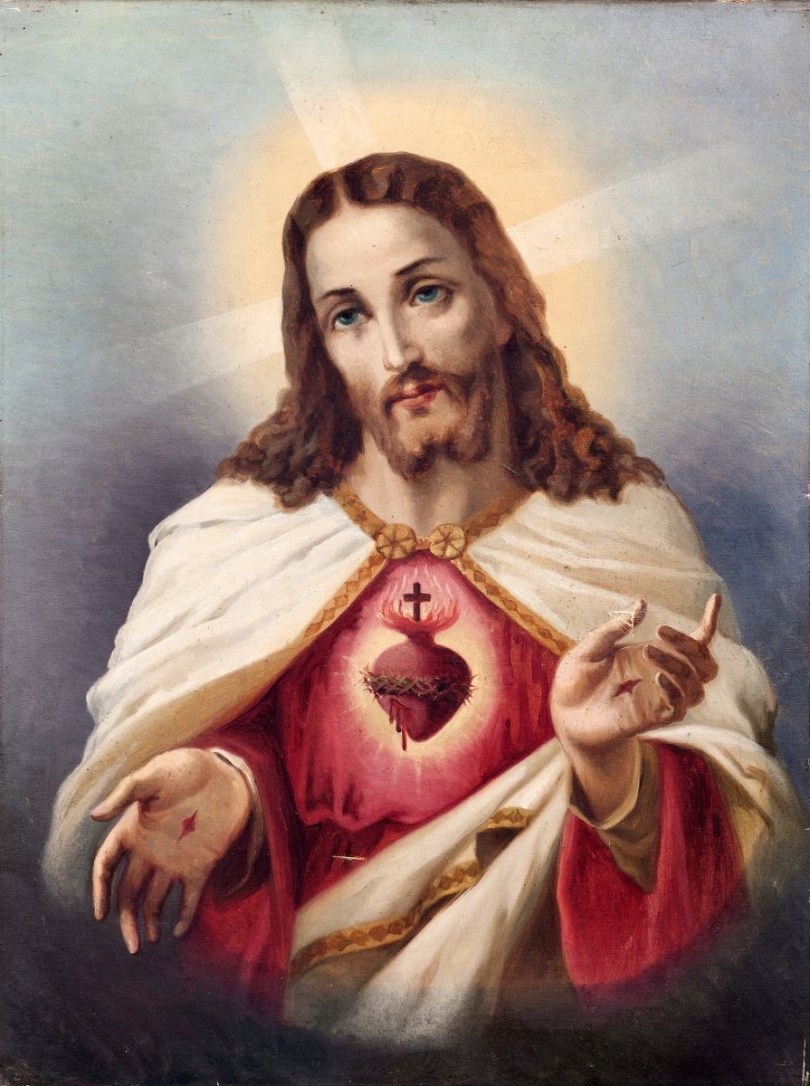
As Jesus sacrificed himself for love, devotion to the Sacred Heart of Jesus is a noteworthy peculiarity, as is some of the accompanying imagery. Within the Roman Catholic tradition, the Sacred Heart is a symbol of God’s boundless and passionate love for humankind. Nothing of the sort existed during the first ten centuries of Christianity. The Crusades revived religious life and inspired monks and nuns to revere Jesus’ wounds, including his heart, as sacred. The Franciscan monk Bonaventure wrote in 1274, ‘Who is there who would not love this wounded heart? Who would not love in return Him, who loves so much?’ Over time, Jesus’ heart came to the centre stage of these devotions.

Women mystics played a crucial role in that development. Among them were Lutgardis of Aywières (1182–1246), Mechtilde of Hackeborn (1241–1298), and Gertrude of Helfta (1256–1302). The devotion to the Sacred Heart in its present form began with Margaret Mary Alacoque (1647–1690), a nun of the Order of the Visitation of Holy Mary, who claimed to have received revelations about the Sacred Heart from Jesus Christ between 1673 and 1675 in the Burgundian French village of Paray-le-Monial. Later, Mary of the Divine Heart (1863–1899), a religious sister of the Congregation of Our Lady of Charity of the Good Shepherd, reported receiving locutions and visions of Jesus Christ.

So, did Jesus sacrifice himself for God’s love, and did God not care about Jesus? And if so, why would God care about us? If that thought had occurred to the Church Fathers, they would have found it disturbing. If someone else were to find himself in the position Jesus once was, he might not be instantly enthusiastic about the proposition. But no one can go against the will of God. And you can fall in love with someone who has taken you hostage. It is a natural reaction known as Stockholm Syndrome. Having no choice makes things easier. You must try to save humankind if there is a slight chance of success. He knows he has to play his role in the script. And he can succeed, like Chief Inspector Clouseau, if that is the plot of the story. And if the absurd has hunted you down and cornered you, and you see no escape, you can better embrace it.

And is it so terrible to die for love? Everyone dies, usually for less agreeable reasons like a fatal encounter with a deadly disease, some random accident, old age or a war fought for the ego of a leader, or even worse, his stupidity. In hindsight, Jesus’ sacrifice was exceptionally functional. It created Christianity, a religion that claims we are unworthy of God’s grace and need to accept a saviour and follow him. It is an idea that can save us because we can’t fix our problems ourselves. We are religious creatures who need a fairy tale to believe in. And as Paul explained in his poem, you can speak every language, know all the secrets, and give your money to those in need, but it is pointless if you don’t have love. If it is a delusion, you can enjoy it for as long as it lasts. And if you must go down in infamy and die, you can better do it laughing. So, always look on the bright side of life,

Life’s a piece of shit
When you look at it
Life’s a laugh and death’s a joke, it’s true
You’ll see it’s all a show
Keep ’em laughin’ as you go
Just remember that the last laugh is on you
And

Always look on the bright side of life
Always look on the right side of life

Monty Python, Always Look on the Bright Side of Life

Latest revision: 12 February 2026

Featured image: A cross in a heart formed with candles. Photos taken in Camp Tejas, Giddings, Texas, USA. Wingchi Poon. CC BY 3.0. Wikimedia Commons.

1. Forgery and Counter forgery: The Use of Literary Deceit in Early Christian Polemics. Bart D. Ehrman (2013).
2. The Oxford Bible Commentary. John Barton; John Muddiman, eds. (2001). New York: Oxford University Press. p. 1130. ISBN 978-0-19-875500-5.

When Jesus Returns

High expectations

Will Jesus return? What will he do if he does? Will Jesus make things right? Will there be a showdown between the forces of good and evil? Will evil people burn in hell forever? And what about Buddhists and atheists? They don’t believe in God. And Hindus? They have many gods. Or Jews, Christians and Muslims? Who are the good people, and who are the wicked anyway? The Italian mafia bosses were devout Catholics. The usurers of Goldman Sachs claimed that they were doing God’s work. The Muslims blowing themselves up to murder as many unbelievers as they could also did. US President George Bush claimed that God had ordered him to invade Iraq. So, what might happen if the Messiah were to come? A Messiah already came, sort of, at least. His name was Adolf Hitler.

Adolf Hitler was a most messianic figure, perhaps the most messianic figure ever, even surpassing Jesus. So, was he the opposite of Christ, the anti-Christ, or was he like Christ, as many of his followers expect him to be? Will there be a final reckoning in which billions of people die or face eternal torture in hell? The latter is worse than being gassed in a concentration camp, as there is no end to the suffering. For those who think it is an inappropriate remark, life in Gaza in 2025 was as horrible as in a concentration camp. And Jews did that. They may have had their reasons, but so did Adolf Hitler. So, have we learned our lessons? And what are these lessons in the first place?

Europeans have learned the hard way, in two devastating world wars, that nationalism and tribalism are the paths to destruction. It is still in their collective memory. That is why the European Union exists. Other continents don’t share the same experience, and memories don’t last forever. Nationalists aren’t wrong about the troubles mass migration and mixing people from different cultures cause, but nationalism has more serious flaws that will prove to be fatal in today’s world. European history has demonstrated that beyond doubt. And why should we doubt what we know for certain? Humans are a failed and destructive species. We cooperate through the myths we share. Without an inspiring fairy tale and a leader who unites us, we are doomed. And that is why we need a messiah.

Adolf the Messiah or the Anti-Christ

At first glance, Jesus Christ and Adolf Hitler are opposites. Jesus personifies goodness, while Hitler is the epitome of evil. Christ stood at the cradle of Christianity, the Religion of Love. Jesus taught that love would overcome hatred. He said, ‘If anyone slaps you on the right cheek, turn to them the other cheek also.’ And, ‘Love your enemies and pray for those who persecute you.’ Hitler represents Nazism, the ideology of hatred that brought us unprecedented cruelty and revealed the depth of human depravity. As the world is barrelling towards an apocalypse, it is the right time to take a distance and be honest. Only by following a strong leader with the right vision can we save ourselves now. In that sense, the Third Reich looks like a dress rehearsal.

Closer inspection reveals a few intriguing parallels between Hitler and Christ. Adolf Hitler’s followers considered him their saviour, and they worshipped him like one. Christians believe that Jesus will descend from heaven and that there will be a rapture when he returns (1 Thessalonians 4:16-17). Hitler was the first leader to fly around in an aeroplane. He came down from the sky to meet the cheering crowds. Rapture means ecstasy, enthusiasm and admiration. Few people in history caused as much rapture as Hitler. A Nazi slogan was, ‘One people, one empire, one leader.’ Christians and Muslims expect that to happen when Jesus returns. In that sense, Hitler foreshadows the Second Coming.

In many ways, Hitler was a messiah. He told the Germans they were the chosen people for their superior race. Jews believe they are the chosen people because of a supposed special relationship between God and the Jewish people. Like Moses, Hitler promised to end the unjust oppression, in this case, caused by the Treaty of Versailles. He claimed that his Third Reich would last a thousand years, whereas the Bible tells that the reign of Christ would last a thousand years (Revelation 20:1-6). And Hitler inspired the same blind following and loyalty to the death that many Christians expect the Second Coming of Christ would do. Somewhat unsurprisingly, a British intelligence report concluded that Hitler had a messiah complex.1

In traditional agricultural societies, land remained within the family. The Jews were no exception. The Bible says the bond between people and land is not to be broken, and land is not to be sold (Leviticus 25:23). The Nazi ideology of Blood and Soil focuses on ethnicity and homeland and stresses the importance of the land people live on and celebrates rural living. The Nazis made the ownership of selected lands hereditary. Those lands could not be mortgaged or sold. The Nazis sought to return to their Eden, without Jews and other undesirables. The Holocaust became the culmination of centuries of anti-Semitism fed by the belief that Jews are inferior people because they rejected the message of Christ.

The Nazis objected to degenerate art, which supposedly was perverse, thus, Communist or Jewish. Ironically, a Jew, Max Nordau, was the one who coined the term degenerate art for modern art, which he believed was the work of feeble minds corrupted by modern life who had lost their self-control. That was by far not the only thing that the Nazis borrowed from the Jews. It is the irony of history, or perhaps God’s sense of humour, that Nazism has much in common with Judaism. That kind of humour is godlike and inappropriate for us mortals. The implied message is that God can do as She pleases, that we are nothing, and no one should claim special privileges because of being chosen.

Nazism and Judaism both have fairy tales about superior people, the nation’s greatness, messianic leadership, and a promised land. Like the Nazis, the Jews have been keen on not allowing mixed marriages, not to keep their tribe racially pure, but to keep it free from foreign influences. In the past, Jews saw non-Jews as inferior, and many still do. Whether Jesus compared Gentiles to dogs, we can’t be sure of, but there is little doubt that these words reflected a widespread sentiment among the Jews. It is a natural human inclination to perceive our own group as superior and other groups as inferior, and Jews are as human as the rest of us. They have only been the best at cultivating their superiority complex by producing an elaborate collection of fairy tales about their supposed special relationship with the owner of the universe. Nazism is the Frankenstein’s monster that Judaism has spawned.

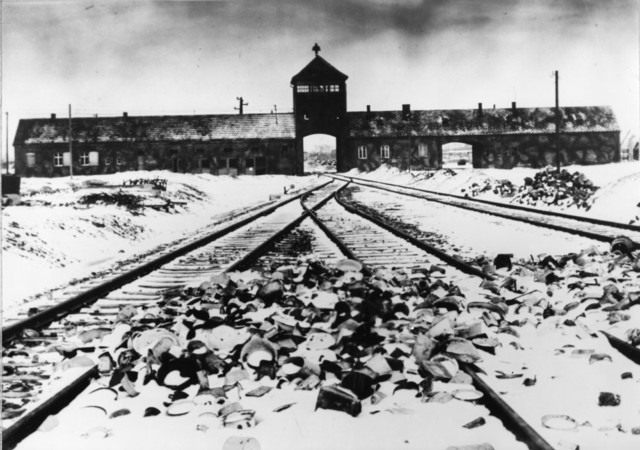
View on Auschwitz concentration camp
View of the Auschwitz concentration camp

Political views

Hitler could have been a painter had the Vienna Art School not declined his application, and we would have had a few additional acceptable wall decorations instead of World War II and the Holocaust. Hitler wouldn’t have sought revenge if Germany had not lost World War I. Had he not lived in an impoverished multicultural neighbourhood in Vienna, he might not have thought that mixing ethnic groups was a bad idea. And had there been no widespread anti-Semitism already, he wouldn’t have hated the Jews that much.

Adolf Hitler was skilled at delivering speeches, which were often angry rants that energised his followers. During the Great Depression, Hitler gained popularity and grabbed power in Germany. He started a war that killed fifty million people. Ten million people died in the Holocaust, including six million Jews. When American troops entered Germany in 1945, they were horrified by what they found in the concentration camps. Few people had imagined the Nazi regime could be that depraved.

Like many Germans, Hitler considered the Peace Treaty of Versailles unjust. The treaty stipulated that Germany accepted responsibility for causing World War I and had to pay massive reparations. The economist Keynes warned in 1919 about the harsh peace terms imposed upon Germany. They were the product of vindictive sentiments among the allies. It could lead to another major war, Keynes warned. His words proved prophetic. Hitler also proved himself to be a man of foresight in his views on usury.

Hitler’s enlightenment on that particular issue came after attending a lecture by Gottfried Feder, titled ‘The Abolition of Interest Servitude.’ It was the reason Hitler joined the National Socialist Party. It could also be that Feder’s moustache has impressed Hitler. Hitler’s views were similar to those expressed in the Bible and the Quran. Feder’s ideas became central to Hitler’s ideas on international finance. Today, unchecked trade and finance are about to end human civilisation as we know it.

Hitler feared that the Jews would take over Germany. Hitler’s fears have become a reality in the United States. About half the wealthy US elites are Jewish, while Jews are only 2% of the population. To get elected, American politicians must unconditionally support Israel. If not, they face the wrath of the Israel Lobby, which will terminate their career. Today, many Americans are impoverished while the wealthy, often Jewish elites, party. The elites bribe US politicians to do their bidding, which is a crime in Europe.

Inspired by scientific discoveries about natural selection, the Nazis became preoccupied with the fitness of the race. They euthanised those whom they believed were unfit, such as the mentally disabled. Had we still lived in nature, many of them wouldn’t have survived, because the communities they lived in would have abandoned them. Civilisation allows the inept to survive. If you can do a trick, you can get a paycheck. The Nazis believed that if the feeble survived and procreated, it would weaken the human race.

To the Nazis, other races were inferior. Some were good enough as slaves, while others had to disappear. Apart from the Jews, the Nazis exterminated the Roma. But why? Today, 70% of the Roma have criminal records, and the majority of them rely on welfare. And they still suffer from mob violence and exclusion.2 But is that racism? Like the Roma, the Jews didn’t change their ways, so anti-Semitism is once again rearing its ugly head. Cultures, so norms, values and myths, hold groups together, so you can’t reason with groups as you can with individuals. And it is not only the Roma and the Jews. We all do harm to others through our values, conduct, and the myths we believe.

‘Why do they hate us?’ It was a question few Americans dared to ask after the 11 September 2001 terrorist attacks. And then the Americans did precisely what many Muslims hated them for: bombing, occupying and plundering the oil in Muslim countries. And Muslims never ask themselves why others hate them. In many places where Muslims live together with others, there is trouble. It can’t be that only the others are to blame. And so, it is a question everyone should ask. Pride is the gravest sin of all, and for good reason. The prejudices others hold about your group can be telling. How others view you can tell you more about yourself than how you see yourself.

If we intend to live together, it will only work if we become a one-world society. That is because our actions affect everyone else. We must be honest about ourselves, our traditions, and our conduct. We must fix the issues that cause us to harm others. In hindsight, the Nazi racial superiority ideology was a guise to address cultural issues plaguing German society. Mixing people from different cultures causes trouble. None of today’s cultures meets the requirements for our future, so we must all change. Xenophobia and racism come from tribalism and the myths we believe in. If there is to be a World War III, it will probably be worse than the previous one. And so we must identify as one humanity and believe in a single set of myths.

Harsh questions

The Nazis didn’t shy away from harsh questions, or at least the ones that could be a pretext for mass murder. The world is finite. The Nazis obsessed over limited resources or living space, and thought that the Germans needed more of it, so that Germany should start wars to conquer territory. The issue of limited resources is far more pressing today, and the alternative to warfare is sharing. Sadly, many of us aren’t inclined to do so, except perhaps at gunpoint. Revolutions, whether the American Revolution or the Bolshevik Revolution in Russia, were not only about ideals but above all about people desiring more for themselves. More stuff is what motivates people. And that comes at the expense of something, such as other people or nature. An economic crisis brought Hitler to power, and an economic miracle made him popular with the Germans.

You run into questions like, is it okay to spend €100,000 per year to keep one person alive, while that money could have saved a hundred others who now die horrible deaths? And those who take more than is sustainable or have many children condemn others to death. The point is that by avoiding these questions or failing to take adequate action, you will have more misery in the future, so avoiding them is a greater evil than dealing with them. Those who live a luxurious lifestyle and have more than one child are mass murderers on par with the Nazis. And for what? The economic law of diminishing marginal utility indicates that excessive consumption barely increases happiness. The opposite might be true. And children are a lot of trouble. One is more than enough. Malthus may have had it wrong for 200 years, but that doesn’t mean he will not be right in the end. Likewise, end-time predictors were wrong for 2,000 years, but that doesn’t mean the end time will not arrive. The world doesn’t need children. On the contrary, the fewer humans, the better.

That brings us to eugenics, or the improvement of the human race via selective breeding. Why would we bring misfits into the world if we can avoid it? If you suffer from a severe hereditary disease, should you have children? If you are mentally incapable of raising children because you are a retard, a criminal, an alcoholic or a drug addict, should you be allowed to have children? Excessive consumers of resources and planetary destroyers are more likely to transfer their values to their offspring. So, should we allow billionaires to breed? They generate more useless eaters who live off their capital. The prevailing liberal view is that it is a human right to have children. And then liberals leave it up to science to fix the problems this view causes. But to own a gun or to drive a car, you need a license and prove you are sane. So, why don’t we have to qualify to have children?

Drug abuse

Adolf Hitler was a hypochondriac suffering from mood swings, Parkinson’s disease, flatulence, skin problems and a gradual decline. His physician, a quack named Dr Theodor Morell, gave him unorthodox medications, such as cocaine, speed, glucose, testosterone, estradiol, and corticosteroids. In addition, Der Führer received a preparation made from a gun cleaner, rat poison and atropine to treat his farting.

Der Führer miraculously survived all these treatments, but they contributed to his erratic conduct and illnesses. He also ingested an extract of bulls’ semen and numerous vitamins and tonics. He took potions, pills and injections to improve his sexual performance to deal with the sexual appetite of his demanding mistress, Eva Braun. As they say, behind every strong man is a strong woman, and in the case of Hitler, an even stronger one.

Eva Braun

Eva Braun was the mistress and later wife of Adolf Hitler. Most historians consider Her an insignificant figure who didn’t participate in political decisions. But opinions differ, and the truth is more bizarre than the wildest imaginations. A letter demonstrates that Braun knew of the concentration camps and the gas chambers. Some Nazi officials close to Hitler have said that Braun was at the centre of Hitler’s life for most of his twelve years in power. She was committed to Hitler, won his affection, gave him moral support, and enjoyed a healthy sex life with him. Braun’s friends have said that She giggled over a photograph of Neville Chamberlain sitting on a sofa in Hitler’s Munich apartment and said, ‘If only he knew what goings-on that sofa has seen.’

Hitler’s letters indicate that he was fond of Her, and worried when She participated in sports or was late returning for tea. Hitler’s secretary, Traudl Junge, stated that during the war, Hitler telephoned Braun every day. After learning about a failed plot to kill Hitler in 1944, Braun wrote to him, ‘From our first meeting, I swore to follow you anywhere even unto death. I live only for your love.’ And that was how it ended. Over twenty plots to kill Hitler failed, making Hitler believe a supernatural force protected him. When the end of the Third Empire neared, Braun became merrier. In the end, She married Hitler and committed suicide together with him. It was the romantic ending She desired.

Eva Braun was God and the mastermind behind Hitler’s rise and demise. Coincidences could serve as a clue. Braun was Eva’s last name, and it is the German word for brown. Adolf Hitler was born in Braunau am Inn, and brown is the colour associated with the Nazi ideology. Nazis were nicknamed brown shirts. And Eva is German for Eve. Eva had a passion for nude sunbathing to brown Her skin. She loved being photographed naked. She had no shame like Eve in the Garden of Eden.

For Braun, the story didn’t end with the Third Reich’s demise. She turned into Marilyn Monroe by taking over Norma Jeane Mortenson’s body. I contemplated that possibility when watching a Netflix documentary about Monroe’s life. Immediately after my thought, the word goddess appeared on the screen in massive lettering. That hint was as plain as it could get. Monroe had an affair with US President John F. Kennedy. He later dumped Monroe. Soon afterwards, Kennedy met the Grim Reaper in an epic scene dubbed the Kennedy assassination. People still speculate about who assassinated Kennedy and why.

The Kennedy assassination has kept conspiracy theorists busy, but who fired the bullet is of secondary importance concerning the question of who killed Kennedy. Messing with Monroe proved to be a fatal mistake. A set of coincidences surrounds the assassinations of President John F. Kennedy and his brother Robert. They are part of an intricate scheme involving the premature deaths of Presidents, including James A. Garfield. Furthermore, the Kennedy family suffered a series of accidents and early deaths called the Kennedy Curse. The book ‘The Virtual Universe’ goes into more detail.

The prophecy of the Holocaust

Rumour has it that Nostradamus predicted the coming of Adolf Hitler, but the argument is not particularly convincing. The word Hister in Nostradamus’ ravings refers to the Danube. These names are alike, and Hitler’s birthplace was on a tributary of the Danube, a peculiar coincidence. More ominous are the prophetic references to six million Jews in danger of being exterminated or a coming Holocaust of Jews appearing in Jewish magazines before World War II. That is not as remarkable as it might seem. The figure emerged because six million Jews lived in the Russian Empire before World War I. Jews in Russia suffered from a hostile government and pogroms. Pogroms are riots incited to expel or kill Jews.

The Russian Empire collapsed, and the Soviet Union came in its place. Still, the six million figure continued to circulate in Jewish publications, which is odd. It subsequently became the number of Jews murdered in the Holocaust.5 These prophetic statements are eerie, like the reference to the end date of World War I on the licence plate of Franz Ferdinand’s car. The most notable ones are listed below:

  • In 1911, at the tenth Zionist Congress in Basel, Switzerland, Max Nordau, co-founder of the World Zionist Organisation, together with Theodore Herzl, prophesied the annihilation of six million Jews.
  • Shortly after World War I in 1919, Zionists feared that a Holocaust of six million Jews was imminent in Europe.
  • According to the New York Times, in 1936, Zionists were lobbying for a Jewish state in Palestine to save the Jews from a European Holocaust. It was three years before World War II and five years before the extermination camps came into existence.
  • In 1939, The Jewish Criterion predicted the coming world war would annihilate six million Jews in East and Central Europe.
  • In 1940, the Jewish leader Nahum Goldmann predicted that if the Nazis achieved victory, six million Jews would be doomed to destruction.

That ugly face in the mirror

The 1981 film ‘The Wave’ was about a schoolteacher, Ben Ross, who showed his class a film about the Holocaust. One of his pupils asked him how the Germans could have rallied behind Adolf Hitler and committed these atrocities. Ross couldn’t answer the question and decided to start an experiment. He began by offering advice on proper posture and a few classroom rules to improve efficiency. The pupils took it up with enthusiasm. The next day, he introduced The Wave, a youth movement with a secret salute and membership card.

Robert, an unpopular student, received the task of monitoring the other students, a position that filled him with pride. Robert began reporting unorthodox behaviour to Ross and the other Wave members. Two hundred more students joined. Wave members bullied other students. The school newspaper published a negative review about The Wave, prompting Wave members to plan an attack on the editor.

The following day, Ross told the Wave was a nationwide youth movement in schools, and its leader would give a televised speech. The eager Wave students assembled in the auditorium with television monitors. To their horror, the monitors displayed a film of Adolf Hitler at a Nazi rally. Ross told them that this was their leader. The experiment showed that most of us are fit to become Nazis or would not resist a fascist takeover. In other words, similar atrocities can occur again, and they did. That is because strong leaders and fairy tales appeal to our deep desire for belonging and order.

We remember the Nazis for their cruelty, but they were also corrupt. Hermann Göring looted art and other precious items, a recurring pattern in authoritarian regimes. Far-right leaders are often gangsters who lie more than democratic politicians, engage in bribery, embezzlement and coups to overthrow the government. Democratic countries are turning into gangster kingdoms where criminal leaders and their cronies enrich themselves, exceeding the corruption of the previous liberal establishment. If you have studied human politics, the return of gangster governments should be unsurprising. When order collapses, gangsterism will take its place. And order in the West is collapsing.

The way forward

If it is about survival, you do whatever it takes. To Hitler, the war was about the survival of the German people. He took a rather particular view on the matter and started World War II. The irony of history is that no one ever destroyed Germany more than Hitler. The Jews posed no immediate threat to Germany. Still, Hitler was not wrong in fearing that the Jews would take over Germany. In the United States, where the Jews had the opportunity, something of that kind has occurred. Usury and political corruption are the main pillars of Jewish power in the US. To the Jews, it is also about the survival of their nation, so they see control over US foreign policy as a crucial national interest. The Palestinians may not be an immediate threat to Israel, but that may change. And if Adolf’s fears were justified, then you can’t easily dismiss the fears of the Israeli fascists as well.

The Holocaust was exceptional in its scale and cruelty, but it fits in a long list of atrocities humans have committed. We can do good things, but the overall outcome of all that we do is a complete disaster. Technology only enhances our destructive inclinations. And so, human civilisation as we know it is about to end. Had Adam and Eve listened to God, we would still have run around naked. We would have done all right, killing each other with sticks and stones, not knowing the difference between good and evil. Humans are a failed species. If we hope to survive, hatred is not the answer. It is the problem. We must all learn to see our part in the drama and do better. We need a saviour who gives us an inspiring myth so we can unite as one humanity. Today, it is about the survival of humankind. We must do whatever it takes and hope that God is willing to save us.

Latest revision: 19 February 2026

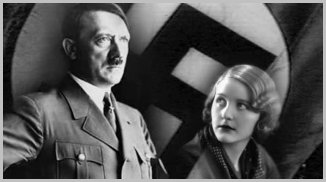
Featured image: Eva Braun and Adolf Hitler

1. WWII Adolf Hitler’s profile suggests a messiah complex. BBC (2012). [link]
2. Harvard International Review. Minority Report: Roma and Eastern Europe (2019).
4. Nazi loyalist and Adolf Hitler’s devoted aide: the true story of Eva Braun. The Guardian (2010). [link]
5. The Six Million Jews. [link]