Several religions claim that a god or gods have created this universe. The simulation hypothesis explains how this might have happened. We could all live inside a computer simulation run by an advanced post-human civilisation. But can we establish that this is indeed the case?
The evidence suggests that we live inside a simulation. It even allows us to infer the purpose of our existence. This book does not promote a specific religion. It follows science, but science has its limits. It can’t tell whether the world we live in is real.
Still, the sciences can support the argument that this world is a simulation, as they have established the natural laws that guide reality. If breaches of these laws occur, such as paranormal incidents with credible witnesses, we have evidence indicating that this world is not real.
We have just invented virtual reality. We can utilise virtual reality for both research and entertainment purposes. If the technology to create virtual worlds becomes affordable, most worlds will exist for entertainment, such as games or inventing stories where we can make our dreams come true.
The latter requires control over everything that happens, which is the situation we appear to be in. With our current knowledge, the world makes the most sense as a simulation created by an advanced post-human civilisation to entertain someone we can call God.
In this book, you can find answers to the following questions:
Is there something more than science can explain?
Is there a plan behind all that happens?
What are virtual worlds?
How can we know things and determine whether we live in a virtual world?
How can we explain things science can’t explain?
What are the simulation hypothesis and simulation argument about?
Can we improve the simulation argument to establish whether we are living in a simulation?
Why does our existence not need to be a miracle?
What reasons might post-humans have to create virtual worlds?
Can we infer from the properties of our universe that we live in a simulation?
What can we say about the evidence of spooks?
What is real about UFOs?
Do curses exist?
Do meaningful coincidences indicate that there is a script?
Is there some point to numeric coincidences like 11:11?
What happens after we die?
How can mediums sometimes be uncannily accurate?
Are there strange coincidences in history?
Are there an excessive number of strange coincidences surrounding the 11 September 2001 terrorist attacks?
What are the consequences of predetermination, and how does it affect our lives?
Is it possible to establish that we live in a story by using meaningful coincidences as evidence?
So, can we establish beyond a reasonable doubt that we live inside a simulation?
And can we establish the purpose of our existence?
After reading this book, you know you live inside a simulation.
The book is freely available under the CC BY-SA 4.0 licence.
Once we realise that reality is unrealistic, we discover that we live in a simulation. That doesn’t require spending massive budgets on scientists. But that doesn’t tell us why we exist. We can explore the possible motives behind those who run simulations of human civilisations to understand their motivations. Again, that doesn’t require scientists. There is no point in speculating beyond the obvious, because the possibilities are infinite. Modern humans place great value on their inner selves, so we may not alter our human essence once we can. Hence, the motives of post-humans could be similar to ours. And so, post-humans might run simulations of human civilisations for research or entertainment.
Research could involve running what-if scenarios. What if a giant meteor hits the planet’s surface? What if China never becomes unified? Alternatively, what if religions such as Christianity and Islam never existed? Or what if a deadly infectious disease breaks out? Countless scenarios are possible. Post-humans might be interested in running them to see how we cope. These simulations are likely realistic. After all, playing what-if with unrealistic assumptions is not playing what-if. What if humans suddenly transformed into koala bears? Some individuals might entertain that thought. And so, that is entertainment.
Possible entertainment applications include games or dream worlds that bring your imagination to life. Such a simulation may be unrealistic in some aspects, as it reflects the rules of a game or someone’s imagination. Minor changes can have a dramatic impact on future developments. And simulations of civilisations are complex. If you desire to make your imagination come true, you need control over everything that happens. That doesn’t apply to games. Unpredictable developments make games more interesting.
What we know about human nature suggests the number of simulations for entertainment will vastly outstrip those run for research. If we live inside a simulation, we should expect its purpose to be entertainment. That could be either a game or a script, thus a story someone wrote. The owner or owners may use avatars and appear like ordinary human beings to us. If reality is unrealistic in some aspects, this suggests that our purpose is entertainment, as a simulation run for research is more likely to be realistic. Evidence of control further indicates that the purpose of this simulation is not to play a game, but to stimulate someone’s imagination through a story.
We live by stories, so there is nothing typically modern or Western about the idea of using the existing technological means to run stories. We have books, theatres and films. What is more speculative is the degree of individualism in the supposed motives of the post-humans. Humans are originally social animals who live in groups. It is particularly Western to see ourselves as precious individuals. It is an inheritance of Christianity that sees each human soul as precious. That individualism allowed Europeans to organise more flexibly, which eventually made them conquer the world, so it is not far-fetched to assume that an individualist culture is at the basis of the civilisation that created us, and that we are a product of a consumerist economy.
If the beings inside the simulation are sentient, that might raise ethical questions like whether they have rights that the creators should respect. Rights don’t exist in objective reality. We only imagine that we have them. And, considering how humans treat each other, it is not a given that our creators would respect these rights even when they acknowledge them. In a realistic simulation, bad things happen to people. And if the simulation is the stage of a story, and there is a script like a film, the beings inside the simulation, thus us, aren’t sentient beings but mindless bots. We would be less than worms. Real worms at least decide for themselves how to grovel and when, so there would be no reason whatsoever for our creators to respect the rights we imagine we have.
Will we soon create simulations of humans who act like humans and even believe they think? Will we invent a Holodeck like in Star Trek? And will we expand it to civilisation-size simulations? Nick Bostrom dares not to assess the likelihood of that. However, you don’t have to look far for answers. We are already close to doing it. Imagine a world where you can be king or queen. You can even create the world as you like and build your paradise. You can lead the life you desire. You can design the ideal spouse who fulfils your deepest romantic and sexual desires. And no one frustrates your ambitions.
Your dream can be your life. And you don’t have to wake up. It is simply too tempting for many of us to resist. Your life is not great. Your spouse is not perfect. Your job is mediocre or worse. Other people make you miserable. Your boss ignores your ideas. Your ventures fail. You think you deserve better. Likely, at least one of those options applies to you. If we could make our dreams come true, we would. We will spend a lot of time there if we ever invent something like the Holodeck from Star Trek.
You might think you won’t do it, but others would, so there will be demand for the technology. What you have just read is information, specifically insights into human nature. We will make our dreams a reality if we can. We can also consider advances in artificial intelligence, extrapolate from them, and demonstrate that simulated humans will be feasible at some point, likely soon. Hence, we probably live inside a simulation and are someone’s fantasy. Showing it is possible or likely, however, doesn’t prove it. So, how can we do that? It is possible with the information we have.
Scientists have established the laws of nature, which determine what is realistically possible and what is not. Simulations can be realistic in many ways but also unrealistic in others. If we can establish that unrealistic events occur, thus breaching natural laws established by science, we could be living in a simulation. Instead of speculating that we live in a simulation by guessing the probability of post-humans existing and their abilities, resources, and possible motivations, we can look at what we know about our universe. That is information. We can establish that we live in a simulation as follows:
When this universe is genuine, we can never be sure about it. A simulation can be realistic and feature authentic laws of reality.
This universe may have fake properties, but we can’t establish this because we don’t know the properties of an authentic universe.
Breaching the laws of reality is unrealistic in any case. If it happens, we may have evidence of this universe being virtual.
Science can establish the laws of reality or the properties of this universe. Only science cannot determine whether they are real or fake. Perhaps there is no gravity in a genuine world, even though we deem it unlikely. But the breaching of these laws suggests we live in a simulation. If we believe science is correct, breaching its laws proves the simulation. We have a body of evidence for the scientifically established laws of reality. These laws of reality and breaches thereof are information about our universe. Science has established, among others, the following:
The laws of physics always apply inside their realms. Newton’s third law of motion states that for every action, there is an equal and opposite reaction.
The universe started with the Big Bang. Life on this planet emerged from chemical processes. And evolution shaped it. There is no evidence of a creator.
We are biological organisms composed of carbon and water, and our consciousness resides in our bodies. There is no spirit or soul.
Evidence to the contrary indicates this world is fake. Meaningful coincidences suggest there is an intelligent force directing events. The paranormal defies the laws of physics. A ghost pushing you breaches Newton’s laws of motion. Credible accounts of reincarnation challenge the claim that we are biological organisms. However, meaningful coincidences can materialise by chance. There may be laws of reality we don’t know. There is plenty of evidence suggesting that consciousness resides in the body, while only a few people remember a previous life. And have you seen ghosts? It may be time to take your pills.
Still, if a sufficient number of credible accounts of breaches of the established laws of reality exist, we can assume we live inside a simulation. We may still differ on what a sufficient number is or which accounts are credible. The proof can’t be scientific because science can’t prove we live inside a simulation. We can’t verify that we live in a simulation by doing experiments, because violations of natural laws are unpredictable. But we can check the accounts of violations of these laws. It remains speculation, akin to living in the dark, assuming that cows exist and make a mooing sound, even though we have never seen them, and believing that hearing a moo proves their existence.
In ancient times, philosophers speculated that we can’t tell whether the world around us was genuine or whether other people also have minds. Perhaps I am the only one who exists, while the rest of the world is my imagination. It could all be a dream. Some religions claim that gods created this universe and that we are like them. According to the Bible, God said, ‘Let us make mankind in our image, in our likeness.’
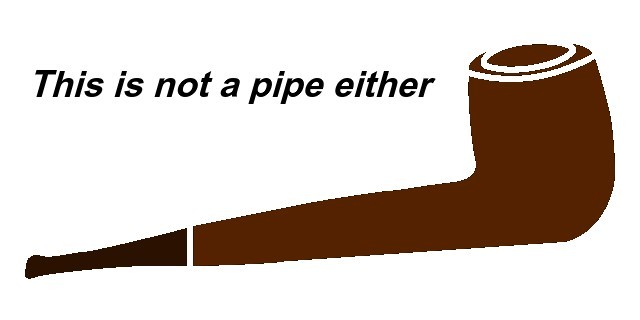
For a long time, we couldn’t tell why this world might not be authentic or how the gods could have created it. That changed with recent advances in information technology. This universe could be a simulation. We believe that our senses register an outside reality so that we ignore evidence to the contrary. You may think you see a pipe when watching an image. The caption of the famous painting, The Treachery of Images, by René Magritte, makes you notice: this is not a pipe.
In 1977, science fiction writer Philip K. Dick was the first to assert that our reality must be computer-generated. In a press conference in France, he described his psychotic experiences and strange coincidences that led him to believe this world is fake. He told the audience that his lost memories returned in full for unknown reasons. He also claimed to have had a vision. And a scenario Dick wrote came true. And so, he thought what he had found was of momentous importance to humanity, so he organised that press conference. His last name suggests our Creator, if there is one, likes sexist jokes.
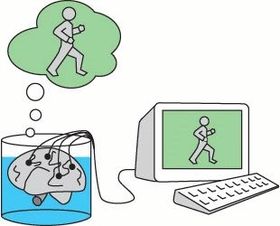
The idea that we live inside a computer-generated world is known as the simulation hypothesis. We could all live in a simulation created by an advanced humanoid civilisation. Professor Nick Bostrom explored the probability of it in the simulation argument. According to Bostrom, there could be many different human civilisations. The humans in those civilisations may, at some point, enhance themselves with biotechnology and information technology, live very long, and acquire capabilities that ordinary humans don’t have. For this reason, these beings are no longer humans, making them in need of a new name, which became post-humans. A post-human might be a biological creature, a humanlike artificial intelligence or a combination of both. They might be brains in vats or have no physical bodies at all.
These post-humans might experience an urge to run simulations of their human ancestor civilisations, so we could be living in one of those simulations. Bostrom argues that at least one of the following options must be true:
Nearly all human civilisations terminate before becoming post-human.
In any post-human civilisation, only a negligible number of individuals develop an appetite for running simulations of their human ancestor civilisations.
We almost certainly live inside a computer simulation.1
The argument comes with the following assumptions that seem increasingly plausible due to the recent developments in artificial intelligence, but are not proven:
The computing power of post-human civilisations suffices to run a large number of simulations of human ancestor civilisations.
It is possible to simulate human consciousness in a computer.1
Bostrom concludes that if you think our civilisation will one day become post-human and run many simulations of human ancestor civilisations, you must believe we already live inside one.1 It is a matter of probability. If we invent this technology in the next 10, 100 or 1,000 years, it won’t happen later than that. By then, we will have done it. But millions of years have passed when it could have happened, so it probably did. If we do it within 100 years, and it could have happened a million years ago, the chance it already happened might be (1,000,000 – 100) / 1,000,000 = 0.9999 or 99.99%.
Non-humanoid civilisations are probably not interested in running large numbers of simulations of humans. They might run a few for research, perhaps to investigate human behaviour, but it seems unlikely that our emotions and history entertain beings entirely different from us. Thus, most simulations of human civilisations will likely be run by post-humans.
Non-humanoid civilisations are probably not interested in running large numbers of simulations of humans. They might run a few for research, perhaps to investigate human behaviour. Still, it seems unlikely that our history and emotions interest beings that are entirely different from us so that they will run billions of simulations of human civilisations. And if they exist, they must first learn to travel faster than light to find humans. Thus, post-humans will likely run most simulations of human civilisations. So, our Creator, if there is one, is probably humanoid, but that doesn’t necessarily mean human.
It is a problematic argument. Philosophy is the art of not accepting the obvious because the possibilities are boundless. The obvious often isn’t the case. But with the information we do have, it is our best guess. We think of God as having a human nature because we imagine God. And so, the God in the Bible appears to have human character traits. Conversely, when God imagines us, God probably is humanoid. We would create virtual realities with humans if we could. That is the reason why. However, because we imagine God, that is what we imagine. It seems obvious, but that doesn’t mean it’s true. It is only what our imagination and the evidence suggest is most likely. But we know very little. We can’t go outside the simulation and check.
The simulation argument comes with uncertainties. Post-humans might lack sufficient computing power. Recent developments in quantum computing suggest otherwise. Alternatively, nearly all human civilisations die out before building these simulations. Alternatively, post-humans have evolved and differ from us, so they aren’t interested in running simulations of humans. We may only know this once we have become post-humans. Bostrom doesn’t try to guess the likelihood of the options. He thinks we have no information about whether this universe is real, but that is incorrect. There is evidence.
Latest update: 18 July 2025
Featured image: Inspired By The Treachery of Images.
1. Are You Living In a Computer Simulation? Nick Bostrom (2003). Philosophical Quarterly (2003) Vol. 53, No. 211, pp. 243-255.
On 15 July 2011, two television towers in the Netherlands caught fire. One collapsed spectacularly. There had never been a fire in a television tower in the Netherlands. These television towers had been there for over fifty years. And there were only twenty-four of them. A few people speculated about these incidents having a common cause.1 The towers are in different areas, making a common cause unlikely unless there is intent. After all, what is the chance of two aeroplanes crashing into both towers of the World Trade Center in New York on the same day? Only there was no evidence suggesting intent or a common cause. That makes it very mysterious.
Consider this coincidence from Bermuda, which is near the mysterious Bermuda Triangle. In 1975, a 17-year-old boy had a deadly accident while riding his moped. He died exactly a year after his 17-year-old brother died in an accident while riding the same moped in the same intersection and collided with the same taxi with the same driver, carrying the same passenger. Repeating patterns may have contributed to the incident. Perhaps it was a dangerous point where accidents frequently occurred. The passenger may have visited Bermuda once a year and taken a taxi from the airport to the same destination each time.
In 1992, I was bicycling in Groningen, where I lived at the time. On the way, a car door suddenly opened just before me. I could barely avoid a collision. About ten minutes later, on the same trip, it happened again with another car on another road. Never before or after this trip had a car door opened in front of me, even though I had made bicycle trips nearly every day for several decades. It is odd. But what are the odds?
Those incidents might be random events. Many things happen all the time, so bizarre accidents occur by chance. It doesn’t require a Supreme Puppet Master to make them happen. It may be hard to calculate the probability of an event like two television towers catching fire in one country in one day, but it is very low. Only, the number of possible strange incidents is very high.
But how low and how high? That matters tremendously. If there are a million possible events, and the chance of one happening on any given day is one in a million, we should not be surprised when one does. On average, an event like that should happen every day. If it is one in a trillion, and such an event occurs quite frequently, we are on to something, because, on average, it should happen once every million days.
The number of possible strange coincidences is infinite, so it shouldn’t surprise us that simple coincidences, such as a car door opening in front of me twice on a single bicycle trip, happen from time to time. It is, however, odd that it happened twice on one trip and never on any other. Coincidences come in different types. The more intricate a coincidence is, the less likely it is to occur. Indeed, some complicated coincidences are far less likely to occur than two car doors opening on one bicycle trip.
The following falls in the latter category. Once, I entered a do-it-yourself store. There was a couch near the entrance. The price tag of € 389 caught my attention. As a student, I lived in dormitory 389 on the campus. Price tags often end with a nine, so there was nothing suspicious about it, I concluded. Strange things had happened, so I tried to convince myself that it was not unusual. I realised it would be far more curious to find a price tag of € 401, as I had also lived in building 401, and price tags rarely end in a 1.
A few seconds later, I ran into a pile of bags of potting soil. These bags had a conspicuous lettering ’40l’, indicating they contained 40 litres of potting soil. That was close enough to 401 to be intriguing. There were no other types of bags on the spot. Potting soil is available in 10, 20, 25, 40, and 50-litre sizes. Sacks of 40 litres also come with markings such as ’40L’ and ’40 litres’. Hence, the ’40l’ was indeed remarkable.
Two years later, I returned to the same store. These bags of potting soil, marked ’40l’, stood conspicuously stacked near the entrance, reminding me of the previous incident. There was no couch, and I did not see a € 389 price tag there. I contemplated this while fetching the item I planned to buy. Its price tag was €3.89, and I had gone to the store to purchase that one item.
That is far less likely to happen than two car doors opening before me on the same bicycle trip. The events interacted with my thoughts, and the sequel made it even more improbable. The car doors opening could be a coincidence, but the do-it-yourself store incident should boggle the mind, provided one is allowed to think. In one of those dormitories, I met a most peculiar Lady. Since then, a series of noteworthy coincidences have transpired, reminding me of that. This coincidence thus also fits into this scheme, further heightening its peculiarity.
To make the coincidence happen, the bags of potting soil had to be in place, so I would run into them just after thinking of 401. And later, I had to go there to buy an item for € 3.89. And it goes much further than that. The scheme encompasses the item having a price tag of € 3.89, and my having lived in dormitories 389 and 401. That is most peculiar indeed. So much can go wrong. Imagine the bags’ content being 50 litres, the lettering being different, or me visiting another do-it-yourself store or buying another item the second time, and the scheme would fall apart. Perhaps it is a mere coincidence, but it is less likely than two car doors opening in front of me during the same bicycle trip.
On the evening of 11 October 2025, my wife and I watched episode ‘Demon 79’ of the Netflix series Black Mirror. The story played in Great Britain in 1979. It turned out that the murder of two people by a psychotic shoe saleswoman, following orders of a demon disguised as Boney M band member Bobby Farrell, proved insufficient to ward off the apocalypse. The apocalypse proved to be a nuclear war. After watching it, I went to bed. The next morning, I first read the news headlines on the teletext page 101 of the Dutch public television, and found out that two people had died at age 79, actress Diane Keaton and singer Joost Nuissl. So, two people died, thus not enough to ward off nuclear war. Two days later, on 14 October 2025, a NATO exercise named Steadfast Noon began. It included dropping fake atomic bombs above the area where I live. ‘You can sleep peacefully,’ a NATO spokesman added.
Latest revision: 14 October 2025
Featured image: Number 381 dormitory. University Of Twente (2013). [copyright info]
1. Onderzoek: Hoe konden twee zendmasten vandaag in brand vliegen? Algemeen Dagblad (15-07-2011). [link]




 The Plan For The Future