Simulation argument II: Adding information

Will we soon create simulations of humans who act like humans and even believe they think? Will we invent a Holodeck like in Star Trek? And will we expand it to civilisation-size simulations? Nick Bostrom dares not to assess the likelihood of that. However, you don’t have to look far for answers. We are already close to doing it. Imagine a world where you can be king or queen. You can even create the world as you like and build your paradise. You can lead the life you desire. You can design the ideal spouse who fulfils your deepest romantic and sexual desires. And no one frustrates your ambitions.

Your dream can be your life. And you don’t have to wake up. It is simply too tempting for many of us to resist. Your life is not great. Your spouse is not perfect. Your job is mediocre or worse. Other people make you miserable. Your boss ignores your ideas. Your ventures fail. You think you deserve better. Likely, at least one of those options applies to you. If we could make our dreams come true, we would. We will spend a lot of time there if we ever invent something like the Holodeck from Star Trek.

You might think you won’t do it, but others would, so there will be demand for such a toy. What you have just read is information, specifically insights into human nature. We will make our dreams a reality if we can. We can also consider the advances in artificial intelligence, extrapolate them, and demonstrate that simulations of humans will be feasible at some point, likely soon. Hence, we probably live inside a simulation and are someone’s fantasy. Showing it is possible or likely, however, doesn’t prove it. So, how can we do that? It is possible with the information we have.

Scientists have established the laws of nature, which determine what is realistically possible and what is not. Simulations can be realistic in many ways, but they can also be unrealistic in some aspects. If we can establish that unrealistic events occur, thus breaching natural laws established by science, we could be living in a simulation. Instead of speculating about us living in a simulation by guessing the probability of post-humans existing and their abilities, resources, and possible motivations, we can look at what we know about our universe. That is information. We can establish that we live in a simulation as follows:

  1. When this universe is genuine, we can never be sure about it. A simulation can be realistic and feature authentic laws of reality.
  2. This universe may have fake properties, but we can’t establish this because we don’t know the properties of an authentic universe.
  3. Breaching the laws of reality is unrealistic in any case. If it happens, we may have evidence of this universe being virtual.


Science can establish the laws of reality or the properties of this universe. Only science can’t determine whether they are real or fake. Perhaps there is no gravity in a genuine world, even though we deem it unlikely. But the breaching of these laws suggests we live in a simulation. If we believe science is correct, breaching its laws proves the simulation. We have a body of evidence for the scientifically established laws of reality. These laws of reality and breaches thereof are information about our universe. Science has established, among others, the following:

  • The laws of physics always apply inside their realms. Newton’s third law of motion states that for every action, there is an equal and opposite reaction.
  • The universe started with the Big Bang. Life on this planet emerged from chemical processes, and evolution shaped it. There is no evidence of a creator.
  • We are biological organisms made of carbon and water, and our consciousnesses reside in our bodies. There is no spirit or soul.

Evidence to the contrary indicates this world is fake. Meaningful coincidences suggest there is an intelligent force directing events. The paranormal defies the laws of physics. A ghost pushing you breaches Newton’s laws of motion. Credible reincarnation stories challenge the claim that we are biological organisms. However, meaningful coincidences can materialise by chance. There may be laws of reality we don’t know. There is plenty of evidence suggesting that consciousness resides in the body, while only a few people remember a previous life. And ghosts, have you seen them? It may be time to take your pills.

Still, if a sufficient number of credible accounts of breaches of the established laws of reality exist, we can assume we live inside a simulation. We may still differ on what a sufficient number is or which accounts are credible. The proof can’t be scientific because science can’t prove we live inside a simulation. We can’t verify that we live inside a simulation by doing experiments, as breaches of natural laws are unpredictable. But we can check the accounts of violations of these laws. It remains speculation, akin to living in the dark and assuming that cows exist and make a mooing sound, even though we have never seen them, and believing that our hearing of a moo proves their existence.

Latest update: 18 July 2025

Satire on False Perspective. William Hogarth (1754).

Strange Universe

The license plate number on the car that drove Franz Ferdinand to his appointment with destiny was just one of the remarkable incidents and experiences on record. In many cases, we can establish the relevant facts to the point where there is little doubt that the event has indeed occurred. We have no evidence suggesting someone has changed the licence plate. Perhaps science will explain these things in the future, as this universe may have properties we don’t yet know. Some have come up with explanations that let go of our understanding of time and cause and effect.

Our usual way of perceiving events is that something happens in a particular place at a specific time. We think of a place as a constant as time passes. Events in the past caused events happening now. And events in the present cause future events. The Allied invasion took place in Normandy on 6 June 1944. Normandy is still there, but 6 June 1944 is history. The liberation of Western Europe from German occupation is a consequence of D-Day. If D-Day had not happened, history would have taken a different turn. In this way, cause and effect work. That makes sense to us.

Perhaps, events connect in ways other than causality and time. The psychiatrist Carl Jung proposed a collective consciousness that connects all events through meaning. If you believe it, that can explain a few things, such as reincarnation accounts and premonitions. Perhaps the collective consciousness carries a deceased person’s memories into someone else or gives premonitions that come true. According to science, this is all total gibberish, not even worth a second of your thought, as it contradicts established laws of science. Only in a story can events connect via meaning.

Others think of time as a dimension, so you can travel to a time like you can travel to a place, even though nobody ever succeeded in doing that as far as we know. These ideas counter our traditional notion of cause and effect over time. But so does the theory of relativity. And the theory of relativity proved to be helpful, so we consider it to be true. Perhaps physics will one day explain premonitions.

A reference to the end date of World War I could thus have ended up on the licence plate of Franz Ferdinand’s car because of some connection we don’t yet know. No plausible explanation is available for that connection, but perhaps some property of this universe is still unexplained. And maybe both are true. All points in time might be connected in another way, while causality also applies. Physicists have to work with queer phenomena that are hard to explain. For example, light behaves like both particles and waves, but waves can’t be particles.

Alternatively, a time traveller could have put AIII 118 on the licence plate, even though the theory of relativity doesn’t allow for that. Time travel to the future may be possible, but going back in time creates logical problems. It would alter future events. And there is another fly in the ointment: chaos theory. Insignificant disturbances can have dramatic consequences. If I could go back to 1914 to screw a license plate with the combination AIII 118 on the car, that may derail the events that were about to occur, and World War I would not end on 11 November 1918 and perhaps not even have started. And sneezing can be enough to do the job, just like a butterfly in Texas can start a storm in China. It seems likely that the Austrian authorities issued the license plate. Plate AIII 118 probably came after AIII 117 and before AIII 119, so we can drop this imaginative scenario into the bin.

And look at what scientists are doing. Recent measurements confirmed the electron’s roundness to a record level of exactness. It deepened the mystery of why the universe consists of matter rather than antimatter. Any asymmetry in the electron’s shape would point to a related asymmetry in the laws of nature that could explain this feature of the cosmos.1 Scientists were baffled. Metaphysical speculation also dominates science, and scientists imagine invisible friends like gravity and electrons to describe our world. And then they discover something suggesting that some of their imaginary friends may not exist. Well, who would have thought that?

Maybe we should let our imagination run free. Anything is possible if we can think of it and corroborate it with experiments. It is how science progresses. A piece of fruit could be an apple for as long as you look at it. And it can turn into a banana once you look the other way. Scientists believe that if experiments confirm it. Some particles turn into waves when you don’t look. Scientists might even base their theories on things that are impossible but do happen because we live inside a simulation. We don’t know that, of course, because we don’t know the properties of a genuine universe.

Some laws of this universe appear ridiculous. Only why should they make sense? Nature doesn’t exist to make sense to us. We can imagine that this universe is a simulation to avoid logical difficulties. It makes more sense than apples turning into bananas. Assuming the obvious, however, can be dangerous. If it quacks, walks, and swims like a duck, it might be a great actor in a duck suit. Apples could turn into bananas when you don’t look. Of course, when you place a camera to observe them, they don’t. And one plus one might only equal two after you have solved the equation. And if faith moves mountains, this universe could be genuine as long as you believe it is.

Latest revision: 19 July 2025

Featured image: Satire on False Perspective. William Hogarth (1754). Public Domain.

1. Electrons are extremely round, a new measurement confirms. Emily Conover (2023). Science News. [link]

Witbreuksweg dormitory

Meaningful Coincidences

On 15 July 2011, two television towers in the Netherlands caught fire. One collapsed spectacularly. There had never been a fire in a television tower in the Netherlands. These television towers had been there for over fifty years. And there were only twenty-four of them. A few people speculated about these incidents having a common cause.1 The towers are in different areas, making a common cause unlikely unless there is intent. After all, what is the chance of two aeroplanes crashing into both towers of the World Trade Center in New York on the same day? Only there was no evidence suggesting intent or a common cause. That makes it very mysterious.

Consider this coincidence from Bermuda, which is near the mysterious Bermuda Triangle. In 1975, a 17-year-old boy had a deadly accident while riding his moped. He died exactly a year after his 17-year-old brother died in an accident while riding the same moped in the same intersection and collided with the same taxi with the same driver, carrying the same passenger. Repeating patterns may have contributed to the incident. Perhaps it was a dangerous point where accidents frequently occurred. The passenger may have visited Bermuda once a year and taken a taxi from the airport to the same destination each time.

In 1992, I was bicycling in Groningen, where I lived at the time. On the way, a car door suddenly opened just before me. I could barely avoid a collision. About ten minutes later, on the same trip, it happened again with another car on another road. Never before or after this trip had a car door opened in front of me, even though I had made bicycle trips nearly every day for several decades. It is odd. But what are the odds?

Those incidents might be random events. Many things happen all the time, so bizarre accidents occur by chance. It doesn’t require a Supreme Puppet Master to make them happen. It may be hard to calculate the probability of an event like two television towers catching fire in one country in one day, but it is very low. Only, the number of possible strange incidents is very high.

But how low and how high? That matters tremendously. If there are a million possible events, and the chance of one happening on any given day is one in a million, we should not be surprised when one does. On average, an event like that should happen every day. If it is one in a trillion, and such an event occurs quite frequently, we are on to something, because, on average, it should happen once every million days.

The number of possible strange coincidences is infinite, so it shouldn’t surprise us that simple coincidences, such as a car door opening in front of me twice on a single bicycle trip, happen from time to time. It is, however, odd that it happened twice on one trip and never on any other. Coincidences come in different types. The more intricate a coincidence is, the less likely it is to occur. Indeed, some complicated coincidences are far less likely to occur than two car doors opening on one bicycle trip.

The following falls in the latter category. Once, I entered a do-it-yourself store. There was a couch near the entrance. The price tag of € 389 caught my attention. As a student, I lived in dormitory 389 on the campus. Price tags often end with a nine, so there was nothing suspicious about it, I concluded. Strange things had happened, so I tried to convince myself that it was not unusual. I realised it would be far more curious to find a price tag of € 401, as I had also lived in building 401, and price tags rarely end in a 1.

A few seconds later, I ran into a pile of bags of potting soil. These bags had a conspicuous lettering ’40l’, indicating they contained 40 litres of potting soil. That was close enough to 401 to be intriguing. There were no other types of bags on the spot. Potting soil is available in 10, 20, 25, 40, and 50-litre sizes. Sacks of 40 litres also come with markings such as ’40L’ and ’40 litres’. Hence, the ’40l’ was indeed remarkable.

Two years later, I returned to the same store. These bags of potting soil, marked ’40l’, stood conspicuously stacked near the entrance, reminding me of the previous incident. There was no couch, and I did not see a € 389 price tag there. I contemplated this while fetching the item I planned to buy. Its price tag was €3.89, and I had gone to the store to purchase that one item.

That is far less likely to happen than two car doors opening before me on the same bicycle trip. The events interacted with my thoughts, and the sequel made it even more improbable. The car doors opening could be a coincidence, but the do-it-yourself store incident should boggle the mind, provided one is allowed to think. In one of those dormitories, I met a most peculiar Lady. Since then, a series of noteworthy coincidences have transpired, reminding me of that. This coincidence thus also fits into this scheme, further heightening its peculiarity.

To make the coincidence happen, the bags of potting soil had to be in place, so I would run into them just after thinking of 401. And later, I had to go there to buy an item for € 3.89. And it goes much further than that. The scheme encompasses the item having a price tag of € 3.89, and my having lived in dormitories 389 and 401. That is most peculiar indeed. So much can go wrong. Imagine the bags’ content being 50 litres, the lettering being different, or me visiting another do-it-yourself store or buying another item the second time, and the scheme would fall apart. Perhaps it is a mere coincidence, but it is less likely than two car doors opening in front of me during the same bicycle trip.

On the evening of 11 October 2025, my wife and I watched episode ‘Demon 79’ of the Netflix series Black Mirror. The story played in Great Britain in 1979. It turned out that the murder of two people by a psychotic shoe saleswoman, following orders of a demon disguised as Boney M band member Bobby Farrell, proved insufficient to ward off the apocalypse. The apocalypse proved to be a nuclear war. After watching it, I went to bed. The next morning, I first read the news headlines on the teletext page 101 of the Dutch public television, and found out that two people had died at age 79, actress Diane Keaton and singer Joost Nuissl. So, two people died, thus not enough to ward off nuclear war. Two days later, on 14 October 2025, a NATO exercise named Steadfast Noon began. It included dropping fake atomic bombs above the area where I live. ‘You can sleep peacefully,’ a NATO spokesman added.

Latest revision: 14 October 2025

Featured image: Number 381 dormitory. University Of Twente (2013). [copyright info]

1. Onderzoek: Hoe konden twee zendmasten vandaag in brand vliegen? Algemeen Dagblad (15-07-2011). [link]

Tunnel of the Large Hadron Collider

Properties Of This Universe

There is an ongoing debate among self-proclaimed pundits who sell books about whether this universe is a simulation. They argue we can know by examining the universe’s properties. They are wrong. We can never say whether these properties, reflected in the established laws of reality, are real or fake. Even when a property of our universe appears strange or consistent with a simulation, it doesn’t prove that this universe is a simulation. It can be a property of an authentic universe. It is like saying, ‘This object is grey, and elephants are grey, so it probably is an elephant.’ Now, imagine that grey object saying moo. However, people continue to buy their books, so the so-called pundits keep writing them, because of what economists call the law of supply and demand.

That is also why science can’t establish whether we live inside a simulation. Science aims to determine the properties of the universe, as reflected in the laws of reality, also known as natural laws. However, science can’t say whether or not these natural laws are, what you might say, real. Hence, any argument that this universe is a simulation based on its properties is a dead end. In its simplest form, the reasoning goes that this universe must be a simulation because the underlying properties are digital. At the most basic level, everything can be just numbers in computer memory.

How does that work? A digital television screen consists of more than a million tiny coloured dots. Every single spot on the screen has a unique number. Also, every colour has a unique number. And so, spot 268,122 on the screen has colour 187,091. From a distance, you see a person or a mountain. At the underlying level, the screen is just a display of digits. It is possible to store numbers in computer memory so that you can represent an entire universe in this way.

Real universes might also be digital. We don’t know. Being digital is a property, not a cause of existence. Another argument based on quantum physics states that our reality is a sequence of states. Nothing exists or happens between them. Like the dots on a television screen, we can represent these states as numbers. Again, this could mean that our universe exists inside a computer. And also in this case, there is no way of knowing whether this applies to a universe that is not computer-generated.

Quantum entanglement is bizarre. Particles can interact directly with each other regardless of the distance between them. If you come to think about it, then one particle at one end of the universe might interact directly with one at the opposite side, as if there is no distance between them. This phenomenon mocks our idea of distance. Billions of light-years are nothing. Forget about warp-speed space travel. You can be on the other side of the universe in the blink of an eye. It can raise questions about the age of the universe, as estimates of its age are related to its size. However, we don’t know whether this behaviour is also present in a real universe that is billions of years old.

Many believe that intelligent extraterrestrials must exist. So far, there is no material evidence of their presence. UFO encounters occur, and people have seen aliens, but no extraterrestrials have revealed themselves to the general public. The physicist Enrico Fermi once asked, ‘Where is everybody?’ Perhaps humankind is the only advanced civilisation in the entire universe. If we live inside a simulation, there may be no point in simulating other beings on remote planets. That is not the only possibility. Perhaps civilisations tend to die out before becoming advanced. Or maybe we overestimate the probability of advanced civilisations contacting us. And possibly aliens do visit us. After all, people have seen them.

Several types of small particles don’t exist most of the time. They come into being when someone observes them. It is the observer effect. If this universe is a simulation, it would be a waste of memory and processing power to represent them all the time. If this universe is real, these particles might, or even should, always exist even when no one is watching. The argument stems from a misconception. These particles don’t disappear when not being observed. They become waves instead. There is no way of knowing whether this kind of observer effect exists in real universes. And why can we notice this? It shouldn’t be hard to conceal the non-existence of unobserved particles in a simulation.

Latest revision: 24 July 2024

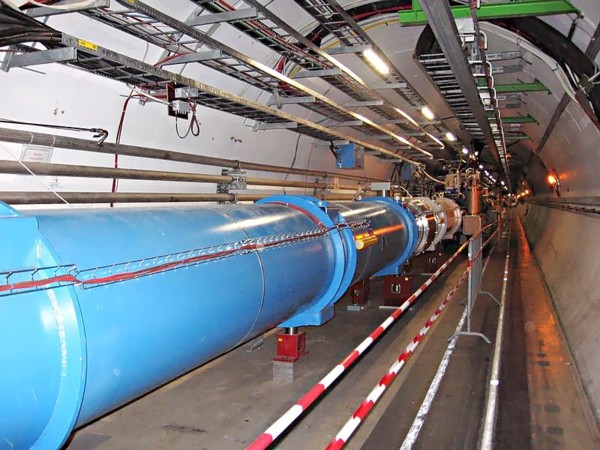
Featured image: Tunnel of the Large Hadron Collider (LHC) of the European Organisation for Nuclear Research. Julian Herzog (2008). Wikimedia Commons.