Graffiti near the Renfe station of Vitoria-Gasteiz

The monster called financial system

Is the financial sector overtaking the real economy?

Less than 1% of foreign exchange transactions are made for trading goods and services. More than 80% are made for exchange rate speculation. Every three days an entire year’s worth of the European Union’s GDP of € 13 trillion is traded in the foreign exchange markets.1 So is the financial sector overtaking the real economy?
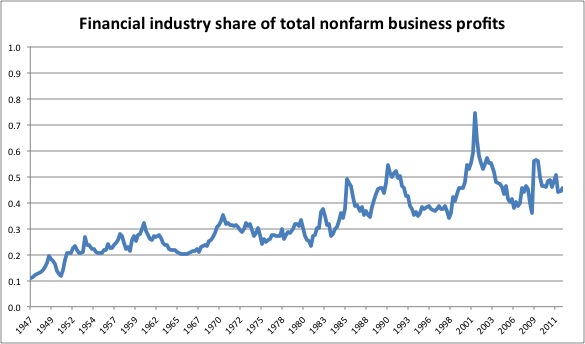
Financial industry share of total nonfarm business profits. Evan Soltas (2013)
Financial industry share of total non-farm business profits. Evan Soltas (2013). Economics and Thought.

In the United States financial sector profits grew from 10% of total non-farm business profits in 1947 to 50% in 2010.2 This figure excludes bonuses. It is explosive stuff and the original research has been removed from the Internet. The findings could give us the impression that the financial sector is a big fat parasite that feeds on us. And who would have guessed that?

What a scary monster the financial system has become. This terrible creature could easily wipe out human civilisation as we know it. That nearly happened in 2008. And it can still happen. We are hostage of this monster. It is too big to fail. But what created it? It wasn’t Frankenstein for sure. The answer is already out there for thousands of years. It is interest on money and loans. In the past this was called usury and often forbidden.

The core problem is that incomes fluctuate while interest payments are fixed. This causes instability in the financial system. And if the investment is more risky, lenders demand a higher interest rate, which contributes to the risk. Limiting interest would reduce leverage and make financial system more stable and less prone to crisis.

It’s the usury, stupid!

Fraud in the financial sector contributed to the financial crisis of 2008. To what extent the fraud or the size of the financial sector are to blame is less clear. Financial crises are not a recent phenomenon. They have caused economic crises in the past. For instance, the stock market crash of 1929 and the subsequent bank failures caused the Great Depression of the 1930s. Back then the financial sector was not as large as it is today and there was no large-scale mortgage fraud. Hence, there must be another cause.

Charging fixed interest rates on debts causes problems as incomes fluctuate. So if some person’s income or some corporation’s profit suddenly drops, interest payments may not be met. When the economy slows down that happens to a lot of people and corporations simultaneously, which makes the financial system prone to crisis. And interest is a reward for risk. Creditors may be willing to lend money to people and corporations that are already deeply in debt, but only if they receive a higher interest rate. So if interest was forbidden, that might not happen, and there could be fewer financial crises.

Banning interest has been tried in the past and it failed time after time. That is because without interest lending and borrowing wouldn’t be possible and the economy would come to a standstill. Until now there was a shortage of money and capital so interest rates needed to be positive, but that may be about to change. The increased availability of money and capital pushed interest rates lower. Money and capital may soon be so abundant that interest rates can go negative. That could be the end of usury.

The scary monsters in the financial system

Apart from exchange rate speculation there are frightening creatures like quantitative easing, shadow banks and derivatives. These things will be explained later in this post. Some experts believe that the financial sector is out of control. That may not be the case. Usury created this monster so Natural Money, which is negative interest rates and a maximum interest rate of zero, could make many of these seemingly hard-to-solve issues disappear, and perhaps shrink financial sector profits too.

Leverage, shadow banking and derivatives make the financial sector so profitable for its operators because of interest and risk. Interest is a reward for risk but interest also increases risk because interest charges are fixed while incomes aren’t. But more risk means more profit for the usurers because all that risk needs to be ‘managed’. That provides opportunities to profit for those who make the deals. Usury is the main cause of financial crises and generates most financial sector profits.

Quantitative easing

Quantitative easing means that central banks print money to buy debt with this newly created money. Trillions of dollars and euros have been printed so central banks now own trillions in debt. In this way the financial crisis of 2008 was stemmed. Investors and banks wanted to get rid of debts and preferred cash because there was a risk that some of these debts would not be repaid in full. This caused the crisis.

But what if there was a tax of 10% per year on cash and central bank deposits? Losing a few percent on bad debts suddenly doesn’t seem such a bad deal any more. Investors may have kept these debts and the crisis would not have occurred. The losses on bad mortgages turned out to be a lot less than 10% per year. That was also because the crisis was halted with central bank actions like quantitative easing.

If there had been a tax on cash and central bank deposits there would always have been liquidity. The crisis may never have happened in the first place and quantitative easing may not have been needed. And if this tax is going to be implemented in the future, investors may gladly gobble up the debt on the balance sheets of central banks, so that quantitative easing can be undone, and most likely at a profit for the taxpayer.

Shadow banks

In order to protect depositors, banks are subject to regulations. Regulations are bad for profits because they limit the risks banks can take. Bankers who were looking for bigger bonuses came up with a scheme that is now called shadow banks. Shadow banks don’t offer deposit accounts to ordinary people so regulations don’t apply. And so shadow banks can take more risk and generate more profits.

A shadow bank borrows money from investors and invests it in products like mortgage-backed securities. A mortgage-backed security is a derivative that looks like a bunch of mortgages. The owner of the security doesn’t own the mortgages themselves, but is entitled to the interest from the mortgages but also the losses when home owners fall behind on their payments. Not owning the mortgages themselves makes trading a lot easier because mortgages involve a lot of paperwork.

Shadow banks can be dangerous because bank regulations don’t apply. Ordinary banks are required to have a certain amount of capital to cushion losses so that depositors can be paid out in full when some loans aren’t repaid. The balance sheet of an ordinary bank might look like the one below:

debit
credit
mortgages and loans
€ 70,000,000
deposits
€ 60,000,000
loans to other banks
€ 10,000,000
deposits from other banks
€ 20,000,000
cash, central bank deposits
€ 10,000,000
the bank’s net worth
€ 10,000,000
total
€ 90,000,000
total
€ 90,000,000

But shadow banks don’t need to comply to these regulations because they don’t have depositors. And so the balance sheet of a shadow bank might look like this:

debit
credit
mortgage-backed securities
€ 500,000,000
short-term lending in money markets
€ 490,000,000
insurance and credit lines
the shadow bank’s net worth € 10,000,000
total
€ 500,000,000
total € 500,000,000

What is so great about shadow banking, at least for bankers? If banks borrow at 2% and lend at 4%, the ordinary bank can make € 1,400,000. The bank’s net worth is € 10,000,000 so the return on investment is 14%. But the shadow bank can make € 10,000,000 and the return on investment is 100%. And you can imagine how great this is for bonuses. Only, if something goes wrong, there is little capital to cushion losses. That’s not a problem for the bankers because by then they have already cashed their bonuses. But it could become our problem as shadow banks can blow up the financial system.

If the loans drop 10% in value because some home owners fall back on their mortgage payments, the capital of the ordinary bank can cushion the loss of € 8,000,000, while the shadow bank goes down in flames leaving an unpaid debt of € 40,000,000. And now we get to the point where financial system blew up. It is the insurance and credit lines part on the balance sheet of the shadow bank. There is no value attached because credit lines so insurances don’t show up on balance sheets or only for a very low amount.

Ordinary banks guaranteed credit to shadow banks just in the case investors like money market funds didn’t want to invest in shadow banks any more. The great thing of credit lines for bankers is that they get a fee for these credit lines while they don’t appear on the balance sheet so that banks don’t have to cut back their lending. When homeowners fell behind on their payments, investors didn’t want to invest in shadow banks any more, and these credit lines had to be used. This means that ordinary banks had to step in and suddenly their capital wasn’t sufficient to cover the losses. Also going down in flames, were the insurers of mortgage-backed securities.

The United States had a government policy of stimulating home ownership. Under the guise of this policy mortgages were given to people who couldn’t afford them. Behind the scenes usury was to blame. If there was doubt whether the borrower could afford the mortgage, a banker could charge a higher interest rate to compensate for the risk. This made the mortgage even less affordable to the borrower. The solution for that problem was giving ‘teaser rates’, meaning that the interest rate was low during the first year so that the home owner could afford the mortgage payments at first. Meanwhile the mortgage was packaged in a mortgage-backed security so the banker was already off the hook when the home owner fell behind on his or her payments.

And there is more. Shadow banks offer higher interest rates to their investors. Shadow banks don’t have a lot of capital so investing in them is a more risky than putting money in a bank account of a regular bank. Investors in shadow banks need a compensation for that risk. That’s no problem because the enterprise is very profitable. It is therefore possible for shadow banks to pay higher interest rates. This might not be possible if interest was forbidden, unless shadow banks had a lot more capital to cover their losses, but that would solve the problem of them being too risky. It is usury that allows for risky schemes like shadow banks to exist.

The multi-trillion-dollar derivatives monster

In 2016 the notational value of all outstanding derivatives is estimated to be $650 trillion. This is the so-called multi-trillion derivatives monster. This figure is more than eight times the total income of everyone in the world.3 Some people are spooked by the sheer size of that number. And indeed, derivatives can be dangerous. In 2003 the famous investor Warren Buffet called derivatives ‘financial weapons of mass destruction’.

Five years later derivatives played a major role in the financial crisis. An improper use of derivatives nearly brought down the world financial system. But derivatives can be useful. Most banks use derivatives to hedge their risks. Banks that managed their risks well using derivatives fared relatively well during the financial crisis compared to banks that didn’t.4 Therefore, derivatives are probably here to stay.

But what about the multi trillion monster? The number is a notational value, not a real value. Derivatives are insurance contracts, often against default of a corporation, a change in interest rates, or home owners falling behind on mortgage payments. You may have a fire insurance on your house to the amount of € 200,000. This is the notational value of the contract. You may pay the insurer € 200 per year. That is the real value of the contract, until something happens, that is.

If your house burns down, the contract suddenly is worth € 200,000. Insurers often re-insure their risks, which is a prudent practice. But re-insurance makes the notational value of the outstanding derivatives increase. So if your insurer re-insures half of your fire insurance to reduce its risk exposure, another contract with notational value of € 100,000 is added to the pile of existing insurance contracts.

So what went wrong? If suddenly half the houses in a nation catch fire because there is a war, insurers go bankrupt. The cause of the financial crisis was many home owners falling behind on their payments at the same time so that insurers of derivative contracts like mortgage-backed securities went bankrupt. The American International Group (AIG) was the largest insurer of these contracts and it was bailed out with $ 188 billion. The US government made a profit of $ 22 billion on this bailout, but only because the financial system wasn’t allowed to collapse.

In a financial crisis a lot of things go wrong at the same time. The financial system can’t deal with a major crisis. If it happens, it may cause the greatest economic depression ever seen, and in retrospect it may herald the collapse of civilisation.

The usury issue

Money circulation in the economy is like blood circulating in the body. It makes no sense for a kidney or a lung to keep some blood just in case the blood stops circulation. The precautionary act makes the dreaded event happen. It is a self-fulfilling prophecy. A financial crisis is like all parts of the body scrambling for blood at the same time. When the blood circulation stops, a person dies. An if the money circulation stops, the economy dies. Hoarding is to blame for that.

Perhaps big banks are too big to fail. Breaking them up may not help because the banking system is closely integrated. Banks lend money to each other. If a few banks fail then others get into trouble too. And in a crisis all the trouble happens at the same time. So perhaps it is better to address the cause of failure itself, which is interest on money and debts. And it may be possible because interest rates are poised to go negative.

A tax on cash makes negative interest rates possible. It can also keep investors from hoarding money. If money keeps on circulating, there may never be a crisis. The crisis happened because investors scrambled for cash when they feared they might lose money on bad debts. But if they expect to lose more on cash, they might keep their debts. And there may have been fewer bad debts in the first place if there had been no interest on debts as interest is a reward for risk.

Featured image: Graffiti near the Renfe station of Vitoria-Gasteiz. Wikimedia Commons. Public Domain.

1. The rise of money trading has made our economy all mud and no brick. Alex Andreou (2013). The Guardian. [link]
2. The Rise of Finance. Evan Soltas (2013). Economics and Thought. [no link because the information has been removed]
3. Here’s What Makes the Derivatives “Monster” So Dangerous (for You). Michael E. Lewitt (2016). Money Morning. [link]
4. Financial innovation and bank behavior: Evidence from credit markets. Lars Norden, Consuelo Silva Buston and Wolf Wagner (2014). Tilburg University. [link]

Arab farmer taking straw to his farm. Public domain.

Clutching at a straw

I read The Limits of Growth in my late teens. Perhaps, I was twenty already. I was young and hoped to live for another sixty years or so. And suddenly, a computer told me that I would live to see the end. The evidence and the logic were convincing. For a long time, I had hardly thought about the impending doom. As a child, I sometimes feared the future when hearing the disturbing song Vluchten Kan Niet Meer or Fleeing Is No Longer Possible on the radio. It unnerved me profoundly as it painted a dismal time ahead where nature would be gone. But that faded once I went to secondary school. After finishing my studies, I became an environmentalist and joined a local Friends of the Earth group in Groningen in 1993.

Friends of the Earth is an international environmental organisation known in the Netherlands as Mileudefensie. They had local groups of activists, most notably in student towns like Groningen. The organisation researches environmental issues and tries to convince people they should change their lifestyles. Friends of the Earth also lobbies with politicians and pressures corporations. Our group was a hodgepodge of students, people with a job, unemployed, activists and ordinary people led by a woman in her thirties, who acted as an Akela at the boy scouts. A 22-year-old student was her boyfriend.

We were not militant like Greenpeace, but sometimes we protested. One day we blocked the entrance of Groningen Airport to protest against the government subsidies for the airport. The police came and told us to leave, which we did. I then concluded that activism would not help. We will not give up our comfortable lifestyles and vote out politicians if they are serious about solutions. And businesses will go bankrupt if they do more to save the environment than others. Their products would be more expensive, and we wouldn’t buy them. And so there were underlying economic and political issues to address. We organised ourselves around themes, for instance, vegetarianism, air pollution, and economic issues. And these caught my interest.

We were short of money, but that changed when I became the treasurer. I took measures to make expenses match income, but I also had some luck. Every year, we obtained a small grant of 2,500 guilders from both the Groningen province and the Groningen municipality. But when I became treasurer, the provincial administration had just denied the allowance we had received the previous years. And so I wrote an appeal to the Appeals Commission. I then went to the Provincial House to discuss the issue with the official responsible for the grant. He explained that it was because we had been late filing our request, and the money jar was already empty. And so, I asked him whether there was any point to the appeal. He said no. It was a done deal. Then I received an invitation for a hearing at the Appeals Commission. I decided not to waste my time by going there, so a commissioner called me that evening, asking me why I hadn’t shown up. And I told him. That probably touched a nerve, as I gave him the impression that no one took the Appeals Commission seriously. And so, our appeal was granted, and we received the subsidy. As I had made a budget that did not anticipate this money and had implemented budgetary discipline, we ended up with income exceeding expenses.

Once over a cliff, a cartoon character can only clutch at a straw. And only in animation pictures the straw holds. The Dutch saying clutching to a straw means grasping to your last hope. On economic issues, our local group worked together with Strohalm, or more precisely, Rinke. He lived in Groningen and was actively engaged in Strohalm and their ideology. As I remember, he was on social benefits, and working for Strohalm and Friends of the Earth was his job. He was serious about it and worked hard. The meaning of the Dutch word strohalm is straw. According to Strohalm, the economy must grow because of interest, and that’s destroying our planet. It is ‘grow-or-die’ because interest rates need to be positive. Interest charges also cause escalating debts, poverty and financial instability. And in the end, the scheme will collapse because the interest adds to the principal until infinity. Any solution begins with ending that, they believed. And as you may have inferred already, I was into sound accounting, so this made me think. Strohalm aimed to ban interest and charge a fee on money, as Silvio Gesell had proposed. You didn’t have to pay the fee on money lent. In this way, it could be attractive to lend money without interest.

In those days, Strohalm started a LETS (Local Exchange Trading System) in Groningen. We exchanged goods and services using fictitious currency. We had a camp to train our persuading skills as environmentalists. Rinke was one of the organisers. He praised me several times and called me an example for others. That was not because of my social skills but because I knew what other people thought and how they would react. My parents and some friends frowned upon me joining the environmentalist movement.

I soon realised that there were serious issues. If you can receive interest elsewhere then why would you lend out money without interest? And if you can borrow money at an interest rate of zero, you would borrow as much as you can and put it in a bank account at interest. Therefore, interest-free money with a holding tax would not work. Only, that wasn’t particularly satisfactory. If you accept doom then you might as well commit suicide. If interest is the root of many social and environmental problems, and can destroy human civilisation, you should make it work. And perhaps it could work. During the Great Depression, it had been tried in a small Austrian village and it was a stunning success.

I am concerned about the planet. For years, I used public transport. And I still do it for work. But at some point, I realised it was pointless. More and more people started driving SUVs. They didn’t care about the planet. So if I saved petrol by taking a train, there was only more for those people. It didn’t matter what I did. A car makes your life comfortable, and I didn’t aspire to higher moral standards than others. So, I bought a car in 2003.

In 1998, I became a freelance IT specialist. I worked for a small bureau named Betamax, led by Martien, a retired manager. I made lots of money, so I had some capital to invest. My first investments were small and unprofitable, as I believed that profits matter. At the time, loss-making internet startups did very well in the stock market, while profitable corporations did poorly. But I had trouble understanding it. And so I thought I had to stay informed about the financial markets. In 2000, I joined the investment message board Iex.nl. At the time, I still said occasionally, ‘With SuperBart,’ when taking up the phone. That was fun and it sometimes caused hilarious moments, for instance, once I expected a call from Ingrid, but it turned out to be Martien. And so, I chose this name as my avatar.

Later I changed my avatar into niphtrique after someone noted that SuperBart sounded arrogant. And since then, I never took up the phone anymore saying, ‘With SuperBart.’ I didn’t need that to feel better anymore. A strange thing about avatars is that you somehow become this person, SuperBart, on the Internet because people do not know you. And so, I introduced a few other avatars to be someone else and have some fun. Most avatars didn’t last long, except dikkevettebeer, or plumpy fat bear, who believed the stock market would crash to zero and the gold price would rise to infinity.

A colourful investment fund manager, Michael Kraland, ran the message board. He also wrote commentaries about his investments. At the time, he rode the hype of the internet and telecom bubbles. His strategy was risky and not sound advice to inexperienced investors. And because he was a bit of a boaster, he received nasty negative comments on the message board, including unproven accusations of wrongdoing. And perhaps also because he was a Jew, which might not be accidental, as he worked in finance. And even though, as far as I know, he never did anything illegal, I nevertheless found him a dubious character.

After some time, a day trader named Cees joined the message board and began sharing conspiracy theories with us. He found them on US message boards and websites. If the markets were about to collapse, a secret group called Plunge Protection Team would come to the rescue. A stock market crash could undermine confidence in the financial system run by Wall Street, so they didn’t allow that to happen. Many readers first ridiculed Cees. But after the internet bubble had popped, and even more so after 9/11, markets often miraculously recovered when they were about to crash. And so, his credibility gradually rose. And the gold price regularly cratered because of sudden selling at peculiar times when most markets were closed. Cees believed central banks were behind this to promote confidence in their currencies. He wrote that if the gold price were to rise, the public would lose trust in our money. When there is little trade, you can sell a bit of gold to make the price drop. The trick was to break a trend. Trend traders, called technical traders, would then join the bandwagon by selling more gold, bringing down the price even further.

That was new to me, and perhaps it wasn’t all true, but there was ample reason to be suspicious. I had already bought some gold for other reasons. I didn’t trust financial markets and those operating them. Those people make a living from your money, so these stories intrigued me. They might be pulling out all the tricks to keep the Ponzi scheme of interest-bearing debt going. After all, debts continued to grow, as did interest payments, so there could soon be a day of reckoning. And I had read The Limits of Growth, so I feared collapse was inevitable. And if the sky has come down on you once, you worry it might happen a second time. Hence, I was constantly on edge concerning my investments, which was not helpful for profits. And I was not good at picking stocks. And so, I bought gold as a long-term investment. I also hoped that gold ownership could help me weather a financial collapse.

I bought my first gold in 1999 before I joined Iex.nl when I learned on the news that the gold price had reached historic lows. And so, I went to my bank to open a gold account. They sent an investment advisor to talk me out of it. He said, ‘No one does that anymore. I know a man who has a silver account with us for two decades. And silver has gone nowhere all that time. Gold mines are making losses because the price of gold is only going down. You should invest in the stock market instead.’ I smelled apathy concerning the precious metals and concluded it could be the beginning of a long-term trend of rising gold and silver prices that might run for decades, which indeed has happened. And so, I pressed on and opened a gold account. Perhaps, they had a good laugh that day at my bank office.

In 2001, after the Internet bubble had popped, I pitched the idea of interest-free money on the message board of Iex.nl. My lack of knowledge of the financial system didn’t deter me. Everyone can participate in a debate on a message board, and you can exchange thoughts with people you would never meet otherwise. Others rebutted me time after time, but I didn’t give up. Lengthy discussions followed, and they took several years. As these discussions proceeded, my knowledge of the financial system increased. And with the benefit of hindsight, debates on the Internet can be more fruitful than academic debates, which often occur in closed circles, because you get more perspectives.

In theory, interest-free money is a sound idea because fixed-interest payments destabilise the financial system. But practical issues stood in the way. The supporters of interest-free currencies didn’t address them. And economists never took interest-free money seriously because if you can receive interest elsewhere, you will not accept interest-free money. Via gold websites, I became familiar with the Austrian School of Economics and their adherents. They question money creation by banks and the need for central banks and point at the inflation caused by money creation. Some hoped to limit money creation or to return to a gold standard. Usually, they were libertarians who saw the government as the root of all evil. And unlike St. Paul, they saw sound money and free markets as the root of all blessings. They were a most peculiar and fanatic bunch, and even though they were on the opposite side of the political spectrum, a comparison with communists is most apt.

Both ideologies are like religions. Like the communists have their prophets, such as Marx, Lenin and Engels, libertarians have them, like Mises, Hayek, and Rand. And both religions have holy books. Communists have Marx’ Das Kapital or the Communist Manifesto, and libertarians have Rand’s Atlas Unshrugged or Ludwig von Mises’s book The Theory of Money and Credit. If their ideology fails, communists blame the capitalists, while libertarians blame the government. They appear to see money as a goal, not a tool. If you held alternative views like me, they might accuse you f being Keynesian, which seemed worse than being Satan himself. To me, these people seemed misers obsessed with money. Perhaps it is not a coincidence that their hero, after which they named their website, is Ludwig von Mises. So Mises for misers, if you didn’t get it already. And even though Wall Street is much eviler than they are, they represent the worship of Mammon in its purest form. They believed they were always right, so they tried hard to convince me I was wrong with my ideas about interest. And so, I learned as much from the Austrians as I learned from Strohalm. And if you come to think of it, perhaps it is also not a coincidence that the miracle of Wörgl happened in Austria.

Two opposing fringe ideas, interest-free money with a holding tax and the Austrian School view of hard money, challenged each other in my mind. It is how Hegelian Dialectic is supposed to work. It was not so that I was constantly brooding on this issue, but I also couldn’t let it go. In 2008 this resulted in a synthesis, Natural Money. In a gold standard, you need positive interest rates to get the economy going. As a result, you end up with unsustainable debt levels that you can never repay in gold, so you must leave the gold standard. But when you do that, the sky is the limit, and debts can escalate to infinity. But limiting the interest rate to zero can curb money creation too, and stop irresponsible lending. If the money supply is stable and the economy grows, prices drop, including the gold price. And so, a well-managed currency with a holding fee could be stronger than gold. As the economy can do better without interest, interest-free money can give better returns. That was the beginning. In the following decade, I produced a more comprehensive theory with the help of modern monetary economics.

Latest revision: 30 January 2023

Featured image: Roadrunner and Wile E. Coyote. Warner Bros. [copyright info]

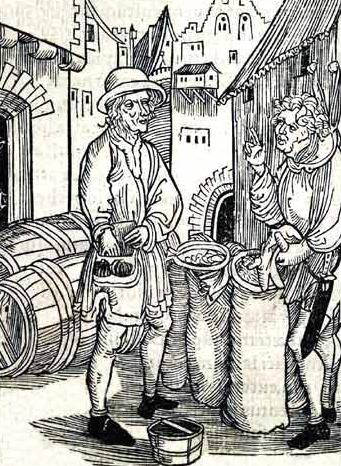
Of Usury, from Brant's Stultifera Navis (the Ship of Fools)

The Problem Of Interest

Compounding

Imagine that Jesus’ mother had put a small gold coin weighing 3 grammes in Jesus’ retirement account at 4% interest just after he was born in the year 1 AD. Jesus never retired but he promised to return. Suppose now that the account was kept for this eventuality. Imagine now that the end is near, and that Jesus is about to return. How much gold would there be in the account in 2018?

It is an amount of gold weighing 11 million times the mass of the Earth. The yearly interest would be a gold nugget weighing 440,000 times the mass of the Earth. There is a small problem, a fly in the ointment so to say. It would be impossible to pay out Jesus because there simply isn’t enough gold.

It might seem that the bank had to close long ago because of a lack of gold, but that isn’t true. As long as Jesus doesn’t show up it can remain open, at least if the borrowers are allowed to borrow more to pay for the interest. If the economy grows 4% it may not be such a big deal. The interest can be created out of thin air by making new loans that allow borrowers to pay for the interest. And if Jesus doesn’t claim his gold when he returns and accepts bank credit, everything will be fine.

There is a limited amount of gold while compound interest is infinite. As long as bankers can create money out of thin air to pay for the interest and people accept bank deposits for payment, everything is fine. Problems only arise when people demand real gold. A bank can go bankrupt when depositors want to take out their deposits in gold.

Central banks

Perhaps Jesus’ retirement account isn’t such a big problem after all. Our money isn’t gold but currencies central banks can print. Assume now that Jesus’ mother had put one euro in the account instead. One euro at 4% interest makes 22,000,000,000,000,000,000,000,000,000,000,000 euro after 2017 years. That may seem an intimidating figure, but the European Central Bank can take 22 pieces of paper and print 1,000,000,000,000,000,000,000,000,000,000,000 euro on each of them. And there you are. Something like this happened during the financial crisis of 2008. This is called quantitative easing. You may have heard that word before.

Central banks can print new dollars and euros to cope with a shortfall. In fact, this is what central banks often do. There is always a shortfall because of interest because most money is debt and interest on this debt needs to be paid. To make up for the shortfall, there are two options. First, people can borrow more. Second, central banks can print new currency. Both things can happen at the same time. Central bank decisions about interest rates are also about dealing with the shortfall caused by interest charges.

When central banks lower interest rates, people can borrow more because interest rates are lower. Central banks lower interest rates when people are borrowing less than is needed to cope with the shortfall. If central banks raise interest rates, people can borrow less because interest rates are higher. Central banks raise interest rates when people are borrowing more than is needed to cope with the shortfall and the extra money makes people want to buy more stuff than can be made. And if people don’t borrow at all, this is a crisis, and central banks may print more currency to cope with the shortfall.

Interest on capital versus economic growth

There is a problem central banks can’t fix by printing more currency. Interest is more than just interest on money. Interest is any return on investment. Throughout history returns on investments were mostly higher than the rate of economic growth. Most of these returns have been reinvested so a growing share of total income was for investors. This can’t go on forever because who is going to buy the stuff corporations make in order to keep these investments profitable? A simple example can illuminate that.

interestvers
Interest income (red) versus total income with interest income growing faster than total income

The graph above shows how total income and interest income (in red) develop with an economic growth rate of 2% and an interest rate of 5% when interest income starts out as 10% of total income and all interest income is reinvested. After 25 years the economic pie has grown faster than interest income and wages have risen. At some point interest income starts to rise faster than total income, and wages go down. After 80 years there’s nothing left for wages. This graph explains a lot about what is going on in reality.

In the short run it was possible to prop up business profits and interest rates by letting people go further into debt to buy more stuff. In the long run, the growth rate of capital income cannot exceed the rate of economic growth. Interest rates depend on the returns on capital so this can explain why interest rates went down in recent years. In the past interest rates below zero weren’t possible but from time to time there were economic crises and wars that destroyed a lot of capital. This created new room for growth.

Wealth inequality and income inequality

When interest rates go down, the value of investments tend to rise. If savings yield little this benefits the wealthy as most people have their money in savings while the wealthy own most investments. But it is important to know the cause otherwise you might think that interest rates should rise. The graph above shows that wealth inequality causes interest rates to go lower, hence redistributing income, for example via higher wages or taxes on the wealthy, can bring higher interest rates.

There is a difference between wealth inequality and income inequality. Your labour income and the returns on your investments are your income. If you are rich but make no money on your investments, your wealth doesn’t contribute to your income. In reality wealthy people make better returns on their investments than others because they have better information and can take more risk. Still, the graph shows that income and wealth inequality can’t increase indefinitely, and that returns on investments can’t exceed the reate of economic growth in the long run, hence interest rates need to go lower.

Most people pay more interest than they receive. The interest paid on mortgages and loans is the proverbial tip of the iceberg. Interest is hidden in rents, in taxes because governments pay interest on their debts, and the price of every product and service because investments have to be made to make these products and services. German research has shown that 80% of the people pay more in interest than they receive, while only the top 10% of richest people receive more in interest than they pay. Lower interest rates benefit most people despite some side-effects that work in the opposite direction.

Economic cycles

Humans are herd animals. They buy stuff and even go into debt to buy stuff when others are going into debt to buy stuff too. Suddenly they may realise that they have bought too much or have gone too deeply into debt, and all at the same time. One day they may be borrowing money, queueing up before the shops, and bidding up prices. The next day, they may decide to pay off their debts, leaving the shop owners with unsold inventories they have to get rid of at fire sale prices. So prices may go up when people are in a buying frenzy and may go down when sales dry up.

When there is a buying frenzy business owners are optimistic and do a lot of investments, and often they go into debt to make those investments. But if suddenly customers disappear, they may be stuck with unsold inventory and debts they cannot repay. Businesses may then have to fire people. Those people are then left without income, and cannot repay their debts too, so sales will go down further. If their debts are not repaid, banks could get into trouble. In most cases the economy will recover. In the worst case banks go bankrupt, money disappears, the economy collapses, and an economic depression takes off.

Interest can make things worse. Assume that you have a business and expect to make a return of 8%. You have € 100,000 yourself and you borrow € 200,000 at 6%. You expect to make 8% so borrowing money at 6% seems a good idea. If you only invest your own € 100,000 you can make € 8,000, but if you borrow an additional € 200,000 you can make € 12,000 (8% of € 300,000 minus 6% of € 200,000, which is € 24,000 minus € 12,000). The balance sheet of your business might look like this:

debit
credit
inventory
€ 250,000
loan 6%
€ 200,000
cash, bank deposits
€ 50,000
owner’s equity
€ 100,000
total
€ 300,000
total
€ 300,000

If sales disappoint and you only make a return of 2% on your invested capital of € 300,000, which is € 6,000, you make a loss because you pay € 12,000 in interest charges. You may have to fire workers. Businesses can go bankrupt because they have borrowed too much and have to pay interest, even when they are profitable overall. Sales often disappoint when the economy fares poorly. This means that more businesses face the same difficulties and make losses because of interest payments. They may have to fire workers and these workers lose their income. This can worsen the slump.

Interest, economic depressions and war

Silvio Gesell discovered that interest rates can’t go below a certain minimum because lending would then stop. Money would go on strike as he put it. Why is that? Low yields make investing and lending money unattractive because of the risks involved. Debtors may not repay and banks may go bankrupt. Depositors then prefer to take their money out of the bank and keep it with themselves.

This can cause economic crises and depressions. Silvio Gesell lived around 1900. Interest rates below zero weren’t possible because of the gold standard. Depositors could go to the bank and withdraw their deposits in gold so that they didn’t have to accept negative interest rates. From time to time there were bank runs, economic crises and wars that destroyed a lot of capital. And this created new room for growth.

There may be a relationship between interest, economic depressions and war. In 1910 the amount of capital income (the red circle in the graph) relative to total income (the two circles together) was close to what it was in 2010. This could have led to an economic depression but then came World War I. The war destroyed a lot of capital so that there was new room for capital growth and interest rates could remain positive.

A few decades later the Great Depression arrived. If interest rates could have gone below zero in the 1930s, the Great Depression might not have happened, Adolf Hitler would not have risen to power and World War II would not have occurred. The currency of Wörgl demonstrates that negative interest rates could have ended the depression. After World War II interest rates never came near zero again. Governments and central banks printed more money. This caused inflation, which eroded trust in money.

People feared that inflation would make their money worth less so interest rates rose. In the 1970s the link between money and gold was abandoned because there was a lot more money than there was gold to back it. In the 1980s governments and central banks started policies to bring down inflation and to promote trust in money. As of 1983 interest rates went down gradually as a consequence of a renewed trust in money and central banks. Debt levels rose and interest rates went near zero.

Promoting inflation might not be a good idea. The end result is unpredictable. The best one can hope for is a poor performing economy and a lot of inflation like in the 1970s. But if interest rates rise because lenders lose their trust in money and debts, people may not be able to repay their debts, and the financial system might get into serious trouble. This can cause another great depression or another great war. But if the alternative is negative interest rates, stability and prosperity, then why not opt for that?
eou_31_questions

Featured image: Of Usury, from Brant’s Stultifera Navis (the Ship of Fools). Albrecht Dürer (1494). Public domain.