1919 Cover of The Natural Economic Order

Discovery of Interest-Free Money

In September 2008, the banking crisis was getting out of hand. Things were falling apart. It seemed as if the financial system could collapse at any moment and that civilisation, as we know it, would end. Today, the 2008 financial crisis is a distant memory, but at the time, not only did the financial press worry. Panic was setting in. It was like 1929. I had long feared an apocalyptic financial collapse and believed that usury, or charging interest on money and debts, would be the underlying cause. On the surface, the cause may appear irresponsible lending, but interest is a reward for the risk of default. Without interest charges on debts, there would be no irresponsible lending.

The events prompted me to watch the animated picture ‘Money as Debt’ on YouTube and reflect once again on Silvio Gesell’s ideas about charging a holding fee on money and using it to eliminate interest charges. I penned down my thoughts about interest-free money with a holding fee, and tried to make an ordered, coherent whole of them. The idea had never seemed workable. Why should you lend out money interest-free if you can receive interest elsewhere? It is why economists didn’t look into it more seriously and why interest-free money remained a fringe idea, mainly attracting eccentrics like me.

Then, in the first days of October, I made a startling discovery. Banning interest promotes financial stability by preventing usurious lending, irresponsible lending, and unproductive financial schemes. That would improve the economy. Think of it like so. When credit card debt and payday lending at high interest rates disappear, people will have more disposable income, and you will have no usurers living off the work of others. That would be more efficient. It also reduces the need for government and central bank interventions to manage the interest-bearing debt. Usury requires government deficits and the creation of money by central banks.

That is because most of our money is debt. If you go to a bank and take out a loan, the bank creates money out of thin air, but you must pay back the loan with interest. You repay the loan with money borrowed by someone else. And the money you need to pay the interest doesn’t exist. Someone else must borrow that as well. On a larger scale, due to interest charges, we need to add extra debt to pay off existing debts with interest. To prevent the usury scheme from collapsing, governments run deficits and central banks print money, which leads to inflation. The inflation rate is often higher than the interest rate you get on a bank account. The profits are for the bankers, who receive huge bonuses.

Now comes the explosive discovery. The economy would do better without usury. If the economy performs better, the yield on investments would be higher, so an investor would receive better returns with negative interest rates. The difference comes from inflation. Without interest charges, there is no need for government deficits and money printing. The economy can thrive without more debt, so there would be no inflation. During the Great Depression, the Austrian town of Wörgl issued a currency with a holding fee. Those holding the money had to pay a 1% monthly fee to keep the money valid, so they would spend it rather than save it. And so, the money kept circulating, and Wörgl’s economy boomed while Austria suffered from the depression.

And so I figured that if the money is interest-free, the currency’s value rises more than the interest you would receive on an interest-bearing currency. Think of it like so. You can have 2% interest with 5% inflation or -2% interest with 0% inflation. The latter would be a better deal. The question then becomes, why lend out money with interest when interest-free money offers better returns? If the idea is that good, and the ‘Miracle of Wörgl’ suggests so, investors would bring their money to the interest-free economy, and the usury economy would collapse. If this became more widely known, the idea would spread and terminate the usury financial system forever.

Until then, I had always believed that interest-free money was sound in theory, but impossible in reality, because rather than good intentions, efficiency drives changes in this world, which is also the reason why we are doomed. The only constant in history is the strong killing the weak. But this money could be the terminator of usury, and a better future for humankind suddenly seemed possible. An incredible power seemed to lurk behind it. And making this knowledge public, I speculated, could unleash an unspeakable force. The Austrian central bank banned the Wörgl money, so we don’t know how it would have ended if it had continued. Perhaps, we would have lived in an entirely different world. A similar type of money lasted for over a thousand years in ancient Egypt. Had I discovered the secret that explains these successes?

That gave me serious doubts. How could the experts have missed it? I was an amateur. And amateurs who think they know better than the experts have become a plague recently. ‘Think for yourself and do your own research,’ has become the motto of a growing squad of nutters that the Dutch would call Wappies. ‘If it snows, that proves climate change is a hoax.’ You know the type. Everyone can gather random posts and articles from the Internet and create their own version of the truth out of thin air. I was anxious about getting it wrong, which made me doubt the greatness of the discovery. It might be a good idea, but it can’t be that good. And that is correct, a decade of research later confirmed, but it is possible nonetheless. And the proof also came as we have seen negative interest rates in the next decade.

Then, on a website promoting Gesell’s ideas, I found the following quotes,

‘The creation of money that cannot be hoarded will lead to a different and more real kind of property.’

– Albert Einstein

‘Gesell’s name will be a leading name in history once it has been disentangled.’

– H.G. Wells

‘The application of Gesell’s principle of circulation of money will lead the nation out of the depression within two to three weeks. I am a humble student of this German-Argentine businessman.’

– Irving Fisher

‘The future will learn more from the spirit of Gesell than from that of Marx.’

– John Maynard Keynes

‘Gesell’s work will initiate a new epoch in the history of mankind.’

– Prof. Dr. B. Uhlemayr

‘Gesell’s discoveries and proposals are of the greatest importance for centuries to come.’

– Dr. Theophil Christen

These brilliant minds agreed that something epic lay beneath the surface and that it could change the future forever. John Maynard Keynes and Irving Fisher were among the greatest economists of their time. If Keynes believed Gesell would make us forget Marx, I might have found out why. And so, the Miracle of Wörgl and the grain money in ancient Egypt may not have been freak accidents but a sign of something more. Ending usury, the scourge that had haunted humankind for thousands of years, seemed within reach. While considering the implications, the following song played on the radio,

Summer has come and passed
The innocent can never last
Wake me up when September ends
Like my father’s come to pass
Twenty years have gone so fast
Wake me up when September ends

– Green Day, Wake me up when September ends

September had just ended. Silvio Gesell first proposed money with a holding fee in his book ‘Natural Economic Order,’ which he first published in German in 1916 as ‘Natürliche Wirtschaftsordnung.’ I figured that its abbreviation could be NWO, which stands for New World Order, not knowing that the German ‘Wirtschaftsordnung’ was, unlike in English and Dutch, one word. So, was my discovery meant to happen? Was it part of something bigger? These thoughts arose, ironically, because I didn’t see ‘Wirtschaftsordnung’ as a single word. It made me feel small and insignificant. Paranoia was creeping in.

What is less known, but definitely worth noting, is that the German Nazis also aimed to abolish interest and contemplated Gesell’s ideas. Gesell himself was not a Nazi, but a liberal and an internationalist. Adolf Hitler was more impressed by the ideas of Gottfried Feder, who had the same kind of moustache Hitler had. Feder had written ‘The Manifesto for the Abolition of Interest-Slavery’ around the same time Gesell wrote ‘The Natural Economic Order’ and proposed nationalising all banks and abolishing interest. Gesell argued for charging a holding fee on currency and not interfering with markets and banks.

I named the discovery Natural Money as a reference to the Natural Economic Order. Strange things began to happen. When I woke up at night, the clock always showed times like 2:22, 4:44 or 5:55, with no exception. That was creepy. Something seemed seriously off with reality. Then, my wife told me she was seeing those time prompts as well. Until then, I hadn’t told her that I was seeing them. Once you enter the Twilight Zone, it begins to affect you. Meaningful coincidences started to occur, making me open to suggestions. What happened around me and in the world seemed to interact with my thoughts. Even the covers and titles of the books in the bookshop at the train station in Leeuwarden radiated a sense of spookiness, with references to my situation. They call it synchronicity.

The animated picture Money as Debt started with a list of assassinated US Presidents who supposedly opposed the banking system, suggesting evil bankers were behind these assassinations, making me fear death under suspicious circumstances if Natural Money would get serious attention. Still, if a repetition of the miracle of Wörgl were to occur, the news would spread fast, and if it were that good, it would be impossible to stop. Killing me wouldn’t help. The Secret Service would be too late. Of course, I had worried far too much. I posted the idea on several message boards. Most people didn’t get it. I mailed the findings to 200 Dutch economic researchers. None of them was interested.

Natural Money had a more favourable reception on the message board of Opednews.com. It generated some discussion as some visitors saw the potential. Still, it didn’t lead to a further propagation of the idea. I also went to Strohalm’s office in Utrecht. They had been working on interest-free currencies for decades. The people of Strohalm received me politely, but they had other priorities. They had a promising project in Uruguay. Doubt crept in again. I didn’t know enough about monetary economics and the financial system to see whether it was an idea worth pursuing. And even if I was right, no one would listen, so I planned to give up and resume my life.

It was disappointing, but not as bad as being evicted from the dormitory by A* nineteen years earlier. To remind myself of that and make me feel better, I played the Sleepwalking album by Gerry Rafferty, the album I had come to associate with the events at the dormitory because of the lyrics of the first song, ‘Sleepwalking.’ And then I wondered whether A* had something to do with the discovery of Natural Money. Over the years, several incidents had occurred, suggesting that She was still interfering with my life. It didn’t take long before clues came up. There is a thin line between paranoia and psychosis. The lyrics of the fourth song of the album ‘On The Way’ were noteworthy,

Drifting along with the wind, telling yourself you can’t win
It’s over, and now we begin, oh yeah, we are on the way

Only one woman, one man, just doing the best that we can
There’s so much we don’t understand,
Oh yeah, but we’re on the way
Light shining down from the east,
bringing a love that won’t cease

– Gerry Raffery, On The Way

In my bed, I was imagining again. By giving up, I had just told myself I couldn’t win. Was this just the beginning? The beginning of what? What did I not understand? What was this love that won’t cease? Was my destiny connected with that of A*? I had loved Her in secret all that time, but never thought, or even hoped, that we could be together. The distinction between my make-believe world and reality, which had been there since I was a child, began to blur. The lyric wasn’t specific, so the suggestion came from me linking the album to the events in the dormitory. And I might still have ignored it if it weren’t for the fifth song,

People come and people go, friends, they disappear
There’s only one thing that I wanna know, tell me where do we go from here
Everybody’s on the make, everybody’s trying to get ahead
In a world like this, you just exist to feed the walking dead.

Lookin’ out on a world gone crazy, waitin’ for the fun to begin
The race is on, yeah, they’re gettin’ ready, Jesus, what a state we’re in
Meanwhile, down in my backyard, I’m sitting doing solitary
Now that I’ve milked the sacred cow, I just worry ’bout the military.

Get ready
Get ready

– Gerry Raffery, Sleepwalking

It is a strange lyric, and it made me think. Is the world about to go crazy, and is something about to start? We exist to feed the walking dead, which could be the defunct banking system, I reasoned. The phrase probably refers to what Karl Marx once wrote, ‘Capital is dead labour, that, vampire-like, only lives by sucking living labour, and lives the more, the more labour it sucks.’ I didn’t know that, so I made up my own interpretation. The sacred cow made me think of Joseph explaining the Pharaoh’s dreams, which is also not so obvious. Now, the story originates from a holy book, and one of the Pharaoh’s dreams involved cows, so that was the connection. Joseph introduced the granaries in Egypt, the story goes. Grain stored in these granaries became the basis of the Egyptian grain money, which, like Natural Money, had a holding fee to cover the storage costs.

These are some incredible leaps of thought that you wouldn’t make if you aren’t psychotic, so by then, I had crossed that line. Sleepwalking was the only album Gerry Rafferty had recorded outside the United Kingdom, and it was in the Netherlands, where I was living at the time. That was not a coincidence, I supposed, and I was right about that at least as it turned out. I had grown open to suggestions. Natural Money could change the world, some of the most brilliant minds had agreed on, and it was something epic, and it had to do with A*. And so, I was well on my way towards the shadow world where I was about to meet A* again after nineteen years. That evening, I felt A * trying to do a mind melt with me, like the Vulcans do in Star Trek, once again. This time, I didn’t resist. And there She was, on the other side. It seemed like a telepathic connection. By then, it was 11 November 2008.

Latest revision: 25 September 2025

Featured image: 1919 Cover of The Natural Economic Order. Wikimedia Commons.

Virtual Worlds

We live in a virtual world, a computer-simulated environment. Virtual worlds, such as computer games, can have numerous users who create personalised avatars, engage in activities, and interact with others. If you are familiar with computer games, you know what an avatar is. Once you enter a game, you become a character inside that game, your avatar, and you have an existence apart from your regular life. Inside the game, you are your avatar, not yourself. Alternatively, you could start a virtual world where you are God and make your dreams come true. In this world, you can also become someone else, a character in your story.

Virtual worlds have rules that may draw from reality or fantasy worlds. Rules can include gravity, methods of procreation, and types of communication. In virtual reality, you can change the rules. You can do away with planets and stars and create a flat surface. Or there is no surface at all. You can eliminate gravity and let everyone float. You can do away with procreation and let individuals emerge from thin air. You can invent species that communicate via light signals or not have species but individuals with random features.

This world might look like the original. Our experiences shape our imagination and influence the options we consider. If we write stories and produce films, most are about humans and their feelings and actions. Only a few are about animals. And the animals we imagine in our tales are like humans. Ed, the talking horse, is more human than a horse. Tales and motion pictures about imaginary beings, such as The Lord of the Rings or the Star Trek series, are rare compared to series about humans. And the fictitious beings in our stories, such as Star Trek, look and act like humans. They usually have two legs and two arms and walk upright. Extraterrestrials in Star Trek feature males and females.

The Holodeck is a virtual reality room available in the Starship Enterprise in Star Trek. Using holograms, it creates a realistic, interactive simulation of the physical world. On the Holodeck, you can make a personalised environment with objects and people, interact with them, or write a story and play a role in it. With the help of artificial intelligence, we might soon create simulations of humans and the world. If the technology becomes cheap, we could make billions of virtual universes. If we do that, it likely happened long ago, and we live inside a virtual world ourselves.1

We are about to do so, so this world is probably a simulation. But can we find out? Most philosophers and scientists think we can’t. They have overlooked the obvious. There is an elephant in the room: the things science can’t explain. It begins with establishing that these phenomena aren’t subjective, so there must be multiple credible witnesses or verifiable evidence. Then, you need to certify that it is not due to randomness or a natural phenomenon. To say that the simulation causes these phenomena upends the knowledge we currently believe we have. And so, we must be thorough. Answering the question begins with investigating what we can or cannot know. That is the domain of knowledge theory, a branch of philosophy which deals with the nature of knowledge.

Latest revision: 18 July 2025

1. Are You Living In a Computer Simulation? Nick Bostrom (2003). Philosophical Quarterly (2003) Vol. 53, No. 211, pp. 243-255.

The nature of reality


We live inside a simulation created by an advanced post-human civilisation. An individual can’t build this universe alone or write the script in detail. That requires a civilisation. Science has established several laws of reality, or natural laws, with a sufficient degree of certainty. Therefore, if breaches of these laws occur, this world is fake. There is enough evidence of breaches. And so, the argument is:

  • Science has sufficiently established specific laws of reality.
  • Breaches of these laws prove that this world is a simulation.
  • There is sufficient evidence of breaches in these laws.
  • Hence, we live in a simulation.

We like to think we are unique and superb creatures, the apex of all that roams this planet, so we attach great value to our inner selves. And the consumerist society teaches us that we are also very deserving, and that only three people are of importance: me, myself, and I. So, if we have the technology, we would build personal virtual realities that allow us to fulfil our every desire. Because we think we are so wonderful, we probably won’t alter our human essence when we can, so post-humans likely have similar motivations to us.

These post-humans could run simulations of human civilisations for entertainment and research. If the technology becomes cheap, the number of simulations for amusement likely vastly outstrips those for research. Our purpose is probably entertainment, and breaches of the laws of reality suggest so. Simulations run for research are more likely to be realistic. Signs of a script indicate that our universe is not a game, but rather someone’s imaginary world. Someone could own this world, and we might call that someone God. God may use avatars in this simulation to play the role of an ordinary human being.

Coincidences, such as the licence plate number of Franz Ferdinand’s car, indicate that there is a script, meaning a computer generates all our thoughts and actions. We aren’t sentient beings. We don’t think for ourselves. We have no intrinsic value to our creators, so God can let us suffer and kill us without remorse. The strength of the evidence outweighs the issues, such as the lack of scientific evidence for the paranormal, the limitations of the human mind, including our tendency to seek causes when randomness applies or to see meaning where there is none, the hindsight bias, and the difficulties in establishing probabilities. In other words, we can know beyond a reasonable doubt that we live in a scripted virtual reality. That is a remarkable conclusion, and it would be even more astounding if we identified some of God’s avatars to gain better insight into the purpose of this universe.

What if God was one of us?
Just a slob like one of us
Just a stranger on the bus

Joan Osborn, One of Us

Latest revision: 24 July 2025

Book: The Virtual Universe

Several religions claim that a god or gods have created this universe. The simulation hypothesis explains how this might have happened. We could all live inside a computer simulation run by an advanced post-human civilisation. But can we establish that this is indeed the case?

The evidence suggests that we live inside a simulation. It even allows us to infer the purpose of our existence. This book does not promote a specific religion. It follows science, but science has its limits. It can’t tell whether the world we live in is real.

Still, the sciences can support the argument that this world is a simulation, as they have established the natural laws that guide reality. If breaches of these laws occur, such as paranormal incidents with credible witnesses, we have evidence indicating that this world is not real.

We have just invented virtual reality. We can utilise virtual reality for both research and entertainment purposes. If the technology to create virtual worlds becomes affordable, most worlds will exist for entertainment, such as games or inventing stories where we can make our dreams come true.

The latter requires control over everything that happens, which is the situation we appear to be in. With our current knowledge, the world makes the most sense as a simulation created by an advanced post-human civilisation to entertain someone we can call God.

In this book, you can find answers to the following questions:

  • Is there something more than science can explain?
  • Is there a plan behind all that happens?
  • What are virtual worlds?
  • How can we know things and determine whether we live in a virtual world?
  • How can we explain things science can’t explain?
  • What are the simulation hypothesis and simulation argument about?
  • Can we improve the simulation argument to establish whether we are living in a simulation?
  • Why does our existence not need to be a miracle?
  • What reasons might post-humans have to create virtual worlds?
  • Can we infer from the properties of our universe that we live in a simulation?
  • What can we say about the evidence of spooks?
  • What is real about UFOs?
  • Do curses exist?
  • Do meaningful coincidences indicate that there is a script?
  • Is there some point to numeric coincidences like 11:11?
  • What happens after we die?
  • How can mediums sometimes be uncannily accurate?
  • Are there strange coincidences in history?
  • Are there an excessive number of strange coincidences surrounding the 11 September 2001 terrorist attacks?
  • What are the consequences of predetermination, and how does it affect our lives?
  • Is it possible to establish that we live in a story by using meaningful coincidences as evidence?
  • So, can we establish beyond a reasonable doubt that we live inside a simulation?
  • And can we establish the purpose of our existence?

After reading this book, you know you live inside a simulation.

The book is freely available under the CC BY-SA 4.0 licence.

You can download your free EPUB here:

https://drive.proton.me/urls/A32TV9FZFM#VK1pUJozUJy5

You can download your free PDF here:

https://drive.proton.me/urls/KNS1R6XKNG#6nawGfcicKuv

Or from here:

The book is freely available as an e-book on Kobe:

https://www.kobo.com/ebook/the-virtual-universe

The book is also available as a Kindle on Amazon. Amazon requires a minimum price, so it is available at that price:

Latest revision: 6 September 2025

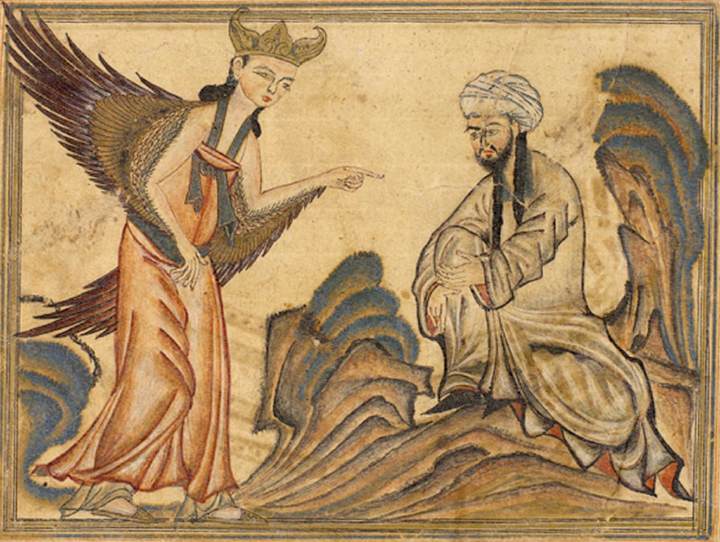
Mohammed receiving his first revelation from the angel Gabriel

Religious Experiences and Miracles

The Jewish people still exist after 2,500 years, while they have not had a homeland for most of the time. That is a remarkable feat. Then Christianity replaced the existing religions in the Roman Empire in one of history’s strangest twists. Somehow, the message of personal salvation through Christ caught on. In the third century, Manichaeism emerged as a new religion. It taught that there was a struggle between the good spiritual world of light and the evil material world of darkness. The prophet Mani, who grew up in a Jewish-Christian Gnostic sect, claimed to have received revelations meant for the entire world, which were to replace all existing religions. It instantly became a spectacular success, spread everywhere in the known world, and could have overtaken Christianity, but it didn’t. A pivotal, and possibly decisive, moment was the conversion of Emperor Constantine to Christianity in 312 AD. He made Christianity the favoured religion in the Roman Empire.

A few centuries later, a small band of Arab warriors established an empire that stretched from the Atlantic to India, spreading the new religion of Islam, in an even stranger and more rapid historical development. Is it a realistic scenario that the supposedly illiterate camel driver Muhammad became a crafty statesman after seeing an angel telling him he came to deliver messages from the God of the Christians and the Jews? After Muhammad’s death, his followers went on to defeat the Byzantine and Persian empires. At the same time, Manichaeism made a one-way trip into the dustbin of history, while in the third century, it appeared to be on the verge of becoming the world’s leading religion. So, why did Mani fail and why did Muhammad succeed? Historians can explain it, but it is an account of what happened rather than an explanation. The question remains, could it occur without someone pulling the strings?

So much can happen, and what happens now has once been extremely improbable. Your reading this text here and now seems highly unlikely a few decades ago. Think of all the things you could have done instead. Or you could have been dead. Yet, you wouldn’t consider your reading this text a miracle. Proselytising religions like Christianity and Islam have a built-in inclination to grow. That may not be the ultimate answer. Jews, Christians, and Muslims worship the same deity. Our universe could be a simulation, and someone could have planned it. But who is to say it couldn’t have happened otherwise?

When Islam arrived on the scene, Jews, Christians and Zoroastrians in the area already believed in an all-powerful creator. Muhammad had met them on his travels, so he was familiar with these religions. Before that, Christianity had faced an uphill struggle. While the Roman state suppressed this religion, pagans left their gods behind and accepted the Christian God as the only true God. And they did so in large numbers.

That begs for an explanation, even though the conversion of Romans to Christianity was a gradual process that took centuries. The Romans occasionally half-heartedly persecuted Christians and executed a few thousand of them over the centuries, not for being a Christian but for not paying their respects to the Roman gods. Despite that, the number of Christians increased 2-3% per year between 30 AD and 400 AD. Each Christian may have converted just one or two persons on average. Over time, exponential growth enabled Christianity to grow from about 100 followers in 30 AD to 30 million by 400 AD.

Such a gradual and steady growth over centuries was somewhat unique for a religion, and so was the blitz conquest of Islam later on. Most people in the Roman Empire, and everywhere else for that matter, lived miserable lives. The promise of an eternal blissful afterlife may have been too tempting for those poor, wretched souls to resist. However, the most often cited reason for conversions was stories about the miracles Christians performed.2 Only in the Middle Ages did the sword become the most compelling Christian argument as Christianity spread further and became integral to European politics. That was not the case in the Roman Empire, so miracles and stories about them were crucial.

An early miracle was Jesus’ appearance to a few followers after his crucifixion. The New Testament mentions miracles that the disciples allegedly performed. These accounts may be exaggerated, but the theme of miracles remains a consistent one in Christianity to this day. The Roman Catholic Church has a rich folklore surrounding relics that are believed to possess magical properties because they are said to have been touched by Jesus. The most famous relics are the Crown of Thorns in Paris, the mysterious Holy Grail, the chalice from which Jesus is said to have drunk, and the Shroud of Turin, a piece of linen cloth with a supposed image of Jesus’ face.

Many of the miracles attributed to these relics are unverifiable or can have other causes, such as luck, but a few cannot be easily explained away. The Roman Catholic Church keeps a record of them. On message boards, people tell stories about prayers heard and miraculous healings. Many of these stories may result from chance or other causes, such as a misdiagnosis or someone seeking attention by lying, but that is not always the case.

A recurring theme is the appearance of the Virgin Mary and other miracles related to her. Thousands of people have seen her. She appeared several times in Venezuela. She revealed herself to Maria Esperanza Medrano de Bianchini in 1976, who received exceptional powers. She could tell the future, levitate, and heal the sick. In Egypt, Mary appeared at a Coptic Church between 1983 and 1986. Muslims have also seen her there. There have been many more Virgin Mary appearances. The most notable sequence occurred in Portugal at Fatima between 13 May and 13 October 1917.

The grand finale was on 13 October 1917, when the Sun reportedly spun wildly and tumbled down to Earth, radiating in indescribably beautiful colours, before stopping and returning to its normal position. Some 40,000 attendants witnessed Mary’s performance. They had gathered because three shepherd children had prophesied that the Virgin Mary would perform a miracle on that date and location. Faking this was hard to do, considering the technology available in 1917. A lack of holographic equipment would have made the effort challenging, not to mention changing the location of the Sun, which is a large ball many times larger than Earth, thus making it difficult to move around. And somehow, the Sun only moved in Fatima, which can only happen in virtual reality.

Jesus also appeared a few times, but less frequently than the Virgin Mary. An intriguing account comes from Kenneth Logie, a preacher of the Pentecostal Holiness Church in Oakland, California, in the 1950s. In April 1954, Logie was preaching at an evening service. During the sermon, the church door opened. Jesus came walking in, smiling to the left and the right. He walked right through the pulpit. Then he placed his hand on Logie’s shoulder. Jesus spoke to him in a foreign tongue. Fifty people witnessed the event. Five years later, a woman in that same church suddenly disappeared. Jesus took her place. He wore sandals and a shiny white robe. He had nail marks on his hands, which were dripping with oil. After several minutes, Jesus disappeared, and the woman reappeared. Two hundred people have seen it. It was on film as Logie had installed film equipment, because strange things were happening.3 Such events can convince people that the message of Christianity, even though it may seem highly peculiar, is correct, as Zeus and Thor failed to show up and perform some tricks.

Mary and Christ are part of a folklore where genuine experiences mix with mental cases seeking attention or con artists profiting at the public’s expense. Usually, there are no 40,000 witnesses, verifiable evidence, or camera footage of what occurred. The Vatican is troubled by the self-proclaimed seers, fortune tellers, prophets, and messengers who believe they have a special bond with the Virgin Mary or have weeping Madonna statues, which they may or may not have prepared to weep. These people could be delusional, crave attention or, like the televangelists in the United States, be after your money. That is not always the case. If you have a religious experience, don’t suffer from mental conditions impairing your judgment, and can’t think of naturalist explanations, you should believe what you see. To quote Shakespeare’s Hamlet, ‘There are more things on heaven and earth, Horatio, than are dreamt of in your philosophy.’

Latest revision: 5 September 2025

Feature image: Mohammad receiving his first revelation from the angel Gabriel. Miniature illustration on vellum from the book Jami’ al-Tawarikh, by Rashid al-Din, published in Tabriz, Persia, 1307 AD. Public Domain.

1. Sapiens: A Brief History of Humankind. Yuval Noah Harari (2014). Harvil Secker.
2. The Triumph of Christianity: How a Forbidden Religion Swept the World. Bart Ehrman. Simon & Schuster (2018).
3. How Jesus Became God: The Exaltation of a Jewish Preacher From Galilee. Bart Ehrman. HarperCollins Publishers (2015).