
There is an ongoing debate among self-proclaimed pundits who sell books about whether this universe is a simulation. They argue we can know by examining the universe’s properties. They are wrong. We can never say whether these properties, reflected in the established laws of reality, are real or fake. Even when a property of our universe appears strange or consistent with a simulation, it doesn’t prove that this universe is a simulation. It can be a property of an authentic universe. It is like saying, ‘This object is grey, and elephants are grey, so it probably is an elephant.’ Now, imagine that grey object saying moo. However, people continue to buy their books, so the so-called pundits keep writing them, because of what economists call the law of supply and demand.
That is also why science can’t establish whether we live inside a simulation. Science aims to determine the properties of the universe, as reflected in the laws of reality, also known as natural laws. However, science can’t say whether or not these natural laws are, what you might say, real. Hence, any argument that this universe is a simulation based on its properties is a dead end. In its simplest form, the reasoning goes that this universe must be a simulation because the underlying properties are digital. At the most basic level, everything can be just numbers in computer memory.
How does that work? A digital television screen consists of more than a million tiny coloured dots. Every single spot on the screen has a unique number. Also, every colour has a unique number. And so, spot 268,122 on the screen has colour 187,091. From a distance, you see a person or a mountain. At the underlying level, the screen is just a display of digits. It is possible to store numbers in computer memory so that you can represent an entire universe in this way.
Real universes might also be digital. We don’t know. Being digital is a property, not a cause of existence. Another argument based on quantum physics states that our reality is a sequence of states. Nothing exists or happens between them. Like the dots on a television screen, we can represent these states as numbers. Again, this could mean that our universe exists inside a computer. And also in this case, there is no way of knowing whether this applies to a universe that is not computer-generated.
Quantum entanglement is bizarre. Particles can interact directly with each other regardless of the distance between them. If you come to think about it, then one particle at one end of the universe might interact directly with one at the opposite side, as if there is no distance between them. This phenomenon mocks our idea of distance. Billions of light-years are nothing. Forget about warp-speed space travel. You can be on the other side of the universe in the blink of an eye. It can raise questions about the age of the universe, as estimates of its age are related to its size. However, we don’t know whether this behaviour is also present in a real universe that is billions of years old.
Many believe that intelligent extraterrestrials must exist. So far, there is no material evidence of their presence. UFO encounters occur, and people have seen aliens, but no extraterrestrials have revealed themselves to the general public. The physicist Enrico Fermi once asked, ‘Where is everybody?’ Perhaps humankind is the only advanced civilisation in the entire universe. If we live inside a simulation, there may be no point in simulating other beings on remote planets. That is not the only possibility. Perhaps civilisations tend to die out before becoming advanced. Or maybe we overestimate the probability of advanced civilisations contacting us. And possibly aliens do visit us. After all, people have seen them.
Several types of small particles don’t exist most of the time. They come into being when someone observes them. It is the observer effect. If this universe is a simulation, it would be a waste of memory and processing power to represent them all the time. If this universe is real, these particles might, or even should, always exist even when no one is watching. The argument stems from a misconception. These particles don’t disappear when not being observed. They become waves instead. There is no way of knowing whether this kind of observer effect exists in real universes. And why can we notice this? It shouldn’t be hard to conceal the non-existence of unobserved particles in a simulation.
Latest revision: 24 July 2024
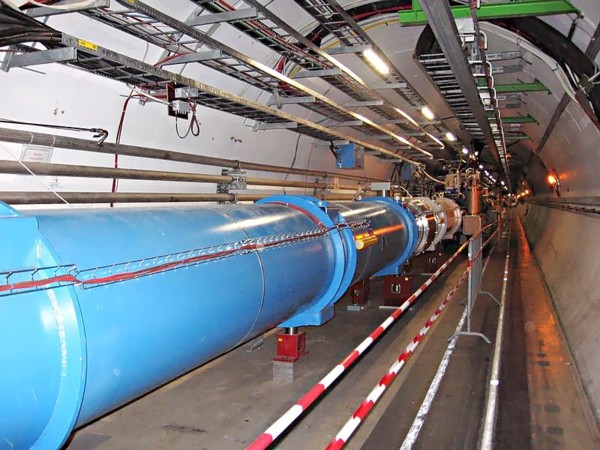
Featured image: Tunnel of the Large Hadron Collider (LHC) of the European Organisation for Nuclear Research. Julian Herzog (2008). Wikimedia Commons.

 The Plan For The Future