
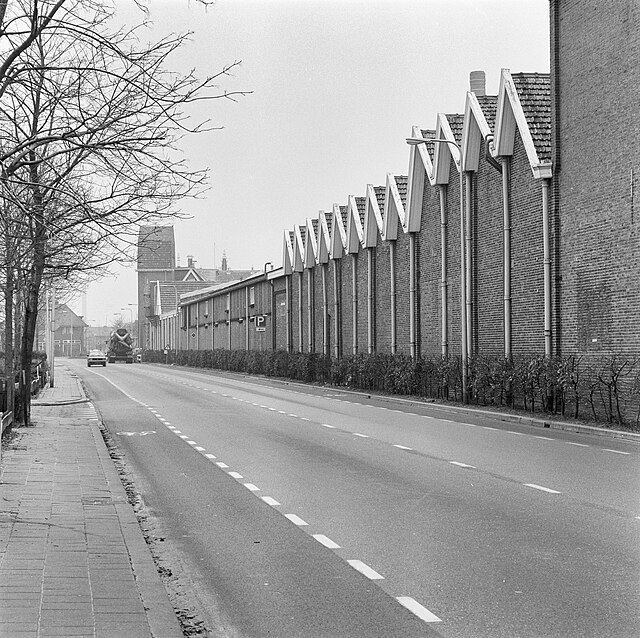
A few hills surround Nijverdal, and locals call them mountains. Evers Mountain is fifteen metres high. The Netherlands is flat, so fifteen metres can be impressive to some, especially if they are on a bike. Nijverdal is a small town, even though locals still call it a village. It didn’t exist before the Industrial Revolution. It is there because a British entrepreneur found it a superb location for a factory. My life in Nijverdal got off on the wrong footing. A few days after relocating, my mother sent me to kindergarten. A new home, a new village, going to school and being without my mother for the first time in a matter of days was too much. I cried for over two weeks in a row and incessantly. They just let me cry. The teacher then put me in another classroom with another teacher, and I stopped crying.
That was tough love. No one seemed to care. Being four years old, I concluded I was alone in this world. It was the first turning point in my life. From then on, I depended on my judgment only, not expecting anything from anyone, not even my mother, who had left me there. And so, I erected a wall around me, and the hard times began. Nijverdal is part of the Hellendoorn municipality. Also, in Dutch, that name starts with hell and ends with thorn. It might refer to thorny bushes on a slope.
My parents had grown up on small farms. They had been poor, and their lives had not been easy. They ignored my complaints just like their parents had ignored theirs. That was not a lack of love. Harsh conditions can make you stronger, so making your children weak is a lack of love. When I was two years old, my mother made me a pair of trousers. They gave me an intolerable itch, but I had to wear them every other week as I only had two. Luckily, I grew out of them after some time. My father was tough, but my mother was tougher. She often said, ‘Kan niet ligt op het kerkhof en wil niet ligt ernaast.’ It means something like, ‘If you say you can’t, you probably mean you don’t want to, but you will have to.’ And children, she never said children but always brats, can never be right, even when they are.
I could read and write numbers and calculate before I could read and write words. At kindergarten, I became intrigued by numbers. I chalked them down on the pavement. I associated numbers with genius and wisdom, so I embarked upon a personal project you might call counting to infinity. At first, I recited numbers on the way back home from kindergarten. My mother was biking, and I sat on the back, counting. I could ask her questions. After arriving at 99, I asked my mother, ‘What comes after 99?’ ‘One hundred,’ she said. And I continued. The next day, I still counted, ‘998, 999, ten hundred.’ ‘No, not ten hundred, but a thousand,’ my mother said.
Soon, I mastered the number system and knew what came after what. Then, I asked my mother, ‘How far can a university professor count? Is it a million?’ ‘Yes, a university professor can count that far,’ my mother answered. But I wasn’t planning to stop at a million. I was aiming for infinite wisdom. I soon found that counting to infinity would be laborious and take a long time. And so, I divided the effort into parts and started counting in bed in the evenings. And then, I fell asleep and lost count. And so, I had to start over again the next day from a number I was sure I had already recited to ensure that I hadn’t missed a single number. Otherwise, it didn’t count. Somewhere near 16,000, I realised it was pointless and gave up.
And money intrigued me. Once, my mother bought some groceries. She paid with one banknote and received several banknotes and coins in return. And so, I asked her, ‘How is that possible? You give one banknote and get groceries, more banknotes and coins in return.’ She said, ‘I gave a one hundred note and received two of twenty-five, one of ten, and some guilders and cents, which is less than one hundred.’
One morning, a pile of banknotes lay on the table in the living room. The amount was 750 guilders, seven notes of a hundred, and two of twenty-five. I took a one hundred out and hid it in my room to marvel at it. I was six and had some awareness of my deed not being right. I took a one hundred, not because it was worth more but because there were more of them, so its disappearance would be less noticeable. I showed it to my sister, Anne Marie, who told my mother.
I was about to receive my first pocket money, so my parents postponed my pocket money by nearly a year. She had left this money there for my father for expenses at work. He had requested 750 guilders, and when he found only 650, he thought my mother had made a mistake and didn’t discuss it with her any further. In this way, it could go unnoticed for weeks. Once I did receive pocket money, I saved it to buy a globe. It had a light inside. You could see the world’s countries in different colours if you put it on. The next thing I saved for was a microscope.
I often woke when daylight broke. In the Summer, that could be as early as 5 AM. I wasn’t allowed to go out of bed that early. So, I lay awake in bed for hours, staring at the ceiling and watching patches of sunlight gradually move on the wall as time passed, probably just thinking, and I sang songs. I waved my father goodbye from my bedroom window when he left in his car to work around 6 AM.
My father and I were very different, but we both enjoyed watching old-style cartoons like Tom and Jerry, Tweety and Silvester, Droopy, Buggs Bunny and Elmer J Fudd, Donald Duck, the Pink Panther, and Roadrunner and Wile E Coyote. And we often went with him to Cafe H* in Daarle, where his friends gathered. It was a traditional Dutch pub called a brown cafe, where the hunters in the area hung out. There wasn’t much to do, so you could go outside or sit inside and hear the hunter’s tales. There was a billiard table, and there was a slot machine. Sometimes, one of my father’s friends gave me a guilder to play it. I had no qualms about hunting but noticed that hunters lived a life of excess. They found it a poor showing if there wasn’t too much meat.
Featured image: Royal Steam Bleachery: Exterior Overview Complex With Halls. A. J. van der Wal. CC BY-SA 4.0.
 The Plan For The Future