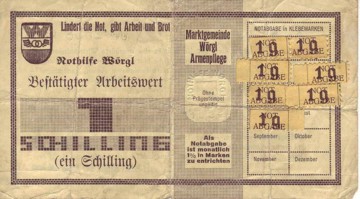
Wörgl bank note with stamps. Public Domain.

Cash for Negative Interest Rates

The problem with cash

Dealing with cash is cumbersome for both businesses and banks, so they are increasingly opting for digital payments. It helps to reduce their costs. Increasingly, people are opting for digital payments over cash. Geezers might still prefer to pay with banknotes and coins, but youngsters often don’t. These are the primary reasons why banknotes and coins could soon go extinct. The authorities have also sought to reduce the use of cash because it has long been the preferred method of payment for criminals.

Cash still plays a significant role. In the European Union, people mainly use them for small transactions. Cash can become an attractive investment when interest rates are negative. In Switzerland, where interest rates have been the most negative at -0.75%, 1,000 franc banknotes and safe deposit boxes were in short supply. And so, interest rates below -1% seem impossible as long as cash yields zero.

When depositors take their money from the bank, the bank can run into trouble. That may happen when interest rates fall below zero. A holding fee on central bank money, including cash, of 12% per year, can make it attractive to lend money at negative interest rates, like -2%, as you don’t pay the holding fee on loaned funds. Bank deposits are money lent to banks, thus loaned funds. You may keep your money in the bank when interest rates are negative because cash has a lower interest rate.

Cash as a loan to the government

In Wörgl, the townspeople bought stamps and glued them to the banknotes to keep them valid. It would be more practical if we didn’t have to glue stamps on banknotes. And a holding fee of 12% per year would make cash unattractive. The charge doesn’t need to be that low to prevent people from withdrawing their money from the bank and putting it in a safe deposit box. If the interest rate on cash were a bit lower than the interest rates on bank accounts, that would be enough to stop people from hoarding banknotes.

When cash is a loan to the government, the interest rate on cash could be the same as the interest rate on short-term loans to the government. That rate would be better than the holding fee and could be as low as -3%. There can be an exchange rate between cash and central bank money. The value of cash would gradually decrease at a rate of 3% per year, and you don’t have to glue stamps on banknotes to keep them valid. The situation resembles 3% inflation, but it is a negative interest rate.

That difference is crucial because negative interest rate currencies may not require government or central bank management. They provide financial stability themselves. There is no money shortage due to interest charges, so there is no permanent need to expand debts to sustain the usury scheme, which requires government and central bank management. With negative interest rates, the money supply can be stable or even shrink without adverse consequences for the financial system or the economy.

Human psychology

Negative interest rates visibly reduce the currency balance in your account, while inflation operates more stealthily, by robbing you while you believe you get more. Wage changes are more noticeable than price changes, as some prices decrease while others increase in value. Even when negative interest rates and deflation are a better deal, and even if we all know it, we might not opt for them. The phenomenon is known as the money illusion. We resist a reduction in monetary units, even if it would make us better off.

It also affects how we look at negative interest rates. When interest rates are negative, money disappears, so inflation is likely to be lower, and prices may even decrease. That could be a better deal for depositors if their real return were higher, but most people dislike seeing their account balance decrease due to a negative interest rate. They might get edgy about their money vanishing into thin air. Negative interest rates sparked outrage among some Belgian depositors, who demanded a ban on these rates.

We prefer the illusion of a small gain that amounts to a loss in reality to the illusion of a similar loss that is, in fact, a better deal. It is not rational, but human psychology is the way it is. We are emotional beings that can think rather than thinking creatures with emotions. There is a fix: hiding negative interest rates and making them appear as inflation. To explain how we can look at the characteristics of Natural Money:

  • The administrative currency carries a holding fee of approximately 12% per year. If you own this money, €1.00 turns into €0.88 after a year. It can make lending at negative interest rates attractive.
  • Interest rates on bank accounts might be around -2% per year. Depositors don’t pay the holding fee, but the interest rate the bank offers.
  • Cash is a short-term loan to the government and carries the interest rate of short-term government loans, which might be -3%.
  • The administrative currency and cash become separate currencies. Cash gradually loses value relative to the administrative currency.

Making cash the money in people’s minds

When bank account statements are in cash currency rather than administrative currency, the public doesn’t notice that the interest rate is below zero. The interest rate on short-term government loans is one of the lowest. Banks must be able to offer at least this interest rate so that people won’t see their balance shrink due to negative interest. And if shops express their prices in the cash currency, it will become the currency in people’s minds.

If the interest rate on cash is -3%, its value decreases by 3% per year in terms of the administrative currency. If a bank offers an interest rate of -2% and settles the account in cash, the interest on the bank account appears to be +1%. And if the deflation rate is 1%, prices go down by 1%. Meanwhile, the value of cash decreases by 3% in the administrative currency, so prices in the cash currency increase by 2%. And so, the public experiences 2% inflation.

You can see it as a deception to prevent people from deceiving themselves. People get aggravated by negative interest rates, but largely ignore inflation. They also fall for the illusion of getting more when interest rates are positive. When the interest rate on bank accounts is 1% and inflation is 3%, you would lose 2% in purchasing power per year by holding a balance in a bank account. A 1% loss is a better deal for depositors. Natural Money can improve the economy, allowing real interest rates to be higher.

Critics might argue that we could be fooled by this scheme, just like inflation fooled us before. We won’t notice the negative interest rate, just like we did inflation before. Separating cash from the administrative currency and expressing prices and the value of bank accounts in cash currency can clear the psychological barrier that stands in the way of the public adopting negative interest rates.

The administrative currency remains the accounting unit in the financial system for bank accounts, debt, and interest, as well as the prices of financial assets, such as stocks and bonds. A similar situation existed in Europe between 1999 and 2002. After introducing the digital euro, cash continued to be the national currency. With Natural Money, the maximum interest rate of zero applies to the administrative currency and not to the cash currency, so interest rates in the cash currency may be above zero.

Latest revision: 1 November 2025

Featured image: Wörgl bank note with stamps. Public Domain.
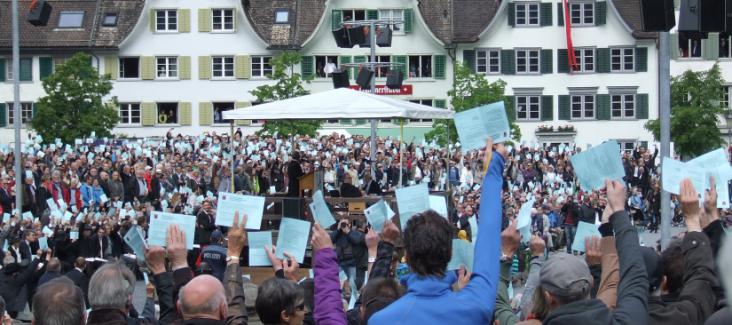
The assembly of the canton Glarus

Swiss democracy

Quality of government

The ideal of a democracy is that the people determine what their government does. Usually, citizens elect politicians every few years. These politicians then make the decisions. Quite often, these decisions differ from what their citizens wish. The reasons may include lobbying, deal-making, party politics, and political games. Leaders may also earnestly believe that going against the will of their people is for the best. Unburdened by responsibilities, citizens may have unrealistic desires.

Democracy doesn’t guarantee high-quality decisions, so there have always been pundits questioning the merits of democracy. No form of government guarantees high-quality choices. It is helpful to distinguish between the quality of the government and its decisions and the quality of democracy. Improving governance is far more complex than improving democracy, which is relatively straightforward, and the subject of this section, which can remain relatively brief for that reason.

In a well-functioning democracy, the government acts following the will of the citizens. In this respect, one political system stands out: the Swiss system. The great thing about it is that it is a proven concept rather than a figment of a political philosopher. In Swiss democracy, authority operates from the bottom up. It is a design flaw, as the world is interconnected, so our choices have consequences for people in other parts of the world. That is why, in most states, including democracies, authority operates top-down.

Features

The Swiss political system features a unique combination of representative and direct democracy. The government and parliament administer the country’s daily affairs, but if citizens feel the desire to take matters into their own hands, they can demand a referendum. The government must respect its outcome.1 Switzerland has the following referendum types:

  • mandatory referendums on changes in the federal constitution
  • optional referendums on federal laws when a specified number of citizens ask for it
  • Similar rules exist on the state and municipal levels.

Switzerland has 26 cantons, which are akin to member states, and over 2,000 municipalities that enjoy a significant degree of autonomy. The Swiss constitution promotes making decisions at the lowest possible level and delegating power to a higher level only if deemed beneficial.

The Swiss elect their National Council every four years. It has proportional representation. Citizens can vote for a political party, as well as for specific persons on the party’s candidate list. The Swiss can cast multiple votes, often one for each available seat in their constituency, allowing them to vote for several candidates and parties.

Switzerland also has a Council of States. All the Cantons have seats, for which there are also elections. Most have two, and a few smaller Cantons have one. Decisions require a majority on the national level in the National Council as well as among the Cantons in the Council of States. The Swiss citizens can overturn these decisions in referendums.

The seven-member Federal Council, elected by the National Council and Council of States together, handles the daily affairs of government. All the major political parties have seats in it. The Federal Council aims for consensus but may revert to voting if it is impossible to reach an agreement. Referendums ensure that this hardly happens.

Evaluation

Referendums have the following consequences:

  • The combination of representatives and referendums keeps citizens in control while unburdening them of daily government affairs. They don’t have to vote on every single matter, but can vote on an issue if they feel it is necessary.
  • Referendums are yes-or-no questions. Before crafting laws, the government consults with various interest groups and considers their concerns. That prevents laws from being voted out in referendums.
  • Whatever choices are made, they are the citizens’ choices. It can breed a sense of responsibility as citizens live with the consequences of their choices. If things go wrong, they can’t blame their politicians.
  • There are fewer political games, coalitions, and deals, as citizens can vote out laws they disagree with. It also promotes stability and cooperation. The largest political parties are in government and aim for consensus.

The distribution of power has the following consequences:

  • There is no single decision maker with a lot of power, such as the President in the United States. The Federal Council performs the daily task of governing, and the largest political parties all have seats in it.
  • Proportional representation in parliament enables multiple political parties that align with the preferences of voters. Small shifts in voter preferences have a minimal impact on the political landscape.
  • The Swiss National Council represents the federation, while the Council of States represents the Cantons. A decision requires a majority in both. This provision aims to safeguard the interests of the rural cantons with smaller populations.

Considerations

Switzerland doesn’t have a Constitutional Court or a House of Parliament to ensure that the Constitution and human rights are respected. Switzerland is bound by the treaties it signed. The Swiss political system is one of the most democratic, but it tends to be conservative. Women received the right to vote only in 1971, as only men could vote.

The Swiss political system is one of the most democratic in the world. And it has safeguards that provide political stability. As referendums are yes-or-no questions, laws require careful crafting and consideration of the concerns of citizens. There are several theories about democracy, but the Swiss political system has proven to work.

In the Swiss political system, authority is decentralised. Delegation of responsibilities is bottom-up. It works from lower levels to higher ones. Most states have a top-down delegation. It flows from the higher levels to the lower ones. That is preferable as decisions in one district can affect other districts as well.

It is also the case at the global level. Switzerland is sovereign. It has been a freeloading country as Swiss banks have been a haven for criminals, tax evaders and dictators from other countries. Had the people of those countries had a say in this matter, that would not have happened. In a global democracy, every world citizen has an equal say.

Latest revision: 11 July 2025

Featured image: The assembly of the canton Glarus. Democracy International (2014). [copyright info]

1. Switzerland’s Direct Democracy. http://direct-democracy.geschichte-schweiz.ch/ [link]

Most viewed posts

Over the last three years more than 70 posts were published on The Plan For The Future. That is an average of one post every fifteen days. And 65 WordPress users started following this blog. Some posts have been viewed more often than others. This is the top 5 of posts based on page views.

The miracle of Wörgl

During the great depression of the 1930s a local currency in the small Austrian town of Wörgl produced an economic miracle. It demonstrated that the economy can do well without more debt if the existing money keeps circulating. This may be the key to keeping the economy afloat without more debt.

Read More

Mother Goddess Eve

Was Eve a goddess and was she the mother of Adam? And did Jesus believe this too because Mary Magdalene told him so? And what is the evidence? Reality can be stranger than fiction, most notably when our reality itself is a fiction created by an advanced civilisation.

Read More

New World Order

The direction of history is towards a single integrated world order. The world is becoming one intellectually, economically and politically. The world is now run by a global elite of business people, politicians, bureaucrats, engineers, journalists, scientists, opinion makers, writers and artists.

Read More

The curse of The Omen

Rumours go that some films have been cursed. The evidence is not always convincing. The Omen stands out. Events took a stranger turn in the Netherlands. And when I began to investigate the most peculiar event of the curse, strange things happened.

Read More

There is a plan for the future

In 1914 Archduke Franz Ferdinand was assassinated in his car in Sarajevo. This triggered World War I. The car had licence plate number A III 118, a possible reference to the Armistice of 11 November 1918  ending the war. So could history be script? And could there be a plan for the future?

Read More

Feature image: Piet Mondriaan painting (1921). Public Domain.

From human nature to a state

Survival of the fittest

Evolution theory can explain how biological organisms evolve over time. Genes determine their nature, which means how organisms behave and what they look like. Genes mutate randomly and this causes variation. It is a reason why humans differ in size, behaviour and skin colour. Mutations are passed on to the organisms’ offspring. These mutations alter the features of organisms. Those that are better suited for their environment are more likely to survive and procreate. This is natural selection or survival of the fittest.

The basic principles of evolution, variation and selection, apply to human societies as well. There has been a lot of variation in political institutions throughout history. Societies that succeeded in adapting to new circumstances usually survived the ones that didn’t. The development of societies can therefore be seen as social and economic evolution. Political institutions are an important part of society. And even though institutions are planned or designed deliberately, while biological variation is random, social evolution looks like natural selection because of competition.

As a consequence later civilisations were wealthier and more powerful than earlier ones. For instance, industrial societies are more powerful than agricultural societies. But social evolution isn’t straightforward. Remnants of earlier phases of development continue to exist once a society moved to the next stage. So, after a society has entered the industrial phase, many farmers still farmed the land in a traditional way without machines. And some modern democratic countries still have a king or a nobility.

Family groups

The earliest humans were hunter-gatherers who didn’t know of property. They lived like chimpanzees in family groups consisting of a few dozen individuals. These groups were self-sufficient. If another family group invaded their territory hunter gatherers could move on as population density was low and there was no property to defend.

Family groups were egalitarian. Social differences were based on age and gender. They had no permanent leader and there was no hierarchy. Leaders were elected based on group consensus. Usually women married outside their group to live in the group of their husbands. Marriage was a means of managing relations with neighbouring groups.

After the invention of agriculture population density increased dramatically and people came into contact with each other more often. Struggles became more intense as farmers invested in the land they cultivated. Harvests had to be protected against thieves. This required a different form of social organisation that included property.

From families to tribes

People became organised in tribes. A tribe consists of a number of related family groups who share common ancestors. Usually descent in a tribe is traced through the male family line. A common ancestor of a tribe might well be a mythical person. In this way it is possible to have large tribes. Tribes are often egalitarian. The family groups of the tribe usually remain independent but they can join their forces for war.

War is the main reason for organising in tribes. A tribe can muster more men for war than a family group. Property rights in tribes usually were related to the family groups rather than individuals. Land remained with the family group and couldn’t be bought or sold. The leader of a tribe usually had no authority over the tribespeople and couldn’t force them to obey. And so there was no rule of law. People had to enforce their rights themselves and blood feuds were common.

Religion plays an important role in organising large scale action. The question whether religion created the social order or that religion was invented to justify the social order is never answered. Most likely the causal relationship went both ways. Tribal organisation isn’t natural so people won’t revert to it once the social order fails. Tribal organisation is sustained by religious beliefs, which are often about common ancestors.

Tribes can develop into chiefdoms. A chiefdom has a lord who has armed vassals. It is the most basic form of political organisation. This type of political organisation came to dominate human history and it still exists today in the form of warlords, militia, drug cartels and street gangs. Chiefdoms have power to coerce people that didn’t exist in group based societies. Chiefdoms already have some features of states.

From tribe to state

Liberal social contract theories assume that states emerged when citizens agreed to subject to a state in exchange for safety and other public services. But tribespeople only temporarily gave up their freedoms to meet an external threat like an invasion. And so the reason for the first states to emerge appears to have been violence or the threat of violence, not the desire for a social contract. States differ from tribes in the following ways:

  • States are the highest authority and have a centralised hierarchy.
  • The state has a monopoly on the use of legal coercive force.
  • The authority of the state is based on territory rather than kinship.
  • States have a justification based on religion or political philosophy.

Population growth and increased population density have been important causes of technological improvements like irrigation works. This allowed for a division of labour and the emergence of elites, which promoted state creation. If the population density is low, conflicts about land and access to resources can be solved by relocation, but this option disappears once population density increases or when physical borders fence in the population. The factors that allowed for the first states to emerge were:

  • There must be a surplus of means of existence to support a state.
  • Society must be large enough to allow for a division of labour.
  • Natural borders must fence in the population so people can’t escape when they are oppressed.
  • Tribespeople must subject themselves to a higher authority either because of an external threat or the charismatic leadership of a leader.

The first states may have emerged when one tribe subjected another. In order to rule the other tribe, the victorious tribe may have introduced centralised repressive institutions and established itself as the ruling class. The threat of being subjected may have induced other tribes to develop more permanent and centralised authoritarian structures. Still many tribes just assimilated conquered tribes and states never emerged.

It seems likely that religious ideas played a major role in the formation of early states as religion can provide sufficient legitimation for the loss of freedom coming from the subjugation to a leader or a hierarchical structure. Religious authority can make it easier to create a large military to subjugate rebellious tribes and to create peace and stability on the home front, which in its turn strengthens the religious authority of the leader.

Certain conditions had to be met for the first states to emerge but there are too many interacting factors to produce a strong theory on how the first states emerged. It may not be important to have such a theory as states nowadays are well-established. States now innovate and copy each other’s institutions because they are in a competitive struggle with each other.

Featured image: Cover of The Origins of Political Order

From: The Origins of Political Order: From Prehuman Times to the French Revolution of Francis Fukuyama.

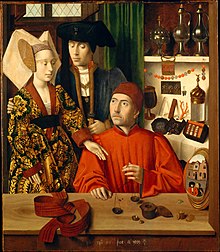
A goldsmith in his shop. Peter Christus (1449).

How the financial system came to be

A goldsmith’s tale

Once upon a time, goldsmiths fabricated gold coins of standardised weight and purity. This made them a trusted source of gold coins. The goldsmiths also owned a safe where they stored their own gold. Other people wanted to store their gold there too because those safes were well-guarded. And so the goldsmiths began to rent out safe storage. People storing their gold with the goldsmith received a voucher certifying the amount of gold they brought in.

At first, these vouchers could only be collected by the original depositor. Later on, any holder of the voucher could collect the deposit. Another innovation was making standard vouchers representing 1, 2, 5 or 10 units. From then on people began to use them as money as paper money is more convenient than gold coins. And so depositors rarely came to collect their gold and it remained inside the vaults of the goldsmiths.

Modern banking

Some goldsmiths also lent out their own gold at interest. As depositors rarely came in to collect their gold, they discovered they could also lend out the gold brought in by the depositors. When the depositors found out about this, they demanded interest on their deposits too. At this point, modern banking took off and paper money became known as banknotes.

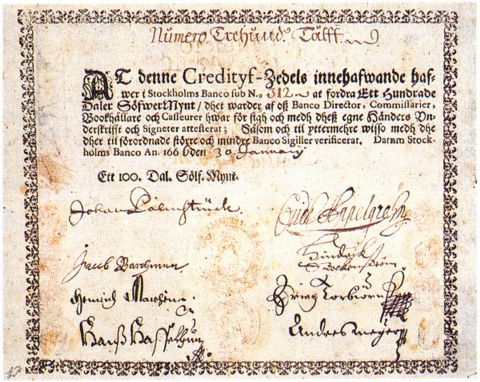
Credit note's holder, Stockholm's Banco sub no. 312
Credit note’s holder, Stockholm’s Banco sub no. 312

Borrowers preferred paper money too so the goldsmiths, who had become bankers, found out that they could lend out more money than they had gold in their vaults. They began to create money out of thin air. This is called fractional reserve banking as not all deposits were backed by gold reserves. The new money was spent on new businesses that hired new people so the economy boomed.

When depositors discovered that there were more bank notes circulating than there was gold in the vaults of the bank, the scheme could run into trouble if all depositors came in at the same time to demand their gold, but this rarely happened. Depositors received interest so they kept their deposits in the bank. They trusted their bank as long as they believed that debtors were paying back their loans.

Bank runs

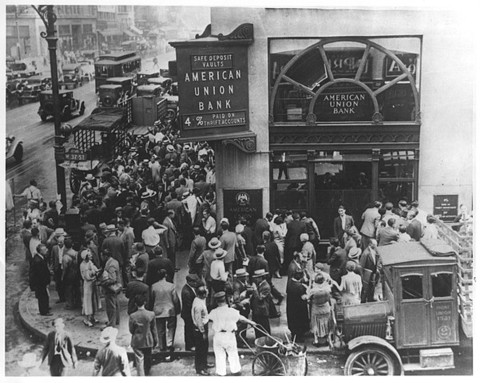
But sometimes people began to doubt that the bank was safe and worried depositors came to the bank to exchange their banknotes and deposits for gold coins. This is called a bank run. If too many people came in at the same time, the bank could run out of gold and close down because not all the gold was there. As a result, the bank’s notes and deposits could become worthless.

Bank run
A crowd at New York’s American Union Bank during a bank run in the Great Depression

People who lost their money had less money to spend. This could hurt sales so that businesses could run into trouble and default on their debts. As a consequence, depositors at other banks sometimes feared that their bank could go bankrupt too, leading to more bank runs. This could escalate into a financial crisis and an economic depression. This happened in the United States during the Great Depression of the 1930s.

Regulations and central banks

To forestall financial crises and to deal with them if they occur, banks were required to have a minimum amount of gold available in order to pay back depositors. Central banks were created to support banks by supplying additional gold if too many depositors came in to collect their gold at the same time. Central banks could still run out of gold but this was solved by ending the gold backing of currencies. Nowadays central banks can print new dollars or euros to cope with any shortfall. Regulations limit the number of loans banks make and therefore the amount of money that exists.

But everyone can lend to everyone. There are ways to circumvent the regulations imposed on banks. For example, corporations can issue bonds or use crowdfunding. And a lot of lending nowadays happens outside the official banking sector in institutions that are not subject to these regulations. Human imagination is the only limit to the amount of debt that can exist. And as long as people expect that those debts will be repaid, even if it is with new debts, there can be trust in these debts. But the financial crisis of 2008 demonstrated that this trust can disappear very suddenly.

Featured image: A goldsmith in his shop. Peter Christus (1449). Metropolitan Museum of Art. Wikimedia Commons. Public Domain.