How well groups make decisions depends on how their members share information and form opinions. In this regard, there are two opposing ideas: the wisdom of crowds versus mass delusions. As a collective, we know far more than any individual, but collectives can act more stupidly than most individuals would alone. You can more easily reason with individuals than with groups. Shared beliefs hold a group together and define its identity. Hence, groups are likelier to stick to their beliefs than individuals when confronted with evidence that they are wrong. Groups know more, but are also less rational than most of their members would be on their own. As the number of individuals in a group increases, their knowledge increases while their wisdom decreases.
Why is that? Groups aren’t merely the sum of their members. Groups have what experts call emergent properties. These are properties that emerge when individuals form a group. These properties seemingly appear out of nowhere. An individual water molecule can’t generate a wave, but billions of water molecules in a lake can. One cell doesn’t make a horse or a rabbit, but billions of cells do. A group of starlings can fly in intriguing patterns, which a single starling can’t. A single neuron can’t produce awareness. These properties emerge from the properties of the individuals. Individuals have properties that determine what they can do in groups, so a group of starlings can fly in intriguing patterns, while a group of humans can’t. And a group of water molecules can’t become a rabbit.
Collective intelligence
Collectives cooperate and achieve much more than individuals. And they can process more information, which the experts call collective intelligence. Their strength lies in their cooperation and in sharing knowledge. Bees and ants demonstrate collective intelligence. They share information about where to find food and use it collectively. Bees build beehives using a sophisticated division of labour, while ants can collectively defeat enemies many times their size.1
It is a natural behaviour of bees and ants. Ants also demonstrate what can go wrong with collective intelligence. They follow each other’s trails. If an ant accidentally walks in a circle, an entire colony might follow it. They could end up walking in circles until they die. In this case, otherwise beneficial behaviour goes wrong with fatal consequences. That is collective stupidity.1 We cooperate based on shared beliefs, which can be incorrect. Usually, our beliefs are beneficial. They strengthen the group’s cohesion, which is often more crucial to our survival than being right.
Groups know more and perform better on quiz questions than individuals because they can share knowledge. In 1906, an Englishman named Francis Galton discovered a phenomenon, later dubbed the ‘wisdom of crowds’. Galton visited a livestock fair where an ox was on display. In a contest, the villagers estimated the animal’s weight. Nearly 800 people participated. No one guessed the weight of 1,198 pounds, but the average of the estimates was 1,207 pounds, thus less than 1% off the mark.
Galton concluded that the finding suggests that democracy is the best form of government. Taking every view into account in Parliament could result in the best possible decisions. At the fair, the contestants independently assessed the ox’s weight. They didn’t arrive at their estimate in a group process, which may explain why it worked so well.2 And so, the term ‘wisdom of crowds’ is deceptive because it is merely the aggregate estimate of independently thinking individuals.
No wisdom of crowds
There is no wisdom of crowds, but the stupidity of groups does exist. A single Jew can make peace with a single Palestinian, but the Jews and the Palestinians as peoples have failed to do so. Groups have collective intelligence, so they process more information than an individual. Humans are social animals rather than rational beings. Crowds can make better estimates on aggregate, but only as independent individuals, so if their members don’t influence each other.
As long as we retain an independent perspective, we can’t develop groupthink and become collectively stupid. When we influence each other, we can go collectively crazy. We desire our peers’ approval, which clouds our judgment. We are social animals who need the group to survive, so we share our group’s beliefs and don’t openly disagree when we don’t. We may share ideas we know are incorrect, so we ignore our knowledge and pass on the group’s views.
We are prone to moral panics, which undermine our rational thinking. A moral panic is a widespread feeling that some evil person or group schemes against our interests and well-being. Often, genuine concerns are causing these feelings, but the claims exaggerate the harm’s seriousness, extent, and certainty. Usually, the panic comes with false claims inciting hatred and fear. The role of moral panics is to promote group cohesion and generate collective action to remove the perceived threat.
Herd behaviour
Information often spreads through herd behaviour. We usually behave the same way.1 YouTube makes use of it. If you come across a video with ten million views, you are more likely to watch it than one with only ten views. Usually, videos with ten views are not worth watching. In most cases, herd behaviour works to our advantage. It allows individuals to survive with less knowledge by depending on collective intelligence. We can’t know everything, so it is usually better to follow the herd. That saves time and energy. Social media is prone to herd behaviour. A cat video can become more popular because it’s already in favour, while a funnier one may go unnoticed.
The same is true for markets. During the Dot-com bubble, investors piled into Internet stocks. Many investors knew these stocks were crap, but they bought them anyway because they kept rising. Groupthink can cause stock market bubbles. In 1841, Charles Mackay wrote about three financial manias: Tulipomania in the Netherlands, John Law’s Mississippi Scheme, and the South Sea Bubble. He argued that greed and fear drive financial markets and can make people act irrationally to the point that people believe a tulip is worth a mansion.3
Confidence game
Information spreads via opinion makers like influencers and can lead to mass delusions. Confident but mistaken people play a crucial role. Self-assured people aren’t always wrong, but when they are, they amplify their errors because they have followers. Most people are insecure and follow the lead of people who appear self-assured. Leaders must be self-assured. Otherwise, no one will follow them. The business of influencers on the Internet is making money out of insecure people by advertising products no one needs.
Confidence is contagious. During the Dot-com bubble, the loudest voices on Internet message boards boasted about their profits in Internet stocks, thereby pulling in more suckers. The quality of group decisions depends on how we aggregate information. To take advantage of collective intelligence, we should try to:
make people feel free to come forward with their information and opinions;
prevent groupthink or group members from becoming biased by the information or opinions of others;
and focus on the underlying causes rather than incidents.
That is difficult in small groups and even harder in societies. It goes against human nature. We follow confident people. And we don’t always like to hear the truth. The most successful politician in Dutch history was Mark Rutte, who became the longest-serving Prime Minister. He is jovial and cheerful. He was also the most prolific liar, and no Dutch politician had ever lied so often and with such confidence. Rutte once admitted that he had no vision, which probably is not a lie. It allowed him to remain pragmatic and make deals.
Rutte’s talents are now coming in handy as he has become the Secretary General of NATO. So far, he has succeeded in keeping the United States on board by praising Donald Trump for being a master strategist. Humans cooperate based on fairy tales, so lying is in our nature. We even learn to believe the lies, so that they become the truth to us. But if our leaders are friendly, visionless, pragmatic deal-makers, who lie to stay in power, we are surely doomed, given the magnitude of the problems humanity faces.
Collective action
Large groups struggle with collective action problems. The larger the group, the less effective it becomes at addressing challenges. Today, humanity faces global collective action problems, most notably the looming technological-ecological apocalypse and the increasing likelihood of another world war. It has become impossible to hide our incompetence in addressing them. The inconvenient truth is:
It is unlikely that we can save ourselves, as the wit of a single worm already exceeds the collective wisdom of humankind. You would make better decisions if you were the leader of the world, even if your judgment is subpar.
We must agree on what to do. In cases of fundamental disagreements, we fight. We cooperate based on fairy tales. Force rather than reason is our most convincing argument. The ideas that won out often did so by force.
Non-contributors benefit from the group effort while enjoying the advantages of not contributing. If they get away with it, the free-loading will spread. It will undermine the group’s morale, and the collective effort will collapse.
Most notably, people in the West suffer from the mass delusion that individual freedom and the interplay of personal interests and preferences through markets and elections ensure the best outcome for the general good.
By withdrawing from the Paris Agreement on combating climate change, the United States has demonstrated once again that it is the land of the freeloaders. Along with our pursuit of material wealth, nation-states and individual freedom are means by which we are about to commit suicide. We can’t deal with the responsibilities that come with freedom.
The saying ‘everyone for himself and God for us all’ reveals a profound truth about ourselves. Humans aren’t capable of solving their problems because of collective action problems and mass delusions. And we are better off with a single leader with unlimited authority. Ideally, this person is like a biblical good shepherd or Plato’s philosopher king. Even someone with a mediocre vision would do, as the wit of a single worm already vastly exceeds the collective wisdom of humankind.
If you like this story, you might want to see this video:
Collective Stupidity – How Can We Avoid It? Sabine Hossenfelder.
Featured image: Texel Rommelpot Tulips View West. Txllxt (2009). Wikimedia Commons. CC BY-SA 4.0.
Latest revision: 30 October 2025
1. Collective Stupidity – How Can We Avoid It? Sabine Hossenfelder. YouTube. 2. The Wisdom of Crowds. James Surowiecki (2004). Doubleday, Anchor. 3. Extraordinary Popular Delusions and the Madness of Crowds. Charles Mackay (1841). Richard Bentley, London.
The license plate number on the car that drove Franz Ferdinand to his appointment with destiny was just one of the remarkable incidents and experiences on record. In many cases, we can establish the relevant facts to the point where there is little doubt that the event has indeed occurred. We have no evidence suggesting someone has changed the licence plate. Perhaps science will explain these things in the future, as this universe may have properties we don’t yet know. Some have come up with explanations that let go of our understanding of time and cause and effect.
Our usual way of perceiving events is that something happens in a particular place at a specific time. We think of a place as a constant as time passes. Events in the past caused events happening now. And events in the present cause future events. The Allied invasion took place in Normandy on 6 June 1944. Normandy is still there, but 6 June 1944 is history. The liberation of Western Europe from German occupation is a consequence of D-Day. If D-Day had not happened, history would have taken a different turn. In this way, cause and effect work. That makes sense to us.
Perhaps, events connect in ways other than causality and time. The psychiatrist Carl Jung proposed a collective consciousness that connects all events through meaning. If you believe it, that can explain a few things, such as reincarnation accounts and premonitions. Perhaps the collective consciousness carries a deceased person’s memories into someone else or gives premonitions that come true. According to science, this is all total gibberish, not even worth a second of your thought, as it contradicts established laws of science. Only in a story can events connect via meaning.
Others think of time as a dimension, so you can travel to a time like you can travel to a place, even though nobody ever succeeded in doing that as far as we know. These ideas counter our traditional notion of cause and effect over time. But so does the theory of relativity. And the theory of relativity proved to be helpful, so we consider it to be true. Perhaps physics will one day explain premonitions.
A reference to the end date of World War I could thus have ended up on the licence plate of Franz Ferdinand’s car because of some connection we don’t yet know. No plausible explanation is available for that connection, but perhaps some property of this universe is still unexplained. And maybe both are true. All points in time might be connected in another way, while causality also applies. Physicists have to work with queer phenomena that are hard to explain. For example, light behaves like both particles and waves, but waves can’t be particles.
Alternatively, a time traveller could have put AIII 118 on the licence plate, even though the theory of relativity doesn’t allow for that. Time travel to the future may be possible, but going back in time creates logical problems. It would alter future events. And there is another fly in the ointment: chaos theory. Insignificant disturbances can have dramatic consequences. If I could go back to 1914 to screw a license plate with the combination AIII 118 on the car, that may derail the events that were about to occur, and World War I would not end on 11 November 1918 and perhaps not even have started. And sneezing can be enough to do the job, just like a butterfly in Texas can start a storm in China. It seems likely that the Austrian authorities issued the license plate. Plate AIII 118 probably came after AIII 117 and before AIII 119, so we can drop this imaginative scenario into the bin.
And look at what scientists are doing. Recent measurements confirmed the electron’s roundness to a record level of exactness. It deepened the mystery of why the universe consists of matter rather than antimatter. Any asymmetry in the electron’s shape would point to a related asymmetry in the laws of nature that could explain this feature of the cosmos.1 Scientists were baffled. Metaphysical speculation also dominates science, and scientists imagine invisible friends like gravity and electrons to describe our world. And then they discover something suggesting that some of their imaginary friends may not exist. Well, who would have thought that?
Maybe we should let our imagination run free. Anything is possible if we can think of it and corroborate it with experiments. It is how science progresses. A piece of fruit could be an apple for as long as you look at it. And it can turn into a banana once you look the other way. Scientists believe that if experiments confirm it. Some particles turn into waves when you don’t look. Scientists might even base their theories on things that are impossible but do happen because we live inside a simulation. We don’t know that, of course, because we don’t know the properties of a genuine universe.
Some laws of this universe appear ridiculous. Only why should they make sense? Nature doesn’t exist to make sense to us. We can imagine that this universe is a simulation to avoid logical difficulties. It makes more sense than apples turning into bananas. Assuming the obvious, however, can be dangerous. If it quacks, walks, and swims like a duck, it might be a great actor in a duck suit. Apples could turn into bananas when you don’t look. Of course, when you place a camera to observe them, they don’t. And one plus one might only equal two after you have solved the equation. And if faith moves mountains, this universe could be genuine as long as you believe it is.
Latest revision: 19 July 2025
Featured image: Satire on False Perspective. William Hogarth (1754). Public Domain.
1. Electrons are extremely round, a new measurement confirms. Emily Conover (2023). Science News. [link]
In the autumn of 1989, I was a student and forced to leave a dormitory because I was immature and didn’t fit in. Most notably, I couldn’t get along with a particular Lady. I returned to my parental home to gather courage before trying out another dormitory. There was not much to laugh about in those days, except for a few episodes of Chief Inspector Jacques Clouseau on German television. My parents lived near the German border, so I could watch them. The German dubbing was as funny as the original.
Clouseau was inept, but he always managed to solve the mystery. Guided by a few hunches and vague clues that only made sense to him, he ignored the obvious explanations of the facts and uncovered the truth by accident. So, how could a bumbling clown like Clouseau be correct while the competent fail? The answer is that he is a fictional character in a story. The plot is that Clouseau is right in the end.
History is Her story, and the pun may be intentional. Apart from women in the Bible, God played other roles. How can we know who they were? That is where Clouseau comes in. We live in virtual reality, so this can be a story with a plot. I could be right if that is the plot of the story. My investigation produced a list of possible avatars of God. It has gaps and overlaps. God may have skipped the childhood years of the avatars She chose. The Lady at the dormitory is one of them. That, I found out nineteen years later.
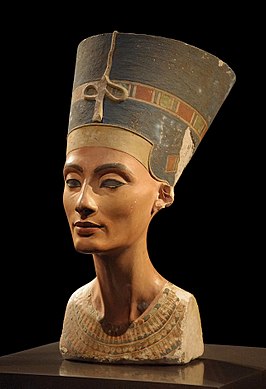
Bust of Nefertiti from the Egyptian Museum in Berlin.
Akhenaten and Nefertiti
As far as we know, the Egyptian Pharaoh Akhenaten and his wife, Nefertiti (1370-1330 BC), were the first monotheists. They promoted the worship of a single deity, a sun disk named Aten, and ordered the end of worship to other gods. In doing so, they broke with the Egyptian religious tradition. Nefertiti may have been an avatar of God. Worshipping the Sun makes sense. Just imagine the Sun doesn’t come back in the morning. You can better ensure he does and sacrifice a bull every evening before sunset. Their new religion didn’t last. After their reign, traditional beliefs returned. They were too far ahead of their time.
Cassandane
Cyrus the Great was a Persian Emperor and one of the first multicultural rulers. He respected the customs and religions of the lands he conquered. That made it easier for him to rule such a large empire. Otherwise, he had to assimilate all the people in his realm into Persian culture, which would have distracted him from making more conquests. And by the way, people didn’t mingle as much as they do today, so cultural differences didn’t cause that much trouble. Cyrus the Great was a prominent figure in history. Iranians still call him The Father. Most Iranians aren’t Christians, so that doesn’t confuse them.
Cyrus also conquered Babylon. The Jews in exile caused trouble with their Zionism there, so Cyrus sent them back to Israel and gave them money to rebuild their temple. The Jews were grateful and considered him a Messiah. The fate of a Messiah is to be married to God, so his wife, Cassandane (567-537 BC), could have been God in disguise. Cyrus and Cassandane loved each other deeply, according to the historical records. Cyrus would not have been a proper Messiah in the biblical sense if a woman had not sealed his fate. Accounts of Cyrus’ demise and death diverge, but that fact is beyond dispute.
The Greek historian Herodotus noted that he died in a battle with the Massagetae, a fearsome steppe people who lived in what is now Kazakhstan and Uzbekistan. To acquire the territory, Cyrus first sent an offer to marry their ruler, Queen Tomyris, a proposal she rejected. He then tried to take the Massagetae territory by military means. Tomyris challenged him to meet her forces in honourable warfare. Learning that the Massagetae were unfamiliar with wine and its intoxicating effects, Cyrus set up a poorly defended camp with plenty of it and left with his best soldiers.
The general of Tomyris’s army, her son Spargapises, overran the camp with his troops. They got drunk, and Cyrus defeated them in a surprise attack and captured Spargapises, who then committed suicide. Tomyris then vowed revenge, leading a second wave of troops herself. Cyrus’ forces suffered massive casualties, and he also died. Tomyris ordered the body of Cyrus brought to her, then decapitated him and dipped his head in a vessel of blood. Accounts on the matter differ, and Herodotus offers us the most colourful account, but others confirm the death of Cyrus at the hands of Tomyris.
Roman medallion with Olympias, Museum of Thessaloniki.
Olympias, mother of Alexander the Great
Olympias (376-316 BC) was the mother of Alexander the Great. Alexander’s lasting legacy is the spread of Greek culture in the Mediterranean. Greek thought and culture later influenced Judaism and Christianity. The Word would never have become flesh without Platonic philosophy. And Christians could never be born of God, the Father, without the influence of Greek mythology. You can see how God works in ways we can’t anticipate. Olympias, who was married to King Philip II of Macedonia, claimed that Alexander was the son of Zeus, the supreme god of the Greeks.
According to the Greek historian Plutarch, Olympias had a dream in which a thunderbolt struck her womb on the eve of her marriage to Philip. Philip was said to have seen himself in a dream sealing up his wife’s womb with a seal. A virgin birth it was, or it could have been. Plutarch offered several interpretations of these dreams, for example, that Alexander’s father was Zeus, the supreme deity of the Greeks. That would have made Alexander the Son of God. And so, Olympias might have been an avatar of God.
Philip chose Aristotle as Alexander’s tutor. Alexander and Philip fought battles together and defeated Thebes and Athens, making Macedonia the dominant power in Greece. They then began to plan an invasion of Persia. Philip remarried, which threatened Alexander’s position as heir to the throne. A brawl at the wedding led to Olympias and Alexander going into exile. While attending the wedding of his daughter to Olympias’ brother, a captain of Philip’s bodyguards assassinated Philip. A possible conspirator was Olympias. The nobles and army immediately proclaimed Alexander King. In the subsequent years, Alexander conquered the Persian Empire and ventured into India. Alexander died young, at the age of thirty-two, possibly from poisoning.
Alexander the Great was one of the most successful conquerors in history. He became popular in the Mediterranean and the Middle East. Legends sprang up about his exploits and life, which had a profound impact on the Abrahamic religions. He is a significant figure in Judaism. The Christians in the Near East turned him into a saint. The Quran mentions him and recites scraps of the legends about him. Alexander supposedly travelled to the ends of the world to build a wall to keep Gog and Magog out of civilised lands. Alexander de Grote (Alexander the Great) was my classmate at primary school for several years, a remarkable coincidence. Perhaps his parents had a humorous fit when naming him.
Queen Dowager Zhao
Chinese emperors held the Mandate of Heaven. The Emperor was the Son of Heaven. The title legitimised the rule of the Emperor. In Chinese thinking, the gods didn’t play a central role. Thus, being the Son of Heaven was the closest to being divine. If insurgents overthrew an Emperor and installed a new one, the old emperor had lost the mandate, and the new Emperor had it instead. That is very pragmatic indeed. This arrangement also provided stability as it deterred potential contenders to the throne.
China’s first emperor was Qin Shi Huang. He unified China for the first time around 220 BC. He was a particularly ruthless person. He had to be because he came out on top after five centuries of relentless warfare that had no equal in history. His reign didn’t last. Qin Shi Huang died in 210 BC while on a trip to procure an elixir of immortality from Taoist magicians, who claimed the potion was stuck on an island guarded by a sea monster. Widespread revolts ended his son’s government shortly afterwards.
A new imperial dynasty soon established itself. Qin Shi Huang’s lasting legacy is not only the unification of China. He also standardised writing throughout the empire and introduced a pictural rather than a phonetic script so people could read the same documents everywhere in China, even when they spoke different languages. As a result, China could build its national identity around a set of writings. China’s identity never perished, even when the country fragmented and warlords temporarily took over.
Qin Shi Huang’s mother was Queen Dowager Zhao (280-228 BC), the wife of King Zhuangxiang of Qin. Queen Dowager Zhao was the daughter of a prominent family. She was a concubine of a merchant named Lü Buwei, who gave her to his protegé, Prince Yiren of Qin. Thanks to Lü’s intervention, Prince Yiren became the ruler of the Kingdom of Qin and King Zhuangxiang. His son Qin Shi Huang succeeded him. It may well be that Queen Dowager Zhao was God in disguise, adding some justification to the title of Her son, Son of Heaven.
When my son was nine, he jokingly referred to himself as the Emperor of China. He often ordered my wife and me. We were making a joke out of it and called him the king. Still, my son insisted he was the Emperor of China. ‘The Emperor of China demands cheese,’ he then added. An article about the first emperor of China appeared in a television magazine shortly after I found out we live in a virtual reality.
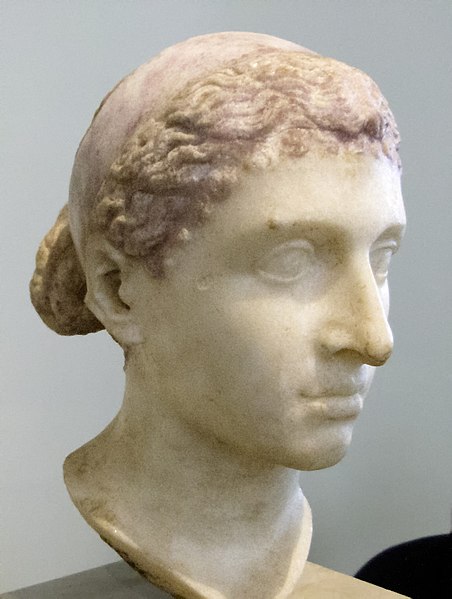
Roman sculpture of Cleopatra wearing a royal diadem
Cleopatra
Cleopatra (69-30 BC) was the last Pharaoh of Ancient Egypt. Few women have proved to be as strong a ruler as Cleopatra, even though She ultimately failed, causing Egypt to lose independence and become a Roman province. She presented Herself as a reincarnation of the Egyptian goddess Isis, who later, with her son Horus, became the template for the images of the Madonna with the child Jesus. Egyptian Pharaohs were deputies of the gods, but Cleopatra went further by claiming to be a goddess Herself.
Even Julius Caesar was impressed by Her personality. He abandoned his plans to conquer Egypt and backed Her claim to the throne. It is not a mere coincidence that Julius Caesar had the same initials as Jesus Christ, and that both died because of betrayal. After Caesar died, She supported her next lover, Mark Antony, in a power struggle with the future Emperor Augustus. That led to Cleopatra’s downfall and suicide. She was already looking forward to Her next role, Mary Magdalene, the wife of an obscure Jewish prophet who was to change world history.
Empress Theodora
Empress Theodora (490-548) was one of the most influential women in Roman history. An official of Her time noted that She was more intelligent than any man. Her husband, Emperor Justinian, realised this as well. He allowed Her to share his throne and take part in decision-making. She was a controversial figure. As a young woman, Theodora earned Her living as an actress, which meant entertaining men with indecent dances in establishments of dubious reputation, and possibly it included prostitution. Procopius’ Secret History, an ancient version of a gossip channel with a preference for slander, is the foremost source of information about Her early life, so we can’t be sure.
Later, Theodora travelled to North Africa as the concubine of Hecebolus, a Roman governor in Libya. Procopius alleged that Hecebolus mistreated Theodora, and their relationship ended in a quarrel. The then-destitute Theodora went to Egypt and converted to Miaphysite Christianity. Theodora later returned to Constantinople, where She met the future Emperor Justinian. Justinian was impressed by Her. He wed Theodora even though She already had an illegitimate daughter, which caused a scandal. And Justinian had to change the law to marry Her.
Theodora assisted Her husband in making decisions, plans, and political strategies, participated in state councils, and had a significant influence on him. She was an intimidating person who instilled fear, yet She feared no one. There was an uprising during their reign, and rioters set public buildings on fire and proclaimed a new emperor. Justinian and his officials discussed the situation and planned to flee, but Theodora spoke out against this plan. According to Procopius, Theodora interrupted the Emperor and his counsellors, saying,
My lords, the present occasion is too serious to allow me to follow the convention that a woman should not speak in a man’s council. Those whose interests are threatened by extreme danger should think only of the wisest course of action, not of conventions. In my opinion, flight is not the right course, even if it should bring us to safety. It is impossible for a person, having been born into this world, not to die; but for one who has reigned, it is intolerable to be a fugitive. May I never be deprived of this purple robe, and may I never see the day when those who meet me do not call me Empress. If you wish to save yourself, my lord, there is no difficulty. We are rich; over there is the sea, and yonder are the ships. Yet reflect for a moment whether, when you have once escaped to a place of security, you would not gladly exchange such safety for death. As for me, I agree with the adage, that ‘royal purple’ is the noblest shroud.1
Her powerful and inspiring speech convinced them to stay. Justinian then ordered his loyal troops to attack the demonstrators, resulting in the deaths of over 30,000 civilians. Some estimates put the death toll as high as 80,000. The corpses must have piled up on the streets of Constantinople. The reason was Her desire to wear a purple robe. After the revolt, Theodora and Justinian ordered the rebuilding of Constantinople. The works included aqueducts, bridges and churches, including the Hagia Sophia, which became one of the world’s architectural wonders.
Theodora participated in Justinian’s legal and spiritual reforms, was involved in women’s rights, and helped underprivileged women. She bought girls who had been sold into prostitution and freed them. She created a convent where former prostitutes could support themselves. Theodora even tried to eradicate prostitution. Theodora and Justinian expanded the rights of women in divorce and property ownership and instituted the death penalty for rape.
Procopius claimed these reforms made women morally depraved, as men could no longer beat and abuse them at will, which might be the reason why Procopius disliked Theodora. He had some other details about Her to share. According to him, the senators had to prostrate themselves whenever entering the Imperial couple’s presence,
Not even government officials could approach the Empress without expending much time and effort. They were treated like servants and kept waiting in a small, stuffy room for an endless time. After many days, some of them might at last be summoned, but going into her presence in great fear, they very quickly departed. They simply showed their respect by lying face down and touching the instep of each of her feet with their lips; there was no opportunity to speak or to make any request unless she told them to do so. The government officials had sunk into a slavish condition, and she was their slave-instructor.
That could be sixth-century gossip, but perhaps the almighty Owner of the magnificent city of Constantinople and the rest of the universe desired to be reminded of Her greatness before She went into the desolate Arab desert as Khadijah to go after Muhammad.
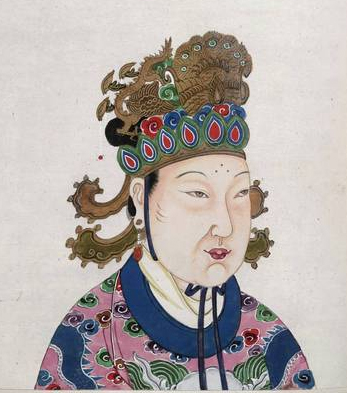
Empress Wu Zetian
Empress Wu Zetian
After Khadijah had departed, another remarkable woman arrived on the scene. Empress Wu Zetian (624-705) was the only female ruler in China’s history and one of its most gifted Emperors. She ruled from 665 to 705, first as the consort of the incompetent Emperor Gaozong, then as the power behind the throne held by Her youngest son and from 690 as the sole Empress. Under Her reign, China’s power increased, the economy improved, and corruption in the imperial court declined. Notwithstanding those impressive feats, the traditionalist Confucianists called Her the Evil Empress. ‘She killed her sister, butchered her elder brothers, murdered the ruler, poisoned her mother,’ their chronicles say.2
It is doubtful that it is all true. A woman on the throne was against widely held misogynistic, traditional Chinese beliefs. Add to that that Wu’s reforms helped the peasants, so the elites weren’t all too pleased with them. There was no glass ceiling in those times preventing women from rising to the top. At the time, that ceiling was made of reinforced concrete. She must have been cunning and ruthless. Her rise to power is a story of intrigue the likes of which the world has not seen before, or afterwards.
Wu came from a wealthy family, and Her father encouraged Wu to read books and pursue an education that included politics, governmental affairs, writing, literature, and music. After being summoned to the palace to become a low-ranking concubine, Wu reportedly revealed ambitions to ‘meet the Emperor’ to Her mother. According to Her account, She once impressed Emperor Taizong with some tough talk,
Emperor Taizong had a horse named Lion Stallion, and it was so large and strong that no one could get on its back. I was a lady in waiting attending Emperor Taizong, and I suggested to him, ‘I only need three things to subordinate it: an iron whip, an iron hammer, and a sharp dagger. I will whip it with the iron whip. If it does not submit, I will hammer its head with the iron hammer. If it still does not submit, I will cut its throat with the dagger.’ Emperor Taizong praised my bravery.
After Emperor Taizong died, Gaozong became emperor at the age of twenty-one. He was inexperienced and frequently incapacitated by a sickness, causing spells of dizziness. His wife, Empress Wang, introduced Wu because Emperor Gaozong didn’t favour her but his concubine, Xiao. Wang was childless, while Xiao had borne him a son. Wang hoped Wu’s beauty would distract the emperor from Xiao. Wu soon overtook Xiao as Gaozong’s favourite. In 652, Wu gave birth to her first child, a son named Li Hong. In 653, She gave birth to another son.
Wu is infamous for the way She supposedly eliminated Wang and Xiao. As the story goes, Wu smothered Her week-old daughter, a child She had with Gaozong, and blamed the baby’s death on Wang, who was the last person to have held her. The emperor believed the story and imprisoned Wang. Xiao soon followed suit. Once She was empress, Wu ordered both women’s hands and feet lopped off and had their mutilated bodies tossed into a vat of wine, leaving them to drown.2 At least that is what the chronicles authored by Her political enemies tell us. It might be true, but it might not be.
In 655, at the age of 31, Wu became Gaozong’s empress consort and a powerful political force. She had considerable sway over the Emperor. From then on, Wu began to intimidate and eliminate Her opponents. One of the first things Wu did was to submit a petition. It praised the faithfulness of Han and Lai, who had opposed Her unprecedented rise to power. Her purpose was to inform them they had offended Her and that She was aware of their opposition. She knew the psychological tricks. Han offered to resign soon afterwards. After removing those who opposed Her rise, She had even more power, and Emperor Gaozong asked Her advice on petitions made by officials and state affairs.
Wu was more decisive and proactive than Her husband, who was often unwell and left decision-making to Her. Historians believe that Wu was the actual ruler for over 20 years during Gaozong’s reign. Her strong leadership and effective governance made China one of the world’s most powerful nations. Empress Wu had a network of spies in the royal court and throughout the empire. There were countless plots against Her.
She reformed the imperial examination system to encourage capable officials to work in the government. Wu eliminated real or perceived rivals to power through death, demotion, and exile. Her secret police took care of that. Wu’s measures were popular. She ensured that free, self-sufficient farmers could work their land, boosting the nation’s economy. She also helped the lower classes through relief.
Upon the death of her husband, Emperor Gaozong, Wu became Empress Dowager and Regent, gaining complete power. Wu poisoned the crown prince, Li Hong, and exiled other princes so that She could put Her son, Emperor Zhongzong, on the throne. Zhongzong was weak and incompetent like his father, so the new Empress Wei sought to place herself in the same position of authority that Empress Wu had enjoyed. Wu then deposed Emperor Zhongzong and placed another puppet on the throne for a while, before finally becoming the sole ruler of China in 690. She remained in power until She fell ill in 705, and a coup returned the throne to Her son Zhongzong. She died the same year.
Maria, daughter of Harald III of Norway
Harald Sigurdsson was the King of Norway from 1046 to 1066. As a young man, he had to flee Norway because he had backed his half-brother Olaf’s claim to the Norwegian throne and was defeated. He and his men went to Russia, where they served as soldiers of Yaroslav I the Wise. Later, they became mercenaries in the Byzantine Varangian Guard. Harald became commander of the Varangian Guard and was involved in the imperial dynastic disputes. Harald spent time in prison because of palace intrigue. In 1042, he requested to leave, but the Empress refused. He escaped and returned to Russia, where he prepared his campaign to claim the Norwegian throne for himself. The Chronicle of the Kings of Norway Saga of Harald Hardrade mentions,
There was a young and beautiful girl called Maria, a brother’s daughter of the Empress, Zoe, and Harald had paid his addresses to her, but the Empress had given him a refusal.
Based on the saga, Michael Ennis wrote a novel, Byzantium, where he speculated about a passionate love affair between Maria and Harald, of which Ennis vividly describes the details. They tried to flee Constantinople together. They ran into a Russian fleet that attacked the city. Maria died, but Harald escaped. The accounts of what transpired diverged, and Ennis filled in the gaps with his imagination. In 1046, Harald returned to Norway and took the throne. On his way back, he stayed in Russia and married Elisiv, a daughter of Yaroslav I. I always had an interest in the Byzantine Empire. That made me read the novel. As I don’t read many books, it is noteworthy.
After failing to conquer Denmark, Harald set his eyes on England. There, he died during the invasion of the country in 1066 AD. His demise is part of a coincidental scheme related to D-Day, as mentioned in The Virtual Universe. Harald’s daughter Maria died on the same day in Norway, a remarkable coincidence. In his book, Ennis speculates that Maria was the reincarnation of Harald’s former lover, who wanted to be with him. She dropped dead when he died. Ordinary people can’t reincarnate into whom they desire or drop dead at the time of their choosing. And so, Maria could have been God. The Finnish band Turisas dedicated a song named ‘The Great Escape’ to Harald, a noteworthy coincidence.
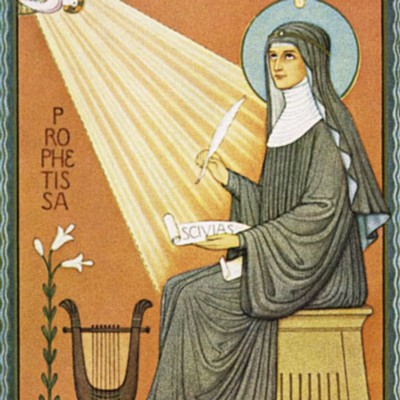
Hildegard Von Bingen
Hildegard von Bingen
Hildegard von Bingen (1098-1179) was a German Benedictine abbess and polymath active as a writer, composer, philosopher, mystic, visionary, medical writer and practitioner. There are more surviving chants by Von Bingen than by any other composer from the entire Middle Ages. She is one of the few known composers to have written both the music and the words. She corresponded with popes, heads of state and emperors. She travelled often during Her preaching tours. Abbots and abbesses sought the prayers and opinions of Von Bingen on various matters.
Hildegard von Bingen claimed to have had visions as a little child. She had unusual perceptions and realised these were visions. Von Bingen explained that she saw all things in the light of God through the five senses: sight, hearing, taste, smell, and touch. Based on these experiences, Von Bingen wrote three books of visionary theology. She also wrote extensively about medicine from Her practical experience. She spoke out against corrupting church practices such as simony.
Von Bingen further wrote, ‘Woman may be made from man, but no man can be made without a woman.’ It refers to the story in Genesis, in which God created Eve from Adam’s rib, perhaps to poke fun by implying the tale is illogical. While promoting chastity, Von Bingen was the author of the first known description of the female orgasm,
When a woman is making love with a man, a sense of heat in her brain, which brings with it sensual delight, communicates the taste of that delight during the act and summons forth the emission of the man’s seed. And when the seed has fallen into its place, that vehement heat descending from her brain draws the seed to itself and holds it, and soon the woman’s sexual organs contract, and all the parts that are ready to open up during the time of menstruation now close, in the same way as a strong man can hold something enclosed in his fist.
The lively description suggests, not only first-hand knowledge Von Bingen should not have acquired during Her lifetime as a nun, but also a lack of shame comparable to Eve. And, according to Von Bingen, Adam had a pure voice. He joined the angels in singing praises to God before the Fall. That is also knowledge Von Bingen could not have acquired during Her lifetime. She either made it up or was present when it happened. If She had been Eve, She was there. Around the time Von Bingen lived, an anonymous monk in the Netherlands wrote down the oldest known written sentence in the Dutch language,
hebban olla uogala nestas hagunnan hinase hic anda thu uuat unbidan uue nu.
The English translation is, ‘Have all birds started nests except me and you. Do we start now?’ A teacher at my primary school told the class about this text. The lines remained in my mind. Later, I imagined a Gregorian chant based on these words when Sadeness from Enigma was often on the radio. These lines intrigued me for no apparent reason, it seemed at the time, and I now suspect that the monk had Hildegard von Bingen in mind. Did they meet? It seems unlikely. Perhaps, he had a vision of Her.
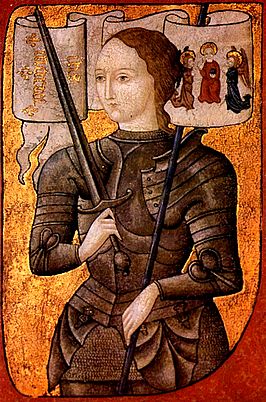
15th-century miniature depicting Joan of Arc
Joan of Arc
In 1429, the situation was desperate. There was no hope for France. The English and their ally, Burgundy, had overrun most of France. Only a small pocket of resistance remained. It is not the start of an episode of Asterix & Obelix, but the story of Joan of Arc (1412-1431). She started as an uneducated peasant girl from Domrémy, an obscure village in Northern France and became a military leader who changed the course of history. After years of defeats, the leadership of France had been demoralised and discredited.
The seventeen-year-old Joan joined a relief army to end the siege of Orléans. She arrived at the city in April 1429, wielding Her banner and bringing hope to the demoralised French army. Nine days after her arrival, the English abandoned the siege. Joan encouraged the French to aggressively pursue the English, which led to another decisive victory at Patay, opening the way for the French army to advance on Reims, where the French crowned their new King with Joan at his side.
But fortunes changed. After the coronation, Joan participated in the unsuccessful siege of Paris in September 1429 and the failed siege of La Charité in November. In early 1430, Joan organised a company of volunteers to relieve Compiègne, which the Burgundians had been besieging. There, Burgundian troops captured Joan. She tried to escape, but the Burgundians handed Her to the English. The English put Joan on trial and burned Her at the stake as a witch.
Joan of Arc led the French army to several crucial victories that boosted French morale and changed the course of the war. She claimed to have divine guidance. Modern scholars try to explain Joan’s visions as delusions, like they usually do, but documents from that time indicate Joan was healthy and sane. She was only nineteen when She died. In the decades that followed, France prevailed. Was She God in disguise? Probably so..
Latest revision: 29 October 2025
Featured image: Roman sculpture of Cleopatra wearing a royal diadem. Altes Museum in Germany. Wikipedia. Public Domain.
1. Lend Me Your Ears: Great Speeches in History. William Safire (2004). Rosetta Books. 2. The Demonisation of Empress Wu. Mike Dash (2012). Smithsonian.
All these accidents That happen Follow the dot Coincidence Makes sense Only with you
State of emergency How beautiful to be State of emergency Is where I want to be
– Björk, Joga
Accidents, emergency, coincidence and connecting the dots. Behind it all could be some kind of love affair. Emergency and 11 September are closely linked to each other, not only because of the number 911 being the emergency services telephone number in the United States. Was someone destined to make sense of these coincidences? If there are messages hidden in pop-music then this could be true. In any case, there have been a few peculiar coincidences related to 11 September in my life.
Marcel is my brother in law and 11 September is his birthday. On 11 September 2001 he turned 33 years old. My sister Anne Marie had booked a trip to New York for them both as a birthday present. In the morning she told him that they were going to New York the next weekend. That afternoon the terrorist attacks took place. They had to cancel the trip. They went to a holiday park in the Netherlands instead.
On 11 September 2010, just after midnight, I turned around in my bed. Suddenly the bed collapsed, leaving me wondering on the ground. After standing up I saw that the time was 0:33. A few moments later I realised that it was 11 September and that Marcel had turned 33 on 11 September 2001. That was nine years before while nine is three times three. On the same day two plane incidents occurred at Eindhoven Airport.1 There have been several intriguing coincidences in my life referring to the lady from the dormitory. She now lives in a suburb of Eindhoven.
On 11 November 2009 (11/11/11 as 2 + 0 + 0 + 9 = 11) I went to the town hall to pick up my new parking licence. The number of the parking licence turned out to be 009011. It was valid until 27 November 2011. If you compress the numbers as numerlogists often do, then 27 November refers to 9/11 as 2 + 7 = 9 and November is the 11th month of the year. The years (20)09 and (20)11 also refer to 9/11. The remaining digits are 20 and 20 = 9 + 11.
The initials of my last name are KI. When translated into digits (A=1, B=2), you get: 11/9 or 11 September in European notation. My first name starts with B, which can be translated into 2. Hence, my initials consist of the numbers making up the emergency services number 911 and 112. Perhaps that is not impressive but the following will make you wonder. I was born on the Iepenstraat, which means Elm Street in English. The horror picture A Nightmare on Elm Street was released on 9 November 1984 (11/9 American notation) in the United States and on 11 September 1986 (9/11 American notation) in the Netherlands. Now that is spooky. In the spring of 2011 I saw a German car with licence plate KLE-KI-911 in Leeuwarden while biking to my work. This car passed by a few times around the same time near the same spot. The first time I only noticed the number 911 so seeing the car multiple times made me notice the extent of the coincidence. KLE are the first three letters of my last name, while KI are the initials of my last name. Dutch licence plates linking my name to 9/11 in this way do not exist. The car appeared in the Netherlands where I was going to my work some 200 kilometres from the home town of its owner.
In the spring of 2013 I put the apartment on the ground floor of our house up for rent. A young woman applied for it. She was born on 11 September 1990 it turned out, and so she had turned 11 years old when the attacks of 11 September 2001 took place. A few days later I called her to inform her that she could rent the apartment. When I called her, her father had just been hospitalised. He died a few days later.
Featured image: Plumes of smoke billow from the World Trade Center after the September 11 attacks. Michael Foran (11 September 2001). Public Domain.
1. Vliegtuig in problemen landt op vliegveld Eindhoven. Nu.nl (2010). [link]
Our intuition processes a lot of information, much more than we realise. Sometimes, it seems like magic. When you drive your car, you may suddenly discover you have travelled a long distance without realising it. That is more likely to happen when you are a frequent driver using the same route. Research has demonstrated that we can train specific abilities to the point that they become a subconscious process. An important domain of our intuition is social information. Unless you are autistic, you intuitively read body language and facial expressions and adapt your actions to the clues others give. Mediums might be so good at asking the right questions to influence minds and reading body language and facial expressions that they appear psychic.
Between 2002 and 2010, a medium named Char appeared regularly on a Dutch television show. She performed readings and claimed to be in contact with the spirits of the dead. Sometimes, she seemed to retrieve specific information that only the person receiving the reading and the deceased could have known. In 2008, journalists from the Dutch television programme Zembla investigated her performances. People wanted to hear that their deceased loved ones were doing fine. And guess what? They were always doing fine up there somewhere.
Zembla claimed that the television show aired only the best parts of Char’s readings, making her performance appear better than it actually was. Char was often wrong, but the programme didn’t air many of her misses. James Randi, always willing to enlighten us, was kind enough to weigh in once again. Randi is sceptical of paranormal claims. He argued that Char could have extracted the information from the people receiving the reading.
The name Char equals the first four characters of the word charlatan. Notice the mention of characters in the previous sentence because this word starts with the same four characters. Interestingly, Zembla was discussing Char’s character, so this is indeed a remarkable coincidence. Yet, I still remember a few guesses she made that defy conventional explanation and left everyone on the scene dumbfounded. It seemed impossible to obtain this information from the individuals who received the reading. Zembla didn’t delve into these cases. If there had been fraud, like using actors, Zembla would have mentioned it.
So, can mediums do better than guessing? That must be possible if we live in a simulation running a script. A so-called gift can be an array of accurate guesses. These guesses are not coincidences. Otherwise, they couldn’t stand out in such a manner. It can make mediums believe they have a gift. The phenomenon is widespread and persistent enough to have caught the attention of scientists like cognitive neuroscientist Julia Mossbridge, who has investigated it. The following is one of the accounts of precognition that she has learned about.
On an October night in 1989, a phone call and a scream awoke a four-year-old girl. She tiptoed barefoot through the hallway. Her mother’s voice said, ‘He died in a car accident!’ That hadn’t happened yet. When she threw her arms around her father before he boarded his flight for that fateful business trip, she knew she would never see him alive again.
Her own experience with psychic gut feelings led Mossbridge to study them. Scientists are seeking explanations. They come up with speculations reminiscent of New Age beliefs, such as the idea that precognition suggests that our consciousness reaches beyond the linear perception of time. And that time behaves in a much stranger way than how we experience it. Several experiments have demonstrated the existence of such precognition. In 1995, the CIA declassified its own precognition research after statisticians had reviewed it and declared it reliable.1
An incident in my life showed how premonitions can come true, and that the likely cause is scripted reality rather than time behaving strangely. On 9 February 2009, a severe storm struck northern France. A storm of this strength occurs only once or twice a decade. I predicted such a storm on this exact date two months earlier. Only I feared that it would be more severe and strike the Netherlands. It was a miss of 400 kilometres (250 miles), but that is still remarkable, most notably because of the events that made me make the prediction. On 19 December 2008, I posted a warning on an internet message board.2 On 9 February 2009, Charles De Gaulle Airport in Paris had to be closed because of the storm.3
Somehow, I got a hunch that a superstorm might strike the Netherlands that day, causing widespread flooding in large parts of the country. It began with an article on an alternative website about the web bot, a piece of computer software that allegedly made accurate predictions in the past. The word ‘alternative’ is a bit deceptive here, as the website was about conspiracies, UFOs and the like. In the autumn of 2008, the web bot predicted that large areas of land would suffer permanent flooding in the first half of 2009. The website reported on it. The article didn’t mention a location or a date, but the word ‘permanently’ suggested that this area is below sea level. That narrowed it down to the Netherlands.
That came after I was haunted by time prompts like 2:22, 3:33, 4:44, and 5:55 on the clock at night, which pushed me into psychosis and made me open to suggestion. The date 9 February came up as I believed it was the birthday of a peculiar Lady I had learned to know as a student on the campus of the University of Twente. My memory for dates can be accurate. I remember the birthdays of some of my former schoolmates from secondary school and the exact date my father quit smoking. A genealogy site, however, states that her birthday is 7 February. And so, I might be wrong. However, this possible mistake made me think of 9 February, so it is like slipping on a banana peel to find a clue, which is in the true tradition of slapstick like Chief Inspector Jacques Clouseau.
That came after I was haunted by time prompts like 2:22, 3:33, 4:44, and 5:55 on the clock at night, which pushed me into psychosis and made me open to suggestion. The date 9 February came up as I believed it was the birthday of a peculiar Lady I had learned to know as a student on the campus of the University of Twente. My memory for dates can be accurate. I remember the birthdays of some of my former schoolmates from secondary school and the exact date my father quit smoking. A genealogy site, however, states that her birthday is 7 February. And so, I might be wrong. However, this possible mistake made me think of 9 February, so it is like slipping on a banana peel to find a clue, which is in the true tradition of slapstick like Chief Inspector Jacques Clouseau.
And I found more clues. A blogger on the website Sargasso.nl wrote on 2 September 2008 (2/9) about a storm that would strike the Netherlands on 9 February 2009 (9/2), potentially flooding large parts of the Netherlands. The author wrote it as a what-if scenario, not as a prediction. The article on Sargasso.nl featured animated graphics that showed the flooding of parts of the Netherlands on 9 February 2009, making the images more impressive. The numerical coincidence of the dates was a bit peculiar. Compressing numbers makes them refer to 11:11 as 9 + 2 = 11. And it was precisely the date that I had guessed. Now, what are the odds of that? That frightened me even more. I saw this as an eerie warning sign. A flood of this kind would put millions of people in danger.4 And I had never come across this blog before. I found it as a result of searching for clues supporting my hunch. If you have a suspicion, you look for clues to confirm it. But you wouldn’t expect to find this. And it was about to get stranger yet.
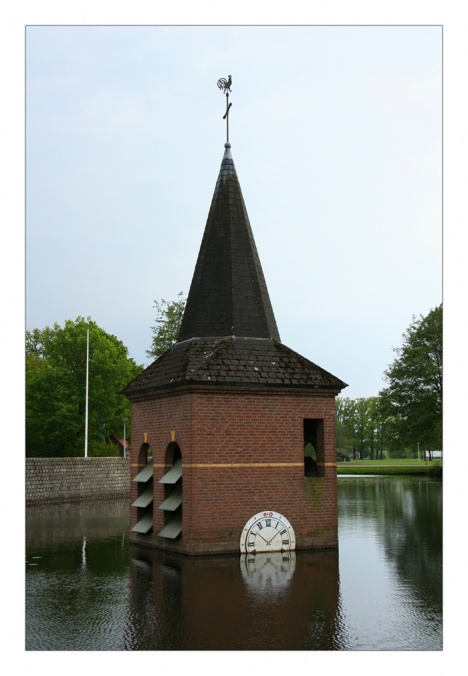
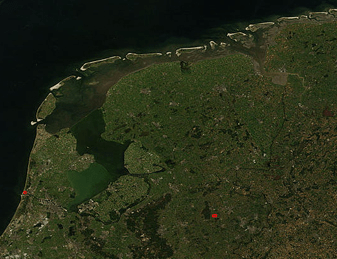
On 13 December 2008, I went to Enschede with my son. We visited the University of Twente. My son didn’t know of my foreboding. I hadn’t discussed it with anyone yet. On the campus was a work of art, a church tower in a pond. It seems to refer to flooded land. It was evening. It was dark, the moon was shining, and a thin layer of ice had settled on the pond. Suddenly, my son told me he saw the coastline of the Netherlands reflected in the moonlight on the ice surface. I didn’t see it, but he kept pointing at the ice until I saw it, too, and very clearly. The Dutch coastline has a peculiar shape that is unlikely to be mimicked by some random incident. That was as eerie as it can get.
Dutch coastline. NASA.
That freaked me out. The church tower in the pond refers to flooded land, and this storm threatened the Netherlands’ coastline. A lunar eclipse was to occur on 9 February 2009, another eerie coincidence. There were a few more strange things. The Dutch singer Boudewijn de Groot had made an album named Lage Landen (Low Countries). The 11th track, Lage Landen, is about a superstorm hitting the Netherlands. The song suggests that the storm will hit on a Monday, while 9 February 2009 was a Monday. Monday is the day dedicated to the Moon (Moon-day), which is noteworthy because of the lunar eclipse and the coastline of the Netherlands reflected in the moonlight.
Album cover of Lage Landen of Boudewijn de Groot
The song was the 11th track and lasted 5:55 minutes, which was peculiar as the date, 9 February 2009, becomes 11:11 after compressing the numbers. It can be rewritten as 9-2-2009 while 9 + 2 = 11 and 2 + 0 + 0 + 9 = 11. When I first came to the University of Twente campus during the introduction weeks, I stayed at Club 9-2, the most notorious residence hall on the entire campus. This address refers to 9 February. It was indeed intriguing because there was a link with the campus and the Lady.
On 18 December 2008, I issued a warning on two message boards. I expected everyone to ignore it, except perhaps a few nutters. What proof did I have? I had never been psychic. I don’t have prophetic foresight. Only this unique long-term weather forecast was more accurate than chance allows. The events that caused me to make the prediction make it an incredible story. As a prediction, it was pretty useless, and luckily, no one took it seriously. Imagine that a large-scale evacuation had taken place. That is why I refrain from making predictions. Still, the incident sheds some light on why mediums can be highly accurate at times, and beyond what chance and mere guessing allow for, while making countless misses on other occasions.
Latest revision: 2 September 2025
Featured image: Church tower in pond on the campus of the University of Twente. Source Unknown. [copyright]
1. Your Consciousness Can Jump Through Time—Meaning ‘Gut Feelings’ Are Memories From the Future, Scientists Say. Elizabeth Rayne (2025). Popular Mechanics. [link] 2. De duistere zijde van de Maan. Maroc.nl (2008). 3. Storm shuts Paris airports. The Guardian (2009). [link] 4. Wat als het toch fout gaat? Sargasso.nl (2008). [link]







 The Plan For The Future