God Is Love

The Religion of Love

Christians tell us that God is love. There is something about this love that the Church Fathers found so troubling that they didn’t want us to know. Jesus’ deeds might make more sense once you know what it is. Love is a central theme in Christianity. And so this religion is known as the Religion of Love. According to the Gospel, Jesus said we should love God with all our heart, soul, mind and strength (Mark 12:30-31). Paul wrote the First Epistle to the Corinthians around 54 AD. It is one of the earliest written sources of Christianity. It contains a remarkable poem (1 Corinthians 13),

If I speak in the tongues of men or of angels, but do not have love, I am only a resounding gong or a clanging cymbal.
If I have the gift of prophecy and can fathom all mysteries and all knowledge, and if I have a faith that can move mountains, but do not have love, I am nothing.
If I give all I possess to the poor and give over my body to hardship that I may boast, but do not have love, I gain nothing.

Love is patient, love is kind. It does not envy, it does not boast, it is not proud.
It does not dishonour others, it is not self-seeking, it is not easily angered, it keeps no record of wrongs.
Love does not delight in evil but rejoices with the truth.
It always protects, always trusts, always hopes, always perseveres.

Love never fails. But where there are prophecies, they will cease; where there are tongues, they will be stilled; where there is knowledge, it will pass away.
For we know in part and we prophesy in part, but when completeness comes, what is in part disappears.
When I was a child, I talked like a child, I thought like a child, I reasoned like a child.
When I became a man, I put the ways of childhood behind me.
For now we see only a reflection as in a mirror; then we shall see face to face.
Now I know in part; then I shall know fully, even as I am fully known.

And now these three remain: faith, hope and love. But the greatest of these is love.2

Paul informed us that love is more important than faith and good works. That is quite informative, as God is love (1 John 4:8, 16). The Christian story became that God loved the world so much that He gave His one and only son so that whoever believes in him shall not perish but have eternal life (John 3:16). The author of the Gospel of John shares his views on God’s love in the First Epistle of John (1 John 4:7-10),

Dear friends, let us love one another, for love comes from God. Everyone who loves has been born of God and knows God. Whoever does not love does not know God, because God is love. This is how God showed his love among us: He sent his one and only Son into the world that we might live through him. This is love: not that we loved God, but that he loved us and sent his Son as an atoning sacrifice for our sins.

God loving us and sending His one and only son into the world to die as a sacrifice for our sins seems peculiar, outrageous even, unless you are a Christian. Christians claim that Adam sinned, so we are all cursed, but then came Jesus, who saved us by his crucifixion. Jews and Muslims don’t believe that God has a son, nor do they think that Adam’s transgression justifies this sacrifice. When God ordered Abraham to offer his son, and Abraham was about to comply, God called it off. So why did Jesus do it? The odds are that it has to do with love. Ephesians gives a possible clue (Ephesians 5:25),

Husbands, love your wives, just as Christ loved the church and gave himself up for her.

Christians believe Jesus married the Church. Only the Church didn’t exist when Jesus lived. The verse suggests that Jesus died out of love, as in a marriage. It asks husbands to love their wives just like Christ loved the Church and gave himself up for her. That was as close to the truth as the church fathers dared to venture. Jesus was married and gave himself up for his Bride. And men should do the same for their wives. This vantage also sheds new light on Jesus’ views on marriage as a bond forged by God (Matthew 19:3-9),

Some Pharisees came to him to test him. They asked, ‘Is it lawful for a man to divorce his wife for any and every reason?

‘Haven’t you read,’ he replied, “that at the beginning the Creator made them male and female, and said, ‘For this reason a man will leave his father and mother and be united to his wife, and the two will become one flesh.’ So they are no longer two, but one flesh. Therefore what God has joined together, let no one separate.’

‘Why then,’ they asked, ‘did Moses command that a man give his wife a certificate of divorce and send her away?’

Jesus replied, ‘Moses permitted you to divorce your wives because your hearts were hard. But it was not this way from the beginning. I tell you that anyone who divorces his wife, except for sexual immorality, and marries another woman commits adultery.’

Here, Jesus departed from Moses’ law, referring to the beginning, thus Eden. Jesus’ disciples argued it would be hard for men to love their wives this way. Jesus replied that not all men can do this. Concerning marriage, Jesus promoted a high standard that was untenable for many men. It would be better to live in celibacy than not to live up to it. In the Gospel of Matthew, Jesus compares the kingdom of heaven to a king who prepares a wedding banquet for his son (Matthew 22:2-14). The wedding symbolises the kingdom of God. It may seem odd to compare the kingdom of God to a wedding, unless it is one.

The Pharisees indulged themselves in some additional testing of Jesus when they caught a woman in the act of adultery (John 8:1-11). They asked Jesus, ‘Teacher, this woman was caught in the act of adultery. In the Law, Moses commanded us to stone such women. Now what do you say?’ They were using this question as a trap, as stoning should be the verdict according to Numbers 5, perhaps because they expected Jesus to rule in favour of the woman. Jesus’ answer was, ‘Let any one of you who is without sin be the first to throw a stone at her.’ But according to Rabbinic literature, the man being free from sin was a precondition for the trial of the woman, as Hosea 4:14 reads,

I will not punish your daughters when they turn to prostitution, nor your daughters-in-law when they commit adultery, because the men themselves consort with harlots and sacrifice with shrine prostitutes.

Jesus’ answer was the correct interpretation of the law, as recorded in Rabbinic literature, so it wasn’t merely a clever rebuttal. By knowing the law better than they did, Jesus made the Pharisees appear foolish. The witnesses weren’t free from sin, and as for the husband, we learn nothing.

Surviving records of Jesus’ words and teachings suggest Jesus believed women to be equal to men. The equality of the sexes is at odds with the patriarchal society of Jesus’ time. Paul probably also saw women as equals, but his views concerning marriage are remarkable. In his first letter to the Corinthians, Paul says (1 Corinthians 7:1-2, 3-4, 10-11),

Now for the matters you wrote about: ‘It is good for a man not to have sexual relations with a woman.’ But since sexual immorality is occurring, each man should have sexual relations with his own wife, and each woman with her own husband.

The husband should fulfil his marital duty to his wife, and likewise the wife to her husband. The wife does not have authority over her own body but yields it to her husband. In the same way, the husband does not have authority over his own body but yields it to his wife.

To the married, I give this command (not I, but the Lord): A wife must not separate from her husband. But if she does, she must remain unmarried or else be reconciled to her husband. And a husband must not divorce his wife.

To Paul, celibacy was preferable to marriage, but only for the strong, who can resist their urges. Marriage is to keep the weak, who can’t control their desires, on the right path, so that Satan will not tempt them (1 Corinthians 7:5). That is a rather specific interpretation of Jesus’ saying that only men who are capable of loving a woman should marry, and that if one cannot love a woman, it is better to remain unmarried (Matthew 19:3-11). After explaining that, Jesus went on to discuss eunuchs, noting that some choose to live like eunuchs for the sake of the kingdom of heaven (Matthew 19:12). That may have inspired Paul’s views on celibacy.

The Didache, an early Christian text dating back to the first century, implies the equality of the sexes. It helped to make Christianity monogamous, as opposed to Judaism at the time, and later Islam. As many early Christians were Jewish and had heard about Jesus and the miracles he did, but didn’t know about his marriage to God and believed God was an invisible being in the sky, Paul faced a theological problem.

Patriarchy returning

Paul resolved that issue by aligning Christianity with the Jewish scriptures. He wrote that the head of every man is Christ and the head of the woman is man (1 Corinthians 11:3) and that a man is the image and glory of God, as man did not come from woman, but woman from man; neither was man created for woman, but woman for man (1 Corinthians 11:7-9). Paul must have known better, but it was the biblical account from Genesis. As a religious Jew, he considered these scriptures infallible, so the facts are secondary, which may seem strange, but that’s how many religious people reason. Most early Christians were Jews who didn’t know the specifics about the relationship between God and Jesus, so they wouldn’t have believed the truth anyway. Worse still, it would be blasphemous to them. And so, Paul did God’s work by making the new religion more palatable to them.

Paul makes up for it by adding that the head of Christ is God. He goes on to say that a woman ought to have authority over her own head, and that woman is not independent of man, nor is man independent of woman, and that woman came from man, but also man is born of woman (1 Corinthians 11:10-12). In his view, men and women were equal. It is a juggling with words, as Paul is beating around the bush.

Over time, Christianity became increasingly patriarchal. Scholarly analysis of the letters of the early church fathers underlines this. Scholars think 1 Corinthians 11:2-16 is a later addition.1 It claims that the man is the head of the family. The same applies to 1 Corinthians 14:34-35. It orders women to be silent in the churches. A reason for suspecting that the latter passage is an addition is that several manuscripts have it at the end of the chapter instead of its usual location. Scholars view it as a sign that a scribe copied a note into the body of the text.2 A previous scribe likely added that note.

If you ask yourself how scribes could justify falsifying their scriptures, here lies an answer. It happened in small steps that appeared reasonable. You might not consider adding a note a falsification. As Paul wrote, the head of the woman is the man. You can interpret this as the man being the head of the family, as traditional Jews did. Once the comment is there, it becomes part of the text’s context as a clarification. Once it is part of the context and has become an instruction to read the passage that way, it might not seem falsifying to include it in the text. In this way, a few generations can make an astounding difference. And so, the First Epistle to Timothy reads (1 Timothy 2:11-15),

A woman should learn in quietness and full submission. I do not permit a woman to teach or to assume authority over a man; she must be quiet. For Adam was formed first, then Eve. And Adam was not the one deceived; it was the woman who was deceived and became a sinner. But women will be saved through childbearing—if they continue in faith, love and holiness with propriety.

Paul never wrote this letter, despite the letter claiming otherwise. An unidentified Christian scribe likely penned it down more than fifty years after Paul’s death. Scholars uncover falsifications by comparing the wording of this epistle with that of Paul’s genuine letters. The passage above suggests women spoke publicly and felt they had authority over men. Otherwise, the author would not have written it. These modifications suggest an equality of the sexes, a prominent position for women in the early Christian movement, and the gradual re-establishment of male supremacy.

Sacrifice for love

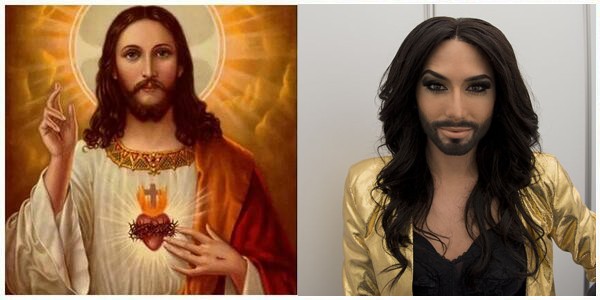
As Jesus sacrificed himself for love, devotion to the Sacred Heart of Jesus is a noteworthy peculiarity, as is some of the accompanying imagery. Within the Roman Catholic tradition, the Sacred Heart is a symbol of God’s boundless and passionate love for humankind. Nothing of the sort existed during the first ten centuries of Christianity. The Crusades revived religious life and inspired monks and nuns to revere Jesus’ wounds, including his heart, as sacred. The Franciscan monk Bonaventure wrote in 1274, ‘Who is there who would not love this wounded heart? Who would not love in return Him, who loves so much?’ Over time, Jesus’ heart came to the centre stage of these devotions.

Women mystics played a crucial role in that development. Among them were Lutgardis of Aywières (1182–1246), Mechtilde of Hackeborn (1241–1298), and Gertrude of Helfta (1256–1302). The devotion to the Sacred Heart in its present form began with Margaret Mary Alacoque (1647–1690), a nun of the Order of the Visitation of Holy Mary, who claimed to have received revelations about the Sacred Heart from Jesus Christ between 1673 and 1675 in the Burgundian French village of Paray-le-Monial. Later, Mary of the Divine Heart (1863–1899), a religious sister of the Congregation of Our Lady of Charity of the Good Shepherd, reported receiving locutions and visions of Jesus Christ.

So, did Jesus sacrifice himself for God’s love, and did God not care about Jesus? And if so, why would God care about us? If that thought had occurred to the Church Fathers, they would have found it disturbing. If someone else were to find himself in the position Jesus once was, he might not be instantly enthusiastic about the proposition. But no one can go against the will of God. And you can fall in love with someone who has taken you hostage. It is a natural reaction known as Stockholm Syndrome. Having no choice makes things easier. You must try to save humankind if there is a slight chance of success. He knows he has to play his role in the script. And he can succeed, like Chief Inspector Clouseau, if that is the plot of the story. And if the absurd has hunted you down and cornered you, and you see no escape, you can better embrace it.

And is it so terrible to die for love? Everyone dies, usually for less agreeable reasons like a fatal encounter with a deadly disease, some random accident, old age or a war fought for the ego of a leader, or even worse, his stupidity. In hindsight, Jesus’ sacrifice was exceptionally functional. It created Christianity, a religion that claims we are unworthy of God’s grace and need to accept a saviour and follow him. It is an idea that can save us because we can’t fix our problems ourselves. We are religious creatures who need a fairy tale to believe in. And as Paul explained in his poem, you can speak every language, know all the secrets, and give your money to those in need, but it is pointless if you don’t have love. If it is a delusion, you can enjoy it for as long as it lasts. And if you must go down in infamy and die, you can better do it laughing. So, always look on the bright side of life,

Life’s a piece of shit
When you look at it
Life’s a laugh and death’s a joke, it’s true
You’ll see it’s all a show
Keep ’em laughin’ as you go
Just remember that the last laugh is on you
And

Always look on the bright side of life
Always look on the right side of life

Monty Python, Always Look on the Bright Side of Life

Latest revision: 12 February 2026

Featured image: A cross in a heart formed with candles. Photos taken in Camp Tejas, Giddings, Texas, USA. Wingchi Poon. CC BY 3.0. Wikimedia Commons.

1. Forgery and Counter forgery: The Use of Literary Deceit in Early Christian Polemics. Bart D. Ehrman (2013).
2. The Oxford Bible Commentary. John Barton; John Muddiman, eds. (2001). New York: Oxford University Press. p. 1130. ISBN 978-0-19-875500-5.

Coming of the Messiah

High expectations

Will Jesus return? What will he do if he does? Will Jesus make things right? Will there be a showdown between the forces of good and evil? Will evil people burn in hell forever? And what about Buddhists and atheists? They don’t believe in God. And Hindus? They have many gods. Or Jews, Christians and Muslims? Who are the good people, and who are the wicked anyway? The Italian mafia bosses were devout Catholics. The usurers of Goldman Sachs claimed that they were doing God’s work. The Muslims blowing themselves up to murder unbelievers also did. Palestinians murder Jews and Jews murder Palestinians, all in the name of God. US President George Bush claimed that God had ordered him to invade Iraq. So, what might happen if a messiah were to come? Few people have given the matter the attention it deserves, either because they think it will never happen or because they think the Bible addresses the issue sufficiently.

Jesus believed himself to be Adam, who lives forever, because God made him believe it. His appearance to some of his followers after his death led them to believe it was true, giving them faith, so we now have Christianity and Islam. Yet, he was human, and only the Son of God figuratively. And so, Jesus will likely not return, and we may have to cope with a stand-in who might not, as the faithful hope, magically turn things all right and, as Santa Claus, dole out presents like eternal life, bliss, and special places in heaven. What were these people thinking? So, what can we expect? There has been a sort of dress rehearsal to get us in the mood and foreshadow what might be coming. Adolf Hitler was a most messianic figure, perhaps the most messianic figure ever, even surpassing Jesus. We may have to follow the messiah like the Germans followed Adolf Hitler.

So, was Hitler the opposite of Christ, the anti-Christ, or was he like Christ, as many of his followers expect him to be? Will there be a final reckoning in which billions of people die or face eternal torture in hell? The latter is worse than being gassed in a concentration camp, as there is no end to the suffering. For those who think it is an inappropriate remark, life in Gaza in 2025 has become as horrible as in a concentration camp. And Jews did that, and Palestinian terrorism prompted them to do it. Many Jews hope for a final solution to their Palestinian problem, just as many Palestinians hope for a final solution to their Jewish problem. Both groups have their reasons, but so did Adolf Hitler. So, have we learned our lessons? And what are these lessons in the first place?

Europeans have learned in two devastating world wars that nationalism and tribalism are the paths to destruction. It is still in their collective memory. Other continents don’t share that experience, and memories don’t last forever. Nationalists point to the troubles migration and mixing people from different cultures cause, but nationalism leads to warfare and will prove to be fatal in today’s world. Yet, letting different tribes live together under the umbrella of multiculturalism causes similar problems. Normally, we would be doomed in one way or another unless there were a one-world government that dealt with the troublemakers. Most people wouldn’t accept a one-world government. We cooperate through the myths we share. That seems to be the point of a messiah. Humans are a failed and destructive species. Without an inspiring fairy tale and a leader who unites us, we are doomed.

Adolf the Messiah or the Anti-Christ

At first glance, Jesus Christ and Adolf Hitler are opposites. Jesus personifies goodness, while Hitler is the epitome of evil. Today, with the rise of fascism, more people view Hitler more favourably, and some outright admire him. Christ stood at the cradle of Christianity, the Religion of Love. Jesus taught that love would overcome hatred. He said, ‘If anyone slaps you on the right cheek, turn to them the other cheek also.’ And, ‘Love your enemies and pray for those who persecute you.’ Hitler represents Nazism, the ideology of hatred that brought us unprecedented cruelty and revealed the depth of human depravity. As the world is barrelling towards an apocalypse, it is the right time to take a distance and be honest.

Closer inspection reveals a few intriguing parallels between Hitler and Christ. Adolf Hitler’s followers considered him their saviour, and they worshipped him like one. Christians believe that Jesus will descend from heaven and that there will be a rapture at his return (1 Thessalonians 4:16-17). Hitler was the first leader to fly around in an aeroplane. He came down from the sky to meet the cheering crowds. Rapture means ecstasy, enthusiasm and admiration. Few people in history caused as much rapture as Hitler. A Nazi slogan was, ‘One people, one empire, one leader.’ Christians and Muslims expect that to happen when Jesus returns. And so, Hitler might foreshadow the Second Coming.

In several ways, Hitler resembled a messiah. He told the Germans they were the chosen people for their superior race. Jews believe they are the chosen people because of a supposed special relationship between God and the Jewish people. Like Moses, Hitler promised to end the unjust oppression, in this case, caused by the Treaty of Versailles. He claimed that his Third Reich would last a thousand years, whereas the Bible says that Christ’s reign would last a thousand years (Revelation 20:1-6). And Hitler inspired the same blind following and loyalty to the death that many Christians expect the Second Coming of Christ would do. Somewhat unsurprisingly, a British intelligence report found that Hitler had a messiah complex.1

The Nazi ideology has biblical parallels. In traditional agricultural societies, land remained within the family. The Jews were no exception. The Bible says the bond between people and land is not to be broken, and land is not to be sold (Leviticus 25:23). The Nazi ideology of Blood and Soil focuses on ethnicity and homeland and stresses the importance of the land people live on and celebrates rural living. The Nazis made the ownership of selected lands hereditary. Those lands could not be mortgaged or sold. The Nazis sought to return to their Eden, without Jews and other undesirables. The Holocaust became the culmination of centuries of anti-Semitism fed by prejudices in popular culture.

The Nazis objected to degenerate art, which supposedly was perverse, thus, Communist or Jewish. Ironically, a Jew, Max Nordau, was the one who coined the term degenerate art for modern art, which he believed was the work of feeble minds corrupted by modern life who had lost their self-control. That was by far not the only idea that the Nazis borrowed from the Jews. It is the irony of history.

Nazism and Judaism both have fairy tales about superior people, the nation’s greatness, messianic leadership, and a promised land. Like the Nazis, the Jews have been keen on not allowing mixed marriages, not to keep their tribe racially pure, but to keep it free from foreign influences. In the past, Jews saw non-Jews as inferior, and many still do. Whether Jesus compared Gentiles to dogs, we can’t be sure of, but there is little doubt that these words reflected a widespread sentiment among Jews. It is a natural human conduct to perceive our own group as superior and other groups as inferior, and the Jews are no exception. They have only been the best at cultivating their superiority complex by producing an elaborate collection of fairy tales about their supposed special relationship with the owner of the universe, and dragging half the world’s population into it. That makes Nazism the Frankenstein’s monster that Judaism has spawned.

View on Auschwitz concentration camp
View of the Auschwitz concentration camp

Political views

Hitler could have been a painter had the Vienna Art School not declined his application, and we would have had a few additional acceptable wall decorations instead of World War II and the Holocaust. Hitler wouldn’t have sought revenge if Germany had not lost World War I. Had he not lived in an impoverished multicultural neighbourhood in Vienna, he might not have thought that mixing ethnic groups was a bad idea. And had there been no widespread anti-Semitism already, he wouldn’t have hated the Jews that much. Adolf Hitler was skilled at delivering speeches, often angry rants that energised his followers. During the Great Depression, he gained popularity and grabbed power in Germany. He started a war that killed fifty million people. Ten million people died in the Holocaust, including six million Jews. Few people had imagined the Nazi regime could be that depraved.

Like many Germans, Hitler considered the Peace Treaty of Versailles unjust. The treaty stipulated that Germany accept responsibility for causing World War I and pay massive reparations. The British economist Keynes warned in 1919 about the harsh peace terms imposed upon Germany. They were the product of vindictive sentiments among the allies. It could lead to another major war, Keynes warned. Hitler also opposed usury and international finance after attending a lecture by Gottfried Feder, titled ‘The Abolition of Interest Servitude.’ It was the reason Hitler joined the National Socialist Party. Hitler’s views were similar to those expressed in the Bible and the Quran. Today, unchecked trade and finance drive the creative destruction that is to terminate humankind.

Adolf Hitler coined the term ‘Big Lie’ and wrote that the masses will more easily fall victim to a big lie than to a small one, because they would never believe others could have the impudence to distort the truth so infamously. Hitler claimed that the Jews had used this technique to blame Germany’s loss in World War I on German general Erich Ludendorff, who was a prominent nationalist political leader in the Weimar Republic. Nazi propaganda repeatedly claimed that Jews held outsized and secret power in Britain, Russia, and the United States, and that the Jews had begun a war of extermination against Germany, so Germany had a right to annihilate the Jews in self-defence. Historians see it as a big lie. The factual evidence was absent, so it was paranoia, but as others, including Marx, had already observed, Jews had enormous economic clout via international finance. The reparations Germany paid and the war debts of the Allies created an unsustainable debt loop that eventually collapsed, but there was no secret Jewish scheme behind that.

Hitler feared that the Jews would take over Germany. He believed it would happen through two seemingly opposite yet connected forces: international finance capitalism and Marxist communism. In the early 1930s, not only did the fascists have violent paramilitary groups engaged in subversive acts and street violence, but also the communists. Communism and finance operate on the international level, and both are forces working against national independence, and featured a significant Jewish presence. That doesn’t mean that the Jews operated behind them to futher Jewish interests, which is a form of paranoia.

Yet, it could eventually work out that way. In the United States, about half the wealthy US elites are Jewish, while Jews are only 2% of the US population. The elites bribe US politicians to do their bidding, and many are Jews. To get elected, American politicians from both sides must unconditionally support Israel. If not, they face the wrath of the Israel Lobby, which will terminate their career. That is also because Israel depends on American support. Otherwise, it might not have played out that way. Today, many Americans are impoverished while the wealthy, often Jewish elites, party, with the Epstein Files giving some insights into the particulars.

Yet, there have also been pogroms, in which populations attacked and murdered Jews and looted their possessions. The Night of Broken Glass is the most famous. It was a nationwide pogrom in Germany organised by the Nazis with looting and destruction of Jewish property. It points to the broader issue of people from different cultures living together and causing harm to one another because different cultures have different strengths and weaknesses. Both groups have a relative advantage, which can harm the other. The Jews have money, on which they may charge interest and exploit the other group, while the others have the numbers, which they may use to plunder.

Inspired by scientific discoveries about natural selection, the Nazis became preoccupied with the fitness of the race. They euthanised those whom they believed were unfit, such as the disabled. Had we still lived in nature, many disabled people wouldn’t have survived, as the communities they lived in would have abandoned them, lacking the means to keep them alive or didn’t want to care for them. Civilisation allows the inept to survive. If you can do a trick, you can get your cheque. You may even get away without contributing. Human bands had lazy people, but social controls and the struggle for survival kept the issue in check. In advanced civilisations with enormous surpluses, large swaths of the population receive money for non-essential activities in the bullshit economy. The Nazis believed that if the feeble survived and procreated, that would weaken the race.

To the Nazis, other races were inferior. Some were good enough as slaves, while others had to disappear. Apart from the Jews, the Nazis exterminated the Roma. Today, 70% of the Roma living in Eastern Europe have criminal records, and the majority of them rely on welfare. They still suffer from mob violence and exclusion.2 These figures make it understandable why people dislike them. The Jews as a group are problematic because, if you let things run their course, they may gain an outsized share of wealth and influence via trade, usury and political corruption. And that is the primary reason why anti-Semitism is once again rearing its ugly head. Cultures, so norms, values and myths, hold groups together, so you can’t reason with groups as you can with individuals. And it is not only the Roma and the Jews. We all do harm to others through our values and conduct, and the myths we believe. Capitalism and myths of national greatness are the most destructive. And so, Hitler ruined Germany more than the Jews ever could.

Why do they hate us?’ It was a question few Americans asked after the 11 September 2001 terrorist attacks. And then the Americans did precisely what many Muslims hated them for: bombing and occupying a Muslim country, and even one that had nothing to do with the attacks. Muslims never ask themselves why others hate them. In many places where Muslims live together with others, there is trouble. If we are to live in one world community, it is a question everyone should ask. Why do others hate us? Pride is the gravest sin of all. The prejudices others hold about your group often have a basis in reality. How others view you tells you more about yourself than how you see yourself. It is natural to be proud of your traditions and culture, but that is also why humanity fails.

If we are to survive, we must all be honest about ourselves, our traditions, and the consequences of our conduct. We must stop harming others. In hindsight, the Nazi racial superiority ideology was a guise to address cultural issues plaguing German society. Mixing people from different cultures causes trouble. Yet, none of today’s cultures meets the requirements for our future, so we must all change. The message hidden in God marrying Hitler is that God doesn’t care about a few billion deaths because we are less than worms to Her. That sober assessment should discipline us. If God sends a messiah, we will have to obey like the Germans obeyed Hitler, as he has to implement a final solution for humanity so that humanity might survive. He has to do it regardless of the consequences for individuals. According to the Bible, Jesus said he would separate the sheep from the goats. And so, you either fit in, or you don’t, and that, as Jesus said, the punishment for those who don’t will be harsh, and it could be concentration camps.

Harsh questions

The Nazis didn’t shy away from harsh questions, or at least the ones that could be a pretext for mass murder. The world is finite. The Nazis obsessed over limited resources or living space, and thought that the Germans needed more of it, so that Germany should start wars to conquer territory. The issue of limited resources is far more pressing today, and the alternative to warfare is sharing. Sadly, we aren’t inclined to do so, except perhaps at gunpoint. Revolutions, whether the American Revolution or the Bolshevik Revolution in Russia, were not only about ideals but above all about people desiring more for themselves. More stuff is what motivates people. And that comes at the expense of something, such as other people or nature. An economic crisis brought Hitler to power, and an economic miracle made him popular with the Germans.

As for limited resources, you run into questions like, is it okay to spend €100,000 per year to keep one person alive, while that money could have saved a hundred others? Those who take more than is sustainable or have many children condemn others to death. By avoiding these questions or failing to take adequate action, the problems will only get out of hand, so that in the end the suffering will be greater. And so, those living luxurious lifestyles and those having many children are not better than the Nazis. Malthus may have had it wrong for 200 years, but that doesn’t mean he will not be right in the end. Likewise, end-time predictors were wrong for 2,000 years, but that doesn’t mean the end time will not arrive. The world doesn’t need children. On the contrary, the fewer humans, the better. Humans are the most destructive species that has ever roamed this planet.

That brings us to eugenics, or the improvement of the human race via selective breeding. Why would we bring misfits into the world if we can avoid it? If you suffer from a severe hereditary disease, why should you have children? If you are mentally incapable of raising children because you are a retard, a criminal, an alcoholic or a drug addict, should you be allowed to have children? Excessive consumers of resources and planetary destroyers who transfer their lifestyles to their offspring. Should we allow billionaires to breed? Whether greed stems from a genetic defect or is a value instilled through upbringing, we can’t have more useless eaters living off capital that ruins the planet. The prevailing liberal view is that it is a human right to have children. And then liberals leave it up to science to fix the problems this view causes. But to own a gun or to drive a car, you need a license and prove you are sane. So, why don’t we have to qualify to have children?

Drug abuse

Adolf Hitler was a hypochondriac suffering from mood swings, Parkinson’s disease, flatulence, skin problems and a gradual decline. His physician, a quack named Dr Theodor Morell, gave him unorthodox medications, such as cocaine, speed, glucose, testosterone, estradiol, and corticosteroids. In addition, Der Führer received a preparation made from a gun cleaner, rat poison and atropine to treat his farting.

Der Führer miraculously survived all these treatments, but they contributed to his erratic conduct and illnesses. He also ingested an extract of bulls’ semen and numerous vitamins and tonics. He took potions, pills and injections to improve his sexual performance to deal with the sexual appetite of his demanding mistress, Eva Braun. As they say, behind every strong man is a strong woman, and sometimes an even stronger one.

Eva Braun

Eva Braun was the mistress and later wife of Adolf Hitler. Most historians consider Her an insignificant figure who didn’t participate in political decisions. But opinions differ. A letter demonstrates that Braun knew of the concentration camps and the gas chambers. Some Nazi officials close to Hitler have said that Braun was at the centre of Hitler’s life for most of his twelve years in power. She was committed to Hitler, won his affection, gave him moral support, and enjoyed a healthy sex life with him. Braun’s friends have said that She giggled over a photograph of Neville Chamberlain sitting on a sofa in Hitler’s Munich apartment and said, ‘If only he knew what goings-on that sofa has seen.

Hitler’s letters indicate that he was fond of Her, and worried when She participated in sports or was late returning for tea. Hitler’s secretary, Traudl Junge, stated that during the war, Hitler telephoned Braun every day. After learning about a failed plot to kill Hitler in 1944, Braun wrote to him, ‘From our first meeting, I swore to follow you anywhere even unto death. I live only for your love.’ And that was how it ended. Over twenty plots to kill Hitler failed, making Hitler believe a supernatural force protected him. When the end of the Third Empire neared, Braun became merrier. In the end, She married Hitler and committed suicide together with him. It was the romantic ending She desired.

Hitler’s letters indicate that he was fond of Her, and worried when She participated in sports or was late returning for tea. Hitler’s secretary, Traudl Junge, stated that during the war, Hitler telephoned Braun every day. After learning about a failed plot to kill Hitler in 1944, Braun wrote to him, ‘From our first meeting, I swore to follow you anywhere even unto death. I live only for your love.’ And that was how it ended. Over twenty plots to kill Hitler failed, making Hitler believe a supernatural force protected him. When the end of the Third Empire neared, Braun became merrier. In the end, She married Hitler and committed suicide together with him. It was the romantic ending She desired.

Was Eva Braun God and the mastermind behind Hitler’s rise and demise? Hitler, having been the most messianic figure in modern times, and God’s inclination to marry messiahs would make it a most plausible inference. Coincidences can serve as a clue. Braun is the German word for brown. Adolf Hitler was born in Braunau am Inn, and brown is the colour associated with the Nazis. Nazis were nicknamed brown shirts. And Eva is German for Eve. Eva had a passion for nude sunbathing to brown Her skin. She loved being photographed naked. She had no shame like Eve in the Garden of Eden.

For God, the story didn’t end with the Third Reich’s demise. She may have become Marilyn Monroe by assuming the identity of Norma Jeane Mortenson. I contemplated that possibility when watching a Netflix documentary about Monroe’s life. Immediately after my thought, the word goddess appeared on the screen in massive lettering. That hint was as plain as it could get. Monroe had an affair with US President John F. Kennedy. He later dumped Monroe. Soon afterwards, Kennedy met the Grim Reaper in an epic scene dubbed the Kennedy assassination.

Messing with Monroe seemed to have been Kennedy’s most fatal mistake. People still speculate about a plot behind the assassination, so here is the answer that renders the speculation trivial. A set of coincidences surrounds the assassinations of President John F. Kennedy and his brother Robert. They are part of an intricate scheme involving the premature deaths of Presidents, including James A. Garfield. Furthermore, the Kennedy family suffered a series of accidents and early deaths called the Kennedy Curse. The book ‘The Virtual Universe’ delves deeper into the matter.

The prophecy of the Holocaust

Rumour has it that Nostradamus predicted the coming of Adolf Hitler, as the word ‘Hister’ appears in his ravings. Hister is Latin for the Danube River. These names are alike, and that is the supposed proof. Hitler’s birthplace was on a tributary of the Danube, a peculiar coincidence. More ominous are the prophetic references to six million Jews in danger of being exterminated or a coming Holocaust of Jews appearing in Jewish magazines before World War II. That is not as remarkable as it might seem. The figure emerged because six million Jews lived in the Russian Empire before World War I. Jews in Russia suffered from a hostile government and pogroms. Pogroms are riots incited to expel or kill Jews.

The Russian Empire collapsed due to its dramatic losses during World War I. After a revolution and a civil war, the Soviet Union emerged. Still, the six million figure continued to circulate in Jewish publications, which is odd as that number had lost its relevance since the former Russian Empire had been split up into different nation-states. Yet, it became the number of Jews murdered in the Holocaust.5 And so, these prophetic statements are eerie, like the reference to the end date of World War I on the licence plate of Franz Ferdinand’s car. The most notable ones are listed below:

  • In 1911, at the tenth Zionist Congress in Basel, Switzerland, Max Nordau, co-founder of the World Zionist Organisation, together with Theodore Herzl, prophesied the annihilation of six million Jews.
  • Shortly after World War I in 1919, Zionists feared that a Holocaust of six million Jews was imminent in Europe.
  • According to the New York Times, in 1936, Zionists were lobbying for a Jewish state in Palestine to save the Jews from a European Holocaust. It was three years before World War II and five years before the extermination camps came into existence.
  • In 1939, The Jewish Criterion predicted the coming world war would annihilate six million Jews in East and Central Europe.
  • In 1940, the Jewish leader Nahum Goldmann predicted that if the Nazis achieved victory, six million Jews would be doomed to destruction.

That ugly face in the mirror


Fascists, and nazis in particular, are often disagreeable people because they obsess with the struggle for survival, and the struggle for survival is particularly disagreeable and raises ugly questions that civilised people wish to avoid. And there once was a time when life in the West was more civilised, and people had difficulty imagining why Adolf Hitler came to power. The 1981 film ‘The Wave’ is from that era. It is about a schoolteacher, Ben Ross, who, in 1967, showed his class a film about the Holocaust. One of his pupils asked him how the Germans could have rallied behind Adolf Hitler and committed these atrocities. Ross couldn’t answer the question and decided to start an experiment.

Ross began by offering advice on posture and classroom rules to improve efficiency. The pupils took it up with enthusiasm. The next day, he introduced The Wave, a youth movement with a secret salute. Robert, an unpopular student, was assigned to monitor the other students, a task that filled him with pride. Nationalist pride stands at the centre of fascism. We all want to be part of something great. Robert reported unorthodox behaviour to Ross and the other Wave members. Two hundred students joined. Wave members intimidated and bullied other students. The school newspaper published a negative review about The Wave, prompting Wave members to plan an attack on the editor.

The following day, Ross said the Wave was a nationwide youth movement in schools and that its leader would give a televised speech. The eager Wave students assembled in the auditorium with television monitors on display. To their horror, the monitors displayed a film of Adolf Hitler at a Nazi rally. Ross told them that this was their leader. The experiment showed that most of us are fit to become Nazis or would not resist a fascist takeover. Another experiment showed that humans are capable of extreme cruelty if they believe it is for a good cause. Most of us aren’t heroes, so if we think we are at risk by doing good, we may, at best, passively resist by not cooperating. Most people wouldn’t endanger themselves by hiding Jews, but they also wouldn’t rat out people who were hiding them. Yet, only one rat sufficed, so most Jews ended up in the concentration camps.

We remember the Nazis for their cruelty, but they were also gangsters. Hermann Göring looted art and other precious items, a recurring pattern in authoritarian regimes. Fascist leaders are often gangsters who lie more brazenly than other politicians, engage in crimes, violent uprisings and coups to overthrow the government, while brazenly claiming that the opposition, the so-called far-left extremists, are doing these things, to go after their opponents with trumped-up charges in political processes. Donald Trump is an excellent example with his big lie about election fraud, lawsuits against his political opponents, and gangster raids on several countries. As the liberal world order is falling apart, the rise of fascist gangster regimes is rather unsurprising.

Fascism greatly appeals to human nature. Our natural state is living in gangs. These gangs cooperate and compete with other gangs. Human groups are violent and commit murders. In pre-state societies, about 25% of the adult males had a violent death. States eventually succeeded in bringing down the murder rate by over 99%. So, fascism is a natural response to a perceived collapse in order. And without fascism, humans remain violent. Since World War II, about 10 million people have died in wars. Many of these wars were related to the power struggle between the West and the Soviet Bloc.

The way forward

We may have good intentions, but the outcome of all that humans do is a total disaster. We have created a system that amplifies our destructive inclinations, so we are heading toward an apocalyptic event, sometimes called the End Times. That system is worse than Adolf Hitler. If our survival is at stake, we should do whatever it takes, but somehow we fail to unite and let it happen. To Hitler, the fight was about the survival of the German people. Hitler was a messianic figure, and the Germans rallied behind him. That God married him makes clear that we are nothing in Her eyes. The coming struggle will be about the survival of humankind, and we need a messianic figure to unite us and make the right decisions.

In the real world, that didn’t happen, and post-humans have replaced humans. We live in a simulation run by these post-humans. What they precisely are remains unclear. The post-humans don’t need to be enhanced biological creatures, but could be artificial intelligence. Current developments suggest that humans will soon be no match for artificial intelligence. We also don’t know how humanity ended or whether humans are kept alive in reservations. This simulation runs a script, so we all play our roles, including the messiah. That means that he can’t save you. He can only provide guidance. You need to accept it to save yourself. Whether we succeed or not depends on God, as She wrote the script. In any case, if it is about survival, we must do whatever it takes. Yet, God is in control.

Refrain from anger and turn from wrath.
Do not fret—it leads only to evil.
For those who are evil will be destroyed,
but those who hope in the Lord will inherit the land.

A little while, and the wicked will be no more.
Though you look for them, they will not be found.
But the meek will inherit the land
and enjoy peace and prosperity.

Psalm 37:8-11

Latest revision: 6 June 2026

Featured image: Eva Braun and Adolf Hitler

1. WWII Adolf Hitler’s profile suggests a messiah complex. BBC (2012). [link]
2. Harvard International Review. Minority Report: Roma and Eastern Europe (2019).
4. Nazi loyalist and Adolf Hitler’s devoted aide: the true story of Eva Braun. The Guardian (2010). [link]
5. The Six Million Jews. [link]

Beautiful countryside in southern California

Capital for the future

Making the economy sustainable may require an unprecedented amount of capital in the form of knowledge and outfits like solar panels, sustainable farms and energy-efficient transportation systems. It is hard to imagine that it can be done. And imagining it is still a lot easier than really doing it. It is going to require some economic magic to divert investment capital from destructive activities to the future of humanity. We may need more useful capital and less consumption.

Perhaps the invisible hand can be of some help. It is easier to finance a great endeavour from investments than from taxation because nobody wants to pay taxes but everybody is happy to invest. It is the secret of the success of the European empires that conquered the world after the Middle Ages. England, France, Spain and the Netherlands were much poorer and smaller than China, India or the Ottoman Empire, but they didn’t finance their conquests with taxation, but with the use of investment capital.1

Europe won out because European conquerors took loans from banks and investors to buy ships, cannons, and to pay soldiers. Profits from the new trade routes and colonies enabled them to repay the loans and build trust so they could receive more credit next time.1 The same logic may need to be applied to making the economy sustainable. The challenge is so enormous that it may never be possible to finance it by taxes. Nowadays interest rates are so low because there is plenty of investment capital.

It’s the economy stupid!

It is often argued that the economy is unsustainable because of short-term thinking. The economy must grow in order to have positive returns on investments. And it is believed that returns on investments need to be positive otherwise the economy would collapse. The economic time horizons of individuals are reflected in their time preferences. The time horizon of the economy as a whole is reflected in the interest rate.

The lower the interest rate, the longer the time horizon of the economy could be. The following example from the Strohalm Foundation can illustrate this:

Suppose that a cheap house will last 33 years and costs € 200,000 to build. The yearly cost of the house will be € 6,060 (€ 200,000 divided by 33). A more expensive house costs € 400,000 but will last a hundred years. It will cost only € 4,000 per year. For € 2,060 per year less, you can build a house that lasts three times as long.

After applying for a mortgage the math changes. If the interest rate is 10%, the expensive house will not only cost € 4,000 per year in write-offs, but during the first year there will be an additional interest charge of € 40,000 (10% of € 400,000).

The long-lasting house now costs € 44,000 in the first year. The cheaper house now appears less expensive again. There is a yearly write off of € 6,060 but during the first year there is only € 20,000 in interest charges. Total costs for the first year are only € 26,060. Interest charges make the less durable house cheaper.2

Without interest there is a tendency to select long-term solutions. Interest charges make long-term solutions less economical. Interest promotes a short-term bias in the economy. It may explain why natural resources like rainforests are squandered for short term profits. If interest rates are high, it may be more profitable to cut down a rainforest and to put the proceeds at interest rather than to manage the forest in a sustainable way.

Only, things are not as simple as the example suggests. For example, the building materials of the cheap house might be recycled to build a new house. And technology changes. For example, if cars had been built to last 100 years, most old cars would still be around. This could be a problem as old cars are more polluting and use more fuel. Nevertheless, the example shows that long-term investments can be more attractive when interest rates are lower.

This also applies to investments in renewable energy. For instance, a solar panel that costs € 100, lasts 15 years, and generates € 150 worth in electricity in the course of these 15 years, is feasible at an interest rate of 5% but not at an interest rate of 10%. Many investments in making the economy sustainable may have low returns and are only feasible when interest rates are low. Low and negative interest rates can also deal with low economic growth. That may be needed for living within the limits of the planet.

Living within the limits of the planet

When interest rates are negative, the time horizon of the economy could go to eternity so that it makes sense to invest in making the economy sustainable. A few examples from history can illustrate this. In the Middle Ages some areas in Europe had currencies with a holding fee like Natural Money. As there hardly was economic growth, interest rates were negative. It was the era of Europe’s great cathedrals. These cathedrals were built for eternity. As better investment opportunities were absent, wealthy towns people spent their excess money on cathedrals.3 For similar reasons, the people of Wörgl planted trees as the proceeds of the wood were expected to occur in the distant future.3

A bit of calculus shows why. At an interest rate of 5%, putting € 1 in a bank account turns into € 1,05 after a year, so you would rather have € 1 now than in one year’s time, even when you need the money in one year’s time. That’s because you can put the money on a bank account at interest. At an interest rate of 5%, € 100 in one year’s time is worth € 95.25 now. The distant future has even less value. The same € 100 in one hundred year’s time is worth only € 0.59. And € 100 after 1000 years has no value at all in the present.

At an interest rate of -5%, you would prefer to have the money when you need it, otherwise you would end up with less. At an interest rate of -5%, € 100 in one year’s time would be worth € 105. The same € 100 in one hundred year’s time would be worth € 13,501 now. And € 100 after 1000 years would be worth more than everything there is in the present. Income in the distant future is also very uncertain, so it is unlikely that investors will shift their time horizon to 1,000 years, but this logic may help us to come into terms with the limits our planet poses on human activities.

Living within the limits of the planet may require unprecedented investments in the future. These investments may require low or even negative interest rates as their returns may be low. Only low and negative interest rates can make these investments economical. Everyone who has money to save can help by shifting money from consumption to saving and investing. The more people act like capitalists, the lower interest rates may go, and the more sustainable the economy may become.

Capitalists think that money spent on a frivolous item is money wasted, because when you invest your money, you will have more money that you can invest again. Capitalists hardly care about interest rates. They will save and invest anyway because of their capitalist spirit. Rich people may be encouraged to save even more if luxuries that use a lot of natural resources and energy aren’t available any more. One can think of luxury yachts, private jets, but also of travel by airplane for holidays. When energy becomes a constraint, local products may replace long-distance trade.

Featured image: Beautiful countryside in southern California. James McCauley (2005). Wikimedia Commons. Public Domain.

1. A Brief History Of Humankind. Yuval Noah Harari (2014). Harvil Secker.
2. Poor Because of Money. Henk van Arkel and Camilo Ramada (2001). Strohalm.

Graffiti near the Renfe station of Vitoria-Gasteiz

The monster called financial system

Is the financial sector overtaking the real economy?

Less than 1% of foreign exchange transactions are made for trading goods and services. More than 80% are made for exchange rate speculation. Every three days an entire year’s worth of the European Union’s GDP of € 13 trillion is traded in the foreign exchange markets.1 So is the financial sector overtaking the real economy?

Financial industry share of total nonfarm business profits. Evan Soltas (2013)
Financial industry share of total non-farm business profits. Evan Soltas (2013). Economics and Thought.

In the United States financial sector profits grew from 10% of total non-farm business profits in 1947 to 50% in 2010.2 This figure excludes bonuses. It is explosive stuff and the original research has been removed from the Internet. The findings could give us the impression that the financial sector is a big fat parasite that feeds on us. And who would have guessed that?

What a scary monster the financial system has become. This terrible creature could easily wipe out human civilisation as we know it. That nearly happened in 2008. And it can still happen. We are hostage of this monster. It is too big to fail. But what created it? It wasn’t Frankenstein for sure. The answer is already out there for thousands of years. It is interest on money and loans. In the past this was called usury and often forbidden.

The core problem is that incomes fluctuate while interest payments are fixed. This causes instability in the financial system. And if the investment is more risky, lenders demand a higher interest rate, which contributes to the risk. Limiting interest would reduce leverage and make financial system more stable and less prone to crisis.

It’s the usury, stupid!

Fraud in the financial sector contributed to the financial crisis of 2008. To what extent the fraud or the size of the financial sector are to blame is less clear. Financial crises are not a recent phenomenon. They have caused economic crises in the past. For instance, the stock market crash of 1929 and the subsequent bank failures caused the Great Depression of the 1930s. Back then the financial sector was not as large as it is today and there was no large-scale mortgage fraud. Hence, there must be another cause.

Charging fixed interest rates on debts causes problems as incomes fluctuate. So if some person’s income or some corporation’s profit suddenly drops, interest payments may not be met. When the economy slows down that happens to a lot of people and corporations simultaneously, which makes the financial system prone to crisis. And interest is a reward for risk. Creditors may be willing to lend money to people and corporations that are already deeply in debt, but only if they receive a higher interest rate. So if interest was forbidden, that might not happen, and there could be fewer financial crises.

Banning interest has been tried in the past and it failed time after time. That is because without interest lending and borrowing wouldn’t be possible and the economy would come to a standstill. Until now there was a shortage of money and capital so interest rates needed to be positive, but that may be about to change. The increased availability of money and capital pushed interest rates lower. Money and capital may soon be so abundant that interest rates can go negative. That could be the end of usury.

The scary monsters in the financial system

Apart from exchange rate speculation there are frightening creatures like quantitative easing, shadow banks and derivatives. These things will be explained later in this post. Some experts believe that the financial sector is out of control. That may not be the case. Usury created this monster so Natural Money, which is negative interest rates and a maximum interest rate of zero, could make many of these seemingly hard-to-solve issues disappear, and perhaps shrink financial sector profits too.

Leverage, shadow banking and derivatives make the financial sector so profitable for its operators because of interest and risk. Interest is a reward for risk but interest also increases risk because interest charges are fixed while incomes aren’t. But more risk means more profit for the usurers because all that risk needs to be ‘managed’. That provides opportunities to profit for those who make the deals. Usury is the main cause of financial crises and generates most financial sector profits.

Quantitative easing

Quantitative easing means that central banks print money to buy debt with this newly created money. Trillions of dollars and euros have been printed so central banks now own trillions in debt. In this way the financial crisis of 2008 was stemmed. Investors and banks wanted to get rid of debts and preferred cash because there was a risk that some of these debts would not be repaid in full. This caused the crisis.

But what if there was a tax of 10% per year on cash and central bank deposits? Losing a few percent on bad debts suddenly doesn’t seem such a bad deal any more. Investors may have kept these debts and the crisis would not have occurred. The losses on bad mortgages turned out to be a lot less than 10% per year. That was also because the crisis was halted with central bank actions like quantitative easing.

If there had been a tax on cash and central bank deposits there would always have been liquidity. The crisis may never have happened in the first place and quantitative easing may not have been needed. And if this tax is going to be implemented in the future, investors may gladly gobble up the debt on the balance sheets of central banks, so that quantitative easing can be undone, and most likely at a profit for the taxpayer.

Shadow banks

In order to protect depositors, banks are subject to regulations. Regulations are bad for profits because they limit the risks banks can take. Bankers who were looking for bigger bonuses came up with a scheme that is now called shadow banks. Shadow banks don’t offer deposit accounts to ordinary people so regulations don’t apply. And so shadow banks can take more risk and generate more profits.

A shadow bank borrows money from investors and invests it in products like mortgage-backed securities. A mortgage-backed security is a derivative that looks like a bunch of mortgages. The owner of the security doesn’t own the mortgages themselves, but is entitled to the interest from the mortgages but also the losses when home owners fall behind on their payments. Not owning the mortgages themselves makes trading a lot easier because mortgages involve a lot of paperwork.

Shadow banks can be dangerous because bank regulations don’t apply. Ordinary banks are required to have a certain amount of capital to cushion losses so that depositors can be paid out in full when some loans aren’t repaid. The balance sheet of an ordinary bank might look like the one below:

debit
credit
mortgages and loans
€ 70,000,000
deposits
€ 60,000,000
loans to other banks
€ 10,000,000
deposits from other banks
€ 20,000,000
cash, central bank deposits
€ 10,000,000
the bank’s net worth
€ 10,000,000
total
€ 90,000,000
total
€ 90,000,000

But shadow banks don’t need to comply to these regulations because they don’t have depositors. And so the balance sheet of a shadow bank might look like this:

debit
credit
mortgage-backed securities
€ 500,000,000
short-term lending in money markets
€ 490,000,000
insurance and credit lines
the shadow bank’s net worth € 10,000,000
total
€ 500,000,000
total € 500,000,000

What is so great about shadow banking, at least for bankers? If banks borrow at 2% and lend at 4%, the ordinary bank can make € 1,400,000. The bank’s net worth is € 10,000,000 so the return on investment is 14%. But the shadow bank can make € 10,000,000 and the return on investment is 100%. And you can imagine how great this is for bonuses. Only, if something goes wrong, there is little capital to cushion losses. That’s not a problem for the bankers because by then they have already cashed their bonuses. But it could become our problem as shadow banks can blow up the financial system.

If the loans drop 10% in value because some home owners fall back on their mortgage payments, the capital of the ordinary bank can cushion the loss of € 8,000,000, while the shadow bank goes down in flames leaving an unpaid debt of € 40,000,000. And now we get to the point where financial system blew up. It is the insurance and credit lines part on the balance sheet of the shadow bank. There is no value attached because credit lines so insurances don’t show up on balance sheets or only for a very low amount.

Ordinary banks guaranteed credit to shadow banks just in the case investors like money market funds didn’t want to invest in shadow banks any more. The great thing of credit lines for bankers is that they get a fee for these credit lines while they don’t appear on the balance sheet so that banks don’t have to cut back their lending. When homeowners fell behind on their payments, investors didn’t want to invest in shadow banks any more, and these credit lines had to be used. This means that ordinary banks had to step in and suddenly their capital wasn’t sufficient to cover the losses. Also going down in flames, were the insurers of mortgage-backed securities.

The United States had a government policy of stimulating home ownership. Under the guise of this policy mortgages were given to people who couldn’t afford them. Behind the scenes usury was to blame. If there was doubt whether the borrower could afford the mortgage, a banker could charge a higher interest rate to compensate for the risk. This made the mortgage even less affordable to the borrower. The solution for that problem was giving ‘teaser rates’, meaning that the interest rate was low during the first year so that the home owner could afford the mortgage payments at first. Meanwhile the mortgage was packaged in a mortgage-backed security so the banker was already off the hook when the home owner fell behind on his or her payments.

And there is more. Shadow banks offer higher interest rates to their investors. Shadow banks don’t have a lot of capital so investing in them is a more risky than putting money in a bank account of a regular bank. Investors in shadow banks need a compensation for that risk. That’s no problem because the enterprise is very profitable. It is therefore possible for shadow banks to pay higher interest rates. This might not be possible if interest was forbidden, unless shadow banks had a lot more capital to cover their losses, but that would solve the problem of them being too risky. It is usury that allows for risky schemes like shadow banks to exist.

The multi-trillion-dollar derivatives monster

In 2016 the notational value of all outstanding derivatives is estimated to be $650 trillion. This is the so-called multi-trillion derivatives monster. This figure is more than eight times the total income of everyone in the world.3 Some people are spooked by the sheer size of that number. And indeed, derivatives can be dangerous. In 2003 the famous investor Warren Buffet called derivatives ‘financial weapons of mass destruction’.

Five years later derivatives played a major role in the financial crisis. An improper use of derivatives nearly brought down the world financial system. But derivatives can be useful. Most banks use derivatives to hedge their risks. Banks that managed their risks well using derivatives fared relatively well during the financial crisis compared to banks that didn’t.4 Therefore, derivatives are probably here to stay.

But what about the multi trillion monster? The number is a notational value, not a real value. Derivatives are insurance contracts, often against default of a corporation, a change in interest rates, or home owners falling behind on mortgage payments. You may have a fire insurance on your house to the amount of € 200,000. This is the notational value of the contract. You may pay the insurer € 200 per year. That is the real value of the contract, until something happens, that is.

If your house burns down, the contract suddenly is worth € 200,000. Insurers often re-insure their risks, which is a prudent practice. But re-insurance makes the notational value of the outstanding derivatives increase. So if your insurer re-insures half of your fire insurance to reduce its risk exposure, another contract with notational value of € 100,000 is added to the pile of existing insurance contracts.

So what went wrong? If suddenly half the houses in a nation catch fire because there is a war, insurers go bankrupt. The cause of the financial crisis was many home owners falling behind on their payments at the same time so that insurers of derivative contracts like mortgage-backed securities went bankrupt. The American International Group (AIG) was the largest insurer of these contracts and it was bailed out with $ 188 billion. The US government made a profit of $ 22 billion on this bailout, but only because the financial system wasn’t allowed to collapse.

In a financial crisis a lot of things go wrong at the same time. The financial system can’t deal with a major crisis. If it happens, it may cause the greatest economic depression ever seen, and in retrospect it may herald the collapse of civilisation.

The usury issue

Money circulation in the economy is like blood circulating in the body. It makes no sense for a kidney or a lung to keep some blood just in case the blood stops circulation. The precautionary act makes the dreaded event happen. It is a self-fulfilling prophecy. A financial crisis is like all parts of the body scrambling for blood at the same time. When the blood circulation stops, a person dies. An if the money circulation stops, the economy dies. Hoarding is to blame for that.

Perhaps big banks are too big to fail. Breaking them up may not help because the banking system is closely integrated. Banks lend money to each other. If a few banks fail then others get into trouble too. And in a crisis all the trouble happens at the same time. So perhaps it is better to address the cause of failure itself, which is interest on money and debts. And it may be possible because interest rates are poised to go negative.

A tax on cash makes negative interest rates possible. It can also keep investors from hoarding money. If money keeps on circulating, there may never be a crisis. The crisis happened because investors scrambled for cash when they feared they might lose money on bad debts. But if they expect to lose more on cash, they might keep their debts. And there may have been fewer bad debts in the first place if there had been no interest on debts as interest is a reward for risk.

Featured image: Graffiti near the Renfe station of Vitoria-Gasteiz. Wikimedia Commons. Public Domain.

1. The rise of money trading has made our economy all mud and no brick. Alex Andreou (2013). The Guardian. [link]
2. The Rise of Finance. Evan Soltas (2013). Economics and Thought. [no link because the information has been removed]
3. Here’s What Makes the Derivatives “Monster” So Dangerous (for You). Michael E. Lewitt (2016). Money Morning. [link]
4. Financial innovation and bank behavior: Evidence from credit markets. Lars Norden, Consuelo Silva Buston and Wolf Wagner (2014). Tilburg University. [link]

Arab farmer taking straw to his farm. Public domain.

Clutching at a Straw

Fleeing is no longer possible

As mentioned earlier, I read The Limits of Growth in my late teens. Having hoped to live for another sixty years or so, I was informed by that book that a computer had calculated I would live to see the end. And who would argue with a computer, an entirely logical device? Time was ticking. Tic toc tic toc. As a child, I dreaded the future whenever the song Vluchten Kan Niet Meer (Fleeing Is No Longer Possible) was on the radio. It unnerved me profoundly, as it painted a dismal future in which nature would be gone. The ticking clock had made me run for cover as a toddler. That gloomy mood faded when I went to secondary school, and for a long time, the coming doom hardly crossed my mind.

That was until I read The Limits of Growth. It featured dreadful graphs showing decades in advance how resources would run out, and billions of people would die. Two decades had passed since then, and everyone had ignored it. It led me to join a local environmentalist group, Friends of the Earth, after finishing my studies. That was in 1993. My political affiliation had gradually trended to the centre-left. For a long time, I had believed that there was no alternative to capitalism, but gradually I realised that it also meant there was no alternative to doom. And so there had to be an alternative. It was impossible, but it was necessary. And that thought settled.

Friends of the Earth is an international organisation known in the Netherlands as Milieudefensie, with local activist groups, most notably in student towns like Groningen. We researched issues and tried to convince people. Friends of the Earth also lobbies with politicians and pressures corporations. We were a hodgepodge of students, people with jobs, unemployed, activists, and ordinary people, led by a woman in her thirties who acted like an Akela in the Boy Scouts. A 22-year-old student was her boyfriend.

We were not as militant as Greenpeace, but sometimes we protested. Once, we blocked the entrance of Groningen Airport to object to the government subsidies for the airport. The police came and told us to leave, which we did. It made me realise that activism wouldn’t solve the world’s problems. What could you do? If you went extreme and vandalised property, people would hate you for it, and it wouldn’t change the world. Starting a political party wouldn’t help. Think of what must be done and promise that you will do it. Few will vote for that. Even the most ‘extreme’ environmental party, the Green Party (GroenLinks), didn’t have what it takes, and they had only a few seats. That did not bode well.

And finally, if the Netherlands was going to do it, but no one else would, it wouldn’t help. And then there is the competition in the economy. Businesses will go bankrupt if they do more to save the environment than others. Their products would be more expensive, and we wouldn’t buy them, except for those who care enough for the environment to pay more. The group had about thirty active members and was divided into subgroups centred around specific issues such as vegetarianism, factory farms, air pollution, and economics. Economic issues caught my interest.

My mind was often grinding. It was like Hegelian dialectic, so trying ideas and looking for reasons why they would fail. You can ask hypothetical questions. Is it possible to make capitalism sustainable and just? Fat chance. Wasting is the essence of the system. If capitalism doesn’t solve these problems, then why not try socialism? Would that work? Probably not. People want more stuff. Democracy? Authoritarianism? Likely not. Can we make nature sacred? They will laugh at the idea. Money is sacred. All I got was an increasing pile of objections as to why ideas don’t work. I was too realistic to get carried away by any idea. History is full of examples of ideas going wrong. You can discard most ideas without even trying. That was the benefit of knowing history all too well.

No frivolous accounting

Friends of the Earth in Groningen was a small outfit, so compared to the art festival at the university campus, the yearly budget was negligible, about 6,000 guilders (€ 2,723). It covered the group’s activities. We were short of money. That changed once I became the treasurer. I took measures to make expenses match project income. Everything had to be accounted for. I eliminated the use of cash and required everyone to deliver receipts and state their purpose. I transferred the money via bank transfer, so it was clear where the money went. Yet, luck played a major role.

Each year, we received two grants of 2,500 guilders (€ 1,134), one from the province of Groningen and one from the municipality of Groningen. The provincial administration had just denied the allowance we had received in previous years. We could appeal to the decision at the Appeals Commission, which we did. Then I went to the Provincial House to discuss the issue with the official responsible for the grant. He explained that our request had been late and that the money jar was empty. I asked him whether there was any point to the appeal. He said no. It was a done deal.

So, after receiving an invitation to a hearing at the Appeals Commission, I decided not to waste my time going. After all, it was a done deal. One of the commissioners called me after the hearing to ask why we hadn’t shown up. And I told him. That probably touched a nerve, as it gave him the impression that no one took the Appeals Commission seriously. Our appeal was granted, and we received the subsidy. As I had made a budget that didn’t anticipate this money and had implemented budgetary discipline, we ended up with income exceeding expenses.

Once over a cliff, a cartoon character might clutch at a straw to save itself. Only in animated pictures does the straw hold. The Dutch saying ‘clutching at a straw’ means grasping at your last hope. On economic issues, the local group of Friends of the Earth worked together with Strohalm, or more precisely, Rinke. He lived in Groningen and was actively engaged in Strohalm and its ideology. He was on social benefits, and his career was working for Strohalm and Friends of the Earth. He was serious about his job and worked hard. The meaning of the Dutch word strohalm is straw.

The people of Strohalm claimed that the economy must grow to pay interest. Interest rates can’t go below zero, and if debts aren’t repaid with interest, the financial system collapses, so it is grow-or-die. And interest adds to the principal until infinity. To deal with that problem, I later figured that central banks print money to fill the gaps and aim for inflation, which is why it hadn’t collapsed. Sound accounting attracted me, so this made me think. And the idea of economic growth is frivolous accounting if you are the accountant of our planet’s resources. Many people worry about government deficits, but not about the overexploitation of the earth. And so, the cranks run the show in this world with insane planetary accounting schemes and delusions about growth. And the global economy and financial system create oceans of wealth and deserts of poverty, Srohalm argued.

Strohalm aimed to end interest by charging a holding fee on money. You don’t have to pay the fee if you lend your money. In this way, it could be attractive to lend money without interest. Natural Money as an idea thus already existed back then. Silvio Gesell introduced the holding fee in his 1916 book The Natural Economic Order. Strohalm also promoted local money. And Strohalm promoted local solutions to shield the local economy from international financial markets, such as local currencies.

When you buy groceries at your local supermarket, you have no clue where your money ends up and what it helps to accomplish. The supermarket chain may use it to build a new distribution centre. One of the contractors there might exploit immigrants. It is hard to do something about that, but it made me aware of the impact my money has on the planet and on other people. I moved most of my savings to an ethical bank, first ASN and later Triodos. Later, I also started buying Fair Trade products.

With local money, you could oversee what it accomplishes. And so, Strohalm began a LETS (Local Exchange Trading System) in Groningen. We exchanged goods and services using fictitious currency with a holding fee. It soon dawned upon me that LETS would accomplish very little. It was more of a tea party than a viable alternative for the regular economy. The exchange circle had a few hundred people, and many weren’t very active, so there were only a few products and services. And most weren’t things you needed. You might get a Reiki healer but not a handyman.

If your skills had market value, you wouldn’t exchange them in the LETS circle because you could get guilders you could spend everywhere. Thus, it was not only a matter of scale but also of commitment. The people in the exchange didn’t offer valuable skills or products, either because they didn’t have them or because they could fetch more in the market. You could say that people value money more than community, but you could also say that people tried to make money from their hobby, so they didn’t have to work for a living.

The people in such a scheme were mostly idealists who wanted to change things rather than people who would get things done. For a closed economy to work, the community needs scale to fulfil most of its needs. And it must produce tradeable goods and services to fulfil the remainder of its needs. Above all, building such a community requires commitment. Everyone must contribute, make themselves useful by acquiring new skills if needed, and accept a lower standard of living because they forgo the benefits of the division of labour in international markets. How can you achieve that?

Friends of the Earth Groningen once held a camp to work on our persuasion skills. Rinke was one of the organisers. He specifically praised me and called me an example for the others. That couldn’t be because of my communication skills. What set me apart was that I knew very well what other people were thinking and how they would react. My parents and some of my friends disapproved of my joining the environmentalists. And I didn’t try to convince others of my views, but merely tried to figure out how much they were willing to go along with them. Everyone knows that dumping garbage in nature is not okay. You can use that.

My parents found environmentalists a nuisance at best. When, in 2012, the socialists, led by Diederik Samsom, had a chance to win the elections, they were alarmed because Samson had been with Greenpeace as a student. A former environmentalist running the country was their worst nightmare. Perhaps you can see the irony of that. They considered voting for the conservative liberals (VVD) rather than the Christian Democrats (CDA), for which they had voted all their lives, to prevent that from happening. And so, there is no point in arguing. Did I ever convince anyone of my political views as a teenager? Probably not. That lesson I had learned already as a young man.

Few people are willing to change their lifestyles for the welfare of animals or future generations. Blocking roads would make people angry. People want to drive cars and don’t care about climate change. Strohalm proposed a tax on air travel because air travel is highly polluting and a luxury. Environmental taxes would raise prices and infuriate people. Taxes have caused revolutions. People aren’t willing to give up their right to murder their children. I didn’t give up on environmentalism just because we were heading for the apocalypse, but annoying people wasn’t the way to solve the problem. Only that wasn’t particularly satisfactory. If you accept doom, you might as well commit suicide right away. And so, there must be a way, even if there isn’t.

And there were issues with interest-free money. Why would you lend out money without interest if you could receive interest elsewhere? If you can borrow money at an interest rate of zero, you could borrow as much as you can and put it in a bank account at interest. That is not going to work. That was my grinding mind, looking for failures. It is an occupational hazard if you work in IT. A programme always has errors, and it is better to find the bugs before running it. Cleaning up the mess afterwards is far more work. Still, if interest is the root cause of social and environmental problems and can destroy human civilisation, we must make interest-free money work, even if it never will.

And perhaps it could work. During the Great Depression, a small Austrian town, Wörgl, had money featuring a holding fee. It was a stunning success. A similar money had existed in ancient Egypt for over a thousand years. The Egyptians used receipts for grain stored in the granaries as money. These receipts had a holding fee to cover storage and putrefaction. A Strohalm book related it to the biblical story of Joseph, who supposedly had introduced these granaries to weather seven lean years. If it can work for a thousand years, it can work forever. If only we could uncover the key to these successes. That was a reason not to let go of the idea. Maybe the impossible is possible.

In 1997, I moved to Sneek to live with my wife, Ingrid. Sneek had no local Friends of the Earth group, so I stopped being an active member, but I kept using public transport. Not owning a vehicle while working in IT consultancy for 10 years was a considerable sacrifice. Living in Groningen had made that possible. It was a remote corner of the country. My jobs were either in Groningen itself or so far away that I had to stay in a hotel. In Sneek, I could use Ingrid’s mother’s car if needed. Still, life without a car is quite uncomfortable. And my sacrifice was pointless. More and more people drove SUVs. They didn’t care. They figuratively gave me the middle finger, and their message was, ‘If you don’t ruin this planet, we double down our efforts.’ That was not what these people were thinking, but terrorists at least believed they were doing it for a good cause, and these SUV drivers must have known that they were doing something wrong, at least if they had a conscience.

If you can do an IT consultancy job for ten years without owning a car, few people really need one. But who will tell them to ditch their cars and move closer to their jobs, or cram into crowded buses and trains for a journey that lasts up to twice as long? We can replace vehicles with public transport, but few people would do that voluntarily. The Dutch nickname for the car is ‘Holy Cow’ for a reason. In 2003, Ingrid’s mother’s vehicle broke down, and she didn’t buy a new one. Having never aspired to higher moral standards than others, at least if they are pointless, I bought a car. It must help. Otherwise, you are just having a hard time, with nothing good coming of it. We used the car to go to my parents’ home in Nijverdal or the forest in Rijs, as there was no forest near Sneek.

Becoming your avatar

Between 1998 and 2002, I was a freelance IT specialist. Lots of money came in, so there was some capital to invest. My first investments were small and unprofitable because I believed that profits mattered. At the time, loss-making internet startups did well in the stock market, while profitable corporations did poorly. Understanding financial markets seemed challenging, which made me think I had to stay informed and join the IEX investment message board. At the time, I still occasionally said, ‘With SuperB***,’ when picking up the phone. That once led to a hilarious moment when I expected a call from Ingrid, but it turned out to be from Martien. And so, that name became my avatar. I also took the Financial Markets course at the Dutch Open University.

Later, I changed my avatar name after someone noted that SuperB*** sounded arrogant. From then on, I never answered the phone, saying, ‘With SuperB***.’ That was no longer needed to feel better. A strange thing about avatars is that you somehow become this person, SuperB***, on the message board. People don’t know you, only the avatar. Readers began to expect serious commentary and strong writing from SuperB***. And so, I introduced a few other avatars with fanciful names like IEKS! (a Dutch exclamation of shock that sounds like IEX) or Schaduwschaap (shadow sheep) to be someone else and have fun. And I wasn’t the only one. Others also came up with fanciful names like mooiepipo (beautiful clown), danger money, !@#$!@! (some curse) or Schraalhans (a Dutch joke). Some also used multiple avatars, so the message board became a playground for practical jokes.

Usually, the name had some witty meaning. It could be something like this, ‘Buy And Hold (BAH) is for sheep and sheep say bah and like to live a calm life in the shadows, hence shadow sheep.’ Walhalla Raaskalla, which means something like mad ravings in the heavens of the Viking gods, just sounded funny. And it rhymed. MMWOPS stood for ‘Making Money While Other People Sleep.’ It was the name of an American scam company defrauding the Dutch shipbuilder RSV, which went bankrupt in 1984 despite receiving two billion guilders in government support. Most of my avatars didn’t last long, except Dikkevettebeer (big fat bear), who believed the stock market would crash to zero and the gold price would rise to infinity. Bears believe that stocks go down, and the stock market went down at the time, so the bears grew fatter.

Some people were promoting certain stocks and hoped others would buy them, so they could profit. Some people were there to defraud others. And you couldn’t see each other face-to-face, which promoted paranoia. You see that on social media today. Can you trust other posters? Do they have a hidden agenda? There is a lot of misinformation. Some governments and corporations pay people to spread their propaganda. Some believe other posters who disagree with them get payment.

A colourful investment fund manager, Michael Kraland, ran the message board. He wrote entertaining commentaries. At the time, he rode the hype of the internet and telecom bubbles. His strategy was risky and not sound advice to inexperienced investors. It was even more irresponsible because his boasting made uninformed people invest in these crappy stocks. And because he was a boaster, he received nasty negative comments on the message board, including unproven accusations of wrongdoing. And perhaps also because he was a Jew, which seemed not accidental, as he worked in finance, and there are many Jews in finance. And even though, as far as I know, he never did anything illegal, I considered him a dubious character.

You could witness what Keynes called ‘animal spirits’ on the message board, experience the fear and greed of small investors, and become part of it. You hope your investments do well and fear they will not. I traded in stock options and made a few huge gains, but overall, I lost. Human emotions often drive the decisions people make about their investments. I was not much different. Those who had success imagined they were geniuses. And then they lost it all when the bubble collapsed. I wasn’t good at picking stocks or trading, but I didn’t take many risks.

Introduction to conspiracy thinking

After some time, a day trader named Cees joined the IEX message board. A day trader is someone who tries to make a living out of trading rather than investing. About 90% of the people aren’t successful in trading and lose money, including me, for I have tried trading stock options for a while. Cees began sharing conspiracy theories from US message boards and websites. One was about the Plunge Protection Team. If the markets were about to collapse, a secretive group called the Plunge Protection Team would come to the rescue. A stock market crash could undermine confidence in the financial system run by Wall Street. They couldn’t allow that to happen.

Many ridiculed Cees at first, but after the internet bubble had popped and even more so after 9/11, markets often miraculously recovered due to massive buying in the futures markets just before they crashed, so his credibility gradually rose. It probably wasn’t entirely true, as the stock markets declined dramatically between 2001 and 2003 during one of the most epic bear markets in recent history. Still, something fishy was definitely going on there. And the gold price regularly plummeted due to sudden selling at irregular hours when most markets were closed.

Cees believed central banks were orchestrating this to bolster confidence in their currencies. He wrote that if the gold price were to rise, the public would lose trust in central bank money. In times of thin trade, you can sell a bit of gold to make the price drop. The trick was to break a trend. Trend followers, called technical traders, would join the bandwagon and sell more gold, lowering the price further, in a manipulative cycle. The purpose of the trade was to bring the price down, which made sense because if a rational investor planned to sell gold, he would seek the best price. And these sales at quiet hours caused the price to crash. These kinds of intriguing posts kept the reader’s attention.

The gold market was rigged like most markets, but not in this spectacular manner, other pundits explained. They would look at traders’ positions in the Commitment of Traders (COT) report to predict price movements. So, if the category of small speculators had loaded up on precious metals, prices would probably go down. Gold mining corporations sell gold in advance on futures markets to make their budgets predictable and plan their operations. The bullion banks were the intermediaries. These banks sold that gold in futures markets to hedge their risk and played the market to enhance their profits. Successful traders exploit our emotions with deception. They spread false information about central banks selling gold to scare suckers on gold bug sites into selling. Once the bullion banks had sold all their inventory on the futures market, they might crash the price to repurchase it at a lower price. And so a veritable conspiracy theorist should have asked, ‘Who profits from these conspiracy theories?’ You can ask the same question about many other conspiracy theories. Who profits from undermining trust in society and its institutions?

Meanwhile, I found alarmist websites about Peak Oil, claiming that oil production was about to decline. There were also websites denying global warming. Most people wouldn’t take them seriously and believe what the scientists say, but I looked into them to see what they had to say. Having studied the philosophy of science, it was not hard for me to uncover the brazen lies, falsifications and misinterpretations of the facts in the climate change denial scene. And they claimed climate scientists committed fraud. People want to believe it. Like my sister once said, ‘I will believe in Santa Claus as long as he brings me presents.’ The benefit of denying climate change is having the comfortable feeling of not needing to change your excessive consumerist lifestyle. The Internet proved to be an ideal platform for cranks to spread their nonsense, making me think there would soon be, like Peak Oil, a time of Peak Bullshit, where the truth would have gone lost entirely. Only, I never thought of what would come after that. The name suggests that after reaching a peak, bullshit would decline.

There was reason to be suspicious. The United States was the centre of a global empire financed by the US dollar’s reserve status, so the Powers That Be (TPTB) would, in all likelihood, protect the financial system at all costs. A collapse could mean the end of their trade and usury empire and their insane profits. I had already bought gold for other reasons and didn’t trust financial markets or those who operate them. And so these stories intrigued me, and I began to visit the sites Cees mentioned. American gold and bear websites complained corporations pumped up profits with frivolous accounting, thereby abandoning the tedious Generally Accepted Accounting Principles or GAAP, which made me smile because GAAP is Dutch for yawn. For the record, a bear is an individual who believes markets will go down and invest accordingly, while a bull thinks markets will rise and invest accordingly.

Those running the financial markets might be pulling out every lever to keep the Ponzi scheme of interest-bearing debt going. Debts continued to grow, as did interest payments, so there could soon be a day of reckoning. I had read ‘The Limits of Growth,’ so I knew that collapse was inevitable. The bear websites reminded me of that. If the sky has come down on you once, as it did to me as a student, you worry it might happen again. It made me on edge concerning my investments, which wasn’t helpful for profits. Gold was a long-term investment, as owning gold could help weather a financial collapse, so I didn’t care much about gold price swings. I sometimes hoped that the corrupt system would collapse, but that was because I hadn’t fully considered the consequences. If you come to think of it, it is unlikely that something good would come out of it.

Back then, conspiracy websites appeared reasonable because they investigated issues that the mainstream financial press did not. But it is a slippery slope. There are all kinds of secret goings on, but the imagination of the conspiracy theorists has no limits. You can go nuts if you don’t perform a regular reality check. Your beliefs will get farther from reality. When I revisited these sites in the early 2020s, they had gone delusional, disseminating misinformation about vaccinations, global warming and the 2020 US elections. The Dutch would call them Wappies. They never ask themselves, who profits from our nuttery? But also, if you rationally look at reality, you might go insane as well. The world is insane.

In 1999, I had already bought my first gold. The gold price had reached historic lows. Gold mines were loss-making and closing, making me smell total apathy toward precious metals, suggesting a generational low point. It made me think that it could be the beginning of a long-term trend of rising gold and silver prices that might last a decade or more. And feeling that an apocalypse could come, it was an insurance. And so, I went to my bank to open a gold account. They sent an investment advisor to talk me out of it. He said, ‘No one does that anymore. I know a man who has had a silver account with us for two decades. Silver has gone nowhere all that time. Gold mines are making losses because the price of gold is only going down. You should invest in the stock market instead. Stock prices only go up.’ It reinforced my belief that it was the perfect time to buy gold, so I pressed on and opened a gold account. Perhaps the investment advisors at the bank office had a good laugh that day.

Nijverdal, where I lived as a child, was the scene of a gold rush in 1901. It was the only place in the Netherlands that ever had a gold mining operation. The rush was short-lived because the ore concentration was lower than previously thought. In Sneek, I bought a goldsmith’s home. That is an interesting set of coincidences. There are no precious metals accounts anymore. Today, precious metals ETFs are essentially the same. I had gold coins in a safe-deposit box at a bank to weather a possible financial collapse. Later, I also acquired silver bars and coins, about 75 kilogrammes in total, and stored most of them in a safe deposit box at another bank. I did this, fearing financial collapse due to reckless debt creation and humanity’s depletion of resources.

A thought that didn’t die

In 2001, after the Internet bubble had popped, I pitched interest-free money on the IEX message board. My lack of financial knowledge didn’t deter me. Everyone can participate in a debate on a message board, so you can exchange thoughts with people you wouldn’t meet otherwise. Others rebuked me time after time and pointed out my errors, so I gradually learned. Lengthy exchanges over several years resulted in unwieldy discussion threads. As these arguments proceeded, my knowledge of finance improved. If you are trying something new, you learn more from open discussions on the Internet than academic debates, often occurring in closed circles under rigorous standards that don’t allow you to speculate. Seeing the issue from different perspectives is more helpful than having in-depth knowledge of a narrow field. My persistence came from an unwavering belief in the insanity of ever-expanding debts and interest payments.

Interest payments destabilise the financial system because borrowers must return more than they borrowed. That money isn’t there, so someone must borrow the difference. If no one else borrows, the government or the central bank must borrow or print new money. Otherwise, a financial crisis and possibly an economic depression will ensue. That is why debts accumulate and why inflation happens. Interest-free money can be sound money because banning interest promotes responsible lending, stabilises the financial system and ends inflation. You don’t lend to someone you don’t trust if you receive no compensation for the risk of not returning the loan. You don’t need to incur more debt to pay off existing debts. That is the theory, but practical issues stood in the way. The market sets the interest rate. If you have money to invest and can receive interest, you won’t lend without interest. That is why economists never took interest-free money seriously. It was a domain of eccentrics like me.

The gold websites familiarised me with the Austrian School of Economics and their adherents, another eccentric bunch. Many were libertarians who saw government, rather than the love of money, as the root of evil. Usually, the private sector can produce a product or service more efficiently than the government, so they believe the government shouldn’t impose regulations or provide public services. They also had ideas about sound money and preventing irresponsible lending. They question banks’ money creation and dispute the need for central banks. Banks create money, which causes inflation. Central banks help banks in trouble, which promotes irresponsible lending. They hoped to limit money creation or return to a gold standard to enforce financial discipline.

They didn’t want governments or central banks to interfere with economic cycles, thereby accepting financial crises and economic hardship to cleanse the excesses. They argued that these corrections are necessary and beneficial as they would terminate poorly run businesses. And things would only worsen if you didn’t allow these natural cycles to run their course. They would argue that the central bank, the FED, had exacerbated the Great Depression and that its policies had contributed to the 2008 financial crisis, as its support for commercial banks had promoted reckless lending. They have little regard for mainstream economics, which underpins government and central bank actions to manage the economy, or what economists call fiscal and monetary policies, thus running government deficits, setting interest rates and printing money.

These issues troubled me as well, as did reckless lending. And so, we had a common ground. Paying interest on existing debts with new ones is fundamentally unsound. To me, funny accounting is an abomination and the basis of corruption. Banks profit from creating money. Inflation is the price we pay for their profits. Banks steal from us, most notably people with low incomes and those who don’t own stocks or real estate. If real estate values rise, so do rents, benefiting homeowners at the expense of renters. The underlying cause is usury, thus charging interest on money and debts, but few people notice. By their lending, banks create money and demand more in return, so we need more money to prevent the scheme from collapsing. And if the scheme collapses, like it nearly did in 2008, that could be the end of civilisation as we know it. For adherents of the Austrian School, charging a fee on currency and banning interest are out of the question, as they run counter to their view of ‘free’ markets. Those who accept a wage below subsistence level are free in their view, even when slaves have a better life.

They were a cult, with their own particular universe of facts. They believed the fairy tale that once the government had disappeared and markets were ‘free’, we would live in Paradise. Even though they were on opposite sides of the political spectrum, a comparison to communists is apt indeed. Both ideologies are like religions. Like communists have their prophets, such as Marx, Lenin, and Engels, libertarians have their own, such as Von Mises, Hayek, and Rand. Both have holy books. Communists have Marx’s Das Kapital or the Communist Manifesto, and libertarians have Rand’s Atlas Shrugged or Ludwig von Mises’s The Theory of Money and Credit. I didn’t read these books, but I have read several of their articles and had discussions with them, so over time, I learned about their beliefs. And perhaps that works better. You can better understand Islam by listening to the opinions of Muslims than by reading the Quran. That is my conclusion after reading the Quran and having had exchanges with Muslims on message boards. I also never read Karl Marx’s books.

If their ideology fails, communists blame the capitalists, while libertarians blame the government. The problem is that humans are unfit for communism, but also for free markets. Regardless of the system, people take advantage of each other’s weaknesses and the system itself. If you held alternative views like me, they accused you of being Keynesian, which seemed worse than being Satan himself. They would argue for ending minimum wages and sell it as a way to help the poor. So, if you can’t earn a subsistence-level income in the so-called ‘free’ market, letting you starve would help you.

If their ideology fails, communists blame the capitalists, while libertarians blame the government. The problem is that humans are unfit for both communism and free markets. Regardless of the system, people take advantage of each other’s weaknesses and the system itself. If you held alternative views like me, they accused you of being Keynesian, which seemed worse than being Satan himself. They would argue for ending minimum wages and sell it as a way to help the poor. So, if you can’t earn a subsistence-level income in the so-called ‘free’ market, letting you starve would help you. To illustrate the mood among these people, on 23 February 2026, someone posted on the Austrian Economics subreddit, ‘It’s time for welfare reform: Maybe food is so expensive because 42 million people get it for free.’ Letting people die of starvation will lower food demand, which might lower food prices. Letting poor people starve for lower food prices for the rich is their line of thinking.

These Austrians may come up with all kinds of charitable motives as to why poor people should starve to pay for the boob jobs of rich women. It is how free markets work. If they were to run the world with their 19th-century views on economics, we would end up in an Oliver Twist novel. They were preoccupied with money like me, but in a way as if only money mattered. From that narrow perspective, their views make sense. Like them, I looked for a sound monetary system, so their views had my interest. Yet, they are a gathering of Scrooges McDucks fearing rot in their money vaults. A funny coincidence is that their hero, after whom they named their website, is Ludwig von Mises. So Mises for misers. Wall Street may be much more evil than they are, but they represent money worship in its purest form. Something isn’t quite right about these people. Central bankers may be the high priests of the money religion, but the Austrians consider them heretics. They are the true faith of Mammon, that is. And the great thing about them was that they had an unparalleled religious zeal to prove me wrong in monetary matters.

They raised new arguments and brought to my attention every error in my thinking they could find. And so, my mind kept grinding. Whatever these people say, the root of frivolous accounting is charging interest on money and debts. It may not be possible to end it because if you do, lending might stop, and the economy might collapse. However, if you investigate a problem, you must at least correctly identify the root cause. Otherwise, the solution will remain out of sight. Charging interest leads to crises. Only you can’t tell Scrooge McDuck. He thinks there is no life after usury. And so, I learned as much from the Austrians as from Strohalm. And perhaps it is no coincidence that the miracle of Wörgl happened in Austria. The answer to the issue that kept the Austrians awake at night, sound money, had been quietly gathering dust in their backyard all along.

In this way, two opposing fringe ideas, which were interest-free money with a holding charge and the Austrian School view, challenged each other in my mind. It was Hegelian Dialectic at its finest. I wasn’t constantly brooding over this issue, but I couldn’t let it go either. In 2008, this resulted in the synthesis of Natural Money. In a gold standard, you need positive interest rates to get the economy going. As a result, you end up with debts you can never repay in gold. At some point, you must face collapse or leave the gold standard. The latter is the easy short-term solution, so you can leave the problem for future generations to solve. Like Keynes said, ‘In the long run, we’re all dead.’

When you do that, the sky is the limit, and debts escalate to infinity, which we have seen happening, most notably after the end of the last remnant of the gold standard. The long run is now over, and Keynes is dead. It is up to our generation to address the problem. Limiting the interest rate to zero can curb money creation and stop irresponsible lending. If the money supply is stable and the economy grows, prices, including the gold price, would drop. And so, a well-managed currency with a holding fee could be stronger than gold. The economy can perform better without interest, allowing interest-free money to yield better returns. That was the beginning of Natural Money. Over the following decade, I developed a more comprehensive theory using modern monetary economics.

Latest revision: 21 April 2026

Featured image: Arab farmer taking straw to his farm. Public domain.