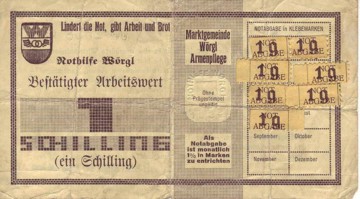
Wörgl bank note with stamps. Public Domain.

Short Introduction

End of growth

The last 200 years have been an era of exceptional economic growth, unlike anything the world has ever seen. Like any exponential phenomenon in a limited room, that growth will end. The best comparison is cancer. If it goes untreated, the host dies. The end of growth, whether it is by death of the host or treatment, has implications for capital, which is addicted to positive returns made possible by squandering planetary reserves. For most of history, there was a shortage of capital. But for the first time, there is a massive excess invested in the bullshit economy, transforming energy and resources into waste and pollution to make money for investors by producing and marketing non-essential products and services in a competition that is about to make humans redundant.

For most of history, economic growth has been negligible. However, it averaged 1.5% over the last two centuries and will soon return to zero, or possibly even lower, perhaps much lower. That has implications for returns on investments, the financial system and interest rates. Investors have become hooked on positive returns, so there must be growth. Otherwise, they lose confidence. It is grow or die, but growth will kill us. And so, we face the prospect of an economic collapse and a collapse of civilisation. We are near a technological-ecological apocalypse. There is a dark force operating behind the scenes that makes us commit suicide. It is usury, or the charging of interest on debts. It makes capital addicted to growth.

The survivors may debate the precise cause of the collapse. I have already received a newsletter email from a pundit claiming that a lack of very cheap oil is leading to debt problems. Future generations may blame the planet for being finite, rather than seeing that human beings were so foolish as to build their civilisation on usury, so that it can only survive through economic growth. Before modern times, humans managed to live without economic growth, as there was hardly any capital and no interest-bearing debt. Past civilisations facing usury-induced economic collapses either disappeared, banned interest, or instituted debt cancellations.

The past 200 years have indeed been exceptional, and that miracle was primarily due to low interest rates. Efficient financial markets promoted growth by depressing interest rates, allowing economic growth to finance the interest. That has blinded us from the financial apocalypse that is upon us. Low interest rates have already brought us unprecedented wealth, albeit at the expense of the planet and future generations. When economic growth returns to sustainable levels, the interest on outstanding debt can collapse the world economy and bring down human civilisation. Luckily, a usury-free financial system for a future without growth already exists: Natural Money.

The nature of usury

Suppose Jesus’ mother had opened a retirement account for Jesus just after his birth in 1 AD at the Bank of the Money Changers next to the Temple in Jerusalem. Suppose she had put a small gold coin weighing three grammes in Jesus’ retirement account at 4% interest. Jesus never retired, but he promised to return. Suppose now that the bank held the money for this eventuality. How much gold would there be in the account in the year 2020? It would be an amount of gold weighing twelve million times the mass of the Earth. There isn’t enough gold to pay out Jesus if he returns.

And so the usurers hope he doesn’t come back, also for other reasons, of course. And for every lending, there is borrowing. The bank is merely an intermediary. There must be people in debt for an amount of gold weighing twelve million times the mass of the Earth. That would never happen. The scheme would have collapsed long before that, and the debtors would have become the serfs of the money lenders. That is why religions like Christianity and Islam forbade charging interest on money or debts.

The usurers have found a way around the issue. Our money isn’t gold anymore. Banks create money from thin air, so the nature of usury has changed. When you go to a bank and take out a loan, such as a car loan, you get a deposit and a debt, which the bank creates on the spot through two bookkeeping entries. You keep the debt, but the deposit becomes someone else’s money once you purchase the car. When you repay the loan, the deposit and the debt vanish into thin air. You must repay the loan with interest. If the interest rate is 5% and you have borrowed €100 for a year, you must return €105.

Nearly all the money we use is created from loans that borrowers must repay with interest. If our borrowing creates money, and we repay our debts with interest, then we may do so by borrowing the interest. That is also what happens in reality, and that is why debt levels continue to rise. So, where does the extra €5 come from? Here are the options:

  • Borrowers borrow more.
  • Depositors spend some of their balance.
  • Borrowers fail to repay their loans.
  • The government borrows more.
  • The central bank prints the money.

Problems arise when borrowers don’t borrow more, and depositors don’t spend their money. In that case, borrowers as a group are short of funds, and some of them are unable to repay their loans. If too many borrowers can’t pay at once, a financial crisis occurs. To prevent that from happening, the government borrows more, and the central bank prints money. They bring that money into the economy, allowing debtors to pay off their debts with interest. Interest compounds to infinity, and there is no limit to human imagination, so frivolous accounting schemes can go a long way before they collapse.

Necessity of interest

We take interest for granted, and economists believe that the economy needs it. Without lending and borrowing, a modern capitalist economy would have been impossible; without interest, loans would also be impossible. Money is to the economy what blood is to the body. If lending and borrowing halt, money stops flowing, and the economy comes to a standstill. That is like a cardiac arrest, which, if untreated, is fatal. And that is also why the financial press reads the lips of central bankers as if our lives depended on it. They manage the flow. Lenders have reasons to demand interest. These are:

  • When you lend out money, you can’t use it yourself. That is inconvenient. And so, you expect compensation for the use of your money.
  • The borrower may not repay the loan, so you desire compensation for that risk.
  • You can invest your money and earn a return. To lenders, the interest rate must be attractive relative to other investments.

That has been the case for a long time, and economists have gradually become quite good at explaining the past. Since then, we have seen financial innovations and are now facing the end of growth. Changes in the economy and the economic system may lead to the end of interest on money and debts. These are:

  • You can use the money in a bank account at any time. You can use the money you have lent as if it were cash. And a debit card is more convenient than cash.
  • Banks spread their risks, central banks help out banks when needed, and governments guarantee bank deposits, so bank deposits are as safe as cash.
  • There is a global savings glut. There are ample savings and limited investment options, which can make lending at negative interest rates attractive.

Negative interest rates are possible. In the late 2010s and early 2020s, the proof came when most of Europe entered negative interest-rate territory. The ECB was unable to set interest rates below -0.5%. Had it set interest rates even lower, account holders would have emptied their bank accounts and stuffed their mattresses with banknotes to avoid paying interest on their deposits, disrupting the circular flows.

As interest rates couldn’t go lower, the ECB took extraordinary measures, flooding the banking system with new money to boost the economy. Had there been a holding fee on cash, interest rates could have gone lower, and there would have been no need to print money. It has happened before. The Austrian town of Wörgl charged a holding fee on banknotes during the Great Depression, which led to an economic miracle by making existing banknotes circulate better rather than printing new money. Ancient Egypt had a similar payment system for over a thousand years during the time of the Pharaohs.

Miracle of Wörgl

In the midst of the Great Depression, the Austrian town of Wörgl was in dire straits and prepared to try anything. Of its population of 4,500, 1,500 people were jobless, and 200 families were penniless. Mayor Michael Unterguggenberger had a list of projects he wanted to accomplish, but there wasn’t enough money to fund them all. These projects included paving roads, installing street lights, extending water distribution throughout the town, and planting trees along the streets.1

Rather than spending the remaining 32,000 Austrian Schilling in the town’s coffers to start these projects, he deposited them in a local savings bank as a guarantee to back the issue of a currency known as stamp scrip. A crucial feature of this money was the holding fee. The Wörgl money required a monthly stamp on the circulating notes to keep them valid, amounting to 1% of the note’s value. The Argentine businessman Silvio Gesell first proposed this idea in his book The Natural Economic Order.2

Nobody wanted to pay for the monthly stamps, so everyone spent the notes they received. The 32,000 schilling deposit allowed anyone to exchange scrip for 98 per cent of its value in schillings. Few did this because the scrip was worth one Austrian schilling after buying a new stamp. But the townspeople didn’t keep more scrip than they needed. Only 5,000 schillings circulated. The stamp fees paid for a soup kitchen that fed 220 families.1

The municipality carried out the works, including the construction of houses, a reservoir, a ski jump, and a bridge. The key to this success was the circulation of scrip money within the local economy. It circulated fourteen times as often as the schilling. It increased trade and employment. Unemployment in Wörgl decreased while it rose in the rest of Austria. Six neighbouring villages successfully copied the idea. The French Prime Minister, Édouard Daladier, visited the town to witness the ‘miracle of Wörgl’ himself.1

In January 1933, the neighbouring city of Kitzbühel copied the idea. In June 1933, Mayor Unterguggenberger addressed a meeting with representatives from 170 Austrian towns and villages. Two hundred Austrian townships were interested in introducing scrip money. At this point, the central bank decided to ban scrip money.1 The depression returned, and in 1938, the Austrians turned to Hitler, as they voted to join Germany.

Since then, several local scrip monies have circulated, but none has been as successful as the one in Wörgl. In Wörgl, the payment of taxes in arrears generated additional revenue for the town council, which it then spent on public projects. Once the townspeople had paid their taxes, they would have run out of spending options and might have exchanged their scrip for schillings to avoid paying for the stamps. That never happened because the central bank halted the project.

The economy of Wörgl did well because the holding fee kept the existing money circulating. A negative interest rate encourages people to spend their money, eliminating the need to borrow and keeping the money circulating in the economy. It demonstrated that the economy required a negative interest rate. A holding fee makes negative interest rates possible, as lenders do not have to pay it after lending the money. The one who holds the money pays the charge. That can make lending money at an interest rate of -2% to a reliable borrower more attractive than paying 12% for the stamps.

Joseph in Egypt

In the time of the Pharaohs, the Egyptian state operated granaries for over 1,500 years. Wheat and barley were the primary food sources in Egypt. Whenever farmers brought their harvest to one of the granaries, state officials issued them receipts stating the amount of grain they had brought in. Egyptians held accounts at the granaries. They transferred grain to others as payment or withdrew grain after paying the storage cost.

The Egyptians thus used grain stored in their granaries for making payments. Everyone needed to eat, so grain stored in the granaries had value.1 Due to storage costs, the money gradually lost its value. With this kind of money, you might have interest-free loans. If you save grain money, you pay for storage. And so, lending the money interest-free to a trustworthy borrower can be attractive. There is no evidence that this happened.

The origin of these granaries remains unclear. Probably, the state collected a portion of the harvests as taxes and stored them in its facilities. The government storage proved convenient for farmers, as it relieved them of the work of storing and selling their produce. And it made sense to have a public grain reserve in case of harvest failures.

The Bible features a tale that supposedly explains the origin of these granaries. As the story goes, a Pharaoh once had a few dreams that his advisers couldn’t explain. He dreamed about seven lean cows eating seven fat cows and seven thin, blasted ears of grain devouring seven full ears of grain. A Jewish fellow named Joseph explained those dreams to the Pharaoh. He told the Pharaoh that seven years of good harvests would follow, followed by seven years of crop failures. Joseph advised the Egyptians to store food for meagre times. They followed his advice and built storehouses for grain. In this way, Egypt managed to survive seven years of scarcity.

The money gradually lost value to cover the storage cost of the grain. It works like buying stamps to keep the money valid, like in Wörgl. Both are holding fees. The grain money circulated for over 1,500 years until the Romans conquered Egypt around 40 BC. It did not end in a debt crisis, which suggests that a holding fee on money or negative interest rates can create a stable financial system that lasts forever.

Storing food makes sense today, even when it costs money. Harvests may become more unpredictable due to global warming and intensive farming. We only have enough food in storage to feed humanity for a few months as it is unprofitable to store more. Food storage ties up capital, so there is also interest cost. But you can’t eat money, so storing food to deal with harvest failures is as sensible now as it was in the time of the Pharaohs. It reveals the stupidity of our current thinking. Our survival needs to be financially viable. Just imagine how that will play out once artificial intelligence and robots can replace us.

Natural Money

The miracle of Wörgl suggests that a currency with a holding fee could have ended the Great Depression. A myth circulating in the interest-free currency movement is that had the Austrian central bank not banned the experiment, the Great Depression would have ended, Hitler wouldn’t have come to power, and World War II wouldn’t have happened. That is a tad imaginative, to say the least, but a holding fee could have allowed for negative interest rates, and they could have prevented the Great Depression from starting in the first place. That is a lot of maybes.

And such money can last. The grain money in ancient Egypt provided a stable financial system for over 1,000 years. The grain backing provided financial discipline. The holding fee prevented money hoarding that could have impeded the flow of money. The money, however, didn’t promote interest-free lending, so the Egyptian state regulated lending at interest to prevent debt slavery. Egyptian wisdom literature condemned greed and exploitative lending, encouraging empathy for vulnerable individuals.

A holding fee of 10-12% per year punishes cash users. If the interest rate on bank accounts is -2%, an interest rate of -3% on cash is sufficient to prevent people from withdrawing their money from the bank. That becomes possible once cash is a separate currency backed by the government, on which the interest rate on short-term government debt applies. Banknotes and coins thus become separate from the administrative currency. So, if the interest rate on the cash currency is -3%, one cash euro will be worth 0.97 administrative euros after one year. And now, we have a definition of Natural Money:

  • Cash is a separate currency backed by short-term government debt and has the negative interest rate of short-term government debt.
  • Natural Money administrative currencies carry a holding fee of 10-12% per year, allowing for negative interest rates.
  • Loans, including bank loans, have negative interest rates. Zero is the maximum interest rate on debts.

Consequences

Natural Money doesn’t fundamentally alter the nature of bank lending. Banks borrow from depositors at a lower rate to lend it at a higher rate. With Natural Money, banks may offer deposit interest rates of -2% to lend it at 0% instead of borrowing it at 2% to lend it at 4%. A maximum interest rate of zero, however, has a profound impact on lending volume, as it severely constrains it, most notably speculative lending and usurious consumer credit, and it favours equity financing over borrowing in business. The strict lending requirements affect business loans, leading to deleveraging.

Businesses still need to attract capital. To address the issue, Natural Money features a distinction between regular banks and investment banks. Regular banks can guarantee promised returns and have government backing because the payment system is a public service. Investment banks invest in businesses and take risks. They are comparable to Islamic banks. Investment banks don’t guarantee returns. Depositors take on risk to get better returns, but they might incur losses or temporarily have no access to their deposits.

While the maximum interest rate restricts lending, the holding fee provides a stimulus, thereby stabilising the financial system. When the economy slows down, interest rates decrease, and more money becomes available for lending as risk appetite increases, making lending at zero interest more attractive. Conversely, if the economy booms, interest rates increase, and the maximum interest rate curtails lending. Consequently, central banks don’t need to set interest rates and manage the money supply, and governments don’t need to manage aggregate demand with their spending.

Reasons to do research

Stamp scrip and other kinds of emergency money have helped communities in times of economic crisis. The economic miracle of Wörgl during the Great Depression of the 1930s, however, was exceptional. The payment of local taxes inflated the impact of the money. Many townspeople had been late on their taxes, but once the economy recovered, they had the money to pay them. Some even paid their taxes in advance to avoid paying the holding fee. It generated additional revenues for the town, which it could spend on the projects. It provided a boost that would have petered out once the villagers had paid their taxes.3 It was not a miracle. It was too good to be true. Still, there is more to it.

Once interest rates reach zero, the markets for money and capital cease to function as interest rates can’t go lower. Money is to an economy what blood is to a body, so it must flow. When the money stops flowing, the effect is like a cardiac arrest, and the economy is in dead waters. To keep the money circulating, those with a surplus must lend it to those with a deficit, and the interest rate should be where the supply and demand for money are equal. When that interest rate reaches zero, lenders stop lending because the return is not worth the risk, so they wait for interest rates to rise. Money then ends up on the sidelines, leading to cardiac arrest, which can be the start of an economic depression.

It happened during the Great Depression. If interest rates had been lower, the markets for money and capital could have remained in operation. We have seen negative interest rates in Europe for nearly a decade. They could have gone lower had there been a holding fee on cash, or even better, a negative interest rate that is just low enough to prevent people from hoarding it. Once interest rates can go lower, a usury-free global financial system may be possible. That gives rise to several questions. Is it possible? Under which circumstances? What are the benefits and the drawbacks? What are the implications for individuals, businesses and governments? And how does it affect the financial system?

There is no alternative

Several other monetary reform proposals do not view the financial system as a system, which it is, and that isn’t hard to guess because the term ‘financial system’ already implies this. You can’t attach the wings of a Boeing to an Airbus and expect the thing to fly. The financial system is a complex system with numerous relationships, many of which existing reform proposals overlook. For instance, if you end the central bank, the economy will crash immediately, even if it is flying smoothly. And that isn’t even hard to find out.

The payment system is a key public interest, so governments and central banks stand behind it. Most banks are private corporations driven by profit. They take risks that might bring down the economy. And so, governments and central banks make regulations and oversee the banks. And banks create money, from which they profit, and we all pay for it via inflation. That is not good, but replacing the system with something worse is worse, like the word ‘worse’ implies.

There is no lack of ill-conceived proposals. And most fail to address the primary underlying cause of the dysfunction of the financial system, which is charging interest on money and debts, commonly known as usury. An inflation-free, stable financial system is possible. It may not even need central banks. But a sound reform proposal sees the financial system as a complex system with intricate relationships that interact with one another.

And so, Natural Money comes with a systems approach that aims to uncover the relevant relationships in the financial system and the consequences of changing them. It means that Natural Money is a comprehensive design. The gravest error you can make is to pick only the elements you like. That design will never fly. Nor would an Airbus take off with Boeing wings. So, you either buy Airbus or Boeing. In the case of Natural Money, that is not an option. There is no alternative.

Latest revision: 1 November 2025

Featured image: Wörgl bank notes with stamps

1. The Future Of Money. Bernard Lietaer (2002). Cornerstone / Cornerstone Ras.
2. The Natural Economic Order. Silvio Gesell (1918).
3. A Free Money Miracle? Jonathan Goodwin (2013). Mises.org.

Banking Operations

Commercial versus savings banks

Historically, the banking sector comprised several types of banks. The distinction between commercial banks, which create money, and savings banks, which don’t, has lost its value due to the existence of efficient financial markets, where banks match terms through borrowing and lending. The distinction between created money and savings is arbitrary, as the following example demonstrates. Suppose that I work at a farm, and the farmer rewards me with a plot of land and leftover wood and materials from a defunct shed, which I use to build my home. After finishing my house, I go to the bank and take out a mortgage. The bank creates money out of thin air.

Until I went to the bank, no money had changed hands. Still, I was able to save for a home of my own. In other words, savings aren’t the same as money in a savings account. In this case, my savings are my home, and if the mortgage is a debt, the money I take out is my savings. To further illustrate the point, suppose that I have no money and also own no home. When I go to the bank for a car loan, the bank creates this money on the spot. If you think there are no savings, you are wrong again. The person who sold you the car had saved the car. I can even borrow money and put it in a savings account. And so, I created savings from thin air by borrowing money and lending it to the bank.

Full-reserve banking

A well-known monetary reform proposal is full reserve banking, as outlined in the Chicago Plan, which means there are only savings banks and no commercial banks that create money. It often resurfaces when banks go bankrupt. With full reserve banking, banks can’t lend out funds deposited in demand accounts or current accounts. Money in these accounts isn’t debt but backed by central bank currency or cash. And depositors can’t withdraw the money from their savings accounts on short notice. In this way, banks can’t go bankrupt because of depositors demanding payment in cash. With full reserve banking, loans must come from savings, which are funds that depositors can’t withdraw on demand, as they have entrusted them to the bank for an extended period.

Lack of cash is usually not the primary reason banks fail, but rather, loan write-offs. That was also the case during the 2008 financial crisis. Full reserve banking addresses a liquidity problem, whereas the crisis was a solvency issue that subsequently led to a liquidity issue. Banks ran into trouble, not because they lacked cash, but because they incurred losses on their loans. As a result, banks began to distrust one another and stopped lending to each other. The financial system can be safe with zero reserve banking, provided that banks are solvent, thus have sufficient capital, and own adequate liquid assets, such as government bonds, that they can sell to meet withdrawals. And so, a reserve requirement can better include liquid safe assets, such as government bonds, rather than currency alone.

Some proponents of full reserve banking are socialists who oppose privately controlled money creation, as they view it as a public subsidy to the private banking sector. Others desire a banking sector free from government interference, so a ‘free’ banking market without central bank interventions and deposit guarantees. At least that is something socialists and their opponents might agree on. Bank credit can contribute to economic cycles and financial crises. With full reserve banking, there would be less bank credit, and interest rates would be higher. To make lending possible, depositors must part with their money for a designated period of time to make it available for lending. As a result, fewer funds are available for lending, and interest rates would be higher.

Shadow banks

Full-reserve banking makes financial markets less efficient, allowing alternative schemes, such as shadow banks, to fill the gap. An example can illustrate that. Suppose that God has ordered banks only to use money in savings accounts for lending so that there is full reserve banking in Paradise. Eve and Adam only do business with each other. Both have €100 in their current account, which they use for their daily business transactions. This money is suitable for payment because it is in the current account. For that reason, they don’t receive interest. Assume now that the bank also offers savings accounts with an interest rate of 4% but money in savings accounts isn’t suitable for payment.

Then a financial advisor comes along, disguised as a snake, advising Eve and Adam for a reasonable fee on how to manage their payments between themselves and to deposit their money into a savings account. So, what you now read in Genesis is made up by bankers to hide their fraud, a conspiracy theorist might infer. But it is just a story. In this way, Eve and Adam both earn interest on their €100. They give each other credit, so that Eve can borrow €100 from Adam, and Adam can borrow €100 from Eve. They don’t need to keep money in their current accounts, so they deposit their funds into a savings account and earn interest. Everybody wins, Eve, Adam, and of course, that snakelike creature.

Initially, Eve and Adam had no savings, only money in their current accounts. The advisor’s scheme allows them to fabricate savings out of credit. It seems like creating money, but Eve and Adam gave each other credit. They agreed to pay later, which exposed both to credit risk. One of them might not repay because you can do so many different things with €100 than put it in a savings account. You can use credit, which is an agreement to pay later, and use it like money. And so, Paradise was lost. Similar schemes exist on a larger scale. These are shadow banks. Shadow banks don’t create money but credit. The difference between fractional reserve money and this type of credit may not be significant in practice, except that it is unregulated, resulting in little oversight.

When banks create money, they do the same. The banks act as intermediaries between Eve and Adam, allowing them to lend money to each other even when they do not conduct business with each other or do not trust each other. The bank also assumes the risk that a debtor will fail to repay and receives a reward in the form of interest. It is also credit, but we refer to it as money because the law regards bank credit as legal tender, thus money. The government backs this scheme, as a stable financial system is a key public interest. Banks must have sufficient capital and reserves to meet emergencies. For that reason, banks are subject to regulations, while shadow banks are not subject to these rules, allowing the latter to offer more competitive interest rates.

As a result, the role of traditional banking has declined. Large corporations could lend and borrow in money markets at rates better than those offered by banks. At the same time, retail investors could invest directly in money markets and get better yields than banks offer. This development started with corporate borrowing. It later expanded into mortgages. The primary reason for regulating banks is that they operate the payment system, which is of public interest, and can borrow from the Federal Reserve. It prompted banks to strip their balance sheets and expose themselves to off-balance sheet risks to generate higher returns on their capital. For instance, offering an emergency credit line to a shadow bank generated profits while not appearing on the balance sheet.

The 2008 financial crisis originated in shadow banks that invested in risky assets, rather than conventional banks that create money through lending. Shadow banks aren’t subject to the same regulations as traditional banks, so they made speculative investments in mortgages. These investments appeared safe because rating agencies failed to do their jobs. Regular banks encountered trouble because they had backed shadow banks, hoping to reap a quick profit from credit insurance. The word they use is off-balance sheet financing. The regular bank didn’t lend money, but guaranteed credit to shadow banks in case of emergency, which is as dangerous as keeping the mortgages on its own balance sheet. But that was legal. It allowed banks to make more money from the same capital. Money creation, therefore, wasn’t the problem, and replacing regular banks with shadow banks could further destabilise the financial system.

If a financial crisis were to occur with loan write-offs, full reserve banking would only ensure that money in current accounts is safe. However, the same problems would emerge in savings accounts. Savings banks can expose themselves to off-balance sheet risks, unless that is forbidden. And they can also go belly up. And they did. If the debtors of a bank fail to meet their obligations, the bank may face financial difficulties, and the savings it holds may be at risk. Also, with full reserve banking, governments and central banks may end up supporting savings banks and even shadow banks to ensure financial stability, thereby rendering the benefits of full reserve banking void. After all, the initial cause was never a liquidity problem, but a solvency issue.

Commercial versus investment banks

The Glass-Steagall Act in the United States severed linkages between regular banking and investment activities that contributed to the 1929 stock market crash and the ensuing depression. Separating banking from investing can prevent banks from providing loans to corporations in which they have invested. The measure aimed to make bankers more prudent. The separation of commercial and investment banking prevented securities firms and investment banks from taking deposits. The reason for the separation was the conflict of interest that arose from banks investing in securities with their own assets, which were their account holders’ deposits. Banks were obliged to protect the account holder’s deposits and should not engage in speculative activities.

The Glass-Steagall Act included the Federal Deposit Insurance Corporation (FDIC), which guaranteed bank deposits up to a specified limit. It also comprised Regulation Q, which prohibited banks from paying interest on demand deposits and capped interest rates on other deposit products. Maximising interest rates can limit the risks banks are willing to take on loans, as these risks can destabilise the financial system.

Until the 1980s, the legislation mainly remained unchanged. With the rise of neoliberalism, government regulations became increasingly disapproved of. Hence, the Glass-Steagall Act became increasingly disregarded, and diligent deregulators repealed it in 1999 as part of their effort to relieve businesses of government regulations that stood in the way of corporations making profits at the expense of the public good. Regulation Q ceilings for all account types, except demand deposits, were phased out during the 1980s. After the 2008 financial crisis, a renewed interest in the Glass-Steagall Act emerged.

In the United States, money market funds circumvented the limits imposed on banks by Regulation Q, luring depositors with higher interest rates, thereby undermining the prudent banking paradigm. The money market funds, which are shadow banks, invested in collateralised debt obligations (CDOs), such as mortgage-backed securities (MBS). The 2008 financial crisis started in money market funds, not traditional banks.

Natural Money works with the same principles. It distinguishes between regular banks, which provide loans, and investment banks, which are partnerships that invest in equity. Islamic banks also operate similarly. The maximum interest rate of zero works like Regulation Q, aiming to limit the risks banks are willing to take on deposits, as interest is a reward for taking on risk. Banking in a Natural Money financial system works as follows:

  • Regular banks make low-risk loans. The money in these banks is secure. The maximum interest rate is zero. And so, deposits have negative yields.
  • Investment banks don’t lend but participate in businesses by providing equity. They can rent houses and lease cars. Investment banks offer higher returns.
  • Both regular banks and investment banks can invest in government securities to manage their risk and meet withdrawals.
  • Regular banks can promise a fixed interest rate. The government may offer support and deposit guarantees.
  • Investment banks don’t guarantee returns. They pay dividends based on their profits. Its depositors are investors who can face losses.

Natural Money enhances financial stability by favouring equity investments over debt investments. The maximum interest rate makes debt investments less attractive. And there is no reward in the form of interest for engaging in high-risk lending, which enhances the financial system’s stability. It stands to reason that the integrity of the system depends on strict adherence to its principles and the termination of evasive, get-rich-quick schemes of financial parasites, which requires a belief in the vision behind the idea of a usury-free economy. Let’s not dismiss that as a fantasy immediately.

Sanitation of banking

The primary cause of the financial system’s failure is usury. Imagine what a maximum interest rate of zero on debts can do. Only the most creditworthy borrowers can get a loan. You may have to save and bring in equity before applying for a mortgage, and that may be the only credit you can obtain. Even an overdraft may be impossible. That may seem harsh, but it is even worse when indebted consumers reach the point of interest payments and can’t make ends meet. If you want to buy something, you have to save for it. Likewise, corporations need to attract capital rather than debt to meet their liquidity requirements. The financial sector will shrink, and much of modern finance may become redundant.

That said, individuals and businesses may obtain better deals in the money market, allowing them to opt for this option rather than a bank. The distinction between traditional banks and shadow banks may blur. Tradional banks may need fewer regulations while shadow banks may need more. That is because without interest, risk may disappear. The central bank may stand behind the payment system, but it may not have to stand behind the lending system. The implicit guarantee of central banks buying debt and issuing currency with a holding fee means that the warranty will remain unused.

Two other themes emerged during the 2008 financial crisis: ‘too big to fail’ and ‘too complex to understand.’ Complexity and size are the outcome of competition. The failure of a large bank can bring down the financial system, and the products traders in financial markets use to hedge their risks or improve their profitability can be complex. Our future civilisation could be simpler, so the sanitation of the financial system should encompass cooperation, simplification and diversification. It may look as follows:

  • There should be an exhaustive list of all legal financial products and their requirements. We shouldn’t allow other financial products to exist.
  • No bank should hold more than a certain percentage of the global market, and no bank should expose itself to more than a certain percentage of another bank.
  • Banks should share services where scale is crucial, such as technological infrastructure and advanced knowledge.

Smaller banks can achieve efficiency improvements by using the same technological infrastructure. As long as they are independent financial institutions, they may share an IT department and operate their businesses on the same software. It may even be a public infrastructure that all banks share, allowing for significant cost savings, while also sharing knowledge and implementing measures related to issues such as fraud prevention.

Latest revision: 13 November 2025

Featured image: Ara Economicus. Beverly Lussier (2004). Wikimedia Commons. Public Domain.
Fiscal and Monetary Policies

Economic cycles

Mismatches between supply and demand cause economic cycles. A harvest may fail, and food prices may rise, leaving us with less money to spend on other items. Mismatches can concern the supply and demand of money, capital, labour, raw materials or consumer products. Interest charges also contribute to economic cycles. Interest rates reflect the market for funds. If all markets were perfect, economists argue, supply could adapt to demand instantly, and there would be no economic cycles. Not unlike many others, economists love fairy tales about a Paradise where everything is perfect. And so, they may advise us to make markets perfect, so that an economic Paradise will ensue.

Economic cycles occur because mismatches between supply and demand emerge periodically and eventually resolve. Economists use the term equilibrium in their models to explain the relationship between supply, demand, and price, but these models are simplifications of reality. There is rarely a stable equilibrium, and fluctuations in demand and supply cause changes in prices, inventories, and employment. There are several theories and explanations regarding those mismatches, economic cycles, and their effects. Most notably, money, credit and interest deserve attention.

According to Say’s law, supply creates its own demand because we make goods and services to use ourselves or to acquire other goods and services. It is most applicable to a simple barter economy. When money serves as a medium of exchange, we can postpone our purchases, leaving producers with excess inventory. Money hoarding can be a serious problem as it interrupts the circular flow of money. When money loses value, we are less likely to postpone purchases. It is why central banks aim for a bit of inflation. However, inflation shouldn’t be too high, as that can undermine trust in the currency.

Expectations are another factor. When consumers feel good about the future, they are more willing to spend on big-ticket items. Likewise, when investors expect brighter prospects, they anticipate higher profits, making them more willing to invest. Conversely, when consumers and investors are pessimistic, the opposite happens. And so, expectations can become a self-fulfilling prophecy. Likewise, when people expect a bank to collapse, it may collapse because that expectation triggers a bank run. Policy makers try to instil confidence in the system because a lack of confidence can break it. The reason is that credit means trust, and trust is what keeps the system going.

During good times, businesses and individuals tend to be confident. Credit is often available because businesses’ and individuals’ future income projections serve as the basis for banks to lend money. And so, companies and individuals can borrow more in good times. When the economy slows and their incomes decrease, they may struggle to make their interest payments. Consumers would have more disposable income without debt, since they wouldn’t have to pay interest. Similarly, businesses can go bankrupt even when they are profitable overall because of interest charges. And so, interest charges can exacerbate and prolong the bust.

Leverage contributes to the overall risk in financial markets. Liquid financial markets make it easier to enter and exit positions, leading investors to believe it is safe to operate with leverage. If markets were not fluid, leverage would appear more dangerous, as it would be more difficult to exit a position. For example, if you aren’t sure that you can renew your mortgage after five years, you aren’t going to buy a home. Liquidity enables risk-taking, allowing the overall level of risk in the financial system to increase. That can become apparent during a crisis. People who have to sell their home during a housing crisis may end up selling it at a low price, leaving them with a debt that takes years to repay. Therefore, maintaining a liquid market is crucial for its safety, and limiting leverage further enhances its security.

Bureaucratic interventions

In the wake of the Great Depression and World War II, government and central bank interventions have become standard tools for bureaucrats to manage the capitalist economy. Fiscal policies involve steering the economy through government expenditures. Ideally, it works as follows. When the economy is performing poorly due to sluggish demand, the government increases spending to boost demand. Conversely, when the economy is overheating due to excessive demand, the government reduces spending to curb demand. Likewise, central banks can lower interest rates to promote borrowing and boost demand, or raise interest rates to discourage lending and curb demand. These policies can have the following undesirable consequences:

  • The timing of the measures may be off, so when the measure has been decided upon and is taking effect, the economy may already be on the desired path.
  • Politicians may interfere and press for increased government spending or lower interest rates to boost the economy and get them re-elected.
  • Central bank interventions cause market participants to take more risk because they expect the central bank to intervene.
  • Due to usury, debt levels increase, so once these policies are commonplace, there are no corrections to cleanse the system from its excesses.

By failing to periodically cleanse the financial system of its excesses, either through a debt jubilee or an economic depression, the economy becomes addicted to credit expansion, and the final collapse will be even more severe. As the US dollar is the world’s reserve currency, a collapse in trust in this currency can trigger a global economic apocalypse. Usury is the primary reason for fiscal and monetary policies, because interest on money and debts generates a money shortage, driving a demand for credit. Debtors must repay more than they borrowed, but that extra money doesn’t exist. And so, governments and central banks fill the gap to prevent the usury scheme from collapsing.

Due to usury, it has become a permanent requirement. To prevent a shortage of money or a liquidity crunch from materialising, governments borrow, and central banks print money. The shortage arises when the private sector fails to borrow enough to cover the interest on existing debts. To counter the problem, the government can borrow and spend this money. Central banks can lower interest rates to make borrowing more attractive. They do so by buying up government debt, thereby decreasing the supply of government debt and increasing the supply of currency, which lowers interest rates because there are fewer debts and more currency to buy them with.

Economists assume that there is a natural interest rate at which the economy grows at its trend rate while inflation is stable. There is no direct way to measure or calculate the natural interest rate. Economists estimate it using their theories and models. The elusive natural interest rate is a crucial element in central bank decisions. The natural interest rate may differ from the actual interest rate due to credit in the financial system. Deviations from this rate trigger booms and busts. The interest rate below the natural rate can generate a boom. In that case, people borrow too much because interest rates are too low, leading to overspending and overinvesting. An interest rate above the natural rate can lead to a bust, resulting in underinvestment and underspending. By setting short-term interest rates and thereby influencing long-term rates, central banks steer credit creation.

The economy can do well by itself

With Natural Money, the economy can manage itself, making fiscal and monetary policies redundant. The holding fee removes the zero-lower bound, providing stimulus during economic slumps. The maximum interest rate curbs lending during economic booms, providing austerity. That mitigates business cycles. And so there will be fewer debt overhangs and financial crises. The market, combined with the price control of the zero upper bound, steers interest rates and the money supply, thereby reducing the role of central banks. The central bank’s currency will then become a unit of account or administrative currency. Natural Money has the following favourable consequences:

  • The holding fee on currency allows for negative interest rates to provide a stimulus, while the maximum interest rate provides austerity by curbing lending.
  • As interest is also a reward for taking risks, a maximum interest rate will take away the incentive to take risks and limit lending to the safest borrowers.
  • In the absence of usury, debt levels don’t increase, while only the safest borrowers can borrow, resulting in fewer bad debts.

There is no need for governments to engage in deficit spending, except to provide liquidity in financial markets, as government debt, rather than administrative currency, serves as a form of liquidity. The holding fee makes it unattractive to own administrative currency. Provided their finances are sound, governments can borrow at negative interest rates and earn interest on their debts. They could aim for the debt level giving the highest interest income. If market participants are willing to lend at -1% when government debt is 100% of GDP and at -2% when government debt is at 70% of GDP, the government could harvest 1% of GDP in the former case and 1.4% of GDP in the latter case.

It will be the end of fiscal and monetary policies. The economy will manage itself. Interest payments don’t create a need to add additional debts. Governments may step in during a crisis to restore trust in the financial system and the economy, but whether such intervention will be necessary is unclear, as there will likely be fewer crises. Natural Money also doesn’t require central banks to do more than handle the daily transactions between banks, as the holding fee terminates the demand for the central bank’s currency.

Latest revision: 12 November 2025

Der Untergang der Titanic. Willy Stöwer (1912)

Harbinger of Things to Come

In 2006 or 2007, a software upgrade of the disk controllers on the principal systems went wrong. For a week, they were out of operation. It was one of the biggest crises in the history of the government office, and perhaps the biggest of all. At the time, Kees and I were working on the systems renewal project at another location. The other database administrators dealt with the issue, as did many others. I knew there was a serious problem as we received regular updates by email, but I didn’t realise how serious it was. After a week, the telephone rang at home. It was 9 PM. My wife, Ingrid, took up the phone. It was the IT director. He said there was an emergency and asked me to come to the office. His voice reflected fear. ‘As if the Titanic had hit the iceberg,’ Ingrid later noted.

I hurried to the office and arrived by 9:30 PM. Many people were still in. It was a massive crisis. There was an atmosphere of fear. The database administrator on duty, Dirk-Jan, brought me up to speed. I searched the database log files, found the error messages, and typed them into the Google search bar. In this way, I found a document on the Internet with the remedy. I then repaired the failures and brought the systems online one by one. Board members and senior managers were standing around me, watching me type. Solving the issue wasn’t complicated, but few people used Google to find the answer at the time.

I learned that the last backup was over a week old, and the mirror copy was offline. You may know what backups are and why you might need them, but you may not know what a mirror copy is. A mirror copy is a safety measure. If you own a computer or a mobile phone, it contains data. That data is on a device. In the early 2000s, it was usually a hard disk. If that disk fails, your data may be gone forever. If you lose some photographs of your late cat, you might feel sad about it, but after a few years, you get over it, perhaps after consulting your psychiatrist and taking a lot of pills.

Corporations can’t afford to lose their data. That would bankrupt them. Their business is their data. Without it, they are out of business. If you have a backup, only the data from after the latest backup may be lost, but that can still kill you, most notably if you haven’t made a backup for a week. We were a government agency, so it wouldn’t have bankrupted us, but it would have been a national political scandal.

Corporate computers have multiple data storage groups in different locations. If one group catches fire or stops operating because of a failed software upgrade, the other groups still have the data. These groups are called mirror copies. We had two groups: the original and the mirror. You can imagine my bewilderment. We had no backup, and the copy wasn’t available. So much had gone wrong that it was a miracle that I succeeded in recovering all the data. But having no mirror and no backup meant we were still on the brink.

An even greater surprise was yet to come. The managers and the board wanted to return to business as usual and run the backlog of batch jobs. Then I said, ‘This is perhaps the most important advice I will ever give in my entire career. Don’t start the batch jobs yet. We are on the proverbial edge of the precipice. Running the jobs might just push us over. Everything went wrong for a week and there is no guarantee whatsoever that it will be all right now. We should bring the mirror copy back online and make a backup first.’

They planned to ignore my advice. Bringing the mirror copy back online and taking a backup would take eighteen hours of precious time. It was a lot of data to back up, as it was everything we had. I was a low-ranking official while the IT director had claimed there was nothing to worry about. But he had left the building. I kept stressing that making a backup was the right thing to do. ‘If something goes wrong that could finish us,’ I told them. It was the worst crisis ever. And so, I pressed for an extensive check-up to see if everything was in order. On that, they could agree.

During the check-up, I found another failure that everyone had overlooked. That scared the managers and the board, prompting them to start another meeting. And then they followed my advice. The IT director was no longer there, and they faced a determined saviour who told them in no uncertain terms that they were about to do something stupid. The operators brought the mirror copy online and made a backup before we resumed normal operations. In this way, rational decision-making prevailed. Nothing went wrong anymore, but no one could have known that beforehand.

If it had gone wrong, the agency probably would have survived. Operations would likely have had to stop for several weeks—that had already happened for a week—and it may have been impossible to recover all the data. That would have made the headlines. But it never came to that. When the journalists of the local newspaper smelled a rat, the board could tell these journalists that the situation was under control and that the data was safe. My wife’s comparison of this situation with the Titanic having hit the iceberg was not entirely apt. Saving the Titanic once it had hit the iceberg was technically impossible. It would have required a miracle. What I did may have appeared to be a miracle, but it was technically possible.

The audit department later evaluated the crisis. The auditors noted that after a week of failures, all the problems suddenly vanished, which they found already hard to believe. What they found even more difficult to fathom, and they stressed the inconceivability of it during a meeting, was that after a week of irrational decision-making, sanity suddenly took hold as we had brought the mirror copy back online and made a backup. They couldn’t figure out why that happened. Our management had kept them entirely in the dark. I didn’t enlighten them either, as it would make our management and board appear incompetent.

My manager, Geert, complimented me for handling the situation. He stressed that my colleagues had been content with me. ‘I was a pleasant colleague,’ he added. Strangely enough, Geert didn’t say something like, ‘Your contribution was critical in saving us from a disaster.’ It reveals something about Geert’s thinking. To him, it was teamwork. Geert wasn’t present that evening, so he may not have learned the details of what transpired. And so, it didn’t help my career. A few years later, the other senior database administrators received a higher salary grade, but I did not. Geert was involved in that decision.

When the office was on the brink, I knew what to do and was determined not to let the ship sink. Our management and the board were clueless and had lost it. Fear gripped them, making them listen to reason. Now it seems that my dealing with the crisis could be a harbinger of things to come.

Latest revision: 4 August 2025

Featured image: Der Untergang der Titanic. Willy Stöwer (1912). Wikimedia Commons. Public Domain.

Confucius. Gouache on paper (ca 1770)

Fairness Matters

Working in groups and sharing

Humans are social animals that operate in groups. We share the workload and the fruits of our efforts, which might be a band of hunter-gatherers, a corporation or a society. We make agreements on who does what and who gets what. That is the social contract. Otherwise, we can’t work together. It helps if we think the social contract is fair. Violations of fairness provoke strong feelings. What is fair isn’t always straightforward. Some people contribute more to the effort than others, which can be either due to willingness or ability. And some people have more needs than others.

A study demonstrated that monkeys also have an idea of fairness. If one ape received less valuable rewards for the same work than its partner, such as less tasty foods, it could become angry and reject the reward. You can become frustrated if you feel your partner gets a better reward for the same job.1

Children have a sense of fairness early on. Giving one individual more than another without reason can surprise toddlers as young as fifteen months old. Children also wish to see you help those they like and harm those they dislike, such as children who do not share their food preferences. Young children already prefer people similar to them (the in-group) to children who are different (the out-group).1 Many people believe it is perfectly fine when those they dislike receive unfair treatment. As young children already have it, it could be a natural inclination that we can unlearn.

We may believe those who contribute more to a group’s success deserve more, for instance, if a venture’s success hinges on a single person’s skills or efforts. That is the excuse for high pay for CEOs of large corporations. Business is a competitive environment, and a CEO can make a difference while a factory worker can’t. When we cooperate, we are more willing to share, but in a competition, we are more willing to accept inequality. In sports, the winner gets everything. But if a team wins, the members share the prize, even if some talented players decide the outcome.

Innate or learned

The golden rule says you should treat others the way you want them to treat you. But is that rule innate or learned? If our sense of fairness is innate, moral rules apply to everyone. If it is learned behaviour, fairness is a matter of taste. If someone is helpful, we react positively. If someone acts harmfully, we react negatively. Infants already do that. An experiment involving toddlers and two puppets, one friendly and helpful, and the other mean and harmful, demonstrated that toddlers more frequently chose the friendly puppet as their preferred toy.1

Some of our ideas regarding fairness are learned or cultural, and some are innate or natural. Researchers tested children in seven cultures (Canada, India, Mexico, Peru, Senegal, Uganda, and the US). They could get candy by pulling a lever. One child pulled the lever, which could give both children the candy or drop it in a box, so both got nothing. The rewards were unequal, sometimes to the advantage and sometimes to the disadvantage of the lever-pulling child.1

The children always reject deals that are unfavourable for themselves. They might accept receiving more than the other child, but never agree to getting less than the other child. In some cultures, older children also reject unfairly advantageous options for themselves. That happened in some countries but not in others. Refusing a bad deal may be a natural human instinct, but forgoing a good deal that is unfair could be a learned behaviour and a cultural norm.1

The mistakes we make

Are poor people responsible for their choices? And what is the influence of choice? During an experiment with pairs of students who did a task together, one received the pay. It was a random pick. Those who received the pay could choose how much they would give the other. Receiving pay was a matter of luck, and most people believed it was unfair, so they were often willing to share.

Adding a choice, for instance, between getting a small reward or participating in a lottery to get the full reward, changes the picture. The participants were less willing to share. If both participants opted to participate in the lottery, we think it is fair that one of them wins. People often think poverty is a choice, as poor people decide not to get an education or divorce and, as a result, cannot work full-time.1

They made these choices, but what were the alternatives? Possibly, the small reward was not enough to live off, so you had to participate in the lottery to have a chance of paying the bills. Or, the alternative to divorce was living with an abusive spouse. Perhaps a good education was too expensive for you, or you were unqualified. But poor people also have options and can influence their lives.1

If we do not reap the consequences of our choices, choices don’t matter. And that is also unfair. That becomes clearer if two individuals have similar opportunities but make different choices. If one decides to spend his money while the other person saves for retirement, we think it is unfair to tax the latter to pay for the retirement of the former. In this case, it might be better not to have options and a mandatory retirement savings scheme.

Liberals in the United States focus on equality so different groups get equal outcomes, but ethnic differences in health, education and wealth remain. Some ethnic groups work harder, divorce less and invest more in their children’s education. Conservatives think working hard and making the right choices should make you better off. Some societies invest in equal opportunities, for instance, by investing in the education of underprivileged children, but conservatives do not like to pay taxes for that.

Luck is everywhere

Your place of birth, the upbringing you received, your education, and the opportunities you had in life determine for a large part your success in society. Successful people usually think their brilliance and hard work brought them there. That is half the story. Your efforts matter, but your talents are a matter of luck. Luck conflicts with fairness. There are many other instances of luck. Some live long, some die early, some have love, some are alone, some are healthy, and some are sick. Luck is part of life. Luck is a privilege. And you may only realise that when you are an unlucky person.

If we can eliminate luck, that would be fairer. But not rewarding talent, even when it is the result of luck, can result in bad outcomes. If a group’s success depends on the brave, the hard-working or the talented, we think they deserve an extra reward. It can inspire them to do their utmost. It is why low-skilled labourers receive low wages. Wages above the market price can bankrupt the business if there is intense competition. That is why minimum wages exist to mitigate the unfair consequences of luck.

Fairness connects to cooperation and inclusiveness. Inequality relates to competition, winners and losers. And we need cooperation as well as competition. In a village economy with little outside trade, villagers can distribute the fruits of their endeavours in ways they see fit. They can weigh issues that the market cannot, such as effort. There are exchanges where members can trade goods and services outside the market economy. But people with sought-after skills often get a better deal in the market.

The market as a party pooper

Economics is about competition, collaboration and contributions. We accept unequal pay for different tasks. Scarce talent can determine the success of an enterprise. Talented people have a better bargaining position than the expendable. We also accept that unsuccessful businesses fail if we do not buy their products. And we think workers deserve a minimum wage, regardless of the market value of their contributions.

Fairness connects to cooperation and inclusiveness. Inequality relates to competition, winners and losers. In a village economy with little outside trade, villagers can distribute the fruits of their endeavours in ways they see fit. The community movement has started exchanges where members trade goods and services outside the market economy. But people with sought-after skills usually get a better deal in the market.

Fairness is about rights and how rewards relate to contributions. It is about how we value contributions and support those who contribute little. The market principle is not always fair but can promote efficiency. For instance, if farmers grow too many carrots and too few bananas, the price of carrots drops and of bananas rises, making people eat more carrots and farmers grow more bananas.

Consumers and producers solve the carrot surplus and the banana deficit by rewarding carrot-eating and banana-growing efforts. It ensures that there is enough food, reduces waste and promotes an alignment of production to our needs and preferences. If farmers grow more carrots, poverty is their reward. Choices do have consequences, so we have food on the table. Markets are not the only way to make people reap the consequences of their choices.

Justice and fairness

The past casts a shadow over the present. We live with the consequences of colonialism, slavery and feudalism. Colonialism and exploitation, including the slave and opium trade, helped to make Western countries rich. This wealth accrued with interest as capitalists invested that surplus in new capital. People in Western countries still enjoy some advantages of colonialism and exploitation. Exploitation alone cannot explain wealth differences between countries. And so, the issue of fairness is not straightforward.

The alternative of colonialism could have been an absence of that surplus as it required trade relations with other continents or modern organisation methods. For instance, the surplus of spice trade came from the price Europeans were willing to pay for these spices. Europeans also controlled the trade routes and collected the surplus. Capital and wealth require saving and investing. The colonies had not yet developed capitalism, so they would not have invested in new means of production as European capitalists did.

Organisation and trade contribute to surplus value, but those in control take that surplus. And some trade practices came down to theft. For instance, the British East India Company collected taxes in India and used a portion to purchase Indian goods for British use. Thus, instead of paying for them, British traders acquired these goods for free by buying them from peasants and weavers using money they had taken from them. Through this scheme and other scams, the British stole trillions of dollars from India.2

Had that theft not occurred, the Indian peasants and weavers would have been better off. But if they didn’t have a capitalist mindset like the English merchants, they would not have invested their money into means of production and research and wouldn’t have increased India’s capital base. The wealthy British traders likely invested parts of the proceeds of their thievery on the London Stock Exchange into new ventures like factories running on steam engines.

History advantages some people and disadvantages other people. In India, the caste system determines what jobs you can do. Some women in India have to clean toilets for $ 1,50 per month because of the caste in which they were born.1 The Indian caste system is a relic from the past. Some inherit large estates and think they deserve them because their grandparents wisely invested the money stolen from poor Indian farmers, while others inherit nothing. In all societies, some groups have fewer opportunities than others.

The powerful make the rules

The powerful make the rules. The tax codes are an example. From the 1920s onwards, multinational corporations emerged, and the question became how to distribute the wealth they created. The League of Nations addressed that issue. Powerful nations like Great Britain, France and Germany dominated the discussion and agreed on rules that suited their interests. They did not grant taxing rights to their colonies.1

The United States also played a crucial role. The tax codes allow corporations to pretend that the profits came from a tax haven like Bermuda instead of the countries where the production and the sales occurred. This corrupting situation undermines democracy and the rule of law everywhere. To the rich, different rules apply than to the rest of us. In 2010, wealthy people hid 21 to 32 trillion US dollars in tax havens.

We think it is fair that you can start a business, and if it is successful and contributes to our well-being, you should be able to get rich. But we believe it is unfair that some people inherit large estates or that individuals become billionaires in a winner-takes-all industry. And we think that the wealthy and multinational corporations should pay taxes. And we believe that receiving an income without working for it usually is not good.

The corruption debate is often about petty corruption that contributes to poverty and inequality but ignores the tax havens and the massive white-collar corruption industry surrounding it. Tax haven countries like Great Britain, the Netherlands, Luxembourg and Switzerland help the elites avoid paying taxes. Many people know the system is unjust but believe we can’t change it. But perhaps we can.

From moral philosophy to revolution

Fairness is the primary concern of moral philosophy. The Golden Rule is a fundamental moral rule. It appears in most ancient religions and traditions. Confucius formulated it as what you do not wish for yourself, do not do to others. Starting with Plato, philosophers tried to find a rational foundation for morality. Today, we know that humans are social animals, and moral systems help us to survive. Our nature allows for different cultural values, but our ethical systems share the same ingredients.

Western moral philosophy has two main traditions. A pragmatic school prevalent in Great Britain and the United States claims that ethical rules are an agreement between group members. Moral rules are thus a cultural phenomenon. David Hume was one of its most prominent philosophers. And outcomes might be more important than intent. If you kill two people by accident, that might be worse than murdering one person. In this tradition, freedom means doing as you please.

On the other hand, you have the idealist, notably German, continental European school. It claims that moral rules can be absolute and apply to everyone, thus universal. A prominent philosopher in this tradition was Immanuel Kant, who was a deeply religious person. He tried to find a rational foundation for morality. In this view, intent might be more important than outcomes. Accidentally killing two people might not be as bad as murdering one. Freedom means liberating yourself from depraved impulses and becoming a rational and morally upright person.

It is thus not entirely a coincidence that Adam Smith lived in Great Britain and that Karl Marx and the Marxist Frankfurt School came from Germany. Heteronomy is acting on desires rather than reason. To Kant, that is reprehensible as you do not behave like you should. Karl Marx believed there was heteronomy in legitimising exploitative social relations. Marx claimed history is the outcome of our unenlightened self-interest, such as greed, and our willingness to trust the fantasies of the elites ruling society. Our unwillingness to be rational by ruthlessly reasoning from the evidence and acting upon it blocks a better future. Religion was opium from the masses, Marx claimed, as it prevented people from seeing the truth and taking action.

The French had already tried such ruthless reasoning from the evidence under the banner of liberty, equality, and brotherhood. Taxes in France were low overall compared to Great Britain, but the elites didn’t pay them, so the burden fell on the peasants and the middle class. And so, revolutions are not only about ideals like liberty, equality, and brotherhood. The fairness of taxes often plays a significant role in revolutions. It happened in England during the Glorious Revolution and in the American colonies during the American Revolution. The French Revolution rid the country of the corrupt old regime and improved the quality of the state but at the cost of bloodshed and war.

While the French Revolution and its aftermath occupied Europe, pragmatism prevailed in Great Britain. One of the leading British conservative politicians, Edmund Burke, tried to find out what works in practice. No matter how good your idea might seem, you can be wrong. Burke saw the need for reform but only pushed for it when necessary, as changing the status quo was dangerous. The French Revolution underpinned his point. But, the conditions in Great Britain and France were very different. After the Glorious Revolution, the British state was responsive to the wishes of taxpaying citizens. Gradual reforms were not an option in France as its entrenched elites didn’t allow them. The current state of the world resembles France before the French Revolution.

Featured image: Confucius (possibly the inventor of the Golden Rule)

1. The Price of Fairness (film). Alex Gabbay (2017).
2. Independence Day: How the British pulled off a $45 trillion heist in India. The India Times (2023).