The collapse of liberalism
In 2016, Trump enthusiasts overran the GodlikeProductions.com message board, where I sometimes came by. The mood turned grim, much as it had fifteen years earlier, when Fortuyn fans flooded the IEX message board. This time, I stayed. I had missed something important. Given my possible future job, not comprehending fascism was no excuse. That made me familiarise myself with the MAGA crowd. At first glance, that club made a gloomy impression, bound by nihilism, hatred and anger. Hanging out with people helps you to understand them. And it served as a reality check. God’s plan seems to turn the world into one happy family, a global multicultural society. It doesn’t necessarily mean that we will all mingle tomorrow, but that we all share a belief in a common destiny as one people, and that nations disappear. So what stands in the way? The former Dutch prime minister Jan Peter Balkenende offered a suggestion: we need shared norms and values. We also identify with groups and believe in religions and ideologies.
There I was bombarded with a constant feed of blacks doing nasty things, such as making racist comments about whites and causing mayhem in supermarkets. At the same time, I followed the feed of r/BlackPeopleofReddit, which features stories and footage of MAGA people harassing blacks or scoulding them with racist slurs. I also found posts there that were as crazy or racist as MAGA. Racism is widespread, not only among whites, but it is not why fascism is seeing a revival. Fascists also worry about crime, loss of identity, and fear the future. As MAGA enthusiasts point out, the violent crime rate among blacks in the United States is six times as high as among whites. Particular immigrant groups in Europe are in the same league. Most immigrants and blacks aren’t criminals, but higher crime rates significantly impact on society. A few criminals can make a neighbourhood unsafe. And so, these are real issues. Also, on the GodlikeProductions.com message board, I was cautious about expressing my opinions. I wasn’t quick to judge. God wrote the script.
The first Trump presidency was not a clean break with the past, as his cabinet featured several old-order Republican figures. They kept The Donald in check. The second Trump administration became a different ballgame. Trump went unhinged after he had surrounded himself with sycophants. His erratic and spiteful caprices became such a spectacle, so hilarious that even Monty Python couldn’t have made it up. To illustrate the point, a post Trump made on his social media goes, ‘The White House considers anyone that uses the term Artificial Intelligence, as opposed to the highly accepted and more accurate term, Super Intelligence, THE ENEMY!’ Total idiocy it is. Listing all his crazy acts and words would add little substance, and require a large team working 24/7 on it for years. It could easily suffice as proof that this world is a simulation and that God likes to joke around. As a Swedish newspaper put it, ‘This is the problem with having a giant baby in charge of the free world.’
If you look more closely, the Trump presidency is a reaction to trends that had been building in the preceding liberal era: free trade and the free movement of people. These go at the expense of communities and local economies everywhere in the world. And immigrants that don’t accept Western values, whatever these may be, undermine the foundations Western societies are built upon, whatever these may be. Critics can find plenty of arguments against this view, and many are valid. And there is so much wrong with Western culture that you could ask yourself what of it is worth preserving. But one truth does not deny another. That is what most of us have trouble figuring out. Culture may be impossible to measure, but it is the one big thing that still divides us. It relates to lived experiences, so the beliefs you grew up with, and the life you have lived.
Trump’s answers to these issues were tariffs and the halt to migration. These are answers to real issues, but they come with a drop in living standards. Yet Trump, the bullshit salesman he is, had promised his voters that they would become so rich that they couldn’t count their money. In that sense, he is a typical politician, who, like Santa Claus, promises presents others pay for. And the problems run much deeper. So, a solution to all our problems is unthinkable, beyond the reach of humans to accomplish.
By 1 January 2025, it was already clear that the second Trump administration would be very different from the first, and that Mr Trump’s erratic conduct could destabilise the world. Also, things will not return to what they were before. The liberal world order has ended, permanently. No doubt the second Trump administration will go down as the greatest joke in the history of government, a lasting monument to God’s sense of humour. His followers believe that God sent Donald Trump. And they are right.
The name Trump means ‘trumpeteer,’ and the sound of trumpets would herald the end times. The word ‘trump’ also means to outdo or overcome the competition, which Donald Trump did in politics like few ever did. And the word ‘trumped-up’ refers to the unparalleled fantasy level of Mr Trump’s statements. And then there is trumpery, referring to Mr Trump’s taste for gold-coloured, carnival-like trinkets that wouldn’t look out of place in a trailer camp. Finally, I live in the former Tromp family residence. Tromp is the Dutch equivalent of Trump. If it is a hint, God may have sent me to oust Mr Trump from the White House. This kind of playing with words was something A******* regularly did at the dormitory, so it looks like God’s kind of humour to me, like the name Bathsheba, suggesting that God seduced David by bathing naked on a rooftop and later returned as the Queen of Sheba.
As to the when, there are no other clues to work with, and as I am growing older, time is running short, so in that sense, it makes sense. When I am eighty, I might be senile or dead, so there is not much more than 20 years left to do that thing God seems to want me to do. And twenty years ago I felt like an old man already awaiting death even. But instead of the Grim Reaper, the Creator came by. My preparations were not yet complete but good enough had the time come, and close to the moment when additional preparation makes little sense, which I estimated to be around 1 April 2027. Maybe I would try something by then, like publishing some materials on message boards, which I had hardly done in all those years, except for Natural Money that is. If nothing of the extraordinary transpires, I plan to let it go and pursue my true ambition, the quiet life and dying anonymously.
We are at a turning point in history. A crucial pillar of Western civilisation, social progress, is falling apart. The rise of Trump is also the rise of ignorance and non-caring. It is a reaction to a reality that doesn’t care about us either, and no matter how smart you are, you can’t fix these problems. People can react that way when they see no way out. Disaster can strike at any time, and things are quite apocalyptic, so people go berserk. That also happened in the past. The 1352 Black Death must have been even more apocalyptic. And what to think of local apocalyptic events like the 26 December 2004 tsunami? Something is different this time, and it relates to the limits of growth, technology replacing humans, the end of social progress, and, of course, the message God gave me. Civilisation is a thin veneer to keep the beast within us in check. We are at the end of Hegel’s ride, so we may either see the end of civilisation or the completion of our journey to Paradise.
Peak bullshit
In the early 2000s, I had a hunch that we would soon see Peak Bullshit, the era when nonsense couldn’t reach higher levels, after seeing that the Internet is an ideal medium to spread misinformation like climate change denial. Social media didn’t exist at the time. Yet bullshit is everywhere and has always been. Humans are social animals who cooperate based on shared imaginations. For that, we need to agree rather than be right. Even in science, there is bullshit. Many people don’t trust science, including climate science, and see it as a hobby for progressives. We can measure temperature and correlate it with CO2 levels, so the fact that climate change results from burning fossil fuels is a no-brainer. Social sciences are a different ballgame. Woke ideology has affected science by narrowing the range of subjects open to investigation or the range of acceptable conclusions.
A high-profile case in the Netherlands was Wouter Buikhuisen’s research into the causes of criminal behaviour. Buikhuisen concentrated on biological factors. Could genes affect conduct, and could you identify criminal genes? Leftist opinion makers attacked him, claiming that the modern capitalist society and authoritarian upbringing cause behavioural issues like crime. Social factors like upbringing play a major role, but temperament, rooted in genes, also affects conduct. Buikhuisen had to deal with personal attacks portraying him as dumb and evil, as well as disturbances during his lectures, some of which involved violence. Partly due to the upheaval and its effect on Buikhuisen’s private life, the research project eventually faltered.
The left long dominated the social sciences because, through science, we might achieve social progress, an idea that appeals mostly to progressives. Conservatives think that going against human nature does more harm than good, and that social engineering is a recipe for disaster. The profit motive also affects research topics and acceptable conclusions. Can you trust the vaccines Big Pharma profits from? And genetic engineering can go wrong, so the concern is legitimate. Yet, a great deal of nuttery came with it as well. The vaccinated people were going to die, anti-vaccine folks claimed. In fact, they were already dead, and fake people had replaced them, so hang Fauci for that. The COVID-19 vaccines weren’t harmless, but the spread of vaccine misinformation may have caused 200,000 fatalities in the US alone.
Behind headlines on fascist media outlets like ‘The British government can sentence concerned parents for five years to prison for protecting them from the influence of LGBTQ propaganda,’ hides a truth that this concerns mistreating children to rid them of their gay or trans feelings. And not allowing these ‘concerned parents’ to beat up their children for such reasons means that the state owns ‘their’ children, these ‘concerned parents’ lament. Yeah, property rights are always a contentious matter. And so, it should be no surprise that these children dare not say that they are gay. And there are greater dangers than migration. With for-profit bullshit factories churning out a steady stream of rage-bait to keep the crazies fired up, and Donald Trump lying more than any politician ever did, the MAGA cult reaches such delusional levels that we may finally have reached Peak Bullshit, so that the Day of Truth may soon be upon us.
Mediocre vision
Our lack of collective intelligence implies that a single leader with a somewhat right vision will already do better, provided that this individual has unlimited authority, like a messiah. Jesus said, ‘I am the way, the truth and the life.’ You can save yourself by following me and accepting that what I say is the truth. That makes having the idea of being the messiah an uneasy predicament for any sensible person. How can you be right? And what if people believe you, and it turns out that you are nuts like those other messiah claimants? I have been wrong many times. But a mediocre vision is already better than no vision at all, which characterises humanity today. Hence, it would be easy for a messiah to do better if everyone followed him like sheep. And if something goes wrong because of a choice he makes, the alternative can still be worse. Had the captain saved the Titanic but made an error that caused 200 fatalities, he would still have saved 2,000.
What I write is the truth as I see it. I may have to revise my views, for being stubborn is unforgivable if you are wrong as a leader. You may find older writings of mine, but insofar as they contradict the current ones, the latter reflect a greater deal of experience-based realism, not a fundamental change of view, except for having to become a dictator, that is. God isn’t going to change human nature, and human nature is more problematic than I previously thought in my naivety. On the other hand, humans are programmable, so it must be possible to have a world civilisation based on a common understanding and a worldwide social contract. It also took me fifteen years to realise that I had to become a dictator and endure a leadership cult.
Learning history is one thing, but experiencing it is a different ballgame. The Dutch culture of the late 20th and early 21st centuries formed me, just as first-century Jewish culture shaped Jesus. The Netherlands is an agreeable place to live in, or according to a 2026 survey, the best place in the world. It is no coincidence that it is also the most socially progressive and most diverse country. Progress comes with drawbacks and losers. Some immigrant groups bring troubles with them. And feminism came at the expense of conservative men. If they can, they will reverse women’s rights. You don’t have to doubt it. Conservative men even rewrote the Bible to that end. Yet, their suffering is real. Many could have been good husbands, but they can’t find wives as many women prefer to stay single.
And the winners write history, or rewrite it, as MAGA tries to do with American history, including Mr Trump’s attempts to rename the Gulf of Mexico and Lake Ontario. I must rewrite history once again by focusing on the underlying mechanisms and human nature to show that culture is the decisive factor in building an agreeable world society, and that it is so critical and ubiquitous that the messiah could only have come from the Netherlands. Of course, I believe it to be right, but if you aren’t the winner, there is no point in being right, because might makes right, nothing else. As faith can move mountains, we can make the world a better place. Europe has been the battleground of ideas, so the Hegelian dialectic has progressed the farthest there, and the outcomes of this grand experiment can guide our future. We face fundamental disagreements about the direction we should take, leading to an authority crisis and a moral crisis.
If the world is to become one society, it will be multicultural. It is an intermediary phase, as cultures will gradually give way to folklore, because we will live by the same standards, share the same myths, and all know that we share a common destiny. We must find out what the future requires of us and, from there, define what constitutes acceptable conduct and what does not. None of the major cultures currently in existence meets the requirements, so the change will be hard on everyone. Cultural differences remain the last barrier to the unification of humankind. And don’t underestimate the change that we can achieve. The Danes and Swedes descend from the raping and pillaging Vikings.
Only a brutal truth exercise that spares no one can save us now. These are shitty issues, and you can’t fix them without getting your hands dirty. Coming from a family of farmers, I am not afraid of shit. The starting point could be the separation of the good and the evil ones, so a day of judgment. You either fit in God’s Paradise, or you don’t. Your life’s record will be the testimony. It doesn’t matter who you are. What matters is what you do. If we care about the world, we can’t have those who don’t care ruin it. We need to deal with them. There is no place for excuses. And you can’t have people believing in false myths. Otherwise, we will fight over our myths until we are all dead. Those who deny the one and only true fairy tale must go to brainwashing centres to clean up their minds. And those who do harm have to repay the damage they did, if it need be, in prison labour camps.
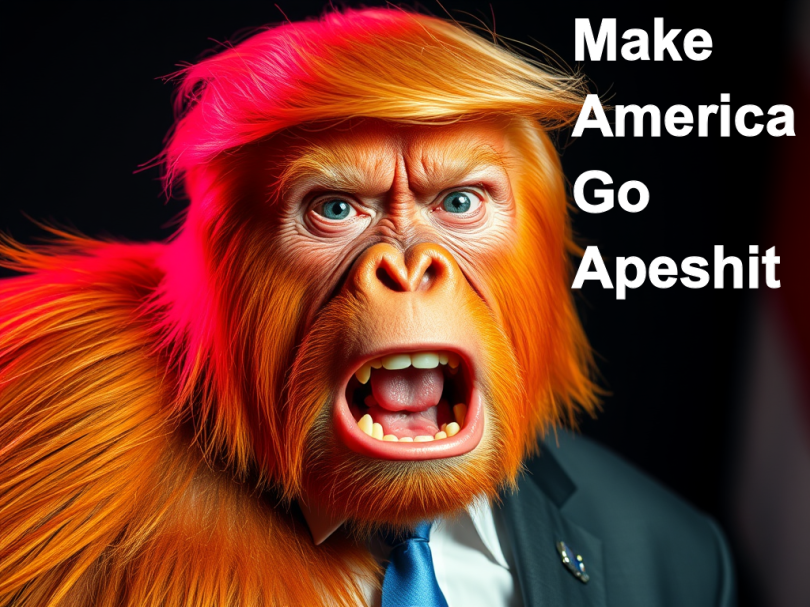
Make America Go Apeshit
A 2013 poll indicated 26% of Americans believed that Barack Obama is the Antichrist or might be.1 Most of them later voted for Trump. Compared to Mr Obama, Donald Trump is a jackass. No woman has accused Obama of sexual misconduct, nor did his name pop up in the Epstein files. His handling of Iran’s nuclear ambitions was vastly superior. The reasons I have found on Godlikeproductions.com for people to hate him were bogus and suggest hatred rather than anything of substance. President Barack Obama once gave the following Easter message: ‘Michelle and I wish you a joyful holiday filled with the enduring power of faith and hope.’ And Donald Trump: ‘Open the fucking strait, you crazy bastards, or you’ll be living in hell. Praise be to Allah.’ Why some think that Obama is an evil genius, and a Muslim, while the Allah-praising Trump is the best choice for Christians, can only hatred explain, and God’s sense of humour, of course.
Racism plays a role here, but it is not the entire story. The introduction of public healthcare insurance has infuriated conservatives. The hatred of progressive presidents has a long history. John F. Kennedy faced the John Birch Society’s Wanted for Treason campaign. The John Birch Society had found that Mr Kennedy was a communist and that communists had infiltrated the highest ranks of the US government and were conspiring to create a totalitarian one-world government. The supposed proof for that was the US administration’s attempt to prevent the spread of John Birch Society propaganda. To American conservatives, the expansion of government or international cooperation like the United Nations smells like communism. These are collectivist organisations. And communists oppose and repress religion, so it is Satan’s work as well, in their view at least. That goes a long way in explaining these sentiments.
If he had them, Kennedy did an excellent job of hiding his communist sympathies. After, like a true puppet of the Military Industrial Complex, having grilled his opponent, Eisenhower, during the election campaign for neglecting America’s defences, making Eisenhower warn of the influence of the Military Industrial Complex at his farewell speech, he risked World War III with the Soviet Union during the Cuban Missile Crisis. Those geniuses at the John Birch Society saw through all that and found Eisenhower to be an even more dangerous radical leftist lunatic extremist. While conspiracy theorists, with their eyeballs glued to their computer screens, were busy analysing every move by every secret society and imagining countless others, the John Birch Society has taken over the United States, with a little help from Russia’s secret services, by making people believe these conspiracy theories. If that was the plot to destroy America, it has succeeded marvellously.
It didn’t happen out of the blue. The United States political system is as corrupt as that of France before the revolution of 1789. Veteran journalist Seymour Hersh shared a few examples. He grew up in the South Side of Chicago, an area controlled by an elected Democratic Party leader. His brother was the most powerful mob boss in Chicago, who oversaw drugs, prostitution, police payoffs and had ties to the corrupt International Brotherhood of Teamsters. Hersh, together with his colleague Jeff Gerth, later reported on Chicago organised crime for the New York Times, with interviews with Roy Cohn, the prominent New York mob lawyer and fixer who had been counsel for Senator Joseph McCarthy when he was on the House Un-American Activities Committee during the Red Scare and later as a mentor to Donald Trump.2
Cohn provided a firsthand view of the dealings between politics and crime, as well as how prominent senators were kept supplied with pretty women. Jeffrey Epstein falls into that same category of men by providing aeroplanes to various politicians, including a former president, and later by running high-end whorehouses at no charge for prominent men. As for the unpublished Epstein files, Hersh wrote that an anonymous source told him that they concern Mossad’s involvement, and that the FBI had uncovered that Israel knew of Epstein’s client list and its blackmail potential.2 Whether that is true remains to be seen, but there is some evidence linking Epstein to Israel. As for the legacy of the 1789 French Revolution, a former French president went to prison for accepting foreign money to finance his political campaign. That is unthinkable in the United States.
As American politicians were increasingly bought and paid for, reforms like those of the Progressive Era became impossible. US politics grew more corrupt until conservatives had enough of it, rallied behind Trump, and threw out the old-order Republicans. And then, under the second Trump administration, the grifting went ballistic, fully banana republic-style without a trace of shame. Repair of the political system is impossible. The only option left is to wipe the slate clean, as France did in 1789. That revolution ousted the corrupt old regime, and after Napoleon had been defeated, Western European governments were left rationalised and cleansed of corruption. With the ousting of an order, a lot of experience goes down the drain, leading to amateurism and preventable failures. Building a new professional cadre takes time. It is the price to pay for a clean slate.
In the United States, liberals and conservatives hate each other’s guts, and there is no way to reconcile them. To illustrate the point, on 31 December 2025, someone reposted a RealDonaldTrump social media post on Reddit headlined ‘Windmills are killing all of our beautiful Bald Eagles!’ It featured a photograph of a dead bird, not a bald eagle, near a windmill in Israel, so not the United States. I reacted jokingly, ‘At least, Donald Trump was real.’ These were unmistakably his words, and he posted them as RealDonaldTrump. That was the joke. My post was downvoted, quite heavily even. It is impossible to say whether Trump haters or Trump lovers did it, because both groups lack a sense of humour, but something is seriously wrong in the minds of those who found it offensive.
Conspiracy theories often relate to facts, but if you investigate them, much remains unproven, inaccurate or wrong. Conspiracy theorists don’t care. Pizzagate may be a fabrication, but they will claim that the Epstein files prove it. If you call conspiracy theories hunches, they make more sense. We don’t know what’s going on, so getting the direction right is already a success. And what are you going to believe in this world where everyone can be a news or opinion source? And hyperboles generate attention, hence advertisement income, so the Conspiracy Industrial Complex keeps feeding the gullible public with new ‘bombshell reports’ and ‘viral videos’ produced by grifters posing as independent journalists. No wonder that people go insane.
Veteran conspiracy theorist named Nick Fuentes nailed it when he concluded in 2026 that a Mass Psychosis Event (MPE) has taken over the US population. Instead of celebrating his success, he lamented that everyone has lost their minds and has gone retarted due to conspiracy theories. He added, ‘I don’t know where to find normal people anymore.’ Among others, he found, perhaps to his amazement, that the COVID vaccines were not made to cull us. Well, who would have guessed that? Known to have been among the most extreme, he found himself overtaken by the general public.
America is falling apart because, to uphold the social order, the public must believe the myths supporting it. That is where authority comes from. Americans support their political order because they were taught that their founding fathers were geniuses with foresight, and that the American Constitution reflects their brilliance. That becomes hard to maintain when the order is a disgrace and a laughing stock. And it happens that the conspiracy theorists aren’t paranoid enough, as the underlying plot is more elaborate than their wildest imaginations could have conceived. God loves a good joke. They all fell for the ultimate psyop: undermining trust in US society to ‘Make America Go Apeshit’ (MAGA) and ready for the messiah. Yet, that was precisely what conservative Christians hoped to achieve.
Human condition
The foundation of a good society is social trust. It means you can trust strangers, the police, the government, and the corporations. It is the high point of social development and requires everyone to be trustworthy. If you live in a village of 1,000 people and everyone is trustworthy, you can leave the door open and your valuables in the garden. Yet, if there is only one thief in the village, that changes. In the past, many small villages were like that, and some still are. There were also many villages where you couldn’t trust others, so it is not a general rule for village life. Yet the example of one thief undermining social trust demonstrates that crime can be a society-killer. Crime rates matter. The same goes for fraud or exploiting loopholes. And so, social trust is a society’s ultimate achievement.
If solving a problem that affects us all requires a joint effort, freeloaders profit from our efforts. If we don’t halt freeloading, people grow disillusioned, and the effort collapses. We can overcome our limits with the help of myths, such as religions, and by punishing those who don’t comply. We can only save ourselves if we do it together. That would be impossible in the real world, as there would never be a myth we all can agree on. Also, tribalism and money are stronger than any moral system. Judas betrayed Jesus, either out of patriotism or greed. He may have hoped that Jesus would establish a Jewish state and then grown disillusioned, or the lure of money proved stronger than his fear of God.
As for the question I asked myself as a teenager, ‘Is it possible the that communists had good intentions?’ If there is no God, as the communists believed, we, the little people, are on our own, against the superior forces of money and tribalism, while religion blinds people to these unpalatable facts. The elites play us out by sowing divisions with their religious and nationalist fairy tales. The communists faced that brutal truth and tried to stamp out profit, nationalism and religion. Maybe for that reason, they named their newspapers ‘The Truth’. Only communist economies performed poorly, regularly leading to starvation, while a new class society with an elite of party bureaucrats replaced the old order. Nevertheless, communism was humanity’s last chance to save itself.
Communist-inspired policies worldwide have led to over 100 million fatalities. These are large numbers, but nothing compared to the end of humanity. Now, suppose that our only choice is communism or death. In that case, it is only reasonable to say that those who wish not to live under communism should kill themselves right now and not drag the rest of us with them. Yet, this world is not real but a simulation. The real humans likely have offed themselves by allowing AI to take over. Their euthanasia might have been agreeable, and we are all going to die someday, so it doesn’t seem a terrible option compared to living under communism. In the real world, there is no God. Now we have another option, but you can’t serve two masters. And it is only reasonable that those who choose suicide kill themselves right now and don’t drag the rest of us with them.
We may be incredibly lucky to be simulations, with God controlling the script. Without God being in control of all that happens, being a messiah is a losing proposition, with zero chance of success, not worth entertaining for rational individuals. Money and tribalism will prevail, and lead to our collective suicide, unless brute force counters them. That force must be truly brutal, as even the communists weren’t up to the challenge. And they have tried very hard indeed, as they have murdered millions and amassed an impressive stash of weaponry. And we may be even luckier, as we can probably do better than communism. That still requires a lot of hard work and stark choices. If you don’t like it, you can still off yourself right now. And it doesn’t matter in the end, for in the end we are all dead, while humans, being so destructive as they are, are not a great asset of Creation either.
Idealism and realism
Our survival requires an unrealistic amount of moral idealism, so an attitude that can get you killed, like turning the other cheek when being slapped. Jesus may have said that, but Christianity wouldn’t have survived like so. Everyone must act like so to make it work. That is why we are doomed. Moral pragmatism is getting by and hoping that God will save the day. Moral idealism is not waiting for God and trying to create Paradise on Earth. A sizeable group of Christians holds the latter view, but also atheist progressives, ranging from communists to liberals. Whether we try to make the world a better place or not, human nature makes the apocalypse a done deal. We must all leave our cynicism behind and care about other people and nature, while understanding that everything is interconnected, so our actions affect others and nature, and transgressions that disturb the balance in Paradise are heinous crimes. We can’t do that on our own. Only God can save us. As Christianity points out, we are sinners and need a saviour.
Moral pragmatism is getting by and hoping that God will save the day. Moral idealism is not waiting for God and trying to create Paradise on Earth. A sizeable group of Christians holds the latter view, but also atheist progressives, ranging from communists to liberals. Whether we try to make the world a better place or not, humans are a failed species, and only God can save us. As Christianity points out, we are sinners and need a saviour. Since the Hegelian dialectic is how God sees social progress, the West has progressed the furthest, so the West will have to lead the way. We need a spiritual rebirth to break away from the system run by merchants and usurers, ground our society in ethical principles, and make humankind live in harmony with nature. Things hardly ever go the way I foresee. Yet, they go precisely according to God’s plan.
Selling versus convincing
US politics does not stand on its own. Moral corruption in the United States is a cultural issue. The government reflects the spirit of their nation. The Trump administration brought the grifting to new highs, starting with a memecoin to profit from the presidency at the expense of his followers. Donald Trump is a typical American phenomenon that precisely demonstrates what is wrong with America. America has a tradition of moral pragmatism, in contrast to Europe’s idealism. You convince Europeans, but sell to Americans. The difference is not just in the wording. It reflects a cultural divide. I have heard Brits use the phrase, but in a negative sense, meaning getting scammed. It is more common in the United States, where it has a more neutral meaning of becoming convinced.
The United States is a nation of salespeople. A typical American book is Dale Carnegie’s How to Win Friends and Influence People. Its cover claims it is the book you need to succeed. To have success, you have to be ‘genuinely interested’ in other people, the book tells us, so you can sell to them and get rich. In other words, the ‘genuine interest’ of Americans in you might be fake. You can check by looking for dollar signs in their eyes. If a Dutchman shows interest in you, it is genuine, or politeness, so usually not with personal gain in mind. And so, the Dutch may appear to be jerks, as they hardly show ‘genuine interest’ in you. The Dutch are also known for their frankness, which others mistake for rudeness. Carnegie’s book also informs us that people can’t handle criticism and that we should praise rather than criticise them. Now, you know we are doomed. So, let me congratulate you on your excellent performance in our collective suicide.
If an American likes your argument, he buys it as if it were a product. It is a different idea of truth, and a corrupt one. It sheds some light on why religion and climate change denial are more widespread in the United States than in Western Europe. It is part of the American success story. Money is power, and bullshit sells. We are religious beings who need myths to believe in. The typical American phenomenon, less seen elsewhere, is the confidence man, the snake-oil salesman, the grifter who sells you a dream. A bit of corruption greases the wheels of industry. It contributed to America’s success. And the United States is not the most corrupt country. Yet, compared to North-West Europe, it is definitely corrupt.
You may not buy the science of climate change because you don’t like taking public transport or cutting back on meat. And so, you buy into climate change denial. That makes you morally corrupt, but no problem, you can buy the story that Jesus died for your sins, and believing that will get you into heaven. That Jesus died for our sins is pretty unbelievable, and if you had been honest and truthful, you would have questioned your faith, which Western Europeans do more than Americans. Americans believe something because they want to believe it, not because they think it is the truth. That is how salespeople’s minds work. It also relates to the religious climate in the United States, which differs from that in Europe, most notably among Protestants.
Moral corruption particularly affects some denominations of Protestantism, such as Evangelicals. Protestantism emerged in response to corruption within the Catholic Church. Protestants take moral integrity seriously and make it a matter of personal responsibility. Catholics merely followed the Church’s lead. Yet, Protestants also take the scriptures seriously. This is why there are so many branches of Protestantism differing on the correct interpretation of the scriptures. It opened the door to a different form of moral corruption. What the Bible says is right and wrong is not always objectively so. But if you, as a moral pragmatist, make ethics a matter of popular sentiment rather than of objective reason, you may end up on the side of evil. Paul condemned homosexual acts in no uncertain terms. We don’t know Jesus’ opinion on this matter, but he said not to judge and that he who is without sin should cast the first stone.
There is no objective moral reason to condemn gays and lesbians or deny them the right to marry. It became a contentious issue for Protestants, who take both scripture and moral conscience seriously. When you follow the scriptures on this matter, you shut down your moral conscience. And if only faith can save you, you don’t have to do good works to compensate for your misdeeds, so you can be evil and still be saved. That is a good sell. For who does not wish to do as he pleases and still get a free pass into heaven? Catholics merely followed the Church’s lead, and must do good works to atone for their sins.
This morally corrupt Protestantism also existed, but didn’t prevail in North-West Europe. Many of the least corrupt countries are there, while LGBTQ rights in these countries remain uncontested. Meanwhile, Catholic priests lived the good life, which the Dutch call ‘het Roomse leven’ or the Burgundian lifestyle. Jews, as Karl Marx observed, often behave like amoral merchants, and this, rather than racism or religious bigotry, stands at the root of today’s anti-Semitism. They are among the merchants and usurers who buy American politicians. It makes the moral corruption in the United States a sensitive issue. It also demonstrates the ubiquitous nature of culture in our conduct and that the harm we do to each other is often a cultural phenomenon. Now we are at the bottom of the manure pit.
My teacher Donald Trump
I have been incredibly fortunate to have lived a peaceful, prosperous life in Western Europe during its most agreeable era. For most of my life, I have barely realised it. The situation you live in looks normal to you. It is not. Living in post-war Western Europe is like winning the lottery jackpot of history and geography. The welfare states of post-war Western Europe have been among the brightest spots in an otherwise bleak history of humankind. I wish that everyone could live a life like that, but you can’t have a paradise if not all the right things are in place. They hardly ever are. People have no clue. Barring a miracle, things aren’t going to stay pretty. The European paradise is fading due to war, resource shortages, environmental degradation, political instability, mass migration, and technological change. It is beyond our control.
Paradises don’t last, because, due to competition, we live in a ‘dynamic environment.’ Competition is a destructive force, even though a creative one, as economists assure us. Donald Trump at least recognised that. Tariffs are a measure to protect uncompetitive industries. Europe may soon have to follow suit. The Soviet bloc survived for decades because it had irredeemable currencies, hampering trade with the rest of the world. Had they chosen to do so, the Soviets could still be there, mired in stagnation, as North Korea still is. But unlike the Americans, they were willing to face the fact that their experiment had failed. If the United States continues on this path, it will become more like the Soviet Union. Yet, if we don’t halt the competition, we need artificial intelligence to keep up with our rivals, and humans may soon become useless.
We are cogs in a system, doing our acts, not unique, wonderful, deserving individuals. If we were, we would all have been like Mahatma Gandhi, and humanity would have done fine. Gandhi was truly one of a kind. My ethical standards do not come close to his. And I should be your saviour? As an engineer with far more data at my disposal than Gandhi ever had, I can confidently claim that the system will lead us to our destruction. Being like Gandhi is not enough. You can’t fix the world’s problems with peaceful action. You must be willing to do whatever it takes, like Hitler. Jokes helped deal with that inconvenient truth, such as imagining coming on stage after an introduction by a lady in tight stockings and a hairdo like Helga from the comedy series Allo Allo, who would raise her hand to give the Hitler salute and scream, ‘Our Great Leader!’ Then, I would come up and say, ‘Oh, it’s me. Shame and scandal in the family.’ My mother wasn’t my mother, and she didn’t know.
Donald Trump hurts people’s feelings, and he seems to love it. Yet, we can’t fix the world’s problems without hurting feelings. You are a bunch of morons busy committing suicide. So, what more is there to say? Mr Trump could be an appetiser for things to come, for the truth is harsh. People are obsessed with feelings. Mr Trump is the greatest snowflake of all, for he can’t stand any criticism. I have worked on a concept plan for the future, which is not more than a direction, for that is what the level of planning and time horizon require. We are about to make a scary jump into the unknown, but the alternative likely is an apocalypse of some kind. Now, I don’t think that God is on my side. Jesus made that mistake. I just play my role in this script like you do. Failure is worse than death. As the Dutch say, ‘Death or the gladiolas.’ Success or death. But even then, you can still have success after death. Jesus changed world history more than anyone else.
If I am the messiah, I have to become a dictator. That was not my ambition, so I was unprepared for that eventuality that seemed unlikely for the first four decades of my life. How to be a dictator? What must I do? I had no clue. And so, God provided me with a great teacher, Donald Trump. Mr Trump has acted as if he were above the law and went after his political opponents. There is no choice but to do that, which would be, as a secondary school bureaucrat noted, a l’état-c’est-moi situation, or as the former Dutch minister of immigration, Marjolein Faber, once put it, ‘I am policy.’ A messiah has the divine right of kings, or as the Chinese would say, the mandate of heaven. It is an absolute rule no one can question. It can provide political stability that enabled the Chinese to administer a vast empire and survive as a nation for over 2,000 years. That is the kind of time horizon this plan has.
Kicking off the revolution
Dutch television once aired a fragment of a preacher standing in front of Donald Trump, with Trump putting up his best sanctimonious face. The preacher thanked Trump for ‘saving America from Satan.’ Then my wife, Ingrid, said, ‘Look! There you have him! That’s Satan!’ She meant Donald Trump. She was joking, but that joke can only be funny if there is some truth to it. My wife doesn’t dislike Mr Trump as I do, and tends to look on the bright side of what he is doing. So, Mr Trump forcing Ukraine to accept a bad deal? That’s fine with her if it ends the war. Taking out Maduro? Things were bad in Venezuela already. Invading Greenland? She didn’t express an opinion. Bombing Iran back to the Stone Age? They shouldn’t have a nuclear bomb. In any case, my wife’s feelings didn’t get in the way of forming the opinion that Mr Trump is a satanic character. Her opinion was as objective as it could be. That makes Trump’s followers believing that Obama was the Antichrist all the funnier. When I later recalled the moment, my wife said the preacher had said ‘Antichrist’ rather than ‘Satan.’
Trump’s lambasting of the pope’s peace efforts, while portraying himself as Jesus, and the religious display by him and his inner circle in the Oval Office, give him a strong shot at the title of Antichrist, who is a boogeyman, only mentioned in John’s first epistle. One mention of an obscure figure, and people’s imaginations go wild. Trump being a jerk is why people voted for him. By his own admission, Trump is a pussy grabber who would ‘do’ his daughter had she not been his daughter. At least 26 women have accused him of sexual misconduct.3 When order falls apart, we revert to gangsterism and choose gangsters as our leaders. You can’t rely on pencil pushers to fight for you in dangerous times. Many fascist leaders have been involved in crimes ranging from embezzlement and violence to coups to overthrow the government, to conspiring with enemy powers, which some call treason. As Trump’s fits are the foundation for US policy, the Trump regime and MAGA have become the world’s first and foremost problem.
The United States threatened to attack Denmark to secure security guarantees it already had, tore up a deal with Iran, and started a war with Iran to acquire a worse deal, while leaving the rest of the world to starve without oil and fertiliser. The regime’s next war could be against Cuba after the US Supreme Court ruled that Exxon should receive damages for the Cuban nationalisation of its assets. Also, not particularly helpful is the US regime’s stance on climate change, including Trump’s Don Quichotte-like fight against windmills. The great experiment with individual freedom, the United States, has failed miserably, and that can hardly be a surprise given the depraved state of human nature.
Donald Trump should face trial in the International Court of Justice in The Hague, Netherlands. The United States can’t give him a fair trial. Liberals may want to hang him, while conservatives might want to give him a pass. Whether trying to overthrow a legitimate election result constitutes treason may remain a matter of contention but that Donald Trump and his pal Bibi Netanyahu violated international law and committed crimes against humanity by starting the Iran war cannot be in doubt, as the world’s expert on murders committed in cynical violation of all norms of human morality and international law, Vladimir Putin, called the assassination of Ayatollah Khamenei a murder committed in cynical violation of all norms of human morality and international law.
On 15 May 2025, precisely 8647 days after 11 September 2001, former FBI director James Comey posted a photo of seashells on social media spelling ‘8647’, a code for removing Trump from office. That drew the ire of the Trump regime after the MAGA movement had previously sold hats with ‘8646’ on them, calling for Biden’s removal from office. The Trump regime now considers writing the number 8647 an act of terrorism. There is no evidence suggesting that Comey intended that 8647-day interval, but he could have. Yet, the incident is also part of the 11 September 2001 coincidence scheme, which is beyond the capabilities of human conspirators to organise.
Now, I hadn’t thought about how to oust Mr Trump, but God provided me with an idea. In April 2025, I dreamed of being part of a crowd in The Hague during the NATO summit scheduled for that summer. The leaders of the NATO member states were all there. When Trump passed by in his car, I began to scold him in Dutch, ‘Hij is een hondenlul (He is a dog dick).’ It is an offensive slur that football fans sing when disagreeing with the referee’s decision. For a moment, there was absolute silence. Bystanders were shocked, making me fear that the police would round me up. But then the crowd joined in, and the singing grew louder until it became a thundering chant. It made the news worldwide, and in every football stadium, it became the chant. From then on, no one called him President Trump anymore. Everyone called him dog dick.
Play time is over. An adult should run the world. If I am Adam reincarnated, I am 6,000 years old. There may be no one else to save you. So, let me be very clear. I don’t need you. You need me. If you don’t want me to be your leader, that’s fine with me. But maybe it is not fine with God. You can try and find out. I never wished to become the overseer of that lunatic asylum called humanity. So if you murder me, that will be your problem, not mine. I suppose that death is my final destination anyhow. So count your blessings. Maybe you can finally grow up, leave your infantile beliefs behind, and sing along with the opening chant of the End Times, ‘Donald is a dog dick’. It is going to be great fun!
Latest revision: 15 September 2026
Featured image: AI-generated
1. One in four Americans think Obama may be the Antichrist, survey says. The Guardian (2013).
2. What I know about Jeffrey Epstein. Seymour Hersh (2026). Substack.
3. The 26 women who have accused Trump of sexual misconduct. Eliza Relman and Azmi Haroun (2017). Business Insider.