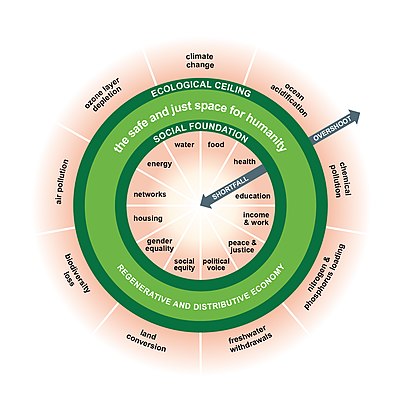
Doughnut economic model

A model for the economy

Doughnut

Our greatest challenge at present is dealing with the limits of the planet. The second greatest challenge is to provide for an acceptable standard of living for everyone. The third may be reducing differences in income and power. To a large extent these are economic questions. The order is important. For instance, what’s the point of achieving a higher standard of living when our planet is destroyed in the process? And it may be good to reduce differences in income and power but not if everyone ends up poorer.

New technologies can make these goals easier to attain. Information technology and the Internet made it possible for people everywhere around the globe to connect and to work together. This created jobs for millions of people in countries like India and China and it provided them with a better standard of living. Imagine nuclear fusion becoming available and energy becoming really cheap. That could halt climate change and make our lives easier. But we don’t know what kinds of technology there will be in the future.

The challenges we face are of an economic nature so a model of the economy can be helpful. Economics is about deciding for what we use the limited means we have and for whom. The distinction between economics and politics is not always clear because economic choices are often of a political nature. Even when you believe that everything should be left to markets then this is a political opinion.

The economist Kate Raworth came up with the idea of doughnut economy. It can be used to assess the performance of an economy by the extent to which the needs of people are met without overshooting Earth’s limits.1 Assessing is not the real challenge here. Making it work is. Raworth did some suggestions but this model outlines a comprehensive global solution.

Much of economics is drawn from experience. Often from experience supposed economic laws were formulated. The supposed laws don’t always work so we need imagination too. Experience may be a good guide to predict human behaviour and it can help us to see how far we can make our imagination become reality.

We can’t continue to live like we do. New technologies alone will probably not save us. The changes we need most likely are a shock for most people, except the poorest. On the bright side there is the 20/80 rule. It states that if you set your priorities right, you can achieve 80% of what’s possible with 20% of the effort needed to achieve the 100%. So if we stop the 20% most resource consuming and polluting non-essential activities then we might achieve 80% of what we can possibly achieve. That may be enough so life may still be acceptable in the future.

This plan contains ideas that ignore political borders like combining environmentalism with supply-side economics. This is a comprehensive solution. People may take their pickings based on their political views but you can’t cherry pick and expect it to work. This plan doesn’t include specific proposals like building windmills nor does it dwell on sustainable development goals. It is an economic model only.

This model gives a general outline as to how to deal with the challenges using underlying economic mechanisms. Many issues have to be resolved along the way, for instance mitigating the consequences for those who suffer the most. In short the model is:

  • The limits of our planet should dictate economics. That is just plain survival. Everything else should be of a secondary nature.
  • Ending poverty should be the second goal in economic thinking. That is our moral obligation. All other goals come after that.
  • People organise themselves in different ways. Organisational flexibility is the feature that made humans so successful as a species.
  • Setting these limits will bring severe dislocations in the economy that have to be addressed in the short term as well in the longer term.
  • Money is power. Ignoring money and the profit motive won’t produce acceptable outcomes. Still, it may be possible to reduce the power associated with money.
  • The economy has a short-term bias. An important reason is interest. Negative interest rates can lengthen the time horizon of investment decisions.
  • Capital represents wealth. Capital can help to make the economy sustainable and to end poverty. Destroying capital usually is not a wise course of action.
  • It is probably easier to build the required capital via investment than via taxation as most people love to invest but hate to pay taxes.
  • It may be better not to tax capital but to tax conspicuous consumption of the wealthy instead and to ban harmful activities if that is feasible.

Caring for our planet should be central in economic thinking. In traditional economics the consequences for the planet are delegated to a marginal role. The approach so far has been that products and services can have hidden costs like the usage of scarce resources and pollution. The proposed solution is that bureaucrats calculate these costs and tax harmful products to the point that their price reflects their true cost.

The government is supposed to use the proceeds from these taxes to repair the damage done, which often doesn’t happen. Still these taxes increase the price of harmful products so people can afford fewer of them. That may help but it is a proverbial drop-in-the-bucket. Economic growth is exponential so measures to reduce resource consumption or pollution are overtaken by the growth of production and consumption.

It is hard to calculate the true cost of products and services. Another problem is that green solutions use scarce resources too. To build a windmill energy is needed, which often comes from non-renewable resources like fossil fuels. Subsidising these solutions can be inefficient. A better way out may be setting hard limits on resource consumption and pollution. That could allocate resources more efficiently and set higher rewards on solutions that really contribute to a sustainable future.

Ending poverty is not always an explicitly stated goal of economics but economics is about making the best use of limited resources. Economic thinking can help to reduce poverty. Capitalism can create wealth efficiently but doesn’t distribute it equally. An important obstacle is interest rates being limited to the downside. Negative interest rates can help to reduce poverty but poor people are often poor for other reasons too, for instance a lack of opportunities or their own behaviour.

Human organisation

The political economy describes how humans organise themselves. Humans are social animals that can cooperate on a large scale in a flexible way. It made humans the dominant species on the planet. There are three major forms of human organisation:

  • communities
  • markets
  • governments

Traditionally humans lived in communities and villages where people help each other. They contributed to their community and expected their community to care for them. Money hardly played a role and trade with the outside world was often barter. People were born into a community and it was difficult to leave. Communities are still important in modern societies but leaving is easier. Many communities are communities of choice that you can join and leave as you like. These are often based on shared interests, for instance a soccer club or a message board on the Internet.2

Markets can distribute goods and services efficiently. This is what is meant by the invisible hand. If people work in their own self-interest, this can benefit society because products and services are made according to the desires of individuals. The theory of supply and demand explains how that is achieved. This is done with the use of money in market transactions. In many instances markets fail to bring desirable outcomes. Markets are flexible but they do not think ahead so they do not take into account the limits of the planet.

Governments set the rules in societies and enforce them, often with the consent of the citizens. They provide public services that markets do not provide efficiently or in an acceptable manner. The organising agent is money too, in this case via taxes and government expenditures on public services. Governments can think ahead but they are less flexible. The limits of the planet aren’t flexible either so it may be a task for governments to enforce them.

Dealing with the consequences

The flexibility of the ways in which we humans organise ourselves allows us to set limits on a global scale and let governments, businesses and communities all over the world deal with them and reorganise themselves accordingly. These limits must be set from the top down like a dictate because the size of the planet can’t be changed. Being too flexible on this issue can be a greater mistake than not being flexible enough.

This requires a global authority. If adequate measures are taken, severe dislocations in the economy can be expected. For instance, if recreational air travel is to be ended, that will affect poor countries depending on tourism. The same is true for people working for businesses that use scarce resources produce non-essential goods and services. Millions of people will lose their jobs and their means of existence.

In the short run they have to be helped out with food and money. In the longer term people, communities, businesses and countries must adapt to the new reality. Multinational corporations may have to relocate jobs to areas that have little to offer to international markets. Ideally everyone has a useful role in society and feels secure but the economy requires a flexible labour market.

Money makes the world go round

Humans have social needs and varying motivations but most people are motivated by money, at least to some extent. Even when people are not motivated by money, those who are often determine what happens. That is because money represents power. Reforming the economy based on ideals and moral values will have little effect if money and financial markets are ignored. We need the goods and services money can buy.

People can be motivated by their jobs but most people work to make a living. Money plays an important role in this process. If you are not rewarded for doing your job well that can demoralise you, most notably if others receive the same reward for doing a poor job. A great experiment called the Soviet Union has proven that beyond reasonable doubt. Markets can help to eliminate businesses that are useless or inefficient.

Sadly the amount of money individuals acquire doesn’t always represent their merits for other people and society. The politically connected can enrich themselves at the expense of taxpayers. Business owners can exploit labourers and enrich themselves by moving jobs to low wage countries. And criminals can become very rich too.

Rich people can buy the respect and cooperation of others. They can make others do what they want them to do. This comes with social status. People like you when you are rich because they hope to benefit from your spending. Social status also comes from the products you can afford. Differences in power and social status can lead to social instability, most notably when many are poor and the rich didn’t deserve their wealth.

It is easier to finance a great endeavours like making the economy sustainable and ending poverty from investments than from taxation because nobody wants to pay taxes but everybody is happy to invest. People may work hard to build some capital for themselves through savings and investment but they won’t work so hard to pay taxes.

This was the secret of the success of the European empires that conquered the world. England, France, Spain and the Netherlands were much poorer and smaller than China, India or the Ottoman Empire, but they didn’t finance their conquests with taxation, but with investment capita. European conquerors took loans from banks and investors to buy ships, cannons, and to pay soldiers. Profits from the new trade routes and colonies enabled them to repay the loans and build trust so they could receive more credit next time.2

Reducing the power associated with money is possible. For instance, if there is a tax on currency, interest rates can go below zero, and owners of money can’t demand interest when there is a capital surplus and positive interest rates aren’t beneficial to the economy. Redistributing wealth via wealth taxes may reduce differences in wealth and power but it can also lead to capital destruction via higher interest rates.

Capitalists save and invest while ordinary people borrow and spend. Wealth taxes divert money from investment to consumption so interest rates may rise and the effect may be a reduction of capital rather than more tax income. And it is consumption that harms the planet. Wealth taxes can be useful but they aren’t part of the solution. It may be better to reduce the consumption of the wealthy instead as they often consume the most.

This would reduce the privileges attached to wealth as it reduces the options for the wealthy to use their riches. At the same time it allows capital to be allocated via markets so that efficiency considerations apply. Hence, more investment capital may become available and the excess may be transferred to governments, people and businesses via negative interest rates.

In other words, it may be smarter to ‘milk the capital of the rich’ by giving the rich fewer options to spend their wealth than to tax their wealth. In this way their capital may grow to the possible maximum and interest rates go lower to the benefit of everyone.

In the neo-liberal era government spending was constrained by interest payments. The public sector was neglected. The price paid was often poor health care, bad roads or an overstretched police force. Once interest rates are negative, we may enter an era of abundance, and interest payments may be added to government budgets. This is to be expected when resources are diverted away from the consumption of the rich.

I want it all, I want it all, I want it all, and I want it now.

– Queen, I want it all

Short-term bias

These words of Queen express the mindset behind an economic system that encourages people to buy as much stuff as possible. More is preferred to less and now is preferred to tomorrow. If we stop buying stuff, or even when we buy less, businesses go bankrupt, people become unemployed, debts can’t be repaid and money becomes worthless. And so there is a quest for economic growth that’s killing us.

Economics teaches that our needs and wants exceed the available goods and services and that we always want more. This is called scarcity. Economics also teaches us that we want stuff sooner rather than later. This is called time preference. And so we must be encouraged to save for the investments needed to make more stuff by promising us more stuff in the future. And so there must be interest, economics teaches us.

To be fair, economics goes beyond this simple caricature, but the short-term bias caused by the belief in scarcity, time preference and positive interest rates, is still everywhere in economic thinking, and also in our thinking because we are influenced by economics. The existence of negative interest rates signals that the basic assumptions underlying economics may not be correct. People keep on saving without the promise of more stuff in the future. And that is a good sign.

Our way of living has to change in a fundamental way. We need to recycle more, buy second hand stuff and forego frivolous consumption. In the future employment may come from addressing needs in society. For instance, former salespeople may care for the elderly. There is an abundance of capital, and if those who have enough constrain their desires, even more capital can be available to meet the challenges humanity is facing.

To make that happen we need new ideas about wealth and poverty. It may be wiser to see wealth as the amount of time we can to sustain our current standard of living. For instance, someone who owns € 50,000 in assets and needs € 10,000 per year to live off may be wealthier than someone who owns € 100,000 and needs € 50,000 per year. This also applies to humanity. The resources of the planet can be considered as our assets. On the basis of this measure we are becoming poorer by the day.

Interest rates are important here. They affect the time horizon of investment decisions. That is because of discounting. When investment decisions are made, this usually comes down to discounting the future income stream from the investment against the interest rate. Higher interest rates promote shorter time-horizons. This can be illustrated with an example from the Strohalm Foundation:

Suppose that a cheap house will last 33 years and costs € 200,000 to build. The yearly cost of the house will be € 6,060 (€ 200,000 divided by 33). A more expensive house costs € 400,000 but will last a hundred years. It will cost only € 4,000 per year. For € 2,060 per year less, you can build a house that lasts three times as long.

After applying for a mortgage the calculation changes. If the interest rate is 10%, the expensive house will not only cost € 4,000 per year in write-offs, but during the first year there will be an additional interest charge of € 40,000 (10% of € 400,000).

The long-lasting house now costs € 44,000 in the first year. The cheaper house now appears less expensive again. There is a yearly write off of € 6,060 but during the first year there is only € 20,000 in interest charges. Total costs for the first year are only € 26,060. Interest charges make the less durable house cheaper.3

In reality things are not that simple. The building materials of the cheap house might be recycled to build a new house. And technology changes. If cars had been built to last 100 years, most old cars would still be around. This could be a problem as old cars are more polluting and use more fuel. Nevertheless, the example shows that long-term investments can be more attractive when interest rates are lower.

The interest rate is not the cause but the consequence of the time horizons of individual borrowers and lenders in financial markets, which are people, businesses and governments. The economy doesn’t magically become sustainable because interest rates are low. Interest rates are low for a reason. If we don’t buy things we don’t need, interest rates go down. The time horizon of the economy lengthens because our economic time horizon lengthens.

Capital and wealth

The painful reality of what our wealth really is has such dramatic consequences for the economy that it is hard to foresee what a future sustainable society might look like. But capital will still represent wealth in the future. The traditional definition of capital is buildings, machines, technology and knowledge to make the products and services we use. This definition ignores the planet and that is not helping us to survive.

Only if we think of the planet Earth as our main capital and believe that we have to keep that capital in tact and that we have to sustain ourselves from the interest of this capital then economics can help us to survive. We must reduce our consumption to the point that the planet can regenerate itself. A true capitalist doesn’t consumes his or her capital either. He or she lives of the interest and saves whatever he or she can for the future.

Traditional capital can help with that. For instance, internet and video conferencing allow us to meet other people without travel. If most traffic is to disappear that would greatly reduce resource consumption and pollution but that may only happen if travel is restricted. Knowledge to make artificial meat from plants can reduce the need for fertilisers and pesticides. If we don’t have to feed livestock any more, lower yields in agriculture are acceptable. This can help to make agriculture in harmony with nature.

We may need more traditional capital in order to sustain ourselves within the limits of the planet even though much of our existing capital may prove to be worthless. For instance, if research is done to make artificial meat taste better then people will find it easier to switch. In that case factory farms may become redundant. We may need massive investments in renewable energy and recycling as well as pollution reduction. If we set limits on our resource consumption and pollution then the capital that can make us live within these limits can be profitable.

As capital represents wealth, lower interest rates can increase wealth. That is because investments must at least generate returns equal to the interest rate. If returns are lower then it makes no sense to invest as it would be better to put the money in a bank account. Hence, with lower interest rates more investments are profitable and more capital can exist. It may explain why wealthy countries often have the lowest interest rates.

The requirement of making at least the interest rate in the market has enormous consequences. A corporation that makes a product people like can go bankrupt when potential customers don’t have enough money and the corporation can’t make enough profit. In other words, if an investment in this corporation yields less than the interest rate in the market, it must fail. That’s why corporations don’t make products for poor people. There is no profit in that. Some economists think this is healthy and natural.

In a similar vein a coal fired power plant that returns 6% is considered efficient and useful while a windmill that makes 2% is seen as inefficient and wasteful at an interest rate of 4%. This logic can be suicidal because of climate change. Something is terribly wrong with this. But if investments don’t make the interest rate in the market, no-one would make them voluntarily. Nowadays windmills and solar energy are profitable because the technology has improved and interest rates have fallen.

In a market economy capital exists for profit. Capital can exist for other motives too. A community can make an encyclopedia or a software product freely available on the Internet. A government can build a road or operate a library or a hospital. But history has demonstrated that people are motivated by money and profit and that a market economy is an effective way to build capital. In order to live within the limits of the planet and to end poverty, markets may need more guidance from governments.

With lower interest rates it may be possible to make investments in ending poverty and making societies sustainable profitable so that people will make these investments voluntarily. Perhaps it is better to make a distinction between what should be done, for instance making the economy sustainable and ending poverty, and what can be done, which depends amongst others, on the interest rate. At an interest rate of 0% the windmill could be profitable and fossil fuels can be phased out. That’s why lower interest rates can be beneficial.

Indeed, there are other measures for usefulness than profitability. Perhaps the requirement to make a specific interest rate may not seem particularly useful to humankind but it can help to allocate capital more efficiently. Hence, for the benefit of humankind capital markets must continue to exist and interest rates may need to be as low as possible to generate the investment capital needed for making the economy sustainable and ending poverty.

Governments should guide this process by defining what is legal and what is not. The investment options for capitalists depend on the products and services that are legal. As the number of options are reduced, for instance by banning resource consuming non-essential consumption, the remaining alternatives can become more attractive, most notably when the excess of investment capital drives interest rates lower so that sustainable production processes with low returns become feasible.

If there is a market

Banning harmful products can elicit black markets, most notably when these products are addictive or save you from a lot of trouble or hard work and if you can use them without being noticed. It would be hard to stop the use of alcohol and drugs because people will use these products anyway. It may be easier to limit air travel as it will be difficult to fly a plane without being noticed.

Black markets and fraud are likely to arise if limits are set on the extraction of resources like fossil fuels and basic materials. The price of these resources could rise and it could be lucrative to extract more than is allowed. It might a good idea to look for places where effective control can be established. That may be on the demand side by banning or limiting certain activities or on the supply side by monitoring production.

Distortions in the markets for resources can produce losses or profits. Governments may need to take ownership of resources and compensate the owners. A government can then contract a miner to mine resources based on quota under specific regulations, and the miners can then be paid for extracting the resources. If markets become distorted by forward-looking planning then governments must intervene.

Perhaps different arrangements are possible. When interest rates are negative then future income discounted against the interest rate will have a higher net present value so it can make economic sense to keep resources in the ground.

Global competition drives down prices and it allows developing nations to build their economies too. Free trade can benefit humankind because it allows people and countries to specialise in what they do best so more and better products can be made at lower prices. Regulations aim to increase the quality of products by setting minimum standards. Regulations can favour large scale operations if they require large investments.

If the economy is to become sustainable the energy cost of producing items as well as the cost of transport may change and affect the scale of production. Regulations can stand in the way of scaling down and localising production but in many cases regulations, for instance regulations about food safety, exist for good reason. Investments to make production processes sustainable may be costly and may also favour economies of scale.

Confidence in money and trust in the financial system

Confidence is key in the capitalist economy because credit is based on confidence. The availability of investment capital comes from confidence in financial system and the economy. Actions that erode trust affect the available credit. Bank failures shatter confidence and stop the circulation of money. The Great Depression really took off after banks went bankrupt. The financial crisis of 2008 escalated once Lehman Brothers was allowed to go bankrupt.

To ensure that businesses can prosper credit must be available. A lack of trust in financial markets results in a destruction of capital. It is not a coincidence that economic crises are often preceded by a financial crisis. That’s why governments and central banks stand behind the financial system and support it at all cost. That’s why we seem to be hostage of the financial system. It doesn’t have to be that way.

Interest on money and debts makes the financial system unstable and prone to crisis because incomes fluctuate while interest payments are fixed. And because there is currency at an interest rate of zero, investors can flee to the safety of currency at no cost whenever there is some trouble. But interest rates are poised to go negative. This may be the opportunity to make the financial system more robust by charging a holding fee on currency and banning positive interest rates on money and debts.

Trust in the financial system and debts is reflected in the interest rate. If the interest rate is negative then investors prefer a certain loss to other investment alternatives. That might happen because of confidence in the currency as a store of value, for instance when inflation is non-existent. It is imperative that governments promote confidence in their currencies by limiting their primary deficits to the point that they are paid from the interest received on their debts.

Interest is the price paid for distrust so governments must be reliable and transparent to inspire confidence in financial markets. If a government is not honest to its creditors then the interest paid on its debts can rise. People like entitlements and do not like taxes so citizens may elect politicians who promise more entitlements or lower taxes. The interest rate on government debt can therefore also reflect the confidence of creditors in the citizens of a country.

A robust financial system that inspires confidence can meet the challenges that lie ahead as they will on the one hand require an unprecedented amount of capital in form of knowledge, new products and new ways of producing and distributing them, while on the other hand there will be severe shock and dislocations in the economy that only a robust financial system can withstand.

A holding fee on currency can ensure liquidity in financial markets so that the economy will not fall apart in times of economic stress. The situation in Wörgl demonstrated that even a deep depression can soon end with negative interest rates. The transformation to a sustainable economy requires an unprecedented amount of low yielding capital that may only be made profitable when interest rates are negative.

Investment guidance policies

For markets to do their job properly, capitalists should deploy their capital in the way they see fit within the options that are available. Additional measures may be needed to guide investments into desired directions like developing countries, recycling, and affordable housing. Wealthy individuals should realise they have a moral duty to make their capital contribute positively to society and the well-being of others. And even if the wealthy do not live up to their moral obligations, the laws and the financial system must channel their efforts in the right direction.

Financing the challenges of the future by investors may work better than financing them from taxes. Investors tend to chose the options that generate the most profits. In doing so they may be able to realise these goals more efficiently and generate more investment capital for the purpose. Favouring desired investments, for instance by excluding them from a wealth tax, can be a way to make them more attractive.

Products should cause as little harm as possible to the planet. Nature should be able to regenerate itself and undo the harm done. To make that possible, corporations should be responsible for the lifecycle of their products. Even when they work with contractors, the responsibility should remain with the corporation that markets a product.

During the neoliberal area businesses were often allowed to regulate themselves. This is didn’t work out well as businesses can gain an advantage from evading responsibilities in the form of reduced costs and higher profits. Governments have a responsibility to make and enforce the law. That may not be enough so journalists and activists have a duty to press businesses into sticking to the rules and governments into enforcing them.

Summary

This is an economic model meant to identify the economics to make the economy sustainable and to end poverty. There will probably be consequences that aren’t fair and they should be addressed where possible. Capital represents wealth. To make the economy sustainable we need a different view on wealth as it not being the amount of assets you currently have but the time your assets can support your lifestyle.

The planet should be seen as our main capital, not the buildings, machines, technology and knowledge to make the products and services we use. If we use more than nature can replenish, we use more than the interest of our main capital, and we become poorer as a consequence, even when the interest rate on traditional capital is positive.

To make the economy sustainable and to end poverty while maintaining an acceptable standard of living requires an unprecedented amount of traditional capital. The effort can better be financed from investments than taxes. Lower interest rates can make investments in making the economy sustainable and ending poverty more attractive.

Limiting our production and consumption will depress interest rates. Low interest rates require trust in the financial system and currencies. The financial system is based on debt, hence the integrity of debtors. A maximum interest rate of zero can improve the quality of debts. A holding fee on currency can ensure liquidity in financial markets.

Instead of spending on frivolous consumption everyone who can afford it should become a capitalist and invest in his or her own future. That can help to make the economy sustainable and to end poverty. Governments can support this process by legislation that bans harmful products and supports investments in areas that are beneficial.

Featured image: Doughnut economic model. Kate Raworth (2017). . CC-SA 4.0. Wikimedia Commons.

1. Doughnut economics: seven ways to think like a 21st century economist. Kate Raworth (2017). Vermont: White River Junction.
2. Political economy. Wikipedia. [link]
3. Sapiens: A Brief History Of Humankind. Yuval Noah Harari (2014). Harvil Secker.

2017 Jeep Grand Cherokee in Makarska, Croatia. Elishur19.

The law of diminishing marginal utility

Imagine you are fond of pizza and very hungry. If I offer you a pizza, you will be very grateful. If, after you have finished, I present you a second, you will not decline, but you will be a bit less grateful. If I offer you a third, you might still eat it, perhaps not to offend me. The fourth pizza you would decline. You might give a lame excuse like nausea to explain your peculiar behaviour. Before the fifth pizza is offered, you may already have sneaked out of my home.

Welcome to the law of diminishing marginal utility. It is a law in economics. It states that the more you have of something, the less use an extra unit has.

It is possible to express the law in terms of money. Suppose you are at a pizza restaurant, hungry, and willing to pay € 12 for a pizza. After eating it, you are not hungry and unwilling to pay € 12 for a second pizza. But if the restaurant owner offers you a discount of € 6, you might accept the offer. A third pizza you may only eat if it is on the house. A fourth pizza you will not eat unless the restaurant owner offers you € 6 to eat it. Eating a fifth pizza might cost the restaurant owner € 12.

number of pizzas eatenvalue of the next pizza in €
0€ 12
1€ 6
2€ 0
3– € 6
4– € 12

What might strike you is that the fourth and fifth pizzas have negative value to you. You are not willing to eat them unless the restaurant owner pays you for it.

Most people have other desires than pizza alone. If you also desire soda, there is a limit to that, too, and at some point, drinking more soda also has a negative value to you. Perhaps you desire a hundred other things, for instance, a refrigerator, and you may even have room for a second, but more refrigerators have no use to you, nor do they fit in your house. And so, the more you have, the less something extra is worth to you, and you might start to think about the future.

Perhaps you have plenty of pizza and soda now, but what about tomorrow and next year, so you might start saving. As we get wealthier, getting more stuff becomes less important to most of us, while certainty about the future becomes more important. At some point, we do not want more stuff, and the law of diminishing marginal utility becomes an obstacle to economic growth.

If you are happy with what you have and care about the future, you may save too much for the economy to grow and capitalists won’t make enough money because they must at least make the interest rate. The law of diminishing marginal utility is, therefore, a grave threat to capitalism. And so is interest. This is where the advertising industry comes in. The trick of advertising is to make us unhappy with what we have and to make us desire more. Buying this or that will make us happier, advertisements promise us.

Fashionable items with a limited lifespan are part of the solution too. It is not always possible to make us desire more stuff, but it is still possible to make us desire new stuff. The dress you bought last year is out of fashion now. In order not to look stupid you have to buy a new one. And then there is technological development. Next year there will be a newer model, and by the way, the software on the old model won’t be supported any more. And of course, luxury items do their bit. Why go for a Volkswagen Polo if you can afford a car with a low marginal sports utility value like the Jeep Grand Cherokee?

Yes, the Jeep Grand Cherokee is an ugly monster, but it is bigger than the Volkswagen Polo and if you can afford to drive it, why not? There is a reason why not.

We, humans, use far more resources than our planet can offer. That’s why capitalism is a grave threat to humanity. Capitalism nowadays is like making us eat the fifth pizza and pay extra for it even though that creates a health hazard while many people are hungry. And there may be no food tomorrow because we have eaten too much today. The Jeep Grand Cherokee is like the fifth pizza. We work hard to buy stuff we do not need. This is how humanity is committing suicide. This can’t go on. There is one obstacle. Businesses must make at least the interest rate, and interest rates below zero are still unthinkable.

In other words, we must learn to care about the future and interest rates may need to go below zero. We must learn to be happy with what we have and settle for less when possible. This may be a grave threat to capitalism for what will happen if we stop spending on excesses? Economists fear that the economy will collapse and that we will be without jobs when business profits decline and interest on debts can’t be paid. That doesn’t have to happen when interest rates are negative. In that case, debts don’t have to be repaid and businesses with little or no profits can survive.

That may seem strange but it is already happening. The law of diminishing marginal utility is kicking in, and it is kicking in big time.

This law affects capital too. If there is only one pizza factory that can supply every pizza addict with one pizza per day, it would almost certainly make a profit. A second factory might make a profit but it might not. And what is more, if the second factory comes into operation, the supply of pizza increases, and according to the law of supply and demand, the price of pizza would drop. That would also cut into the profits of the first factory.

A third factory is even more likely to be loss-making and it could make the other factories loss-making too. At some point, there is little use for capital. That causes the demand for capital to drop and interest rates to go negative. Traditional economics would consider this unhealthy or temporary.

That doesn’t need to be and it can be desirable. Three pizza factories fiercely competing and without profits might be better for consumers than one that is profitable if we assume that pizza is a necessity. Everyone must eat something. There could be an ample supply of investment capital at negative interest rates so profits may not be needed for pizza factories to stay in business.

A problem is that excess investment capital can go to businesses that suicide humanity by using scarce resources to produce the stuff we do not need. Negative interest rates can help to make the economy sustainable but only if the excesses do not happen. This would require governments to ban or tax excesses or to regulate their production so that these products don’t have a harmful impact. That would make them a lot more expensive.

But the fun of driving a Jeep Grand Cherokee, apart from giving environmentalists the middle finger, comes from the fact that you can afford to drive it, so the fun may be even greater when it is three times as expensive.

When people start saving more and businesses hardly make profits then where does the money go? It can be used to make the economy sustainable. It can go to people in need who still have use for money. The money can help to reduce poverty and it can be used to address pressing needs in society. And we could have far more leisure time. What’s the point of working so hard for things we do not need? We may only have to work for twenty hours per week and still have a good life. It seems possible that humanity will survive capitalism and that capitalism will be transformed into an economic model that can endure for the foreseeable future.

Featured image: 2017 Jeep Grand Cherokee in Makarska, Croatia. Elishur19. CC BY 4.0. Wikimedia Commons.

Amazon Blue Front Economist

Currency

Political Economy and Currency

A dictionary defines currency as the system of money used in a particular country. You find both the words ‘general’ and ‘particular’ in this general definition of this particular term. A currency belongs to a specific country. Financial transactions within that country are in that currency. If you go to Sweden to do some shopping, be sure you have some Swedish crowns on you. The economist’s definition is government money. It includes coins, banknotes, and central bank deposits, but not commercial bank deposits.

Under the gold standard, each currency represented a fixed amount of gold, and national central banks held gold in their vaults to back that promise. You could exchange banknotes for the amount of gold the currency represented. That was the basis of the currency’s value. And so, the underlying currency was not the national currency, but the international currency, gold. Under the gold standard, the world had a single currency, gold. You could exchange bank deposits for currency, thus gold.

Today, we have national fiat currencies, and bank deposits are also money. But what gives fiat currencies their value? It is the national economies backing them, because of the equation known as the Quantity Theory of Money, which says that Money Stock (M) * Velocity (V) = Price (P) * Quantity (Q), so Money Stock (M) depends on Velocity (V), Price (P) and Quantity (Q), and the value of a single unit such as the Swedish crown, is M / units in circulation. The money stock includes bank deposits.

Honest money

Proponents of the gold standard argue that gold is honest money and that fiat money is a fraud. However, the scam is usury, and charging interest on gold is a fraud. There isn’t enough gold to repay all debts, and interest compounds that problem. In that sense, fiat is honest money because it merely promises to pay in fiat, which a government can make good on. Everyone knows that this money will be worth less in the future, and no one knows by how much, which everyone knows. Usury turns money into a Ponzi scheme. And so, only usury-free fiat money is honest money.

Usury may seem victimless, but it corrupts everything, bringing down nations and civilisations. It is the gravest crime against humanity. As a result, honest people become increasingly rare. A society or a civilisation collapses due to scams and greed. Crimes seem victimless when you are unaware of the consequences, don’t care about them, or even deny them. But everything you do affects people, animals, plants, and future generations. Today’s economy is an orgy of planetary destruction, transforming energy and resources into waste and pollution, driven by the pursuit of profit.

Interest is the price of distrust, not only in the currency, but also in debtors. Usury-free money requires honest debtors. Planning not to repay your debts, or hiding the risk that you might not be able to, is a most serious offence, as harmful as demanding interest. Many financial frauds are comparable to usury. These crimes often seem victimless, but they cause distrust. They are worse than murder, because distrust causes interest rates to rise, and usury is a destroyer of civilisations.

A usury-free financial system requires a political economy with high ethical standards. The moral foundation of our civilisation is the ethics of the merchant, which is no ethics at all. And as long as there is no permanent world peace, nation-states will do anything to finance their war effort, such as offering interest on loans. Humans are a self-destructive species that may only do the right thing when inspired by fairy tales. And so, an honest political economy and permanent world peace remain unthinkable unless an inconceivable event, such as the emergence of a new world religion, were to occur.

Import and export

International trade also affects a currency’s value. When a country exports more than it imports, demand for its currency exceeds supply, driving its currency higher against other currencies. That makes foreign products more affordable than domestic products, allowing exports and imports to balance. Conversely, the opposite happens if a country imports more than it exports. After World War II, the German mark became a strong currency because Germany was exporting more than it imported.

That isn’t always the case. Countries lend and borrow in international markets. The central bank of Japan printed yen to buy US dollars, thereby increasing the supply of yen and decreasing the supply of US dollars by lending those yen to traders. As a result, Japan continued to export more than it imported for decades. The Japanese central bank set interest rates at a low level. Traders borrowed yen to buy US Treasuries with higher interest rates, pocketing the difference, subsidised by Japan’s willingness to depress the value of their currency. Without usury, that would have been impossible.

Likewise, countries that import more than they export can borrow foreign currency to cover their import costs. These countries can run into trouble as they borrow a currency they can’t print. They can borrow because, in a usury-based financial system with national currencies, interest is a reward for the risk of default. Had borrowing at interest been impossible, deficit nations would have to balance imports and exports. Instead, they go into debt and export more than they import to pay the interest on their debts.

The primary reasons for these persistent imbalances are usury and the existence of independent nations with national currencies and economic policies. The alternative would be to let these imbalances correct themselves, which would require the free movement of people around the world so they can settle where the opportunities are, or government policies to support weaker regions, such as ordering corporations to employ people in these areas. That becomes possible with a single world government and currency.

Reserve currency

Reserve currencies facilitate international trade. Since World War II, the US dollar has been the most widely used reserve currency. The arrangement allowed the United States to enjoy a higher standard of living and have a large military paid for by foreign nations. In the 1960s, the French Minister of Finance, Valéry Giscard d’Estaing, referred to it as the US’s ‘exorbitant privilege’. The US dollar and Wall Street have been the pillars upon which the US financial empire rested. Previously, Great Britain had a similar privilege.

The arrangement also gave exporting industries in foreign nations a competitive advantage. By buying US dollars for their currency reserves, competitors of the United States were able to suppress the value of their own currencies and sell their products at a lower price, leading to the deindustrialisation of the US. If you own a money printing press, printing money is also an easy way out. The US dollar reserve status harmed US exports and allowed other countries, such as China and Japan, to build their industries.

The US Dollar’s reserve status also made the FED responsible for the international financial system. The FED had to rescue foreign banks during the 2008 financial crisis. Americans felt they ended up paying to prop up foreign banks. That is incorrect, as the holders of US dollar-denominated debts paid for it, not indebted Americans. And had the Fed not acted, and the global economy had collapsed, they would have discovered that the rest of the world had been funding the United States.

Due to usury, debtor nations face a shortage of US dollars, making them hostages to the US dollar-based usury financial system. Meanwhile, creditor nations, lured by interest payments, store their wealth in US dollar-denominated debt. That has been the basis of the US empire. It was a deliberate choice by US policy makers to financialise the US economy under the guise of Reaganomics and neoliberalism, and to generate financial profits in the bullshit economy to attract investment capital.

Belief in the US dollar’s value and the promise of financial profits fueled the neoliberal economic boom. The imbalances in the system accelerated the conversion of energy and resources into waste and pollution, a process that economists refer to as wealth creation. The US dollar reserve status meant that Americans have lived beyond their means, paid for by austerity in the rest of the world. In other words, Americans could spend their way into prosperity while other countries had to export their way into it.

Government debt and liquidity

A government doesn’t need to borrow if it can print currency. Such a scheme doesn’t instil confidence in currencies. For that reason, central banks became independent of governments to promote trust in their currencies, as creditors don’t trust politicians. Instead of printing currency outright, the usurers made governments borrow and pay interest. Still, when a government borrows in its own currency, it can always repay the loan with interest, if needed, by printing currency. That makes government debt as safe as the currency itself, so banks could use it as a liquidity reserve in the financial system.

It has become unthinkable that a sovereign government would go bankrupt, so banks use government debt as an investment or collateral, thereby promoting liquidity in the financial system and generating profits for the usurers who operate the system. When a bank lacks cash, it can sell government bonds or pledge them as collateral for a loan from another bank. Government debt is a central pillar upon which trust in the financial system rests. US banks hold more in government debt than in commercial loans. Therefore, when the government goes bankrupt, the financial system collapses with it.

With fiat currencies, the currency is as good as the political economy backing it. Ideally, a stable society, industrious people, and a prudent, honest government help a fiat currency maintain its value. In reality, tax evasion also plays a role. High-net-worth individuals take their wealth from the societies that helped them generate it, because they don’t want to pay for the public education and infrastructure that made their wealth possible, and transfer it to tax havens that parasitise on productive economies. A single tax regime for the entire world can remedy that issue.

Under a gold standard, there was no guarantee that a government could repay its debts in gold. And so, only gold itself was a safe reserve, which constrained liquidity in the financial system. Fiat currencies in the usury financial system are not a store of value, but they usually suffice as a medium of exchange. With inflation rates of 10%, lending and borrowing can continue at higher interest rates. Therefore, under normal circumstances, interest-bearing investments in a fiat currency can retain their value.

Gold money requires interest, as you can store it without loss. Therefore, gold can’t be money in a usury-free financial system. Other forms of backing, such as food reserves, are also problematic as they generate a monetary demand for these items, which can make them more expensive. By owning gold, you can protect yourself against the failures of the political economies backing the world’s fiat currencies. Precious metals, however, offer little protection against societal collapse or revolution. Gangs or revolutionaries may take your possessions and murder you, so you are as safe as the society you live in.

Single currency

The member states of the eurozone have embarked on a monetary experiment. What is novel about the single currency is that the member states are sovereign, yet they share a single fiat currency. Eurozone member states can still issue debt, despite having agreed to limit their debt and deficits under the Stability and Growth Pact. The problems that arose demonstrate the relationship between sovereign governments and the currencies they issue. In a broader historical context, the euro is a prelude to a single world currency, and the euro experiment highlights the problems that come with it:

  • Under the gold standard, there was a single currency, gold.
  • After the gold standard had ended, states began issuing fiat currencies.
  • Under the euro standard, the Eurozone has a single fiat currency, the euro.

A state’s prerogative to issue currency hands it a degree of independence in making political choices that impact the economy. If France still had the franc, and the country decided to lower the retirement age, it could finance the entitlements by printing francs. The franc would have lost value, and prices in France would have increased, with the French ultimately paying the cost. The Quantity Theory of Money makes it clear. The money printing makes M rise, and the lowering of the retirement age makes Q fall, so that P increases, and to compensate for the loss in purchasing power, lenders will demand higher interest rates.

The French socialists would then blame the higher prices on price-gouging corporations and the higher interest rates on usurious bankers, and the French would go on strike to demand lower prices and lower interest rates. However, now that France has entered the Eurozone, the consequences of its political and economic choices are felt across the entire Eurozone, and going into debt or printing currency to lower the retirement age has become a scam at the expense of other Eurozone member states.

In a fiat currency regime, government debt is ‘safe’, meaning that the government borrows in its own currency and promises to repay both the principal and interest in that same currency. In the past, France could borrow French francs in the market and repay them with interest, as it could print francs if needed. And so, France could always repay its debts in French francs. In today’s world, banks hold government debt as a liquidity reserve based on its presumed safety. Government debt is a pillar upon which trust in the financial system rests. So, to make the eurozone work, its member states must underwrite each other’s debts.

The underwriting was not part of the initial eurozone setup. That problem came to light during the eurozone crisis that escalated in 2012. ECB President Mario Draghi decided to do ‘whatever it takes’ to save the euro. Investors were losing trust in the debts of several eurozone countries. The recession following the 2008 financial crisis had deteriorated their finances. Due to the higher interest rates they had to pay on their debts, these countries were heading toward default, which would bring down the euro. It forced the ECB to underwrite these debts by buying them until their interest rates dropped.

The underlying cause of the crisis is usury. High interest rates pushed these countries toward default, while lower interest rates made their debts safe again. The fiscal irresponsibility, insofar as there was one, also relates to usury. Had these governments not been allowed to borrow at interest rates above zero, their finances would have been in excellent shape. And finally, the crisis began with subprime lending in the United States, which wouldn’t have occurred without usury, as there would be no reward for the risk of default. And so, a global fiat currency can only work when it is usury-free.

International Currency Unit

The euro experiment has shown that a single world currency, or International Currency Unit (ICU), doesn’t require a one-world government if all the world’s governments yield their prerogative to issue the currency, as the Eurozone members have done, and accept that they can’t issue debt if no lenders are willing to lend at a negative interest rate. In a Natural Money usury-free financial system based on a currency with a holding fee, the ICU becomes a unit of account only, as no one wants to pay the 10-12% holding fee. Government debt, rather than currency, will be the liquidity in the financial system.

All the world’s governments can issue their debt in the ICU, provided lenders are willing to lend them at interest-free rates. Hence, a global usury-free financial system founded on the International Currency Unit (ICU) can be politically neutral. It doesn’t require reserve currencies that can benefit specific nations. The ban on usury ensures the system’s integrity, as there is no reward for taking on risk, while debt issuance depends on a lender’s willingness to lend without interest. That includes government debt. Enforcement still requires a higher authority to oversee nation-states.

Governments can only issue debt to the extent that lenders are willing to lend them funds at a negative or zero rate of interest. When a government can’t borrow, it must either raise taxes or reduce spending. With Natural Money, government debt becomes a separate currency that also backs banknotes and coins. If nation-states continue to exist, these will be the national currencies. The same applies to a world government. The world government needs a tax base and may issue ICU-denominated debt that may become the Global Reserve Currency (GRC).

Private vouchers and crypto vouchers

Private vouchers and crypto vouchers, touted as currencies by their sales teams, are not currencies because no government has issued them, and there is no law requiring us to accept them for payment. They are comparable to supermarket chains’ value stamps and value tokens in computer games. If your employer proposes to pay you in Dogecoin, you can refuse and request payment in the national currency. It is your prerogative by law. But you can’t refuse the national currency. The government doesn’t accept crypto vouchers for tax payments unless it can’t issue a credible currency.

The proponents of crypto vouchers promise that they provide an alternative payment system independent of governments and banks. For criminals, they may do so. You can also legally invest in crypto. Those who hold crypto vouchers see them as a hedge against state-issued currencies. In that sense, crypto vouchers have a role similar to that of precious metals, as they are also eternal. As a result, a few crypto vouchers have seen spectacular value increases. Crypto vouchers don’t offer as much protection as gold, as they depend on a technological infrastructure that may fail.

National currencies hand nation-states a degree of political and economic autonomy. Governments have usurped the prerogative to issue currency and, through legal tender laws, to determine what is money. A contentious issue is that governments permit private banks to exploit their national money systems for private gain through usury, thereby undermining the currency. The crypto vouchers don’t have that issue, as lending and borrowing can’t increase their supply, so their sales teams market them as a store of value. But they aren’t gold, so the question is: who will end up empty-handed?

Latest revision: 13 December 2025

Featured image: Amazon Blue Front Parrot. Beverly Lussier (2004). Wikimedia Commons. Public Domain.

Graffiti near the Renfe station of Vitoria-Gasteiz

The monster called financial system

Is the financial sector overtaking the real economy?

Less than 1% of foreign exchange transactions are made for trading goods and services. More than 80% are made for exchange rate speculation. Every three days an entire year’s worth of the European Union’s GDP of € 13 trillion is traded in the foreign exchange markets.1 So is the financial sector overtaking the real economy?

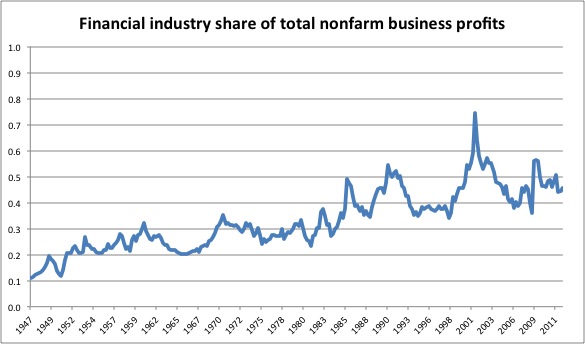
Financial industry share of total nonfarm business profits. Evan Soltas (2013)
Financial industry share of total non-farm business profits. Evan Soltas (2013). Economics and Thought.

In the United States financial sector profits grew from 10% of total non-farm business profits in 1947 to 50% in 2010.2 This figure excludes bonuses. It is explosive stuff and the original research has been removed from the Internet. The findings could give us the impression that the financial sector is a big fat parasite that feeds on us. And who would have guessed that?

What a scary monster the financial system has become. This terrible creature could easily wipe out human civilisation as we know it. That nearly happened in 2008. And it can still happen. We are hostage of this monster. It is too big to fail. But what created it? It wasn’t Frankenstein for sure. The answer is already out there for thousands of years. It is interest on money and loans. In the past this was called usury and often forbidden.

The core problem is that incomes fluctuate while interest payments are fixed. This causes instability in the financial system. And if the investment is more risky, lenders demand a higher interest rate, which contributes to the risk. Limiting interest would reduce leverage and make financial system more stable and less prone to crisis.

It’s the usury, stupid!

Fraud in the financial sector contributed to the financial crisis of 2008. To what extent the fraud or the size of the financial sector are to blame is less clear. Financial crises are not a recent phenomenon. They have caused economic crises in the past. For instance, the stock market crash of 1929 and the subsequent bank failures caused the Great Depression of the 1930s. Back then the financial sector was not as large as it is today and there was no large-scale mortgage fraud. Hence, there must be another cause.

Charging fixed interest rates on debts causes problems as incomes fluctuate. So if some person’s income or some corporation’s profit suddenly drops, interest payments may not be met. When the economy slows down that happens to a lot of people and corporations simultaneously, which makes the financial system prone to crisis. And interest is a reward for risk. Creditors may be willing to lend money to people and corporations that are already deeply in debt, but only if they receive a higher interest rate. So if interest was forbidden, that might not happen, and there could be fewer financial crises.

Banning interest has been tried in the past and it failed time after time. That is because without interest lending and borrowing wouldn’t be possible and the economy would come to a standstill. Until now there was a shortage of money and capital so interest rates needed to be positive, but that may be about to change. The increased availability of money and capital pushed interest rates lower. Money and capital may soon be so abundant that interest rates can go negative. That could be the end of usury.

The scary monsters in the financial system

Apart from exchange rate speculation there are frightening creatures like quantitative easing, shadow banks and derivatives. These things will be explained later in this post. Some experts believe that the financial sector is out of control. That may not be the case. Usury created this monster so Natural Money, which is negative interest rates and a maximum interest rate of zero, could make many of these seemingly hard-to-solve issues disappear, and perhaps shrink financial sector profits too.

Leverage, shadow banking and derivatives make the financial sector so profitable for its operators because of interest and risk. Interest is a reward for risk but interest also increases risk because interest charges are fixed while incomes aren’t. But more risk means more profit for the usurers because all that risk needs to be ‘managed’. That provides opportunities to profit for those who make the deals. Usury is the main cause of financial crises and generates most financial sector profits.

Quantitative easing

Quantitative easing means that central banks print money to buy debt with this newly created money. Trillions of dollars and euros have been printed so central banks now own trillions in debt. In this way the financial crisis of 2008 was stemmed. Investors and banks wanted to get rid of debts and preferred cash because there was a risk that some of these debts would not be repaid in full. This caused the crisis.

But what if there was a tax of 10% per year on cash and central bank deposits? Losing a few percent on bad debts suddenly doesn’t seem such a bad deal any more. Investors may have kept these debts and the crisis would not have occurred. The losses on bad mortgages turned out to be a lot less than 10% per year. That was also because the crisis was halted with central bank actions like quantitative easing.

If there had been a tax on cash and central bank deposits there would always have been liquidity. The crisis may never have happened in the first place and quantitative easing may not have been needed. And if this tax is going to be implemented in the future, investors may gladly gobble up the debt on the balance sheets of central banks, so that quantitative easing can be undone, and most likely at a profit for the taxpayer.

Shadow banks

In order to protect depositors, banks are subject to regulations. Regulations are bad for profits because they limit the risks banks can take. Bankers who were looking for bigger bonuses came up with a scheme that is now called shadow banks. Shadow banks don’t offer deposit accounts to ordinary people so regulations don’t apply. And so shadow banks can take more risk and generate more profits.

A shadow bank borrows money from investors and invests it in products like mortgage-backed securities. A mortgage-backed security is a derivative that looks like a bunch of mortgages. The owner of the security doesn’t own the mortgages themselves, but is entitled to the interest from the mortgages but also the losses when home owners fall behind on their payments. Not owning the mortgages themselves makes trading a lot easier because mortgages involve a lot of paperwork.

Shadow banks can be dangerous because bank regulations don’t apply. Ordinary banks are required to have a certain amount of capital to cushion losses so that depositors can be paid out in full when some loans aren’t repaid. The balance sheet of an ordinary bank might look like the one below:

debit
credit
mortgages and loans
€ 70,000,000
deposits
€ 60,000,000
loans to other banks
€ 10,000,000
deposits from other banks
€ 20,000,000
cash, central bank deposits
€ 10,000,000
the bank’s net worth
€ 10,000,000
total
€ 90,000,000
total
€ 90,000,000

But shadow banks don’t need to comply to these regulations because they don’t have depositors. And so the balance sheet of a shadow bank might look like this:

debit
credit
mortgage-backed securities
€ 500,000,000
short-term lending in money markets
€ 490,000,000
insurance and credit lines
the shadow bank’s net worth € 10,000,000
total
€ 500,000,000
total € 500,000,000

What is so great about shadow banking, at least for bankers? If banks borrow at 2% and lend at 4%, the ordinary bank can make € 1,400,000. The bank’s net worth is € 10,000,000 so the return on investment is 14%. But the shadow bank can make € 10,000,000 and the return on investment is 100%. And you can imagine how great this is for bonuses. Only, if something goes wrong, there is little capital to cushion losses. That’s not a problem for the bankers because by then they have already cashed their bonuses. But it could become our problem as shadow banks can blow up the financial system.

If the loans drop 10% in value because some home owners fall back on their mortgage payments, the capital of the ordinary bank can cushion the loss of € 8,000,000, while the shadow bank goes down in flames leaving an unpaid debt of € 40,000,000. And now we get to the point where financial system blew up. It is the insurance and credit lines part on the balance sheet of the shadow bank. There is no value attached because credit lines so insurances don’t show up on balance sheets or only for a very low amount.

Ordinary banks guaranteed credit to shadow banks just in the case investors like money market funds didn’t want to invest in shadow banks any more. The great thing of credit lines for bankers is that they get a fee for these credit lines while they don’t appear on the balance sheet so that banks don’t have to cut back their lending. When homeowners fell behind on their payments, investors didn’t want to invest in shadow banks any more, and these credit lines had to be used. This means that ordinary banks had to step in and suddenly their capital wasn’t sufficient to cover the losses. Also going down in flames, were the insurers of mortgage-backed securities.

The United States had a government policy of stimulating home ownership. Under the guise of this policy mortgages were given to people who couldn’t afford them. Behind the scenes usury was to blame. If there was doubt whether the borrower could afford the mortgage, a banker could charge a higher interest rate to compensate for the risk. This made the mortgage even less affordable to the borrower. The solution for that problem was giving ‘teaser rates’, meaning that the interest rate was low during the first year so that the home owner could afford the mortgage payments at first. Meanwhile the mortgage was packaged in a mortgage-backed security so the banker was already off the hook when the home owner fell behind on his or her payments.

And there is more. Shadow banks offer higher interest rates to their investors. Shadow banks don’t have a lot of capital so investing in them is a more risky than putting money in a bank account of a regular bank. Investors in shadow banks need a compensation for that risk. That’s no problem because the enterprise is very profitable. It is therefore possible for shadow banks to pay higher interest rates. This might not be possible if interest was forbidden, unless shadow banks had a lot more capital to cover their losses, but that would solve the problem of them being too risky. It is usury that allows for risky schemes like shadow banks to exist.

The multi-trillion-dollar derivatives monster

In 2016 the notational value of all outstanding derivatives is estimated to be $650 trillion. This is the so-called multi-trillion derivatives monster. This figure is more than eight times the total income of everyone in the world.3 Some people are spooked by the sheer size of that number. And indeed, derivatives can be dangerous. In 2003 the famous investor Warren Buffet called derivatives ‘financial weapons of mass destruction’.

Five years later derivatives played a major role in the financial crisis. An improper use of derivatives nearly brought down the world financial system. But derivatives can be useful. Most banks use derivatives to hedge their risks. Banks that managed their risks well using derivatives fared relatively well during the financial crisis compared to banks that didn’t.4 Therefore, derivatives are probably here to stay.

But what about the multi trillion monster? The number is a notational value, not a real value. Derivatives are insurance contracts, often against default of a corporation, a change in interest rates, or home owners falling behind on mortgage payments. You may have a fire insurance on your house to the amount of € 200,000. This is the notational value of the contract. You may pay the insurer € 200 per year. That is the real value of the contract, until something happens, that is.

If your house burns down, the contract suddenly is worth € 200,000. Insurers often re-insure their risks, which is a prudent practice. But re-insurance makes the notational value of the outstanding derivatives increase. So if your insurer re-insures half of your fire insurance to reduce its risk exposure, another contract with notational value of € 100,000 is added to the pile of existing insurance contracts.

So what went wrong? If suddenly half the houses in a nation catch fire because there is a war, insurers go bankrupt. The cause of the financial crisis was many home owners falling behind on their payments at the same time so that insurers of derivative contracts like mortgage-backed securities went bankrupt. The American International Group (AIG) was the largest insurer of these contracts and it was bailed out with $ 188 billion. The US government made a profit of $ 22 billion on this bailout, but only because the financial system wasn’t allowed to collapse.

In a financial crisis a lot of things go wrong at the same time. The financial system can’t deal with a major crisis. If it happens, it may cause the greatest economic depression ever seen, and in retrospect it may herald the collapse of civilisation.

The usury issue

Money circulation in the economy is like blood circulating in the body. It makes no sense for a kidney or a lung to keep some blood just in case the blood stops circulation. The precautionary act makes the dreaded event happen. It is a self-fulfilling prophecy. A financial crisis is like all parts of the body scrambling for blood at the same time. When the blood circulation stops, a person dies. An if the money circulation stops, the economy dies. Hoarding is to blame for that.

Perhaps big banks are too big to fail. Breaking them up may not help because the banking system is closely integrated. Banks lend money to each other. If a few banks fail then others get into trouble too. And in a crisis all the trouble happens at the same time. So perhaps it is better to address the cause of failure itself, which is interest on money and debts. And it may be possible because interest rates are poised to go negative.

A tax on cash makes negative interest rates possible. It can also keep investors from hoarding money. If money keeps on circulating, there may never be a crisis. The crisis happened because investors scrambled for cash when they feared they might lose money on bad debts. But if they expect to lose more on cash, they might keep their debts. And there may have been fewer bad debts in the first place if there had been no interest on debts as interest is a reward for risk.

Featured image: Graffiti near the Renfe station of Vitoria-Gasteiz. Wikimedia Commons. Public Domain.

1. The rise of money trading has made our economy all mud and no brick. Alex Andreou (2013). The Guardian. [link]
2. The Rise of Finance. Evan Soltas (2013). Economics and Thought. [no link because the information has been removed]
3. Here’s What Makes the Derivatives “Monster” So Dangerous (for You). Michael E. Lewitt (2016). Money Morning. [link]
4. Financial innovation and bank behavior: Evidence from credit markets. Lars Norden, Consuelo Silva Buston and Wolf Wagner (2014). Tilburg University. [link]

The future of interest rates

There is a relationship between the amount of capital in a market economy, wealth inequality, savings, the level of debt, and interest rates. If an economic depression or a world war can be avoided, this relationship may decide the future of interest rates, and interest rates may go negative. If this makes you yawn, you have read the message already, and you can proceed with more exiting ventures like checking out what your friends are doing on Facebook or Instagram.

If instead you are thrilled by the idea of knowing more about this relationship, you may continue reading. Interest rates are the result of supply and demand for money and capital. Money and capital differ from consumer goods like coffee and services like haircuts. Money is a medium of exchange. You use money to buy and sell consumer goods and services. And capital isn’t consumer goods or services either. Capital is used to make these consumer goods and services. Hence supply and demand for money and capital need a separate explanation.

The price of money

A kilogram of coffee might cost € 7 in France and $ 8 in the United States. But what does that mean? Is coffee more expensive in the United States than in France? That entirely depends on the price of the dollar and the euro. If one dollar is worth € 0.80 then $ 8 is € 6.40, which is less than € 7. The price of the euro and the dollar change every day because of changes in supply and demand in the market for euros and dollars. But the price of euros and dollars is not the price of money, at least according to economists.

When economists talk about the price of money, they do not mean the price of dollars and euros. They talk about the interest rate. The supply and demand for money and capital determine the interest rate, hence the interest rate is the price of money. This price has a relation with the returns on capital because investments in capital are an alternative to lending. Money isn’t produced and consumed like coffee. If you borrow money, you may have to return it with interest. Borrowers may pay for the use of money, not for the money itself.

There are people and corporations that have savings as well as people and corporations that need money for consumption or investment. So there is supply and demand for money. But what determines the supply and demand for money and therefore the interest rate? It begins with the choice people have when spending their income. They can choose between consumption and saving. Savings can be used for investments in corporations to make products and services in the future.

Consumption versus investment

Economists sometimes use a simple model consisting of only households and businesses to explain things like consuming and saving. Households consume the stuff businesses make. In order to make that stuff, businesses need investment capital provided by households from their savings. It is important to notice that some households borrow and some businesses save, but on balance households save while businesses borrow to invest.

Households can do two things with their income. They can either use it for buying stuff, which is consumption, or save so that businesses can invest. For example, if you are a plumber and need to buy a new van for your business, which is an investment, you may have to forego a new car for your family, which is consumption, to save money for the van. You could also borrow the money for the van so that you can buy the family car too, but in that case someone else has to save so that you can borrow.

If people spend a lot of money on consumption, businesses sell a lot of stuff and make great profits. Businesses may be willing to invest so that they can sell even more and make even more profits. But if there are only a few savings because people spend a lot of money on consumption, so businesses might fear they can’t borrow and may be willing to pay higher interest rates, so that interest rates go up.

When interest rates go up, some businesses may abort their investment plans as they don’t expect to make enough money to pay for the interest. At the same time, more households may be willing to save. So when interest rates go up, the demand for money goes down and the supply of money goes up.

On the other hand, if households save a lot of money and do not consume, there are a lot of savings, but businesses are not willing to invest because they have trouble selling stuff and making profits. In that case households fearing that they don’t receive interest on their savings are willing to lend at lower interest rates, and interest rates go down. But how do households choose between consuming and saving?

Time preference

Economists believe that your choice between saving and borrowing depends on your time preference as well as the interest rate. Time preference is your willingness to forego your needs or desires in the present in order to fulfil your needs or desires in the future. An example can illustrate this. Assume that you want to buy a new car. You want that new car now but you don’t have the money. You can either wait and save to buy the car later or you can borrow to buy the car now.

Assume the car costs € 10,000. If the interest rate is 10%, you may realise that borrowing money to buy the car will cost you dearly. If you pay back € 1,000 each year, you repay the loan in 10 years. Over that period you pay € 5,500 in interest so the car will cost you € 15,500 instead of € 10,000. The alternative is to wait and save money to buy the car.

If you can manage saving € 1,500 per year and the interest rate on savings is also 10%, you could buy the car after less than six years. But then the car only costs you € 8,250 because you receive € 1,750 in interest. At an interest rate of 10% borrowing money to buy this car costs nearly twice as much as saving.

That may convince you to save and drive your old car for six more years. If the interest rate is lower, you may find borrowing more attractive than saving because you would rather have the new car now. Your time preference tells how strong your desire is to have the car now rather than later. It determines the interest rate you are willing to pay. Not surprisingly, different people have different time preferences.

Time preferences affect interest rates. Suppose that you want to borrow money for a new car. Suppose that you can only borrow the money from John. John has € 10,000 but he wants to buy a car too. Time preferences are going to decide whether or not John is going to lend you this money. If your time preference is 7% and John’s time preference is 5%, he will keep his old car for a while and lend the money to you. He may do this because he expects to buy a bigger car once you have repaid your loan with interest.

The interest rate could be anywhere between 5% and 7% depending on your and John’s negotiating skills. You won’t borrow at interest rates above 7% and John won’t lend at interest rates below 5% but any interest rate between 5% and 7% is acceptable to both you and John. In this way time preferences affect interest rates.

When interest rates go down, more people may borrow and fewer people may save because of their time preferences. If the interest rate is 4%, John may buy that bigger car now and borrow the money to buy it. If the interest rate is 8%, you would save to buy the car. When interest rates rise, more people may opt for saving instead of borrowing. The interest rate may move to where supply equals demand, which depends on the time preferences of lenders and borrowers but also on the demand for investment capital.

Capitalist spirit

Time preference only works for ordinary people. There are other people too. They are called capitalists. You probably have heard about them. Capitalists think differently. They suffer from a condition called capitalist spirit, which is having little or no time preference. Capitalists think that money spent on a frivolous item is money wasted, because when you invest your money, you end up with more money that you can invest again.

Capitalists save regardless of the interest rate. They rather invest in the distant future when they are dead than spoil their money on frivolous items during their lifetimes. Consequently capitalists end up with a lot of money when they die. What’s the point of that? Capitalists invest in businesses that make the frivolous items ordinary people enjoy. Ordinary people wouldn’t have invested their money, but spent it on frivolous items instead so that these items wouldn’t have been produced in the first place.

Perhaps you think that all capitalists are wealthy. But that isn’t true. Anyone who saves as much as he or she can regardless of the interest rate can be called a capitalist. What is important here, is that the capitalists as a group own most capital, and because capitalists own so much money and capital, and keep on saving and investing, there is a surplus of savings. And if there is a surplus of savings at an interest rate of zero, the interest rate should be negative according to the law of supply and demand.

Convenience

When you lend money to someone else you can’t use it yourself. There may be a new mobile phone you want to buy, but alas, you have lent out your money. This is not convenient. But then you remember with a smile on your face that you will be able to buy the phone but also an additional hip phone cover next year because you receive interest on that loan. So, if you don’t receive interest on your money, you may not bother lending it out because you may suddenly need it. Interest rates on long-term loans are higher than interest rates on short-term loans because the longer you can’t use your money, the less convenient it is.

When you deposit money at a bank, you lend it to the bank but you can still use it any time. That is possible because when you make payment, for example for legal advice, this money ends up the account of the lawyer. The bank will then be borrowing this money from the lawyer instead until she uses it to pay someone else. This is convenient so you are willing to lend money to a bank. For that reason interest rates on current accounts and checking accounts are low. Having money in a bank account is more convenient than cash so the bank may even charge you for having an account.

Risk

Lending out money can be risky. There are two types of risk. First the borrower may not pay back the loan. That could make you reluctant to lend. So if someone of questionable integrity wants to borrow money from you, and you fear that she may not pay back, she could offer you a very high interest rate so that you might think, ‘Well, she may not pay back, but the interest rate is very attractive, so I’ll take my chances and do it anyway.’

Second, money may become worth less in the future. This is called inflation. If there’s a lot of inflation then the money that buys a mobile phone today may only buy a phone cover next year. In that case you may spend your money right away on a mobile phone before it is too late. That is unless someone wants to borrow the money from you and offers a very high interest rate, so that your can buy a better model next year.

The business of a bank is to know its customers. For that reason lending money to a bank is less risky than lending out money to an individual or a corporation. And because banks are supposed to be good at managing risk, they can borrow at lower interest rates, meaning that interest rates on bank accounts are lower than those on loans.

And because banks know their customers and lend to many different people, they can manage risk better than you can and lend at lower interest rates than you are willing to because if you lend money to a someone you don’t know, you may desire a higher interest rate because you don’t know whether he or she is going to repay the loan.

Returns on investments

If you have money, you could invest it in corporations or real estate. Corporations pay dividends and real estate pays rent. If the rents and dividends are higher than the interest rate you get by lending out your money, you may prefer investing to lending. But investing is more risky than lending. If sales are sluggish, profits may go down and dividends may be cut, but lenders still get their interest. Nevertheless investments are an alternative to lending, so if investments offer better yields, you may opt for investing.

If someone wants to borrow money from you, the interest rate must be high enough otherwise you may invest this money instead. Other people who have money are in a similar position. Borrowers need to offer attractive interest rates in order to be able to borrow. Similarly, if dividends and rents are low, people with money may prefer lending to investing, so that borrowers can negotiate lower interest rates. In this way the returns on investments affect interest rates on loans.

The type of money used

The properties of money can affect interest rates. Just imagine that apples are money and you are saving to buy a house. If someone wants to borrow 1,000 apples from you, and promises to repay those 1,000 apples after 10 years when you plan to buy your house, you would gladly accept this generous offer. You may even accept an offer of 900 apples because that is better than letting your apples rot. In this case you would settle for a negative interest rate. But you would only do so if there are no alternatives.

If you could make 10% per year in the stock market, you could exchange your apples for Apple stock because their gadgets are in great demand and outrageously expensive. In that case, it doesn’t matter that apples rot and you could demand interest on a loan. But if returns on the stock market are low or when stock prices are fluctuating so wildly that you can’t sleep at night, you may prefer the offer of 900 apples.

If the money had been gold, you would never accept such an offer, even when the stock market is doing terrible. You can always keep your gold in a safe deposit box. Similarly, you wouldn’t accept negative interest rates on euros or dollars because you can take your money from the bank and store the bank notes in a safe deposit box. The problem with this is that if you put money in a safe deposit box, other people can’t use it for buying and selling stuff. And this can cause an economic depression.

Central banks

It is often said that central banks set the interest rate. But how do they do that? Central banks can print money. If central banks believe that the interest rate is too high, they print more money so that there is additional supply and interest rates go down. On the other hand, if central banks believe that the interest rate is too low, they print less money so that interest rates go up. If the central bank says that it sets the interest rate to 3%, this means that it will print precisely enough money to keep the interest rate at 3%.

Why do central banks print money? Money isn’t produced and consumed like coffee. If you borrow money, it has to be returned with interest. Most money is debt so where does the interest come from? Capitalists let their money grow on their bank accounts so the money to pay the interest from must come out of thin air. Individual borrowers may be able to repay their debts with interest but on aggregate borrowers can’t.

More money needs to be borrowed to pay for the interest. That’s why the total amount of debt increases each year. And if people aren’t borrowing enough, the central bank may print more money to prevent a financial crisis.

Sometimes people don’t borrow enough to keep the economy going and sometimes they borrow too much so that the economy is overheating. Central banks adapt their money printing to prevent these things from happening. Central banks raise interest rates and print less money (or stop printing money or even destroy money) when they want people and businesses to borrow less and they lower interest rates and print more money when they want people and businesses to borrow more.

The future of interest rates

Interest rates went down because capitalists acquired more and more capital over the years and kept on saving and investing regardless of the interest rate. In the past returns on capital have mostly been higher than the economic growth rate while most returns were reinvested so that a growing part of total income was for capitalists. As capitalists reinvested most of their capital income, this is not sustainable in the long run.

interestvers
Capital income (red) versus total income with capital income growing faster than total income

The graph above shows how total income and capital returns (in red) develop if the economic growth rate is 2%, the return on capital is 5%, capital income starts out as 10% of total income, and all capital income is reinvested. After 25 years the economic pie has grown faster than interest income and more is available for wages. At some point interest income starts to rise faster than total income, and less becomes available for wages. And after 80 years there’s nothing left for wages.1

This graph explains a lot about what is going on in reality. When wages started lagging, people couldn’t afford to buy all the stuff corporations made. As a consequence business profits, which is capital income, went down. In the short run it was possible to prop up business profits by allowing people go into debt to buy more stuff. But at some point people couldn’t borrow more unless interest rates went down. As capital income went down, capitalists became willing to lend money at lower interest rates, allowing people to borrow more to buy stuff. As interest rates went lower, more and more people went into debt because interest rates moved below their time preferences.

Nowadays most people are borrowing from the capitalists, for instance via mortgages, car loans, and credit cards, but also via governments as governments borrow from the capitalists too. Many people and governments can’t afford to borrow more. Interest rates are already near zero and may need to go negative if the law of supply and demand is going to do its job. In that case capitalists may start handing out money to the rest of us so that we can keep on buying the stuff their corporations make.

Capitalists may only lend at negative interest rates if money is like apples and not like gold.2 When interest rates are negative, people may buy land or real estate so that the prices of these properties may rise. Property taxes are often based on the value so properties may become less attractive at higher prices. Alternatives are gold or bitcoin, but at some point gold or bitcoin may become so expensive that the risk of losing money on these investments could deter people from buying more. Nevertheless, these alternatives put a constraint on how low interest rates can go. Interest rates must remain attractive for investors.

1. The End Of Usury. Bart klein Ikink (2018). Naturalmoney.org. [link]
2. Feasibility Of Interest-free Demurrage Currency. Bart klein Ikink (2018). Naturalmoney.org. [link]