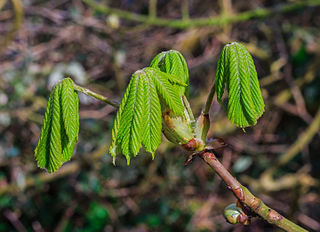
Close up of chestnut tree branch at De Famberhorst in the Netherlands

The Tree Garden

Once I went to bed in the evenings and sometimes during the day, my imagination took over, most notably when sitting on the swing in the back garden. There were several different fantasies, often recurring. In one, I drove a car on a road called De Weg (The Way), reflecting my life path. There is a parallel with the Chinese Tao. And our home had wings and could fly, but only in my imagination. Once, in a dream, all the houses in Nijverdal spread their wings, went up in the air, and installed themselves in new locations during school time, so I got lost on my way home. That gave me the idea.

A few times, I had a crush on a girl. And out of nowhere came a strange and scary imagination. She would consume me or digest me inside her stomach. The inside of her stomach consisted of giant gears that crushed me. That imagination didn’t relate to my feelings for these girls, which weren’t particularly strong, or a fear for them as they weren’t particularly intimidating. It just seemed to come out of the blue. In hindsight, it was a foreboding of things to come three decades down the line.

In the autumn of 1976, I had gathered a bag of chestnuts and left them on the ground behind the shed in the backyard. The following spring, dozens of small chestnut trees popped up on the spot. It was the start of my tree garden in the backyard land and the germinate club that specialised in growing trees, most notably chestnut trees. The backyard land belonged to our neighbour, Mrs. Schaap (Mrs. Sheep). She came from the Dutch Indies and was in her sixties when we moved there. She was a widow. Her husband had died a few years earlier, and the patch would become a kitchen garden tilled by her husband. And so, that land remained fallow, and I could begin a tree garden there.

Mrs. Schaap didn’t mind, and we could get along. I was often on her terrace, drinking lemonade with her. She also drank nettle tea, ate nettle soup against her rheumatism, and let me taste them. They were not a thrilling taste sensation. They were like green tea. Ms Schaap became very old and died in 2014, aged 100. On the other side was a garden centre owned by the Ter Horst couple. The wife often came over to let my mother do her hair. To me, the garden centre was an adventure centre. I could hide between the bushes and trees and move inconspicuously. I saved trees and plants from the garbage heap, sometimes with friends, to relocate them in the tree garden. Once, I sold a plant to Ms Schaap, but my mother cancelled the sale.

For over a decade, Mrs. Schaap had a fancy man, Mr. Langelaar. His wife had dementia and later died. He often came over, and they sat in the garden reading books. Ms Schaap sometimes came to buy a few cigarettes from my mother. She didn’t want to keep them at home as that would make her smoke more. I vaguely remember Ms Schaap having a fish tank in the living room at first. My father later confirmed it. That is noteworthy, as at our previous address in Eibergen, our next-door neighbour was also a lady of the same age from the Dutch Indies with a fish tank. I regularly visited the other neighbours as well. They were mostly older people who had kitchen gardens, chickens, cows and rabbits.

We had a horse, first a pony named Tilly, and later, a real horse, Desi, for my mother to ride. A horse in your pasture attracted girls who wanted to ride it. My mother only allowed Alexandra to do that. She had long, curly blond hair and was beautiful, but she was six years older, so I barely looked at her. As the story goes, she had been on holiday with her parents in Morocco once, where a wealthy man offered her parents 3,000 camels to marry her. My mother sold the horse in the early 1980s when interest rates skyrocketed, and mortgage payments became a drag on the budget.

Trees became special to me. I made drawings of trees and made up stories about them in which they could talk and fly. And I began drawing maps, first of the Netherlands and later of Europe or imaginary countries with coastlines, villages, cities, roads, and rivers. These imaginations made life more agreeable. In bed, a fairy tale world took over. This situation remained so during my teenage years and didn’t change during adulthood. There was a strict disjunction between reality and imagination. I was imaginative but didn’t believe my imagination. That was unusual. Most people are less imaginative but believe in their fantasies.

I still love trees. After buying my house, I left the garden and the trees the way they were, much to the chagrin of my neighbour, a lawyer who wanted them cut down. And I planted Christmas trees next to the railroad near my home. One survived and has grown large. In the early 2000s, a deadly chestnut disease began to kill chestnut trees. They suffered the same fate as the elms culled by the Dutch Elm Disease. That is peculiar, as I was born on Elm Street in the Netherlands and had grown chestnut trees later on. The fact that the elm disease is Dutch adds some juice to this coincidence.

In school, a book once presented the children with a choice about the type of future they preferred. Option one was a sober room with a light bulb. A boy on a wooden stool asked his parents, ‘When will there be electricity so I can read?’ This option represented a simple life with little comfort. Option two was a boy attached to a machine. He didn’t appear all that healthy. It represented an advanced technological society. I chose the first option.

Feature image: Close-up of a chestnut tree branch at De Famberhorst in the Netherlands. Dominicus Johannes Bergsma (2016). Wikimedia Commons.

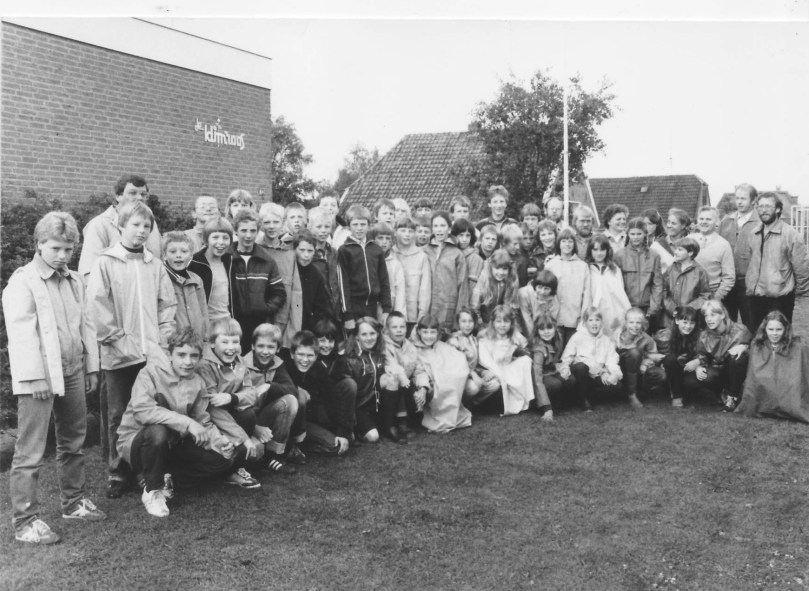
Primary school class

Primary school


My primary school was De Klimroos, a Roman Catholic school. I was a loner. The harassment usually wasn’t extreme, but occasionally it was, making the school a war zone. Every day was a battle. But I was in it for the long run to finish school. That came with thoughts like, ‘Standing with the back against the wall is not so bad because they can’t attack you from behind.’ And, ‘Humiliation is bearable as most people will forget about it after a week or so.’ Sometimes, they blamed me for things I didn’t do. Once, there was a fight between two boys. One boy’s glasses fell on the ground and broke. I was one of the bystanders. Someone might have accidentally stood on the glasses. Everyone said it was me. I had seen these glasses lying, and they weren’t close to my feet but to other children’s feet. Only no one believed me. It was pointless to argue. It became an insurance affair, but in the end, the insurers agreed that it wasn’t my fault because the glasses were already lying on the ground.

Not being good at sports was another disadvantage. Sports at school was one year of torment, but it ended on a high note. Before the summer holidays, the last lesson was monkey cage, a freestyle adventure and great fun. The teacher sometimes made the children choose teams. I was always the last one remaining. No one wanted me in their team. We had school swimming for a year. Nearly all the children got their swimming diplomas, except me. The following year, my mother made me go to the swimming pool alone to attend swimming courses early in the morning before school, between seven and eight AM. And so, I got the first diploma, A, and the year after, even the second, B. The year after that, my teacher, Mr B*****, once sent me on an errand to another class led by Mr. H*********. When I came in, some kid yelled, ‘Enasniël can’t swim.’ Mr H********* then whispered in my ear, ‘What diploma do you have?’ I whispered, ‘B.’ And then he asked the kid, ‘What diploma do you have?’ He said, ‘A.’ ‘Enasniël has B,’ Mr H********* said. And then the joke was on him.

My lucky number was twenty-six. When looking at it, you immediately see why it is such a beautiful number. So that doesn’t require any further explanation. My date of birth, 26 November, was another reason. Green was my favourite colour, also for obvious reasons. Everyone can see that other colours aren’t as green. Green is also the colour of success, while red is the colour of failure. If something goes well, you see a green check mark. If something goes wrong, you see a red cross. I dedicated a little poem to the number twenty-six. It may go down in history as one of the best poems about the number twenty-six ever written, but that is entirely due to a lack of competition. The English translation is below,

Twenty-six letters in the alphabet,
Twenty-six weeks makes half a year
Two litres of mercury weigh close to twenty-six kilogrammes
And oh, how heavy that is.

Near the entrance was a sign attached to the fence. On it was the name of the company that had installed it. On its back, someone had written, ‘Enasniël Drogoel ís crazy.’ The text remained there for several years. Everyone could see it when passing the gate. It was nearly impossible to miss. It reminded me of what others thought of me. There was a wall around me, so it hardly mattered. One day, a teacher gave me a chore near the entrance and some tools, allowing me to remove the sign.

For many years, I had two friends, Marc and Hugo. They were classmates. Hugo came first. I ran into him when passing his home. He invited me in. And so, we became friends. Hugo’s mother had a board position in the Roman Catholic Church. His father was a manager. Marc came somewhat later. His father was a sales agent for a Swedish firm. They had a Volvo. They had a dog, a boxer named Boris. Marc had a sleeping room in the attic with his younger brother, filled with Legos and other toys. The Swedish firm sold sewing threads, so we had a lot of wires to play with. And there was a radio.

We started a few clubs. I was the instigator. Our inventions club came first. We gathered money to buy technical items and Legos and experimented with a broken television my mother had left in the attic. We opened it, inspected its interiors, removed some parts, and put them back together. Marc warned me about the capacitor, which he believed was inside it, as it had an electrical charge, and we made fun of what might happen if we hit it. We made the television work again without understanding how.

Later came the germinate club. And the antique club, which was more of an excavations club. We found pottery pieces in the ground and stored them in the shed. We also buried a tube with a document in the forest. It contained our names, signatures, a date and an explanation, and we hoped someone would uncover it after 1,000 years. And we listened to the radio. Marc and I shared a passion for the radio programme Dik Voormekaar Show, with funny voices and noises, and where everything went wrong, a brainchild of the comedian André van Duin. I truly enjoyed everything he did. Van Duin also made songs and sketches together with Corrie van Gorp. It was hilarious.

Marc was fond of gadgets. In the 1970s, digital watches from Japan came to the market. They were expensive at first, costing as much as 300 guilders, but Marc soon had one. These watches had features like a stopwatch, time zones or a calculator. Hugo was a bragger. The things he or his parents owned were always better. When his father bought a Hyundai car, these were the best cars in the world, even though a Hyundai didn’t come close to a Volvo. We had a Peugeot and no reason to boast.

One day, when arriving at school, the children were awaiting me on the path from the gate to the schoolyard. They stood on both sides and scolded me while I passed. They had all agreed on it and had perhaps organised it. Otherwise, there wouldn’t be enough kids to fill the entire stretch on both sides. Marc walked at my side like a true friend, but Hugo was among the kids scolding me. Hugo once explained his friendship as a kind of charity. He said his mother had told him it was a good deed to befriend sorry kids like me. His mother was a high-ranking figure in the Catholic Church, so she might have taught Hugo that he had to earn his place in heaven.

And then there was the strange incident with the plum. Once, I told Hugo that two plum trees were in our backyard. Hugo said that was impossible, ‘Plums grow on bushes, not on trees.’ And there was no way of convincing Hugo. He was sure I was wrong. We had two plum trees, and it was late autumn or early winter, so the trees were bare, and it was impossible to show him plums hanging in a tree. After the argument, we went to the fallow land behind the shed, which would later become my tree garden. There also was a plum tree, one I hadn’t thought of, and there, high up, hung one shrivelled plum in that tree, which was otherwise completely bare. And I pointed at the plum, saying, ‘There you see a plum hanging in that tree.’ That finally convinced Hugo. In hindsight, it is most peculiar that there was a plum. One sole plum was hanging there. The birds had not eaten it. That wind hadn’t blown it out. You could almost think it was left hanging there for me to prove Hugo wrong.

Whenever someone complimented me, I believed this person was mocking me or wanted something from me. Some children praised me for my calculating skills, but they were jeering, and I knew. They didn’t like clever kids. In the sixth grade, we had mental arithmetic, so we couldn’t use paper to calculate. Once, the teacher asked us to calculate the average of 1/3 and 1/5. And then the teacher said the answer was 1/4. Everybody had that answer except me, as I had 4/15. And so, I laid out the proper calculation, which we all had learned, loudly in the class, making the teacher, Mr R****, look like a fool. More than three decades later, my wife once went shopping with my mother in Nijverdal. Someone discovered she was my mother’s daughter-in-law, so this person said to her, ‘So, you married Mr Headstrong?’ If you are right and they are wrong, they ridicule you and call you stubborn.

And my father regularly said, ‘You are so good at tuning the radio. Can you please do that for me?’ He followed courses named Management Labour New Style. To inspire workers, you praise them and tell them how great they are to make them do what you want. Tuning a radio was a simple job anyone could do, so he was lazy, making me wonder, ‘Does he really think I am that stupid?’ Criticism worked better with me. People usually don’t lie when they criticise you.

My grades were not exceptional. They mostly ranged between seven and eight, with ten being the maximum. That is partly due to the school’s egalitarian socialist philosophy, which made getting a higher grade than eight nearly impossible. Some children were as intelligent as I was. Hugo was among them. And there was a girl named Madelon who was more intelligent. However, the combination of being clever, a strange loner and doing poorly at sports was particularly unlucky, making me a subject of pestering.

After initially being timid, I grew more courageous over time while liking a good joke. I prepared a smoking device and lit it near the paper storage next to the bicycle shed, making it appear that the papers had caught fire. At eleven, I had become the tallest boy at school, had grown fearless, settled some scores, and intimidated those who stood in my way. Once, there was an incident with fountain pen refills. We had fountain pens. They had refill cartridges, which some kids, including me, collected to make rings or other objects. Some kids played with them in class, so the teacher took the cartridges from them and put them in the bin. I took them out, probably on the way to the toilets, and they saw me doing it. They demanded them back and threatened me, but I didn’t return them.

Another incident was at a school camp. We were biking, and another kid tried to push me off the road. I didn’t budge and crashed into him, which severely damaged my bike’s wheel. It folded. The teachers made a school camp newspaper with jokes about the damaged bike. I gave the perpetrator a bloody nose, but I don’t remember whether that was at school camp or later. There probably were a few more incidents. The final year’s school report has gone blank because Mr. B****** had used a different type of ink that didn’t stand the test of time. Still, I vaguely remember him expressing concern about my increasing assertiveness and the clashes with other children.

I was also a sensitive kid. Once, I accidentally hit a girl or broke something of her. She kept complaining about the incident, making me miserable because I had wronged her. Ultimately, I could make her happy with a guilder, which settled the matter.

Twenty-five years later, we had a primary school reunion. My former schoolmates gave me a hero’s welcome. They all cheered when I came in. It felt like being an Olympic gold medal winner returning to his home village after the games. One of them said that they appreciated my coming. They believed they had made my life so miserable they had expected that I wouldn’t come. All the other black sheep hadn’t shown up. But the thought of not coming had never crossed my mind.

Featured image: my primary school class

Nijverdal

A few hills surround Nijverdal, and locals call them mountains. Evers Mountain is fifteen metres high. The Netherlands is flat, so fifteen metres can be impressive to some, especially if they are on a bike. Nijverdal is a small town, even though locals still call it a village. It didn’t exist before the Industrial Revolution. It is there because a British entrepreneur found it a superb location for a factory. My life in Nijverdal got off on the wrong footing. A few days after relocating, my mother sent me to kindergarten. A new home, a new village, going to school and being without my mother for the first time in a matter of days was too much. I cried for over two weeks in a row and incessantly. They just let me cry. The teacher then put me in another classroom with another teacher, and I stopped crying.

That was tough love. No one seemed to care. Being four years old, I concluded I was alone in this world. It was the first turning point in my life. From then on, I depended on my judgment only, not expecting anything from anyone, not even my mother, who had left me there. And so, I erected a wall around me, and the hard times began. Nijverdal is part of the Hellendoorn municipality. Also, in Dutch, that name starts with hell and ends with thorn. It might refer to thorny bushes on a slope.

My parents had grown up on small farms. They had been poor, and their lives had not been easy. They ignored my complaints just like their parents had ignored theirs. That was not a lack of love. Harsh conditions can make you stronger, so making your children weak is a lack of love. When I was two years old, my mother made me a pair of trousers. They gave me an intolerable itch, but I had to wear them every other week as I only had two. Luckily, I grew out of them after some time. My father was tough, but my mother was tougher. She often said, ‘Kan niet ligt op het kerkhof en wil niet ligt ernaast.’ It means something like, ‘If you say you can’t, you probably mean you don’t want to, but you will have to.’ And children, she never said children but always brats, can never be right, even when they are.

I could read and write numbers and calculate before I could read and write words. At kindergarten, I became intrigued by numbers. I chalked them down on the pavement. I associated numbers with genius and wisdom, so I embarked upon a personal project you might call counting to infinity. At first, I recited numbers on the way back home from kindergarten. My mother was biking, and I sat on the back, counting. I could ask her questions. After arriving at 99, I asked my mother, ‘What comes after 99?’ ‘One hundred,’ she said. And I continued. The next day, I still counted, ‘998, 999, ten hundred.’ ‘No, not ten hundred, but a thousand,’ my mother said.

Soon, I mastered the number system and knew what came after what. Then, I asked my mother, ‘How far can a university professor count? Is it a million?’ ‘Yes, a university professor can count that far,’ my mother answered. But I wasn’t planning to stop at a million. I was aiming for infinite wisdom. I soon found that counting to infinity would be laborious and take a long time. And so, I divided the effort into parts and started counting in bed in the evenings. And then, I fell asleep and lost count. And so, I had to start over again the next day from a number I was sure I had already recited to ensure that I hadn’t missed a single number. Otherwise, it didn’t count. Somewhere near 16,000, I realised it was pointless and gave up.

And money intrigued me. Once, my mother bought some groceries. She paid with one banknote and received several banknotes and coins in return. And so, I asked her, ‘How is that possible? You give one banknote and get groceries, more banknotes and coins in return.’ She said, ‘I gave a one hundred note and received two of twenty-five, one of ten, and some guilders and cents, which is less than one hundred.’

One morning, a pile of banknotes lay on the table in the living room. The amount was 750 guilders, seven notes of a hundred, and two of twenty-five. I took a one hundred out and hid it in my room to marvel at it. I was six and had some awareness of my deed not being right. I took a one hundred, not because it was worth more but because there were more of them, so its disappearance would be less noticeable. I showed it to my sister, Anne Marie, who told my mother.

I was about to receive my first pocket money, so my parents postponed my pocket money by nearly a year. She had left this money there for my father for expenses at work. He had requested 750 guilders, and when he found only 650, he thought my mother had made a mistake and didn’t discuss it with her any further. In this way, it could go unnoticed for weeks. Once I did receive pocket money, I saved it to buy a globe. It had a light inside. You could see the world’s countries in different colours if you put it on. The next thing I saved for was a microscope.

I often woke when daylight broke. In the Summer, that could be as early as 5 AM. I wasn’t allowed to go out of bed that early. So, I lay awake in bed for hours, staring at the ceiling and watching patches of sunlight gradually move on the wall as time passed, probably just thinking, and I sang songs. I waved my father goodbye from my bedroom window when he left in his car to work around 6 AM.

My father and I were very different, but we both enjoyed watching old-style cartoons like Tom and Jerry, Tweety and Silvester, Droopy, Buggs Bunny and Elmer J Fudd, Donald Duck, the Pink Panther, and Roadrunner and Wile E Coyote. And we often went with him to Cafe H* in Daarle, where his friends gathered. It was a traditional Dutch pub called a brown cafe, where the hunters in the area hung out. There wasn’t much to do, so you could go outside or sit inside and hear the hunter’s tales. There was a billiard table, and there was a slot machine. Sometimes, one of my father’s friends gave me a guilder to play it. I had no qualms about hunting but noticed that hunters lived a life of excess. They found it a poor showing if there wasn’t too much meat.

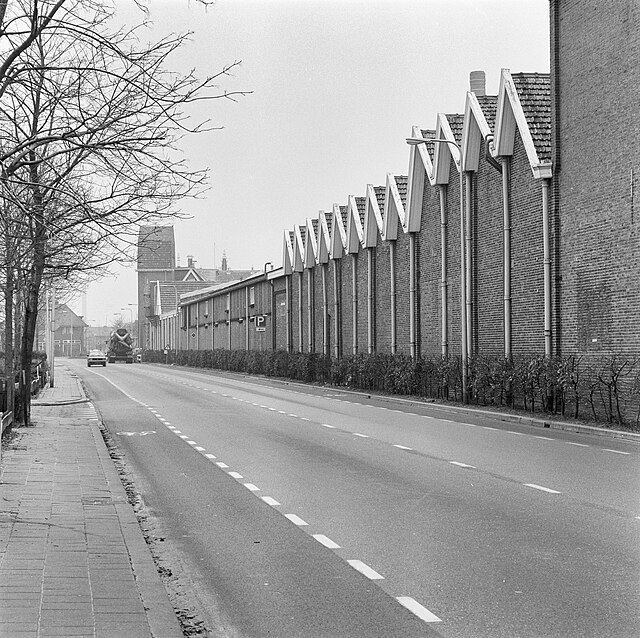
Featured image: Royal Steam Bleachery: Exterior Overview Complex With Halls. A. J. van der Wal. CC BY-SA 4.0.

The farm

Nearly every Sunday, we went to our grandparents. For most of the afternoon, we visited my father’s parents near Vragender, a village close to Winterswijk. They lived on a remote farm with my father’s youngest brother, Paul, my uncle, who had continued and greatly expanded it. On our way home, we went to my mother’s parents for an hour and a half. In 1976, they sold their remote farm near Beltrum, another village nearby, and moved to a small apartment for seniors in Eibergen. And to stress the remoteness, the Dutch call this area De Achterhoek (The Rear Corner). Winterswijk is at the rear of that area. Thus, a farm outside a village near Winterswijk is as remote as it can get in the Netherlands, at least if you look at the words. We live inside a story, so you should. The Netherlands is a tiny country, so De Achterhoek is not as remote as the desert of Algeria, the mountains of Chile, or the taiga of Siberia. Enschede is only 25 kilometres away, and Amsterdam is 125.

The atmosphere at both venues couldn’t be more different. My father’s family was noisy and outgoing, while my mother’s was quiet and withdrawn. If we visited my father’s parents, all the aunts, uncles, and cousins were there. The men played cards in the living room and blamed their mates vociferously for each other’s mistakes. A dense smoke of cigarettes filled the room, so I often went outside with my cousins to play and get some fresh air. It was always fun to be there. At my mother’s parents, there were never aunts, uncles or cousins. Most people my grandparents knew were old too and gradually dying. They discussed diseases like tumours, heart attacks and strokes, hospitals, treatments, mostly failing, and funerals, so my sister and I went outside together to escape the gloom.

Part of the local folklore in De Achterhoek is the rock band Normaal. Their greatest hit was Oerend Hard (Bloody Fast). It is about speeding on motorbikes and the accidents that come from that. They also made a song Ik ben maor een eenvoudige boerenlul (I’m just a simple farm prick). The wording reveals the mood in De Achterhoek. The local tradition is not one of pretence and elevated taste. If you asked the locals what Normaal is about, the answer would be høken, which is having fun by excessive drinking and being rough. I was not a fan of Normaal, but they were popular in De Achterhoek and adjacent Twente.

For those who don’t like to say they live on the edge of civilisation, De Achterhoek has yet another name: De Graafschap (The Shire). That is also the name of a place where an imaginary tale about Hobbits started. That is noteworthy because my life’s story begins here, and the character Frodo in the film looks like me when I was young. It illustrates how much effort has gone into this story. And the name Vragender might relate to questions about gender. My father’s youngest brother, Paul, lived there with my grandparents.

He was a kind man, and we could get along very well. It began when I was five. He praised my calculation skills and made me do sums on his lap while I became interested in his farm. And so I stayed with my grandparents quite often during the holidays. My uncle bred pigs. I fed the pigs, saw piglets being born and pigs going to the slaughterhouse, witnessed the artificial inseminating of sows dubbed KI, and saw tails being cut from piglets because they would otherwise injure each other by biting them off. It made me familiar with his business operations. Paul greatly expanded the farm to achieve economies of scale. He focused on efficiency. The farm was clean because the manure fell through a grate, and the pigs lived in confined spaces.

Sows that didn’t give birth to as many piglets as the others went to the slaughterhouse. Paul selected sows based on the number of nipples for his breeding to improve his pedigree. A sow with twelve nipples could raise more piglets than one with ten. From his piglets, he chose the best sows. The others, including the boars, went to the slaughterhouse after being fattened. It was a necessity. His business could only survive with efficiency and economies of scale. Humans slaughtered pigs since time immemorial. Little has changed since then, except for the scale and efficiency. Paul was my favourite uncle.

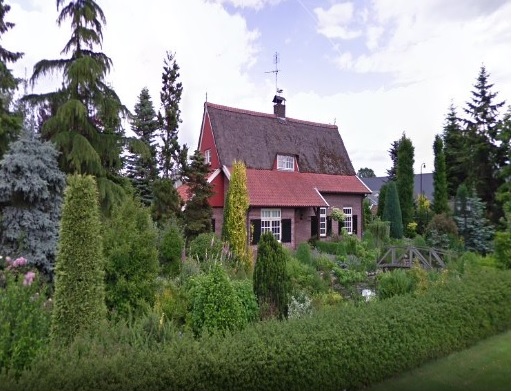
Paul’s work never stopped. If there was an emergency, like a sow in agony, he set the alarm clock to check on it in the middle of the night. My father worked hard, but Paul worked even harder. There always loomed dangers so that Paul could fret. An infectious disease could erase his pedigree. And the price of pigs fluctuated wildly. He had years with high profits and years with massive losses. But overall, his business went well. The old farm was from the 1930s and poorly constructed. When he married in 1977, he had it demolished and a new farm built. The new farm was in traditional style and an eye-catcher. It was huge and included a home for my grandparents. He had spent 500,000 guilders on it, more than three times the average home price, or so I heard. People came to the farm to take a picture of it. It was indeed exceptional. You can ask yourself, how many pigs died for it? But that is not only Paul’s fault because most of us eat meat.

Latest revision: 5 February 2025

Featured image: the farm that belonged to my uncle. Google Streetview. [copyright info]

Eibergen

Near Enschede, in the east of the Netherlands, is a village called Eibergen. I was born there in Iepenstraat, which means Elm Street. The assassination of US President Kennedy took place on Elm Street, and that event became part of a web of remarkable coincidences. A Nightmare on Elm Street is a horror film first released in the United States on 9 November 1984 (11/9) and in the Netherlands on 11 September 1986 (9/11). 9/11 refers to the terrorist attacks of 11 September 2001, another event marked by an array of remarkable coincidences. These words indicate that this is the beginning of a most peculiar story full of coincidences that aren’t coincidences. And it is a story inside a story.

Eibergen means egg mountains, which could be a cryptic reference to a womb. The initials of my last name, KI, make the Dutch abbreviation for artificial insemination, a way to become pregnant without sexual intercourse so that a virgin can give birth. By the way, it is also the Dutch abbreviation for artificial intelligence. The name of the nearby city, Enschede, may refer to the female reproductive organ. And the initials of my first and middle name, BH, make the Dutch abbreviation for a bra. The song A Boy Named Sue by Johnny Cash is about funny names, particularly of this kind, building strong character. The meaning of songs relates to this story, too.

I lived in Eibergen until the age of four. I recall a little of that time. As far as I remember, nothing unusual happened. You might expect something extraordinary if you know the plot of this story, but it didn’t. Often, I went out on a tricycle to feed the sheep in the pasture at the end of the street. Being a shepherd may have been my calling. I was afraid of the clock on television. If it appeared, I took cover behind the sofa. I remember that my mother was pregnant. She was ironing. My sister Anne Marie was born in 1971. I sang songs for the baby in the baby room while my mother changed diapers.

Our home was in a block of similar houses. Next door lived an older lady, probably in her sixties. She came from the former Dutch Indies and had a fish tank in the living room. On the other side was another young family with children. They had a daughter of my age and a younger son. I remember playing with them. And I once electrocuted myself by putting the chain of the stopper of the kitchen sink into a wall outlet. Others later said I had used scissors, but I am sure it was the stopper’s chain, which then was confirmed by my mother. It suggests my memories are of good quality.

My father went to work around 6 AM and returned around 9 PM. He loved his job. On Saturdays, he often went out with his friends, hunting, I suppose. And so, I hardly saw him. At home, he caught up on his sleep on the couch to wake up when sports started on television. So, when I was three years old, I once said to my mother, jokingly, I suppose, ‘Who is that man sleeping on the couch?’ That is what my mother later told me. My father probably took the hint as I remember that he took me out of bed every morning before he went to work and played with me for a few minutes for a few weeks.

When I was three, I fell on my teeth on the wooden table in the living room in a brutal smash. A piece of the wood broke off. My front teeth turned black shortly afterwards until my permanent teeth came. And so, I became an ugly duckling for years to come. We also had a biking accident. My mother was biking, Anne Marie was in the front, I was in the back, and my mother had trouble handling the bags full of groceries at the handlebar. And then the bike fell over. In early 1973, we moved to Nijverdal, which means ‘industrious valley’. It suggests we left the mountains for a life in a valley, but the Dutch mountains are imaginary, and the name of a song by my favourite band, The Nits. The music you love may reveal your character. And that might be correct in my case.

Latest revision: 18 December 2024

Featured image: my mother, my younger sister, and I (in the foreground)