
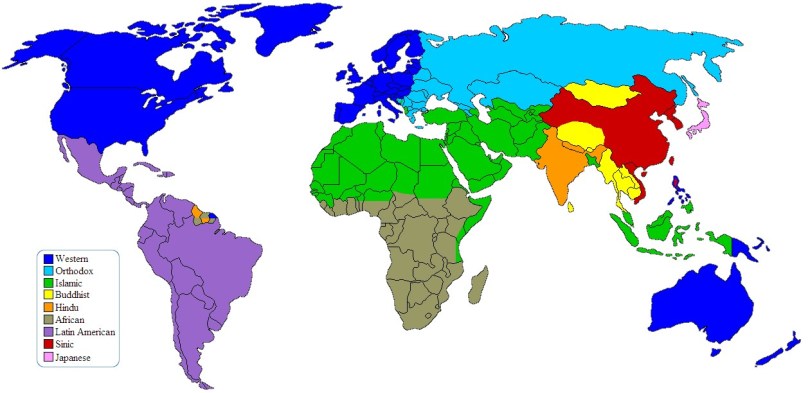
The West and the rest
Those who hope to understand why the world is the way it is must learn about civilisations and cultures, especially Western civilisation and culture. Over the last 500 years, living conditions have changed dramatically due to modernisation. If you lived 2,000 years ago, you could go forward 500 years or more and live a life more or less the same as before. If you lived 500 years ago, you couldn’t, because you would have entered a completely different world. Modernisation involves the division of labour, industrialisation, urbanisation, social mobilisation, and increased education and wealth. Social mobilisation occurs when groups in society organise themselves politically to advance their interests. Expanding scientific and engineering knowledge allows us to shape our environment like never before. Modernisation was the most dramatic change in the history of humankind.
The West’s imperialism unified the world, but it also destroyed the ways of indigenous peoples. The Chinese speak of one hundred years of national humiliation when referring to the era between 1840 and 1950, when Western powers broke the Chinese Empire and plunged it into civil war. It all began with British drug dealers lobbying with their government to start a war in the name of free trade after the Chinese government tried to get rid of them. Among Muslims, similar sentiments exist because of Western military interventions in Islamic countries. There is oil in Iraq, and the United States invaded the country under a false pretext. Coincidence? It may not be much of a solace to them, but Westerners killed more of their kind than of any other race during their internal wars. One might ask what the world would have been like if the Chinese or the Muslims had been the first to modernise. As Karl Marx guessed, capitalism, hence a bourgeois society, was essential to modernisation, so it wouldn’t have made much of a difference.
We live in a bourgeois world rather than a religious one. Moral values don’t drive it, but trade and finance or the ethics of the merchant, which means no ethics at all. How that happened may seem like a complex historical process, but if you look under the hood, the engine was competition. The bourgeois culture of trade and finance has now spread over the globe. No corner of the Earth remained unaffected. Some societies adapted more successfully than others. History is a bitch. For centuries, white males have invented nearly everything. Some white males who haven’t invented anything think they deserve special privileges for that. But cultures appropriate from other cultures and move on. The West inherited from the Greek and Roman cultures that preceded it, and other cultures have inherited from the West. Today, Europe, where it all started, is becoming a backwater.
Blaming the West for history doesn’t help, nor does denying that the West shaped the world as it is today. It is crucial to see that competition drove this process, and that trade drives the competition, so the apocalyptic disaster we are about to face is primarily an issue of bourgeois culture, not Christian culture, a truth that the bourgeoisie has been successful in making us ignore with their Gospel of Eternal Growth and by bribing us with more stuff. Modernisation might not have happened in any other way, for you must keep a carrot before the donkey to make it run. If you take a cynical stance, you may summarise the bourgeois culture as having three pillars:
- personal freedom, thus doing as you please,
- capitalism, thus taking what you can,
- imperialism, thus imposing your will upon others.
Capitalism may seem plunder, but it often is not. That is the bourgeoisie’s argument. Both parties can gain from a trade. Equally often, it is plunder, and that is what they hide from us with their fairy tales of mutual benefit. Both parties might benefit at the expense of others, future generations, or other life on the planet. The essence of trade, according to the official propaganda line of the capitalist politbureau, is that two parties engage in it out of free will, and both benefit or believe they do, which also makes them happy, so that it doesn’t matter that they get screwed.
We are consumption addicts. Drug dealers and opioid addicts also think they benefit. A tool salesman and a logger both profit from trading a chainsaw to cut down the rainforest. Still, had the world not modernised, we would still live in shacks and have barely enough food. Thanks to this morally depraved system, we have the means to live in Paradise, so something good came out of the evil, at least if we now succeed in overcoming the evil. That bourgeois culture didn’t magically pop out of thin air. It is part of the Western cultural heritage, which thus merits further investigation.
Western culture
Hence, we might need a world civilisation and perhaps even a universal culture, as there is a limit to the diversity we can handle. You can’t allow harmful activities to continue, so all cultures need scrutiny. The West was the first civilisation to modernise. But why? Samuel Huntington mentions the characteristics of Western civilisation he believed crucial for modernisation.1 Modernisation affects everyone, so, researching how a future global civilisation and culture will look, might include investigating which elements of Western culture are universal rather than typically Western. And to explain how we got here, we could focus on the features of Western civilisation and how they emerged and developed. According to Huntington, the defining characteristics of Western civilisation are:
- The Classical legacy. The West inherited from previous civilisations, most notably Classical civilisation. This legacy includes Greek philosophy and rationalism, Roman law, and Christianity. The Islamic and Orthodox cultures also inherited from Classical civilisation, but not as much as the West.
- Western Christendom, Catholicism and Protestantism. Western Christian peoples believe they differ from Muslims, Orthodox Christians and others. The rift between Catholicism and Protestantism did not change that.
- Separation of the spiritual and the temporal. Jesus taught that his kingdom was not of this world and that his followers should respect worldly authorities, even pagan ones like the Roman Empire. And so church and state could become separate authorities.
- The rule of law. It was often a distant ideal, but the idea persisted that power should be constrained. The rule of law is the basis of constitutionalism and the protection of human rights.
- Individualism. Individualism gradually developed during the Middle Ages. Eventually, people began to promote equal rights for everyone.
- Social pluralism. The West had diverse autonomous groups not based on kinship or marriage, like monasteries and guilds, and later other associations and societies. Most Western societies had a powerful aristocracy, a substantial peasantry, and an influential class of merchants. The strength of the feudal aristocracy helped to check absolutism.
- Representative bodies. Social pluralism gave rise to Estates and Parliaments to represent the interests of the aristocracy, clergy, merchants and other groups. Local self-government forced nobles to share their power with burghers, and in the end, yield it. Representation at the national level supplemented autonomy at the local level.
The above list is not complete, nor were all those characteristics always present in every Western society. Some of these characteristics were also present in non-Western societies. It is the combination of features that makes Western civilisation unique. Huntington claimed that Western culture is not universal and added that such a belief is a form of arrogance promoted by centuries of Western dominance.1
That view is not beyond dispute. For instance, liberal democracy has at least some appeal to people from other civilisations. The experiences from Taiwan and Hong Kong indicate that the Chinese may prefer liberal democracy too if they are free to choose. On the other hand, recent developments in the United States and Europe suggest that the legitimacy of democracy can still be contested. Most people would prefer food and security to political influence. So, if a dictator promises to address a real or perceived threat, he might even become popular. In any case, the West has seen an unprecedented amount of social experiments, and in the process, the West may have uncovered elements of universal culture.
The list above does not tell us why the West came to dominate the world for so long. Western culture is a product of a historical accident, but not entirely so, and therein lies the issue. The accident may be about how these characteristics emerged. Their interaction may be a different story. Presumably, there is competition between societies, and the most successful tend to win out. This process involves trying ideas and discarding less successful ones. Conquest usually comes with imposing ideas on others. And you cannot go back in time, so once successful ideas have spread, there is no going back. It is, therefore, not always clear what is typically Western about Western culture.
There are reasons to believe that the future will be entirely different from the past. Humanity is using far more resources than the planet can provide. Something has to give. If humans succeed in dealing with this issue in a civilised manner, then the world may change to the point that the present cultures have lost most of their meaning. The future is unknown, but the past is not. To explain where we are now and why Western civilisation has led the modernisation process, we can investigate the characteristics of Western culture and how they interact.
Greek philosophy
Traditional cultures centre around an idea of wisdom reflected in belief. Wisdom was a greater good than knowledge. If you studied the teachings of the great ancient prophets and philosophers, whether it was Buddha, Confucius, or Christ, you know all you need to know.2 Traditional cultures do not pursue new knowledge for the sake of it, for instance, by studying gravity to come up with a theory of gravity. Greek philosophy was different. Greek philosophers engaged in a rational and fundamental inquiry into the nature of reality and our knowledge and beliefs. It was a quest for knowledge rather than wisdom.
Western Christendom
From Christianity, the West inherited a claim on universalism. Christianity, like Islam, claims to represent the only universal truth that everyone should accept. Christianity, like Islam, also maintains that all people are equal. Everyone can either embrace or reject the only true religion, so there are only believers and non-believers. Non-believers may be inferior to believers, but that is due to their own choice. The West thus inherited the principle of equality from Christianity. In the first few centuries, Christianity spread through individual conversions. Christianity promotes a message of personal salvation, and in this way, it planted the seeds of individualism in the West.
Confucianism, Hinduism, and Buddhism do not claim to be the universal truth, while Judaism lacks missionary zeal. Equality was not the main concern for these religions either. Ideologies invented in the West like Liberalism and Socialism and prescriptions to organise societies promoted by the West like human rights, democracy, and free trade also came with passionate claims on universal truth. Even some atheists demonstrate a desire to convert others. This missionary zeal is not prevalent in other civilisations, except Islam. For instance, China and India do not demand other nations to take over their religions or economic and social models.
Christianity features a division between the profane and the spiritual. Jesus allegedly has said that his kingdom is not of this world (John 18:36). Hence a Christian does not need to challenge worldly authorities. And you should give back to Caesar what is Caesar’s, and to God what is God’s (Mark12:17). A Christian could pay Roman taxes. That made it possible to separate church and state so that, in modern Western societies, religions can be equal before the law. And, Christianity came with a powerful message of mercifulness and equality that appealed to the masses.
And it allowed Christianity to spread within the Roman Empire without causing wars and uprisings. As a result, Roman authorities did not consistently view the new religion as the most urgent threat to the empire as there were barbarian invasions and rebellions to deal with. Periods of persecution thus alternated with periods of relative peace for the Christians. Christians believed the Creator to be a higher authority than the emperor, and they renounced the Roman gods, but they did not challenge Roman rule. The Jews did resist, and so Roman armies practically wiped them out.
Not challenging worldly authorities allowed the Catholic Church to establish a vast network of priests, monasteries, and convents and a hierarchy to manage them. As a result of the Investiture Conflict, the Catholic Church gained control over the appointment of bishops and thus became an independent institution with political influence all over Europe. That contrasts with other civilisations. In Orthodox Christianity, the emperor oversaw the church. In Islam and Hinduism, priests and religious scholars could have considerable influence on political affairs. Only, these civilisations had no centralised independent religious institution like the Catholic Church. In China, established religion did not play a prominent role in politics.3
Rule of law and representative bodies
Law consists of the rules of justice in a community. In pre-modern societies, the law was often believed to be fixed by a higher authority, for instance, custom, a divine authority or nature. It made law independent from rulers, at least in theory, and to some extent also in practice. Religious law is administered by priests explaining holy texts. That applies to Judaism, Islam and Hinduism. In China, the state provided the law.3 There never was a Christian law like there is Islamic law, so Christians accepted worldly authorities and their laws.
The Catholic Church embarked on a project of introducing Roman Law throughout Europe. Consequently, Roman Law is nowadays the basis of the laws of most European nations and many nations outside Europe. Roman Law is a civil law meant to regulate affairs between citizens in a society and is not religious. The involvement of the Catholic Church in this project reflects the Christian separation between spiritual and worldly affairs. In England, another tradition of civil law called Common Law emerged.
The rule of law requires the law to be a countervailing power to worldly rulers. Feudal Europe did not have centralised states, so the Catholic Church could use its political power to introduce Roman Law. In England, a power struggle between king and nobility led the king to promote Common Law in the Royal Court to undermine his opponents who administrated the local courts.3 The king prevailed but remained checked by the rule of law and a strong aristocracy who forced him to sign a document, the Magna Carta, that guaranteed the rights of the nobility. The Magna Carta is a precursor to modern constitutions.
The rule of law often was a distant ideal rather than a reality. The outcome depended on the balance of power between the political actors in each society. These were the king, the aristocracy, and the clergy. Traditionally, the aristocrats and clergy were powerful. They had a representation in the Parliaments called Estates that decided over taxes. After the Middle Ages, centralised states began to emerge with kings trying to acquire absolute power and aspiring to decide on their own over taxes.
A power struggle between the kings and the aristocracy ensued. In Poland and Hungary, the aristocrats prevailed. These states soon collapsed because the aristocrats did not want to pay taxes for the defence of the country. In France and Spain, the king more or less prevailed by bribing the aristocracy with tax exemptions and putting the burden of taxes on peasants and the bourgeoisie, who had no representation in the Estates. This move undermined the tax base of the state. In England, a civil war broke out that ended with the arrangement that the aristocracy and the bourgeoisie represented in Parliament decided over the taxes they paid.3
It made taxation legitimate as it required the consent of those who paid taxes. The aristocracy and bourgeoisie in England had a stake in the success of the state. They profited from the colonies, for instance, via the slave and opium trade, so they were willing to pay taxes if they believed that it was necessary. In this way, England could win out in the colonial wars with France in the century that followed despite having fewer resources. England’s finances were in good shape, so England could borrow more money at lower interest rates to finance these wars than France could.
Individualism and social pluralism
In traditional societies, male family lines were the basis of the organisation of families. Families rather than individuals owned property. Family elders made important decisions. In Western Europe, individuals could make important decisions about marriage and property themselves. They already had substantial freedoms in the Middle Ages. This development started soon after Germanic tribes had overrun the Roman Empire and converted to Christianity.3 Christianity comes with an individualistic message of personal salvation.
The Catholic Church took a strong stance against practices that held family structures together, such as marriages between close kin, marriages to widows of dead relatives, the adoption of children and divorce. It allowed the church to benefit from property-owning Christians who died without an heir. For that reason, women could own property too. These individual property rights undermined family structures.3 Individual property rights later became crucial for the development of modern capitalism.
As a result, the Catholic Church could finance its large organisation, provide relief to the poor, and become a significant power. Western Europeans in the Middle Ages did not trace their descent only through the family line of their father, which would be necessary to maintain strict boundaries between families. In this way, it became harder to carry out blood feuds as the circle of vengeance was smaller, and many people felt related to both sides.3
It allowed feudalism to replace kinship as a basis for social solidarity so that social organisation could become a matter of choice rather than custom. In theory, feudalism was a voluntary submission of one individual to another based on the exchange of protection for service. In practice, this was often not the case, but with the spread of the rule of law, feudal relationships turned into legal contracts in which both the lord and serf had rights and obligations.3
In the Middle Ages, there were no strong states in Western Europe. The aristocracy was powerful and responsible for the defence of their realms. As the economy began to flourish, an influential class of merchants emerged in the cities. Many cities gained independence and became responsible for their governance and defence. Serfs flocked to cities in search of opportunities and freedom, thereby further undermining the power of feudal lords. In Northern Italy, feudalism had already ended by 1200 AD and cities run by wealthy merchants came to dominate the area.
Kinship as an organising method had largely vanished. Europeans could organise themselves for a wide array of purposes. In the Middle Ages, there were monasteries, convents, and guilds. There were also military orders, such as the Knights Templars. Later on, societies and corporations emerged. This European pluralism contrasted with the absence of civil society, the weakness of the aristocracy, and the strength of centralised bureaucracies in Russia, China, and the Ottoman Empire.1
The Renaissance
The Renaissance began in the merchant towns of Northern Italy. The elites of Northern Italy became less religious. This process is called secularisation. Wealthy merchants had money to spend on frivolous pursuits like art and literary works. Optimism replaced pessimism. Medieval virtues like poverty, contemplation and chastity came to be replaced by new virtues like participating in social life and enjoying life. The Italian cities needed the active participation of wealthy individuals to finance public efforts like defence.
The pursuit of wealth became seen as a virtue, which signalled the emergence of modern capitalism. People in traditional societies and Medieval Europe frowned upon trade and the pursuit of wealth. They believed that wealthy people must share their riches with their community. Trade often comes with questionable ethics and was seen as a necessary evil.
Building on the existing European tradition of individualism, entrepreneurial individuals came to be cherished. The Italian Renaissance tradition includes individuals like Michelangelo, who was known for his unparalleled artistic versatility, and Giovanni Giustiniani, a mercenary who organised the defence of Constantinople against the Turks and Christopher Columbus, who discovered America.
The separation between the worldly and spiritual realms reduced the obstacles to secularisation. The Renaissance started in the cradle of the Roman Empire. Italian merchants sailed the Mediterranean. The legacy of the ancient Greeks and Romans was everywhere around them. It prompted a renewed interest in classical antiquity, including ancient Greek and Latin texts. The works of the Greek philosophers and their rational enquiries into the nature of reality were rediscovered and began to affect European thought. These texts were secular and promoted virtues different from Christian virtues.
Printing and gunpowder were Chinese inventions that came to Europe. Around 1450, the first movable type printing system was introduced in Europe, making it possible to print books in large numbers. From then on, new ideas could spread faster. Constantinople, the last Christian stronghold in the Eastern Mediterranean, fell into the hands of the Ottoman Turks, blocking traditional trade routes with the Indies. The Portuguese then began to look for new trade routes by sailing around Africa, starting the European exploration of the world.
Double shock
Around 1500, two developments rocked Europe. The first was the discovery of a previously unknown continent, America. It uprooted the belief in traditional knowledge as Europeans discovered their ignorance. It spurred a fundamental questioning of existing ideas and a drive for knowledge2 that would lead to modern science that uses observations to produce general theories. The works of the Greek philosophers turned out to be helpful in this respect.
The second was Protestantism challenging the moral authority of the Catholic Church. The Catholic Church had become corrupted by the buying and selling of church offices. Martin Luther taught that salvation is a gift of God that you might receive through faith in Jesus Christ. In line with European individualism, he made faith a matter of personal choice rather than tradition. Luther taught that the Bible is the only source of divine knowledge, thereby challenging the authority of the Catholic Church. He translated the Bible into German, making it accessible to laypeople.
The Portuguese had found new trade routes to the Indies, and Columbus had discovered a continent that promised unparalleled riches. Small bands of Spaniards with firearms overran existing empires and plundered them. After plunder came exploitation. Colonisation was a profitable enterprise that could sustain itself. It generated sufficient revenues to expand the colonies further. Enterprise and investment capital rather than state armies and taxes drove European colonisation. The resulting larger markets favoured economies of scale. After the invention of the steam engine, these economies of scale propelled the Industrial Revolution.
A revolutionary mix
In 800 AD Western Europe was backward compared to the more powerful Islamic, Orthodox Byzantine, and Chinese civilisations. By 1800 AD, China was still a match for England and France, and the Ottoman Empire was a significant power. But the Industrial Revolution was taking off, tilting the balance of power decisively towards the West in the following decades. Europeans had acquired a mindset that made them more curious, enterprising, and flexible. When the gap between industrial and non-industrial nations became clear, Italy, Austria, and Russia started industrialising too. China, Persia, and the Ottoman Empire did not. It may now be possible to identify the elements of Western culture that were crucial to modernisation and shape the ways how Westerners behave:
- a religion with a message of equality, missionary zeal and an uncompromising claim on the truth;
- individualism promoting flexible organisation for different purposes;
- a separation between spiritual and worldly affairs allowing for secular law and secular pursuits;
- a quest for knowledge and truth, for instance, reflected in science and the scientific method;
- an absence of a strong centralised political power, but instead, an uncertain balance between countries and political actors within countries that promoted competition;
- a rule of law that limited the powers of political actors and guaranteed individual property rights so that investments were more secure;
- entrepreneurial spirit and a drive for profit.
The introduction of railroads exemplifies this trend. The first commercial railroad opened in 1830 in England. By 1850 there were already 40,000 kilometres of railroads in Europe. Asia, Africa, and Latin America together had only 4,000 kilometres.2 The first railroad in China was opened only in 1876. It was 24 kilometres long and built by Europeans. The Chinese government destroyed it a year later. In Persia, the first railroad was built in 1888 by a Belgian company. In 1950 the railway network of Persia amounted to only 2,500 kilometres in a country seven times the size of Britain which had 48,000 kilometres of railroads. The technology of railroads was relatively simple, but the Chinese and the Persians did not catch on. They could not do so because they thought and organised very differently.2
Until 1800, Europe did not enjoy an obvious advantage over China, Persia or the Ottoman Empire, but Europe had gradually built a unique potential. It had developed a culture of individualism, curiosity, and enterprise. When the technological inventions of the Industrial Revolution appeared, Europeans were in the best position to use them.2 They were more innovative, motivated by profit, and organised themselves flexibly for new purposes like building and maintaining railroads.
On the back of these advantages, European ideas spread over the world. Ideologies invented in Europe like capitalism and communism inherited the missionary zeal and uncompromising claim on the truth from Christianity. Similar thoughts were formulated elsewhere, for instance, by Chinese philosophers, but not as a coherent ideology. A few Chinese philosophers proposed that theories require the support of empirical evidence, but they did not develop a scientific method. Science was at the basis of European inventions. Science produced results, which promoted European power and fostered European superiority thinking.
The culture of the future
As the first civilisation to modernise, the West has led in the culture of modernity for several centuries. During that time, the West could impose its will on other civilisations and often did so. Western ideas and values have spread over the globe. As other societies are catching up and acquiring similar patterns for education, work, wealth, and class structure, there may be a universal culture in the future.1 It is by no means certain, but it is possible, most notably if some ideas are superior to others or work better, but that is the same.
Hegelian dialectic sees history as a battleground for ideas. Revolutions like the French Revolution illustrate this point. The old order tried to undo its achievements but failed in the end. Indeed, the French Revolution was why Hegel came up with his concept in the first place. It suggests that more powerful ideas replace weaker ones in a survival-of-the-fittest-like competition. Nearly all the ideological struggle has taken place in the West so the surviving ideas from the West could be superior. It might explain why liberal democracy is a success, to varying degrees at least, in countries with different cultures, for instance, Japan, India, Botswana, Turkey, Taiwan, Costa Rica, Pakistan, Thailand, Uruguay, South Africa, Ukraine, Indonesia and Hong Kong.
The future may be different from the past, so existing cultures may not last. Humanity must face issues like the limits of the planet and poverty as one civilisation. And modernisation does not have to mean Westernisation. Japan was the first non-Western country to modernise. Today it is one of the most advanced countries in the world, and also, a liberal democracy. At the same time, Japan has retained its unique culture and identity. So far, non-Western cultures have been modernising without disappearing. In many ways, Chinese, Islamic, Buddhist or Hindu cultures reassert themselves. As the wealth and influence of non-Western societies is increasing, they are becoming more confident about the merits of their cultural heritage and may be less likely to Westernise.1
Furthermore, the West may not be in the best position for the future as the future could put different demands on societies than the past. There still is competition between countries. Other countries, for instance, China, may now be better positioned to deal with future challenges so that other civilisations, including the West, may have to adapt to China, most notably with issues regarding government effectiveness. That does not necessarily imply dictatorship, but other nations may increasingly copy features from Confucian societies. For the West, it may mean that individualism and individual rights will be reversed to some extent. And charging interest on money and debts may promote wealth inequality, financial instability, excessive government interference in the economy, and short-term thinking so other societies may have to adapt to the Islamic civilisation and abolish interest on money and debts.
People from different cultures interact more often, so a global culture may emerge in the longer term. In any case, the West cannot impose its ideas and values upon others in the future. Often people from other civilisations are resentful of the West’s imperialism.1 The Chinese speak of one hundred years of national humiliation when referring to the period between 1850 and 1950 in which Western powers broke the Chinese Empire and plunged it into civil war. Among Muslims, similar sentiments exist. The West’s recent military interventions in Islamic countries stirred up these sentiments.
These feelings may subside over time, and non-Western peoples may develop a neutral stance towards the West and its past. In the process, they may discover that at least some elements of Western culture have universal appeal. Societies from different civilisations have much in common because human nature does not depend on culture. There may be concepts, for instance, democracy, that can work in other civilisations. The West has tried out more ideas than other civilisations, so it more likely has uncovered elements of a possible universal culture in the process than other civilisations.
Barring a collective challenge coinciding with the emergence of a universal religion that inspires people from all backgrounds, global culture is unlikely to emerge anytime soon. A universal religion has not yet arrived, but this universe could be a virtual reality created by an advanced humanoid civilisation for the personal entertainment of someone we can call God. And so, the advent of a new religion is a realistic possibility. This religion could provide a plausible explanation for our existence, promote a shared destiny, and allow for a greater degree of diversity than currently existing religions and ideologies.
Featured image: Map from Clash of Civilisations, Wikimedia Commons, User Kyle Cronan and User Olahus, GFDL.
1. The Clash of Civilisations and the remaking of world order. Samuel. P. Huntington (1996).
2. Sapiens: A Brief History Of Humankind. Yuval Noah Harari (2014). Harvil Secker.
3. The Origins of Political Order: From Prehuman Times to the French Revolution. Francis Fukuyama (2011).
 The Plan For The Future