Rational debates and progress

Knowledge or wisdom?

Ancient cultures had religious traditions and wisdom. Chief Seattle’s speech reflects the beliefs of traditional peoples who live in nature as hunter-gatherers. It is an idealised version as traditional peoples like the Native Americans also drove species into extinction. They didn’t have the means to destroy nature as much as we do. Modern people may think these so-called primitives and their ways of knowing are irrational. Knowledge and rationality aren’t wisdom. It is the theme of the biblical story of The Fall. Instead of listening to God, who knew better, Eve and Adam wanted to learn the truth themselves. We would not have been in this mess today if they followed God’s command.

The Chinese have their own tradition and wisdom. Confucius was their best-known philosopher. He lived 2,500 years ago and is still influential today. His teachings comprise moral rules, correct social relationships, justice, kindness, and sincerity. Chinese tradition and beliefs like loyalty to the family, ancestor veneration, and respect for elders were the basis of Confucius’ teachings. Confucius argued that family should also be central to government policies. The Chinese Tao is the natural order of the universe. You can only grasp it intuitively. You can’t understand it with reason, let alone quantify it. The Tao path to wisdom is understanding the whole by experiencing it. One of the greatest poems ever written is the Tao Te Ching, attributed to the sage Laozi. It begins like this,

The Tao that can be told is not the eternal Tao.
The name that can be named is not the eternal name.

When you try to express the natural order in words or give it a name, you are astray already, or so says the Tao. It disconnects you from the whole of Creation. The Buddha is another source of ancient wisdom. Our desires trap us in this world of suffering, he taught. Once you have what you desire, you desire something else, so you will never be happy. You can escape that and achieve enlightenment with the help of meditation, physical labour and good behaviour. The end of craving is the end of suffering. The capitalist consumerist system aims at the opposite, which is creating new desires, and if needed for that, making us unhappy.

The Western tradition is one of expressing things in words and quantifying them. Wisdom in Greek refers to knowledge and insight and its practical application in life. In Greek philosophy, wisdom was the highest good a human could aspire to. We can develop this virtue through study, reflection and experience. The Greeks believed wisdom comes from knowledge. In hindsight, that was a mistake.

Socrates was a Greek philosopher who lived around 400 BC. He is a founder of the practice of rational debate. Socratic debates are discussions between people with different viewpoints who wish to establish the truth using reasoned arguments. In his dialogues, Socrates acted as if he was ignorant. Admitting your ignorance is the first step in acquiring knowledge. The Greek philosophers began a quest for knowledge. European philosophers and scientists continued it nearly 2,000 later.

Is there progress, or can there be?

When we think of progress, we think of things getting better. But are they getting better? One invention can cure a disease, but another can kill us. Undoubtedly, our knowledge has increased. But is that progress? And can there be progress if we are less happy than our grandparents were? So, is there such a thing as progress? And if so, can we achieve progress through rational debates and persuasion? Or does it come by force because of the competition between groups of people?

We see progress as moving towards a goal, for instance, well-being. According to science, we do not have a purpose. Some religions, like Christianity, see history moving towards God’s aim. We enter Paradise one day, and all that occurs is necessary to get there. That is a peculiar view, but it implies progress and a type of progress that eludes the understanding of mere mortals like us. Did Jesus have to die? Was the Holocaust necessary? Was there no other way?

If we have a purpose, and you can get your hands on a time machine, there is a fellow you might want to meet, Georg Wilhelm Friedrich Hegel. He believed that spirit drives history through ideas and that history progresses towards a goal. Hegel lived before Charles Darwin published On The Origin Of Species, and it shows. The evolution theory completely upset our thinking about the purpose of humanity. Most intellectuals eventually considered it silly to think we exist for a reason.

Around 1800 AD, when Hegel was alive, scientific discoveries began to affect the lives of ordinary people, and the Industrial Revolution took off. At the same time, enlightenment ideas started to affect societies. The American Revolution followed the Glorious Revolution in England. Then came the French Revolution, which ended the old aristocratic regime and mobilised the masses for the first time. A few years later, the armies of Napoleon spread enlightenment ideas over Europe.

Hegel was there to witness it, and he was impressed. He learned to see history as a struggle towards progress where more powerful ideas replace weaker ones. He made a daring attempt to explain history, and as a result, his thinking greatly affected history. Marxism and the Soviet Union would not have existed without him. The conflict between capitalism and socialism dominated global politics for most of the twentieth century. His thinking inspired others, for instance, the Neoconservatives.

Hegel’s dialectic


Hegel was a philosopher of progress. He believed things would get better and we would, one day, live in a utopia. We increase our knowledge over time. By reflecting on our thoughts, we can challenge them. Or something might happen that changes your mind. You might believe all swans are white until a black one comes along. From then on, you think most swans are white while some are black. Hegel came up with a three-stage scheme for progress in thought:

  1. You believe all swans are white. That is your thesis.
  2. There comes a shocker. You see a black swan, the antithesis.
  3. Then you think most swans are white, and some are black. It is the synthesis.

And that is progress. Hegelian dialectic is this elegant three-stage scheme with thesis, antithesis, and synthesis. You can see why people liked it so much. It is wonderfully simplistic, and it explains so much, or so it appears. The synthesis is incorrect if there are red swans, but it is better than the thesis. The prediction that the next swan I see will be black or white is more often correct than that the next swan will be white. And even though the synthesis may still be incorrect, it better predicts future events. You can also apply it to Socratic dialogues, where people with different viewpoints wish to establish the truth using reasoned arguments. Our viewpoints are imperfect, and exchanging ideas can bring progress, which we can discover using Hegel’s dialectic.

Suppose we have a time machine and fetch Adam Smith from 1770 and Karl Marx from 1870 and bring them to the present so they can meet. They first study each other’s books, and then we let them start an argument. Smith sets out the thesis. He says capitalism and free markets work best at raising the general living standard because self-interest makes people do a good job, and increases in scale improve efficiency. Then, Marx comes up with the antithesis. He argues that the living conditions for workers are miserable, and capitalism distributes its benefits unfairly as factory owners and traders are wealthy. They agree on minimum wages, as they have good intentions.


Ideas may look great in theory but usually work out differently in practice. Experiments can help to find out. There was a capitalist experiment in the United States and a communist one in the Soviet Union. Perhaps Marx would be disappointed when the time machine brought him to the Soviet Union in the 1980s. The workers in Western capitalist societies were better off. And maybe Smith will be disappointed when he sees the United States today. And both may say, ‘This is not how it is supposed to be.’ They may not blame the plan but the execution. It is always someone else’s fault. That is the standard excuse of planners who have seen their plans fail.

We play a small part in a greater whole of humanity. Hegel says our consciousnesses are part of a general consciousness called spirit. Spirit reflects the ideas in society and how they change. Our ideas about slavery are an example. Today, most people believe slavery is wrong, but in the past, most people didn’t think so. The spirit requires individual freedom of thought and the ability to be part of society with a spirit containing these ideas. In dialectic terms, the individual is the thesis, our society the antithesis, and to take part in that society is the synthesis. We have our individual thoughts and desires. But we live in a society. By engaging ourselves, we become part of that spirit.

We aren’t free and subject to outside forces, but we can cut ourselves off from the outside world, turn inward, and experience freedom of thought. That makes us unhappy because we desire unity with the eternal absolute truth, God or the universe, Hegel claims. We express this desire in religion. We feel insignificant towards that absolute and want to be part of it. Our reason is the alternative absolute. We can imagine a relationship between the particular, which are objects like cows and the universal ideas. So, a cow participates in the universal concept of cowness that all cows share. We exist in unity with the universal, and with reason, we can conquer the world. Thus, knowledge is power.

Hegel claims reason conquers the world. And now we get back at Napoleon. Hegel saw Napoleon as the embodiment of Enlightenment ideas conquering the world. Napoleon did so by military force. He was impressed by the French successes. He learned to see history as a struggle towards progress where more powerful ideas replace weaker ones. It is good to know that Hegel believed there is an absolute truth, so reasonable people might, or should, not compromise with unreasonable people and overcome them by force. And that belief has had a significant impact on history. It became the model for ideological conflict. Leaders may fight for power, but ideological conflicts are about ideas.

Hegel and history

The most well-known is the conflict between communism and capitalism. Hegel’s dialectic affected Marx’s thinking and that of the communist revolutionaries. Hegel believed the direction of human history is progress towards greater rationality. Hegel was an idealist, which means his philosophy was concerned with ideas. Marx, on the other hand, was a materialist who believed historical changes have material causes. Change doesn’t come from ideas but from circumstances in the world around us. Often, these are economic. So, Hegel might argue that slavery would end because people consider it wrong, while Marx might say slavery will stop when other forms of labour are economically more efficient.

Marx claimed we work in relations like master-slave or employer-employee, not because we want to, but because it is the most appropriate way of production in a given stage of our economic development. These relations form the structure of a society, the foundation on which a legal and political system arises, and that shapes our social consciousness. So, in a capitalist society, the legal system might centre around property rights, and labour rights might be non-existent. And it was like so in the 19th century. Not our consciousness directs our social existence, but our social existence determines our consciousness. So, serfdom in Europe didn’t end because serfs wanted to be free; it was because new forms of labour organisation had become more efficient.

Change comes from contradictions between the underlying material reality and the social superstructure. You can see that in Hegelian terms. There was serfdom in Western Europe because it suited economic conditions (thesis). It ended because serfs flocked to cities to earn more as craftspeople. It undermined the social superstructure of serfdom (antithesis). Lords of manors had to provide an attractive alternative to keep their peasants. Serfs became free (synthesis), which best suited the new conditions. Marx believed humans were free at first and lived as communists (thesis). As the economic reality changed (antithesis), societies became slave states (synthesis). In the following sequence of thesis-antithesis-synthesis, slave states developed into feudal societies. Those societies became capitalist states because of economies of scale and capital requirements. The thesis-antithesis-synthesis may seem contrived, but the status quo changes due to forces that undermine it, creating a new status quo.

Marx prophesied that in the next round of thesis-antithesis-synthesis, the working class would overthrow the capitalist states and start socialism. Marx believed it was a historical necessity. After all, the Hegelian dialectic works behind it, so communists were more advanced, reasonable people who sought to overthrow the backward capitalist order. Marx was a prophet as he prophesied what would happen and had a vision of paradise. Humans first lived in a state of nature, the simple communism of the group, Marx’s Eden and we will return to communism, Marx’s paradise. Marx called religion opium for the masses, but Marxism resembles a religion. Like Christianity, Marxists think history has a purpose and an end times in which we enter the worker’s paradise. Ideologies come with prophets and holy books. The Capital of Karl Marx was the sacred book of Marxism.

Ideas require power to change the world. Marx claimed the exploited masses, the employees, should rise against their employers because their profits come from paying workers less than they are worth. All the workers across the world had to unite in a revolution. Capitalists disagreed. They argued that wages are the market price of labour, and the capitalist sells his products at the market price. The profits and the losses are for him. An entrepreneur seeks to employ the means of production, including labour, in the most efficient way, so the market value of an employee might increase due to the capitalist production organisation. Workers in socialist countries often had lower wages than workers in Western market economies. The communists and the capitalists believed they were reasonable, that their ideas were better, and that you shouldn’t compromise with unreasonable people, causing a stand-off between two ideological blocks, the Cold War.

In a Hegelian sense, capitalism seems better because it won out. However, capitalist societies introduced reforms like minimum wages and welfare. Agreeable societies have mixed economies, a mixture of capitalist and socialist elements, thus a market economy and an active government that intervenes in markets with regulations or money transfers like welfare. That could be the synthesis of capitalism and socialism. Capitalism is now the thesis of a new Hegelian question. The antithesis is that our production and consumption are about to cause an ecological or technological catastrophe. We need a different political economy. Hegelian thinking has limitations. It stylises questions as choices between two opposites. So, it is either capitalism or socialism or a mixture of both. Experts often use models to deal with complex problems. The use of models requires expertise or even wisdom. We have to learn how the parts interact and contribute to the whole.

Featured image: Portrait of Georg Wilhelm Friedrich Hegel. Jakob Schlesinger (1831). Public Domain.

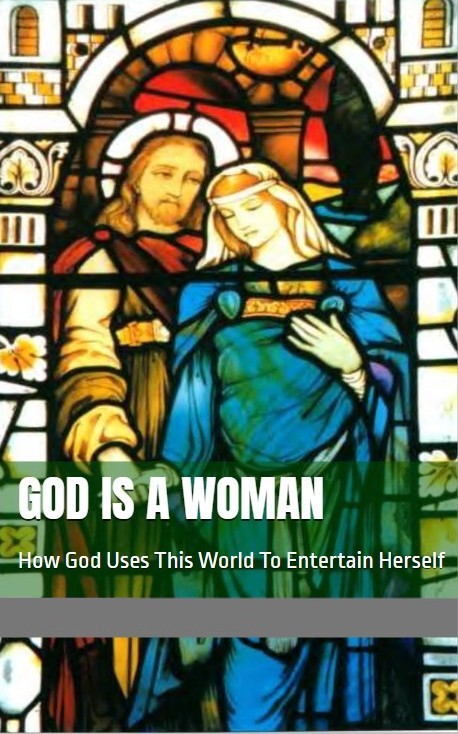
Book: God is a Woman

Who is God? This question has remained unanswered until now. We live in a virtual reality created by an advanced humanoid civilisation to entertain one of its members, whom we call God. God can play a role as an ordinary human in this world. Several people who changed history have been God in disguise.

The worship of the Jewish deity Yahweh spread through Christianity and Islam. Half the world now believes that Yahweh, also known as the Father or Allah, is the all-powerful owner of this universe. In a simulation, this is not a mere accident. This deity is the veil behind which the owner of the universe hides.

Mary Magdalene was an avatar of God. She led Jesus to believe that She was Eve reincarnated, while he was Adam reincarnated, and that Eve did not come from Adam’s rib, but was her son, so Adam and, therefore, Jesus were the Sons of God. God also married Muhammad, but he didn’t know.

The Jewish Bible is a collection of myths and historical events. The stories about Creation, the Fall, Noah, Abraham, and Moses are mostly fictional. The history of the Jews began in the era of the Judges. Deborah was the first historical person in the Bible. She founded the Jewish nation and was God in disguise.

This book addresses the following topics:

  • Why are humans religious, and how did their religions develop?
  • Why could this universe be virtual?
  • Why are our faiths incorrect, while God could exist?
  • How did the Jewish religion emerge and evolve?
  • Who was the historical Jesus?
  • What was the relationship between Mary Magdalene and Jesus?
  • Was Eve the mother of Adam?
  • Why is the Virgin Mary such a powerful figure?
  • Why is Jesus the Last Adam?
  • Did Jewish patriarchs, prophets, and kings marry God?
  • Did Muhammad marry God?
  • What could be the hidden message in the Quran regarding the number 19?
  • Why are Christians born of God?
  • What is the meaning of God’s love?
  • How did Paul shape Christianity?
  • How did Christians turn Jesus into God?
  • Why is the Gospel of John so different from the other Gospels?
  • What other avatars did God have in this world?
  • Looking at history, what might a Messiah be like?
  • Why can’t prophecies be accurate predictions?
  • Are there signs indicating we are living in the End Times?

By reading this book, you will discover that God is a woman from an advanced humanoid civilisation who uses this world to entertain Herself and can participate in this story as an ordinary woman.

The book is freely available under the CC BY-SA 4.0 licence.

You can download your free EPUB here:

https://drive.proton.me/urls/1SF6J335KR#JaLKrJnVcCeJ

You can download your free PDF here:

https://drive.proton.me/urls/QZY0YTZTXG#deujdTKULcSx

Or from here:

The book is freely available as an e-book on Kobe:

https://www.kobo.com/ebook/god-is-a-woman-7

The book is also available as an e-book on Amazon Kindle. Amazon requires a minimum price, so it is available at that price:

Latest revision: 6 September 2025

Virgin Mary

Mother Goddess Mary

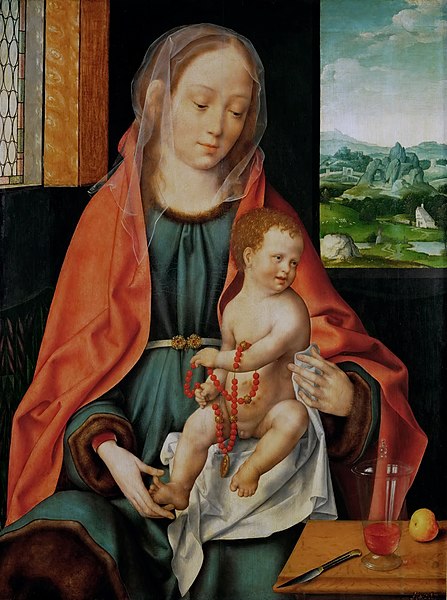
Jesus’ birth mother, Mary, plays a prominent role in Christianity. As the story goes, she was a virgin who birthed Jesus. She is the central figure in Roman Catholicism and Eastern Orthodox Christianity. She is the Mother of God, Church tradition holds, thereby implying Jesus was God and that God has a mother, which is indeed highly peculiar. Many Catholics pray to Mary rather than to Jesus or God. In this way, Mary is a proxy for God. The Quran consistently names Jesus the son of Mary rather than the Son of God. The images of Mary with the child resemble those of the Mother Goddess. They picture Jesus as the Son of God, the Mother. That is most noteworthy because Jesus believed he was Adam, the Son of Eve, the Son of God. How could this happen? Inquiring minds want to know. Now, there is the historical explanation, and there is the script that God wrote.

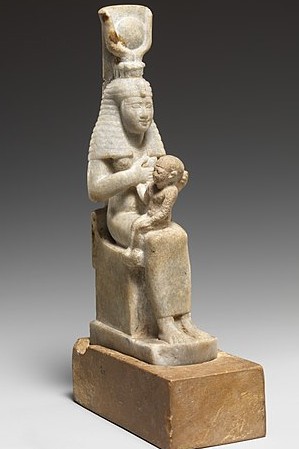
Isis with Horus
Isis with Horus. Metropolitan Museum of Art.

In the early years of Christianity, there was probably no cult of the Virgin Mary. The earliest Christian paintings, made around 235 AD, depict Christ, Peter, and martyrs, but not Mary. The first solid evidence of devotion to the Virgin Mary dates back to the third century, but its origin remains unclear. Perhaps, early Christians prayed to Mary as they did to other saints. Possibly, Mary granted the most requests, which made her increasingly popular. In this sneaky manner, the Mother Goddess sneaked into the Church through a back door, via the cult of the Virgin Mary. The ability to give birth without the need of a man is the miracle of the Mother Goddess. Christians later created statues and icons of the Virgin with the child Jesus, looking like the Egyptian mother goddess Isis with her child Horus.

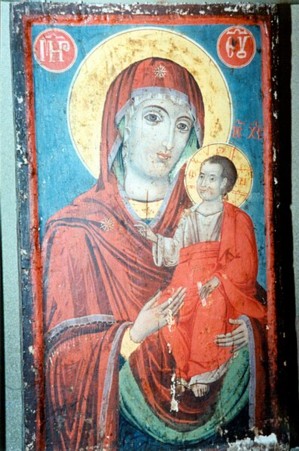
Saint Mary Bolnichka Icon
Saint Mary Bolnichka Icon.

So, what brought Mary to this elevated status? Mary is not only the mother of Jesus, but Christians and Muslims believe she was a virgin. Jesus’ birth from a virgin didn’t happen. That we can be sure of. Matthew and Luke mention Jesus’ virgin birth, but Mark and John don’t. Had it been common knowledge, all the Gospels would have mentioned it. And if it had happened, it would have been common knowledge. So, was it a myth that sprouted up in the Christian community? Or did the Church Fathers have a pressing cause to invent the story of Jesus’ virgin birth? There is reason to believe the latter.

And Jesus became a carpenter

The virgin birth of Jesus never happened. In Galatians, Paul writes that God sent His Son, who was born of a woman (Galatians 4:4). That was around 55 AD. Had he known about the virgin birth, that would have been an excellent opportunity to mention it, but somehow he forgot. Or the virgin birth hadn’t happened, which is more likely. A motive for inventing the virgin birth that immediately presents itself is that if God were Jesus’ Father, he couldn’t have a human father. It is not entirely satisfactory. If Jesus saw God as his Father, there is no pressing need for that. In that case, Jesus said ‘Father’ to God. That would be all there is to it, and there would be no reason to make this up.

And so, you might believe that the myth emerged within the Christian community to fill in the gap, as there was no narrative of Jesus’ birth. You wouldn’t think the Church’s leaders orchestrated it. There is reason to think otherwise, as we will see. Paul’s phrase ‘born of a woman’ also suggests so. And so, there must be more to it. That the virgin birth is an intentional falsification, you can infer by comparing Mark to Matthew. Mark dates from around 70 AD. Matthew came a few years later. Both are truthful to some extent. You can use one to detect the lie in the other. Mark tells that people in Jesus’ hometown called him ‘the carpenter’ and ‘Mary’s son’ (Mark 6:3),

Isn’t this the carpenter? Isn’t this Mary’s son and the brother of James, Joseph, Judas, and Simon? Aren’t his sisters here with us?’

The Gospel of Mark doesn’t mention Joseph, who was Jesus’ human father. It does note that Jesus had brothers and sisters, of whom we learn only the names of the brothers. You would expect the townspeople to call him Joseph’s son. But they didn’t, and called him Mary’s son, as if the virgin birth had occurred, while Mark doesn’t mention that noteworthy incident that you would definitely report on if you knew it had happened. It could be an error, but the mistake is so specific that it seems intentional. That it could be an edit, you can find in Matthew (Matthew 13:55),

Isn’t this the carpenter’s son? Isn’t his mother’s name Mary, and aren’t his brothers James, Joseph, Simon and Judas? Aren’t all his sisters with us?

The Gospel of Matthew mentions both the virgin birth and that Jesus has a human father and explains them in the virgin birth story, where Joseph accepts Jesus as his son, rendering such an edit redundant. Mark came before Matthew, scholars agree, and it contains fewer fancies. Mark and Matthew both drew on the same source, which referred to Jesus as the carpenter’s son. Likely, Mark dates from shortly after the Church Fathers had decided to introduce the virgin birth. The clumsy editing makes it seem as if Jesus were a carpenter.

By the time Matthew wielded his pen, the Church Fathers had contrived a proper cover story so that they didn’t have to remain secretive about his human father anymore. Such an explanation presumes that the authors of Mark and Matthew were prominent people within the Church who had contact with its leadership. They wouldn’t have done so if it had not been a solution to a theological problem.

The author of Matthew also sought a prophecy in the scriptures that predicted Jesus’ virgin birth. Isaiah wrote that a young woman would give birth to a son as a sign that God would destroy Judah’s enemies (Isaiah 7:14). Isaiah addressed King Ahaz in the eighth century BC and didn’t foresee the coming of Jesus, who would arrive seven centuries later. The Greek translation of the Jewish Bible, available in the first century AD, translated a young woman as a virgin. The author of Matthew saw it as a prophecy of Jesus’ virgin birth. There was no prophecy of this event that never happened, and that is no coincidence.

The author was particularly preoccupied with proving that Jesus was the long-awaited Jewish Messiah. To that aim, he fabricated a genealogy to demonstrate that Jesus descended from the House of David. And behold, he uncovered fourteen generations in all from Abraham to David, fourteen from David to the exile to Babylon, and fourteen from the exile to the Messiah, Jesus, which is so neat that it only happens in fairy tales. The prophet Micah prophesied that a ruler would come from Bethlehem (Micah 5:2). And somehow Matthew ‘discovered’ that it was the birthplace of Jesus. Mark and John don’t mention the virgin birth or Bethlehem. Jesus was probably born in Nazareth, had an ordinary childhood and joined the movement of John the Baptist.

Mary as the New Eve

If Jesus called God his Father, there is no reason to invent the virgin birth. You don’t need to prove that God is Jesus’ Father. If Jesus said so, that would be good enough. His having a human father wouldn’t change that. The answer to the mystery is that Jesus never called God ‘Father,’ but rather ‘Mother.’ Jesus was the Son of God because God, in the person of Mary Magdalene, convinced Jesus that he was Adam reincarnate, and that She was Eve reincarnate. And Eve didn’t come from Adam’s rib, but Adam was Eve’s son. The virgin birth of Jesus from Mary replaced the ‘virgin birth’ of Adam from Eve.

You can infer that from Christian theology. God announced there would be enmity between the offspring of the serpent and that of the woman (Genesis 3:15). Christians see it as a prophecy predicting the coming of Jesus. They believe the seed of the woman refers to the virgin birth of Jesus, while it was Adam’s. That made Mary the New Eve. In this manner, Mary became the replacement for Eve. It is, however, doubtful that those who invented the virgin birth also came up with this.

Eve being Adam’s mother and Jesus calling God his Mother contradicts the Jewish scriptures. You can’t have that, so you have to work on that fact to make it fit. So, why not say Jesus was born of a virgin instead? After all, Jesus was Adam, and Eve was a ‘virgin’ when she gave birth to Adam. And God’s name was Mary, just like Jesus’ mother, while God was Jesus’ Mother. That was very convenient indeed, a convenience provided by providence, no doubt. Mark and Matthew both name Jesus Mary’s son, perhaps because she played a prominent role during Jesus’ ministry and was present at the cross.

Cloak and dagger

The Virgin Mary appeared more frequently to people than Jesus and performed more miracles than any other saint. There is little or no evidence of many of these supposed miracles, but the Fatima Miracle had 40,000 witnesses, so there should be no doubt that something spectacular had happened there. God the Father doesn’t appear in this way. And there are no 40,000 witnesses who saw a miracle that the Father announced. That is because there never was a Father. Virgin Mary became such a potent figure because she is the cloak behind which God the Mother has hidden Herself so far. Now, we are at the cloak-and-dagger part: the Quran boasts a hidden secret.

In the Quran, Mary is the most prominent woman and the only woman mentioned by name. The Quran dedicates an entire chapter, chapter 19, to the Virgin Mary. The number 19 has great significance in Islam. Some Muslims indulge in arcane numerological explanations as to why that is so. The Quran refers to this number in the chapter named ‘The Hidden Secret.’ And so, the Quran may hold a hidden secret related to this number. The Quran also claims Mary was a virgin, thus confirming the miracle of the Mother Goddess. The Virgin Mary became the cloak behind which God hid Her identity.

The star and crescent became Islam’s symbol. It has a long history predating Islam, as it was associated with a Moon goddess. In the Bible, the moon refers to the woman and the star to the child (Genesis 37:9). Hence, the Islamic symbol represents the Madonna with the child Jesus or the relationship between Khadijah bint Khuwaylid and Muhammad. She was fifteen years older. A woman of Her age could have been his mother.

The St. Mary of Zion Church in Ethiopia is said to contain the Ark of the Covenant. Legend has it that the Ark came to Ethiopia with King Menelik after he visited his father, King Solomon. The Ark symbolises Mary of Zion. The Ark is supposed to be the residence of Yahweh, the God of Israel.2 That is remarkable, as God’s name was also Mary.

Statue storm

The Protestant Reformation was an attempt to return to Christianity’s roots by viewing Scripture as the sole source of Christian truth. The Protestants ended church traditions that lacked biblical grounds, including the veneration of the Virgin Mary. Nothing in the Bible justifies the cult of Mary. Protestants removed icons and statues from their Churches because one of the Ten Commandments prohibits making images for worship (Exodus 20:4-5). In the Netherlands, the Protestant Reformation caused a ‘statue storm’ where Protestant religious vigilantes ravaged Catholic Church interiors.

Protestantism developed in an era of emerging rationalism and naturalism. And so, Protestants also object to magic and superstition, deeming it Satan’s work, while Catholics love miracles like healings at Lourdes and weeping Mary statues. Miracles have always been part of the Catholic tradition.

The Protestants erased an essential part of Christianity’s original message of the Mother Goddess giving birth to Her son. Instead of getting closer to the truth, the Protestants wandered further from it. And it didn’t solve anything, but only generated more confusion. The Protestants soon began fighting among themselves over the interpretation of the scriptures. You can’t be wrong, because if you are, you end up frying eternally in Satan’s ovens. That was the reason Protestantism started in the first place. So, after the Protestant storm is over, we have over 45,000 branches of Christianity.

Latest revision: 9 December 2025

Featured image: Madonna and Child, Kunsthistorisches Museum Wien. Public Domain.

Other images: Isis with Horus. Metropolitan Museum of Art. Wikimedia Commons. Public Domain; Saint Mary Bolnichka Icon. Wikimedia Commons. Public Domain.

1. Church of Our Lady Mary of Zion. Wikipedia.

The Last Adam

Adam is the Son of God (Luke 3:38) and Jesus the Firstborn of all Creation (Colossians 1:15). Was Jesus Adam reincarnated? And was Adam born? Firstborn means you are the family heir, so the Firstborn of All Creation means you inherited the world. That is the standard interpretation with which most scholars would likely agree. The Christian doctrine states that Jesus already existed with God before creation and thus was not Adam. That is not what the words say, nor is it what Jesus’ inner circle believed. Existence before creation is not the same as being born. And Adam was the Son of God. When Paul was busy writing Colossians, he was also working on Christian theology, and his thoughts were still in a state of flux. And so, there may be more to it than theologians can explain.

Theologians regurgitate a century-old, pre-chewed menu of previous generations of theologians. Do theologians ever come up with something new rather than yet another insight on a hair-splitting detail? Do they discuss the simulation argument? No! They occupy themselves with century-old controversies. Why would Jesus sacrifice himself for Adam’s transgression? It makes more sense if Jesus believed he was Adam, who had to redeem himself. That was an idea Paul entertained for a while, for Jesus thought he was Adam. Only that generated serious theological problems. How could the perfect sinless Jesus also be the sinner Adam? And so, his mind ground on. Eventually, Christians came to believe that Jesus existed before creation, as laid out in the Gospel of John.

Don’t blame theologians for not being sufficiently imaginative. You could easily go astray. That ireful cloud that led the Israelites out of Egypt in a 2,500-year-old Jewish fairy tale was Eve from an even older Iraqi fairy tale, who gave birth to Adam, which the surviving Jewish version of the Iraqi fairy tale doesn’t mention. And by the way, that cloud from the fairy tale was Judge Deborah, the first historical person in the Bible. She started the Jewish nation by slaying Israel’s enemies and claiming that a magical cloud named Yahweh did it. She later married Jesus as Mary Magdalene and Muhammad as Khadijah bint Khuwaylid. You can’t guess it unless God gives you the clue that unlocks the mystery.

The message of Jesus being Adam still features in Christian doctrine as a remnant of an original belief. Jesus is the New Adam, and his birth mother is the New Eve, which implies that Jesus married his mother in a previous life. And precisely that was the original message of Christianity. Paul compares Jesus to Adam. In Romans, he writes, ‘Just as through the disobedience of the one man the many were made sinners, so also through the obedience of the one man the many will be made righteous.’ (Romans 5:19)

Paul didn’t blame Eve for the Fall. Later writers posing themselves as Paul cast the blame on Eve. But Paul, a god-fearing individual who still knew the truth, wasn’t that daring. In 1 Corinthians, Paul noted, ‘As in Adam all die, so in Christ, all will be made alive.’ Jesus thus became the redeemer for Adam’s Fall. Paul called Jesus the Last Adam (1 Corinthians 15:45). Jesus being Adam’s reincarnation was an early Christian belief until the narrative changed to Christ’s existence before creation. And so, you only find the comparison in Paul’s letters, the earliest surviving documents of Christianity.

The Quran underpins the idea that Jesus is Adam. You have to read between the lines. Jesus was like Adam in the way he was created (Quran 3:59), and the Quran supports the Christian claim that Jesus was born of a virgin (Quran 3:47, 19:16-22). Hence, they are both ‘born of a virgin.’ Not really, of course, but people believed it. And several Quran verses state that God ordered the angels to prostrate before Adam (Quran 2:34, 7:11, 15:28-29, 17:61, 18:50, 20:116, 38:71-74). The Quran mentions it seven times, making it appear significant. And seven times, Jesus says ‘I am’ in the Gospel of John, stressing his supposed divinity.

The Epistle to the Hebrews claims that God made Jesus, the firstborn, into the world, superior to the angels and made the angels worship him (Hebrews 1:1-7). And if the Quran is a message from God, the presumed guy in the sky, who possesses superpowers but is not Superman, and also not a man, then Jesus could be Adam. The Quran also claims Jesus will return (Quran 43:61). If he were Adam, God’s firstborn, who had already returned once, he could. Otherwise, it all gets even odder than it already is.

Latest revision: 16 August 2025

Mohammed receiving his first revelation from the angel Gabriel

Religious Experiences and Miracles

The Jewish people still exist after 2,500 years, while they have not had a homeland for most of the time. That is a remarkable feat. Then Christianity replaced the existing religions in the Roman Empire in one of history’s strangest twists. Somehow, the message of personal salvation through Christ caught on. In the third century, Manichaeism emerged as a new religion. It taught that there was a struggle between the good spiritual world of light and the evil material world of darkness. The prophet Mani, who grew up in a Jewish-Christian Gnostic sect, claimed to have received revelations meant for the entire world, which were to replace all existing religions. It instantly became a spectacular success, spread everywhere in the known world, and could have overtaken Christianity, but it didn’t. A pivotal, and possibly decisive, moment was the conversion of Emperor Constantine to Christianity in 312 AD. He made Christianity the favoured religion in the Roman Empire.

A few centuries later, a small band of Arab warriors established an empire that stretched from the Atlantic to India, spreading the new religion of Islam, in an even stranger and more rapid historical development. Is it a realistic scenario that the supposedly illiterate camel driver Muhammad became a crafty statesman after seeing an angel telling him he came to deliver messages from the God of the Christians and the Jews? After Muhammad’s death, his followers went on to defeat the Byzantine and Persian empires. At the same time, Manichaeism made a one-way trip into the dustbin of history, while in the third century, it appeared to be on the verge of becoming the world’s leading religion. So, why did Mani fail and why did Muhammad succeed? Historians can explain it, but it is an account of what happened rather than an explanation. The question remains, could it occur without someone pulling the strings?

So much can happen, and what happens now has once been extremely improbable. Your reading this text here and now seems highly unlikely a few decades ago. Think of all the things you could have done instead. Or you could have been dead. Yet, you wouldn’t consider your reading this text a miracle. Proselytising religions like Christianity and Islam have a built-in inclination to grow. That may not be the ultimate answer. Jews, Christians, and Muslims worship the same deity. Our universe could be a simulation, and someone could have planned it. But who is to say it couldn’t have happened otherwise?

When Islam arrived on the scene, Jews, Christians and Zoroastrians in the area already believed in an all-powerful creator. Muhammad had met them on his travels, so he was familiar with these religions. Before that, Christianity had faced an uphill struggle. While the Roman state suppressed this religion, pagans left their gods behind and accepted the Christian God as the only true God. And they did so in large numbers.

That begs for an explanation, even though the conversion of Romans to Christianity was a gradual process that took centuries. The Romans occasionally half-heartedly persecuted Christians and executed a few thousand of them over the centuries, not for being a Christian but for not paying their respects to the Roman gods. Despite that, the number of Christians increased 2-3% per year between 30 AD and 400 AD. Each Christian may have converted just one or two persons on average. Over time, exponential growth enabled Christianity to grow from about 100 followers in 30 AD to 30 million by 400 AD.

Such a gradual and steady growth over centuries was somewhat unique for a religion, and so was the blitz conquest of Islam later on. Most people in the Roman Empire, and everywhere else for that matter, lived miserable lives. The promise of an eternal blissful afterlife may have been too tempting for those poor, wretched souls to resist. However, the most often cited reason for conversions was stories about the miracles Christians performed.2 Only in the Middle Ages did the sword become the most compelling Christian argument as Christianity spread further and became integral to European politics. That was not the case in the Roman Empire, so miracles and stories about them were crucial.

An early miracle was Jesus’ appearance to a few followers after his crucifixion. The New Testament mentions miracles that the disciples allegedly performed. These accounts may be exaggerated, but the theme of miracles remains a consistent one in Christianity to this day. The Roman Catholic Church has a rich folklore surrounding relics that are believed to possess magical properties because they are said to have been touched by Jesus. The most famous relics are the Crown of Thorns in Paris, the mysterious Holy Grail, the chalice from which Jesus is said to have drunk, and the Shroud of Turin, a piece of linen cloth with a supposed image of Jesus’ face.

Many of the miracles attributed to these relics are unverifiable or can have other causes, such as luck, but a few cannot be easily explained away. The Roman Catholic Church keeps a record of them. On message boards, people tell stories about prayers heard and miraculous healings. Many of these stories may result from chance or other causes, such as a misdiagnosis or someone seeking attention by lying, but that is not always the case.

A recurring theme is the appearance of the Virgin Mary and other miracles related to her. Thousands of people have seen her. She appeared several times in Venezuela. She revealed herself to Maria Esperanza Medrano de Bianchini in 1976, who received exceptional powers. She could tell the future, levitate, and heal the sick. In Egypt, Mary appeared at a Coptic Church between 1983 and 1986. Muslims have also seen her there. There have been many more Virgin Mary appearances. The most notable sequence occurred in Portugal at Fatima between 13 May and 13 October 1917.

The grand finale was on 13 October 1917, when the Sun reportedly spun wildly and tumbled down to Earth, radiating in indescribably beautiful colours, before stopping and returning to its normal position. Some 40,000 attendants witnessed Mary’s performance. They had gathered because three shepherd children had prophesied that the Virgin Mary would perform a miracle on that date and location. Faking this was hard to do, considering the technology available in 1917. A lack of holographic equipment would have made the effort challenging, not to mention changing the location of the Sun, which is a large ball many times larger than Earth, thus making it difficult to move around. And somehow, the Sun only moved in Fatima, which can only happen in virtual reality.

Jesus also appeared a few times, but less frequently than the Virgin Mary. An intriguing account comes from Kenneth Logie, a preacher of the Pentecostal Holiness Church in Oakland, California, in the 1950s. In April 1954, Logie was preaching at an evening service. During the sermon, the church door opened. Jesus came walking in, smiling to the left and the right. He walked right through the pulpit. Then he placed his hand on Logie’s shoulder. Jesus spoke to him in a foreign tongue. Fifty people witnessed the event. Five years later, a woman in that same church suddenly disappeared. Jesus took her place. He wore sandals and a shiny white robe. He had nail marks on his hands, which were dripping with oil. After several minutes, Jesus disappeared, and the woman reappeared. Two hundred people have seen it. It was on film as Logie had installed film equipment, because strange things were happening.3 Such events can convince people that the message of Christianity, even though it may seem highly peculiar, is correct, as Zeus and Thor failed to show up and perform some tricks.

Mary and Christ are part of a folklore where genuine experiences mix with mental cases seeking attention or con artists profiting at the public’s expense. Usually, there are no 40,000 witnesses, verifiable evidence, or camera footage of what occurred. The Vatican is troubled by the self-proclaimed seers, fortune tellers, prophets, and messengers who believe they have a special bond with the Virgin Mary or have weeping Madonna statues, which they may or may not have prepared to weep. These people could be delusional, crave attention or, like the televangelists in the United States, be after your money. That is not always the case. If you have a religious experience, don’t suffer from mental conditions impairing your judgment, and can’t think of naturalist explanations, you should believe what you see. To quote Shakespeare’s Hamlet, ‘There are more things on heaven and earth, Horatio, than are dreamt of in your philosophy.’

Latest revision: 5 September 2025

Feature image: Mohammad receiving his first revelation from the angel Gabriel. Miniature illustration on vellum from the book Jami’ al-Tawarikh, by Rashid al-Din, published in Tabriz, Persia, 1307 AD. Public Domain.

1. Sapiens: A Brief History of Humankind. Yuval Noah Harari (2014). Harvil Secker.
2. The Triumph of Christianity: How a Forbidden Religion Swept the World. Bart Ehrman. Simon & Schuster (2018).
3. How Jesus Became God: The Exaltation of a Jewish Preacher From Galilee. Bart Ehrman. HarperCollins Publishers (2015).