The Grades

Unemployment in the early 1980s was high, especially among young people. I had asked my mother, ‘What is the point of studying for unemployment?’ She stressed that there would always be room for the best. They had lived in poverty and had learned that you must work hard to earn your place under the sun. I never experienced poverty, but my parents kept reminding me that you shouldn’t take a comfortable life for granted. It made me work hard, possibly harder than everyone else. It was a conservative Protestant school, so that says something. In primary school, I didn’t see the point of working hard.

Occasionally, I knew more than my teachers. My father later told me about a mayor he knew. He had been my history teacher before he became a politician for the Christian Democrats. He told my father that I once had corrected him during the lessons. It annoyed him, so he checked his books during the break to discover I was right. He was not the only one. A geography teacher admitted I knew more than he did about Russia.

On the final exams, my average grade was the highest (8.6 out of 10). The scores were good but not outstanding and resulted from hard work. Some pupils had stellar degrees in mathematics without working hard, but not me. My average was good but not stellar. If I didn’t prepare for a test, which happened once, my grade dropped dramatically to 3.5. And so, the mathematics teacher, Mr. Blaak, had a field day and made jokes about me spending too much time on the school newspaper. And I never solved the Rubik’s cube, despite spending much time on it. It demonstrates I was not a genius.

My weak spot was explaining literature. It is about guessing the supposed motives of book authors. My scores were consistently poor, the poorest of the class. I considered guessing other people’s motives and decoding hidden messages in texts a waste of time. The authors themselves often marvelled at what the literature experts found out about their intentions from the books they had written. Art and literature were a lot of fluff about feelings, quite often imagined. And I did poorly at it, and it probably has to do with my Asperger’s Syndrome. With the final exams nearing, I began to fret and asked my teacher, Mr. Amelink, to give me additional practice exams. A teacher could only dream of such a fanatic pupil, so he was helpful, but the grades remained as poor as before.

Before the final exam, I prayed that the grade wouldn’t be too bad. Not only to my surprise, my result was the best of everyone, only equalled by Geraldine, a girl with a striking hairdo, a bit alternative, who dressed outspokenly and flaunted her interest in art and literature. Mr. Amelink was also amazed and suggested the extra lessons had made a difference. Another girl became curious about this feat. She said, ‘You have a mysterious way of winning in the end.’ I was too embarrassed to tell about the prayer. It was selfish to pray for a higher grade. People in Africa needed God’s help much more. And it could not be that God granted that wish, or could it? While doing the test, the questions appeared more concrete than usual, making it easier to answer them.

There is a subtle difference between speculating about hidden motives and understanding the meaning of texts. I was good at the latter. It inflated my grades, as explaining texts comprised 50% of the scores in English and French. If a particular English or French word was unfamiliar to me, I could still infer its meaning from the subject of the text, the author’s opinions and the purpose of the paragraph or sentence. By connecting the dots, you often arrive at the correct answers. I hardly made errors in these questions.

At the time, there was no reason to suspect God had anything to do with it. Still, later developments added a peculiar twist to this incident, as I may have uncovered messages from God in pop music lyrics. The teacher’s name, Amelink, suggests a possible link to the isle of Ameland, and Ameland was to become part of a set of peculiar coincidences. A song named The Foundling of Ameland refers to this island. It includes a scene with the foundling walking over the water. But that was still over twenty years into the future. And I disappointed my economics teacher. Had my grade for economics been slightly higher, I would have received a 10, and an economist would have come to the school to give me the diploma. My teacher had hoped for that.

Dutch replica of Noah's Ark. By Ceinturion.

Genesis from Where?

Creation of the world

Where do the first chapters of Genesis come from? They deal with Creation, the fall, and the flood. Who wrote them? These stories mostly ran in Mesopotamia, the birthplace of several ancient civilisations. These civilisations are much older than the Jewish nation and had myths about Creation and the flood that are at least 1,000 years older than the Jewish Bible. The Jews lived in exile in Babylon when they compiled their scriptures. They took local myths to write the first chapters of Genesis. A Babylonian creation myth, the Enūma Eliš, is a bit like the first chapter of Genesis,

When in the height heaven was not named,
And the earth beneath did not yet bear a name,
And the primaeval Apsu, who begat them,
And chaos, Tiamat, the mother of them both
Their waters were mingled together,
And no field was formed, no marsh was to be seen;
When of the gods, none had been called into being,
And none bore a name, and no destinies were ordained;
Then were created the gods amid heaven,
Lahmu and Lahamu were called into being.

Both Enūma Eliš and Genesis start with chaotic waters before anything comes into being. Genesis says, ‘The earth was formless and empty, darkness was over the surface of the deep, and the Spirit of God was hovering over the waters.’ In both, a fixed, dome-shaped firmament divides these waters from the habitable Earth, and both have descriptions of the creation of celestial objects and the ordering of time.

The purpose of creation myths is to explain why we exist. Humans are naturally curious and desire answers to such questions. Another purpose is justifying the social order. The peasant population toiled to support the lavish lifestyles of the elites, who were the priests and the rulers. And so, the gods, or God, created man to work the ground, bring offerings to the temple, and pay taxes. The Jewish Bible lays out in great detail the required offerings to the temple and the priests in Leviticus, so Judaism looks like yet another peasant-exploitation scheme devised by priests.

Men and women

The creation of man in Genesis resembles the creation account in the Mesopotamian Epic of Gilgamesh, which describes how the gods, tired of working on creation, created a man to do the job. They put a god to death and mixed his blood with clay to produce the first human in the likeness of the gods,

In the clay, god and man
Shall be bound,
To a unity brought together;
So that to the end of days
The Flesh and the Soul
Which in a god have ripened –
That soul in a blood kinship is bound.

In Genesis, God created humans in the likeness of the gods (1:26) and rested after six days of hard labour (Genesis 2:2-3). God then made a man to work the ground (Genesis 2:5) and made him from soil (Genesis 2:7). In the Epic of Gilgamesh, the gods created the first man in Eden, the garden of the gods in Mesopotamia between the Tigris and Euphrates rivers. The same happened in Genesis (Genesis 2:14). There is another story about the origin of man in the story of Enki and Ninmah. The gods, burdened with creating the Earth, complained to Namma, the primordial mother. Namma then kneaded some clay, placed it in her womb, and gave birth to the first humans.

The Mesopotamians thus had at least two creation stories: one in which the gods created humans from soil and another in which a goddess gave birth to humanity. The story of Eve and Adam in Genesis relates to these two tales. Likely, Adam was Eve’s son in the original tale, and the Jewish scribes used the first story to tailor the story of Eve and Adam to their theological requirements. Adam’s purpose was to be a companion to Eve rather than to work the garden, as the Bible now claims.

The epic further details that the first man, Enkidu, was wild, naked, muscular, hairy and uncivilised. The gods then sent a nude woman to tame him. By making love to him for a week, she turned him into a civilised man of wisdom, who was like a god. She made him a meal and clothed him. In Genesis, Eve made Adam eat (Genesis 2:6), which gave him the learning of the gods. Eve and Adam were naked (Genesis 3:7) before the Lord gave them clothes (Genesis 3:21).

The Epic of Gilgamesh differs from the Genesis account, but the similarities are striking. In both stories, a god creates a man from the soil. The man lives naked in nature. A woman then tempts him. In both accounts, the man accepts food from the woman, receives knowledge, covers his nakedness, and leaves his former life. The appearance of a snake stealing a plant of immortality in the epic is also noteworthy. There were likely similar stories circulating, and we have only a few remaining clay tablets. There might also have been a story where the first woman, Eve, gave birth to the first man, Adam.

The Great Flood

The Great Flood in Genesis also closely resembles the account in the Epic of Gilgamesh. Few scholars doubt that the epic is the source of the biblical narrative. The epic notes that the city of Shurrupak, situated on the banks of the Euphrates River, had grown. The deity Enlil could not sleep because of the sounds the city made. To deal with the noisy humans below, the gods agreed to drown them all.

The deity Ea warned his friend Utnapishtim and asked him to build an ark. With his children and hired men, Utnapishtim built an enormous boat and went on it with his relatives, animals, and craftsmen. The storm god, Adad, sent a terrible thunderstorm with pouring rains that drowned the city. Then, the gods regretted what they had done.

After seven days, the weather calmed. Utnapishtim looked around and saw an endless sea. He saw a mountain rising out of the water. After another seven days, he released a dove into the air. The dove returned, having found no place to land. He then released a swallow that also came back. Then, he released a raven that didn’t come back. Utnapishtim disembarked and made an offering to the gods.

According to the Bible, everyone had grown evil. Only Noah was blameless and faithful. For that reason, God decided to send a flood to wipe out humanity, but to spare Noah and his family. God then ordered Noah to build an ark that could also harbour males and females of every animal species and provide food for them all.

The flood came for forty days. No one survived. After forty days, Noah sent out a raven. Then, he sent a dove to see if the waters had receded. Once the waters receded, the Lord instructed Noah to leave the ark with his wife, his sons, and their wives, and to release the animals. Noah then disembarked and made a sacrifice.

The Greek version

A long time ago, there was a great war between the Olympic gods and the so-called Titans. Some titans sided with the gods. Prometheus, whose name means ‘thinking ahead’, was one of them. He foresaw that the Olympic gods, led by Zeus, would win the battle, so he sided with them. After the battle, Zeus rewarded him by letting him create various life forms. Prometheus, with Zeus’ permission, first created animals and then decided to make upright figures, modelled after the gods. Without consulting Zeus, Prometheus then breathed the breath of life into humans, displeasing the supreme god. Prometheus also stole the fire of the gods and gave it to the humans.

Zeus punished Prometheus for his transgressions by tying him to a rock. Every day, an eagle came by to peck out his liver, which would grow back during the night, a torment without end. A hero named Heracles, however, later liberated him. Zeus also punished the humans. He ordered Hephaestus, the god of blacksmithing, to create a beautiful but dangerous and inquisitive new creature, the woman. Zeus then sent the woman, whose name was Pandora, to humankind, gave her a box and warned her in strong terms to never look inside, even though he knew she wouldn’t be able to resist her curiosity. All the gods had put dangerous gifts within the box.

The men, impressed by her looks, adopted Pandora. One day, the curious Pandora could no longer resist the urge and decided to open the box. Out of the box then popped up all the disasters that have plagued humanity since then: famine, disease, earthquakes, and war. The disaster spreads like lightning among the people who, until then, had lived free from troubles and disease. Women told an alternative account in which Pandora didn’t open the box, but her husband, a brother of Prometheus named Epimetheus, whose name means ‘thinking afterwards’. There are a few noteworthy parallels with the Bible:

  • The humans were created in the image of the gods.
  • The creation of humans happened by breathing the breath of life into them.
  • The creation of woman occurred after the creation of man.
  • The woman’s curiosity brings disaster to humankind.
  • Pandora’s box plays a role similar to the tree of knowledge in Eden.

The ancient Greeks also had a flood myth. The Greek supreme god, Zeus, had decided to punish humanity with a flood. King Lycaon of Arcadia had sacrificed a boy to Zeus, who, appalled by this offering, decided to put an end to human evil by unleashing a deluge. Deucalion and Pyrrha survived Zeus’ world-destroying flood by building an ark. Warned by the titan Prometheus, they sailed on away and landed on Mount Parnassus, where the goddess Themis instructed them to repopulate the earth by throwing stones that would turn into new people. The similarities between these stories suggest that cultures influenced each other, yet also diverged in significant ways.

Latest revision: 23 September 2025

Featured image: Dutch replica of Noah’s Ark. By Ceinturion CC BY-SA 3.0. Wikimedia Commons.

The Great Reset

During the coronavirus pandemic, the World Economic Forum (WEF) launched a plan, The Great Reset. It aims to rebuild the world economy more intelligently, fairer and sustainably while adhering to the United Nations Sustainable Development Goals (SDG). These SDGs include ending poverty, improving health and well-being, better education, equality, clean water and sanitation, affordable and clean energy, jobs and economic growth. That sounds great, but is it a reset? It would be up to so-called responsible corporations and international non-governmental organisations (NGOs) to implement the agenda before 2030. Not everyone thinks that is a great idea.

The change is supposed to be powered by the Fourth Industrial Revolution, a fusion of technologies in fields such as artificial intelligence, robotics, the Internet of Things, autonomous vehicles, 3-D printing, nanotechnology, biotechnology, materials science, energy storage and quantum computing. I get an uneasy feeling when I read that. It looks like an excuse for technology addicts to play with our future. Is it because I am against progress, or is it because of a rational fear that something is about to go seriously wrong even though I don’t know exactly what?

Under the umbrella of the Great Reset, so-called young global leaders of the WEF came up with new ideas. For instance, new technologies can make products like cars and houses cheaply available as a service, ending the need to own these items. A young global leader wrote an article titled, ‘Welcome to 2030. I own nothing, have no privacy, and life has never been better.’1 She hoped to start a discussion, and the article produced a slogan that also became an Internet meme, ‘You’ll own nothing, and you’ll be happy.’ There certainly is an economic rationale for sharing items like cars, most notably if they become more expensive to keep because of technological innovation.

Property, for instance, a home, can give you economic freedom. If you own a home, you don’t have to pay rent. And you own some capital when you retire. Some people think the WEF is a sinister elite club scheming to achieve a secret agenda where the elites own everything, and the rest of us ends up with nothing. And that might happen anyway if current trends continue because that is how capitalism works. Capital accumulates and ends up in the hands of a few because of interest. It is not a secret since Karl Marx figured that out. And it leads to a crisis when the impoverished masses can’t buy the things that capital produces. With negative interest rates, there is no need for that.

Property rights have become a semi-religious value in Western culture. That prevents us from taking the property of the elites and ending their stranglehold on our political economy. Marx advised that workers or the state would take over corporations. That might not be a good idea because workers and governments often do poorly at running corporations. Markets and private enterprises can efficiently provide goods and services, but it comes with wealth inequality and happens at the expense of future generations. Our societies must find the right balance. At some point, the disadvantages of the current political economy start to outweigh the advantages.

We use far more resources than the planet can provide, and wealth inequality is now so extreme that we might need a genuine Great Reset. Taking the wealth from the elites and discontinuing enterprises that don’t provide for our essentials is not communism, as long as there are markets and private property. People should prosper if their work benefits society and enterprises often do better at providing for our needs. But we don’t benefit from the corrupting influence of oligarchs. Their wealth comes from inheritance, criminal and shady activities, and, most notably, accumulated interest on their capital. That arrangement may have suited us in the past, but not now.

Economists believe property rights are essential for economic growth, and that business owners should be able to do as they please. For instance, Elon Musk has the right to ruin Twitter because he owns the company. Should employees and others suffer from the irrational behaviour of their owners? In the Netherlands, a series of interesting trials took place, where corporations tried to escape the influence of their majority shareholder Gerard Sanderink, who allegedly didn’t act rationally in the interest of these companies.2 Limited property rights and a collectivist attitude have not prevented China from becoming a large and advanced economy surpassing the United States and may have contributed to China’s success.

The degree of individualism currently existing in the West may do more harm than good. They promote political fights and litigation and prevent us from doing what we should do. And perhaps, less privacy can go a long way in reducing crime. Property rights and individualism were crucial to start capitalism and made the West dominate the world for centuries. And so, we have learned to see them as necessary, inevitable or even desirable. But once the European imperialist capitalist engine ran, these features became less important than economic stability. If you start a business, you must be able to estimate your returns, but you can lease everything and own nothing.

Individualism and property rights also play a positive role in society. The cultural heritage of the West is extensive compared to other cultures, for instance, if you express it in the number of books written or discoveries made. Self-interest and personal responsibility can inspire us to work harder and do a better job. The Soviet Union failed to produce enough food for its citizens while there was enough arable land. In the Soviet Union, farmers had to work on collective enterprises where they could not do as they saw fit and didn’t share in the profits. The tragedy of the commons is that we don’t care for public spaces as much as our possessions. Homeowners usually take better care of their houses than tenants. The same is true for car owners.

As they are now, property rights protect the elites. And the WEF plan is just a fart in the wind, not a Great Reset. We face unprecedented worldwide challenges while wealth inequality is at extreme levels, so individualism and property rights need limits. And we need a proper Great Reset, or a switch from economic to political control of the world’s resources if we intend to live in a humane world society that respects our planet. It is what a corporation named Patagonia did in 2022.3 We can do that on a global scale.

It begins with seizing the wealth of oligarchs and criminals and all hidden wealth in offshore tax havens, including their so-called charities, placing them in sovereign wealth funds, and setting a limit on what individuals can own or earn. And perhaps, we need to build our future on values rather than balance sheets. And everyone should contribute. Capital accumulates by interest, and people who live off interest don’t work for a living. That might be as bad as being on the dole while you can work. And peddling unnecessary products that harm life on Earth could be as bad as being a criminal.

Laws should prevent people and corporations from doing wrong, but they often fail to do that. Corporations pollute the environment or exploit employees to make a profit. But consumers desire excellence for rock-bottom prices. It is profitable to break the law if you can get away with it or when the gain is higher than the fine. And if there are loopholes, they become exploited. The anonymity provided by money, large corporations and markets turn us into uncaring calculating creatures. That is why big pharma, the military-industrial complex, the financial industry, and the Internet giants threaten us. If corporations do right out of their own, many laws and regulations become redundant. If moral values can replace the law, it could be better.

Less efficiency, poorer service and a smaller choice of products can be preferable if that doesn’t lead to deprivation and starvation. For instance, why must you get your meal from a takeaway restaurant instead of preparing it yourself? Or why do you need to dress up in the latest fashion if you have ample wearable clothing? And you must work to pay for these things, so if you don’t buy them, you have time to prepare your meal or mend your clothes. We don’t want to give up these things, so in a democracy, we can’t fix this problem. Perhaps we might accept the change if God sends a Messiah who tells us this is for the best.

That might be wishful thinking, but what else can make it happen if it is not religion? Do you believe we will come to our senses, become one humanity, and do right on our own? That is wishful thinking. God is our only hope. As we are heading for the Great Collapse in one way or another, the End Times could be now. We might live inside a simulation run by an advanced humanoid civilisation.4 Hence, God might own this world, and you might soon discover that you own nothing and be happy. God’s kingdom might be a utopian society as early Christians lived like communists (Acts 4:32-35).

So what can we achieve by taking political control of the world’s resources and means of production by seizing the elite’s wealth and placing it in sovereign wealth funds? You can think of the following:

  • We can direct our means to the goals of a humane society, be respectful of this planet, and plan long-term.
  • We can dismantle harmful corporations or give them a new purpose without starting an economic crisis with mass unemployment.
  • We can make corporations employ people in developing countries and give them an education and decent salaries.
  • We can fund essential government services in developing countries and eliminate corruption insofar as it is due to insufficient pay of government employees.
  • We can make corporations produce sustainably and pass on the cost to consumers.
  • We can determine the pay of executives.
  • We can halt developments like artificial intelligence, genetic engineering, and nuclear energy if we believe they are undesirable.
  • We can end the incentive to produce and consume more and stop the advertising industry from tracking us.
  • We can end stress in the workplace if we axe bullshit jobs and redirect workers to the needs of society. A twenty-hour working week might be enough.

Interest stands in the way of a better future. The economy ‘must’ grow to pay for the interest. We ‘must’ work harder in bullshit jobs to pay for the interest. Corporations ‘must’ sell harmful products to pay for the interest. Corporations ‘must’ pay low wages or move production to low-wage countries to pay for the interest. And because of interest, money disappears from where it is needed most and piles up where it is needed least. Interest is our tribute to the wealthy. If we hope to live in a humane world society that respects creation, ending interest might be imperative. That is where Natural Money comes in.

Latest revision: 28 April 2023

Featured image: You’ll own nothing and you’ll be happy. WEF.

1. Welcome To 2030: I Own Nothing, Have No Privacy And Life Has Never Been Better. Ida Auken. World Economic Forum (2016).
2. Zakenman Gerard Sanderink tierend in rechtszaal: ‘Deze rechtbank deugt voor geen meter!’ AD.nl (2023).
3. Patagonia’s Next Chapter: Earth is Now Our Only Shareholder. Patagonia (2022).
4. Are You Living In a Computer Simulation? Nick Bostrom. Philosophical Quarterly, 2003, Vol. 53, No. 211, pp. 243-255.

Book: The Virtual Universe

Several religions claim that a god or gods have created this universe. The simulation hypothesis explains how this might have happened. We could all live inside a computer simulation run by an advanced post-human civilisation. But can we establish that this is indeed the case?

The evidence suggests that we live inside a simulation. It even allows us to infer the purpose of our existence. This book does not promote a specific religion. It follows science, but science has its limits. It can’t tell whether the world we live in is real.

Still, the sciences can support the argument that this world is a simulation, as they have established the natural laws that guide reality. If breaches of these laws occur, such as paranormal incidents with credible witnesses, we have evidence indicating that this world is not real.

We have just invented virtual reality. We can utilise virtual reality for both research and entertainment purposes. If the technology to create virtual worlds becomes affordable, most worlds will exist for entertainment, such as games or inventing stories where we can make our dreams come true.

The latter requires control over everything that happens, which is the situation we appear to be in. With our current knowledge, the world makes the most sense as a simulation created by an advanced post-human civilisation to entertain someone we can call God.

In this book, you can find answers to the following questions:

  • Is there something more than science can explain?
  • Is there a plan behind all that happens?
  • What are virtual worlds?
  • How can we know things and determine whether we live in a virtual world?
  • How can we explain things science can’t explain?
  • What are the simulation hypothesis and simulation argument about?
  • Can we improve the simulation argument to establish whether we are living in a simulation?
  • Why does our existence not need to be a miracle?
  • What reasons might post-humans have to create virtual worlds?
  • Can we infer from the properties of our universe that we live in a simulation?
  • What can we say about the evidence of spooks?
  • What is real about UFOs?
  • Do curses exist?
  • Do meaningful coincidences indicate that there is a script?
  • Is there some point to numeric coincidences like 11:11?
  • What happens after we die?
  • How can mediums sometimes be uncannily accurate?
  • Are there strange coincidences in history?
  • Are there an excessive number of strange coincidences surrounding the 11 September 2001 terrorist attacks?
  • What are the consequences of predetermination, and how does it affect our lives?
  • Is it possible to establish that we live in a story by using meaningful coincidences as evidence?
  • So, can we establish beyond a reasonable doubt that we live inside a simulation?
  • And can we establish the purpose of our existence?

After reading this book, you know you live inside a simulation.

The book is freely available under the CC BY-SA 4.0 licence.

You can download your free EPUB here:

https://drive.proton.me/urls/A32TV9FZFM#VK1pUJozUJy5

You can download your free PDF here:

https://drive.proton.me/urls/KNS1R6XKNG#6nawGfcicKuv

Or from here:

The book is freely available as an e-book on Kobe:

https://www.kobo.com/ebook/the-virtual-universe

The book is also available as a Kindle on Amazon. Amazon requires a minimum price, so it is available at that price:

Latest revision: 6 September 2025

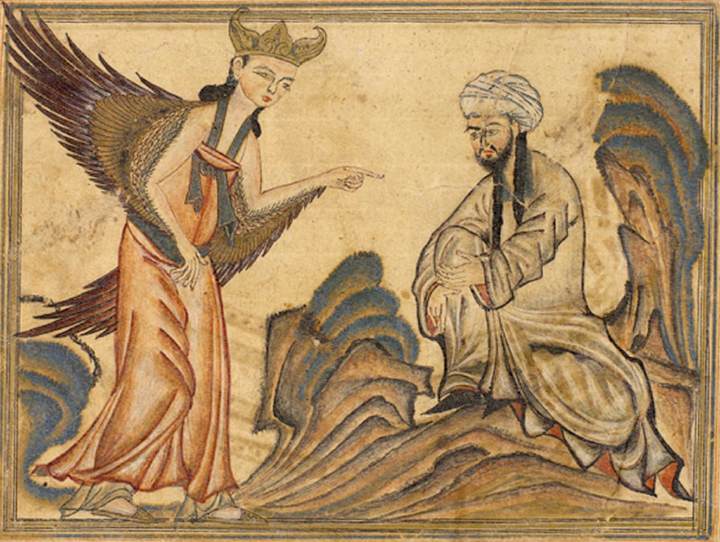
Mohammed receiving his first revelation from the angel Gabriel

Religious Experiences and Miracles

The Jewish people still exist after 2,500 years, while they have not had a homeland for most of the time. That is a remarkable feat. Then Christianity replaced the existing religions in the Roman Empire in one of history’s strangest twists. Somehow, the message of personal salvation through Christ caught on. In the third century, Manichaeism emerged as a new religion. It taught that there was a struggle between the good spiritual world of light and the evil material world of darkness. The prophet Mani, who grew up in a Jewish-Christian Gnostic sect, claimed to have received revelations meant for the entire world, which were to replace all existing religions. It instantly became a spectacular success, spread everywhere in the known world, and could have overtaken Christianity, but it didn’t. A pivotal, and possibly decisive, moment was the conversion of Emperor Constantine to Christianity in 312 AD. He made Christianity the favoured religion in the Roman Empire.

A few centuries later, a small band of Arab warriors established an empire that stretched from the Atlantic to India, spreading the new religion of Islam, in an even stranger and more rapid historical development. Is it a realistic scenario that the supposedly illiterate camel driver Muhammad became a crafty statesman after seeing an angel telling him he came to deliver messages from the God of the Christians and the Jews? After Muhammad’s death, his followers went on to defeat the Byzantine and Persian empires. At the same time, Manichaeism made a one-way trip into the dustbin of history, while in the third century, it appeared to be on the verge of becoming the world’s leading religion. So, why did Mani fail and why did Muhammad succeed? Historians can explain it, but it is an account of what happened rather than an explanation. The question remains, could it occur without someone pulling the strings?

So much can happen, and what happens now has once been extremely improbable. Your reading this text here and now seems highly unlikely a few decades ago. Think of all the things you could have done instead. Or you could have been dead. Yet, you wouldn’t consider your reading this text a miracle. Proselytising religions like Christianity and Islam have a built-in inclination to grow. That may not be the ultimate answer. Jews, Christians, and Muslims worship the same deity. Our universe could be a simulation, and someone could have planned it. But who is to say it couldn’t have happened otherwise?

When Islam arrived on the scene, Jews, Christians and Zoroastrians in the area already believed in an all-powerful creator. Muhammad had met them on his travels, so he was familiar with these religions. Before that, Christianity had faced an uphill struggle. While the Roman state suppressed this religion, pagans left their gods behind and accepted the Christian God as the only true God. And they did so in large numbers.

That begs for an explanation, even though the conversion of Romans to Christianity was a gradual process that took centuries. The Romans occasionally half-heartedly persecuted Christians and executed a few thousand of them over the centuries, not for being a Christian but for not paying their respects to the Roman gods. Despite that, the number of Christians increased 2-3% per year between 30 AD and 400 AD. Each Christian may have converted just one or two persons on average. Over time, exponential growth enabled Christianity to grow from about 100 followers in 30 AD to 30 million by 400 AD.

Such a gradual and steady growth over centuries was somewhat unique for a religion, and so was the blitz conquest of Islam later on. Most people in the Roman Empire, and everywhere else for that matter, lived miserable lives. The promise of an eternal blissful afterlife may have been too tempting for those poor, wretched souls to resist. However, the most often cited reason for conversions was stories about the miracles Christians performed.2 Only in the Middle Ages did the sword become the most compelling Christian argument as Christianity spread further and became integral to European politics. That was not the case in the Roman Empire, so miracles and stories about them were crucial.

An early miracle was Jesus’ appearance to a few followers after his crucifixion. The New Testament mentions miracles that the disciples allegedly performed. These accounts may be exaggerated, but the theme of miracles remains a consistent one in Christianity to this day. The Roman Catholic Church has a rich folklore surrounding relics that are believed to possess magical properties because they are said to have been touched by Jesus. The most famous relics are the Crown of Thorns in Paris, the mysterious Holy Grail, the chalice from which Jesus is said to have drunk, and the Shroud of Turin, a piece of linen cloth with a supposed image of Jesus’ face.

Many of the miracles attributed to these relics are unverifiable or can have other causes, such as luck, but a few cannot be easily explained away. The Roman Catholic Church keeps a record of them. On message boards, people tell stories about prayers heard and miraculous healings. Many of these stories may result from chance or other causes, such as a misdiagnosis or someone seeking attention by lying, but that is not always the case.

A recurring theme is the appearance of the Virgin Mary and other miracles related to her. Thousands of people have seen her. She appeared several times in Venezuela. She revealed herself to Maria Esperanza Medrano de Bianchini in 1976, who received exceptional powers. She could tell the future, levitate, and heal the sick. In Egypt, Mary appeared at a Coptic Church between 1983 and 1986. Muslims have also seen her there. There have been many more Virgin Mary appearances. The most notable sequence occurred in Portugal at Fatima between 13 May and 13 October 1917.

The grand finale was on 13 October 1917, when the Sun reportedly spun wildly and tumbled down to Earth, radiating in indescribably beautiful colours, before stopping and returning to its normal position. Some 40,000 attendants witnessed Mary’s performance. They had gathered because three shepherd children had prophesied that the Virgin Mary would perform a miracle on that date and location. Faking this was hard to do, considering the technology available in 1917. A lack of holographic equipment would have made the effort challenging, not to mention changing the location of the Sun, which is a large ball many times larger than Earth, thus making it difficult to move around. And somehow, the Sun only moved in Fatima, which can only happen in virtual reality.

Jesus also appeared a few times, but less frequently than the Virgin Mary. An intriguing account comes from Kenneth Logie, a preacher of the Pentecostal Holiness Church in Oakland, California, in the 1950s. In April 1954, Logie was preaching at an evening service. During the sermon, the church door opened. Jesus came walking in, smiling to the left and the right. He walked right through the pulpit. Then he placed his hand on Logie’s shoulder. Jesus spoke to him in a foreign tongue. Fifty people witnessed the event. Five years later, a woman in that same church suddenly disappeared. Jesus took her place. He wore sandals and a shiny white robe. He had nail marks on his hands, which were dripping with oil. After several minutes, Jesus disappeared, and the woman reappeared. Two hundred people have seen it. It was on film as Logie had installed film equipment, because strange things were happening.3 Such events can convince people that the message of Christianity, even though it may seem highly peculiar, is correct, as Zeus and Thor failed to show up and perform some tricks.

Mary and Christ are part of a folklore where genuine experiences mix with mental cases seeking attention or con artists profiting at the public’s expense. Usually, there are no 40,000 witnesses, verifiable evidence, or camera footage of what occurred. The Vatican is troubled by the self-proclaimed seers, fortune tellers, prophets, and messengers who believe they have a special bond with the Virgin Mary or have weeping Madonna statues, which they may or may not have prepared to weep. These people could be delusional, crave attention or, like the televangelists in the United States, be after your money. That is not always the case. If you have a religious experience, don’t suffer from mental conditions impairing your judgment, and can’t think of naturalist explanations, you should believe what you see. To quote Shakespeare’s Hamlet, ‘There are more things on heaven and earth, Horatio, than are dreamt of in your philosophy.’

Latest revision: 5 September 2025

Feature image: Mohammad receiving his first revelation from the angel Gabriel. Miniature illustration on vellum from the book Jami’ al-Tawarikh, by Rashid al-Din, published in Tabriz, Persia, 1307 AD. Public Domain.

1. Sapiens: A Brief History of Humankind. Yuval Noah Harari (2014). Harvil Secker.
2. The Triumph of Christianity: How a Forbidden Religion Swept the World. Bart Ehrman. Simon & Schuster (2018).
3. How Jesus Became God: The Exaltation of a Jewish Preacher From Galilee. Bart Ehrman. HarperCollins Publishers (2015).