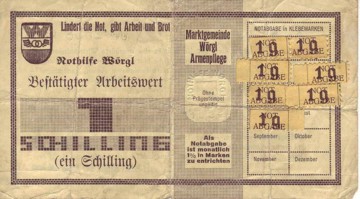
Wörgl bank note with stamps. Public Domain.

Short Introduction

End of growth

The last 200 years have been an era of exceptional economic growth, unlike anything the world has ever seen. Like any exponential phenomenon in a limited room, that growth will end. The best comparison is cancer. If it goes untreated, the host dies. The end of growth, whether it is by death of the host or treatment, has implications for capital, which is addicted to positive returns made possible by squandering planetary reserves. For most of history, there was a shortage of capital. But for the first time, there is a massive excess invested in the bullshit economy, transforming energy and resources into waste and pollution to make money for investors by producing and marketing non-essential products and services in a competition that is about to make humans redundant.

For most of history, economic growth has been negligible. However, it averaged 1.5% over the last two centuries and will soon return to zero, or possibly even lower, perhaps much lower. That has implications for returns on investments, the financial system and interest rates. Investors have become hooked on positive returns, so there must be growth. Otherwise, they lose confidence. It is grow or die, but growth will kill us. And so, we face the prospect of an economic collapse and a collapse of civilisation. We are near a technological-ecological apocalypse. There is a dark force operating behind the scenes that makes us commit suicide. It is usury, or the charging of interest on debts. It makes capital addicted to growth.

The survivors may debate the precise cause of the collapse. I have already received a newsletter email from a pundit claiming that a lack of very cheap oil is leading to debt problems. Future generations may blame the planet for being finite, rather than seeing that human beings were so foolish as to build their civilisation on usury, so that it can only survive through economic growth. Before modern times, humans managed to live without economic growth, as there was hardly any capital and no interest-bearing debt. Past civilisations facing usury-induced economic collapses either disappeared, banned interest, or instituted debt cancellations.

The past 200 years have indeed been exceptional, and that miracle was primarily due to low interest rates. Efficient financial markets promoted growth by depressing interest rates, allowing economic growth to finance the interest. That has blinded us from the financial apocalypse that is upon us. Low interest rates have already brought us unprecedented wealth, albeit at the expense of the planet and future generations. When economic growth returns to sustainable levels, the interest on outstanding debt can collapse the world economy and bring down human civilisation. Luckily, a usury-free financial system for a future without growth already exists: Natural Money.

The nature of usury

Suppose Jesus’ mother had opened a retirement account for Jesus just after his birth in 1 AD at the Bank of the Money Changers next to the Temple in Jerusalem. Suppose she had put a small gold coin weighing three grammes in Jesus’ retirement account at 4% interest. Jesus never retired, but he promised to return. Suppose now that the bank held the money for this eventuality. How much gold would there be in the account in the year 2020? It would be an amount of gold weighing twelve million times the mass of the Earth. There isn’t enough gold to pay out Jesus if he returns.

And so the usurers hope he doesn’t come back, also for other reasons, of course. And for every lending, there is borrowing. The bank is merely an intermediary. There must be people in debt for an amount of gold weighing twelve million times the mass of the Earth. That would never happen. The scheme would have collapsed long before that, and the debtors would have become the serfs of the money lenders. That is why religions like Christianity and Islam forbade charging interest on money or debts.

The usurers have found a way around the issue. Our money isn’t gold anymore. Banks create money from thin air, so the nature of usury has changed. When you go to a bank and take out a loan, such as a car loan, you get a deposit and a debt, which the bank creates on the spot through two bookkeeping entries. You keep the debt, but the deposit becomes someone else’s money once you purchase the car. When you repay the loan, the deposit and the debt vanish into thin air. You must repay the loan with interest. If the interest rate is 5% and you have borrowed €100 for a year, you must return €105.

Nearly all the money we use is created from loans that borrowers must repay with interest. If our borrowing creates money, and we repay our debts with interest, then we may do so by borrowing the interest. That is also what happens in reality, and that is why debt levels continue to rise. So, where does the extra €5 come from? Here are the options:

  • Borrowers borrow more.
  • Depositors spend some of their balance.
  • Borrowers fail to repay their loans.
  • The government borrows more.
  • The central bank prints the money.

Problems arise when borrowers don’t borrow more, and depositors don’t spend their money. In that case, borrowers as a group are short of funds, and some of them are unable to repay their loans. If too many borrowers can’t pay at once, a financial crisis occurs. To prevent that from happening, the government borrows more, and the central bank prints money. They bring that money into the economy, allowing debtors to pay off their debts with interest. Interest compounds to infinity, and there is no limit to human imagination, so frivolous accounting schemes can go a long way before they collapse.

Necessity of interest

We take interest for granted, and economists believe that the economy needs it. Without lending and borrowing, a modern capitalist economy would have been impossible; without interest, loans would also be impossible. Money is to the economy what blood is to the body. If lending and borrowing halt, money stops flowing, and the economy comes to a standstill. That is like a cardiac arrest, which, if untreated, is fatal. And that is also why the financial press reads the lips of central bankers as if our lives depended on it. They manage the flow. Lenders have reasons to demand interest. These are:

  • When you lend out money, you can’t use it yourself. That is inconvenient. And so, you expect compensation for the use of your money.
  • The borrower may not repay the loan, so you desire compensation for that risk.
  • You can invest your money and earn a return. To lenders, the interest rate must be attractive relative to other investments.

That has been the case for a long time, and economists have gradually become quite good at explaining the past. Since then, we have seen financial innovations and are now facing the end of growth. Changes in the economy and the economic system may lead to the end of interest on money and debts. These are:

  • You can use the money in a bank account at any time. You can use the money you have lent as if it were cash. And a debit card is more convenient than cash.
  • Banks spread their risks, central banks help out banks when needed, and governments guarantee bank deposits, so bank deposits are as safe as cash.
  • There is a global savings glut. There are ample savings and limited investment options, which can make lending at negative interest rates attractive.

Negative interest rates are possible. In the late 2010s and early 2020s, the proof came when most of Europe entered negative interest-rate territory. The ECB was unable to set interest rates below -0.5%. Had it set interest rates even lower, account holders would have emptied their bank accounts and stuffed their mattresses with banknotes to avoid paying interest on their deposits, disrupting the circular flows.

As interest rates couldn’t go lower, the ECB took extraordinary measures, flooding the banking system with new money to boost the economy. Had there been a holding fee on cash, interest rates could have gone lower, and there would have been no need to print money. It has happened before. The Austrian town of Wörgl charged a holding fee on banknotes during the Great Depression, which led to an economic miracle by making existing banknotes circulate better rather than printing new money. Ancient Egypt had a similar payment system for over a thousand years during the time of the Pharaohs.

Miracle of Wörgl

In the midst of the Great Depression, the Austrian town of Wörgl was in dire straits and prepared to try anything. Of its population of 4,500, 1,500 people were jobless, and 200 families were penniless. Mayor Michael Unterguggenberger had a list of projects he wanted to accomplish, but there wasn’t enough money to fund them all. These projects included paving roads, installing street lights, extending water distribution throughout the town, and planting trees along the streets.1

Rather than spending the remaining 32,000 Austrian Schilling in the town’s coffers to start these projects, he deposited them in a local savings bank as a guarantee to back the issue of a currency known as stamp scrip. A crucial feature of this money was the holding fee. The Wörgl money required a monthly stamp on the circulating notes to keep them valid, amounting to 1% of the note’s value. The Argentine businessman Silvio Gesell first proposed this idea in his book The Natural Economic Order.2

Nobody wanted to pay for the monthly stamps, so everyone spent the notes they received. The 32,000 schilling deposit allowed anyone to exchange scrip for 98 per cent of its value in schillings. Few did this because the scrip was worth one Austrian schilling after buying a new stamp. But the townspeople didn’t keep more scrip than they needed. Only 5,000 schillings circulated. The stamp fees paid for a soup kitchen that fed 220 families.1

The municipality carried out the works, including the construction of houses, a reservoir, a ski jump, and a bridge. The key to this success was the circulation of scrip money within the local economy. It circulated fourteen times as often as the schilling. It increased trade and employment. Unemployment in Wörgl decreased while it rose in the rest of Austria. Six neighbouring villages successfully copied the idea. The French Prime Minister, Édouard Daladier, visited the town to witness the ‘miracle of Wörgl’ himself.1

In January 1933, the neighbouring city of Kitzbühel copied the idea. In June 1933, Mayor Unterguggenberger addressed a meeting with representatives from 170 Austrian towns and villages. Two hundred Austrian townships were interested in introducing scrip money. At this point, the central bank decided to ban scrip money.1 The depression returned, and in 1938, the Austrians turned to Hitler, as they voted to join Germany.

Since then, several local scrip monies have circulated, but none has been as successful as the one in Wörgl. In Wörgl, the payment of taxes in arrears generated additional revenue for the town council, which it then spent on public projects. Once the townspeople had paid their taxes, they would have run out of spending options and might have exchanged their scrip for schillings to avoid paying for the stamps. That never happened because the central bank halted the project.

The economy of Wörgl did well because the holding fee kept the existing money circulating. A negative interest rate encourages people to spend their money, eliminating the need to borrow and keeping the money circulating in the economy. It demonstrated that the economy required a negative interest rate. A holding fee makes negative interest rates possible, as lenders do not have to pay it after lending the money. The one who holds the money pays the charge. That can make lending money at an interest rate of -2% to a reliable borrower more attractive than paying 12% for the stamps.

Joseph in Egypt

In the time of the Pharaohs, the Egyptian state operated granaries for over 1,500 years. Wheat and barley were the primary food sources in Egypt. Whenever farmers brought their harvest to one of the granaries, state officials issued them receipts stating the amount of grain they had brought in. Egyptians held accounts at the granaries. They transferred grain to others as payment or withdrew grain after paying the storage cost.

The Egyptians thus used grain stored in their granaries for making payments. Everyone needed to eat, so grain stored in the granaries had value.1 Due to storage costs, the money gradually lost its value. With this kind of money, you might have interest-free loans. If you save grain money, you pay for storage. And so, lending the money interest-free to a trustworthy borrower can be attractive. There is no evidence that this happened.

The origin of these granaries remains unclear. Probably, the state collected a portion of the harvests as taxes and stored them in its facilities. The government storage proved convenient for farmers, as it relieved them of the work of storing and selling their produce. And it made sense to have a public grain reserve in case of harvest failures.

The Bible features a tale that supposedly explains the origin of these granaries. As the story goes, a Pharaoh once had a few dreams that his advisers couldn’t explain. He dreamed about seven lean cows eating seven fat cows and seven thin, blasted ears of grain devouring seven full ears of grain. A Jewish fellow named Joseph explained those dreams to the Pharaoh. He told the Pharaoh that seven years of good harvests would follow, followed by seven years of crop failures. Joseph advised the Egyptians to store food for meagre times. They followed his advice and built storehouses for grain. In this way, Egypt managed to survive seven years of scarcity.

The money gradually lost value to cover the storage cost of the grain. It works like buying stamps to keep the money valid, like in Wörgl. Both are holding fees. The grain money circulated for over 1,500 years until the Romans conquered Egypt around 40 BC. It did not end in a debt crisis, which suggests that a holding fee on money or negative interest rates can create a stable financial system that lasts forever.

Storing food makes sense today, even when it costs money. Harvests may become more unpredictable due to global warming and intensive farming. We only have enough food in storage to feed humanity for a few months as it is unprofitable to store more. Food storage ties up capital, so there is also interest cost. But you can’t eat money, so storing food to deal with harvest failures is as sensible now as it was in the time of the Pharaohs. It reveals the stupidity of our current thinking. Our survival needs to be financially viable. Just imagine how that will play out once artificial intelligence and robots can replace us.

Natural Money

The miracle of Wörgl suggests that a currency with a holding fee could have ended the Great Depression. A myth circulating in the interest-free currency movement is that had the Austrian central bank not banned the experiment, the Great Depression would have ended, Hitler wouldn’t have come to power, and World War II wouldn’t have happened. That is a tad imaginative, to say the least, but a holding fee could have allowed for negative interest rates, and they could have prevented the Great Depression from starting in the first place. That is a lot of maybes.

And such money can last. The grain money in ancient Egypt provided a stable financial system for over 1,000 years. The grain backing provided financial discipline. The holding fee prevented money hoarding that could have impeded the flow of money. The money, however, didn’t promote interest-free lending, so the Egyptian state regulated lending at interest to prevent debt slavery. Egyptian wisdom literature condemned greed and exploitative lending, encouraging empathy for vulnerable individuals.

A holding fee of 10-12% per year punishes cash users. If the interest rate on bank accounts is -2%, an interest rate of -3% on cash is sufficient to prevent people from withdrawing their money from the bank. That becomes possible once cash is a separate currency backed by the government, on which the interest rate on short-term government debt applies. Banknotes and coins thus become separate from the administrative currency. So, if the interest rate on the cash currency is -3%, one cash euro will be worth 0.97 administrative euros after one year. And now, we have a definition of Natural Money:

  • Cash is a separate currency backed by short-term government debt and has the negative interest rate of short-term government debt.
  • Natural Money administrative currencies carry a holding fee of 10-12% per year, allowing for negative interest rates.
  • Loans, including bank loans, have negative interest rates. Zero is the maximum interest rate on debts.

Consequences

Natural Money doesn’t fundamentally alter the nature of bank lending. Banks borrow from depositors at a lower rate to lend it at a higher rate. With Natural Money, banks may offer deposit interest rates of -2% to lend it at 0% instead of borrowing it at 2% to lend it at 4%. A maximum interest rate of zero, however, has a profound impact on lending volume, as it severely constrains it, most notably speculative lending and usurious consumer credit, and it favours equity financing over borrowing in business. The strict lending requirements affect business loans, leading to deleveraging.

Businesses still need to attract capital. To address the issue, Natural Money features a distinction between regular banks and investment banks. Regular banks can guarantee promised returns and have government backing because the payment system is a public service. Investment banks invest in businesses and take risks. They are comparable to Islamic banks. Investment banks don’t guarantee returns. Depositors take on risk to get better returns, but they might incur losses or temporarily have no access to their deposits.

While the maximum interest rate restricts lending, the holding fee provides a stimulus, thereby stabilising the financial system. When the economy slows down, interest rates decrease, and more money becomes available for lending as risk appetite increases, making lending at zero interest more attractive. Conversely, if the economy booms, interest rates increase, and the maximum interest rate curtails lending. Consequently, central banks don’t need to set interest rates and manage the money supply, and governments don’t need to manage aggregate demand with their spending.

Reasons to do research

Stamp scrip and other kinds of emergency money have helped communities in times of economic crisis. The economic miracle of Wörgl during the Great Depression of the 1930s, however, was exceptional. The payment of local taxes inflated the impact of the money. Many townspeople had been late on their taxes, but once the economy recovered, they had the money to pay them. Some even paid their taxes in advance to avoid paying the holding fee. It generated additional revenues for the town, which it could spend on the projects. It provided a boost that would have petered out once the villagers had paid their taxes.3 It was not a miracle. It was too good to be true. Still, there is more to it.

Once interest rates reach zero, the markets for money and capital cease to function as interest rates can’t go lower. Money is to an economy what blood is to a body, so it must flow. When the money stops flowing, the effect is like a cardiac arrest, and the economy is in dead waters. To keep the money circulating, those with a surplus must lend it to those with a deficit, and the interest rate should be where the supply and demand for money are equal. When that interest rate reaches zero, lenders stop lending because the return is not worth the risk, so they wait for interest rates to rise. Money then ends up on the sidelines, leading to cardiac arrest, which can be the start of an economic depression.

It happened during the Great Depression. If interest rates had been lower, the markets for money and capital could have remained in operation. We have seen negative interest rates in Europe for nearly a decade. They could have gone lower had there been a holding fee on cash, or even better, a negative interest rate that is just low enough to prevent people from hoarding it. Once interest rates can go lower, a usury-free global financial system may be possible. That gives rise to several questions. Is it possible? Under which circumstances? What are the benefits and the drawbacks? What are the implications for individuals, businesses and governments? And how does it affect the financial system?

There is no alternative

Several other monetary reform proposals do not view the financial system as a system, which it is, and that isn’t hard to guess because the term ‘financial system’ already implies this. You can’t attach the wings of a Boeing to an Airbus and expect the thing to fly. The financial system is a complex system with numerous relationships, many of which existing reform proposals overlook. For instance, if you end the central bank, the economy will crash immediately, even if it is flying smoothly. And that isn’t even hard to find out.

The payment system is a key public interest, so governments and central banks stand behind it. Most banks are private corporations driven by profit. They take risks that might bring down the economy. And so, governments and central banks make regulations and oversee the banks. And banks create money, from which they profit, and we all pay for it via inflation. That is not good, but replacing the system with something worse is worse, like the word ‘worse’ implies.

There is no lack of ill-conceived proposals. And most fail to address the primary underlying cause of the dysfunction of the financial system, which is charging interest on money and debts, commonly known as usury. An inflation-free, stable financial system is possible. It may not even need central banks. But a sound reform proposal sees the financial system as a complex system with intricate relationships that interact with one another.

And so, Natural Money comes with a systems approach that aims to uncover the relevant relationships in the financial system and the consequences of changing them. It means that Natural Money is a comprehensive design. The gravest error you can make is to pick only the elements you like. That design will never fly. Nor would an Airbus take off with Boeing wings. So, you either buy Airbus or Boeing. In the case of Natural Money, that is not an option. There is no alternative.

Latest revision: 1 November 2025

Featured image: Wörgl bank notes with stamps

1. The Future Of Money. Bernard Lietaer (2002). Cornerstone / Cornerstone Ras.
2. The Natural Economic Order. Silvio Gesell (1918).
3. A Free Money Miracle? Jonathan Goodwin (2013). Mises.org.
Banking Operations

Commercial versus savings banks

Historically, the banking sector comprised several types of banks. The distinction between commercial banks, which create money, and savings banks, which don’t, has lost its value due to the existence of efficient financial markets, where banks match terms through borrowing and lending. The distinction between created money and savings is arbitrary, as the following example demonstrates. Suppose that I work at a farm, and the farmer rewards me with a plot of land and leftover wood and materials from a defunct shed, which I use to build my home. After finishing my house, I go to the bank and take out a mortgage. The bank creates money out of thin air.

Until I went to the bank, no money had changed hands. Still, I was able to save for a home of my own. In other words, savings aren’t the same as money in a savings account. In this case, my savings are my home, and if the mortgage is a debt, the money I take out is my savings. To further illustrate the point, suppose that I have no money and also own no home. When I go to the bank for a car loan, the bank creates this money on the spot. If you think there are no savings, you are wrong again. The person who sold you the car had saved the car. I can even borrow money and put it in a savings account. And so, I created savings from thin air by borrowing money and lending it to the bank.

Full-reserve banking

A well-known monetary reform proposal is full reserve banking, as outlined in the Chicago Plan, which means there are only savings banks and no commercial banks that create money. It often resurfaces when banks go bankrupt. With full reserve banking, banks can’t lend out funds deposited in demand accounts or current accounts. Money in these accounts isn’t debt but backed by central bank currency or cash. And depositors can’t withdraw the money from their savings accounts on short notice. In this way, banks can’t go bankrupt because of depositors demanding payment in cash. With full reserve banking, loans must come from savings, which are funds that depositors can’t withdraw on demand, as they have entrusted them to the bank for an extended period.

Lack of cash is usually not the primary reason banks fail, but rather, loan write-offs. That was also the case during the 2008 financial crisis. Full reserve banking addresses a liquidity problem, whereas the crisis was a solvency issue that subsequently led to a liquidity issue. Banks ran into trouble, not because they lacked cash, but because they incurred losses on their loans. As a result, banks began to distrust one another and stopped lending to each other. The financial system can be safe with zero reserve banking, provided that banks are solvent, thus have sufficient capital, and own adequate liquid assets, such as government bonds, that they can sell to meet withdrawals. And so, a reserve requirement can better include liquid safe assets, such as government bonds, rather than currency alone.

Some proponents of full reserve banking are socialists who oppose privately controlled money creation, as they view it as a public subsidy to the private banking sector. Others desire a banking sector free from government interference, so a ‘free’ banking market without central bank interventions and deposit guarantees. At least that is something socialists and their opponents might agree on. Bank credit can contribute to economic cycles and financial crises. With full reserve banking, there would be less bank credit, and interest rates would be higher. To make lending possible, depositors must part with their money for a designated period of time to make it available for lending. As a result, fewer funds are available for lending, and interest rates would be higher.

Shadow banks

Full-reserve banking makes financial markets less efficient, allowing alternative schemes, such as shadow banks, to fill the gap. An example can illustrate that. Suppose that God has ordered banks only to use money in savings accounts for lending so that there is full reserve banking in Paradise. Eve and Adam only do business with each other. Both have €100 in their current account, which they use for their daily business transactions. This money is suitable for payment because it is in the current account. For that reason, they don’t receive interest. Assume now that the bank also offers savings accounts with an interest rate of 4% but money in savings accounts isn’t suitable for payment.

Then a financial advisor comes along, disguised as a snake, advising Eve and Adam for a reasonable fee on how to manage their payments between themselves and to deposit their money into a savings account. So, what you now read in Genesis is made up by bankers to hide their fraud, a conspiracy theorist might infer. But it is just a story. In this way, Eve and Adam both earn interest on their €100. They give each other credit, so that Eve can borrow €100 from Adam, and Adam can borrow €100 from Eve. They don’t need to keep money in their current accounts, so they deposit their funds into a savings account and earn interest. Everybody wins, Eve, Adam, and of course, that snakelike creature.

Initially, Eve and Adam had no savings, only money in their current accounts. The advisor’s scheme allows them to fabricate savings out of credit. It seems like creating money, but Eve and Adam gave each other credit. They agreed to pay later, which exposed both to credit risk. One of them might not repay because you can do so many different things with €100 than put it in a savings account. You can use credit, which is an agreement to pay later, and use it like money. And so, Paradise was lost. Similar schemes exist on a larger scale. These are shadow banks. Shadow banks don’t create money but credit. The difference between fractional reserve money and this type of credit may not be significant in practice, except that it is unregulated, resulting in little oversight.

When banks create money, they do the same. The banks act as intermediaries between Eve and Adam, allowing them to lend money to each other even when they do not conduct business with each other or do not trust each other. The bank also assumes the risk that a debtor will fail to repay and receives a reward in the form of interest. It is also credit, but we refer to it as money because the law regards bank credit as legal tender, thus money. The government backs this scheme, as a stable financial system is a key public interest. Banks must have sufficient capital and reserves to meet emergencies. For that reason, banks are subject to regulations, while shadow banks are not subject to these rules, allowing the latter to offer more competitive interest rates.

As a result, the role of traditional banking has declined. Large corporations could lend and borrow in money markets at rates better than those offered by banks. At the same time, retail investors could invest directly in money markets and get better yields than banks offer. This development started with corporate borrowing. It later expanded into mortgages. The primary reason for regulating banks is that they operate the payment system, which is of public interest, and can borrow from the Federal Reserve. It prompted banks to strip their balance sheets and expose themselves to off-balance sheet risks to generate higher returns on their capital. For instance, offering an emergency credit line to a shadow bank generated profits while not appearing on the balance sheet.

The 2008 financial crisis originated in shadow banks that invested in risky assets, rather than conventional banks that create money through lending. Shadow banks aren’t subject to the same regulations as traditional banks, so they made speculative investments in mortgages. These investments appeared safe because rating agencies failed to do their jobs. Regular banks encountered trouble because they had backed shadow banks, hoping to reap a quick profit from credit insurance. The word they use is off-balance sheet financing. The regular bank didn’t lend money, but guaranteed credit to shadow banks in case of emergency, which is as dangerous as keeping the mortgages on its own balance sheet. But that was legal. It allowed banks to make more money from the same capital. Money creation, therefore, wasn’t the problem, and replacing regular banks with shadow banks could further destabilise the financial system.

If a financial crisis were to occur with loan write-offs, full reserve banking would only ensure that money in current accounts is safe. However, the same problems would emerge in savings accounts. Savings banks can expose themselves to off-balance sheet risks, unless that is forbidden. And they can also go belly up. And they did. If the debtors of a bank fail to meet their obligations, the bank may face financial difficulties, and the savings it holds may be at risk. Also, with full reserve banking, governments and central banks may end up supporting savings banks and even shadow banks to ensure financial stability, thereby rendering the benefits of full reserve banking void. After all, the initial cause was never a liquidity problem, but a solvency issue.

Commercial versus investment banks

The Glass-Steagall Act in the United States severed linkages between regular banking and investment activities that contributed to the 1929 stock market crash and the ensuing depression. Separating banking from investing can prevent banks from providing loans to corporations in which they have invested. The measure aimed to make bankers more prudent. The separation of commercial and investment banking prevented securities firms and investment banks from taking deposits. The reason for the separation was the conflict of interest that arose from banks investing in securities with their own assets, which were their account holders’ deposits. Banks were obliged to protect the account holder’s deposits and should not engage in speculative activities.

The Glass-Steagall Act included the Federal Deposit Insurance Corporation (FDIC), which guaranteed bank deposits up to a specified limit. It also comprised Regulation Q, which prohibited banks from paying interest on demand deposits and capped interest rates on other deposit products. Maximising interest rates can limit the risks banks are willing to take on loans, as these risks can destabilise the financial system.

Until the 1980s, the legislation mainly remained unchanged. With the rise of neoliberalism, government regulations became increasingly disapproved of. Hence, the Glass-Steagall Act became increasingly disregarded, and diligent deregulators repealed it in 1999 as part of their effort to relieve businesses of government regulations that stood in the way of corporations making profits at the expense of the public good. Regulation Q ceilings for all account types, except demand deposits, were phased out during the 1980s. After the 2008 financial crisis, a renewed interest in the Glass-Steagall Act emerged.

In the United States, money market funds circumvented the limits imposed on banks by Regulation Q, luring depositors with higher interest rates, thereby undermining the prudent banking paradigm. The money market funds, which are shadow banks, invested in collateralised debt obligations (CDOs), such as mortgage-backed securities (MBS). The 2008 financial crisis started in money market funds, not traditional banks.

Natural Money works with the same principles. It distinguishes between regular banks, which provide loans, and investment banks, which are partnerships that invest in equity. Islamic banks also operate similarly. The maximum interest rate of zero works like Regulation Q, aiming to limit the risks banks are willing to take on deposits, as interest is a reward for taking on risk. Banking in a Natural Money financial system works as follows:

  • Regular banks make low-risk loans. The money in these banks is secure. The maximum interest rate is zero. And so, deposits have negative yields.
  • Investment banks don’t lend but participate in businesses by providing equity. They can rent houses and lease cars. Investment banks offer higher returns.
  • Both regular banks and investment banks can invest in government securities to manage their risk and meet withdrawals.
  • Regular banks can promise a fixed interest rate. The government may offer support and deposit guarantees.
  • Investment banks don’t guarantee returns. They pay dividends based on their profits. Its depositors are investors who can face losses.

Natural Money enhances financial stability by favouring equity investments over debt investments. The maximum interest rate makes debt investments less attractive. And there is no reward in the form of interest for engaging in high-risk lending, which enhances the financial system’s stability. It stands to reason that the integrity of the system depends on strict adherence to its principles and the termination of evasive, get-rich-quick schemes of financial parasites, which requires a belief in the vision behind the idea of a usury-free economy. Let’s not dismiss that as a fantasy immediately.

Sanitation of banking

The primary cause of the financial system’s failure is usury. Imagine what a maximum interest rate of zero on debts can do. Only the most creditworthy borrowers can get a loan. You may have to save and bring in equity before applying for a mortgage, and that may be the only credit you can obtain. Even an overdraft may be impossible. That may seem harsh, but it is even worse when indebted consumers reach the point of interest payments and can’t make ends meet. If you want to buy something, you have to save for it. Likewise, corporations need to attract capital rather than debt to meet their liquidity requirements. The financial sector will shrink, and much of modern finance may become redundant.

That said, individuals and businesses may obtain better deals in the money market, allowing them to opt for this option rather than a bank. The distinction between traditional banks and shadow banks may blur. Tradional banks may need fewer regulations while shadow banks may need more. That is because without interest, risk may disappear. The central bank may stand behind the payment system, but it may not have to stand behind the lending system. The implicit guarantee of central banks buying debt and issuing currency with a holding fee means that the warranty will remain unused.

Two other themes emerged during the 2008 financial crisis: ‘too big to fail’ and ‘too complex to understand.’ Complexity and size are the outcome of competition. The failure of a large bank can bring down the financial system, and the products traders in financial markets use to hedge their risks or improve their profitability can be complex. Our future civilisation could be simpler, so the sanitation of the financial system should encompass cooperation, simplification and diversification. It may look as follows:

  • There should be an exhaustive list of all legal financial products and their requirements. We shouldn’t allow other financial products to exist.
  • No bank should hold more than a certain percentage of the global market, and no bank should expose itself to more than a certain percentage of another bank.
  • Banks should share services where scale is crucial, such as technological infrastructure and advanced knowledge.

Smaller banks can achieve efficiency improvements by using the same technological infrastructure. As long as they are independent financial institutions, they may share an IT department and operate their businesses on the same software. It may even be a public infrastructure that all banks share, allowing for significant cost savings, while also sharing knowledge and implementing measures related to issues such as fraud prevention.

Latest revision: 13 November 2025

Featured image: Ara Economicus. Beverly Lussier (2004). Wikimedia Commons. Public Domain.

The Great Reset

During the coronavirus pandemic, the World Economic Forum (WEF) launched a plan, The Great Reset. It aims to rebuild the world economy more intelligently, fairer and sustainably while adhering to the United Nations Sustainable Development Goals (SDG). These SDGs include ending poverty, improving health and well-being, better education, equality, clean water and sanitation, affordable and clean energy, jobs and economic growth. That sounds great, but is it a reset? It would be up to so-called responsible corporations and international non-governmental organisations (NGOs) to implement the agenda before 2030. Not everyone thinks that is a great idea.

The change is supposed to be powered by the Fourth Industrial Revolution, a fusion of technologies in fields such as artificial intelligence, robotics, the Internet of Things, autonomous vehicles, 3-D printing, nanotechnology, biotechnology, materials science, energy storage and quantum computing. I get an uneasy feeling when I read that. It looks like an excuse for technology addicts to play with our future. Is it because I am against progress, or is it because of a rational fear that something is about to go seriously wrong even though I don’t know exactly what?

Under the umbrella of the Great Reset, so-called young global leaders of the WEF came up with new ideas. For instance, new technologies can make products like cars and houses cheaply available as a service, ending the need to own these items. A young global leader wrote an article titled, ‘Welcome to 2030. I own nothing, have no privacy, and life has never been better.’1 She hoped to start a discussion, and the article produced a slogan that also became an Internet meme, ‘You’ll own nothing, and you’ll be happy.’ There certainly is an economic rationale for sharing items like cars, most notably if they become more expensive to keep because of technological innovation.

Property, for instance, a home, can give you economic freedom. If you own a home, you don’t have to pay rent. And you own some capital when you retire. Some people think the WEF is a sinister elite club scheming to achieve a secret agenda where the elites own everything, and the rest of us ends up with nothing. And that might happen anyway if current trends continue because that is how capitalism works. Capital accumulates and ends up in the hands of a few because of interest. It is not a secret since Karl Marx figured that out. And it leads to a crisis when the impoverished masses can’t buy the things that capital produces. With negative interest rates, there is no need for that.

Property rights have become a semi-religious value in Western culture. That prevents us from taking the property of the elites and ending their stranglehold on our political economy. Marx advised that workers or the state would take over corporations. That might not be a good idea because workers and governments often do poorly at running corporations. Markets and private enterprises can efficiently provide goods and services, but it comes with wealth inequality and happens at the expense of future generations. Our societies must find the right balance. At some point, the disadvantages of the current political economy start to outweigh the advantages.

We use far more resources than the planet can provide, and wealth inequality is now so extreme that we might need a genuine Great Reset. Taking the wealth from the elites and discontinuing enterprises that don’t provide for our essentials is not communism, as long as there are markets and private property. People should prosper if their work benefits society and enterprises often do better at providing for our needs. But we don’t benefit from the corrupting influence of oligarchs. Their wealth comes from inheritance, criminal and shady activities, and, most notably, accumulated interest on their capital. That arrangement may have suited us in the past, but not now.

Economists believe property rights are essential for economic growth, and that business owners should be able to do as they please. For instance, Elon Musk has the right to ruin Twitter because he owns the company. Should employees and others suffer from the irrational behaviour of their owners? In the Netherlands, a series of interesting trials took place, where corporations tried to escape the influence of their majority shareholder Gerard Sanderink, who allegedly didn’t act rationally in the interest of these companies.2 Limited property rights and a collectivist attitude have not prevented China from becoming a large and advanced economy surpassing the United States and may have contributed to China’s success.

The degree of individualism currently existing in the West may do more harm than good. They promote political fights and litigation and prevent us from doing what we should do. And perhaps, less privacy can go a long way in reducing crime. Property rights and individualism were crucial to start capitalism and made the West dominate the world for centuries. And so, we have learned to see them as necessary, inevitable or even desirable. But once the European imperialist capitalist engine ran, these features became less important than economic stability. If you start a business, you must be able to estimate your returns, but you can lease everything and own nothing.

Individualism and property rights also play a positive role in society. The cultural heritage of the West is extensive compared to other cultures, for instance, if you express it in the number of books written or discoveries made. Self-interest and personal responsibility can inspire us to work harder and do a better job. The Soviet Union failed to produce enough food for its citizens while there was enough arable land. In the Soviet Union, farmers had to work on collective enterprises where they could not do as they saw fit and didn’t share in the profits. The tragedy of the commons is that we don’t care for public spaces as much as our possessions. Homeowners usually take better care of their houses than tenants. The same is true for car owners.

As they are now, property rights protect the elites. And the WEF plan is just a fart in the wind, not a Great Reset. We face unprecedented worldwide challenges while wealth inequality is at extreme levels, so individualism and property rights need limits. And we need a proper Great Reset, or a switch from economic to political control of the world’s resources if we intend to live in a humane world society that respects our planet. It is what a corporation named Patagonia did in 2022.3 We can do that on a global scale.

It begins with seizing the wealth of oligarchs and criminals and all hidden wealth in offshore tax havens, including their so-called charities, placing them in sovereign wealth funds, and setting a limit on what individuals can own or earn. And perhaps, we need to build our future on values rather than balance sheets. And everyone should contribute. Capital accumulates by interest, and people who live off interest don’t work for a living. That might be as bad as being on the dole while you can work. And peddling unnecessary products that harm life on Earth could be as bad as being a criminal.

Laws should prevent people and corporations from doing wrong, but they often fail to do that. Corporations pollute the environment or exploit employees to make a profit. But consumers desire excellence for rock-bottom prices. It is profitable to break the law if you can get away with it or when the gain is higher than the fine. And if there are loopholes, they become exploited. The anonymity provided by money, large corporations and markets turn us into uncaring calculating creatures. That is why big pharma, the military-industrial complex, the financial industry, and the Internet giants threaten us. If corporations do right out of their own, many laws and regulations become redundant. If moral values can replace the law, it could be better.

Less efficiency, poorer service and a smaller choice of products can be preferable if that doesn’t lead to deprivation and starvation. For instance, why must you get your meal from a takeaway restaurant instead of preparing it yourself? Or why do you need to dress up in the latest fashion if you have ample wearable clothing? And you must work to pay for these things, so if you don’t buy them, you have time to prepare your meal or mend your clothes. We don’t want to give up these things, so in a democracy, we can’t fix this problem. Perhaps we might accept the change if God sends a Messiah who tells us this is for the best.

That might be wishful thinking, but what else can make it happen if it is not religion? Do you believe we will come to our senses, become one humanity, and do right on our own? That is wishful thinking. God is our only hope. As we are heading for the Great Collapse in one way or another, the End Times could be now. We might live inside a simulation run by an advanced humanoid civilisation.4 Hence, God might own this world, and you might soon discover that you own nothing and be happy. God’s kingdom might be a utopian society as early Christians lived like communists (Acts 4:32-35).

So what can we achieve by taking political control of the world’s resources and means of production by seizing the elite’s wealth and placing it in sovereign wealth funds? You can think of the following:

  • We can direct our means to the goals of a humane society, be respectful of this planet, and plan long-term.
  • We can dismantle harmful corporations or give them a new purpose without starting an economic crisis with mass unemployment.
  • We can make corporations employ people in developing countries and give them an education and decent salaries.
  • We can fund essential government services in developing countries and eliminate corruption insofar as it is due to insufficient pay of government employees.
  • We can make corporations produce sustainably and pass on the cost to consumers.
  • We can determine the pay of executives.
  • We can halt developments like artificial intelligence, genetic engineering, and nuclear energy if we believe they are undesirable.
  • We can end the incentive to produce and consume more and stop the advertising industry from tracking us.
  • We can end stress in the workplace if we axe bullshit jobs and redirect workers to the needs of society. A twenty-hour working week might be enough.

Interest stands in the way of a better future. The economy ‘must’ grow to pay for the interest. We ‘must’ work harder in bullshit jobs to pay for the interest. Corporations ‘must’ sell harmful products to pay for the interest. Corporations ‘must’ pay low wages or move production to low-wage countries to pay for the interest. And because of interest, money disappears from where it is needed most and piles up where it is needed least. Interest is our tribute to the wealthy. If we hope to live in a humane world society that respects creation, ending interest might be imperative. That is where Natural Money comes in.

Latest revision: 28 April 2023

Featured image: You’ll own nothing and you’ll be happy. WEF.

1. Welcome To 2030: I Own Nothing, Have No Privacy And Life Has Never Been Better. Ida Auken. World Economic Forum (2016).
2. Zakenman Gerard Sanderink tierend in rechtszaal: ‘Deze rechtbank deugt voor geen meter!’ AD.nl (2023).
3. Patagonia’s Next Chapter: Earth is Now Our Only Shareholder. Patagonia (2022).
4. Are You Living In a Computer Simulation? Nick Bostrom. Philosophical Quarterly, 2003, Vol. 53, No. 211, pp. 243-255.

Joseph interpreting the Pharaoh's dream

Joseph in Egypt

Money with a holding fee existed in ancient Egypt for over 1,500 years. Egypt had storehouses of grain run by the state. Grain was the primary food source for the Egyptians. When farmers came with their harvest, they would get a receipt telling how much they brought in and on what date. A baker could return the receipt and exchange it for grain after paying for the storage cost and loss due to degradation.

The origins of the grain storage remain unclear. The government collected taxes in kind, thus a portion of the harvest, and had to store it. The government storage probably proved convenient for farmers as they didn’t have to keep and sell their grain, which was a significant convenience. And it made sense to have a public grain reserve in case the harvests failed.

The Egyptians used these receipts as money, as grain was a commodity everyone needed. Because of the storage costs, the receipts gradually lost value. With this kind of money, you might have interest-free loans. Someone in possession of this money who likes to save it will lose by storing it and can keep his capital intact by lending it without interest. There is no evidence that this happened.

The grain storage relates to a story in the Bible. It is fiction but might tie money with a holding fee to the Abrahamic religions. As the story goes, the Pharaoh had dreams his advisers couldn’t explain. He dreamt about seven lean cows eating seven fat cows and seven thin and blasted ears of grain devouring seven full ears of grain.

Joseph explained those dreams to the Pharaoh. He told the Pharaoh that seven years with good harvests would come, followed by seven years with crop failures. He advised the Egyptians to store food. They followed his advice and built storehouses for grain. In this way, Egypt survived the seven years of scarcity (Genesis 41):

When two full years had passed, Pharaoh had a dream: He was standing by the Nile when out of the river, there came up seven cows, sleek and fat, and they grazed among the reeds. After them, seven other cows, ugly and gaunt, came up out of the Nile and stood beside those on the riverbank. And the cows that were ugly and gaunt ate up the seven sleek, fat cows. Then Pharaoh woke up.

He fell asleep again and had a second dream: Seven heads of grain, healthy and good, were growing on a single stalk. After them, seven other heads of grain sprouted–thin and scorched by the east wind. The thin heads of grain swallowed up the seven healthy, full heads. Then Pharaoh woke up; it had been a dream.

In the morning, his mind was troubled, so he sent for all the magicians and wise men of Egypt. Pharaoh told them his dreams, but no one could interpret them for him. Then, the chief cupbearer said to Pharaoh, ‘Today I am reminded of my shortcomings. Pharaoh was once angry with his servants, and he imprisoned me and the chief baker in the house of the captain of the guard.

Each of us had a dream the same night, and each dream had a meaning of its own. Now, a young Hebrew was there with us, a servant of the captain of the guard. We told him our dreams, and he interpreted them for us, giving each man the interpretation of his dream. And things turned out exactly as he interpreted them to us: I was restored to my position, and the other man was hanged.’

So Pharaoh sent for Joseph, and he was quickly brought from the dungeon. When he had shaved and changed his clothes, he came before Pharaoh. Pharaoh told Joseph, ‘I had a dream, and no one can interpret it. But I have heard it said of you that when you hear a dream you can interpret it.’ ‘I cannot do it,’ Joseph replied to Pharaoh, ‘but God will give Pharaoh the answer he desires.’

Then Pharaoh said to Joseph, ‘In my dream, I was standing on the bank of the Nile, when out of the river there came up seven cows, fat and sleek, and they grazed among the reeds. After them, seven other cows came up–scrawny and very ugly and lean. I had never seen such ugly cows in all the land of Egypt. The lean, ugly cows ate up the seven fat cows that came up first. But even after they ate them, no one could tell they had done so; they looked just as ugly as before. Then I woke up.

‘In my dreams I also saw seven heads of grain, full and good, growing on a single stalk. After them, seven other heads sprouted–withered and thin and scorched by the east wind. The thin heads of grain swallowed up the seven good heads. I told this to the magicians, but none could explain it to me.’

Then Joseph said to Pharaoh, ‘The dreams of Pharaoh are one and the same. God has revealed to Pharaoh what he is about to do. The seven good cows are seven years old, and the seven good heads of grain are seven years old; it is one and the same dream. The seven lean, ugly cows that came up afterwards are seven years old, and so are the seven worthless heads of grain scorched by the east wind: They are seven years of famine.

‘It is just as I said to Pharaoh: God has shown Pharaoh what he is about to do. Seven years of great abundance are coming throughout Egypt, but seven years of famine will follow them. Then, all the abundance in Egypt will be forgotten, and the famine will ravage the land. The abundance in the land will not be remembered, because the famine that follows it will be so severe.

The reason the dream was given to Pharaoh in two forms is that the matter has been firmly decided by God, and God will do it soon. ‘And now let Pharaoh look for a discerning and wise man and put him in charge of the land of Egypt.

Let Pharaoh appoint commissioners over the land to take a fifth of the harvest of Egypt during the seven years of abundance. They should collect all the food of these good years that are coming and store up the grain under the authority of Pharaoh to be kept in the cities for food. This food should be held in reserve for the country, to be used during the seven years of famine that will come upon Egypt, so that the country may not be ruined by the famine.’

The plan seemed good to Pharaoh and to all his officials. So Pharaoh asked them, ‘Can we find anyone like this man, one in whom is the spirit of God?’ Then Pharaoh said to Joseph, ‘Since God has made all this known to you, there is no one so discerning and wise as you. You shall be in charge of my palace, and all my people are to submit to your orders. Only with respect to the throne will I be greater than you.’ So Pharaoh said to Joseph, ‘I hereby put you in charge of the whole land of Egypt.’

During the seven years of abundance, the land produced plentifully. Joseph collected all the food produced in those seven years of abundance in Egypt and stored it in the cities. In each city, he put the food grown in the fields surrounding it. Joseph stored up huge quantities of grain, like the sand of the sea; it was so much that he stopped keeping records because it was beyond measure.

The seven years of abundance in Egypt came to an end, and the seven years of famine began, just as Joseph had said. There was a famine in all the other lands, but in the whole land of Egypt, there was food. When all of Egypt began to feel the famine, the people cried to Pharaoh for food. Then Pharaoh told all the Egyptians, ‘Go to Joseph and do what he tells you.’

When the famine had spread over the whole country, Joseph opened these storehouses and sold grain to the Egyptians, for the famine was severe throughout Egypt. All the countries came to Egypt to buy grain from Joseph because the famine was severe in the whole world.

The story further tells how the Egyptians became the serfs of the Pharaoh (Genesis 47):

There was no food in the whole region because the famine was severe. Both Egypt and Canaan wasted away because of the famine. Joseph collected all the money found in Egypt and Canaan as payment for the grain they were buying and brought it to Pharaoh’s palace.

When the money of the people of Egypt and Canaan was gone, all of Egypt came to Joseph and said, ‘Give us food. Why should we die before your eyes? Our money is used up.’ ‘Then bring your livestock,’ said Joseph. ‘I will sell you food in exchange for your livestock since your money is gone.’

So they brought their livestock to Joseph, and he gave them food in exchange for their horses, their sheep and goats, their cattle and donkeys. And he helped them through that year with food in exchange for all their livestock.

When that year was over, they came to him the following year and said, ‘We cannot hide from our lord that since our money is gone and our livestock belongs to you, there is nothing left for our lord except our bodies and our land.

Why should we perish before your eyes–we and our land as well? Buy us and our land in exchange for food, and we, with our land, will be in bondage to Pharaoh. Give us seed so we may live and not die, and the land may not become desolate.’

So Joseph bought all the land in Egypt for Pharaoh. The Egyptians, one and all, sold their fields because the famine was too severe for them. The land became Pharaoh’s, and Joseph reduced the people to servitude from one end of Egypt to the other.

Joseph told the people, ‘Now that I have bought you and your land today for Pharaoh, here is seed for you so you can plant the ground. But when the crop comes in, give a fifth of it to Pharaoh. The other four-fifths you may keep as seed for the fields and as food for yourselves and your households and your children.’

‘You have saved our lives,’ they said. ‘May we find favor in the eyes of our lord; we will be in bondage to Pharaoh.’ So Joseph established it as a law concerning land in Egypt -still in force today- that a fifth of the produce belongs to Pharaoh.

A settlement of storage costs took place when someone brought in the receipts. The receipts gradually lost value over time to cover the storage cost. It was similar to buying stamps to keep the money valid, like in Wörgl. The grain money remained in circulation after the introduction of coins around 400 BC until the Romans conquered Egypt around 40 BC. The grain money survived for over 1,500 years. It was not a financial crisis that ended it, but the Roman conquest. It suggests a holding fee on money or negative interest rates can be the basis of a stable financial system that lasts for eternity.

Finally, there is a wisdom that we can easily overlook. Storing food makes more sense than saving money, even when you make losses on the storage. Today, the weather grows increasingly unpredictable due to global warming, so massive harvest failures become increasingly likely. Storing food makes more sense than ever in a time when people cling to money more than ever, and there is only enough food in storage to feed humanity for a few months. It doesn’t require a rocket scientist to figure that Joseph’s advice to the Pharaoh to store food for meagre times makes more sense than ever.

Latest revision: 13 January 2024

Featured image: Joseph interpreting the Pharaoh’s dream. Illustrations for La Grande Bible de Tours. Gustave Doré (1866). Public Domain.

Slums in Jakarta

From scarcity to abundance

The road to prosperity

Until very recently nearly everyone lived in abject poverty. Most people had barely enough to survive. In 1651 Thomas Hobbes depicted the life of man as poor, nasty, brutish, and short. Yet a few centuries later a miracle had happened. Many people are still poor but more people suffer from obesity than from hunger while the life expectancy in the poorest countries exceeds that of the Netherlands in 1750, the richest country in the world in the wake of the Industrial Revolution.

In 1516 Thomas More wrote his famous novel about a fictional island named Utopia. Life in Utopia was nearly as good as in the Garden of Eden. The Utopians worked six hours per day and took whatever they needed. His book inspired writers and dreamers to think of a better world while leaving the hard work to entrepreneurs, labourers and engineers. Today many of us have more than they need but still we work hard and feel insecure about the future.

Why is that? The answer lies within the nature of capitalism. It is not enough that we just work to buy the things we need. We must work harder to buy more, otherwise businesses go bankrupt, investors lose money, and people will be unemployed and left without income. In other words, the economy must grow. That worked well in the last few centuries, and it brought us many good things, but it may be about to kill us now.

People in traditional cultures didn’t need much. They were easily satisfied. Many modern people in capitalist societies believe they never have enough. You can always go for a bigger house, a more expensive car, or more luxury items. Many of us do not need more but the advertisement industry makes us believe that we do. We believe in scarcity even when there is abundance. And so the economy must grow. That is what they tell us.

But what are the consequences of this belief? If you eat too much this is great for business profits. And if you become obese as a consequence and need drugs for that reason, you again contribute to business profits so this is even better. Meanwhile we are using the resources of this planet in a much faster pace than nature can replenish. Humanity is standing before the abyss. Civilisation as it is will not continue for much longer. The end is near.

What has this to do with interest? If we want more products and services, we need more businesses, so we need investments. To do investments, we need savings. And to make people save, we need interest to make saving attractive. Consequently investments need to be profitable to pay for the interest. But there can be too much of a good thing. If we don’t need more stuff, we don’t need more savings, and interest rates go down.

A sustainable and humane economy?

Is it possible for humanity to live in harmony with itself and nature? We work harder than ever before and in doing so we destroy life on this planet. It seems hard to change this. If you organise production differently then your products might not be sold at a price that covers the cost to make them. In a market economy the value of a product is the price it fetches in the market. Marketing often comes down to inflating the market price of a product or a service to make more profit.

In the past there have been two fundamentally different approaches to the economy. For instance, before Germany became united in 1990, there were a capitalist and a socialist Germany. Socialist Germany ensured that everyone was employed. People in socialist Germany had enough but they had little choice as to what products they could buy. For instance, in socialist Germany there were two kinds of yoghurt while there were sixty in capitalist Germany.

And there was little freedom in socialist Germany. The secret police were everywhere. When Germany became united the socialist economy collapsed. Socialist corporations suddenly were bankrupt because no-one wanted to buy the products they produced. The ensuing reorganisation of the economy led to mass lay-offs and a staggering rise in unemployment. Ultimately 60% of the jobs in the former socialist firms disappeared.

Many lives and communities in former socialist Germany were destroyed. And people suddenly felt insecure about their future as businesses had to compete and make a profit in order to survive. In a market economy efficiency considerations determine what is produced. These efficiency considerations are the result of customer preferences as well as the requirement to make a profit. Loss-making businesses usually can’t attract capital in a market economy.

The quest for efficiency results in fewer and fewer people producing the things we need. To keep everyone employed in a capitalist economy unnecessary products and services must be produced, causing a rapid depletion of scarce resources as well as lots of waste. At least in theory we work can a few hours per day so we have more time for our mobile phone and each other. It may also be possible to free up resources to address poverty and other social problems.

And what has this to do with interest? The profit a corporation is expected to make should be higher than the interest rate in the markets for money and capital. Because what’s the point in making the effort and taking the risk of running a business if you can get the same return on a savings account? And so it appears that with negative interest rates corporations with zero profits can survive and that the economy doesn’t need to grow.

Share of Labour Compensation in GDP at Current National Prices for United States

The road to inequality

Not so long ago an economist wrote a book that sent a shock-wave through the economic world because of stating a major cause of wealth inequality, which is that the return on capital usually is higher than the rate of economic growth. Capitalists reinvest most of their profits so capital usually grows faster than the economy most of the time. It can be proven beyond any doubt that capital can’t grow faster than the economy forever. Something will have to give at some point.

And what has this to do with interest? Interest is any return on capital. Interest income is the income of capitalists. That includes business profits and interest on bonds. The graph shows that labour income as part of the economy has diminished in recent decades in the United States. And that is because the capital share of national income has risen. In the past depressions and wars destroyed a lot of capital. Since 1945 there hasn’t been a serious depression or a world war.

The capitalist economy is like a game of monopoly. First everyone is doing great and capital is built in the form of housing and hotels. At some point some people can’t pay their bills anymore. To keep the game going, the winners can lend money to the losers. But at some point the losers can’t pay the interest any more. To keep the game going, interest rates must be lowered, so they can borrow more. But at some point some people can’t pay the interest again.

This happens in the real economy too. In a game of Monopoly we can start all over again. In the real economy that’s not an option. It would mean closing down factories in another great depression or destroying houses in another world war. So the game must continue. In Monopoly the rich can lend money at negative interest rates to the rest so that they can pay their bills. In the real economy this may be possible too.

Monopoly features a scheme that looks like a universal basic income. Every time you finish a round you get a fixed sum of money from the bank. At some point the bank may end up empty. The rich can then lend money to the bank at a negative interest rate to pay for it. It might seem a stupid thing to do because Monopoly is just a game. But the real economy is not. It may need an income guarantee for everyone financed by the rich.

An outline of the future economy

Can we have an economy that is humane and in harmony with nature? A few centuries ago no-one would have believed that we could live the way we do today and most people would have believed that it is more likely that unicorns do exist. If excess resource consuming consumption is to be curtailed, fewer options for consumers remain, for instance there may only be organic products, and supermarkets in the future might look a bit like those in former socialist Germany.

That may not be so bad. People in socialist Cuba live as long as people in the United States despite the United States spending more on healthcare than any other country in the world. Cubans eat no fast food so they live a healthier life style. And Cubans suffer less from a negative self image than people who are exposed to the advertisement industry. Advertisements aim to make us unhappy with ourselves and what we have in order to make us buy more products and services.

Like in former socialist Germany there isn’t much freedom in Cuba. If the government is to regulate the fat content in fast food or the sugar content in sodas then we lose our freedom to become obese. Alternatively, the government could even end our freedom to destroy life on this planet and kill our children. That may be oppression. But the alternative may be a collective suicide of humanity. Even though socialism failed we may have to pick the best parts out of it and integrate them into a market economy.

If the most resource consuming non-essential activities are to be axed, entire industries will be wiped out like in socialist Germany. One can think of making air travel sustainable and what that will with ticket prices. It is bad for economic growth. Many people would not like this. Still, life in a future sustainable market economy can be much more agreeable than life in Cuba or former socialist Germany.

So what has this to do with interest? A dramatic change to make the economy sustainable can cause a massive economic shock like the Great Depression. The economy can soon recover if interest rates can go negative. Before you say that it is more likely that unicorns exist, this has been tested during the Great Depression. The outcome is dubbed the Miracle of Wörgl. And evidence for the existence of unicorns has not yet been so forthcoming.

If interest rates are low then the creators of ideas and makers of things are rewarded more. They are the entrepreneurs and labourers rather than the owners of capital. It is in the spirit of Silvio Gesell who believed that labour and creativity should be rewarded and not the passive ownership of capital. Only when there is a shortage of capital or more demand for goods and services than there is supply, people need to be encouraged to save.

The economy is already constrained by a lack of demand rather than supply. That will be even more so when excessive consumption is to be curtailed and the rich have fewer options to spend their money on. And so it may become possible to fund an income guarantee with income taxes as well as negative interest on government debt. This can improve the bargaining position of labourers.

It is better to have an income guarantee rather than a universal basic income because that would be cheaper. There is little to gain from handing out money to people that already have enough. And the scheme should provide an incentive to work. A simple example can explain how that might work out. Assume there is an income guarantee of € 800 per month and a 50% income tax. The following table shows the consequences for different income groups.

Perhaps it doesn’t feel right that people are being paid for doing nothing. But nowadays people are paid for producing and selling things we do not really need and by doing so they endanger our future. Someone who does nothing at all can be worth much more for society than a travelling salesperson, a trader on Wall Street or a constructor who builds mansions for the rich. Of course it is better that people do something useful and useful people should be rewarded for their efforts, but doing nothing is always better than doing something stupid, and having zero value is always better than having negative value.

Another question is how this can be paid for? The Miracle of Wörgl shows us that the economy can flourish without growth when interest rates are negative so that most people will be employed. Money can still be a motivator to run a business or to go to work but less so than in the present. It doesn’t have to stop people from starting a business. Many entrepreneurs didn’t intend to become rich. They just wanted to be an entrepreneur or believed in the product they were making or selling. Still, there is no doubt whatsoever that a humane economy in harmony with nature will be very different from the economy of today.

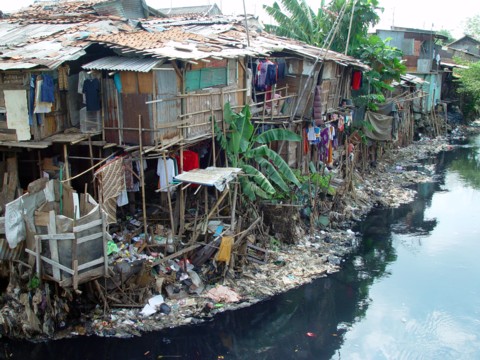
Featured image: Slums built on swamp land near a garbage dump in East Cipinang, Jakarta Indonesia. Jonathan McIntosh (2004).

Other images: Share of Labour Compensation in GDP at Current National Prices for United States. FED. Public Domain