
China and India are very different countries. Only five decades ago, both were equally poor. In the 1970s, India’s GDP per capita was slightly higher than China’s. Both countries were socialist at the time. In population, the two countries are roughly equal. Today, China’s GDP per capita is five times India’s. How to explain this massive divergence? First of all, China’s market-oriented economic reforms started in 1978, while India liberalised in 1991. In the 1980s, China’s economy grew by 10% annually compared to India’s 6%. At the same time, China’s population grew by 1.5% annually compared to India’s 2.3%, so GDP per capita increased by 5% per year more in China, resulting in an 89% increase over those 13 years. And so, China’s earlier start doesn’t explain the massive difference. China’s development has been government-directed, much like Japan’s, while India liberalised in 1991, with the government intervening little, so its development path looks more like that of the United States. There is more individual liberty in India than in China.
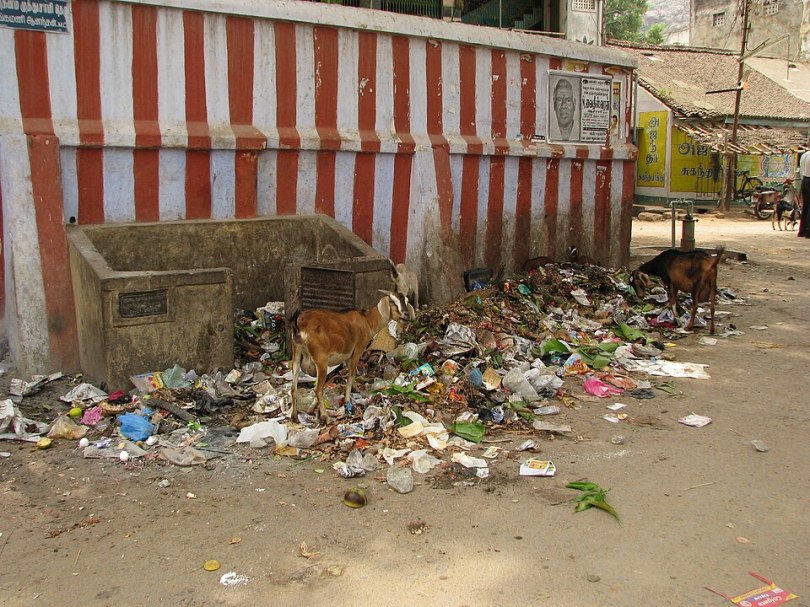
Government policies are essential. Compared to India, China is very organised. If you are a distant observer, you might get the impression that India is messy, with garbage on the streets, and that China is orderly and that the streets are clean. As I have never been to those countries, my impressions come from reading and seeing. India is the largest democracy, or perhaps was, as democracy is in decline worldwide, and that is an enormous achievement, given its ethnic and religious diversity. Mahatma Gandhi came from India, and he is one of the greatest humans in recent history. The Indians had to forge a national identity on the British colonial legacy. The Chinese had it easy, as they already had a strong national identity with a 2,000-year history. That is no small advantage, as European countries also had to forge national identities to industrialise because industrialisation requires markets of scale.
In recent years, India’s economic growth rate outpaces China’s, partly due to population growth, so it is still a long way from overtaking China in GDP per capita. The point of the text is not to praise China for beating the West in the rat race to humanity’s destruction, for that is where it all leads to, but to highlight why India lags China so much. As a picture can say more than a thousand words, so can a description of a situation, such as the editorial ‘Why China Works and India Does Not’ by Jayant Bhandari, which appeared on Lewrockwell.com in 2026,1 which tells us much more than statistics ever will. He writes,
When trying to understand the future of a country, one should not be particularly interested in its elites or exceptionally successful people. They are outliers. […] The essence of a society is better understood in its small towns, isolated communities, workshops, farms, churches, diners, and ordinary households—in the behaviour of people whose names will never appear in a newspaper.
Now, here comes his complaint,
Suppose a piece of equipment malfunctions, and you take it to a technician in India. He will probably tell you to return a few days later. When you do, you can be reasonably certain that it will not have been repaired.
You return a few days later, and then perhaps again and again. On your third, fourth, or fifth visit, the technician may finally hand the equipment back, supposedly repaired. Somewhere during your visits, to escape your pestering, he might have claimed that the work took longer because there were more problems than anticipated, even though you can see that your equipment wasn’t even touched given the dust that had accumulated on it. You will not only have visited repeatedly; you may also be asked to pay more.
When you test the equipment, however, you discover either that the original problem has not been fully corrected or that the repair has created entirely new problems. While you are trying to explain yourself, he is constantly distracted, dealing with several other irate customers like you and confusing your problem with theirs. Everyone grows increasingly impatient, louder, and more exasperated.
You point out what is wrong. To an objective observer, the defect is obvious. Yet the technician may flatly refuse to recognise it—or seemingly fail to understand what you are talking about. He might even suggest that you take the equipment home, let things settle down, and see whether the problem somehow sorts itself out. If you discover the problems after you have taken it away, the technician will pass all the blame to you, calling it newly created.
It is not an exception, he argues, but commonplace in India,
So common is this experience in India that one struggles to think of exceptions. Anyone who has spent enough time there will have his own collection of similar stories. Nor is it merely about technicians. Their customers belong to the same society and are the other side of the same coin. The pattern appears in dealings with government offices, private companies, professionals, contractors, and even friends and family. Life becomes a constant stream of firefighting and brain damage: following up, reminding people, correcting what was supposedly corrected, and keeping track of the never-ending accumulation of unfinished work.
Meanwhile in China, things are very different indeed,
For the last five years, I have owned a cellphone from a Chinese manufacturer. I have taken it several times to the company’s service centres in China for repairs.
The experiences have been almost absurdly inexpensive, and every technician I have dealt with has been thoroughly competent and adroit with his hands. On one occasion, the battery was replaced without charge because the company regarded the problem as a possible manufacturing defect—this despite my telling them that the phone had once fallen into a swimming pool. Broken glass was repaired without charge even when the phone was well outside warranty, and screen protectors have routinely been replaced for free.
Whenever I was told to return in an hour or two, the work was done when I returned, usually better than I had expected. During my most recent visit, however, something went wrong. The repair had created several new problems, probably because something had been connected incorrectly during reassembly.
Of course, mistakes happen. Chinese technicians are not infallible. Chinese bureaucrats can be incompetent. Chinese institutions can malfunction. That is not the distinction I am making. The distinction became apparent when I showed the technician what had gone wrong. […]
She looked at the phone and immediately acknowledged the problems. She did not deny even those that were minor or difficult to demonstrate. She did not pretend that I was imagining them or treat me as an irritating customer who needed to be made to disappear. She accepted reality and took ownership. Her supervisor became involved to understand what had gone wrong. He took over the repair, completely disassembled the phone, and rebuilt it.
Why is this so important? The author argues,
Such incidents may look small, but they are not. They reveal the moral habits on which complex societies depend: ownership of error, pride in workmanship, responsiveness to the customer, and the willingness to correct a problem rather than hide it. These are not merely technical skills. They are civilisational emotions in action.
A complex society depends on millions of people whose work continually intersects with that of others and cannot be individually supervised. Tiny compromises may be invisible and impossible to trace back to the person who made them, but they accumulate and compound. So do tiny acts of conscientiousness. Over time, they determine whether a society works.
He mentions a few other examples, like a Chinese private hospital treating him for a small injury without charging him, and a government-run hospital being prompt on the job and charging a low fee, while at Indian private hospitals trying to scam you, and public hospitals offering no service without bribes. It is due to cultural differences. It is not that there are no scammers in China, nor that there are hard-working people in India, but overall, there is a significant difference. He continues,
The difference is not that China has no bad hospitals or incompetent doctors. It is that, in my experience, the ordinary institutional instinct is far more often directed toward solving the problem placed in front of it. In China today, my experience is increasingly that someone takes ownership of the problem. Often, someone approaches you almost as soon as you enter, finds out what you need, identifies who is responsible, directs you to that person, and tries to move you through the system.
In an Indian government office, the first seemingly impossible task is to discover who is responsible. Then you must discover where he is. He is unlikely to be at his desk. When you eventually find him, you must deal with his arrogance, his god complex, and his need to make you genuflect, beg, and prostrate yourself before him. He sends you somewhere else; that person sends you to another, and you go around in circles.
Eventually, you zero in on someone who might be responsible, his ego now inflated by the realisation that he vaguely holds the power. In India, nobody is ever fully responsible, so one must proceed carefully.
Then the dance around the bribe begins. Paying is not enough; you must strategise. You cannot tell the bureaucrat that you distrust him, even though he knows perfectly well that you should. Trust him too much, and he will take you for a fool. Everything must be wrapped in euphemism and pretence.
Pay the wrong person, and you lose the money. Even paying the right person creates no obligation to complete the work. You must work out who actually has power and what combination of money, deference, persistence, and connections might make the machinery move.
Over time, the scale and shamelessness of bribery in India have increased. In the past, euphemisms were still necessary—the gift for his children, for example. Today, bureaucrats speak openly about their collections. The amount collected can itself become a mark of status, even enhancing one’s value in the marriage market.
I cannot remember dealing with an Indian bureaucracy without paying a bribe. Nor is there any recourse: go higher up, and you encounter a more expensive level of the same system. Those unaccustomed to corruption often fail to appreciate its corrosiveness. It does not merely add another cost to government; it destroys the purpose of whatever institution, law, or scheme it infects.
Well, indeed, if your operation is a scam, then it is not what it pretends to be, such as a hospital or a repair service. Yet, China scores low on the Corruption Perceptions Index, even though it does somewhat better than India. There must be widespread corruption in China as well, mostly in government. One explanation I came across is that Chinese corruption is aimed at getting things done. So if you pay, you get something in return, like a building permit. In India, as the author observes, even paying the right person does not create an obligation to complete the work. In any case, if you are in India, you should expect that people will try to scam you. Corruption is not the core issue here. It’s doing your job, being truthful, and keeping agreements, rather than trying to get away with doing nothing, breaking agreements, and shifting the blame when things go wrong.
China and India were equally poor a few decades ago, and to come this far, the Chinese changed their values and work ethic, so the condition in India may well be a transitional phase. It is only that the Chinese government plays a greater role in directing the modernisation process, and puts a greater effort into education and standards. A good society functions on social trust, which requires moral integrity that a mere liberalisation of markets cannot bring. Competition may improve service, so if some businesses do a better job, they will get more customers at the expense of the scammers. Yet competition drives the rat race to our destruction, so if moral integrity can’t do the trick, we are doomed. If we take no pride in contributing something good, society will not flourish. Culture makes an enormous difference. Moral integrity is hard to measure, but it makes societies work. Cultures change, so India is not lost, nor is any other country.
1. Why China Works and India Does Not. Jayant Bhandari (2026). LewRockwell. [link]

