
Final answer
Why do we fight wars? We can settle for the simple answer that it is in our nature to do so, and then you can go on with your life. As we near the end of days, that life could be short, so it might be better to delve deeper into the matter to resolve the question once and for all, or to arrive at a more profound analysis of the causes of humanity’s termination before it occurs. By then, it might be too late to make such an analysis to make a meaningful difference. There have been many wars, but for the sake of argument, let’s take the war in Ukraine as a case study. One reason to do that is that it is one of the most recent wars, so we had the opportunity to learn the most from history. And the war was unnecessary, as relations between Russia and Ukraine had been friendly until 2014. So, if we, with all the knowledge of history, can’t prevent unnecessary wars, then what hope is there for us?
For the analysis, we could set aside propaganda and establish the facts to understand better why it happened. But then you have to discern between the main issue and the side issues. So, let’s start with the essence. Exactly 7 years, 7 months, and 7 days after Russia-supported Ukrainian separatists shot down Malaysia Airlines Flight 17 (MH17) in Ukrainian airspace, Vladimir Putin ordered Russian troops to invade Ukraine in a so-called special military operation known as the Ukraine War. The Flight 17 plane, which took off from Amsterdam and was mostly loaded up with Dutch people, first flew on 17 July 1997, exactly 17 years before the shootdown. That was precisely one year after the crash of Trans World Airlines Flight 800 on 17 July 1996, which crashed 777 days before Swissair Flight 111. Hence, the war was destined to start on 24 February 2022. We could stop here, but that would also be quite unsatisfactory and bad journalism.
In early 2021, Russia began a military buildup along Ukraine’s borders, while Putin demanded security guarantees and the prevention of Ukraine joining NATO. Putin being an evil dictator appears the primary cause of the war at first glance, but a closer look reveals a more nuanced picture. We have emotional problems with applying logic. Our minds work like so: he is an evil dictator, so he must be wrong. That is not always the case. Adolf Hitler had a genuine case for tearing up the Versailles Peace Treaty and occupying the Rhineland. Many other things he did were less reasonable, but we know all about that. After World War II, the Allies realised that without the unreasonable Treaty of Versailles, the war probably wouldn’t have happened. Leaders make mistakes. Western leaders ignored Russian interests by expanding NATO into former Soviet territory and promising NATO membership to Ukraine after promising Russia not to do so.
Yet, making peace is not so easy. Giving in to Putin’s demands could embolden him to invade other countries. He is an evil dictator after all. So, when Donald Trump was desperately seeking the Nobel Peace Prize to make a name for himself and, like a veritable peace dove, was prepared to give Putin what he claimed to desire, Putin proved unwilling to come to the negotiating table. Blaming the West or Russia is not going to prevent the next war. Other conflicts could escalate into war, such as those between India and Pakistan, Israel and Iran, and Thailand and Cambodia. There are always causes to fight for, and men who wish to make names for themselves. Vladimir Putin wants to go into history as the one who made Russia great again. These kinds of ambitions are killing us.
The conflict in Ukraine comes with a history, as do many others. And new conflicts can pop up at any time. Who would have thought that the United States would be willing to invade Greenland to acquire security guarantees it already had? The motives of the warring parties make sense from their perspective. Putin’s case for invading Ukraine in 2022 had more merit than the US’s case to invade Iraq in 2003. Had the Soviet Union, a state founded on a myth of a brotherhood of peoples that brutally repressed nationalism, still existed, the war would not have happened. Had there been no nationalism, Europe wouldn’t have fought two world wars. There is no hope for world peace if it is up to us humans. Barring a miracle, warfare will go on until humans are extinct. Accepting failure and stopping breeding are a more elegant way to achieve the final solution to the human problem.
Historical background
The history of Russia and Ukraine is closely linked. Between 800 and 1240 AD, the Ukrainian capital, Kyiv, was the centre of Kyivan Rus, a state founded by Viking traders seeking a land route to the Mediterranean. It encompassed western Russia, Belarus, and much of Ukraine. The Rus were Scandinavian Vikings, so Russia received its name from that people. By 1240, the Mongols overran the area. When Mongol power waned by 1400, a new Russian state emerged around Moscow. By then, Ukraine had become part of Poland while Turkey took over Crimea and the surrounding territories. As a result, Ukraine separated from Russia and developed its own culture and language. Polish and Turkish power declined from the 17th century onwards, and Russia filled that void. By 1800, Russia had become a large empire controlling most of Ukraine.
During World War I, the Russian Empire collapsed, and a civil war followed the Bolshevik Revolution of 1917. By 1922, the communists had won and conquered most of Ukraine. In the late 1920s, the Soviets forcefully collectivised farms. Farmers lost their land and ended up in prison labour camps. Agricultural output dropped, leading to a famine and the deaths of three to five million people, mostly in Ukraine. In 1939, Hitler and Stalin made a pact. They divided Poland, and the Soviet Union acquired Estonia, Latvia, Lithuania, and Western Ukraine. After Germany had invaded the Soviet Union in 1941, some 250,000 Ukrainians helped the Germans, and Ukrainian fascists murdered 100,000 Poles in an ethnic cleansing campaign. At the same time, 6,000,000 Ukrainians fought in the Red Army. After the Soviet Union collapsed in 1991, Ukraine became independent. Yet, Crimea remained home to the Russian Black Sea fleet.
When the Soviet Union retreated from Eastern Europe, NATO leaders promised Mikhail Gorbachev that NATO would not expand into its former sphere of influence.1 Yet, Eastern European countries were eager to join NATO. Once liberated from Soviet oppression, they sought security guarantees against Russia, which joining NATO could provide. Several policymakers in the West believed that would be a historic mistake. Russia could see it as a violation of promises made.2 NATO expansion proceeded nonetheless. The collapse of the Soviet Union had broken the Russian spirit and national pride. Russia had been an empire, and the Soviet Union a world power. It was all in shambles, while many Russians had become destitute due to the liberal economic reforms imposed by the West.
Vladimir Putin was employed by the Soviet secret service, the KGB, for sixteen years. After leaving the service in 1991, he worked as the deputy mayor of Saint Petersburg. In this capacity, he oversaw the disappearance of precious metals and food, leading to allegations of corruption.3 Later, Putin joined President Boris Yeltsin’s staff. In 1998, Yeltsin appointed him director of the FSB, the successor to the KGB. On 9 August 1999, he became Prime Minister. One month later, on 9 September (so 9/9/99), a series of terrorist attacks started inside Russia, killing 307 and wounding over 1,700 in a week, which the FSB attributed to Chechen militants. Yet, it was the FSB itself that perpetrated them. State Duma speaker Gennadiy Seleznyov announced that another bombing had occurred in Volgodonsk, while that bombing had yet to happen, proving it was a government operation. In Ryazan, the police apprehended FSB agents planting bombs.
Putin had been the FSB’s head until a month before these attacks, which undoubtedly took time to prepare. No evidence exists that Putin ordered these attacks, but he is definitely the kind of guy for it, and his KGB training has taught him not to leave behind any evidence. The conductors of an independent investigation either died mysteriously or ended up in prison. Putin vowed to go after the Chechen terrorists, which made him popular with the Russian people. Had the Russians found out that Putin himself had ordered these attacks, they might have supported him even more. Stalin is one of Russia’s most popular guys, with a 70% approval rate, so Russians love to be murdered by their leaders. The terrorist attacks became a pretext for a long and bloody war in Chechnya.
A few months later, Yeltsin stepped down and appointed Putin his successor. Putin pledged to restore Russia’s prestige and sphere of influence. He eliminated the oligarchs who opposed him and stripped them of their possessions. His opponents, including those who lived abroad, suffered from shortened lifespans, attributable to causes such as falling out of windows or exposure to nerve gases. The remaining oligarchs had to learn to pay taxes to survive, which improved state finances.
Vladimir Putin sees the former Soviet territories as a primary interest for Russia and seeks influence or dominance in the region. In 2005, despite corruption, voter intimidation, election fraud and the poisoning of the pro-Western candidate Viktor Yushchenko, Ukraine held free elections due to a popular uprising, much to the dismay of Putin, who had hoped to retain his influence in the country with the help of his favourite, Viktor Yanukovych. Most other Soviet republics remained within Russia’s sphere of influence, except Georgia, which aspired to membership in the EU and NATO. Russia then invaded Georgia in 2008.
Prelude
Since its independence from the Soviet Union in 1991, Ukraine had a multi-party system with numerous corrupt political parties in which oligarchs play a central role. Ukraine is one of Europe’s most corrupt countries, which Russia’s propaganda outlets are keen to point out. Only Russia is even more corrupt. We learn little about it, because Russia has no free press anymore, and those who have investigated it, if they didn’t end up in prison, died prematurely, with the most famous fatality being Alexei Navalny, who had documented the massive corruption of Putin and his cronies, which included a massive 17,700-square-metre palace to store Putin. Following a 2020 nerve agent poisoning by the FSB, which he miraculously survived, Navalny ended up in an Arctic penal colony in February 2024, where he died under suspicious circumstances.
Ukraine became almost evenly split into two political blocs. One sought cooperation with the West, while the other aimed for closer ties with Russia. People in the West and the centre of Ukraine favoured the Western-oriented bloc, while people in the East and the South favoured the Russia-oriented bloc. It coincided with the languages spoken. People in the East mostly spoke Russian, and people in the West mostly spoke Ukrainian. Whether or not the Russian speakers were actually Russians is a matter of debate, but it highlights why the emergence of a conflict was only a matter of time.
Those living in eastern Ukraine spoke Russian, felt connected to Russia, and desired friendly relations with Russia. Those living in the West thought they were Ukrainian, felt unrelated to Russia, and hoped to become part of the West and be free from Russian influence. It was a recipe for trouble, which the imperial powers, the United States and Russia, sought to exploit. Samuel Huntington called Ukraine a cleft country as these blocs identify with separate civilisations. Ukraine had plans to join NATO. In 2008, Putin warned Moscow would view that plan as a direct threat to Russia’s security.4
After fair elections, Putin’s favourite, Viktor Yanukovych, became president in 2010. By 2013, there was strong support for an economic treaty with the European Union (EU) in Parliament. After lengthy negotiations, a deal was in the making. Then, Yanukovych decided not to sign a political association and free trade agreement with the EU and instead to seek closer ties with Russia. Russia was Ukraine’s largest trading partner, and Putin had offered loans on favourable conditions while threatening to harm the interests of the Ukrainian oligarchs and politicians if they rejected his proposal.5
Protests erupted, calling for the resignation of the president and the government. The demonstrations were initially peaceful, but President Yanukovych responded with a police crackdown that included the use of snipers. The protesters held out for months and fought back with chains, sticks, stones, petrol bombs, a bulldozer and firearms. At some point, the police could no longer defend themselves from protesters’ attacks. In the end, 108 civilians and 13 police officers had died. The Euromaidan protests led to the ousting of the government, and President Yanukovych fled. Most Ukrainians didn’t want to sever ties with Russia at that point, as Ukraine relied on cheap Russian gas.5 After the Maidan Revolution, pro-Russian protests and uprisings erupted in Crimea, the Donbas and Odesa with Russian support.
Pro-democratic groups had started the Maidan Revolution. Most participants were ordinary citizens. However, the violence of the well-organised fascists, which included the use of snipers, likely decided the outcome. The Ukrainian fascist movement has a history which traces back to the partisan movement from the 1940s. After the Maidan Revolution, fascists patrolled the streets of Kyiv. They also provided fighters for the war against Russia-backed separatists. Among them was the Azov regiment, a group of 900 fighters with Nazi sympathies.6 Their bravery on the battlefield at a time when the regular army struggled to defend Ukrainian territory made them more respected in Ukraine.
Russia claimed that the Maidan Revolution was a Western-sponsored coup to overthrow a legitimate government. Yanukovych had become President after fair elections. Between 1991 and 2014, the US spent $5 billion to support civil society and NGOs aimed at strengthening democracy, anti-corruption efforts, and economic development. These groups had played a central role in starting the protests.7 Had the fascists not come to their aid, the police might have been able to subdue the demonstrations with force.
Putin sees foreign aid money as interference and a threat to Russia. After pro-democratic protests in Russia, he made Russian NGOs receiving money from abroad subject to a foreign agent law and closed their operations. Since the Orange Revolution in 2004, Putin also began investing in increasing Russian influence abroad. It included interference with the 2016 US elections with misinformation.8 After the Maidan Revolution, the Obama administration had chosen not to antagonise Russia by sending more arms to Ukraine. The previous Bush administration had provided Georgia with money and weapons in an attempt to build a bridgehead in the southern Caucasus region, provoking Russia to invade Georgia in 2008.7
Ukraine War
Ukraine was drifting away from Russia and aligning itself with the West. Most Ukrainians didn’t wish to live under Putin’s rule, but they also hoped for a good relationship with neighbouring Russia. That is why they elected Volodymyr Zelensky. A Ukrainian NATO membership would endanger that. Putin believed Ukraine was of crucial interest to Russia. Losing Ukraine would be a damaging geopolitical loss for Putin. The Russian invasion of Crimea and the Donbas insurgency had soured Russian-Ukrainian relations. There had been a truce, but there was regular shelling of civilian areas.9 The Donbas attracted Ukrainian fascist fighters seeking combat experience. Russia-backed separatists have reported terrorist attacks with a total of 1,000 fatalities between 2015 and 2021.10
Zelensky had won the 2019 elections by promising to seek peace with Russia. The fascists blocked these plans by threatening to use violence and murder Zelensky.11 A return of Ukraine to the Russian sphere of influence was not to be expected. The truce with Russia was nothing more than a truce, as neither party had any genuine desire for peace. Ukraine intended to regain its lost territories while Putin hoped to bring Ukraine under Russian influence. Ukraine was building its military and seeking NATO membership. Although NATO considers itself a defensive alliance, it is part of the Western sphere of influence. Putin sees NATO as a coalition against Russia that threatens Russia’s security.
When Russia invaded Ukraine, few pundits expected the Ukrainian army to hold out for more than a few weeks. In the early days of the war, Zelensky rejected an evacuation offer from the United States, saying he needed ammunition, not a ride. Street fighting in Kyiv was about to commence. Zelensky, who had previously been an actor, unified the nation and secured weapons and other support from his Western allies. He had previously played the Ukrainian President in a comedy. So, has fiction become a reality? Or is reality fiction? We know the answer now, so these are rhetorical questions.
During the first months of the war, there were peace talks. Both Ukrainian President Zelensky and Russian President Putin seemed willing to make concessions. Western powers blocked a peace deal, fearing the agreement would reward the aggressor state, Russia. Western powers also hoped to weaken Russia.12 The discovery of the Bucha massacre in early April, in which Russian troops had murdered over 400 civilians, was another reason the peace talks failed.13 Since then, the war dragged on, while Ukraine depended on Western support to keep its army in the field. It was a stalemate, with Russia making a few territorial gains at the expense of massive losses in military personnel, yet the nature of warfare changed completely, with drones and artificial intelligence taking centre stage.
In 2025, Donald Trump became President of the United States. He initially held a favourable view of the Russian position and went so far as to parrot Russian propaganda narratives. He took upon himself the role of a peace dove, while claiming he had ended 8 wars already, and attempted to broker a peace deal with Russia by pressuring Ukraine to accept the loss of territory and give up NATO membership. The sudden change in American policy left America’s European allies in disarray, prompting them to increase their support for Ukraine. Trump soon found out that what his European allies told him was all true, and that the man in the Kremlin wasn’t at all interested in peace, so Trump then focused on making Europe pay for the war.
Clash of civilisations
Geopolitical actors abide by the logic of gang warfare, which is a particularly cynical one, but also natural to humans. Since the end of the Cold War, US policymakers have generally held two views: the Neoconservative view, driven by a desire to spread Western values by force, and realpolitik. In his book The Clash of Civilisations, Huntington argues that it is arrogant and dangerous to assume Western culture is superior. He urged the West to respect other civilisations and their leading nations, and to allow them spheres of influence that coincide with cultural and civilisational borders. It implies that Ukraine should align with Russia. Realpolitik could mean throwing Ukraine under the bus to prevent war.
After the collapse of the Soviet Union, the Neoconservative view won out, as the United States found itself the hegemon in a unipolar world. It emboldened the Neoconservatives’ aggressive attitude and pursuit of global dominance. US planners aimed to prevent the emergence of a rival power anywhere in the world. They hoped to establish a global order, the New World Order, which George H.W. Bush described in his speeches as peaceful cooperation among nations. This arrangement would allow other countries to pursue their legitimate interests while deterring them from seeking a larger regional or global role or from challenging US leadership.11
A single world order can bring peace or at least reduce warfare. The Romans pacified the Mediterranean, thereby creating the world-famous Pax Romana everyone is talking about on social media (just kidding, as no one is discussing it). The Americans sought to copy that idea and create a Pax Americana. From behind the desks of the geopolitical planners, it may have seemed a marvellous idea with the bonus of an excellent business opportunity for the military-industrial complex. It brought the Iraq War, with hundreds of thousands of fatalities. It is the prerogative of the hegemon to ignore the subjected people. The Romans never considered how the Gauls felt about Roman occupation. The resentment about the West’s colonial past and military interventions is understandable, but the end of Western dominance will not end warfare. Nothing will, except a single world order.
The clash-of-civilisations view doesn’t provide a workable alternative. Ukraine and Russia are Christian Orthodox and Slavic, but most Ukrainians now choose the West. It also applies to Taiwan and some other countries that share China’s Confucianist heritage, such as Japan and South Korea. Huntington predicted that these countries would seek leadership from the leading nations of their respective civilisations, Russia and China. The world has grown closely integrated. Separating along civilisational lines makes little sense anymore. Yet, China’s growing military power makes Neoconservative thinking increasingly risky. China seeks sovereignty over Taiwan and the South China Sea, using force to back up its claims, and China’s navy is now the largest. If China’s neighbours feel threatened and seek an alliance with the United States, that could be another path to World War III.
Gang warfare
Geopolitical actors act as gangs, defending and expanding their turf. It is insightful to paint the picture of the Ukraine war as gang warfare, so Putin’s mafia state attacking a state backed by the US mobster state run by neoconservative gangsters and the military-industrial complex, which, amongst others, invaded Iraq to loot its oil. And by the way, fascist thugs in Ukraine, the so-called Nazis, whom Putin was harping about while having Nazi mercenaries from the Wagner Group fighting on the Russian side, have prevented a peace deal with Russia. Meanwhile, Ukraine alleges that China is supporting the Russian war effort, while China claims it can’t accept Russia losing the war.15 The major powers are all making their cynical calculations. The major powers are all making their cynical calculations and risking everything. That the nukes have not already been flying may be such a miracle that it proves we live inside a simulation.
Humans operate in gangs. It is our nature. We are gangsters. And so, the gang is our default political organisation. This type of establishment dominated most of human history and still exists today in the form of warlords, militia, drug cartels, and street gangs. States have proven to be effective in repressing gangs and violence within their borders. But once order breaks down, gangs will pop up everywhere and take over.16 Gang leaders see themselves as public benefactors, on par with eminent statesmen, or as wealth-creating entrepreneurs suffering from brutal government repression. Or to quote Al Capone,
I have spent the best years of my life giving people the lighter pleasures, helping them to have a good time, and all I get is abuse, the existence of a hunted man.
In a unipolar world, where one power dominates, most countries fear and respect the hegemonic power. A hegemonic power can provide order, much like a police officer, or it can be a big bully. The United States was the hegemon between 1990 and 2020. Other countries didn’t challenge that position. It allowed the United States elites to develop delusions of grandeur and invade Iraq because of a belief in the superiority of Western culture and values based on the Hegelian dialectic. The Neoconservative planners assumed Iraq would miraculously turn into a liberal democracy after the invasion.17 Probably, the business case for the oil industry also seemed profitable to Dick Cheney. We are gangsters after all, even when we have the best interests of humankind in mind.
In a world with two major powers, a stable situation can emerge. During the Cold War, there was mutual assured destruction (MAD) in case of a nuclear war. Still, the United States and the Soviet Union were on the brink of nuclear war during the 1962 Cuban Missile Crisis and again in 1983, when Ronald Reagan’s aggressive rhetoric made the Soviet leadership believe the US would attack. They put their nuclear forces on high alert. On both the Soviet and US sides, warning systems for incoming enemy missiles malfunctioned and sounded the alarm. The soldiers watching the alarms detected red flags, suggesting these alarms were false. And so, we were lucky to come out of the Cold War alive. In a multipolar world, alliances shift, and a stable situation is less likely to emerge. That is what we are heading to, and Russia and China are aiming for.18
On the eve of World War I, Europe was a multipolar continent with five major powers in shifting alliances. The future of the multinational Austrian-Hungarian Empire was in peril as the nationalism of the different peoples living in it gradually undermined it. After a Serbian nationalist assassinated Archduke Franz Ferdinand, the leadership of the Austrian-Hungarian Empire believed it had to eliminate the Serbian threat. Russia felt it had to support its ally Serbia to prevent it from being overrun by the Austrian-Hungarian Empire. Germany felt threatened because its foes, France and Russia, surrounded it. Germany saw no option but to back its only ally, the Austrian-Hungarian Empire. France and Great Britain backed Russia because it was their ally, and Germany their foe. And so, an assassination plunged Europe into a war that killed over ten million people. We are drifting toward a multipolar world with several powers, and hence a politically unstable one.
Conspiring for world peace
Before World War I, the socialist movements had declared their opposition to war, which, according to them, meant workers murdering each other to enrich their capitalist masters. Once the war had started, most socialists and trade unions backed their government and supported their country’s war effort. The workers would have been better off if they had united and refused to fight. So, why did they go to war nonetheless? You and the other are better off without a war. But you don’t know what the other will do. If you don’t fight, the other might kill you. Workers in France were uncertain about the actions of their German counterparts. If the latter had joined the army, but not the French, then Germany would have overrun France. Furthermore, nationalist stories about pride and heritage proved more inspiring than the rational appeal to the self-interest of the international proletariat.
After World War II, Western elites conspired to prevent future warfare by promoting cooperation among nations through international institutions, such as the United Nations, the World Bank, and the IMF. Nationalists and socialists distrusted the capitalist and internationalist Western elites, who were the primary beneficiaries. Still, a single world order is a requirement for permanent world peace. Nowadays, Western power is in decline. A peaceful world order doesn’t appear to emerge anytime soon, not from peasants and workers of all nations joining hands, nor from the secretive scheming of the elites. Humans are incapable of bringing permanent peace on their own. Perhaps the survivors of World War III will come to their senses, but not for long. It is not in our nature. Memories die after a few generations, and there will always be new just causes to fight for, and there will be men who wish to make a name for themselves.
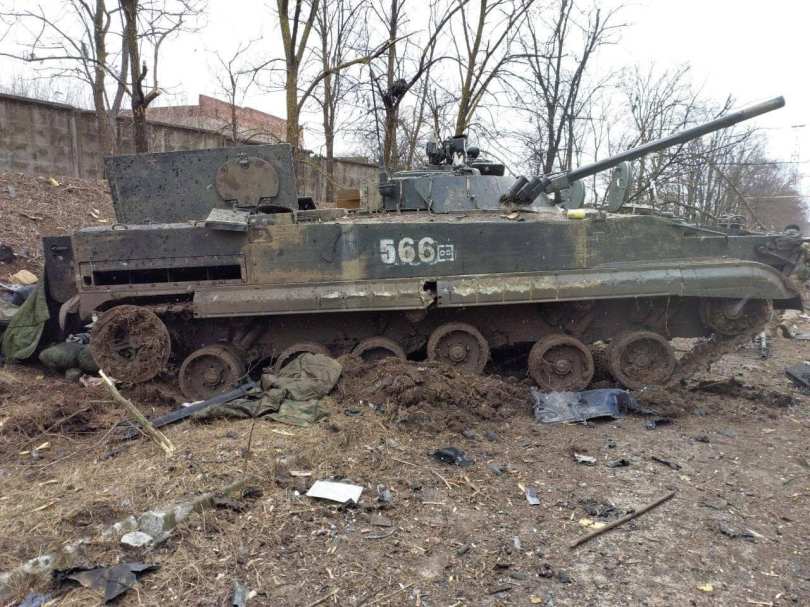
Featured image: Destroyed Russian tank near Mariupol. Ministry of Internal Affairs of Ukraine. Wikimedia Commons.
Latest revision: 18 September 2026
1. NATO Expansion: What Gorbachev Heard: Declassified documents show security assurances against NATO expansion to Soviet leaders from Baker, Bush, Genscher, Kohl, Gates, Mitterrand, Thatcher, Hurd, Major, and Woerner. George Washington University (2017). [link]
2. NATO expansion: a policy error of historic importance. Michael MccGWire. Review of International Studies (1998). [link]
3. Putin’s Career Rooted in Russia’s KGB. David Hoffman (2000). Washington Post. [link]
4. Putin warns Nato over expansion. The Guardian (2008).
5. A US-Backed, Far Right–Led Revolution in Ukraine Helped Bring Us to the Brink of War. Jacobin (2022). [link]
6. Profile: Who are Ukraine’s far-right Azov regiment? AlJazeera (2022). [link]
7. Did Uncle Sam buy off the Maidan? Marc Young (2015). Die Zeit. [link]
8. Fact Sheet: What We Know about Russia’s Interference Operations. German Marshall Fund of the United States.
9. UN report on 2014-16 killings in Ukraine highlights ‘rampant impunity’. United Nations (2016). [link]
10. Ukraine-Russia Crisis: Terrorism Briefing. The Institute for Economics & Peace (2022).
11. Why Zelensky won’t be able to negotiate peace himself. Ted Snider (2024). Responsible Statecraft.
12. ‘We want to see Russia weakened’: Defence Secretary Lloyd Austin says he wants Putin’s forces depleted so he cannot repeat what he has done in Ukraine during his Kyiv trip. Daily Mail (2022). [link]
13. The Grinding War in Ukraine Could Have Ended a Long Time Ago. Branko Marcetic. Jacobin (2023). [link]
14. Defence Planning Guidance (1992). George Washington University. [link]
15. China tells EU it can’t accept Russia losing its war against Ukraine, official says. Nick Paton Walsh. CNN (2025) [link]
16. The Origins of Political Order: From Prehuman Times to the French Revolution. Francis Fukuyama (2011). [link]
17. What the Neocons Got Wrong. Max Boot. Foreign Affairs (2023). [link]
18. China-Russia ties strengthen, accelerate multipolar world. Andrew Korybko (2025). GlobalTimes.cn. [link]

