Core beliefs
Marx sees human history in terms of class struggle. Hegel had an idealist concept of a struggle of ideas driving history. The Marxist view of history holds that change arises from the material interests of classes, particularly those of the ruling and working classes. Individuals can play key roles at certain moments in history, but change depends on economic and class factors. There is an unavoidable historical progress from primitive to advanced, so from primitive societies, to feudalism, to bourgeois capitalism, which would finally end in workers owning the means of production, so socialism.
The second core Marxist idea is the law of value under capitalism. Capitalism is a system of production for the profit of the owners of the means of production, who exploit those who own nothing but their ability to work. Labour creates all the things and services that we use and need, but the value of that labour is appropriated by the owners of the means of production as ‘surplus value’ over and above what labour receives for its work. That surplus value is accumulated as capital, which adds value to labour. A worker with the proper equipment can produce far more widgets than one without.
Marx’s theories have little standing in economics, but that is not the strength of Marxism. It lies in recognising that the organisation of societies depends on economic factors, with competition as the hidden driving force. We work in corporations because that gives a competitive advantage, which affects the organisation of societies. The simple fact that we have time zones with standardised times is a result of the Industrial Revolution and train schedules. And Marx offered keen insights into what is wrong with capitalism, but these were 19th-century views, so translating them into modern equivalents can be illuminating.
Value is subjective
Marx claimed that capitalists’ profits come from appropriating the value that workers create, so stealing it. He based his claim on the labour theory of value, which economists of his time considered valid. The theory says that the price of an item equals the cost of labour required to make it, thus including the labour to produce the raw materials. If making a pair of shoes takes twice as much labour as making a pair of trousers, shoes cost twice as much as trousers. Marx asked himself, ‘If that is correct, how can there be profits?’ It is because the theory is wrong, not because capitalists are appropriating the value that workers create. There is no objective measure of value.
On the market, the price of an item depends on what people are willing to pay for it, not on what it costs to make. Otherwise, you could work a year on building a better mousetrap and sell it for €50,000. Nobody will buy a €50,000 mouse trap. However, after spending another €50,000 on building a brand in a marketing campaign, you might sell that same mousetrap for €200,000. That is because value is subjective. It might seem stupid to buy a €200,000 mousetrap, but if you have too much money and showing off the mousetrap makes you attractive to the ladies, it may be worth it.
Marx drew the incorrect conclusion that labour gives a product value, when it is entrepreneurship that does. Businesspeople organise the production and distribution of goods and services, which includes hiring labour, managing customer and supplier networks, making estimates about future consumer desires, or creating them with marketing campaigns, and doing all of this at a profit, as the operation requires capital. Marx overlooked that part of capitalism. That is why communist countries are poor. They don’t have entrepreneurs. As we near the end of humanity, with the profit motive as the primary cause, leaving it there would be a fatal mistake.
Value is what we believe it is. Nothing is sacred. Everything is for sale, including the rainforests and even the Earth. The so-called owners think it is all theirs and can do with it as they please. In a communist dictatorship, the government tells you what to believe. In the market, a story becomes true if you can sell it. That is why businesses advertise products that are bad for us. As money represents power, we stare into the moral abyss. That is why communists called their newspapers The Truth.
In a world without someone telling us what the truth is, there is no truth, and communism is just another message on the marketplace. The communists appealed to the workers’ self-interest. And that was a poor sell because workers were worse off under communism. It is why communism was doomed to fail, not because it is impossible to live like communists. Early Christians did. Rather than concluding he had just proven the labour value theory wrong, Marx claimed capitalists stole from their employees.
Silvio Gesell made the astute observation that the problem is not entrepreneurs and profits but passive interest income. Plenty of people live off their capital without contributing anything, except perhaps by bringing in capital to produce things we don’t need. Gesell aimed for a society where capital has no privilege, so where there is no passive capital income, but where people can put their talents to good use and are rewarded for taking risks and making the right decisions. And if we terminate the bullshit economy, which includes status products like €200,000 mousetraps, that could create a fairer economy.
Fulfilling work
Marx further said that producing for markets alienates us from what we make. Many workers experience this. It is why Dilbert comics are so successful. Marx claimed we could be free, creative beings, but the modern, technologically developed world dictates our lives. Marx believed that ending the market mechanism and replacing it with democratic planning would liberate us. So if workers received what they owed and we replaced capitalism with democratic planning, we would live in a paradise where we could do the jobs we like and have everything we need.
That is a silly idea. There will be long lines of people who wish to be actresses, but few want to be cleaners. Likewise, communes don’t attract farmers and construction workers, but artists and Reiki healers. We need food and homes, not art and quacks. Work is doing something useful. If it isn’t useful, it isn’t work, but a hobby. Even if everyone contributes, planning will never do as well as markets. You could live with that if you have enough and have no worries. You might want a pear, but you could settle for an apple. And you have heard of oranges but never tasted one.
Capitalism causing misery
Marxists claim that capitalism causes misery as adding capital means doing more with fewer workers, which reduces the need for labour, pushing wages below the subsistence level and leaving workers to starve. In the 19th century, most economists believed wages would remain close to the subsistence level. If wages increased, more people would survive, expanding the labour supply. That would cause wages to decrease, so that more people would starve. The market would keep population levels in check. Marxists argue that making more stuff with fewer people was impossible because the unemployed couldn’t buy it. So, there would be either underconsumption or overproduction.
Marx himself held a slightly different view. Capitalist production occurs only if it is profitable. The drive for more production undermines the profitability of that production, Marx believed. Capitalists compete against each other to gain market share and a larger share of profits appropriated from workers. To gain an advantage, they resort to labour-saving technology to reduce costs and increase labour productivity. Marx argued that profit comes from labour, so investment in machines replacing labour may increase productivity, but at the expense of profitability. It would eventually lead to the halting of production and the layoff of workers. That didn’t happen because of Say’s Law.
Due to higher production efficiency and increased production, items became cheaper, so consumers had money to spend on other items. And humans can create money from thin air. When capitalists produce more, they must sell their merchandise, and, if necessary, they can encourage people to borrow money. And so, the general level of opulence rose. Marx had vastly underestimated human ingenuity in finance, marketing and job creation in the services sector and government, the so-called bullshit jobs in the bullshit economy. These jobs make sense because they solve problems in an increasingly complex society, but didn’t exist before as people lived simpler lives.
Scientific and rational
Marx believed that his theories were scientific and rational. He devised a theory of history using Hegel’s dialectic, arguing that power structures in society reflect economic conditions. To Marx, it was not new ideas challenging the status quo but economic conditions that drove historical change. He would say that the status quo of serfdom in Europe ended because towns challenged it by providing alternative jobs for serfs. Lords had to compete with them for their labour. And so, employer-employee relationships replaced serfdom, which became the new status quo.
Marx also believed nationalism was a temporary phase, imposed by economic conditions. Industrialisation required larger markets, thus societies rather than communities. Nationalism allowed the elites to divide and rule the working class. And because capitalism would eventually bankrupt itself, Marx predicted, as if it were a logical certainty, communism would replace employer-employee relationships, and everyone would become free and equal. In reality, people weren’t free or equal under communism, and a new elite of party bureaucrats replaced the capitalists.
Marx aimed to violently overturn the existing capitalist order through revolution, whereas Hegel believed that the French Revolution and the Napoleonic Wars had been necessary to replace the feudal or aristocratic order with a new order grounded in European Enlightenment ideals. Karl Marx became the prophet of the most successful cult in recent history. In many ways, Marxism became Christianity without God, by claiming there is a plan behind history, that there will be an End Time, a communist revolution, after which we will live in Paradise. Marx raised concerns that are still valid today:
- Instead of saying we will enter the communist paradise as a historical necessity, we may argue that the script is that we are about to enter God’s Paradise, which could be a Hegelian synthesis of the Marxist challenge to the existing bourgeois order.
- Instead of saying capitalists steal value from workers, you can argue that we work to make the rich richer. Despite economic growth in advanced economies, many workers still can hardly get by. And that is not because they are all lazy or stupid.
- Instead of saying the system alienates us from what we produce, you can argue that we are part of a system over which we have no control. We can’t democratically decide on ending the creative destruction of this planet and humanity.
- Instead of saying that capitalism causes misery, it has improved billions of lives, at great cost perhaps. Yet it will end in a disaster due to excessive resource consumption or technological development caused by out-of-control competition.
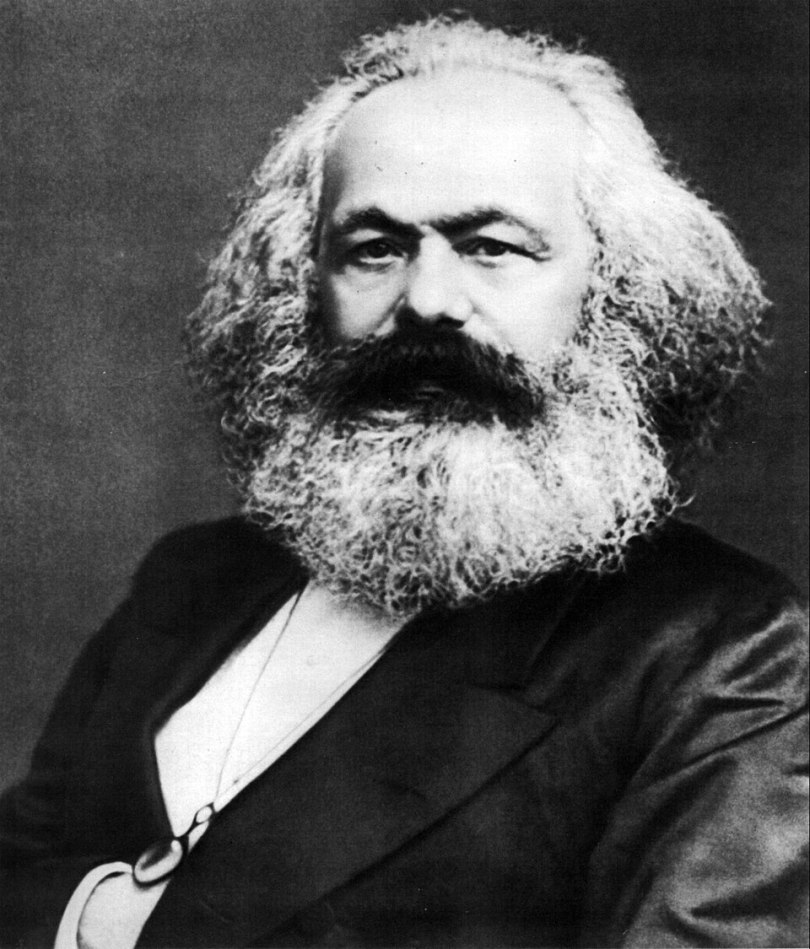
Feature image: A portrait of Karl Marx. Public Domain.