
‘Politics is not worth a lightning bolt to me. Throw it to the sharks,’ sang the Dutch band Normaal in the 1980s. Many people feel disillusioned with the government and politicians. Is there something wrong with politics? Is it the system? Are our expectations too high? Do politicians interfere with matters that should require expert knowledge? Do we not elect the right people? Is the political system not democratic enough? There are no simple answers, but some countries do better than others. Francis Fukuyama wrote two books about political order. Good government is an uphill struggle that never stops.
And democracy often has frustrated the establishment of good government. So, there is reason to think, ‘What is the point of politics?’ Over the centuries, there might have been some progress in political institutions, which are customs, laws, government organisations, and other arrangements. Human nature does not change, so politicians have not evolved to a higher standard. People in the past devised institutions to provide stability and make governments work better. In recent decades, globalisation has made several institutions dysfunctional, most notably, the nation-state.
The basics
So, what is the point of politics? We organise ourselves economically and politically with the use of ideas. Among those ideas are money, states, and religions or ideologies. That made us successful as a species. We have languages to describe situations and the things we can do. And we discuss other people and what they are doing and thinking. That gives us information about other people, for instance, who can do a particular job best and who are reliable and who are not. We use that information to cooperate.1
Politics deals with questions like: what should we do as a group, what must our rules be, and who shall lead us? What we are going to do, is decided by ideas like sowing crops in the spring, doing a rain dance in the summer to please the rain fairy, and harvesting in the autumn. And we may have a priest who leads the rain dance. We do the rain dance we believe in the rain fairy. If rain does not come, we might try to please the fairy by electing another priest. But beliefs can be wrong.
This short tale already tells a lot about politics. There is a belief system. There are rules. And there is authority. Villagers believe the performance of the priest influences the rainfall. Political leaders influence what happens, but in many cases, they must deal with circumstances over which they have little control. Leaders might revert to public display, like ordering more elaborate rain dances to show us they are working on the problem. Things can go wrong because of our beliefs.
The big man
We are social animals, and politics is in our nature. We discuss plans, who should do what, which rules we must follow, and who should lead. Traditional societies also have politicians. For example, the big man leads a family group in Papua New Guinea. He earns his status by gaining the community’s trust, usually by solving conflicts and distributing resources to the members of his tribe. The big man can lose his position, and someone else can take his place.2
The big man is a politician, like the alpha male of a chimpanzee band. Much of politics comes down to solving conflicts in the group and distributing resources and favours. To become the leader, the big man forges a coalition of followers. His followers benefit from his leadership. He can also take actions that benefit the entire community and gain widespread respect. Not much has changed since then. Politicians look after the interests of their followers and can work in the public interest.
The role of institutions
Politicians are like big men in Papua New Guinea or priests of the rain fairy. And they can disappoint us by giving us fewer favours than we expected or not bringing rain. In democracies, we elect our leaders, so why do we not select better ones? Perhaps the problem is not politicians but how we conduct politics and organise societies. The programmatic political parties of Western Europe may have been an apex in the development of politics. They promoted general policies in the interest of their constituency or the public interest. But these parties have lost their lustre.
Today’s world differs from the world where they emerged and flourished. If you were born in a socialist or Roman Catholic family in the Netherlands in 1900, you remained a socialist or a Roman Catholic for the rest of your life. Dutch society was stable, and politicians did not need to compete for attention. The ideologies and religions of these parties have not passed the test of time. They have no answers to the questions of today. Many voters think traditional parties do not represent interests. In the absence of new ideas, politics becomes about identities and personalities.
Institutions can raise politics beyond the level of individuals and their interests, emotions and weaknesses. Traditional societies already have them. The rule of electing a new priest when rain fails to come is an institution. It tells us what we should do when rain doesn’t come. Otherwise, villagers might disagree and start a bloody conflict. The harvest is of the utmost importance. If you do not have faith in the measures taken, you feel obliged to protect yourself and your family from the stupidity of others. Institutions like rain dances can keep the peace but do not guarantee good outcomes.
Political development
The first humans were hunter-gatherers who lived in small bands. They had no property. In times of conflict, they often relocated. Later on, bands coalesced into tribes. Tribes could arrange more men for warfare. A reason to do so was the Agricultural Revolution, causing a switch to crop planting and cattle herding. Crops and livestock that needed defence from thievery and pillaging.
People living in tribes could have a lot of freedom. Tribes were loosely connected, and tribal leaders had limited authority. They might settle disputes, but only if parties agreed on them being the referee. Tribal leaders usually did not give orders. Another political development was the lord with his armed vassals. In Europe, this was called feudalism. Similar arrangements existed elsewhere in the form of warlords and gangs.
The requirements of warfare promoted the development of states. There was intense competition between states in China during the warring states era. Chinese states had armies of up to 500,000 men. They rationalised their organisation and tax systems. As a result, the first modern states appeared in China, and China remained the most advanced state for nearly 2,000 years.
States have the authority to order people. After humans switched to crop planting and cattle herding, there was more food, and more people could live in the same area. And more people could create more sizeable production surpluses to maintain states. States provided more security than tribes as they had police and standing armies, so the inhabitants could benefit from the defence and political stability that states could provide.
The modern state
Modern states have a rationally organised administration with merit-based recruitment and promotion. That happened in China first. Chinese emperors did not have to pass an exam. They inherited the title or came out on top during a power struggle. Emperors had unchecked powers, and there was no guarantee that only good emperors made it to the throne.2 Institutions can protect the country from poor rulers. This problem does not go away if we elect our leaders. That is why democratic states also have institutions, most notably, the separation of powers.
The separation of powers aims to split the state into three independent branches, which are the administration (the executive), the parliaments (the legislative) and the courts (the judiciary). Each has its responsibilities, and the branches should not interfere with each other’s tasks. Parliaments make the laws, the administration executes them, and the courts verify whether they are applied correctly. Ideally, the administration has no power over the parliaments and the courts. For instance, the administration should not nominate or appoint candidates for the parliaments and the courts, and the courts should stay out of political affairs, which is the domain of parliaments.
As political leaders change and can raise controversy, many nations have a ceremonial head of state to provide a sense of stability and continuity in the form of a person. Some countries hold on to their royal families, while others have presidents to perform that role. Usually, ceremonial presidents are highly respected individuals who do not interfere with political affairs. Royals can also provide a stable sense of nationhood, but kingship is a birthright. Kings do not need to have particular qualities, so they may lose the respect of their nation, while a ceremonial president has earned the nation’s respect and, therefore, is less likely to lose it.
Our predicament
Improvements in democratic political systems are possible, but our current predicament is not so much the result of a lack of democracy. Our belief systems are at stake, for instance, nationalism, socialism and liberalism, but also cultures, religions and traditions. And we have made money the prime mover of our decisions. Wealth inequality has increased in recent decades, creating a self-reinforcing trend in which an oligarchy has all the wealth and power. Identity conflicts and pride also block progress.
You can analyse the economy from a socialist or a capitalist perspective. The results are very different, and neither is the analysis entirely wrong or right. The proponents of ideologies and religions tend to have an explanation for everything. Within the confines of their models, their arguments make sense. If you believe in the rain fairy, it makes sense to think she is angry when rainfall does not come. Many of our belief systems are models of reality with merits and drawbacks, and we should treat them like so.
Our political institutions are the result of ideas from the past. They still have merits but grow increasingly problematic. Clinging to obsolete thoughts is like doing rain dances to prevent harvest failures when the cause is climate change. If existing ideas stop working, people become frustrated and lose faith. If crops continue to fail, some villagers may realise that electing a new priest does not solve the problem. They may worship the weather spirit instead and start a violent conflict with followers of the rain fairy.
The issues we now face come primarily from failing ideas and institutions rather than politicians. Existing religions and ideologies have no answers to the issues of today as many are global collective action problems, while centralised complex systems are ineffective in dealing with them. If the collapse is at hand, we may need to find common ground about what we should do and delegate practical decision-making about how to do it to the local level when possible.
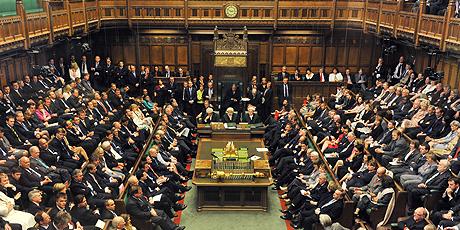
Featured image: House Of Commons in the United Kingdom. Parliament.uk. [link]
1. Sapiens: A Brief History Of Humankind. Yuval Noah Harari (2014). Harvil Secker.
2. The Origins of Political Order: From Prehuman Times to the French Revolution. Francis Fukuyama (2011).
 The Plan For The Future