
Social struggle forever?
The motto of the French Revolution was, ‘Liberty, equality, brotherhood.’ We should all be free and equal, as brothers and sisters. More than two centuries later, it has yet to happen. We quarrel and fight because we establish social hierarchies and compete for resources. Equality can come at the expense of liberty. And we find it difficult to relate to people we don’t know. It takes a juggler to keep all three balls of freedom, equality, and brotherhood in the air. Then, there is a fourth ball named prosperity and a fifth called peace. It may be too much for us simple humans.
Critical Theory, sometimes called Cultural Marxism, examines and criticises society and culture using the social sciences and the humanities. Marx believed that society results from unenlightened self-interest, our willingness to accept the stories of the elites, and our unwillingness to accept facts. Max Horkheimer described Critical Theory as seeking to liberate human beings from the circumstances that enslave them. You can free yourself from your thoughts, for instance, the belief that your position in society is natural or divinely ordained. And you can free yourself and your group from the oppression by another. Critical Theory examines power structures, societal roles, cultures and their alternatives.
You can ask yourself why most members of parliament are men. Is it the consequence of culture, human nature, or power structures? Critical Theory is pointless if it tries to liberate us from human nature. The theorists, however, suspect a conspiracy of those in power. They think men keep women out of positions of power. Men being in power has consequences. Some men sexually abuse women. If men are in control, men may get away with abuse. How societies deal with the issue varies. Muslim women cover their hair or wear full-body covering with eyeholes, to prevent rape, while liberal women want to dress as they like and expect men not to behave like dicks. And that led to disappointment, so they started the Metoo movement.
The question of rape has elements of nature, culture, and power structures. Evolutionary success is about spreading your genes, and rape is a method to spread your genes. A culture affects how people look at rape. If we consider rape disgraceful, fewer men will do it. And power structures affect whether you can do as you please or not. If women have more power, fewer men will get away with rape.
The abolition of slavery has been another issue of social justice. Our nature makes us pursue social status, not only for ourselves as individuals but also for the groups we belong to. This can explain why raising blacks to equality with whites aroused strong negative sentiments. In the past, most people considered slavery normal or natural, but our values, thus our culture, have changed. Societies have entrenched interests, thus power structures that can block change. Slave owners were wealthy people with power.
Over 1,000 years to end slavery
Ending slavery and serfdom in Western Europe took nearly 1,000 years. Around 600 AD, the opposition to enslaving Christians began in Europe when the Pope prohibited Jews from owning Christian slaves. In 1102, the Council of London banned the infamous business, prevalent in England, of selling men like animals. Around 1220, the Sachsenspiegel, a most influential German law code, condemned slavery as a violation of man’s likeness to God. The argument for abolishing slavery thus was a Christian view on human dignity. By 1500 AD, slavery and serfdom had become rare in Western Europe.
By then, slavery had taken off in the colonies. Non-Christians could still become enslaved. A similar historical process unfolded that would officially end slavery more than three centuries later. Shortly after 1500, Spain banned the slavery of Native Americans but allowed unpaid forced labour or corvée called Encomienda. The natives became serfs on paper but enslaved in practice as the corvée extended. The natives were physically strong and died of diseases brought by the Europeans.
European plantation owners needed more labourers, strong and sturdy ones. European slave traders brought the enslaved from Africa in ships and crammed them into cargo holds in chains and with little room to move. Unhygienic conditions, dehydration, dysentery, and scurvy led to an average mortality rate of 15% during the voyage. Between 1526 and 1860, slave traders put an estimated 12.5 million Africans on ships in Africa, and 10.7 million survived the trip to the Americas. Slave traders did not see them as humans.
The cruelty of the treatment of enslaved by their masters is hard to imagine for us. Likewise, if you have not been in a concentration camp during World War II, you might find it hard to understand what happened there. Eyewitness accounts provide us with some insights. In his diaries published in The Voyage Of The Beagle, Charles Darwin wrote that enslaved received beatings or torture for insignificant offences, mistakes or for no reason at all. Public opinion in Great Britain shifted, and Britain was about to abolish slavery in its colonies. The Industrial Revolution had taken off in earnest, and the British economy didn’t depend as much on slave labour as it did in the past.
History of blacks in the United States
Slavery caused a civil war in the United States. The Northern states had abolished slavery soon after the American Revolution. They didn’t depend on slave labour. That was different in the South. The invention of the cotton gin was a boon to the cotton industry and even increased the demand for slave labour. Slave plantations in the United States produced two-thirds of the global cotton supply by 1860. Remarkable efficiency improvements came from record-keeping by tracking each person’s output and harshly punishing those who didn’t meet their assigned production targets.
The dispute leading to the Civil War was about whether or not to allow slavery in the new territories in the West. The controversy came to a head when Abraham Lincoln, who opposed slavery’s expansion, became president, and Southern states seceded. Lincoln, hoping to reunite the country, didn’t plan to abolish slavery at first. That changed when a peace deal remained out of sight, and the North needed more soldiers to fight the war. Lincoln then signed the Emancipation Declaration of 1 January 1863, which freed the enslaved and allowed them to enter the army of the North. Many enslaved escaped and fled from the South to obtain their freedom and to join the Northern Army.
At the time, Frederick Douglass was an influential black writer. He complained about the unequal pay of black soldiers, who earned less than white privates. The North’s weak response to the cruel treatment of black prisoners of war by the South also angered him. He forced himself into President Lincoln’s office, and the two men learned to know each other. It was a learning experience for both. Lincoln learned how slavery affected black people, while Douglass came to understand the political reality. Whites didn’t accept the equality of blacks. John Wilkes Booth assassinated Lincoln for promising blacks suffrage.
After the Civil War, whites regained control in the South. Paramilitary groups, such as the Ku Klux Klan and the White Man’s League, disrupted political campaigning, ran officeholders out of town, lynched black voters, and committed voter fraud. The federal government didn’t stop it. Voting became more restrictive, for instance, with literacy requirements and underfunding or closing black schools. States and counties introduced laws to enforce racial segregation, the so-called Jim Crow laws. Successful blacks faced violence and destruction of their businesses and were killed, for instance, during the Tulsa massacre of 1921.
Racial segregation officially ended in the 1960s after the civil rights movement took on the issue. The non-violent resistance under the leadership of Martin Luther King was successful because of television, as scenes of police violence highlighted the oppression of blacks and damaged the credibility of the United States. It forced President Kennedy to act. And one century after Lincoln signed the Emancipation Declaration, he signed the Civil Rights Act. Since then, everyone in the United States has been equal before the law, but whites and blacks in the United States still don’t mingle often but go their separate ways.
Something went wrong somewhere
In December 1992, I was on holiday in Florida and visited Miami. My travelling agent had advised me not to enter a quarter where blacks lived. I accidentally drove into that district and tried to book a hotel room. The black lady behind the counter was kind enough to talk me out of it. She said, ‘Folks like you shouldn’t come here, you know.’ Whites weren’t welcome. A few months earlier, a jury had acquitted four Los Angeles policemen of the beating of Rodney King, a black taxi driver, even though the evidence was clear. Fury erupted, incited by grievances about racial and economic inequality. The city burned.
Something went wrong somewhere. The something and the somewhere are not as straightforward as in the past. Multicultural societies in Europe face similar issues as the success of immigrants often relates to their ethnicity. Most immigrants do better than blacks who have lived in the US for generations. Is white racism causing this? Is it a historical legacy coming from poverty and the underfunding of schools? Are many US blacks poorly adapted to mainstream society?
Jews also faced discrimination and violence, but they did much better than blacks. Education is part of their cultural heritage. Education didn’t matter much to enslaved blacks in the United States. Later on, during the Jim Crow years, their education was wilfully neglected. Another factor contributing to the persistence of racial inequality in the United States is that the black family disintegrated from the 1960s onwards. In 1965, Senator Daniel Moynihan warned the rise of out-of-wedlock births among blacks would cause a disaster.
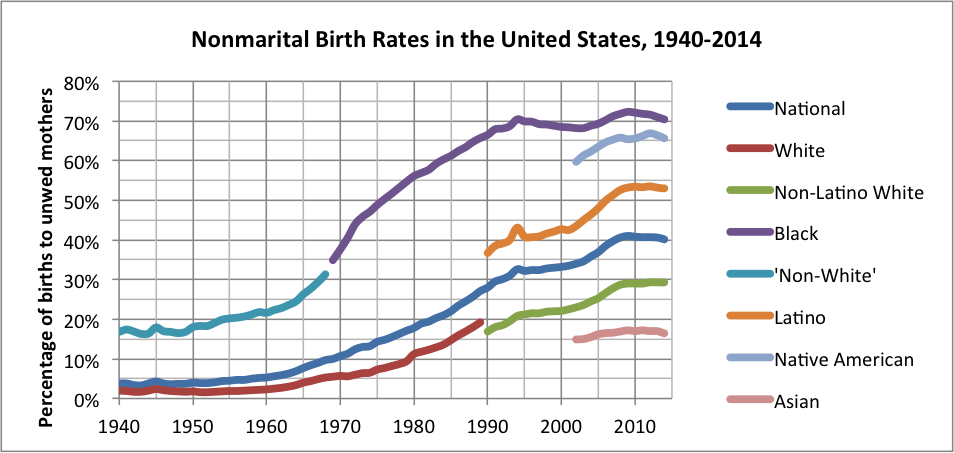
There might be a relationship between the strength of communities and families and success. Asians do well in US society. You have an advantage when you grow up in a stable environment with married parents. Married parents can invest more time in raising children and providing for them. It doesn’t explain why Muslims from North Africa perform poorly in European societies. There is more to the issue of success in society than family and community alone. Attitudes towards society and education may also matter. Blacks and North Africans often feel resentment and think society is not theirs. Blacks may say it is a white man’s world, so it is not theirs. And if you don’t believe you are part of society, you are less likely to participate.
Rodney King speeded on the highway and refused to stop. The police pursued him in a chase. After they had stopped him, police officers kicked him and beat him with batons, causing severe injuries. King had been on parole for robbery. There are similar cases. In 2013, the acquittal of a neighbourhood watch in the fatal shooting of the 17-year-old Trayvon Martin gave rise to the Black Lives Matter movement. Martin had no convictions. The police had once found jewellery in his possession but couldn’t prove he had stolen it. The death of George Floyd in 2020 is another noteworthy case. A police officer knelt on Floyd’s neck for over nine minutes while Floyd was handcuffed and lying face-down in the street, leading to his death. Floyd allegedly had used a counterfeit twenty-dollar bill. He had served eight jail terms on petty crimes. Young black men fill US prisons. If the police violence stops, that will remain so.
Historical perspective
We view things from today’s perspective and look at the past with today’s values. It doesn’t help to understand history or social progress. Darwin wrote about a slave owner, ‘I was present when a kind-hearted man was on the point of separating forever the men, women, and little children of a large number of families who had long lived together.’ He was a kind man but didn’t see the enslaved as people. Among the Nazis were family men who cared for their wives and children. They only didn’t see Jews as people, either.
Most of us eat meat and hardly think of animal suffering in the meat industry. Or we buy clothes made by children in Bangladesh. Many people in Europe and the United States condone the cruel treatment of immigrants because they think there are too many. Future generations may view our conduct as appalling as we view slavery today. Seeing the abolition of slavery as a historical process and acknowledging the limits of our compassion helps us understand why it took so long. It doesn’t take that much for us to become cruel.
Abolishing slavery took 1,500 years. Slavery was common in most traditional and ancient societies but had ended in Western Europe by 1,500 AD. Europeans then turned the slavery of blacks from Africa into a commercial enterprise of unprecedented scale and brutality. The trade and exploitation of enslaved people became a pillar of the European capitalist economy in the following centuries. European Christians engaged in the slave trade, but Christianity also contributed to its end. Most Christian churches approved of slavery and benefited from it, but they also tried to convert indigenous peoples.
These conversions were often brute, but in doing so, European Christians admitted indigenous peoples were humans worthy of conversion. And if they were Christians, enslaving them conflicted with Christian principles. The ideal of equality in the West has its roots in Christendom. Europeans gradually began to apply the principle of equality to the enslaved, regardless of race. Meanwhile, the Industrial Revolution became the engine of economic growth, so slavery contributed less to the economy. Factory workers were cheap, so businesses’ bottom line didn’t suffer from abolishing slavery, except in the South of the United States.
The cruel treatment of the enslaved made more and more people believe slavery should end. The economics were favourable. The importance of slave exploitation to the European economy had declined. Had that not been the case, ending slavery could have taken longer or not have happened at all. People asked, ‘How can you be a Christian, keep slaves and treat them cruelly?’ The slaveholders were used to slavery and saw it as necessary or natural. Some do-gooders wanted to end an institution that existed since time immemorial. The end of slavery was a successful revolution. Once slavery had ended, a counter-revolution in the form of the segregation and Jim Crow era commenced.
Segregation ended with the Civil Rights Act, yet another successful revolution, but resentment between blacks and whites in the United States remains. Contrary to many European nation-states, the United States was an immigrant society with a significant black minority. Society was fragmented. American values are more about individual achievement than European values. However, due to mass migration, similar issues arose in Western Europe, and societies became more fragmented, often along ethnic lines. Human nature goes a long way in explaining what happened:
- We grow up in a social order and usually accept it. Without order, there is chaos, so we often resist change as it can cause mayhem and bloodshed.
- We value social status. It is our rank in the social hierarchy. Raising the rank of blacks to equals angered many whites as it was a degradation to them.
- Humans are xenophobic. It protects us from harm but can cause brutality. Many whites thought blackness was an infectious disease.
- Cultural differences make living together uneasy. Blacks and whites in the US often have different life experiences, conduct, and values.
- The black community in the US is weak. Blacks couldn’t defend themselves against white paramilitary groups. Today, the black family man is the exception, not the rule.
Change doesn’t come easy and requires activism. Once you solve an issue, new ones emerge. At some point, social struggle fails to produce meaningful improvement. It seems the law of diminishing returns on investments is also present here. Black Lives Matter makes less sense than the Civil Rights Movement. Mischaracterising police brutality as if it is racist and directed against blacks is not helpful. The US police are 100 times as lethal as their British counterparts, which is a shocking number. However, if you account for crime rates, they don’t excessively target blacks. The data suggest the opposite. Blacks are three times as likely to be killed by the police but eight times as likely to commit murder. BLM makes no issue of gang violence that kills many blacks.
Do black lives matter to BLM? Or is BLM an expression of anger and frustration in a group lacking self-reflection? It is time for blacks to consider their contribution to the problem. BLM doesn’t differ much from MAGA, which is the expression of white anger and frustration. Most arguments have been made and settled in most reasonable people’s minds. There is still widespread bigotry and discrimination, but mischaracterising issues makes it harder to solve them. Police brutality doesn’t stand on itself, either. In the US, people have different attitudes regarding violence and the use of guns than in Britain. A US police officer knows that a suspect can pull a gun anytime. A British police officer doesn’t have to worry about that. Progress from here on will be slow or remain elusive unless we identify as one humanity, join hands and work on a better future.
Latest update: 24 July 2024
Featured image: Storming of the Bastille and arrest of Governor M. de Launay on 14 July 1789. Public domain.
 The Plan For The Future