

Imagine there is a lake in a distant forest. On its surface grows a plant. Its leaves darken the water, so all life below it dies. The plant was at first tiny, and it has been there for 1,000 days. But it doubles in size every day. So, here is a question. If the plant blankets half the lake, how many days are left to save the life there? The correct answer is one day. Behold the power of exponential growth. If the plant depends on life in the lake, it will also die.
Behold the power of exponential growth. The plant doubles in size each day. And so, it covers the entire lake tomorrow. It doesn’t matter how long it has been there already. It stops growing once there is no more room. As soon as the lake is fully covered, life in the lake ends. And if the plant depends on that life, it will also die.
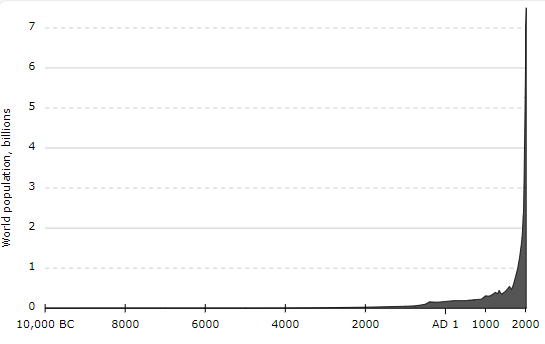
The lake represents the Earth, the plant humanity, and the leaves are people like you and me. The graph above shows the human population numbers over the last 12,000 years. These numbers had been very low for a long time. In 1804, there were one billion people. Since then, the human population has gone berserk. There were two billion humans in 1927, three billion in 1960, four billion in 1974, five billion in 1987, six billion in 1999, seven billion in 2011, and eight billion in 2022.
The experts expect the number to decline in the future. Only, how will that decline occur? That is anyone’s guess. The signs are ominous. Currently, humans use nearly twice as many resources as the Earth can deliver.1 We can do that for a short while, but it will end badly. The lifestyles of the rich are unsustainable, but so are the number of children many people have. Rich people with many children are the worst. Continuing their current lifestyles will lead to an apocalyptic event, and it will happen sooner rather than later.
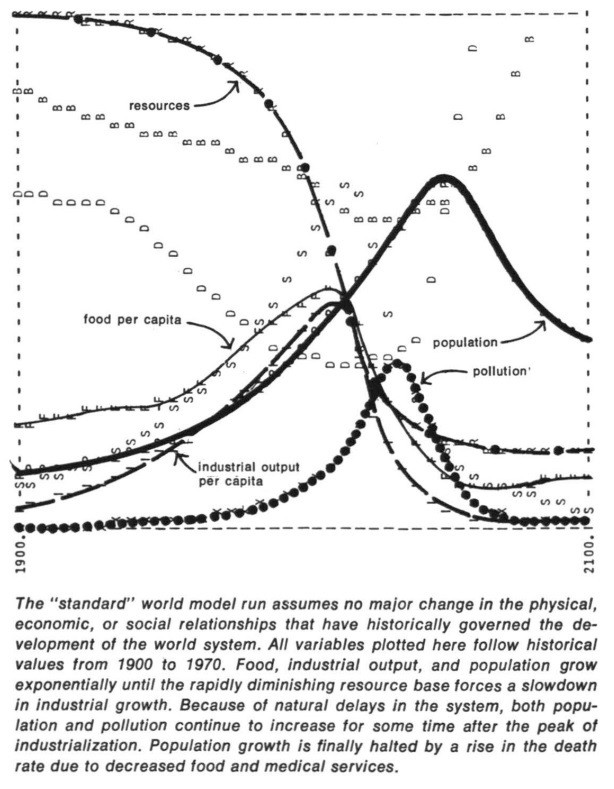
In 1972, a group of scientists known as the Club of Rome ran a computer programme predicting an apocalypse when natural resources would run out shortly after 2000 AD.2 Their computer printed out a scary diagram detailing how, demonstrating we should be very, very afraid. So far, the reckless have had numerous opportunities to point out how foolish the cautious have been, and the ultimate laughing stock is the man with the sign saying, ‘The end is near.’
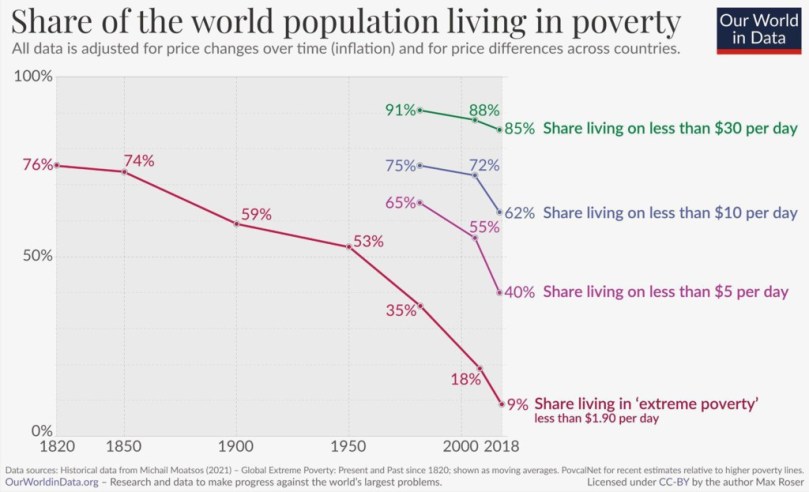
According to the World Bank, extreme poverty dropped from 76% of the world’s population in 1820 to 9% in 2018. Their definition of extreme poverty is dubious, but it is beyond doubt that the percentage of destitute people has declined. The Club of Rome lacked sufficient and precise data, and unanticipated developments affected the outcome. New technologies enable the extraction of more resources and the more efficient use of existing ones. Some oil reserves have become accessible with new or improved extraction methods. And if you use the oil to produce a solar panel, you get several times as much energy during the solar panel’s lifespan as from burning the oil itself.
Essential resources, such as oil and freshwater, are becoming increasingly scarce or may soon be in short supply.3 With current consumption levels, proven oil reserves may last until the 2060s. Total oil reserves are more than twice as large, but pumping the remaining oil could be costly,4 while climate change could prevent us from burning it. PFAS, microplastics, and other pollutants are everywhere and accumulating in our bodies. Brain samples collected in early 2024 measured, on average, about 0.5% plastic.5
Life has never been better for most people. Are we on the verge of the apocalypse? The problem is growth in a limited area. When there is growth, the increases add to the existing total. The plant can’t grow beyond the pond’s size, so once it reaches its limits, for every leaf that grows, another must die. The Earth is stressed. We disrupt the balance in nature, but we can’t predict what will happen and when. We can’t overuse the Earth for long. The day before growth ends could be our best.
Scientists have identified nine processes that regulate the Earth’s stability and resilience. These are climate, biosphere, land use, freshwater, nutrients, ozone, aerosols, and ocean acidity. These processes have boundaries that are unsafe to cross. By exceeding these boundaries, we risk triggering irreversible environmental changes that could lead to catastrophic consequences for both human civilisation and natural ecosystems, these scientists argue. As of 2024, we have breached six of these nine planetary boundaries.
Humankind has gone batshit crazy. We delude ourselves into thinking that economic growth will solve our problems. We are like cancer cells telling each other that our aggressive growth strategy has paid off handsomely so far, so that more cancer will make things better. That is, of course, until the host dies.
Barring an apocalyptic event, such as the planet reaching a tipping point due to climate change, World War III, or a technology like artificial intelligence or genetic engineering going wrong and out of control, doom will likely be piecemeal, occur over decades, and not affect everyone equally. Many might survive and enhance themselves using technology, turning themselves into post-humans. If we compare humanity’s lifespan with 1,000 days, we live on the proverbial last day.
We can step out. The Old Order Amish, also known as Pennsylvania Dutch, live modestly and choose which technologies they use. More and better stuff doesn’t make us happier once we have enough, feel secure, and live in a supportive community. Surveys suggest the Old Order Amish are happier than the average citizen. They show us that we can live simply and don’t need new technologies and products. We don’t have to go that extreme. We can choose the technologies we use and make different choices. And our lifestyles need not be that austere as long as we don’t stress the Earth.
Latest revision: 2 July 2025
Featured image: Amish family, Lyndenville, New York. Public domain.
1. overshoot.footprintnetwork.org
2. The Limits to Growth. Donella H. Meadows, Dennis L. Meadows, Jørgen Randers, William W. Behrens III (1972). Potomac Associates – Universe Books.
3. Theworldcounts.com. Depletion of Natural Resources.
4. Plummeting ‘Energy Return on Investment’ of Oil and the Impact on Global Energy Landscape. Siddharth Misra (2023). Journal of Petroleum Technology.
5. Microplastics are infiltrating brain tissue, studies show: ‘There’s nowhere left untouched’. The Guardian (2024).
 The Plan For The Future