
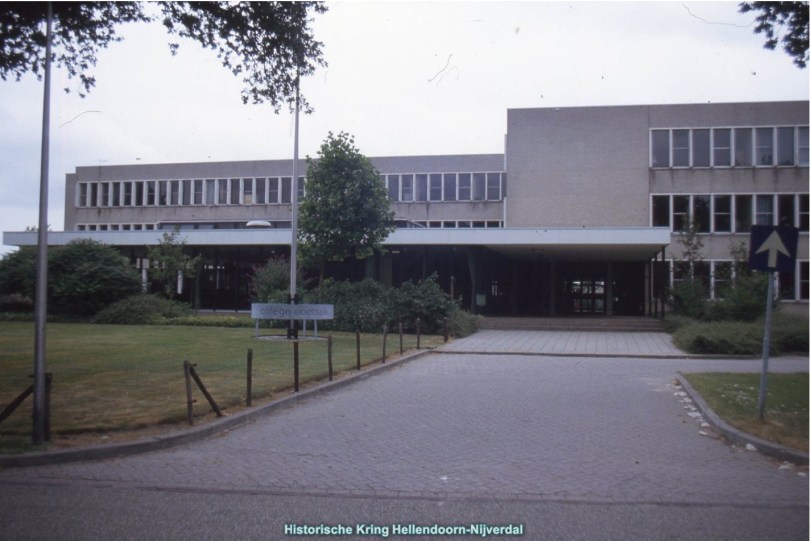
Nijverdal had a secondary school, Noetsele College. It was a Protestant comprehensive school with 1,500 pupils. It was near my friend Marc’s home. The building impressed me. It was huge and three storeys high. Okay, this was Nijverdal, not Tokyo, remember that. It was one of the most extensive buildings in Nijverdal. My primary school had only 200 pupils and one floor. My mother once told me we had passed by that building bicycling, and I said decisively, ‘I want to go to this school.’ It was close to home, and perhaps I feared she would send me to Pope Pius X College in Almelo, a similar Catholic school where many Roman Catholics sent their children. That was eighteen kilometres from home, which meant bicycling that distance twice a day for years, no matter the weather.
In contrast to the liberal, loose, and left-leaning primary school, this school was right-leaning, disciplined, and conservative. Conservative Protestants had a significant influence. Nearby Nijverdal was Rijssen, a conservative Protestant village without a comprehensive secondary school. People from Rijssen thus sent their children to Nijverdal. About Rijssen, people said there were twenty-two different churches because of the various types of Protestantism that disagreed on a particular matter. Television was a device of Satan for many of them, so they didn’t have one or hid it in a sealable closet so the neighbours and the preacher couldn’t see it.
When we visited my grandparents on Sundays, we saw them attending church, the black-stockinged Protestants. The women wore hats. They didn’t observe the traffic, so my father had to stop the car when they crossed the street. Someone later told me that if they died in an accident, they considered it God’s will. To these conservative Protestants, Roman Catholics like me weren’t real Christians but idol worshippers of the Virgin Mary. Our days at school started with a lecture from the Bible and ended with prayer. Nijverdal was predominantly Protestant, but there were also Roman Catholics.
I did fit in much better there, so my former classmates didn’t give me a hero’s welcome at the secondary school reunion. Marc was my classmate during the first year, so I still had a friend. In the second year, they reshuffled the groups, and I ended up in a different group with a great atmosphere. That group included a few classmates from primary school, but Marc was no longer in it. On Ascension Day, we went out bicycling. We started early, at six AM. It was a local tradition in Twente called dew kicking. A few classmates, including me, continue that tradition to this day. After that, no major reshuffling of the classes occurred. I had a good time and hardly went out alone during breaks.
Instead of Marc, Patrick P. became my mate. He sat beside me. I knew him from primary school. He was a lively character with a vivid imagination, albeit a bit over the top. He made drawings of our business accounting teacher, Mr B*****, in various Superman outfits and then prodded me during the lessons to attract attention, ‘Look… look… SuperB*****.’ He had a small studio in an attic above a garage, where he could be a disc jockey. Patrick hoped to become a celebrity one day, which indeed happened, as he was on television and radio several times, even though not as a disc jockey, but as a traffic expert.
It was not all calm and peaceful. For all those six years, my math teacher was Mr. B****. We initially had a problematic relationship. When Mr. B**** entered the classroom the first time, I said sarcastically to Marc, who sat beside me, ‘Is he our mathematics teacher?’ Mr. B**** had an insignificant stature and a remarkable face. He had heard it, and ordered me to his desk, noted my name, and promised to ‘polish the sharp edges of my personality.’ To his very personal taste, I was a bit too feisty, so from then on, Mr. Blaak frequently punished me for insignificant offences everyone else got away with.
Nearly every week, I had to stay an extra hour, which was more time than all my classmates combined. I worked hard and had good grades. Still, Mr. B**** tried to catch me for not doing my homework. He meticulously inspected my notebook a few times. It was pointless. I always did my homework, and did it all. At some point, after being punished again for something everyone else got away with, I couldn’t take it anymore, and went into tears. That was nearly two years later. Mr. B**** had gone too far, and he knew. He stopped punishing me, but I didn’t stop making jokes about him. Once, I let my notebook go around the class with a fill-in exercise, allowing my classmates to use their imagination on ‘Mr. B**** is a … because he … while he ….’ My classmates came up with over twenty suggestions, some of which were rancid.
Once they were sixteen, many youngsters went to a bar named Lucky in Rijssen. I didn’t go at first. I lived on the road to Rijssen, so those who came from Nijverdal to visit Lucky passed by my home. One Saturday evening, a few classmates rang the bell at nine PM. They wanted me to go with them. Being already in my pyjamas, I put on my clothes and went to a bar for the first time. Going to bars and discotheques became a habit. I could dance, chat with friends, and hope for love to come. The encounters in Lucky were sometimes a bit physical. Some girls pulled me over to get a kiss. Others pinched me in the butt when I passed by. If I looked back to see who did it, these girls were grinning and pointing at each other. It always happened in the same spots. You could count on it. One of my friends later told me he had the same experience.
I became a member of the School Council, which advised the school board on some matters of lesser importance. This council comprised board members, teachers, parents, and three pupils. It wasn’t a popular job, so after showing a slight interest, I found myself a member. There, I witnessed firsthand how bureaucrats keep themselves busy at work. The school had a Financial Commission, which had overstepped its bounds by entering the domain of the Cultural Council. I don’t remember what the Financial Commission did wrong, but it caused a fuss. The discussions then focused on whether that had been inappropriate, thus a transgression, or inelegant, and therefore merely a matter of taste. It dragged on for several meetings because the head of the Financial Commission was also a member of the School Council. A member of the Cultural Council accused the Financial Commission of appropriating too much power and acting like the famous authoritarian French king Louis XIV, thereby creating, and these were his exact words, a ‘L’etat c’est moi’ situation, referring to something Louis XIV supposedly had said to stress that only he made the decisions. Louis XIV claimed to have the divine right of kings, thus unlimited authority, because God had appointed him.
Featured image: College Noetsele by Historische Kring Hellendoorn-Nijverdal, from MijnStadMijnDorp, CC-BY 4.0
 The Plan For The Future