Perhaps You Can See the Irony of It

On a road to nowhere

After the terrorist attacks of 11 September 2001, a populist politician, Pim Fortuyn, gained popularity because traditional politicians had failed to address the growing unease of the Dutch about Muslim immigrants. Fortuyn promoted a messianic personality cult. He called himself the Son of the People of the Netherlands. About the leader the Netherlands needed, Fortuyn wrote in his book De Verweesde Samenleving (The Orphaned Society), ‘A leader of stature is Father and Mother in one. He dictates the law and oversees the herd’s cohesion. The skilful leader is the Biblical Good Shepherd.’ Fortuyn anticipated the coming of the Great Leader of the Netherlands as he wrote, ‘Towards a Father and a Mother, on the way to the Promised Land,’ and, ‘Let us prepare for his arrival so that we can receive him.’ He posed himself as the Messiah. It was one of the reasons I didn’t like him. Perhaps you can see the irony of that.

Fortuyn called Islam a backward religion and claimed that Western civilisation was superior. He valued the achievements of Western civilisation, such as the separation of church and state, LGBTQ rights and freedom of opinion. Many Muslims hold on to a medieval worldview. Still, Islam opposes interest charges on money and debts, and I believed that interest was one of the gravest threats to civilisation, so my views of Islam were more favourable. We could learn something from Islam. Even more so, out-of-control technology might end human civilisation, either through an apocalyptic event or by altering humans to the point that they cease to exist. You can’t blame Islam for that. It is Western civilisation that has brought us to the brink. And if you can only choose between doom and women wearing body covering garments and honour killings, the choice is not that difficult, for a rational individual at least. We are on a road to nowhere,

We’re on a road to nowhere
Come on inside
Taking that ride to nowhere
We’ll take that ride
I’m feeling okay this morning
And you know
We’re on the road to paradise
Here we go, here we go

Talking Heads, Road To Nowhere

The song says that the road to nowhere is to paradise. That is the duplicity of it. Everywhere Fortuyn went, there was chaos and conflict. He seemed to enjoy it. Establishment politicians didn’t like him because they feared he would undermine society. The Netherlands has had a consensus-building tradition known as the Polder model for over a century. Fortuyn broke with that tradition.

False Messiah

Fortuyn saw himself as the coming Great Leader of the Netherlands. History took an unexpected turn. On 6 May 2002, a left-wing loner assassinated him, an event that shocked the Netherlands. ‘The bullet came from the left,’ Fortuyn’s supporters claimed. Exactly 911 days later, an Islamic fanatic murdered the Dutch filmmaker Theo van Gogh. Fortuyn’s sudden popularity was closely linked to 9/11, while Theo van Gogh had just finished 06/05, a motion picture about the assassination of Fortuyn. Van Gogh was killed on 2 November 2004 (11/2 in American notation), while 112 is the European emergency services telephone number. That points to the hand of God. The Bible has warned us of false messiahs like Fortuyn. I hope you can see the irony of that as well.

Jan-Peter Balkenende

Fortuyn aspired to become Prime Minister. Instead, Jan-Peter Balkenende got that job. He looked like an apprentice from the Hogwarts School of Witchcraft and Wizardry. Harry Potter became his nickname. And that was not a coincidence, as the Netherlands was in for a massive bout of magic. Captain Decker, a song by Boudewijn de Groot, has the following lines,

Captain Decker, Flying Dutchman,
climbs above the timeless
space machine you’re living in,
starts to turn you inside out,
he needs you to know
what he was really all about

Captain Decker, Boudewijn de Groot

The timeless space machine could refer to the place where God is living. A Dutchman may need God to know what he is about. The animated picture Kroamschudd’n in Mariaparochie by Herman Finkers explores the possibility of Christ being born in Twente. My birthplace is Eibergen, just over the border in Achterhoek. In the 1980s, there were plans to create an independent province of Twente. It was to include Eibergen and Nijverdal. Finkers came from Almelo, like Ilse DeLange. DeLange’s fourth studio album, The Great Escape, plays a central role in God’s messages in pop music.

World peace

In December 2008, there were many strange incidents. One of them was that the candy vending machine at the office delivered a particular message. Often, I went there to fetch a Twix bar. This time, the machine malfunctioned and failed to produce a Twix. It repeatedly misfired. That had never happened before, and to my knowledge, no one else had trouble with the machine that day. After trying three different options, it finally worked when I chose option 22: a Nuts bar. That was nuts, even more so because 22 = 11 + 11.

It was about to get even nuttier. To me, 11:11 represents a strange coincidence with two parts. The next day, I bought a bag of potato crisps from the same machine. This time, it worked fine, but after opening the bag, I found a small piece of paper with the crisps. It was a temporary tattoo with the following Chinese text:

世界和平

One of my colleagues knew a Chinese man who translated it for me. The characters stand for world peace. No one else got a temporary tattoo with a bag of crisps. It was a production glitch. The paper had slipped into the bag, perhaps from another product line, and it ended up in my hands. Remarkably, my colleague Ronald Oorlog was absent that day. He had fallen ill. His last name, Oorlog, is the Dutch word for war. Now, that is a funny coincidence. Another colleague, Rene H, joked about the text, saying, ‘World peace is what Miss World would say she wanted after winning the prize.’

Linking it to Sneek

A nursing home in Sneek is named Nij Nazareth (New Nazareth). The nickname is The Banana because the building is banana-shaped. A former neighbour of Allard and Geke, nicknamed The Hedgehog because of his hairdo, has taken residence there. If the name New Nazareth means anything, it could mean that the Second Coming comes from this particular town, which was, by some miraculous accident, my town of residence. It could be that there were other places and buildings with the same name. And so, I used a search engine to look for them, but nothing else came up. Perhaps I was making too much of this coincidence. In the song Het Sneker Café, the unrivalled poet of the Dutch language, Drs. P mocks the making of outlandish connections to a pub in Sneek,

There once was a girl of seventeen years of age,
the only child of a wine merchant,
who sought shelter in the Jura,
because she was lost on a trip.
She found an unoccupied house at the edge of the forest,
and felt from the outset that this is not right.
She took a glance at the window and what appeared:
Inside was the skeleton of a salesman in toiletries,
who had been missing for years
and had once stayed with his uncle and aunt in Bordeaux when he was young.
And there, they had almost exactly the same type of lampshades
as a small pub in Sneek.

Drs. P, Sneker café

There is a nursing home in Sneek named Nij Nazareth (New Nazareth). Its nickname is The Banana because the building is banana-shaped. A former neighbour of Allard and Geke, nicknamed The Hedgehog because of his hairdo, has taken residence there. If the name New Nazareth means anything, it could mean that the Second Coming comes from this particular town, which happens to be my town of residence, perhaps for the same reason that the building is there. To rule out the possibility that there were other places or buildings with the same name, I used a search engine, but nothing else came up, which made it more noteworthy, though perhaps I was making too much of this coincidence. In the song Het Sneker Café, the unrivalled poet of the Dutch language, Drs P, mocks the making of outlandish connections to a pub in Sneek,

You see now how the pub again and again
affects the social interaction.
How here and there, and yes, even overseas
one stumbles upon this pub from Sneek.
It’s inexplicable and almost occult,
something that fills the world with trepidation.

Drs. P, Sneker café

As a prophecy, it is slightly off the mark by focusing on a pub, of which Drs P did not disclose the name, so that it remains a subject of speculation, and not on Sneek itself. Prophesies somehow tend to be off. That seems to come with predestination. If we knew our predestined future, it wouldn’t materialise. Yet there are inexplicable, occult connections that fill the world with trepidation. And that nursing home, New Nazareth, is not the only thing that justifies the trepidation. You pronounce Sneek like ‘snake,’ and there was allegedly a serpent in Paradise. In scripted reality, there is no coincidence, so we can safely argue that there might be more to it.

Pope end times prophecy

In January 2013, an Australian poster on the message board Godlikeproductions.com started a thread titled ‘112 Keeps Coming Up In The Media.’ Others joined in with their own selective biases and found many 112s popping up in the media. That same number is the European Emergency Services telephone number, and since I had lived in room 112 in that fateful dormitory, the thread caught my attention. The discussion remained active for several weeks. During that time, Pope Benedict XVI resigned on 11 February 2013, a highly unusual move. He was the first pope to step down in almost 600 years.

That became material for this thread. 11 February is also the 112 European Day, which celebrates the emergency services telephone number. 11 February is 11/2 in European notation, and 112 is the European emergency services telephone number, so that is why. You must admit the European bureaucrats have found a most peculiar occasion to throw a party. In any case, the Pope’s resignation came unexpectedly, like a bolt from the blue. And lightning struck the Vatican a few hours after the Pope had resigned.1 It made several people wonder, so the thread came back alive.

Pope Benedict XVI’s resignation on European 112 Day is also noteworthy because of the 112th Pope End Times Prophecy attributed to Saint Malachy. The prophecy alleges 112 popes would reign, starting with Celestine II, until the End of Times. Benedict XVI was the 111th Pope. His resignation prepared the way for the 112th Pope, Pope Francis, who, according to the prophecy, would become the last Pope before the End of Times and Jesus’ return. That made me curious, so I investigated the matter and discovered that Saint Malachy had died on 2 November (11/2 in American notation) 1148, and I added that noteworthy item to the thread.

The prophecy raves about the 112th Pope, ‘In the final persecution of the Holy Roman Church, there will reign Peter the Roman, who will feed his flock amid many tribulations, after which the seven-hilled city will be destroyed, and the dreadful Judge will judge the people.’ Some claim it refers to Judgement Day or the second coming of Jesus Christ. It requires quite a stretch of the imagination to make it fit Francis’s tenure, but humans are imaginative beings. Pope Francis died on Easter Monday, 21 April 2025, at the age of 88, and the 113th Pope, Leo XIV, came. My preparations weren’t yet complete, but had progressed far enough to think that the End Time could commence within a few years.

If so, that century-old prediction could be remarkably close in time, even though it doesn’t match the described events. It seems too accurate to be a coincidence, yet not entirely on the mark. The same holds for Finkers’ animated picture of Christ’s birth in Twente. My birthplace, Eibergen, is a few kilometres outside Twente. Likewise, the 9 February 2009 superstorm prediction was too accurate to be a coincidence. The date was correct, but the location was off by about 400 kilometres. Route N666 didn’t precisely end in Borssele, the location of the only remaining Dutch nuclear power plant, but in nearby Heerenhoek within the Borssele municipality. The other Dutch atomic plant, which had been closed, was in Doodewaard (Death Holm), a remarkable name. The former Doodewaard municipality had been 66.5 square kilometres in size, so close to 66.6 that it is noteworthy.


Jesus’ ministry occurred sometime between 26 and 30 AD, a period that will soon mark 2,000 years, which is worth noting. We might find out soon whether or not God finally means business this time. After 2,000 years of waiting, you wouldn’t expect that anymore, and most people live as if Judgment Day will not occur during their lifetimes. And as you might know, the hour will come as a thief in the night. The Day of the Lord will come unexpectedly, suddenly, and without warning. That is to say, if that day ever comes. Likewise, you wouldn’t expect an autistic individual like me to be the messiah. Okay, men with Asperger’s Syndrome tend to be faithful, and God might prefer a man with ‘a heart of gold’, but maybe there is more to it. So, what makes autistic people special?

Latest revision: 11 February 2026

1. Lightning strikes St Peter’s Basilica as Pope resigns. BBC (12 February 2013).
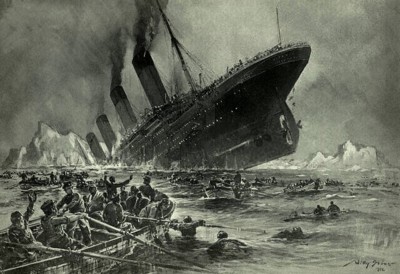
Der Untergang der Titanic. Willy Stöwer (1912)

Harbinger of Things to Come

In 2006 or 2007, a software upgrade of the disk controllers on the principal systems went wrong. For a week, they were out of operation. It was one of the biggest crises in the history of the government office CJIB, and perhaps the biggest of all. At the time, Kees and I were working on the systems renewal project at another location. The other database administrators dealt with the issue, as did many others. I knew there was a serious problem because we received regular email updates, but I didn’t realise how serious it was. After a week, the telephone rang at home. It was 9 PM. My wife, Ingrid, took up the phone. It was the IT director. He said there was an emergency and asked me to come to the office. His voice reflected fear. ‘As if the Titanic had hit the iceberg,’ Ingrid later noted.

I hurried to the office and arrived by 9:30 PM. Many people were still in. It was a massive crisis. There was an atmosphere of fear. The database administrator on duty, Dirk-Jan, brought me up to speed. I searched the database log files, found the error messages, and typed them into the Google search bar. In this way, I found an online document with the remedy. I then repaired the failures and brought the systems online one by one. Board members and senior managers were standing around me, watching me type. Solving the issue wasn’t complicated, but few people used Google to find the answer at the time.

I learned that the last backup was over a week old, and the mirror copy was offline. You may know what backups are and why you might need them, but you may not know what a mirror copy is. A mirror copy is a safety measure. If you own a computer or a mobile phone, it contains data. That data is on a device. In the early 2000s, it was usually a hard disk. If that disk fails, your data may be gone forever. If you lose some photographs of your late cat, you might feel sad about it, but after a few years, you get over it, perhaps after consulting your psychiatrist and taking a lot of pills.

Corporations can’t afford to lose their data. That would bankrupt them. Their business is their data. Without it, they are out of business. If you have a backup, only data after the latest backup may be lost, but that can still kill you, especially if you haven’t backed up for a week. We were a government agency, so loss of data wouldn’t have bankrupted us, but it would have been a national political scandal.

Corporate computers have multiple data storage groups in different locations. If one group catches fire or stops operating because of a failed software upgrade, the other groups still have the data. These groups are called mirror copies. We had two groups: the original and the mirror. You can imagine my bewilderment. We had no backup, and the copy wasn’t available. So much had gone wrong that it was a miracle that I succeeded in recovering all the data. But having no mirror and no backup meant we were still on the brink.

An even greater surprise was yet to come. The managers and the board wanted to return to business as usual and run the backlog of batch jobs. Then I said, ‘This is perhaps the most important advice I will ever give in my entire career. Don’t start the batch jobs yet. We are on the proverbial edge of the precipice. Running the jobs might just push us over. Everything went wrong for a week and there is no guarantee whatsoever that it will be all right now. We should bring the mirror copy back online and make a backup first.’

They planned to ignore my advice. Bringing the mirror copy back online and taking a backup would take eighteen hours of precious time. It was a lot of data to back up, as it was everything we had. I was a low-ranking official while the IT director had claimed there was nothing to worry about. But he had left the building. I kept stressing that making a backup was the right thing to do. ‘If something goes wrong that could finish us,’ I told them. It was the worst crisis ever. And so, I pressed for an extensive check-up to see if everything was in order. On that, they could agree.

During the check-up, I found another failure that everyone had overlooked. That scared the managers and the board, prompting them to start another meeting. And then they followed my advice. The IT director was no longer there, and they faced a determined saviour who told them in no uncertain terms that they were about to do something stupid. The operators brought the mirror copy online and made a backup before we resumed normal operations. In this way, rational decision-making prevailed. Nothing went wrong anymore, but no one could have known that beforehand.

If it had gone wrong, the agency would have survived. Operations would likely have had to stop for several weeks—that had already happened for a week—and it may have been impossible to recover all the data. That would have made the headlines. But it never came to that. When the local newspaper’s journalists smelled a rat, the board could tell them that the situation was under control and that the data was safe. My wife’s comparison of this situation to the Titanic hitting an iceberg was not entirely apt. Saving the Titanic once it had hit the iceberg was technically impossible. It would have required a miracle. What I did may have appeared to be a miracle, but it was technically possible.

The audit department later evaluated the crisis. The auditors noted that after a week of failures, all the problems suddenly vanished, which they found already hard to believe. What they found even more difficult to fathom, and they stressed the inconceivability of it during a meeting, was that after a week of irrational decision-making, sanity suddenly took hold as we had brought the mirror copy back online and made a backup. They couldn’t figure out why that happened. Our management had kept them entirely in the dark. I didn’t enlighten them either, as it would make our management and board appear incompetent.

My manager, Geert, complimented me for handling the situation. He stressed that my colleagues had been content with me. ‘I was a pleasant colleague,’ he added. Strangely enough, Geert didn’t say something like, ‘Your contribution was critical in saving us from a disaster.’ It reveals something about Geert’s thinking. To him, it was teamwork. Geert wasn’t present that evening, so he may not have learned the details of what transpired. And so, it didn’t help my career. A few years later, the senior database administrators received a higher salary grade, except me. Geert was involved in that decision. If you save people from their own stupidity, you shouldn’t expect gratitude. In this case, the truth had remained hidden because it would have hurt the egos of those in charge. My dealings with the crisis could be a harbinger of things to come.

Latest revision: 25 February 2026

Featured image: Der Untergang der Titanic. Willy Stöwer (1912). Wikimedia Commons. Public Domain.

Grapevine snail. Jürgen Schoner.

Learning Opportunities

In 2005, my employer embarked upon an ambitious systems renewal project. The IT director aimed to make a mark by replacing our existing IT systems with a brand new solution. As the story goes, the IT director had visited Oracle headquarters near San Francisco. He could get a steep discount on the Oracle ERP solution. I wasn’t a firsthand witness, but several colleagues gave similar accounts. And so, it could be the truth. ERP can administer an entire business. It is a total-for-everything solution, but only if you model your business the way ERP prescribes. In other words, every department must change how it conducts its affairs. It is like a straitjacket. That makes ERP awkward to use.

It wasn’t a good idea to purchase an enterprise solution without first considering whether you need it. But instead of the IT director admitting he had bought the ERP on a whim and writing off the license fee, which would have been a minor loss of a few hundred thousand euros, perhaps, he sought to justify the purchase. Possibly, the IT director wanted to save face, but you wouldn’t expect that kind of vanity from a religious person like him. Business consultants came to assess the quality of our IT systems and to write a report proposing a solution. Unsurprisingly, the report stated that our systems were obsolete and that we should switch to Oracle ERP to save lots of money. And now I spill some beans. These outdated systems were still doing fine fifteen years later.

A strategic information planning phase preceded the project. Cap Gemini business consultants organised brown paper sessions where employees could help identify the business requirements. It was different from what I had learned as a student. I had a good grade, but as a student, I was naive and believed good grades mattered. We had to list our components by writing them on brown paper and sticking them to the wall. The consultants would then call them ‘services’. I wrote the word database on brown paper and stuck it to the wall, and the Cap Gemini business consultant concluded that we needed a database service. That didn’t seem like a proper strategic business analysis to me. Anyone could paste the word ‘service’ after a component’s name. It dawned upon me that it might not end well. Cap Gemini charged over €150 per hour for its consultants, who dressed in suits, leading managers to believe it possessed expertise in strategic information planning.

There were political troubles early on. A Cap Gemini project leader left because she didn’t share the IT director’s vision. He surrounded himself with yes-men. And you can’t have competent people standing in the way. In the Information Planning course at the university, we learned that you must first define the business requirements and then select a solution based on these requirements. It can save you a lot of trouble. The business consultants did the opposite, trying to justify a choice already made. Over time, it grew into an all-encompassing megalomanic plan. Most departments didn’t want the IT department dictating their operations. And so, the consultants planned to supplement the Oracle ERP with several special-purpose modules. Making special-purpose software would render ERP pointless, as the whole point of using ERP was to avoid building such software.

We didn’t dive into the deep end without first testing the waters, so we initiated a pilot project to develop a basic ERP-based system. It was a brand-new system for administering Plukze, a law that allowed the government to confiscate criminals’ assets. Plukze was a straightforward bookkeeping system, and ERP can keep books well, so the pilot succeeded. It was like sending a rocket into the sky and then, after a successful test, deciding to put a man on the Moon. That is an entirely different ballgame.

They trained me to become an ERP system administrator, and then I started as a junior under the guidance of an experienced administrator who was a temporary hire from a software consultancy firm. Once, I made a mistake by putting a database index on maintenance while the ERP system was running. The ERP proved more sensitive to regular database maintenance than the Designer/2000 systems, so it began to malfunction. I mentioned my index maintenance as a likely cause. We restarted the system, which resolved the issue. I remarked that I hadn’t anticipated the problem as regular systems could handle such an operation, which implied criticism of the new system. For all kinds of ordinary operations, the ERP had lengthy instruction sets that you could find on the Oracle support website.

You couldn’t do maintenance work while the system was operational, not even simple, unintrusive things that other systems could deal with. The situation is comparable to Windows failing after moving a file to another directory, and the solution is to restart the computer. You wouldn’t expect it. I had yet to learn that. Yet the ERP was the IT director’s pet project, and it hung in the balance, so everyone was on edge. The project leader, likely fearing for his career, complained about me to higher management, labelling me unfit. I had been open about my mistakes and views, but that is quite problematic in a politically charged environment. They took me off the project. Fear was in the air. A circulating story was that the IT director had once threatened a manager in the lift who had openly disagreed with him during a meeting.


After the pilot proved a success, the enterprise systems renewal project took off. Once it had started, Oracle began to determine its direction. Oracle consultants soon found that we needed additional solutions from Oracle and, of course, the latest technology. Some of these technologies were still in the marketing phase and had not yet proven to work. Our decision-makers, the architects and managers, agreed. So when the special-purpose software proved cumbersome and inadequate, they tried new ideas, such as using BPEL, a business process model language, on top of ERP. This way, the business model could be tailor-made while still using ERP, or so they promised.

No one had done that before, for good reasons, as it turned out. Captain Kirk might have ventured there, but more cautious captains who cared for their crew and ship wouldn’t have. The consultants were there to make money for their employers by making the customers happy, so they tried the idea. Those who were critical would undoubtedly be first in line for a Professional Skills course. Despite working in information technology, I was never keen on using new technologies. Do not use them more than necessary. And so, I had no smartphone until 2020, and I only got one because my employer gave me one to log in to systems from home during the coronavirus pandemic lockdowns. By then, functioning in society without one had become practically impossible.

The project’s pointlessness began to demoralise me. Goals were constantly changing as ideas were always failing. IT employees became stretched to their limits for years in a row. Software releases that took one person and a few minutes with Designer/2000 took hours or even days, and required a dozen specialists working according to a script of up to fifty steps. Working late or on weekends became a regular occurrence, including ordering pizza, Chinese food, or other food, since you can’t bring the system down for so long during office hours. The database administrators bore the brunt of the pressure as the job role expanded to everything related to Oracle. Everything we did was Oracle, so database administration became the focal point for all the advanced stuff. And that began to take its toll, and I started to suffer from stress and repetitive strain injury.

My colleague Kees, the tech genius, was kind and always helpful. You could call him at home anytime, and he would help you. One evening, a year before the system renewal project had started, it seemed that I had messed up a database during a maintenance operation. I called him at home. He came over and helped me check it. But Kees was too helpful. He enthusiastically jumped on every crazy plan our management came up with. He was an innovator and loved new technologies. That made him the darling of management. I lagged behind Kees, but the other database administrators couldn’t keep up at all. It was like having a Trojan horse in our department as the project pushed more and more unmanageable technology into it. Kees didn’t look after the department’s interests but the project’s. The things he invented and built had to be kept up and running by the others. Kees didn’t take many notes, but was always willing to help us. Indeed, the entire system’s renewal project might have collapsed had Kees gone missing.

Our managers had no clue what they were doing and believed that more advanced technology like Oracle RAC clusters would fix things, but that only aggravated our troubles. RAC was pointless, required additional knowledge, and was still prone to failures, even though much less than previously, as the technology had matured and the new systems were on Unix. And so, I would sometimes sarcastically note, ‘The most reliable RAC cluster is one with one machine.’ That was the same as not having RAC at all. Pesky problems piled up on my desk. I constantly had to learn new skills. Project leaders pressured me to work on plans that were bound to fail. That couldn’t go on. I wanted to help people, but it was better not to fix other people’s problems or work on ideas that would fail. People were creating problems at a much faster pace than I could fix them. There was too much work, and most of it was pointless.

The escalating stress compelled me to make radical changes, focusing on the most critical issues while avoiding those that were pointless or doomed to fail. Whenever multiple project leaders pressured me, I referred them to my manager, saying, ‘He should set the priorities.’ Whenever a colleague tried to bequeath his pesky problem to me, I explained how he could fix it himself. ‘It begins with using Google,’ I said repeatedly. At the time, not everyone used search engines. Many still relied on their knowledge, manuals, and support from Oracle. Google has helped me solve more issues faster. Often, someone else has had the same problem and posted the solution on the Internet. But if you solve more problems, you get even more. It was a learning opportunity. If you solve other people’s problems, they stop thinking for themselves. I had to stop doing that.

As things spiralled out of control, our management decided we needed more qualified database administrators. Our salaries were too low to attract the right people, so they gave the new hires and Kees a higher salary grade while leaving me out. They also increased the number of temporary positions. The headcount went from four to fourteen database administrators. And still, we couldn’t handle the workload. Kees was a brilliant technician, and despite that, or perhaps partly because of that, things went downhill.

Kees was quicker on the job than I was, except for one notable occasion when a system administrator had wiped out a disk containing several crucial databases. It caused a crisis, prompting all the database administrators to scramble and restore the data, bringing the systems back online. I was the first to develop a working procedure for restoring databases and getting them back online, which the others then used. It doesn’t seem a mere coincidence. It was the third major crisis that the database administrators had to fix.

Temporary hires came and went. One of them was Ronald Oorlog. His last name means war, and he was ill when the World Peace temporary tattoo from the candy vending machine ended up in my hands. Rene H was the one who often joked about a master copy of the ERP system containing the settings, quoting a line from The Lord of the Rings, ‘Master precious… master precious…’ Another, Chris, told me he had met Jesus in his effort to evangelise me. He said it as if he had encountered Jesus in person. In hindsight, it was a noteworthy coincidence.

As things spiralled out of control, our management decided we needed more qualified database administrators. Our salaries were too low to attract the right people, so they gave the new hires and Kees a higher salary grade while leaving me out. They also increased the number of temporary positions. The headcount went from four to fourteen database administrators. And still, we couldn’t handle the workload.

Yet another colleague, database administrator Raoul, had roots in the former Dutch colony, Suriname. He once made a surprisingly frank statement. He worked for his uncle, he told me, who also came from Suriname. Apart from him, his uncle only hired Dutch people. ‘That is because the Dutch are more reliable,’ he added, ‘They do the job as agreed. You don’t have to check on them.’ That probably was true. Otherwise, he wouldn’t have said it. Surinamese don’t take life as seriously as the Dutch. The Dutch might call the Surinamese relaxed or even lazy, as many of them seem to think you can do what you failed to do today tomorrow. Don’t read this as only criticism. Doing nothing is better than doing something stupid, which we were busy doing at the time.

The year 2008 neared its end, and things took an unexpected turn. God seemed to have a message for me. Long-lasting stress can cause psychosis, so here is the probable cause. My perspective on what mattered changed profoundly. The job became a sideshow, and most of what we did at work was pointless. It was time to set the right priorities, cut my working hours and work on the project I gradually came to name ‘The Plan For the Future.’ Despite that, my performance at the job remained acceptable. We had so many database administrators that database administration became a separate department, headed by a manager who knew the job because he had previously been a database administrator.

This manager held me in high regard because I tried to manage the workload by focusing on what mattered and halting foolish plans. In 2011, he called me an example for all the others in front of everyone. He shared my view that Kees acted like a Trojan horse, causing trouble for the database administration department. Even fourteen database administrators couldn’t handle the workload, indicating that something was seriously wrong. Still, Kees was only a facilitator, not the culprit, because it was the IT director’s pet project, and our systems architects let Oracle drive the agenda. The focus was on new technologies rather than building a functional system. Everyone else went along with it, so sometimes it felt like being the only rational person in an insane environment.

After several years and over 100 million euros spent, the new system finally went into operation. That brand-new system, which had cost so much effort, accepted only incoming messages and acknowledged their receipt. Over a hundred people had worked on it for years. An experienced programmer might build a programme capable of doing only that in one day. It was a bloated set of software and machines with the latest technology, including RAC databases, but it was capable of nothing. The IT director had organised a party in which he proudly announced that we finally had a system made ‘under architecture.’ By phrasing it that way, he made it seem as if architecture was the project’s main objective. It made me think that our architects were incompetent. Those I saw in meetings didn’t dispel that impression, as they spoke vaguely and made simple things seem complicated. It would take me years to nuance that prejudice.

Again, as the story goes, our board then made a politically brilliant move by selling the project to the government in The Hague as a success, arguing that after spending more than 100 million euros, they needed a few million more to fix a few remaining issues. It worked. Appearance can go a long way to hide the facts. The board used that money to hire a software company to rebuild everything in Java. From then on, the ERP handled only financial administration, but they succeeded in making it appear that the new Java software was just an add-on to the ERP. There was so much lipstick that you couldn’t see the pig anymore. The budget was tight, with little money for testing and fixing bugs.

Unsurprisingly, the new Java systems crashed nearly every day, and the problem lists grew so long that no one could keep track of them. The Java systems consumed massive resources and generated large volumes of data, including millions of messages that no one dared to discard. Perhaps you could use them to find out what went wrong. And so much went wrong. These systems were dreadful, not only for us but also for those who used them. They split the database administration department into Oracle Designer 2000 (Boring Old Stuff), the ERP and Java systems (Enterprise Architecture), and the problem-generating department (New Developments), where the cool, advanced stuff happened. We had a say and could give our preferences. I didn’t want to work on the problem systems of Enterprise Architecture, but ended up in that horror show with Sico, since no one else wanted to. So much for having a say in matters. Sico was our ERP specialist, and I had some ERP knowledge, so my fate was sealed.

Over the years, I had grown cynical about everything our board and management were doing. During the crisis and the strategic information planning phase, they had proven to be a bunch of clueless clowns. The systems renewal project confirmed that impression. Only one project succeeded in those years, building an old-fashioned Designer/2000 system. Had we made the other systems using Designer/2000 or its successor, APEX, from the start, it might have cost less than 5% and succeeded. But then again, that was old technology without a future. We switched to Java, which seemed a good choice. My problem was that I looked too far ahead. With Java, you could do much more than with Oracle Designer or APEX, allowing the systems to grow more complex, which would eventually bring us down, or so I surmised. Fifteen years later, that premonition is gradually materialising.

The new Java systems used a hundred times as much memory and disk space as the Designer/2000 systems for doing the same job. That was an understatement. Making a fair comparison was difficult. The outcome of my calculation was 3,000 to 16,000 times as much. However, the new systems initially processed low transaction volumes and would scale up over time. Our architects didn’t see resource consumption as an issue. The price of memory and disks went down over time. Cheap resources make us wasteful. We can do without over 99.99% of the data we store. Imagine that sending an email costs €0.10 per recipient. That would eliminate all wasteful email and spam. And over 99% of the emails I receive, either at work or at home, are not worth reading.

Unsurprisingly, the data storage became overburdened. We were too far ahead of our time. The IT director then fired the manager responsible for data storage, citing that corporations like Google and Facebook can scale up quickly. Only, we weren’t Google, but an insignificant government agency with a few hundred IT employees. I was on leave when it happened, learned about it the following Monday, and thought, ‘The IT director is responsible for the mess. He is the one who should be fired.’ A few hours later, a soccer club, VVV from Venlo, fired its trainer, who had the same first and last name as our IT director.1 Now that is a remarkable coincidence.

The failed systems renewal project became a learning experience. The government in The Hague had smelled the rat and had sent someone to oversee the CJIB and reorganise it. The IT director had to go. Geert replaced him. He was the manager who had promised to restore my confidence in my employer, but left me out for the promotion that the other senior database administrators received. Geert didn’t have a bureaucratic mindset. Rather than depending on procedures, he gave us responsibility and confidence.

We began working in smaller teams, handling a few systems owned by a single department. As a side benefit, there was less hassling between business units competing for resources. And we began working in smaller steps. That makes software development manageable. This way of working is agile. The symbol of agile is a snail. You know, as agile as a snail. Just kidding. Twenty years earlier, the insurer FBTO had already organised its IT department in a similar fashion, which worked well.

The IT department got its act together under Geert’s leadership. Most other government offices have yet to catch up. Red tape still makes our work harder than it needs to be, but rules aren’t an excuse for evading your responsibilities anymore. This story comes with a few learning opportunities. First, if your vision is wrong, hard work can’t make up for it. Second, you can’t change everything at once. It is better to work step by step. Third, things hardly ever go according to plan. You must make adjustments on the way. Fourth, giving people responsibilities with confidence helps to get the best outcomes. We all make mistakes, and if we can be open about them, we can learn from them. Only those who keep making them are unsuitable for their job.

Latest revision: 6 April 2026

Featured image: Grapevine snail. Jürgen Schoner (2005). Wikimedia Commons. Public Domain.

1. VVV-Venlo ontslaat trainer Van Dijk. Nu.nl (20-12-2010). [link]

Another Whiff of Coincidence

The aftermath of the superstorm prediction

A whiff of coincidence was in the air. Perhaps it was more than that. And I took notice. In the Autumn of 2008, the time-prompt phenomenon haunted me for weeks. On the Internet, people wrote about similar experiences. As a result, I became preoccupied with numbers for a while, most notably double-digit numbers and multiples of eleven. For instance, in December 2008, we passed a gas station in Sneek. There was a billboard indicating prices. One number was flashing, indicating a price of 1.199. 11 and 99 were both multiples of 11. And I noticed it because of my preoccupation. And so, eleven and some other numbers, for instance, the emergency services telephone numbers 112 and 911, play a significant role in the following report. Some of these stories might be lame, while others could make you wonder.

Also in December 2008, I predicted that a superstorm would strike the Netherlands on 9 February 2009, the birthday of the Lady from the dormitory. The storm came, but it was less severe and hit Northern France rather than the Netherlands. Charles de Gaulle International Airport of Paris had to be closed that day. You can read more about that here:

Psychics, mediums, and premonition

Like psychics and mediums, we can sometimes have accurate premonitions. My personal experience may tell a lot about why that is so.

Read More

The superstorm prediction story came with a peculiar sequel. On 1 June 2009, Air France flight 447 disappeared above the Atlantic Ocean. The incident involved an Airbus 330 with manufacturer serial number 660.1 Both are multiples of 11, referring to 11:11. Flight AF447 and the 9 February 2009 superstorm relate to the Charles de Gaulle International Airport in Paris. It happened 112 days after 9 February 2009, while 112 is the European emergency services telephone number.

At first, I did not consider a relationship between the Air France AF447 flight disappearance and the superstorm. The next day, a helicopter crashed on Ameland.2 We were about to spend our holidays there, and there already had been a few coincidences related to Ameland. That attracted my attention, but I did not think much of it. The next day, my son Rob was watching the news. Suddenly he came to me yelling: ‘Guess what, the plane that crashed was due to arrive at 11:11 AM in Paris.’ That was incorrect. The plane was due to arrive at 11:10 AM. But Rob’s remark made me investigate the incident.

On 30 June 2009, Flight IY626 crashed in the Indian Ocean near Comoros,3 29 days after Flight AF447 disappeared above the Atlantic Ocean. AF447 was destined for the Charles de Gaulle International Airport in Paris. IY626 had departed from this airport. There are 29 days between 1 June 2009, the day flight AF447 disappeared and 30 June 2009, the day flight IY626 crashed, while 2/9 refers to 9 February (American notation).

The church tower in the pond at the university campus of Enschede played a central role in the circumstances that made me make the superstorm prediction. And university campus of Enschede was where I met the Lady. The artwork refers to flooded land. Enschede has area code 53. The last major flooding disaster in the Netherlands happened in 1953. This event is known as the February Storm of 53. The Dutch film De Storm about the 1953 flooding disaster came out in 2009.4

The premiere of the film, which lasts 110 minutes, was on 11 September 2009 (9/11, while 9+1+1=11 and 2+0+0+9 =11, making a reference to 11:11) at the 11th Festival Film by the Sea in Vlissingen.4 Vlissingen was the destination of our summer holidays in the four previous years. Enschede turns up in several spooky coincidences, so it is noteworthy that Enschede has a sorority named Spooky.5

Exactly three years after a blogger from Sargasso.nl posted the story about the fictional superstorm with a flooding disaster hitting the Netherlands on 9 February 2009, the presentation of the World Risk Index of the United Nations University was held on 2 September 2011. The Netherlands had the highest risk of flooding disasters in the European Union. The Netherlands is ranked number 69 worldwide,6 a peculiar ‘position’.

FC Twente becoming Dutch soccer champion

In 2010, FC Twente from Enschede became champion of the Dutch soccer Premier League for the first time ever. In 2009, AZ from Alkmaar had been champion. A is the first letter of the alphabet, while Z is the last. In Greek, that is Alpha Omega. On 21 December 2012, the day the Mayan calendar supposedly ended, there was one match in the Dutch soccer Premier League: AZ – FC Twente. In the years before 2009, PSV Eindhoven was the champion. Eindhoven means Final Gardens, a reference to Paradise. It is where the Lady from the dormitory currently lives.

On 2 May 2010, we went with my parents, my sister and brother-in-law and their children to an indoor playground in Almelo to celebrate my mother’s 65th birthday. It was the day FC Twente became champion. A screen played Disney XD channel for children. I was watching it. Three American football players appeared. One of them had shirt number 19, and another had 53. Then, the football players with numbers 19 and 53 stood side by side and began jumping, making the number 1953 noticed. It was the year of the flooding disaster, and it linked to Enschede because of the area code 53 and the church tower in the pond, and it happened on the day FC Twente from Enschede became champion.

In the years that followed, Ajax Amsterdam became champion. The Ajax team is nicknamed Sons of God, and Amsterdam is often abbreviated to Adam. Adam is the Son of God (Luke 3:38). Johan Cruijff, the most famous Ajax football player in history, has the initials JC like Jesus Christ. His nicknames were Number 14, The Skinny One and The Oracle. Number 14 was his shirt number. And that number refers to the initials of the Lady. I was a skinny person employed as an Oracle developer and database administrator. Cruijff also became the trainer for FC Barcelona in Spain. According to persistent rumours in the Dutch press, people in Barcelona called him The Saviour.

2 September 2011 is a curious date (2/9/11 or 2/9/2011 while 20=9+11), making multiple combinations of elevens. That day, the Dutch national soccer team, nicknamed the Dutch Eleven, won their Euro 2012 qualifying match against San Marino in Eindhoven. The score was 11-0, surpassing their previous 9-0 record score.7 This is a 9:11 reference. Soccer is played by two teams of 11 players, and 11:11-reference.

And on 2 September 2011 was the farewell party of star soccer player Ruiz of FC Twente, who played a crucial role in the championship of FC Twente in 2010.8 In his new team Fulham, Ruiz had number 11. His first match for his new team was on 11 September 2011. Remarkably, FC Twente played its next contest in group K of the Europa League on 15 September 2011 against Fulham, Ruiz’s new team. K is the eleventh letter of the alphabet, while the match result was 1-1. The return match was on 1 December 2011. 1 December is 1/12 (European notation), while 112 is the European emergency telephone number.

A peculiar set of plane crashes

On 15 September 2012, a small plane crashed in a field near Den Helder in the Netherlands. At the same time, there was an air show in Den Helder, but the accident was not related to the air show.9 That evening, another small plane crashed in the Netherlands in a field in Valkenswaard near Eindhoven. This plane had taken part in the Den Helder airshow earlier that day.10

On the same date, a small plane flying for the Dutch KLM Flight Academy was found crashed in a canyon in the mountains east of Phoenix, Arizona. Three people died on the crash site.11 Three weeks later, on 6 October 2012, another small aircraft flying for the KLM Flight Academy crashed into another small plane. Both managed to make an emergency landing, and nobody was injured.12 There had never been any accidents involving the KLM Flight Academy before.

The following related incident pairs can be identified: two planes crashing on the same day in the Netherlands and two aircraft of the KLM Flight Academy crashing, linked by the Netherlands and the date 15 September 2012. The number three occurred three times. Three planes were in the news on 15 September 2012, and three people were killed. And there were three weeks between the accidents.

And so, I pondered on 10 October 2012 whether or not the number three was part of this scheme. A few hours later, the news reported that three people had killed themselves in a rare triple suicide in Utrecht. Among the dead were two twin brothers aged 33.13 That made it even more bizarre. According to the report, police entered the apartment after the family had received farewell letters.

On 17 July 2014, Malaysia Airlines Flight 17 (MH17) was shot down in Ukrainian airspace. The plane was a Boeing 777-200. The incident happened four months after Malaysia Airlines Flight 370 (MH370) went missing on 8 March 2014. The aircraft is still missing, which makes its disappearance particularly mysterious. That plane also was a Boeing 777-200, and the 404th plane of that type produced while 404 is the number associated with missing (not found) web pages.

The Flight 17 plane first flew on 17 July 1997, exactly 17 years before the accident.14 That was exactly one year after the crash of Trans World Airlines Flight 800 on 17 July 1996.15 It crashed 777 days before Swissair Flight 111.16 That is peculiar because of the numbers 777 and 111. Exactly 7 years, 7 months, and 7 days after Malaysia Airlines Flight 17 (MH17) was shot down in Ukrainian airspace, Putin started the Ukraine war. Did he count the days? Probably not.

Looking at the numbers

Again in December 2008, we took a trip to Amsterdam by train. Rob and I had been noticing 11 related coincidences all day. In the evening, we were on the train destined for Sneek and sat down. Rob then said: ‘The number of this train unit has nothing to do with eleven.’ He was mistaken. The number was 242 or 2 * 11 * 11. And I took notice.

In January 2009 after work, I sat down in train unit 306. I realised that 306 is not a multiple of 11. My calculation was 330 – 306 = 14. It demonstrated that 306 was not divisible by 11. So this was not spooky. Then I looked to the left. On the track next to me was train unit 234. This number was not a multiple of 11 either as 234 – 220 = 14 also. Then I found myself contemplating whether or not the number 14 turning up was a coincidence. I looked to the right just when bus 14 was entering the bus station. 14 translated into letters is AD, the initials of the Lady. If you turn that number upside down, you get ‘hi’.

My lucky number was 26 because I was born on 26 November. As I remember it, the Lady was born on 9 February (9/2 European notation). That links the number 92 to Her. Now it happens to be that 92 is 26 upside down. And probably we were both born in 1968. We crossed each other’s path in 1989, while 89 is 68 upside down. That makes it a pair of related coincidences like 11:11. Also, 1968 and 1989 were revolutionary years. If this is not a mere coincidence, then some thinking has gone into this.

Numbers do not have any meaning except their value, and coincidences can happen by chance. Thinking of myself as rational, I once tried to debunk these suggestions as irrational. When commuting home from work on the train, I tried to convince myself that number coincidences are selective remembrance. If you focus on something, for instance, a specific number, you notice it more often. Upon nearing train station Sneek North, I told myself, ‘Let’s focus on 86, a number that has no meaning to me, and I will start to see it.’ And indeed, the following number I saw was 86 on the licence plate of a car parked at the station. Did that prove my point, or was Someone poking fun at me?

At the time, most Dutch licence plates had the following formats: AA-AA-99, 99-AA-AA, and 99-AAA-9 (A is a letter, and 9 is a number). The chance of a two-digit number like 86 on the first licence plate was close to one per cent. One year later, this incident came to my mind again. When parking my bike at work, I thought of it for no apparent reason. Then I walked down the parking lot and noticed the licence plates. Among the eight licence plates I saw, three had an 86, one had a 68, two had an 11, which might refer to 11:11, and two were unrelated to the incident, a pretty impressive score.

On 17 March 2012, the number 26 popped up conspicuously often. It never happened like that. As it is my lucky number, I would have noticed that. That afternoon Ingrid, Rob, and I were biking. The number 26 kept coming up, for instance, on licence plates. I began wondering what kind of luck was waiting for us. Rob wanted to go to the restaurant named Het Paviljoen near the lake. It was closed in March, so I warned him it would be closed. Rob wanted to go there anyway. The restaurant turned out to be open unofficially. The owner was waiting for a supply truck. It was late, and it arrived when we were there. After we left, the restaurant closed.

I also noticed the number 92. For a while, it appeared that when I left a building, the first car to pass often had the number 92 on its licence plate, perhaps, about one in three to five times, while once in a hundred was to be expected. Once, I tried to cross a road. The first car passing had a licence plate number with a 92. The second car also had 92 in its licence plate number. And so did the third. Only these three cars passed before I could cross. It was a temporary phase, and selective remembrance played a role, but it did not seem entirely coincidental.

A small white car with licence plate number 9-GXD-2 was parked in Leeuwarden on a parking lot near the train station nearly every morning for years. The letter O is not on Dutch car licence plates, so I imagined the X could represent an O linking God to 9 February (9-GOD-2). I also found this car parked 100 metres from my home in Sneek a few times. That may seem insignificant, but a related incident makes it noteworthy.

I own a green Opel Astra with licence plate TZ-GT-18. Once when we were on holiday in Zeeland, I noticed another green Opel Astra with licence plate TZ-GT-54. That attracted my attention. Later, I found it parked in Sneek near my home several times. It was in the same parking place where the car with licence plate 09-GXD-2 had also been. The distance between Zeeland and Sneek is 300 kilometres. That combination of peculiar events is like seeing 11:11.

Featured image: Poster for the film The Storm. Universal Studios (2009). [copyright info]

1. Air France Flight 447. Wikipedia. [link]
2. Helikopter stort neer boven Ameland. Volkskrant (2 June 2009). [link]
3. Yemenia Flight 626. Wikipedia. [link]
4. Stormachtige start voor 11e Film by the Sea. Trouw (9 September 2009). [link]
5. Lesleden dispuut Spooky doen graag uit de doeken wie ze zijn. Huis Aan Huis Enschede (4 May 2018). [link]
6. Nederland heeft grootste kans op natuurramp in Europa. Nu.nl (2 September 2011). [link]
7. San Marino on the end of record Netherlands win. UEFA (2 September 2011).
8. Verdrietige Ruiz verlaat Twente met pijn in het hart. Trouw (2 September 2011). [link]
9. Een gewonde bij vliegtuigcrash Den Helder. RTL Nieuws (15 September 2012). [link]
10. Straalvliegtuig gecrasht in Valkenswaard. Nu.nl (15 September 2012). [link]
11. 3 found dead after small plane crashes in Ariz. Fox News (15 September 2012). [link]
12. Weer ongeluk lesvliegtuig KLM. Trouw (6 October 2012). [link]
13. Drievoudige zelfmoord in Utrechtse studentenflat. Nu.nl (10 October 2012). [link]
14. Malaysia Airlines Flight 17. Wikipedia. [link]
15. TWA Flight 800. Wikipedia. [link]
16. Swissair Flight 111. Wikipedia. [link]

The newspaper Pravda dated 29 May 1919

Strife

My sister Mary Anne was an ordinary kid with a social life, friends and later boyfriends, and social skills. And I was a peculiar child, a loner and a bit strange, and having a social disadvantage, which is probably Asperger’s Syndrome. My sister didn’t take life as seriously as I did. She was more pragmatic and had a more flexible arrangement with the truth. Perhaps, not surprisingly, my sister later became a fashion saleswoman and was good at her job. In sales, you shouldn’t care about the truth. ‘That looks good on you.’ That’s a lie! Nothing looks good on me. I am far too sexy for any clothing. And so, I was upset when it came out that Saint Nicholas (Santa Claus) didn’t exist. Everyone had lied to me for years. It was already hard to fathom that people could lie occasionally.

Mary Anne was two years younger and promised she would still believe in Saint Nicholas if he brought her presents. I was rigid when it came down to the truth. Most people lie if that suits them. I was different. My sister was amazed at how I kept strictly to the facts, even when it harmed my interests. ‘ An Enasniël never lies,’ she said more than once. These were her exact words. She added an article to my name and said, ‘An Enasniël.’ Perhaps that was to stress that I was a specimen of a highly peculiar species, of which she only knew one. But I wasn’t perfectly honest. I still remember an instance when I cheated. I once arranged a few letters before the beginning of a Scrabble game to pick them up, make a word, and get extra points.

Mary Anne had a way of nagging me. It began early. She followed me wherever I went as soon as she could walk and was set free from the kids’ box. Probably, she didn’t intend to annoy me at first, but when she suddenly became my constant companion, it felt intrusive. Perhaps she craved attention, and my frustrated reactions fulfilled that desire. And so, she went on and on, and Mary Anne became adept at soliciting vexed responses. It went from bad to worse and escalated into protracted strife.

Whenever there was a conflict, my mother blamed me. I was older and should be wiser. That changed once she caught on to how these conflicts started and escalated, as Mary Anne usually was the culprit. She never showed remorse and pulled out all the stops. She could become angry if she didn’t get her way. So, she did get her way. On one occasion, Mary Anne smashed a chair at me so fiercely that its leg broke on my shoulder. Was it blind anger, or did she aim for my head? That is unclear. Perhaps she had aimed for my head and not thought of the consequences. My mother later said that she had terrorised the family. She usually got what she wanted in this way. And so, home was a war zone as well. I was always plotting and scheming to get back at her.

My cousin Rob and I started a new club, The Company, a spy club. Rob’s brothers joined the club. We could get our hands on a set of walkie-talkies, and we hid in the alleys in Haaksbergen, talking to each other over the radio. We thought of ourselves as spies, so Rob and I wrote each other letters in code. My tree garden in a fallow backyard behind the shed became our headquarters. I built a hut, made a lookout post so we could survey the area, and erected a flagpole to raise our flag.

Mary Anne and her friends soon invaded this land. And they made a hut of their own. It took a long time to get them out. I had to be careful because she could become enraged, take up a shovel or a hoe and come after me, and then you had to run for your life. I wasn’t violent or mean. These silly wars weren’t worth any injuries. Mary Anne’s best friend, Dorothee, was once indignant after I had shot a cork at her legs using a sawn-off bicycle pump on this land and hit her trousers with it. I split up the tree garden, introduced a border, and retook the land after my sister lost interest in her stake.

And I found a way to get back at her. Rob and I started a funny newspaper, The Big Company Newspaper. It had a lot of fiction in which we named Mary Anne and her friends Dorothee and Ellen as ‘The Morons’. We didn’t use their names but called them Moron M, Moron D, and Moron E. We were constantly ‘fighting’ The Morons. The war against morons was our primary mission. We fought hard, for instance, by reading my sister’s secret diary and writing about it in the newspaper. Later, after some people had complained about the word morons, which wasn’t nice indeed, we renamed The Morons into The Wokkels after a particular potato crisp and named them Wokkel M, Wokkel D, and Wokkel E, respectively. Wokkel sounds like mokkel, the Dutch for bitch, and you only had to turn the W upside down to get at that word.

Occasionally, the newspaper reporting had a remote relationship to facts. I made up most of the stories while Rob took care of the drawings. Mary Anne practised horse riding and played hockey. These were elite sports for the upper class. Even though we had different political opinions, as Rob was left-wing while I was right-wing, we were both anti-posh and anti-elite. In the rag, Mary Anne spoke with a posh accent, or as the Dutch would say, with a hot potato in her mouth. To stress the nature of our newspaper, the fictitious Bureau van Lulkoek (Bullshit Agency) issued it. It was fake news, so we labelled it as fake news. People take the written word seriously, whether it is a tweet from Paris Hilton or the Bible. You can never be careful enough. You can’t have people take nonsense seriously.

We were thirteen when we began and eighteen when we stopped. The rag started childish and rude, but over time, it grew funnier, and my sister became, not entirely a side-show, but definitely of lesser importance. The paper began to feature fantasy stories about us fighting organised crime and other groups in the neighbourhood. We outwitted everyone, including the CIA, the KGB, and the mafia. We always came out victorious because of odd coincidences and the stupidity of our opponents, who usually attacked each other, so we didn’t have to do anything to win.

One of the stories we added was an account of an expedition led by Dr Livingstone, the grandson of the famous Dr Livingstone, to the so-called mountains near Nijverdal, where cannibals hid in the forests. They were German soldiers who had stayed there since World War II and were unaware that the war had ended. Not all expedition members returned whole. We also mocked advertisements. The newspaper featured Roweco, a corporation selling light bulbs and robots. And there was Geopondex, a producer of automatic spear throwers. Its advertising slogan was, ‘Otiosity is our quality,’ a catchy phrase. We sold those newspapers to pay for the materials. These were the early 1980s, so we didn’t use computers. We used a typewriter, paper, and special rub-on fonts to create newspaper headlines.

To give you a glimpse of the kind of buffoonery the funny newspaper was about, I cite one article in its entirety. To understand the story, you need to know that at age fifteen, I invented a new game, chessers, a combination of checkers and chess, but I was the only person playing it. The tale itself is entirely fictional, so it didn’t happen. So, here it goes,

The world championship chessers, which is a merger of chess and checkers, took place in the sports hall of Nijverdal. It started on Saturday, 11 May, and continued on Monday, 13 May. The current world champion, Mr. E Drogoel, had to compete against a Roweco chessers robot due to a lack of human opponents. The main prize consisted of a cash prize of f 0.05 (€ 0.02) and a challenge cup made of pure tin with a height of two millimetres. The fight was rather slow and tedious. Half of the audience, Mr. Drogoel’s father and mother, left the hall. After six moves, the robot gave up because its batteries were empty. Mr. E Drogoel then received the trophy from the director, Mr. E Drogoel, of the Dutch Chessers Promotion Committee (DCPC). After that, the public relations officer of DCPC, Mr. E Drogoel, gave a speech about the fascinating aspects of chessers. After this mediocre performance, the remaining two-person audience, namely the journalist from Nieuwsblad de Grootcompagnie and the reporter from Radio Huunt (an imaginary local radio station), started throwing rotten eggs, tomatoes, beer bottles and car parts.

My mother criticised my childish behaviour. Once, I disturbed Mary Anne’s birthday party with a smoking device. I also had hidden a microphone in her room. After all, we had a spy club. We hardly ever made recordings, and the ones we did were so poor that I couldn’t make out what she and her friends were saying. However, being able to make a recording gave me a sense of power. The newspaper reported what they supposedly said during their secret meetings in that room. I also placed devices in my room that would throw Lego blocks at her if my sister entered to plunder my piggy bank. Still, my sister and I often played together. We played games like Who Is It, chess and Stratego. Mary Anne became the chess champion at her school. She later said it was because we played so much chess together. Our mutual understanding improved once we became adults.

It still doesn’t explain the situation well enough. Copies of the newspaper reveal a great deal of hatred towards my sister. It would be better to clarify this further by referencing a few specific events. Instead of listing incidents, it might be better to mention a few similar events suggesting a pattern. When my sister went to kindergarten, we bicycled to school together because her school was next to mine, allowing my mother to stay home. Mary Anne once ran into a flat tyre on our way to school. I set her on the back seat of my bicycle and took her to school. I took her bicycle with me, expecting to bring her back home this way. When school finished, my bicycle and my sister were gone. Her bicycle with the flat tyre was still there. I had to walk home, a stretch of 1,5 kilometres.

You might think it was just an incident. After all, Mary Anne was five or six. Perhaps she didn’t know better. That was what my parents thought, so they didn’t punish her. I had received punishments for lesser offences, like a severe spanking for singing in bed around five AM. And the affair with the flat tyre was not a mere incident. I already knew that. More than a decade later, my sister had taken my bicycle to go out and had run into a flat tyre. She left it that way in the shed. I asked her repeatedly to fix the bicycle or bring it to the repair shop, but she didn’t. When my sister needed her bicycle, I took it and went out. She scolded me and came furiously after me, but I was on a bicycle, thus much faster.

When I was a teenager, I saved money for the future, but Mary Anne was short of cash, likely because she wanted to go out with friends or buy candy. To finance her expenses, she stole money from my piggy bank. I noticed money disappearing, but I needed proof before telling my mother. It was time to set up a trap. After receiving the pocket money, I told my mother in my sister’s presence so she could hear it, ‘I will bring this money to the piggy bank now.’ After doing that, I returned and said, ‘I will now go out to the tree garden in the backyard and will be away for at least an hour.’

Then, I positioned myself outside the house near the front door window to observe the entrance of my room and started lurking. And after fifteen minutes, bingo! I slipped inside, went upstairs and waited for
my sister to come out. I then asked her to empty her sacks, which she refused. A wrestle unfolded, and I cleared her pockets myself, thereby retrieving a sum of 2,25 guilders. And lo and behold, that same amount had gone missing from my piggy bank. I told my mother, but also, this time, she didn’t punish Mary Anne, perhaps out of fear of what my sister might do.

And again, you might think she was just a teenager short of cash. But that was not the whole truth. Years later, when my parents were married for twenty-five years, Mary Anne and I bought a stereo set together as a present for them. It cost 1,000 guilders, but my sister had no money, so she borrowed her share, 500 guilders, from me. She promised to pay back once she had some money herself. Time passed, and my sister did get a job. And so, I asked her nicely several times to give me my money back, which she never did. And then, when we were at my parents’ house, she proudly announced she was saving 250 guilders per month to buy a home with her fancy man, Marcel, who later became her husband. I was furious and made a scene, and finally, I did get my money back. These incidents reflect a disregard for me that was always there. My parents never took action against it, so I had to fend for myself. Many people have suffered far more, but unlike them, I must explain myself to you. I know that many people have suffered far worse than I ever did, but unlike them, I must explain myself to you.

We also had two white rabbits when we were teenagers. My sister later revealed how we got them. When my parents were on a journey, my grandfather came to look after us. She talked my grandfather into buying these rabbits and a rabbit hutch by telling him it was something her parents had agreed to, which was a lie, which she also said. She knew my parents would disapprove, and she still seemed proud of her deception, so when my parents returned, the rabbits were there and stayed. She was an animal lover, or so she proclaimed, and she reproached my father for being a hunter, calling him a murderer, but I had to clean up the hutch. My sister was a popular kid, while I was not. She could get away with things I could not. She often made my life miserable, and the funny newspaper brought it into balance.

We also had two white rabbits when we were teenagers. My sister later revealed how we got them. When my parents were on a journey, my grandfather came to look after us. She talked my grandfather into buying these rabbits and a rabbit hutch by telling him it was something her parents had agreed to, which was a lie, which she also said. She knew my parents would disapprove, and she still seemed proud of her deception, so when my parents returned, the rabbits were there and stayed. She was an animal lover, or so she proclaimed, and she reproached my father for being a hunter, calling him a murderer, but I had to clean up the hutch. My sister was a popular kid, while I was not. She could get away with things I could not. And the funny newspaper brought it into balance.

A final titbit underscores my sister’s character. She had a red-haired boyfriend, Peter, for several years until he broke up with her to date another girl. That was his mistake—never make Mary Anne angry! She schemed to have him back, luring him into a break-up with the other girl and becoming her girlfriend again so she could dump him for revenge. My sister was mean and excessively domineering.

I hate to write about it because it makes my sister look bad. There are no hard feelings. She has changed quite a lot and isn’t like that today anymore. The same is true for me. And now, my sister is in a miserable situation because she has a brain tumour, which she handles with more spirit and optimism than I would have done, so I don’t want to make her life more miserable than it already is. But my mission seems to be the kind that justifies any means and requires you to know the conditions that shaped me. At the time, my sister didn’t seem like preparation for my future.

The story depicts actual events but contains fictitious names.

Latest revision: 2 August 2025

Featured image: The newspaper Pravda (Russian for The Truth) dated 29 May 1919. RIA Novosti archive. Wikimedia Commons. Public Domain.