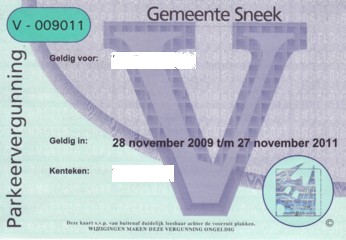
parking licence

Events In My Life Related To 11 September

All these accidents
That happen
Follow the dot
Coincidence
Makes sense
Only with you

State of emergency
How beautiful to be
State of emergency
Is where I want to be

– Björk, Joga

Accidents, emergencies, coincidence and connecting the dots. There is a link between emergency and 11 September, not only because of the number 911 being the emergency services telephone number in the United States, but also because of the terrorist attacks on 11 September 2001 involving emergency services. Starting on 11 September, the remainder of the year has 112 days. And 112 is the European emergency services telephone number. Was someone destined to make sense of these coincidences? There have been a few peculiar coincidences related to 11 September in my life.

It happens that my office in Leeuwarden is close to a former Schuurmans fireworks plant that had exploded in 1971, and the World Trade Centre, a four-story-high building at the time, making a subtle reference to both the Enschede fireworks accident of 13 May 2000 and the 11 September 2001 terrorist attacks. Both events relate to coincidences in my life. In order not to make this a lengthy chapter exceeding your attention span, the focus of this essay is on the connections with the 11 September 2001 terrorist attacks. More recently, they have added an 11-storey hotel to the Leeuwarden WTC, with a restaurant named Élevé on the 11th floor, a subtle reference to the number 11, so 11:11.

Marcel is my brother-in-law, and 11 September is his birthday. On 11 September 200,1 he turned 33 years old. My sister Anne Marie had booked a trip to New York for them both as a birthday present. In the morning, she told him that they were going to New York the next weekend. That afternoon, the terrorist attacks took place. They had to cancel the trip and went to a holiday park in the Netherlands instead.

On 11 September 2010, just after midnight, I turned around in my bed. The bed collapsed, leaving me on the ground, wondering. After standing up, I saw it was 0:33. A few moments later, I realised it was 11 September and that Marcel had turned 33 on 11 September 2001. That was nine years before, while nine is three times three. On the same day, two incidents involving planes occurred at Eindhoven Airport.1 A******* now lives in a suburb of Eindhoven.

On 11 November 2009 (11/11/11 as 2 + 0 + 0 + 9 = 11), I went to the town hall to pick up my new parking licence. It had the number 009011. It was valid until 27 November 2011. If you compress the numbers as numerologists often do, then 27 November corresponds to 9/11, since 2 + 7 = 9, and November is the 11th month of the year. The years (20)09 and (20)11 also refer to 9/11. The remaining digits are 20 and 20 = 9 + 11.

The initials of my last name are KI, which is the Dutch acronym for artificial insemination, so the method for virgins to give birth, as well as artificial intelligence, so the programme that has spawned this world ‘like a virgin’. When translated into digits (A=1, B=2), you get 11/9, or 11 September, in European notation. My first name starts with B, which can be translated into 2. My initials represent the digits that make up the emergency services numbers 911 and 112. I was born on the Iepenstraat, which means Elm Street in English, in a place called Eibergen, a reference to fallopian tubes. The horror film A Nightmare on Elm Street was released in the United States on 9 November 1984 (11/9 American notation) and in the Netherlands on 11 September 1986 (9/11 American notation).

In the spring of 2011, a German car with licence plate KLE-KI-911 passed me in Leeuwarden while I was bicycling to my work. This car passed by a few times around the same time near the same spot. The first time, I only noticed the number 911. Seeing the car multiple times made me notice the extent of the coincidence. KLE are the first three letters of my last name, while KI are the initials of my last name. Dutch licence plates linking my name to 9/11 do not exist. The car appeared where I was going to work, some 200 kilometres from the owner’s home town.

In the spring of 2013, I put the apartment on the ground floor of our house up for rent. A young woman applied for it. She was born on 11 September 1990, it turned out, and so she had turned 11 years old when the attacks of 11 September 2001 took place. A few days later, I called her to inform her that she could rent the apartment. When I called her, her father had just been hospitalised. He died a few days later. That was odd.

Latest revision: 17 July 2026

Featured image: Plumes of smoke billow from the World Trade Center after the September 11 attacks. Michael Foran (11 September 2001). Public Domain.

1. Vliegtuig in problemen landt op vliegveld Eindhoven. Nu.nl (2010). [link]

broken mirror

A Shattered Mirror

Autistic individuals have a social handicap. Yet, it comes with a benefit. We all can think logically, but if you’re autistic, you are less prone to group pressure. Humans are social animals who cooperate by sharing their fictions, such as money, laws, and nation-states, as well as religions and ideologies. We share beliefs to cooperate, so groups pressure their members into accepting them. Most people accept false beliefs or do stupid things to get accepted by the group. That ailment doesn’t plague autistic persons. That sets them apart. Autism is also a failure of intuition, so that autistic people can be inept and poorly adapted to their environments. They might make up for that by analysing the situation. Sometimes, it yields better results because intuition can fail us.

Most of our thinking happens intuitively. Intuition works fast. You can call it fast thinking.1 When our intuition fails us, which may happen when the situation changes, our reason steps in. You can call it slow thinking. You consider and evaluate the options. If intuition suffices, that is a waste of time and energy. Evolution made this happen. Wasting energy reduces your chances of survival, as you must find a new meal sooner, and that meal may not be forthcoming. You could die of starvation because of thinking too much, because your brain consumes a lot of energy. And species that considered all the possibilities when a hungry pride of predators was coming their way didn’t survive.

Great chess players don’t consider all the options. Their intuition presents a few options that their reason consciously evaluates. They thereby ignore billions of options, most of which are not worth considering. That’s what makes them such great chess players. Training and experience help improve our intuition, so intuition is not entirely innate. Our brains have limited processing capabilities. Clogging a brain with countless useless options downgrades its performance. That’s also why we train for our jobs. Chess players may fail to see the best moves. Computers don’t have intuition to consider options and calculate through them. They have sufficient processing power to find better moves than chess players, enabling computers to beat the best human chess players.

So, what if intuition fails you more often than most people? In that case, you consider options other people don’t think of. They may call you crazy or insane. Indeed, most options you consider may not be worthwhile, but you don’t know that until you have found that out yourself. If that applies to you, then you may be autistic. If the condition is sufficiently mild or you are sufficiently intelligent, you can still lead an ordinary life like everyone else, with a job and a spouse. As you lack innate intuition, you must train yourself to do what comes naturally to most people.

An example can illustrate that. Yuor brian autmotaically corercts speillng erorrs. You were probably able to read the previous sentence without any effort. Otherwise, you must solve the puzzle by trying different words in various orders to see if they make sense. In that case, you consider several possible meanings, and perhaps you find something no one else has found. And if there is a hidden meaning, you might only find it in this way.

Many people think of autistic people as weirdos cracking riddles no one else can. Fixing broken mirrors requires patience, dedication, imagination, and determination. Perhaps Newton and Einstein were autistic. They may have appeared to be geniuses simply because they tried ideas others didn’t think of. In this way, they may have discovered things other people couldn’t. Autistic people can keep working on their eccentric projects despite constant rejection. And sometimes, they are on the right track.

Figuring out social rules by trying actions and evaluating others’ responses is a recipe for trouble. Most people make sense of the world intuitively, but if you are autistic, you may have to do it like so. To you, reality appears like a 10,000-piece jigsaw puzzle or a shattered mirror. You must fit the pieces together by applying logic to evidence. That takes a lot of time and effort, and the pieces hardly ever fit perfectly. What you end up with is something similar to what other people consider reality. If you are normal, you make sense of the world intuitively by ignoring misfitting pieces in your model of reality and filling in the gaps with the fairy tales others tell you to believe. However, if you do not, you’re out there, alone in the wilderness, making sense of it yourself.

That can give autists an advantage. As people say, good judgment comes from experience, and experience comes from bad judgment. And autism makes irrational conduct appear irrational, and if you are not autistic, rational behaviour can seem insane. Humans are social animals rather than rational beings. They see crazy as the opposite of normal rather than of rational. So, if irrational is normal, normal people think that rational is insane. And normal is believing fairy tales that have been proven untrue and fighting over them until we are all dead. A group’s survival may depend on the eccentric who walks a different path and accepts the consequences, such as rejection and ridicule. For who else can find the answers when everybody’s intuition fails?

Latest revision: 24 June 2026

1. Thinking, Fast and Slow. Daniel Kahneman (2011). Penguin Books.