The Dark Side

Trade and finance

In the past, ordinary people regarded merchants and bankers with suspicion. In popular culture, trade and banking were the domains of people of questionable ethics. Merchants are as slippery as eels, so it is hard to pin down the issue, but everywhere you see the death and destruction they cause. Hermes, the Greek god of trade, was also the god of thieves. Jesus Christ chased the money changers from the Jewish temple. In The Parable of the Talents, however, Jesus said that you must put your qualities to work. Talents were money, so it could mean putting your money to work. And Jesus said that it is easier for a camel to go through the eye of a needle than for a rich man to enter the kingdom of God.

Jesus lived 2,000 years ago. Economics as we know it now didn’t exist, so we can’t blame him for lacking a consistent view on economics. Someone claiming to be Paul added that the love of money is the root of all sorts of evil. The Jewish sage Jesus Sirach noted, ‘A merchant can hardly avoid doing wrong. Every salesman is guilty of sin.’ The Jews and Protestants excluded him from their canons, but his musings are in the Catholic Bible. Greed, or the pursuit of profit, drives trade. Traditional moral systems considered it wrong. We have gone a long way since then. Today, we hold a different view and see trade as mutually beneficial, so those who engage in trade do so voluntarily because they all benefit. Eels are very slippery indeed. And so are merchants.

Today, trade and finance are at the core of our economic and moral system. And so, Friedrich Hayek could write, ‘The disdain for profit is due to ignorance and to an attitude that we may, if we wish, admire in the ascetic who has chosen to be content with a small share of the riches of this world, but which, when actualised in the form of restrictions on others, is selfish to the extent that it imposes asceticism, and indeed deprivations of all sorts, on others.’ Our ethic is that we can do as we please, as if consequences don’t exist. And the ascetic is selfish when he says everyone should live like him. It is moral depravity at its finest. And so, what was good has become evil, and what was evil has become good.

The problem is not self-interest as such, but greed or the ethic of the merchant, and that the difference isn’t clear. Many merchants are people like you and me without evil intent. Shop owners make a living like everyone else and provide their customers with a service. They are often people who care, not the greedy, evil kind that run Wall Street or sell weapons to warring factions in Africa. But something is profoundly wrong with trade. Even a shop owner doesn’t produce something. They provide a service by trading in markets. And individual merchants may have ethical values, but markets never have them. Everything is for sale. Suppressing trade promotes illicit markets and crime. And so, we accept the drawbacks, thinking the alternatives are worse. That is a fatal mistake.

A pragmatic approach says that outcomes matter more than intent, so if the result of nefarious intent, like greed, is good, it is good. And if the outcome of good intent is terrible, it is wrong or perhaps even evil. If factory owners destroy artisans’ businesses and pay their employees low wages, but overall opulence increases as cloth becomes cheaper, then it is good. Likewise, if a country switches to socialism out of good intentions, but the population starves, it is evil. Before the Industrial Revolution, nearly everyone was as miserable as today’s poorest. Capitalism has lifted billions out of poverty. So why bother?

Trade and finance became the engine of growth, bringing industrialisation, modernisation, colonisation, the slave trade, mass migration, the loss of livelihoods for craftspeople, and the depopulation of the countryside. Various movements, such as socialists, anti-globalists, religious groups, small-is-beautiful, and environmentalists, attempted to provide alternatives to the current order with their visions of Paradise, but they all failed. The system is amoral, a brute force driven by our sentiments and urges. As consumers, we crave the best service at the lowest price, and as investors, we desire corporations to increase their profits. And we don’t think about the consequences.

Usury: the destroyer of civilisations

Money is to the economy what blood is to the body. It must flow. Otherwise, the economy will die. If we stop buying stuff, businesses go bankrupt, we become unemployed, the government receives no taxes, and everything comes to a standstill. That never happens because we spend money on necessities like fast food, smartphones, and sneakers. When we buy less, the economy slows, and we enter a recession, or if it gets worse, a depression. Businesses disappear, and people become unemployed and depressed. Usually, the economy recovers, but it may take time, sometimes decades. It is why we must keep buying stuff, and even more, to make the economy grow.

In the past, when borrowers couldn’t repay their debts, they became the moneylenders’ serfs. It is why several ancient civilisations had regular debt cancellations and why religions like Christianity and Islam forbade interest on money or debts. Usury is paying for the use of money, which is a profoundly evil practice. The evil of it lies in the money flows. We all need a medium of exchange. A simple explanation helps to clarify the issue. Imagine the Duckburg economy running on 100 gold coins. With these 100 gold coins, everyone has enough money, and the Duckburg economy operates smoothly. Scrooge McDuck owns ten, but he is a miser and doesn’t use them to buy items from others.

The economic flows of Duckburg now suffer a 10-coin shortfall. Products then remain unsold, and several ducks lose their jobs. To prevent that, Scrooge McDuck can lend these coins for one year at 10% interest to ducks who come short, so the money keeps flowing. At the end of the year, the economy is 11 short. Scrooge McDuck then lends 11 coins at 10%. In this way, he will own all the coins after 25 years. Scrooge McDuck can implode the Duckburg economy by keeping the money in his vault. When the citizens of Duckburg become desperate, Scrooge McDuck can buy their homes, let them pay rent, and become even richer. If you think that is smart, you have the ethics of a merchant. It demonstrates why, in traditional popular culture, merchants and bankers were evil.

Two things have changed since then. Starting with the Industrial Revolution, economic growth picked up, which helped to pay for the interest charges. The nature of money has also changed. It isn’t gold anymore. Nowadays, banks create money from thin air, so the nature of usury has also changed. When you go to a bank and take out a loan, such as a car loan, you get a deposit and a debt that the bank creates on the spot by creating two bookkeeping entries. The deposit becomes someone else’s money once you purchase the car. When you repay the loan, that bank deposit and the debt disappear. You must repay the loan with interest. If the interest rate is 5% and you have borrowed € 100 for a year, you must return € 105.

Nearly all the money we use is deposits created from loans that borrowers must return with interest. Banks might pay interest on deposits. The depositors of a bank act like Scrooge McDuck. They have more money than they need and keep it in the account at interest. If they have borrowed € 1,000,000 at 5% interest, they must return € 1,050,000 after a year. Where does the extra € 50,000 come from? Here are the options:

  • borrowers borrow more;
  • depositors spend some of their balance;
  • borrowers don’t pay back their loans;
  • the government borrows more or
  • the central bank prints the money.

Problems arise when borrowers don’t borrow and depositors don’t spend their money. In that case, borrowers are € 50,000 short, and some can’t repay their loans. If many borrowers can’t, you have a financial crisis. Borrowers can reduce their spending to pay off their debts, leading to a slowdown of the economy. The economy is also unstable due to investor expectations. They expect more in the future. If debts remain unpaid or people stop spending, they incur losses and may lose trust and stop investing.

If they lose trust, they stop investing, less money flows into the economy, businesses go bankrupt, people become unemployed, and more borrowers get into trouble. As a result, even less money flows, causing banks to go bankrupt. Economists call it deflationary collapse. That happened in the 1930s, causing the severest economic depression in modern history. There was no money in the economy because lenders feared losing it. To prevent that from happening, governments run deficits and central banks print currency whenever there are shortages in the money flows. With interest on debts, these things are hard to avoid. But if the system never collapses, debts and interest payments only grow.

The 2008 financial crisis could have been much worse than the 1930s, potentially leading to the collapse of civilisation as we know it. That was due not only to the accumulation of far more debts but also because most people now live in cities, where they have become dependent on markets and governments. In the 1930s, most people still lived in the countryside. Central banks prevented a collapse by printing trillions of US dollars, euros, and other currencies. The shortfall was that enormous. We now buy our necessities in shops and rely on the government to keep the system running. We have not only become the usurers’ hostages, but also the hostages of markets and governments.

Barataria: an economic fairy tale

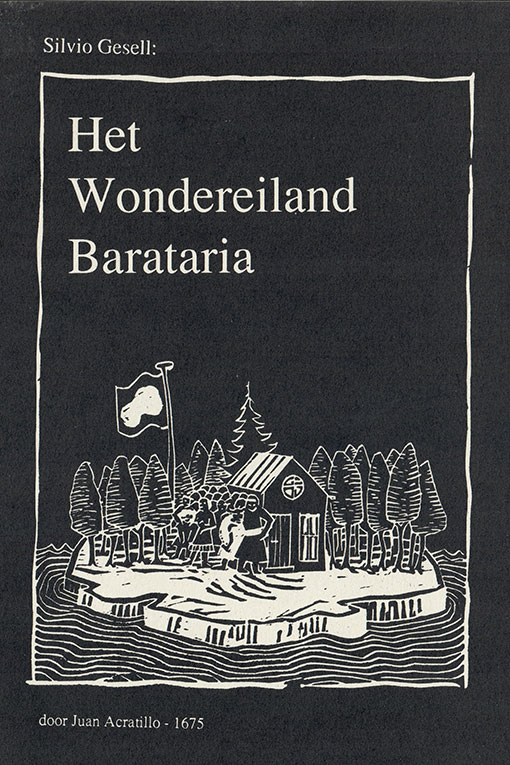
Money equals power, and the lure of riches corrupts us, so the alternatives to the system of trade and usury have failed. They can’t compete. A few people step out, but it is like a rehab from a consumption addiction. It is a sober life while everyone around you keeps on living the good life. After us, the deluge is the prevailing mood. The deluge is already taking off. Storms feed on the warming sea water and leave their burden on our shores. But what are our options anyway? In the early 1990s, the Strohalm Foundation published The Miracle Island Barataria, an economic parable by the Argentinian-German economist Silvio Gesell.1 I rewrote the narrative somewhat to better highlight its message. Gesell explores three options: (1) communism or socialism, (2) a market economy without traders and bankers, and (3) a fully capitalist economy.

In 1612, a few hundred Spanish families landed on Barataria, an island in the Atlantic, after their ships had sunk. The Spanish government believed they had drowned, so no one searched for them, and they became an isolated community. They worked together to build houses, shared their harvests, and had meetings in which they decided about the affairs that concerned everyone. It was democracy and communism. After ten years, the teacher, Diego Martinez, called everyone into a meeting. He noted that working together and sharing had helped them build their community, but the islanders had become lazy. They came late to work, took long breaks, and left early. They spent their time at meetings discussing what to do, but much work remained undone.

‘If someone has a good idea, he must propose it in a meeting to people who don’t understand it. We discuss it but usually we don’t agree or we don’t do what we agree upon. And so, nothing gets done and we remain poor. We could do better if we have the right to the fruits of our labour and take responsibility for our actions,’ Martinez said, ‘The strawberry beds suffered damage because no one had covered them against night frost.’ He mentioned several other examples. Martinez said, ‘If the strawberries are yours, you protect them. And if you have a promising plan you think is worthwhile and you can keep the earnings, you do it yourself and hire people to help you.’

He proposed splitting the land into parcels and renting them to the highest bidder to finance public expenses. Fertile lands would fetch a higher price than barren ones, giving everyone an equal opportunity to make a living. He also proposed introducing ownership so the islanders would feel responsible for their property. But with property, you need a medium of exchange or money. The islanders decided to use potatoes as money. Everyone needed potatoes. They had value, so they were good money.

Potatoes are bulky, thus difficult to carry, and they also rot. At the next meeting, Santiago Barabino proposed setting up a storehouse for potatoes and issuing paper money, which could be exchanged for potatoes when needed. So, you had banknotes of 1, 2, 5 and 10 pounds of potatoes. The Baratarians agreed. The notes had a date of issue and gradually lost their value to cover the storage cost and rot. If you returned the banknote to the potato storage after a year, you received 10% less. And because the issue date was on the banknote, buyers and sellers knew its value.

For several years, Barataria had banknotes representing stored potatoes. Their value declined over time to pay for the storage and the rot. Borrowers didn’t pay interest. If you had savings, you would lend them to trustworthy villagers if they agreed to return notes representing the same weight. The notes lost value, making everyone spend their money quickly and store items and food in their storehouses. The general level of opulence rose, but there were no poor or rich people. There were no merchants buying things at a low price to sell them at a high price. Businesses didn’t pay interest, and there were no merchants, so things were cheap in Barataria. The chronicle notes that the islanders acted as good Christians and helped each other.

Then Carlos Marquez had a new idea. He addressed Baratarians, ‘How many losses do housewives suffer from keeping food in their storehouses? We shouldn’t put our savings in perishable products, but money with stable value. We can back our money with something we don’t need and doesn’t deteriorate. The Pinus Moneta is a nut we can’t eat, and doesn’t rot,’ he said, ‘We don’t have to back money with a commodity of value like potatoes. The things we buy and sell give the money its value. If we do that, we can buy things when we need them and don’t have to store them ourselves.’

What a great convenience that would be. It seemed too good to be true. Diego Martinez argued against the proposal. He told his fellow islanders that a medium of exchange passes hands. It remains in circulation. But savings stay where they are unless those who are short of money borrow them and pay interest. You end up paying interest to use the currency you need to buy the things you need. His argument was to no avail. And that is the price of democracy. People often decide about questions they don’t understand.

Most islanders preferred to spend their time getting drunk in the pub instead of studying the issues of government. And if you are doing well, you can’t imagine that seemingly insignificant errors can ruin you. Marquez spoke passionately, while Martinez warned cautiously, saying things were fine as they were and he couldn’t foresee the consequences. That swayed opinions. The islanders switched to money backed by the Pinus Moneta. This money didn’t lose its value. That made it attractive to save money.

Suddenly, everyone tried to exchange their supplies for the Pinus Moneta, causing mayhem in the marketplace. Everyone brought everything they had to the market. But no one could sell their goods because everyone wanted money. That was until the company Barabino & Co came up with a plan. Barabino & Co. set up a bank with accounts that Baratarians could use for saving and making payments. Everyone could bring their money to the bank and receive an extra 10% after a year. The naive Baratarians agreed. They could have known there weren’t enough nuts of the Pinus Moneta to pay the interest. And they didn’t ask themselves how Barabino & Co. would generate the profits to pay that interest. With this borrowed money, Barabino & Co. bought goods from the islanders and deposited money into their accounts, but Barabino & Co. only purchased food and seeds.

The following spring, Barabino & Co. hiked food and seed prices. Most islanders paid more for food and seeds than they received in interest. They went into debt with Barabino & Co. With the profit, Barabino & Co. bought the next harvest and cranked up food prices even further. Soon, Barabino & Co. owned everything. Most were in debt and worked hard, but a few wealthy people lived off interest income. They didn’t work and lived a life of luxury on the interest on their accounts. The Baratarians needed money to pay for the items they bought from Barabino & Co. They had to borrow this money from Barabino & Co. and pay interest to use it. There weren’t enough nuts to pay back all loans with interest, so the islanders went further into debt year after year. They paid interest on money the bank created out of thin air, giving it to the wealthy. That is usury.

The Baratarians worked harder and grew more creative in earning money. The islanders invented, produced and sold more products, most notably wooden items made from the trees on the island. Not everyone could keep up, and more people lived in the fields. At least, the economy grew, and the Baratarians grew accustomed to luxuries they hadn’t had before. They had wooden chairs, boxes, ornaments, toys, outhouses, carts and tables. The islanders had managed without these items before, but now, they believed they needed them.

The change came with other unfavourable consequences. The Baratarians became agitated, deceitful, and immoral. Crime rose as everyone desired the luxuries that the rich enjoyed, and for which they didn’t have to work. Of their Christian faith, not much remained except an empty shell. They were busy making money. Then came the day the Baratarians had cut down all the trees on the island. They suddenly lacked the wood needed to make the tools for harvesting their crops, and they starved. That was the day the Pinus Moneta lost its value. After all, you can’t eat money.

Adam Smith and the Wealth of Nations

The tale tells how devious acts contributed to an outcome most of us now deem desirable. By selling our souls to the money god, most of us have a better life than people in the Middle Ages. That improvement came with wars, colonialism, the slave trade, pollution, and miserable working conditions, and ultimately, it could bring the end of human civilisation. With the help of saving and investing, capitalists build their capital. Capitalism is about making sacrifices in the present by saving to have a better future via investing. It also led to a mindless process called competition via innovation and economies of scale. Economists call it creative destruction.

In the original tale, the wood didn’t run out, but the British rediscovered the island to find a class society much like theirs. The story tells how devious acts contributed to an outcome most of us now deem desirable. By subjecting ourselves to this system of trade and usury, most of us live a more agreeable life than people in the Middle Ages. It came with wars, colonialism, the slave trade, pollution, miserable working conditions, the destruction of communities and societies, and, eventually, the end of human civilisation. With the help of saving and investing, capitalists build their capital. Capitalism involves making sacrifices in the present by saving to have more in the future via investing. You can always do better. It promoted competition via innovation and economies of scale. But there is no ultimate goal, a vision of Paradise, only creative destruction without end.

The Baratarians were in debt, worked hard and were creative. Those who couldn’t keep up became homeless. As there was never enough money to pay back the principal with interest, the Baratarians went deeper into debt, worked even harder and became more creative by inventing and selling new products, producing an economic boom that ended in starvation once the trees were gone. It looks like the problem we face. The Earth’s resources are finite, and interest accumulates to infinity. Our money becomes worthless once there is nothing left to buy or sell.

Adam Smith, the founder of modern capitalist thought, claimed that pursuing our private interests promotes the public good. A baker doesn’t bake bread to serve the community but to make a living. It is why we have something to eat. The baker doesn’t want to lose customers, so he bakes what they desire. Otherwise, they go to his competitor. Smith believed it would work out well as humans are moral creatures. We temper our behaviour as it affects others. Therefore, moral relativists could argue that we don’t need public interest. The private interest will do just fine. But it is not how markets operate. We may have ethical values, but markets never have them. The least scrupulous usually wins the competition, so the greater evil usually wins in the markets. We have found that out and now want governments to oversee the markets.

Factory owners didn’t consider the plight of the artisans they put out of business or the miserable working conditions of their workers. They would have gone out of business if they had done so. Moral considerations don’t drive business decisions, so psychopaths end up in high places in corporate management.2 These psychopaths in business provide us with harmful products like cigarettes, prostitution, gambling casinos, and semi-automatic rifles. They expand their market by advertising their wares. A merchant will say, ‘If I don’t supply the market, someone else will, so why not profit from death and destruction myself?’ The merchant then claims liberty is the highest value, and restricting markets equals oppression, thus the ultimate evil. Why not let everyone buy cocaine and semi-automatic rifles? It increases GDP. These are the morals of the merchant we now live by.

Without self-interest and trade, we would be poorer, and poverty was Smith’s primary concern. Increasing production was the way out. Self-interest and trade were the tools to achieve that. It succeeded marvellously. Since the Industrial Revolution, production increases have lifted billions of people out of poverty. Adam Smith argued:

  • The division of labour drives production increases. If you specialise in a trade, you can do a better job or produce more at a lower cost.
  • A market’s size limits the division of labour. Transport costs limit market sizes. Energy cost drives the volume and distance of trade.
  • Merchants preferred precious metals as money. It enabled them to store their gains, allowing them to wait for opportunities to make financial profits.

Producers produce items at different times, in different locations, and in different quantities than consumers need. That is why we trade. Traders bridge those gaps by storing, transporting, and dividing goods. Trade promotes large-scale production and labour efficiency, so fewer people provide for our necessities. That allows for more fanciful products and services and industries, thus a higher standard of living.

The evil empire of trade and usury

Economic and financial power translates into military power. The Europeans didn’t finance their conquests with taxes but with the profits from their colonial enterprises. No one likes to pay taxes, but everyone loves a profit. The scheme thus became an unprecedented success. Venture capitalists paid for the first ships, hoping to find new trade routes and riches. And they found them. The Europeans reinvested their profits, so their capital grew, and their financial and military strength increased.

After the bourgeoisie had taken control of the British government during the Glorious Revolution, the British state became a venture of the propertied class, like the Dutch Republic already was. The Dutch Republic, run by merchants, was the most successful and wealthiest nation at the time. The British imported knowledge of Dutch governance by appointing a Dutch governor as their king. In the following centuries, Great Britain became the world’s largest empire.

The British bourgeoisie benefited from a functioning state and was willing to pay for it. The storyline is that taxation became legitimate as it had the consent of the taxed. The British bourgeoisie didn’t like to pay for corruption or ineptitude, so the state’s performance improved.3 With its secured and enlarged tax base, the clamp down on corruption and ineptitude, the invention of modern banking, including a central bank, trust in British financial markets improved, and Great Britain could borrow more at lower interest rates.

It helped Great Britain to defeat France, a country with twice as much wealth and twice as large a population. In France, the wealthy didn’t pay taxes, and the government was always short of funding. France defaulted on its debts several times. The French government was inept and corrupt, which made lenders unwilling to lend to it. The British economic successes, thus having a large market, low interest rates, and high wages, helped to ignite the Industrial Revolution.

During the Napoleonic age, several European countries modernised their governments into modern bureaucracies, with career paths based on qualifications and merit. The British later also modernised their administration, aligning it more with the rational principles of government that other European countries had adopted after the French Revolution.4 The benefits of the division of labour imply it is better to let bureaucrats run bureaucracies and businesspeople run businesses. You don’t let government bureaucrats run a business, nor do you allow your businesspeople to run the government.

The United States followed a different path. When the Founding Fathers set up their new state based on the modern principles of their time, they were ahead of Europe. They introduced regular elections for the president and parliament and a separation of powers between the administration, parliament and the judiciary, thus creating checks and balances to prevent dictatorship or mob rule. The US also became the first democracy. All free men had received the right to vote by 1820.4 Several European countries later followed suit.

The US administration, however, didn’t become a modern professional bureaucracy at first, and the US government remained plagued by corruption, cronyism, and the presence of unqualified individuals. Politicians gave their supporters government offices when they won the election.4 In 1881, a disgruntled man who had campaigned for US President Garfield and sought a diplomatic job as compensation shot the president. Appointing people for political reasons had become unthinkable in most of Western Europe. Modernisation efforts in the US began in the 1880s, took decades, and never fully succeeded. Political appointments are now making a comeback.

The founding fathers had set up the United States as an oligarchic republic run by the propertied classes, similar to Great Britain and the Dutch Republic. Rather than leaning on a clean government like the British elites, the American elites learned to employ corruption, for instance, via campaign financing, bribing judges, and funding think tanks that advise the US government. After World War II, the United States emerged as a superpower, and the gold-backed US dollar became the currency used in international trade. To finance its military, the US began to run deficits in the 1960s and ended the exchangeability of the US dollar for gold in 1971. The US dollar then became the de facto reserve currency, most notably because oil-exporting countries continued to accept the US dollar.

The US dollar’s reserve status allowed the US elites to employ the productive capacity of the rest of the world for their empire. Foreign countries delivered goods and labour in exchange for US dollars, which the United States printed out of thin air. The US financial elites in institutions like the World Bank and the IMF pushed developing countries into US dollar debts, which made them depend on exports to serve the US empire. As a result, the domestic economy of the United States began to suffer from the Dutch disease. The Dutch natural gas exports created a demand for the guilder, which drove up the Dutch currency and made Dutch industries uncompetitive in the 1970s.

The Dutch remedied the issue in the 1980s by making a collective national agreement between the government, employers, and unions to keep wage increases below those of its competitors for several years. Demand for the US dollar, however, increased, not because of exports, but because of foreign nations being dependent on it, pushing up its value and eroding the competitiveness of American manufacturing. And the US didn’t need to correct that issue, because of the US dollar’s reserve status.
The US dollar has become an international store of value, and so has US government debt. There was even pressure to go into debt, to satisfy the global demand for US dollars. As a result, deficits have escalated further, and the American economy depends on controlling the world’s financial markets. The American empire is now the Evil Empire of Trade and Usury, the Babylon of our time. However, the end of an empire doesn’t always turn things for the better.

Latest revision: 7 August 2025

Featured image: cover of The Miracle Island Barataria

1. Het wondereiland Barataria. Silvio Gesell (1922).
2. 1 in 5 business leaders may have psychopathic tendencies—here’s why, according to a psychology professor. Tomas Chamorro-Premuzic (2019). CNBC.
3. The Origins of Political Order: From Prehuman Times to the French Revolution. Francis Fukuyama (2011).
4. Political Order And Political Decay. Francis Fukuyama (2015).

Grapevine snail. Jürgen Schoner.

Learning Opportunities

In 2005, our government office embarked upon an ambitious systems renewal project. The IT director aimed to make a mark by replacing our existing IT systems with a brand new solution. As the story goes, the IT director had visited Oracle headquarters near San Francisco. He could get a steep discount on the Oracle ERP solution. I wasn’t a firsthand witness, but several colleagues gave similar accounts. And so, it could be the truth. ERP can administer an entire business. It is a total-for-everything solution, but only if you model your business the way ERP prescribes. In other words, every department must change how it conducts its affairs. It is like a straitjacket. That makes ERP awkward to use.

It wasn’t a good idea to purchase an enterprise solution without first considering whether you need it. But instead of the IT director admitting he had bought the ERP on a whim and writing off the license fee, which would have been a minor loss of a few hundred thousand euros, perhaps, he sought to justify the purchase. Possibly, the IT director wanted to save face, but you wouldn’t expect that kind of vanity from a devout Christian like him. He hired business consultants to assess the quality of our IT systems and write a report to propose a solution. Unsurprisingly, the report stated that our systems were obsolete and that we should switch to Oracle ERP, as that would save us a lot of money. And now I spill some beans. These outdated systems were still doing fine fifteen years later.

A strategic information planning phase preceded the project. Cap Gemini business consultants organised brown paper sessions where employees could help identify the business requirements. It was different from what I had learned as a student. I had a good grade, but as a student, I was naive and believed good grades mattered. We had to list our components by writing them on brown paper and sticking them to the wall. The consultants would then call their services. I wrote the word database on brown paper and stuck it to the wall, and the Cap Gemini business consultant concluded that we needed a database service. That didn’t seem like a proper strategic business analysis to me. Anyone could paste the word service behind the name of a component. It dawned upon me that it might not end well. Cap Gemini charged over €150 per hour for their consultants, who dressed in suits, leading managers to believe they possess strategic information planning expertise.

There were political troubles early on. A Cap Gemini project leader left because she didn’t share the vision of the IT director. He surrounded himself with yes-men. In the Information Planning course at the university, we learned that you must first define the business requirements and then select a solution based on these requirements. It can save you a lot of trouble. The business consultants did the opposite as they tried to justify a choice already made. Over time, it grew into an all-encompassing megalomanic plan. Most departments didn’t want to have the IT department dictate their operations. And so, the consultants planned to supplement the Oracle ERP with several special-purpose modules. Making special-purpose software would render ERP pointless, as the whole point of using ERP was to avoid building such software.

We didn’t dive into the deep end without first testing the waters, so we initiated a pilot project to develop a basic system using ERP. It was a brand new system to administer Plukze, a law that allowed the government to confiscate the assets of criminals. Plukze was a straightforward bookkeeping system, and ERP can keep books well, so the pilot succeeded. It was like sending a rocket into the sky and then, after a successful test, deciding to put a man on the Moon. That is an entirely different ballgame.

I received training to become an administrator of the system. I made a mistake by putting a database index on maintenance while the ERP system was running. The ERP proved to be more sensitive to regular database maintenance than the Designer/2000 systems, and the ERP began to malfunction. I mentioned my index maintenance as a likely cause. We restarted the system, which resolved the issue. I remarked that I hadn’t anticipated the problem as regular systems could handle such a simple operation, which implied criticism of the new system. For all kinds of simple actions, the ERP had lengthy instruction sets that you could find on the Oracle support website.

You couldn’t simply reorganise an index or do other database maintenance while the system was running. I had yet to learn that. The environment was politically sensitive because the IT director’s pet project was at stake, so many were on edge. The project leader, likely fearing for his career, complained about me to higher management, labelling me unfit. And so, they took me off the project. Fear was in the air. A circulating story was that the IT director threatened a manager in the elevator who had openly disagreed with him during a meeting. I was open about my mistakes and views, and that didn’t help me.

After the pilot proved a success, the enterprise systems renewal project took off. Once it had started, Oracle began to determine its direction. Oracle consultants soon found that we needed additional solutions from Oracle and, of course, the latest technology. Some of these technologies were still in the marketing phase and had not yet proven to work. Our decision-makers, the architects and managers, agreed. So when the special-purpose software proved cumbersome and inadequate, they tried new ideas, such as using BPEL, a business process model language, on top of ERP. This way, the business model could be tailor-made while still using ERP, or so they promised.

No one had done that before, and for good reasons, as it turned out, so even Captain Kirk wouldn’t have gone there. The other consultants, hence those who were not from Oracle, were there to make money for their employers by making the customers happy, so they tried the idea. And if you are critical, you will undoubtedly be first in line for the course Professional Skills. I am a special case. Despite working in information technology, I am not keen on using unnecessary new technologies and try to live without them. And so, I had no smartphone until 2020. By then, functioning in society without one had become practically impossible.

The pointlessness of the project began to demoralise me. Goals were constantly changing as ideas were always failing. IT employees became stretched to their limits for years in a row. Software releases that took one person and a few minutes with Designer/2000 took hours or even days, and required a dozen specialists working according to a script of up to fifty steps. Working late or on weekends became a regular affair, including ordering pizza, Chinese, or other food, as you can’t bring down the system for so long during office hours. The database administrators bore the brunt of the pressure as the job role expanded to everything related to Oracle. Everything we did was Oracle, so database administration became the focal point for all the advanced stuff. And that began to take its toll, and I started to suffer from stress and repetitive strain injury.

My colleague Kees, the tech genius, was kind and helpful. You could call him at home, and he would help you. One evening, before the system renewal project had started, I once feared I had messed up a vital database during a maintenance operation. I called him at home. He came over and helped me check it. But Kees was too helpful. He enthusiastically jumped on every crazy plan our management devised. He was an innovator and loved new technologies, which made him the management’s darling. I lagged behind Kees, but the other database administrators couldn’t keep up at all. It was like having a Trojan horse inside our department as the project pushed more and more unmanageable technology into the department. Kees didn’t look after the department’s interests but the project’s. The things he invented and built had to be kept up and running by the others. Kees didn’t make a lot of notes, but was always willing to help us. Indeed, the entire systems renewal project might have collapsed had Kees gone missing.

Our managers had no clue what they were doing and believed more advanced technology like Oracle RAC clusters would fix things, but that only aggravated our troubles. RAC was pointless, required additional knowledge, and was still prone to failures, even though much less than previously, as the technology had matured and the new systems were on Unix. And so, I would sometimes sarcastically note, ‘The most reliable RAC cluster is one with one machine.’ That was the same as not having RAC at all. Pesky problems piled up on my desk. I constantly had to learn new skills. Project leaders pressured me to work on plans that were bound to fail. That couldn’t go on. I wanted to help people, but it was better not to fix other people’s problems or work on ideas that would fail. People were creating problems at a much faster pace than I could fix them. There was too much work, and most of it was pointless.

The escalating stress compelled me to make radical changes, focusing on the most critical issues while avoiding those that were pointless or doomed to fail. Whenever multiple project leaders pressured me, I referred them to my manager, saying, ‘He should set the priorities.’ Whenever a colleague tried to bequeath his pesky problem to me, I explained how he could fix it himself. ‘It begins with using Google,’ I said repeatedly. At the time, not everyone used search engines. Many still relied on their knowledge, manuals, and support from Oracle. Google has helped me solve more issues at a faster pace. Often, someone else has had the same problem and posted the solution on the Internet. But if you solve more problems, you get even more. It was a learning opportunity. If you solve other people’s problems, they stop thinking for themselves. I had to stop doing that.

As things spiralled out of control, our management decided we needed more qualified database administrators. Our salaries were too low to attract the right people, so they gave the new hires and Kees a higher salary grade while leaving me out. They also increased the number of temporary positions. The headcount went from four to fourteen database administrators. And still, we couldn’t handle the workload. Kees was a brilliant technician, and despite that, or perhaps partly because of that, things went downhill.

Kees was quicker on the job than I, except on one notable occasion when a system administrator had wiped out a disk on which several crucial databases resided. It caused a crisis, prompting all the database administrators to scramble and restore the data, bringing the systems back online. I was the first to develop a working procedure for restoring databases and getting them back online, which the others then used. It doesn’t seem a mere coincidence. It was the third major crisis that the database administrators had to fix.

Temporary hires came and went. One of them was Ronald Oorlog. His last name means war, and he was ill when the World Peace temporary tattoo from the candy vending machine ended up in my hands. Rene H was the one who often joked about a master copy of the ERP system containing the settings, quoting a line from The Lord of the Rings, ‘Master precious… master precious…’ Another, Chris, told me he had met Jesus in his effort to evangelise me. He said it as if he had encountered Jesus in person, as if Jesus had walked around and he ran into him. In hindsight, it was a noteworthy coincidence.

As things spiralled out of control, our management decided we needed more qualified database administrators. Our salaries were too low to attract the right people, so they gave the new hires and Kees a higher salary grade while leaving me out. They also increased the number of temporary positions. The headcount went from four to fourteen database administrators. And still, we couldn’t handle the workload.

Yet another colleague, database administrator Raoul, had roots in the former Dutch colony, Suriname. He once made a surprisingly frank statement. He worked for his uncle, he told me, who also came from Suriname. Apart from him, his uncle only hired native Dutch. ‘That is because the Dutch are more reliable,’ he added, ‘They do the job as agreed. You don’t have to check on them.’ I supposed it was true. Otherwise, he wouldn’t have said it. Surinamese don’t take life as seriously as the Dutch. The Dutch might call the Surnamese relaxed or even lazy, as many of them seem to think that you can do tomorrow what you failed to do today. Don’t read this as only criticism. After all, doing nothing is better than doing something stupid.

The year 2008 neared its end, and things took an unexpected turn. God seemed to have a message for me. Long-lasting stress can cause psychosis, so here is the probable cause. My perspective on what mattered changed profoundly. The job became a sideshow, and most of what we did at work was pointless. It was time to set the right priorities, cut my working hours and work on the project I gradually came to name ‘The Plan For the Future.’ Despite that, my performance at the job remained acceptable. We had so many database administrators that database administration became a separate department headed by a manager who knew the job because he had been a database administrator previously.

This manager held me in high regard because I tried to control the workload by focusing on what mattered and trying to halt foolish plans. In 2011, he called me an example for all the others in front of all the others. He shared my view that Kees acted like a Trojan horse, causing trouble to the database administration department. Even fourteen database administrators couldn’t handle the workload, indicating that something was seriously wrong. Still, Kees was only a facilitator, not the culprit, because it was the IT director’s pet project, and our systems architects let Oracle drive the agenda. The focus was on new technologies rather than building a functional system. Everyone else went along with it, so sometimes it felt like being the only rational person in an insane environment.

After several years and spending over 100 million euros, the new system finally went into operation. That brand new system, which had cost so much effort, only accepted incoming messages and acknowledged their reception. Over a hundred people had worked on it for years. An experienced programmer might build a programme capable of doing only that in one day. It was a bloated set of software and machines with the latest technology, including RAC databases, but it was capable of nothing. The IT director had organised a party in which he proudly announced that we finally had a system made ‘under architecture.’ By phrasing it that way, he made it seem as if architecture was the project’s main objective. It made me think that our architects were incompetent. Those I saw in meetings didn’t debunk that impression as they spoke vaguely and made simple things appear complicated. It would take me years to nuance that prejudice.

Again, as the story goes, our board then made a politically brilliant move by selling the project as a success to the government in The Hague, arguing that after spending more than 100 million euros, they needed a few million more to fix the remaining bugs. It worked. Appearance can go a long way to hide the facts. The board used that money to hire a software company to rebuild everything in Java in nine months. From then on, the ERP only did the financial administration, but they made it appear that the new Java software was just an add-on to the ERP. The budget was tight. There was no money for testing and fixing bugs.

Unsurprisingly, the new Java systems crashed nearly every day, and the problem lists grew so long that no one could keep track of them. The Java systems consumed a lot of resources and generated a lot of data, such as millions of messages that no one dared to discard. Perhaps, you could use them to find out what went wrong. And so much went wrong. These systems were dreadful, not only for us but also for those who used them. They split up the database administrator department into Oracle Designer 2000, called legacy, the ERP and Java systems, called Enterprise Architecture, and new developments. We had a say and could give our preferences. I didn’t want to work with the problem systems of Enterprise Architecture, but I ended up in that horror show together with Sico, as no one else wanted to. Sico was our ERP specialist, and I was one of the few with ERP knowledge, so I was doomed beforehand.

Over the years, I had grown cynical about everything our board and management were doing. During the crisis and the strategic information planning phase, they had proven to be a bunch of clueless clowns. The systems renewal project confirmed that impression. Only one project succeeded in those years, building an old-fashioned Designer/2000 system. Had we made the other systems using Designer/2000 or its successor tool APEX from the start, it might have cost less than 5%, and it would have succeeded. But then again, that was old technology, so it had no future. And so, I didn’t foresee at the time that Java would turn out to be the right choice.

The new Java systems used a hundred times as much memory and disk space as the Designer/2000 systems for doing the same job. That was an understatement. Making a fair comparison was difficult. The outcome of my calculation was 3,000 to 16,000 times as much. However, the new systems initially processed low volumes of transactions and would scale up. Our architects didn’t see resource consumption as an issue. The price of memory and disks went down over time. Cheap resources make us wasteful, and you can see that everywhere around you. We can do without over 99.99% of the data we store.

Unsurprisingly, the data storage became overburdened. We were too far ahead of our time. The IT director then fired the manager responsible for data storage, citing that corporations like Google and Facebook can scale up quickly. Only, we weren’t Google, but an insignificant government agency with a few hundred IT employees. I was on leave when it happened. I learned about it the following Monday and thought, ‘The IT director is responsible for the mess. He is the one who should be fired.’ A few hours later, a soccer club, VVV from Venlo, fired its trainer, who had the same first and last name as our IT director.1 Now that is a remarkable coincidence.

The failed systems renewal project became a learning experience. The government in The Hague had smelled the rat and had sent someone to oversee the CJIB and reorganise it. The IT director had to go. Geert replaced him. He was the manager who had promised to restore my confidence in my employer, but left me out for the promotion that the other senior database administrators received. Geert didn’t have a bureaucratic mindset. Rather than depending on procedures, he gave us responsibility and confidence.

We began working in smaller teams, handling a few systems owned by a single department. As a side benefit, there was less hassling between business units competing for resources. And we began working in smaller steps. That makes software development manageable. This way of working is agile. The symbol of agile is a snail. You know, as agile as a snail. Just kidding. Twenty years earlier, the insurer FBTO had already organised its IT department in a similar fashion, which worked well.

Leadership does make a difference. The IT department got its act together under Geert’s leadership. In 2025, many other government offices have yet to catch up. Bureaucratic rules still make our work harder than it needs to be, but today, they aren’t an excuse for evading your responsibilities. And so, this story comes with a few learning opportunities. First, without the right vision, you fail, no matter how hard you work. Second, you can’t change everything at once. You must have a long-term vision. Third, things hardly ever go according to plan. It is better to work in smaller steps towards your goals and make adjustments on the way. And you should give people confidence. We make mistakes. But if we do, we should learn from them to do better next time.

Latest revision: 2 August 2025

Featured image: Grapevine snail. Jürgen Schoner (2005). Wikimedia Commons. Public Domain.

1. VVV-Venlo ontslaat trainer Van Dijk. Nu.nl (20-12-2010). [link]

Sign Hell, Norway, CC BY-SA 3.0

Satan and Judgement Day

Satan has always been God’s trustworthy servant. Some experts on the matter say he began his career as a serpent in Eden and later took charge of the furnaces that burn the evildoers for eternity. Others disagree and claim he is a fallen angel named Lucifer who didn’t do any grovelling in Eden. His task was to make God look good. We like to believe God cares for us, but prayers often remain unanswered while bad things transpire, such as misfortune and unpleasant neighbours. How can an almighty, good God allow this to happen? The obvious answer is that there is no god, or God doesn’t care. That is not what we like to hear. Once the Israelites had done away with Baal, Astarte and the others and switched to monotheism, they had to address this uncomfortable issue.

Suddenly, they had no one to blame for their misfortune except themselves. How could that happen? After all, the Israelites were God’s chosen people. Did they do something wrong? So, if things went wrong, it was time to repent, prophets like Isaiah and Jeremiah claimed. There usually was some idolatry or depravity occurring in their midst. That must have made God angry, the prophets proposed. But even when the Israelites prayed relentlessly, lived according to the Ten Commandments, and did all the prescribed rituals and offerings, things often didn’t improve. Why? It was a tricky question.

The Israelites dedicated an entire book, the Book of Job, to the issue, dubbed the problem of evil. Job was a particularly pious and virtuous man who was doing well. But on a fateful day, Satan challenged God by claiming that Job’s devoutness was due to his prosperity. His belief was insincere, Satan argued. God could not allow the mere possibility of insincerity and agreed to test Job and let Satan ruin Job. Even after the loss of his possessions, his children, and finally, his health, Job still refused to curse God. Job did everything God could expect of a faithful servant and more, or so it seemed.

Job’s friends tried to comfort him and figure out why he was suffering and what he could do about it. They suggested Job might have done something wrong. But Job proclaimed his innocence and complained about his fate. In the end, God showed up, telling him to shut up. His sin was hubris because he thought he didn’t deserve to suffer. Everything happens for a reason. It wasn’t entirely satisfactory, so Satan’s role gradually enlarged over time, and he came to do the dirty work so God’s hands remained clean. Still, in the Bible, God killed millions, while Satan only murdered a dozen. And nothing ever happens without God willing it, so God is responsible for Satan’s mischief also. The problem of evil remains unresolved and continues to boggle many minds today. How can a good God let evil happen or even do evil? That we are mere amusement was something few could think of, let alone accept.

The Quran says Satan is a fallen angel named Lucifer (Iblis) who, unlike the other angels, refused to bow to Adam. It alludes to Isaiah, where the morning star fell from heaven (Isaiah 14:12-14). Isaiah probably referred to a Babylonian king, but Luke says that Jesus saw Satan falling from heaven (Luke 10:8). A scribe probably noticed the similar phrasing and had his eureka moment. He could explain how Satan popped up and couldn’t resist sharing his findings with the other scribes, so it became the Christian interpretation of Isaiah’s words, which Islam took over. Also, Satan’s unwillingness to bow to Adam comes from an obscure Christian source. The Quran notes, ‘The angels prostrated themselves, all together. Except for Satan. He refused to be among those who prostrated themselves.’ (Quran 15:30-31) Then follows a conversation between God and Satan (Quran 15:32-42),

God said, ‘O Satan, what kept you from being among those who prostrated themselves?’

Satan said, ‘I am not about to prostrate myself before a human being, whom You created from clay, from moulded mud.’

God said, ‘Then get out of here, for you are an outcast. And the curse will be upon you until the Day of Judgment.’

Satan said, ‘My Lord, reprieve me until the Day they are resurrected.’

God said, ‘You are of those reprieved until the Day of the time appointed.’

Satan said, ‘My Lord, since You have lured me away, I will glamorise for them on earth, and I will lure them all away except for Your sincere servants among them.’

God said, ‘This is a right way with Me. Over My servants you have no authority, except for the sinners who follow you. And Hell is the meeting-place for them all.’

Like in the Book of Job, God and Satan appear to be on speaking terms, or even better, work together on a grand scheme and discuss what to do. Many Jews see Satan as an agent of God who tempts us into sinning so that he may accuse us in the heavenly court. That is also what the Quran says. A Christian might ask why the angels should have prostrated themselves before Adam. Jesus was the second Adam, so God made Jesus, the firstborn of the world, superior to the angels and made the angels worship Him (Hebrews 1:1-7). Satan is an imaginary character like Spike or Suzy. Satan is not the only red herring. The End Times are another. Suppose there will come an End Times. What can we know about it? So, what is the worth of the prophecies in the Bible and the Quran?

The book ‘The Virtual Universe’ addresses the consequences of predestination. A prophecy is like a premonition. Why can fortune-tellers sometimes make accurate predictions? And why are their predictions unreliable at the same time? The answer is that the scriptwriter knows the future but not us. And so, the script can make predictions come true to the point that we notice that something is off, while the proof of foreknowledge remains elusive.

We can’t know the future because our knowing will alter it. If I know I will have a car accident tomorrow, I will remain home, and the accident will not happen, so if I am to have that accident, then I shouldn’t know. I may pass a sign saying, ‘You will have a car accident tomorrow’ and laugh about it, and the next day, I will find out it was a sign. As long as I don’t believe it is a sign, it can be precise.

And so, the prophecies of the ancient Greek oracles only made sense in hindsight. In 1914, no one could have guessed that the licence plate number on Franz Ferdinand’s car, in which he was assassinated, referred to the end date of the upcoming world war triggered by that same assassination. The prophecy in Revelation can’t be accurate because too many people take it too seriously. If many people expect the End Times, they can’t know the specifics about that event. And no one knows the hour, not even Jesus knew. The specifics mentioned in the Bible may turn out to be correct in unsuspected ways, such as the prophecies of the Greek oracles. But we will only know in hindsight.

Latest revision: 14 July 2025

Featured image: Photo of a sign in Hell, Norway, taken by Matthew Mayer in 2001, released under GFDL. ‘Gods’ means cargo or freight in Norwegian, while the old spelling of ‘expedition’ has since become ‘ekspedisjon’. God’s Expedition, however, is a popular reading with English-speaking tourists.

Storming of the Bastille and arrest of the Governor M. de Launay on 14 July 1789.

Liberty, Equality, Brotherhood

Social struggle forever?

The motto of the French Revolution was, ‘Liberty, equality, brotherhood.’ We should all be free and equal, as brothers and sisters. More than two centuries later, it has yet to happen. We quarrel and fight because we establish social hierarchies and compete for resources. Equality can come at the expense of liberty. And we find it difficult to relate to people we don’t know. It takes a juggler to keep all three balls of freedom, equality, and brotherhood in the air. Then, there is a fourth ball named prosperity and a fifth called peace. It may be too much for us simple humans.

Critical Theory, sometimes called Cultural Marxism, examines and criticises society and culture using the social sciences and the humanities. Marx believed that society results from unenlightened self-interest, our willingness to accept the stories of the elites, and our unwillingness to accept facts. Max Horkheimer described Critical Theory as seeking to liberate human beings from the circumstances that enslave them. You can free yourself from your thoughts, for instance, the belief that your position in society is natural or divinely ordained. And you can free yourself and your group from the oppression by another. Critical Theory examines power structures, societal roles, cultures and their alternatives.

You can ask yourself why most members of parliament are men. Is it the consequence of culture, human nature, or power structures? Critical Theory is pointless if it tries to liberate us from human nature. The theorists, however, suspect a conspiracy of those in power. They think men keep women out of positions of power. Men being in power has consequences. Some men sexually abuse women. If men are in control, men may get away with abuse. How societies deal with the issue varies. Muslim women cover their hair or wear full-body covering with eyeholes, to prevent rape, while liberal women want to dress as they like and expect men not to behave like dicks. And that led to disappointment, so they started the Metoo movement.

The question of rape has elements of nature, culture, and power structures. Evolutionary success is about spreading your genes, and rape is a method to spread your genes. A culture affects how people look at rape. If we consider rape disgraceful, fewer men will do it. And power structures affect whether you can do as you please or not. If women have more power, fewer men will get away with rape.

The abolition of slavery has been another issue of social justice. Our nature makes us pursue social status, not only for ourselves as individuals but also for the groups we belong to. This can explain why raising blacks to equality with whites aroused strong negative sentiments. In the past, most people considered slavery normal or natural, but our values, thus our culture, have changed. Societies have entrenched interests, thus power structures that can block change. Slave owners were wealthy people with power.

Over 1,000 years to end slavery

Ending slavery and serfdom in Western Europe took nearly 1,000 years. Around 600 AD, the opposition to enslaving Christians began in Europe when the Pope prohibited Jews from owning Christian slaves. In 1102, the Council of London banned the infamous business, prevalent in England, of selling men like animals. Around 1220, the Sachsenspiegel, a most influential German law code, condemned slavery as a violation of man’s likeness to God. The argument for abolishing slavery thus was a Christian view on human dignity. By 1500 AD, slavery and serfdom had become rare in Western Europe.

By then, slavery had taken off in the colonies. Non-Christians could still become enslaved. A similar historical process unfolded that would officially end slavery more than three centuries later. Shortly after 1500, Spain banned the slavery of Native Americans but allowed unpaid forced labour or corvée called Encomienda. The natives became serfs on paper but enslaved in practice as the corvée extended. The natives were physically strong and died of diseases brought by the Europeans.

European plantation owners needed more labourers, strong and sturdy ones. European slave traders brought the enslaved from Africa in ships and crammed them into cargo holds in chains and with little room to move. Unhygienic conditions, dehydration, dysentery, and scurvy led to an average mortality rate of 15% during the voyage. Between 1526 and 1860, slave traders put an estimated 12.5 million Africans on ships in Africa, and 10.7 million survived the trip to the Americas. Slave traders did not see them as humans.

The cruelty of the treatment of enslaved by their masters is hard to imagine for us. Likewise, if you have not been in a concentration camp during World War II, you might find it hard to understand what happened there. Eyewitness accounts provide us with some insights. In his diaries published in The Voyage Of The Beagle, Charles Darwin wrote that enslaved received beatings or torture for insignificant offences, mistakes or for no reason at all. Public opinion in Great Britain shifted, and Britain was about to abolish slavery in its colonies. The Industrial Revolution had taken off in earnest, and the British economy didn’t depend as much on slave labour as it did in the past.

History of blacks in the United States

Slavery caused a civil war in the United States. The Northern states had abolished slavery soon after the American Revolution. They didn’t depend on slave labour. That was different in the South. The invention of the cotton gin was a boon to the cotton industry and even increased the demand for slave labour. Slave plantations in the United States produced two-thirds of the global cotton supply by 1860. Remarkable efficiency improvements came from record-keeping by tracking each person’s output and harshly punishing those who didn’t meet their assigned production targets.

The dispute leading to the Civil War was about whether or not to allow slavery in the new territories in the West. The controversy came to a head when Abraham Lincoln, who opposed slavery’s expansion, became president, and Southern states seceded. Lincoln, hoping to reunite the country, didn’t plan to abolish slavery at first. That changed when a peace deal remained out of sight, and the North needed more soldiers to fight the war. Lincoln then signed the Emancipation Declaration of 1 January 1863, which freed the enslaved and allowed them to enter the army of the North. Many enslaved escaped and fled from the South to obtain their freedom and to join the Northern Army.

At the time, Frederick Douglass was an influential black writer. He complained about the unequal pay of black soldiers, who earned less than white privates. The North’s weak response to the cruel treatment of black prisoners of war by the South also angered him. He forced himself into President Lincoln’s office, and the two men learned to know each other. It was a learning experience for both. Lincoln learned how slavery affected black people, while Douglass came to understand the political reality. Whites didn’t accept the equality of blacks. John Wilkes Booth assassinated Lincoln for promising blacks suffrage.

After the Civil War, whites regained control in the South. Paramilitary groups, such as the Ku Klux Klan and the White Man’s League, disrupted political campaigning, ran officeholders out of town, lynched black voters, and committed voter fraud. The federal government didn’t stop it. Voting became more restrictive, for instance, with literacy requirements and underfunding or closing black schools. States and counties introduced laws to enforce racial segregation, the so-called Jim Crow laws. Successful blacks faced violence and destruction of their businesses and were killed, for instance, during the Tulsa massacre of 1921.

Racial segregation officially ended in the 1960s after the civil rights movement took on the issue. The non-violent resistance under the leadership of Martin Luther King was successful because of television, as scenes of police violence highlighted the oppression of blacks and damaged the credibility of the United States. It forced President Kennedy to act. And one century after Lincoln signed the Emancipation Declaration, he signed the Civil Rights Act. Since then, everyone in the United States has been equal before the law, but whites and blacks in the United States still don’t mingle often but go their separate ways.

Something went wrong somewhere

In December 1992, I was on holiday in Florida and visited Miami. My travelling agent had advised me not to enter a quarter where blacks lived. I accidentally drove into that district and tried to book a hotel room. The black lady behind the counter was kind enough to talk me out of it. She said, ‘Folks like you shouldn’t come here, you know.’ Whites weren’t welcome. A few months earlier, a jury had acquitted four Los Angeles policemen of the beating of Rodney King, a black taxi driver, even though the evidence was clear. Fury erupted, incited by grievances about racial and economic inequality. The city burned.

Something went wrong somewhere. The something and the somewhere are not as straightforward as in the past. Multicultural societies in Europe face similar issues as the success of immigrants often relates to their ethnicity. Most immigrants do better than blacks who have lived in the US for generations. Is white racism causing this? Is it a historical legacy coming from poverty and the underfunding of schools? Are many US blacks poorly adapted to mainstream society?

Jews also faced discrimination and violence, but they did much better than blacks. Education is part of their cultural heritage. Education didn’t matter much to enslaved blacks in the United States. Later on, during the Jim Crow years, their education was wilfully neglected. Another factor contributing to the persistence of racial inequality in the United States is that the black family disintegrated from the 1960s onwards. In 1965, Senator Daniel Moynihan warned the rise of out-of-wedlock births among blacks would cause a disaster.

There might be a relationship between the strength of communities and families and success. Asians do well in US society. You have an advantage when you grow up in a stable environment with married parents. Married parents can invest more time in raising children and providing for them. It doesn’t explain why Muslims from North Africa perform poorly in European societies. There is more to the issue of success in society than family and community alone. Attitudes towards society and education may also matter. Blacks and North Africans often feel resentment and think society is not theirs. Blacks may say it is a white man’s world, so it is not theirs. And if you don’t believe you are part of society, you are less likely to participate.

Rodney King speeded on the highway and refused to stop. The police pursued him in a chase. After they had stopped him, police officers kicked him and beat him with batons, causing severe injuries. King had been on parole for robbery. There are similar cases. In 2013, the acquittal of a neighbourhood watch in the fatal shooting of the 17-year-old Trayvon Martin gave rise to the Black Lives Matter movement. Martin had no convictions. The police had once found jewellery in his possession but couldn’t prove he had stolen it. The death of George Floyd in 2020 is another noteworthy case. A police officer knelt on Floyd’s neck for over nine minutes while Floyd was handcuffed and lying face-down in the street, leading to his death. Floyd allegedly had used a counterfeit twenty-dollar bill. He had served eight jail terms on petty crimes. Young black men fill US prisons. If the police violence stops, that will remain so.

Historical perspective

We view things from today’s perspective and look at the past with today’s values. It doesn’t help to understand history or social progress. Darwin wrote about a slave owner, ‘I was present when a kind-hearted man was on the point of separating forever the men, women, and little children of a large number of families who had long lived together.’ He was a kind man but didn’t see the enslaved as people. Among the Nazis were family men who cared for their wives and children. They only didn’t see Jews as people, either.

Most of us eat meat and hardly think of animal suffering in the meat industry. Or we buy clothes made by children in Bangladesh. Many people in Europe and the United States condone the cruel treatment of immigrants because they think there are too many. Future generations may view our conduct as appalling as we view slavery today. Seeing the abolition of slavery as a historical process and acknowledging the limits of our compassion helps us understand why it took so long. It doesn’t take that much for us to become cruel.

Abolishing slavery took 1,500 years. Slavery was common in most traditional and ancient societies but had ended in Western Europe by 1,500 AD. Europeans then turned the slavery of blacks from Africa into a commercial enterprise of unprecedented scale and brutality. The trade and exploitation of enslaved people became a pillar of the European capitalist economy in the following centuries. European Christians engaged in the slave trade, but Christianity also contributed to its end. Most Christian churches approved of slavery and benefited from it, but they also tried to convert indigenous peoples.

These conversions were often brute, but in doing so, European Christians admitted indigenous peoples were humans worthy of conversion. And if they were Christians, enslaving them conflicted with Christian principles. The ideal of equality in the West has its roots in Christendom. Europeans gradually began to apply the principle of equality to the enslaved, regardless of race. Meanwhile, the Industrial Revolution became the engine of economic growth, so slavery contributed less to the economy. Factory workers were cheap, so businesses’ bottom line didn’t suffer from abolishing slavery, except in the South of the United States.

The cruel treatment of the enslaved made more and more people believe slavery should end. The economics were favourable. The importance of slave exploitation to the European economy had declined. Had that not been the case, ending slavery could have taken longer or not have happened at all. People asked, ‘How can you be a Christian, keep slaves and treat them cruelly?’ The slaveholders were used to slavery and saw it as necessary or natural. Some do-gooders wanted to end an institution that existed since time immemorial. The end of slavery was a successful revolution. Once slavery had ended, a counter-revolution in the form of the segregation and Jim Crow era commenced.

Segregation ended with the Civil Rights Act, yet another successful revolution, but resentment between blacks and whites in the United States remains. Contrary to many European nation-states, the United States was an immigrant society with a significant black minority. Society was fragmented. American values are more about individual achievement than European values. However, due to mass migration, similar issues arose in Western Europe, and societies became more fragmented, often along ethnic lines. Human nature goes a long way in explaining what happened:

  • We grow up in a social order and usually accept it. Without order, there is chaos, so we often resist change as it can cause mayhem and bloodshed.
  • We value social status. It is our rank in the social hierarchy. Raising the rank of blacks to equals angered many whites as it was a degradation to them.
  • Humans are xenophobic. It protects us from harm but can cause brutality. Many whites thought blackness was an infectious disease.
  • Cultural differences make living together uneasy. Blacks and whites in the US often have different life experiences, conduct, and values.
  • The black community in the US is weak. Blacks couldn’t defend themselves against white paramilitary groups. Today, the black family man is the exception, not the rule.


Change doesn’t come easy and requires activism. Once you solve an issue, new ones emerge. At some point, social struggle fails to produce meaningful improvement. It seems the law of diminishing returns on investments is also present here. Black Lives Matter makes less sense than the Civil Rights Movement. Mischaracterising police brutality as if it is racist and directed against blacks is not helpful. The US police are 100 times as lethal as their British counterparts, which is a shocking number. However, if you account for crime rates, they don’t excessively target blacks. The data suggest the opposite. Blacks are three times as likely to be killed by the police but eight times as likely to commit murder. BLM makes no issue of gang violence that kills many blacks.

Do black lives matter to BLM? Or is BLM an expression of anger and frustration in a group lacking self-reflection? It is time for blacks to consider their contribution to the problem. BLM doesn’t differ much from MAGA, which is the expression of white anger and frustration. Most arguments have been made and settled in most reasonable people’s minds. There is still widespread bigotry and discrimination, but mischaracterising issues makes it harder to solve them. Police brutality doesn’t stand on itself, either. In the US, people have different attitudes regarding violence and the use of guns than in Britain. A US police officer knows that a suspect can pull a gun anytime. A British police officer doesn’t have to worry about that. Progress from here on will be slow or remain elusive unless we identify as one humanity, join hands and work on a better future.

Latest update: 24 July 2024

Featured image: Storming of the Bastille and arrest of Governor M. de Launay on 14 July 1789. Public domain.

Virtual Worlds

We live in a virtual world, a computer-simulated environment. Virtual worlds, such as computer games, can have numerous users who create personalised avatars, engage in activities, and interact with others. If you are familiar with computer games, you know what an avatar is. Once you enter a game, you become a character inside that game, your avatar, and you have an existence apart from your regular life. Inside the game, you are your avatar, not yourself. Alternatively, you could start a virtual world where you are God and make your dreams come true. In this world, you can also become someone else, a character in your story.

Virtual worlds have rules that may draw from reality or fantasy worlds. Rules can include gravity, methods of procreation, and types of communication. In virtual reality, you can change the rules. You can do away with planets and stars and create a flat surface. Or there is no surface at all. You can eliminate gravity and let everyone float. You can do away with procreation and let individuals emerge from thin air. You can invent species that communicate via light signals or not have species but individuals with random features.

This world might look like the original. Our experiences shape our imagination and influence the options we consider. If we write stories and produce films, most are about humans and their feelings and actions. Only a few are about animals. And the animals we imagine in our tales are like humans. Ed, the talking horse, is more human than a horse. Tales and motion pictures about imaginary beings, such as The Lord of the Rings or the Star Trek series, are rare compared to series about humans. And the fictitious beings in our stories, such as Star Trek, look and act like humans. They usually have two legs and two arms and walk upright. Extraterrestrials in Star Trek feature males and females.

The Holodeck is a virtual reality room available in the Starship Enterprise in Star Trek. Using holograms, it creates a realistic, interactive simulation of the physical world. On the Holodeck, you can make a personalised environment with objects and people, interact with them, or write a story and play a role in it. With the help of artificial intelligence, we might soon create simulations of humans and the world. If the technology becomes cheap, we could make billions of virtual universes. If we do that, it likely happened long ago, and we live inside a virtual world ourselves.1

We are about to do so, so this world is probably a simulation. But can we find out? Most philosophers and scientists think we can’t. They have overlooked the obvious. There is an elephant in the room: the things science can’t explain. It begins with establishing that these phenomena aren’t subjective, so there must be multiple credible witnesses or verifiable evidence. Then, you need to certify that it is not due to randomness or a natural phenomenon. To say that the simulation causes these phenomena upends the knowledge we currently believe we have. And so, we must be thorough. Answering the question begins with investigating what we can or cannot know. That is the domain of knowledge theory, a branch of philosophy which deals with the nature of knowledge.

Latest revision: 18 July 2025

1. Are You Living In a Computer Simulation? Nick Bostrom (2003). Philosophical Quarterly (2003) Vol. 53, No. 211, pp. 243-255.