

What is the point?
The biological purpose of our existence is to preserve our genes and allow them to replicate, so our brains are occupied with staying alive and mating, not with making us happy. Anxiety keeps us from doing stupid things. Happiness can make us complacent, which can be fatal. If we see happiness as a goal for our societies, it could be a sign that our civilisation is dying. In Paradise, we will be happy, or so we hope. Thus, what is the point of new ideas, technological development and social struggle? Why do we have agriculture, industry, cities, writing, money, empires, science, property, human rights and democracy? If these things don’t make us happier, what is their point? As human civilisation is in its final days, the historian Yuval Harari asks this question in his book Sapiens: A Brief History of Humankind.1
Things often don’t happen to make us happier. Things often don’t happen to make us happier. Our forefathers switched from hunting and gathering to crop planting and animal herding because agriculture feeds more people. It was a success for human genes, as there could be more copies of them, and for the genes of domesticated animals and plants as well. It made the lives of humans and farm animals more miserable. By growing crops or herding animals, people had more food. More children survived, so there were more mouths to feed, and people remained as hungry as before. Compared to hunter-gatherers, farmers worked harder, had less varied diets, and experienced more violent conflicts.1 Paradise was lost. That is, in short, the story of Eve, Adam, Cain, and Abel.
Social reforms, such as equal rights for women, aim to promote fairness. But it doesn’t always make people happier. If there is a norm, for example, the man being the head of the family, many women might be content with the arrangement. Men might have accepted that women had been in charge if that was the norm. A norm gives clarity, and change brings discomfort. Feminism liberated women, and overall, it probably made women happier, but not always, and the process of changing norms raises tensions. So what makes us happy? That is not easy to answer. It depends on our characters and circumstances. Several issues influence our happiness:
- fulfilment of our needs
- chemical processes in the body
- money
- our expectations
- our desires
- having a sense of purpose
- social trust
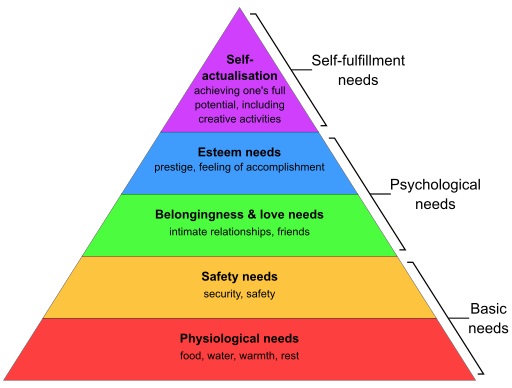
Hierarchy of human needs
Abraham Maslow thought of a hierarchy of human needs. He claimed that basic needs such as food and shelter are paramount. Once you have them, you desire security. Maslow believed that if you have food and security, you crave love and attention. And if you have all that, you want to be respected and have a sense of purpose in your life. These needs exist but not in such a neat hierarchical order.
Chemical processes in the body
Some people are always cheerful despite adversity and misery. Others are always bitter and fret, even when they prosper and have nothing to worry about. That has to do with body chemistry. If cheerfulness is chemistry, we can take pills to be happy. Pharmaceutics can end a depression. Is this a false sense of happiness? And what is the difference with the bliss you get from a drug like cocaine? More and more people use pills to feel better. It is often an easy way out.
Money
If you are poor, some extra money makes you happier. Poor people often feel miserable because they worry about making ends meet. It becomes less clear once you can buy the things you need and have no financial worries. More money can make you happier if you spend it on the right things. What is right is a personal matter. So if you can afford it, you should buy that garden gnome you always craved.
The more you have, the less more makes you happier. Your first automobile can make you happy. You can go where you want when you want. A second vehicle makes less of a difference. You and your husband can go to different places on the same evening. A third and a fourth car probably have no use unless you are a car collector and have a garage where you can spend your days gazing at your automobiles.
Expectations
Suppose your daddy promised you ice cream. If you expected a small cone and received a medium-sized one, the outcome exceeded your expectations, which can make you happy. But if you anticipated a large cone and received a medium-sized one, the result didn’t meet your expectations, which could have made you unhappy.
If you anticipated less than what you got, that could make you happy, but if you expected more, it could make you unhappy. We adapt to new situations. After a while, our happiness or sadness is gone. Having low expectations can be a path to happiness. If you expect the day to be miserable, and that does not materialise, it can make you happy.
Expectations management can make a great difference in happiness. Promising nothing or setting the bar low is the way to success. It is also the reason why politicians nearly always disappoint, as they usually are like Santa Clauses promising presents to their followers, whether it is more spending or lower taxes, more regulations or fewer.
Social identification and ranking
What you desire depends on the groups you identify with. If you are a fan of a famous pop artist, you crave her merchandise. Our genes make us desire items that make us more attractive to potential mates, such as clothing. We rank one another socially and compare ourselves to others. If you are better off than the people you compare yourself with, that can give you satisfaction. Being worse off, such as receiving less pay for the same job than your colleagues, has the opposite effect.
Your happiness depends on the people you compare yourself to. The attention given to celebrities, their riches, and their beautiful husbands and wives can give you the unpleasant feeling that your life is subpar. That can make you go to the gym or the plastic surgeon, buy things you can’t afford and turn down potential spouses who are not rich or do not look so great. These problems didn’t exist a century ago, and we might be happier without the Internet and television.

Craving
Gautama Buddha also weighed in on the issue. He was a happiness expert who lived 2,500 years ago but is still famous for founding Buddhism. Mr Buddha taught us that we crave temporary feelings and things which cause permanent dissatisfaction. As soon as you have achieved a desired goal, such as love, or acquired a desired object, such as a garden gnome with a straight hat, you will crave something else, like a garden gnome with a crooked hat. That is why there is a large selection of garden gnomes on the market.
Our desires tie us up in this world, so our souls will reincarnate and keep suffering from craving, or so Mr Buddha said. Yet, it keeps the economy going. When we stop doing that and disengage ourselves from this world, we disappear into nothingness, a state of eternal peace, and the economy collapses because investors can’t make profits. If you take away the Buddhist fluff about souls being tied to this world, happiness comes from accepting life as it is and not desiring more. And that is a valuable lesson that is still valid today.
Having a sense of purpose
Believing your life has a purpose can make you feel better. That human feature contributes to the success of religions. If you believe in God, you may think you play a role in God’s wonderful cosmic scheme, while atheists may believe their lives are purposeless, which is not inspiring. But at least they can poke fun at theists who delude themselves in this fashion, so it can still be a good life. The psychologist Daniel Kahneman arrived at a similar conclusion.
Kahneman interviewed women and asked which daily activities gave them pleasure and what made them happy. Caring for their children was among the activities that gave them the least pleasure. But when he asked these women what made them the happiest, they answered that their children gave them the most joy. Their children gave meaning to their lives. Similarly, if you think your job makes other people happy, that can bring a smile on your face.1
Good societies, bad societies
Finally, there is something humans have some agency in, which is the quality of their societies, and working on that issue is the principal goal of this entire project. Yet, as you can see, it is a single ingredient the happiness mix, and you can be happy without it, so you shouldn’t expect too much on the happiness scale. Maybe, people in Denmark are happier than in Venezuela, but because the situation you live in is the normal, the difference may be smaller than we might think. There are plenty of people who act like Santa Clauses promising you this or that if vote for them you buy their products, and they didn’t make you happier either. In the post-apocalyptic world, there is little left to dole out, but we can have enough, and build a good society.
Latest update 14 October 2026
Featured image: Smiley. Public Domain.
Other images: Maslov’s pyramid chart of the hierarchy of needs. Androidmarsexpress (2020). CC BY-SA 4.0. Wikimedia Commons. Rock-cut seated Buddha statue, Andhra Pradesh, India. CC BY-SA 3.0. Adityamadhav83. Wikimedia Commons.
1. Sapiens: A Brief History of Humankind. Yuval Noah Harari (2014). Harvill Secker.

