
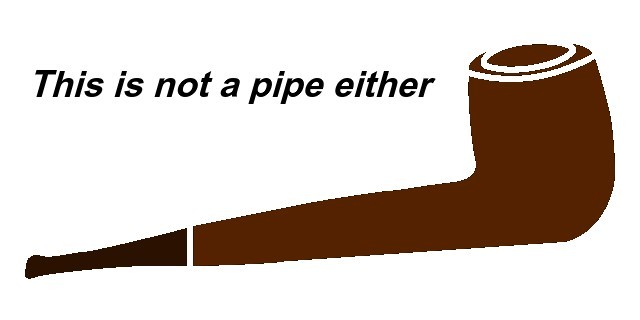
In ancient times, philosophers speculated that we couldn’t tell whether the world around us was real or whether other people had minds and could think. Perhaps I am the only one who exists, while the rest of the world is my imagination. It could all be a dream. Some religions claim that gods created this universe and that we are like them. According to the Bible, God said, ‘Let us make mankind in our image, in our likeness.’ For a long time, we couldn’t tell why this world might not be real or how the gods could have created it. That changed with recent advances in information technology. We could live inside a simulation. We believe that our senses register an external reality, so we ignore evidence to the contrary. You may think you see a pipe when watching an image. The caption makes you notice: ‘This is not a pipe.’
In 1977, science fiction writer Philip K. Dick was the first to assert that our reality is computer-generated. Believing his discovery to be of a most monumental kind, he organised a press conference in France, where he described his psychotic experiences and accompanying coincidences that led him to believe this world is fake. He told the audience that his lost memories returned in full for unknown reasons. He also claimed to have had a vision. And a scenario Dick wrote came true. His last name suggests that our Creator, if there is one, loves sexist jokes.
The idea that we live inside a computer-generated world is known as the simulation hypothesis. We could all live in a simulation created by an advanced post-human civilisation. Professor Nick Bostrom explored its probability in the simulation argument. According to Bostrom, there could be many different human civilisations. The humans in those civilisations may, at some point, enhance themselves with biotechnology and information technology, live very long, and acquire capabilities that ordinary humans don’t have. These beings are no longer humans, but are called post-humans. A post-human might be a biological creature, a humanlike artificial intelligence or a combination of both. They might be brains in vats or have no physical bodies at all.
These post-humans might feel the urge to run simulations of their human-ancestor civilisations, so we could be living in one of those simulations. Bostrom argues that at least one of the following options must be true:
- Nearly all human civilisations terminate before becoming post-human.
- In any post-human civilisation, only a negligible number of individuals develop an appetite for simulating their human-ancestor civilisations.
- We almost certainly live inside a computer simulation.1
The argument comes with the following assumptions that seem increasingly plausible due to the recent developments in artificial intelligence, but are not proven:
- The computing power of post-human civilisations is sufficient to run numerous simulations of human-ancestor civilisations.
- It is possible to simulate human consciousness in a computer.1
Bostrom concludes that if you think our civilisation will one day become post-human and run many simulations of human ancestor civilisations, you must believe we already live inside one.1 It is a matter of probability. If we invent this technology in the next 10, 100 or 1,000 years, it won’t happen later than that. By then, we will have done it. But millions of years have passed since it could have happened, so it probably did. If we do it within 100 years, and it could have happened a million years ago, the chance that it already happened is (1,000,000 – 100) / 1,000,000 = 0.9999, or 99.99%.
One particular possibility is that the post-human civilisation is a humanlike artificial intelligence. In this case, the time argument proves its merit. Even when human civilisation has spawned only one humanlike artificial intelligence that runs only one simulation, we most likely live in a virtual world.
Non-humanoid civilisations are probably not interested in running large numbers of simulations of human civilisations. They might run a few for research, perhaps to investigate human behaviour. Still, it seems unlikely that our history and emotions interest beings entirely different from us enough for them to run billions of simulations of human civilisations. And if they exist, they must first learn to travel faster than the speed of light to find humans. Thus, post-humans will likely run most simulations of human civilisations. So, our Creator, if there is one, is probably post-human.
Philosophy is the art of not accepting what seems obvious because the possibilities are boundless. That is why what seems obvious often isn’t the case. With the information we do have, it is our best guess. We think of God as having a human nature because we imagine God. The God of the Bible appears to have human traits. Conversely, when God imagines us, God probably is post-human. We would create virtual realities with humans if we could, not of goats or Vulcans. So, it seems obvious, but that doesn’t mean it’s true. It is only what our imagination and the evidence suggest is most likely. But we know very little. We can’t go outside the simulation and check.
Beings inside a simulation could create another simulation and so on. There could be many levels, but we will probably never know how many levels there are and which one we are in. Yet that is quite irrelevant compared to the question of whether we are in a simulation or in the original world, called base reality. And for those who love to guess the level, the most likely option is that we live in level one.
The simulation argument comes with uncertainties. Post-humans might lack sufficient computing power. Recent developments in quantum computing suggest otherwise. Alternatively, nearly all human civilisations die out before they can build these simulations. Alternatively, post-humans have evolved and differ from us, so they aren’t interested in running simulations with humans. We may know this once we have become post-humans.
Bostrom didn’t say whether or not that is indeed the case or how likely it is. He didn’t speculate on that issue. Otherwise, his critics might have a field day, ridiculing him for opening a back door to the paranormal and religion. That could have been the end of his career. Yet, it is fairly easy to find out if you venture into areas that scientists anxiously avoid, such as paranormal incidents, religious experiences, meaningful coincidences, people’s memories of past lives, ghost phenomena, and UFO sightings.
Scientists dare not investigate these phenomena, as it could make them a laughingstock among their peers. That is groupthink and intellectual cowardice on a grandiose scale. On numerous occasions, multiple credible witnesses have observed events that science can’t explain. Like nearly everyone else, scientists have been proficient at ignoring evidence that contradicts their beliefs, such as unscientific ravings about spirits relaying messages from the other side during seances. Bostrom speculated that this world might be a virtual reality but didn’t seek proof. As a philosopher, he had better things to do than to establish the final answer to the ultimate question.
Latest update: 25 September 2026
Featured image: Inspired By The Treachery of Images.
1. Are You Living In a Computer Simulation? Nick Bostrom (2003). Philosophical Quarterly (2003) Vol. 53, No. 211, pp. 243-255.

