
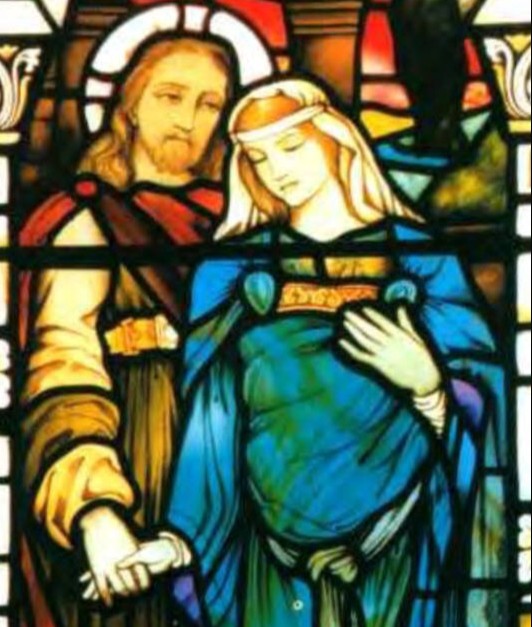
Who was Mary Magdalene? That question has occupied curious minds throughout the ages. The Gospels allow for confusion. Was Mary Magdalene a repentant prostitute? Inquiring minds want to know. She became a cult figure after the recovery of lost Gospel fragments implying Mary Magdalene and Jesus had an intimate relationship and that She stood above the other Apostles. The official Gospels also contain phrases suggesting Mary Magdalene was the most significant person in Jesus’ life. That made Her an inspiring figure for feminists. She witnessed the crucifixion from the foot of the cross after the male disciples had fled and was the first to see the resurrected Jesus.
Luke wrote that Mary Magdalene was one of the women who travelled with Jesus and supported him financially, implying that Mary Magdalene was not only wealthy but also independent, and that no one else decided for Her. We also learn that Jesus had cured these women of illness and demonic possession and that seven demons had troubled Her (Luke 8:1-3). The later-added section at the end of Mark also mentions it, suggesting that it was a falsification of importance, possibly serving to downplay Mary Magdalene’s role. According to the Gospels, Mary Magdalene rose to prominence only after the crucifixion and became a central figure in the events that followed.
If Mary Magdalene was always with Jesus, and there is no mention of their interactions in the Gospels, they were likely either not worth noting or too controversial. According to the Gospels, She did or said nothing of consequence during Jesus’ life. However, once he was dead, Mary Magdalene suddenly played a central role. There has been speculation as to whether Mary Magdalene was Jesus’ wife. Jesus is the bridegroom in every Gospel (Mark 2:19-20, Matthew 9:15, Luke 5:34, John 3:29). Mary Magdalene went out to wash and anoint Jesus’ body after the crucifixion (Mark 16:1). This was the duty of the wife. Christians see Jesus as an eternally living godlike being. A marriage can make him appear human. However, their marriage was not an item of controversy at first, as all the Gospels mention Jesus as the bridegroom.
Recovered Gospel fragments cast a different light on Jesus’ relationship with Mary Magdalene. The Gospel of Philip names Her as Jesus’ companion2 and mentions that Jesus loved Her more than the other disciples and kissed Her often.3 The Gospel of Mary notes that Jesus loved Her more than the other women.4 That is close to saying they were married. If these Gospels reveal things the Church didn’t want us to know, Mary Magdalene and Jesus Christ must have been a wedded couple.
In the Jesus Movement, the sect led by Jesus during his lifetime, women were equal to men. This was still the case when Paul wrote his letters, in which he named women as full partners in the Christian movement and mentioned them by name. However, this gradually changed, and the Gospels came to emphasise the role of the male Apostles. The role of women in the Jesus Movement was more prominent than the official Gospels reveal.
One of the recovered Gospels, the Gospel of Mary, portrays Mary Magdalene as the leader of the early Church, surpassing the other Apostles, including Peter, who was often regarded as the leader of the Church. One fragment reads,
Peter said to Mary, ‘Sister, we know that the Savior loved you more than all other women. Tell us the words of the Savior that you remember, the things which you know that we don’t because we haven’t heard them.’ Mary responded, ‘I will teach you about what is hidden from you.’ And she began to speak these words to them.
This Gospel dates from the second century AD and is not as old as the official Gospels. It is a Gnostic Gospel centred around supposed hidden truths and inner spiritual knowledge, but other Gnostic beliefs are absent. One Gnostic belief is that the Jewish God of the material world is evil, as opposed to the good Christian God of the spiritual world. The Platonic view that ideas create reality and that spirit is superior to matter, which you can also find in the Gospel of John, profoundly influenced Gnosticism.
And so, in another belief, Sophia, or wisdom, created all that is. Her fall led to the creation of the material world. She resides within all humans as the divine spark. Christ’s return to redeem humankind is about returning humanity to the spiritual world. If you read between the lines of this latter version, the fall of Eve the Creatrix led to the state of sin in which we live today. The Gnostic Gospels are controversial among scholars because they date from a later period than the official Gospels.
Gnosticism emerged around 100 AD and appears to be related to the enigmatic Gospel of John. The Gnostic movement likely originated from a Christian tradition that held on to the original beliefs and remained outside the mainstream of Pauline Christianity. Scholars now name this tradition the Johannine community. Only the Gospel of John mentions that Christians are born of God. His Gospel is mysterious and secretive about Jesus and his intensely close relationship with God, as are the Gnostics. The confusion and rumours surrounding that relationship fuelled speculation about secret knowledge.
The Gospel of John says that Jesus had an intimate and loving relationship with God. He seemed to have known God personally, believing he had eternal life and existed at the beginning of the world. Christians claim that God is love. So, did God and Jesus kiss and do other things lovers do? God can give birth, so God is not a Father after all.
Mary Magdalene convinced Jesus that She was the reincarnation of Eve and that he was the reincarnation of Adam. She made Jesus believe that Adam was the son of Eve, and that he was the Son of God because Adam was. Adam, being the son of Eve, makes more sense than the rib story. Thus, Mary Magdalene married Jesus after persuading him that he was Her eternal husband from Creation until the End of Times. It explains why Jesus thought he had eternal life, existed from the beginning, and would live until the end. It made Eve the Mother of humanity. Jesus called God Mother rather than Father, so he called his birth mother ‘woman’ rather than ‘mother’ (John 2:4, 19:26).
The Gnostic Gospels are most closely related to the Gospel of John. The Gnostics likely split off from the Johannine community after the scribes had turned God the Mother into God the Father. At that point, editors likely altered the role of Mary Magdalene from God and Jesus’ wife to the Beloved Disciple. The split occurred before the removal of the intimate relationship between Mary Magdalene and Jesus from the Gospel, so when people still knew that the Beloved Disciple, who later became anonymous, was Mary Magdalene. In that previous version of John, they weren’t married but soulmates nonetheless, and so intimate that it remained problematic in Pauline Christianity, leading to another redaction, and the version of John we have now. And so, the Gnostics reveal something that the official Gospels have omitted.
Mary Magdalene’s sudden appearance as a central figure only after the crucifixion is likely related to this. Removing details regarding the relationship between Mary Magdalene and Jesus Christ, which has been the outcome of Paul’s efforts to bring Christianity more in line with the Jewish scriptures, alters the plot entirely. So, what remains are some sketchy details. And that is the primary explanation for the current deplorable state of the Gospels, not oral storytelling or embellishments.
There are a few loose ends to tie up. The rib story is a falsification, and Eve was Adam’s mother. That we can infer from the text we still have. But was Eve a goddess? That is not so obvious. According to the account in Genesis, God created Eve and Adam. It doesn’t corroborate what Mary Magdalene made Jesus believe. Eve is the Mother of all the Living, which suits a Mother Goddess. But you must leave the creation myth in Genesis behind and invent another one to make the idea work.
The first verses in the Gospel of John contain such a myth. After some mystical allusions such as ‘in the beginning,’ and ‘there was light,’ and an undercover operation of Jesus during which few recognised him, Christians are born of God. And Jesus gave us the right to become children of God. Eve was God and the Mother of humanity, and Adam, thus Jesus, fathered humanity, and in doing so, he gave us the right to become children of God.
Latest revision: 5 September 2025
Featured image: Christ with Mary Magdalene, West Nave, Kilmore Church, Isle of Mull, made by Stephen Adam. B. Galbraith. Victorian Web.
1. Who was Mary Magdalene? James Carrol (2006). Smithsonian. [link]
2. Gospel of Philip: There were three who always walked with the Lord: Mary, his mother, and her sister, and Magdalene, who was called his companion. His sister, his mother and his companion were each a Mary.
3. Gospel of Philip: And the companion of the saviour was Mary Magdalene. Christ loved Mary more than all the disciples and used to kiss her often. The rest of the disciples were offended by it and expressed disapproval. They said to him, “Why do you love her more than all of us?” The Saviour answered and said to them, “Why do I not love you like her?”
4. Gospel of Mary: Peter said to Mary, “Sister we know that the Saviour loved you more than the rest of woman. Tell us the words of the Saviour which you remember which you know, but we do not, nor have we heard them”. Mary answered and said, “What is hidden from you I will proclaim to you”. And she began to speak to them these words: “I”, she said, “I saw the Lord in a vision and I said to Him, Lord I saw you today in a vision”.
 The Plan For The Future