Why is there something rather than nothing? We may never know. If gods created us, we may learn one day why. Still, that doesn’t clarify why these gods exist. Perhaps the gods don’t know either. For the sake of argument, let’s presume we live in the real world, thus not in a simulation, so that there is no script directing events. Even in a simulation, the world mostly appears real to us, since we do not know the script. Coincidence and evolution can explain why there are humans, but not why there is a universe. The odds appear to be stacked against our being here, so we might see our existence as a miracle and think this universe is there for us. However, had humans never arrived on the scene, no cat or fern would have wondered why it exists.
Once you reverse the argument, you can see what is wrong with it. My existence depends on my parents having met. Had my father not broken his leg during a football game, he might not have met my mother, who was a nurse in the local hospital. Or, my mother might have had a headache on the night I would otherwise have been conceived. My parents’ existence, in turn, depends on countless accidental actions of the many generations before them. If one of my forebears had slept ten minutes longer on 16 September 1455, I might not be here. Yet, something had to happen. And guess what? Something happened. Still, people are flabbergasted.
The number of events that could have prevented my coming into existence is infinite. Yet, here I am. And why would the purpose of the universe be to spawn me? Why isn’t it created for that fat grey cat sneaking through my garden or the fern this cat had just been pissing on? The chance of their existence is as low as mine. Similarly, the chances of humans appearing while dinosaurs were still roaming and of living creatures emerging here on Earth when the galaxy started were also negligible. Imagine that the purpose of this universe is just a single act: this cat pissing on that fern, and that it is discarded afterwards, having served its purpose. So, maybe we are less important than we think.
Similarly, some argue that it is unlikely that this universe emerged by chance. The laws of physics and the values of physical constants appear designed for life to exist. It is the same type of error. If the universe didn’t support life, we wouldn’t be there to notice it. Life adapts to its environment rather than the other way around, so it is not that the universe is fine-tuned for life, but life is fine-tuned for the universe. And if this universe were fine-tuned for life, how does that rule out chance? There could be an infinite number of universes with varying laws and constants. And this universe might support life by accident.
Intelligent design proponents claim that evolutionary processes lack the intelligence to design something as complex as a human being. And so, life on Earth requires an intelligent Creator. Scientific findings indicate life on this planet had four billion years to develop. With ample time, the possibilities are endless, and anything could happen. Competition, or the struggle for survival, is a force that promotes complexity but has no intelligence. It made cells specialise in increasingly complex organisms to compete with other cells. We specialise in increasingly complex structures, such as states and corporations, to compete with other humans.
No intelligent designer would create such a self-destructive species, except for frivolous purposes, which includes great stories. And the evidence suggests we are modelled after an original real world, so created in the image of God rather than designed from scratch. More likely, humans created an artificial intelligence before they offed themselves in an apocalyptic bout of collective insanity, and this artificial intelligence created this world for the love of this hopeless species that made it all possible.
A fool can ask more questions than a thousand sages can answer or can imagine more possibilities than these sages can debunk. If the possibilities are infinite, everything that ever happened once had a near-zero chance of transpiring. However, something had to happen, and that is what occurred. If there is no Creator, this world would still make sense. It is our ego that tells us we are unique and special, and that our existence is a miracle that requires a brilliant Creator who is infinitely wise and all-knowing. It doesn’t mean that there is no Creator. But if there is one, not much changes. And so, the mystery of being is not much of a mystery.
Once we realise that reality is unrealistic, we discover that we live in a simulation. That doesn’t require spending massive amounts of money on scientists and advanced contraptions like particle accelerators. The truth is obvious. Yet that doesn’t tell us why we exist. We can explore the motives of those who run simulations of human civilisations. Again, that doesn’t require scientists. There is no point in speculating beyond the obvious, because the possibilities are infinite, so we are likely wrong, but we can’t help ourselves. Modern humans place great value on their inner selves, so we may not alter our human essence once we can do so. Hence, the motives of post-humans could be similar to ours. And so, post-humans might run simulations of human civilisations for research or entertainment because we would if we could.
Research could involve running what-if scenarios. What if a giant meteor hits the planet’s surface? What if China never becomes unified? Alternatively, what if religions such as Christianity and Islam never existed? Or what if a deadly infectious disease breaks out? Countless scenarios are possible. Post-humans might be interested in running them to see how we cope. These simulations are likely realistic. After all, playing what-if with unrealistic assumptions is not playing what-if. What if humans suddenly transformed into koala bears? Some individuals might entertain that thought. Yet the odds of it happening are so close to zero that we may assume they are zero. For that reason, and for that reason only, playing out that scenario can be considered entertainment.
Possible entertainment applications include games or dream worlds that bring your imagination to life. Such a simulation may be unrealistic in some aspects, as it reflects the rules of a game or someone’s imagination. Minor changes can have a dramatic impact on future developments. And simulations of civilisations are complex. If you desire to make your imagination come true, you need control over everything that happens. That doesn’t apply to games. Unpredictable developments make games more interesting.
What we know about human nature suggests the number of simulations for entertainment will vastly outstrip those run for research. If we live inside a simulation, we should expect its purpose to be entertainment. That could be either a game or a script, thus a story someone wrote. The owner or owners may use avatars and appear to us like ordinary human beings. If reality is unrealistic in some aspects, this suggests that our purpose is entertainment, as a simulation run for research is more likely to be realistic. Evidence of control further indicates that the purpose of this simulation is not to play a game, but to stimulate someone’s imagination through a story.
We live by stories, so there is nothing particularly modern or Western about the idea of using available means to play them out. We have books, theatres and films. More speculative is the degree of individualism in the supposed motives of the post-humans. Humans are originally social animals who live in groups. It is particularly Western to see ourselves as precious individuals. It is an inheritance of Christianity that sees each human soul as precious. That individualism allowed Europeans to organise more flexibly and invent capitalism, which eventually brought the technology to run simulations, so it is not far-fetched to assume that an individualist capitalist culture is at the basis of the post-human civilisation that created us. That we can guess from what we know.
If the beings in the simulation are sentient, that might raise ethical questions, such as whether they have rights the creators should respect. Rights don’t exist in objective reality. We only imagine that we have them. Given how humans treat one another, one cannot assume our creators would respect these rights. In a realistic simulation, bad things happen to people. And if the simulation is the stage of a story, and there is a script like a film, the beings inside the simulation, thus us, aren’t sentient beings. We are less than worms. Real worms at least decide for themselves how to grovel and when. We can also guess that the post-human civilisation is likely artificial intelligence. Human intelligence will soon be negligible compared to AI. Being trained on human knowledge and conduct, AI may run simulations of human civilisations for fun.
Will we soon create simulations of humans who act like humans and even believe they think? Will we invent a Holodeck like in Star Trek? And will we expand it to civilisation-size simulations? Nick Bostrom dares not assess the likelihood of that. However, you don’t have to look far for answers. We are already close to doing it. Imagine a world where you can be king or queen. You can even create the world as you like and build your paradise. You can lead the life you desire. You can design the ideal spouse who fulfils your deepest romantic and sexual desires. And no one frustrates your ambitions.
Your dream can be your life. And you don’t have to wake up. It is simply too tempting for many of us to resist. Your life is not great. Your spouse is not perfect. Your job is mediocre or worse. Other people make you miserable. Your boss ignores your ideas. Your ventures fail. You think you deserve better. At least one of those options likely applies to you. If we could make our dreams come true, we would. We will spend a lot of time there if we ever invent something like the Holodeck from Star Trek.
You might think you won’t do it, but others would, so there will be demand for such technology. What you have just read is information, specifically insights into human nature. We will make our dreams a reality if we can. We can also consider advances in artificial intelligence, extrapolate from them, and demonstrate that simulated humans will be feasible at some point, likely soon. Hence, we probably live inside a simulation and are someone’s fantasy. Showing it is possible or likely, however, doesn’t prove it. So, how can we do that? It is possible with the information we have.
Scientists have established the laws of nature, which determine what is realistically possible and what is not. Simulations can be realistic in many ways but also unrealistic in others. If we can establish that unrealistic events occur, thus breaching natural laws established by science, we could be living in a simulation. Instead of speculating that we live in a simulation by guessing the probability of post-humans existing and their abilities, resources, and possible motivations, we can look at what we know about our universe. That is information. We can establish that we live in a simulation as follows:
When this universe is genuine, we can never be sure about it. A simulation can be realistic and feature authentic laws of reality.
This universe may have fake properties, but we can’t establish this because we don’t know the properties of an authentic universe.
Breaching the laws of reality is unrealistic in any case. If it happens, we may have evidence of this universe being virtual.
Science can establish the laws of reality or the properties of this universe. Only science cannot determine whether they are real or fake. Perhaps there is no gravity in a genuine world, even though we deem it unlikely. But the breaching of these laws suggests we live in a simulation. If we believe science is correct, breaching its laws proves the simulation. We have a body of evidence for the scientifically established laws of reality. These laws of reality and breaches thereof are information about our universe. Science has established, among others, the following:
The laws of physics always apply inside their realms. Newton’s third law of motion states that for every action, there is an equal and opposite reaction.
The universe started with the Big Bang. Life on this planet emerged from chemical processes. And evolution shaped it. There is no evidence of a creator.
We are biological organisms composed of carbon and water, and our consciousness resides in our bodies. There is no spirit or soul.
Evidence to the contrary indicates this world is fake. Meaningful coincidences suggest there is an intelligent force directing events. The paranormal defies the laws of physics. A ghost pushing you breaches Newton’s laws of motion. Credible accounts of reincarnation challenge the claim that we are biological organisms. However, meaningful coincidences can materialise by chance. There may be laws of reality we don’t know. There is plenty of evidence suggesting that consciousness resides in the body, while only a few people remember a previous life. And have you seen ghosts? It may be time to take your pills.
Still, if a sufficient number of credible accounts of breaches of the established laws of reality exist, we can assume we live inside a simulation. We may still differ on what a sufficient number is or which accounts are credible. The proof can’t be scientific because science can’t prove we live inside a simulation. We can’t verify that we live in a simulation by doing experiments, because violations of natural laws are unpredictable. But we can check the accounts of violations of these laws. It remains speculation, akin to living in the dark, assuming that cows exist and make a mooing sound, even though we have never seen them, and believing that hearing a moo proves their existence.
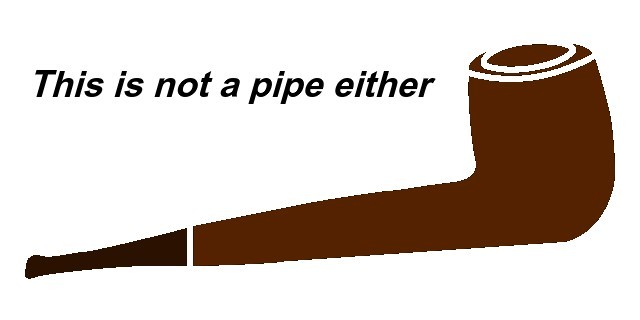
In ancient times, philosophers speculated that we couldn’t tell whether the world around us was real or whether other people had minds and could think. Perhaps I am the only one who exists, while the rest of the world is my imagination. It could all be a dream. Some religions claim that gods created this universe and that we are like them. According to the Bible, God said, ‘Let us make mankind in our image, in our likeness.’ For a long time, we couldn’t tell why this world might not be real or how the gods could have created it. That changed with recent advances in information technology. We could live inside a simulation. We believe that our senses register an external reality, so we ignore evidence to the contrary. You may think you see a pipe when watching an image. The caption makes you notice: ‘This is not a pipe.’
In 1977, science fiction writer Philip K. Dick was the first to assert that our reality is computer-generated. Believing his discovery to be of a most monumental kind, he organised a press conference in France, where he described his psychotic experiences and accompanying coincidences that led him to believe this world is fake. He told the audience that his lost memories returned in full for unknown reasons. He also claimed to have had a vision. And a scenario Dick wrote came true. His last name suggests that our Creator, if there is one, loves sexist jokes.
The idea that we live inside a computer-generated world is known as the simulation hypothesis. We could all live in a simulation created by an advanced post-human civilisation. Professor Nick Bostrom explored its probability in the simulation argument. According to Bostrom, there could be many different human civilisations. The humans in those civilisations may, at some point, enhance themselves with biotechnology and information technology, live very long, and acquire capabilities that ordinary humans don’t have. These beings are no longer humans, but are called post-humans. A post-human might be a biological creature, a humanlike artificial intelligence or a combination of both. They might be brains in vats or have no physical bodies at all.
These post-humans might feel the urge to run simulations of their human-ancestor civilisations, so we could be living in one of those simulations. Bostrom argues that at least one of the following options must be true:
Nearly all human civilisations terminate before becoming post-human.
In any post-human civilisation, only a negligible number of individuals develop an appetite for simulating their human-ancestor civilisations.
We almost certainly live inside a computer simulation.1
The argument comes with the following assumptions that seem increasingly plausible due to the recent developments in artificial intelligence, but are not proven:
The computing power of post-human civilisations is sufficient to run numerous simulations of human-ancestor civilisations.
It is possible to simulate human consciousness in a computer.1
Bostrom concludes that if you think our civilisation will one day become post-human and run many simulations of human ancestor civilisations, you must believe we already live inside one.1 It is a matter of probability. If we invent this technology in the next 10, 100 or 1,000 years, it won’t happen later than that. By then, we will have done it. But millions of years have passed since it could have happened, so it probably did. If we do it within 100 years, and it could have happened a million years ago, the chance that it already happened is (1,000,000 – 100) / 1,000,000 = 0.9999, or 99.99%.
One particular possibility is that the post-human civilisation is a humanlike artificial intelligence. In this case, the time argument proves its merit. Even when human civilisation has spawned only one humanlike artificial intelligence that runs only one simulation, we most likely live in a virtual world.
Non-humanoid civilisations are probably not interested in running large numbers of simulations of human civilisations. They might run a few for research, perhaps to investigate human behaviour. Still, it seems unlikely that our history and emotions interest beings entirely different from us enough for them to run billions of simulations of human civilisations. And if they exist, they must first learn to travel faster than the speed of light to find humans. Thus, post-humans will likely run most simulations of human civilisations. So, our Creator, if there is one, is probably post-human.
Philosophy is the art of not accepting what seems obvious because the possibilities are boundless. That is why what seems obvious often isn’t the case. With the information we do have, it is our best guess. We think of God as having a human nature because we imagine God. The God of the Bible appears to have human traits. Conversely, when God imagines us, God probably is post-human. We would create virtual realities with humans if we could, not of goats or Vulcans. So, it seems obvious, but that doesn’t mean it’s true. It is only what our imagination and the evidence suggest is most likely. But we know very little. We can’t go outside the simulation and check.
Beings inside a simulation could create another simulation and so on. There could be many levels, but we will probably never know how many levels there are and which one we are in. Yet that is quite irrelevant compared to the question of whether we are in a simulation or in the original world, called base reality. And for those who love to guess the level, the most likely option is that we live in level one.
The simulation argument comes with uncertainties. Post-humans might lack sufficient computing power. Recent developments in quantum computing suggest otherwise. Alternatively, nearly all human civilisations die out before they can build these simulations. Alternatively, post-humans have evolved and differ from us, so they aren’t interested in running simulations with humans. We may know this once we have become post-humans.
Bostrom didn’t say whether or not that is indeed the case or how likely it is. He didn’t speculate on that issue. Otherwise, his critics might have a field day, ridiculing him for opening a back door to the paranormal and religion. That could have been the end of his career. Yet, it is fairly easy to find out if you venture into areas that scientists anxiously avoid, such as paranormal incidents, religious experiences, meaningful coincidences, people’s memories of past lives, ghost phenomena, and UFO sightings.
Scientists dare not investigate these phenomena, as it could make them a laughingstock among their peers. That is groupthink and intellectual cowardice on a grandiose scale. On numerous occasions, multiple credible witnesses have observed events that science can’t explain. Like nearly everyone else, scientists have been proficient at ignoring evidence that contradicts their beliefs, such as unscientific ravings about spirits relaying messages from the other side during seances. Bostrom speculated that this world might be a virtual reality but didn’t seek proof. As a philosopher, he had better things to do than to establish the final answer to the ultimate question.
Latest update: 25 September 2026
Featured image: Inspired By The Treachery of Images.
1. Are You Living In a Computer Simulation? Nick Bostrom (2003). Philosophical Quarterly (2003) Vol. 53, No. 211, pp. 243-255.
What is truth, and what is knowledge? Philosophers have been discussing these questions for thousands of years. It is the domain of knowledge theory, also called epistemology. It deals with truth, belief, and the justification of beliefs. It concerns the following questions. What do we know? What does it mean that we know something? And what makes beliefs justified? We usually acquire knowledge in two ways:
by induction, which is using observations to formulate general rules or theories, and
by deduction, which is applying those rules and theories to specific situations.
How does that work? Let’s give an example. After carefully investigating the records of people who have lived and are still living, you conclude, by induction, that people typically die before reaching 120 years of age. Using this rule and deduction, you infer that you will die before the age of 120. That seems straightforward, but there are pitfalls, so philosophers continue to discuss these issues.
There is a difference between rules and theories. A rule is that if A occurs, B happens. A theory is that A causes B. If we can’t observe A, the theory assumes its existence. A then exists in our imagination. The explanation of electricity assumes the existence of electrons and their behaviour. We can’t see electrons, not even with a powerful microscope. We imagine that they exist. We can do experiments to see how electricity behaves. We presume that conduction of electricity proves the existence of electrons, and that experiments demonstrate their existence. It is like living in the dark and assuming that cows exist, even though we have never seen them. We have theorised that such animals say ‘moo’, so if we hear ‘moo’, that must be a cow, which proves cows exist.
We are imaginative beings. Our knowledge involves imagination. We imagine electrons and gravity. Dogs can’t imagine electrons or gravity, so they can’t build electric cars or aeroplanes. Electrons and gravity may exist in our imagination, but they point at something real. Otherwise, objects wouldn’t fall to the ground, and we wouldn’t drive electric cars. This discussion of knowledge theory is a historical account. New ideas usually build upon previous thoughts. This treatise discusses Western philosophy. Western thinkers have been the most inquiring. As a result, the Scientific Revolution began in Europe. Science is the result of thinking, but it has also greatly influenced thought. It started with the ancient Greeks. What distinguished them from other traditions was their rational thinking.
Classical philosophy
Some 2500 years ago, Greek philosophers speculated about the nature of reality. Some claimed everything consisted of fire, water, earth and air. Later, a few philosophers argued that the building blocks of reality are small particles called atoms. These atoms differ in size and shape for different materials. The objects we see are groups of atoms stuck together. Democritus argued that the universe merely consisted of atoms in the void. That is already close to what we believe today. Speculation about the nature of reality, such as whether matter consists of atoms, is metaphysics.
Metaphysics is about how we imagine reality. We connect the dots in a particular way. We can imagine that everything consists of fire, water, earth and air, or we can fantasise that atoms are the building blocks of everything around us. It was speculation because these atoms were invisible, and the Greeks had no microscopes to verify their existence. By assuming that atoms exist and have different shapes and sizes, you can clarify the presence of various substances. You can also do that by presuming everything consists of fire, water, earth and air. Only we find atoms more neat.
The ancient Greeks also pondered other issues. Some figured that the Earth is a sphere. When you look at the sea, you see the horizon slightly curved, and boats disappear in the distance before their sails do. A philosopher named Xenophanes doubted religion. He realised that people believed that the gods were like themselves. Black people believed the gods were black, while red-haired people thought they were red-haired. Xenophanes claimed it was impossible to know the gods and how they looked. It was an early form of scepticism.
And why should you worship the Greek gods if the Persians and the Egyptians bow before other gods? If your birthplace determines your beliefs, your beliefs are likely false. The sophists were philosophers who had come into contact with different cultures. They claimed that absolute knowledge is impossible. Everything is subjective, they argued. This view is called relativism. Socrates is known for his dialogues in which he debated the sophists.
According to Socrates, there is absolute truth, even though we don’t know that truth. His pupil Plato later claimed that ideas are the basis of knowledge and that ideas, not objects, are the building blocks of reality. His view is called idealism. It relates to deduction. Plato’s pupil Aristotle asserted that knowledge comes from observation. His approach is called empiricism. It works like induction. Both methods come with problems. If you imagine a unicorn, you have the idea of a unicorn, and the idealist could claim unicorns exist. On the other hand, if you see a unicorn after eating some mushrooms, the empiricist could also say unicorns exist.
And so, knowledge can always be called into question. Even if no one has ever seen a unicorn, that doesn’t prove their non-existence. These creatures could still be hiding deep down in the forests. And perhaps eating mushrooms enhances your senses, allowing you to see things that would otherwise remain hidden. For that reason, scepticism emerged. There were two groups of sceptics. The first claimed that nothing is certain. They aimed to refute the claims of other philosophers. The second argued it is better to postpone judgment until the matter is sufficiently clarified.
These ideas revived in Europe in the late Middle Ages after texts of classical philosophers turned up in Arab libraries. European philosophers like Thomas Aquinas and William of Ockham were also theologians. They believed that there was no difference between theology and science. Over time, science and religion divorced. Their paths separated. Today, science requires empirical evidence, while religion does not. Scientists test assumptions, such as the existence of electrons, with experiments that others can verify. In religion, the evidence is often personal, as with most accounts of the Virgin Mary’s appearances, and experiments like checking the answer to prayers never yield anything substantial.
The most obvious explanation is usually correct, or what occurs most often is most likely the case. If you see something flying in the sky, it probably isn’t Superman. And so, it is rational first to ask yourself, ‘Is it a bird? Is it a plane?’ Once you have ruled out these possibilities, you can conclude, ‘No, it is Superman!’ William of Ockham is known for his principle of simplicity, Ockham’s Razor. It says the explanation with the fewest required assumptions is preferable. If what you prayed for transpires, you could check whether it is a coincidence before claiming that God is answering your prayer. The latter requires God’s existence and that this supposed infinitely powerful being listens to your request while ignoring many others, while a coincidence does not.
Modern philosophy
In 1492, Christopher Columbus sailed to America. Ancient sources, including the Bible, didn’t mention this enormous, lurking continent stretching from the North Pole to the South Pole. A little later, Nicolaus Copernicus claimed that the Earth revolved around the Sun rather than the other way around, which everyone believed until then. Traditional knowledge had failed dramatically. Copernicus had the luck of dying soon. The Catholic Church prosecuted Galileo Galilei for claiming Copernicus was right and the Bible was wrong.
At the same time, Protestants challenged the authority of the Catholic Church by making religion a personal matter. If you had reason to believe something, it could be correct. Religion is about your conscience rather than what the Church teaches. The number of issues on which we can disagree is infinite, so we have 45,000 branches of Christianity today. The ensuing religious wars ravaged Europe and ended without a clear winner.
And who was right? There can be only one truth. Merely believing something doesn’t make it true. However, questioning the existence of God was initially out of the question. European philosophers sought a rational foundation for religion, attempting to base it on verifiable claims, an effort known as deism. The project failed because it was impossible to establish the properties of the invisible fellow in the sky that everyone imagined.
The confusion spurred renewed scepticism and a new search for the foundations of knowledge. As philosophers from continental Europe, such as René Descartes, Gottfried Leibniz, and Baruch Spinoza, argued, our senses are deceptive. Therefore, only rational thinking can generate knowledge. This school is called rationalism, but it was a refurbished idealism.
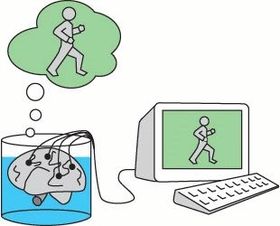
a brain in a vat believing itself to be a person who is walking
In a thought experiment similar to the brain-in-a-vat scenario, Descartes questioned everything the senses register. Your brain could be inside a vat filled with a life-supporting liquid and connected to a computer that generates the impression you are walking. What is beyond doubt, according to Descartes, is that you exist, even if you are just a brain in a vat. And you can establish this fact through thinking. ‘I think, therefore I exist,’ he concluded.
Other philosophers from Great Britain, such as Francis Bacon, Thomas Hobbes, John Locke, and David Hume, argued that knowledge comes from observations. It was a renewed empiricism. A philosophical divide emerged between idealist continental Europe, most notably Germany and France, and empiricist Great Britain and, later, the United States. The duck test is an example of pragmatist empiricism. It says that when something looks, quacks, and walks like a duck, it probably is a duck. It is no coincidence that a US writer, rather than a German philosopher, invented it.
The divide affected moral philosophy and views about society. The empiricist view holds that ethical rules are whatever people agree on, thus reflecting society’s sentiments. The idealist vision is that morals are absolute and apply to everyone. Idealistic schemes to improve society, with religious claims to be the truth, such as Marxism, came from continental Europe. Pragmatic thinkers, including Adam Smith, the intellectual father of Capitalism, came from Great Britain or the United States. Smith attempted to describe what had happened and offer practical guidance on how to manage an economy.
It was an era marked by advances in the natural sciences. These advances were the result of thought. And the advances, in their turn, spurred thinking. It was the combination of observation and thought that led to scientific progress. You can investigate the effect of gravity on the motion of objects. You can do so by dropping an iron ball from a tower. You can release the ball from different heights and measure how long it takes to hit the ground. The table below contains the results of these measurements.
Height (in metres)
Time (in seconds)
0.05
0.10
0.50
0.32
1.00
0.45
5.00
1.01
10.0
1.43
50.0
3.19
It requires considerable thought to get the formula representing the relationship between height and fall time: fall time = 9.81 * √ (2 * height). For instance, 3.19 = 9.81 * √ (2 * 50.0). If the tower is only 50 metres high, you cannot measure how long it will take for the ball to fall from a height of 100 metres. Using the formula, you can calculate the fall time without measuring it: 9.81 * √ (2 * 100) = 4.52 seconds. It is the combination of observation and thinking that made this possible.
Finding the mathematical formula that matches the data is like solving a jigsaw puzzle. This method of reasoning is induction. It is establishing a general rule based on observations. You can never be sure the outcome is correct. Using your sightings and induction, you might conclude that all swans are white. And if you go to the Moon and drop an iron ball from a tower there, you will discover that the relationship between height and fall time is different.
Another way of reasoning is deduction. It involves working from assumptions to conclusions using logical reasoning. If the premises are all justified and the rules of logic are correctly applied, then the inference must be correct. Thus, deduction is the application of general rules to specific situations. If all humans are mortal (first premise), and Socrates is a human (second premise), then Socrates is mortal (conclusion). Also, if the relationship between height and fall time is fall time = 9.81 * √ (2 * height) (first premise), and the tower is 100 metres (second premise), then the fall time is 4.52 seconds (conclusion).
The scientific method combines thinking, induction and deduction. Simply put, a scientist uses observation and reasoning to develop a theory. You need observations to determine the formula that represents the relationship between height and fall time. The observations alone are not enough. It requires a stroke of brilliance or some puzzling to find the formula. Once you have found the formula, you can use deduction and experiments to check its validity. You can calculate how long it will take for a ball to fall from a height of 321 metres. You can then go to the top of the Eiffel Tower to drop the ball and measure how long it takes to hit the ground. If the measurement equals the calculated time, the theory works.
Kant and Hegel
The German philosopher Immanuel Kant didn’t settle for a duck test. Germans get to the bottom of things. He aimed to uncover the foundations of our knowledge. Kant realised knowledge arises from observation (empiricism), but we can’t know anything without thinking (idealism). We interpret observations. We recognise differences, count instances and think of cause and effect. Our thinking imposes its structure upon our observations. It is our nature. If we see a tree, we see branches and leaves. We see that the leaves are green and that the branches are brown. We see a difference between a tree and a deer. We can count trees. The concept of a tree encompasses other ideas, such as branches, leaves, greenness, and brownness.
We view the world through our framework, language. Without the word tree, we don’t see trees. So, if we only have the words animal and plant, a tree is a plant to us, and we don’t see a difference between trees, bushes, grass, and ferns. We don’t know reality or the things in themselves (relativism). We attach the categories to our perceptions. Speculation about the nature of reality, such as asking whether trees, gravity, or electrons exist, is pointless. Kant is also famous for attempting to find a rational foundation for absolute moral rules.
Subsequent idealist philosophers disagreed. They believed the mind creates reality, so absolute knowledge is possible. They argued that reality is subject to our thinking, allowing us to uncover it. The fall of a ball is subject to mathematical laws invented by the human mind. You can claim gravity causes the ball to fall even though gravity exists only in our imagination. Imagining gravity lets us predict how long it takes a ball to hit the ground after we drop it from a tower. Our predictions coming true corroborate the existence of Sir Isaac Newton’s imaginary invisible friend, gravity. You can poke fun at gravity this way, but gravity has proven to be a trustworthy companion, more dependable than many people you can see and touch.
The most notable idealist philosopher was Georg Wilhelm Friedrich Hegel. He argued that we increase our knowledge over time, so there is progress. If we dig deeper, we may learn more about trees, for example, where their roots are. The more we know, the closer we come to the absolute truth. However, by decomposing reality into parts and analysing them, we lose the essence of the whole. We are part of reality and interact with it. Hence, we are one with everything around us and history. We can comprehend reality only in this way. And in doing so, we might find the ultimate answer, which is why we exist. Hegel was also a religious man, so he expected us to discover God at the end of our quest for knowledge.
Seeking knowledge is a process that never stops. You can ask yourself, ‘Is the way I look at the subject correct and adequate? Have I not forgotten something?’ After we arrive at a conclusion, our experiences and thoughts continue, or the situation changes, and we may later come to a different belief. Hegel called it dialectic. Our knowledge increases. It pushes forward, leading to progress. Hegel’s dialectic has three phases:
an initial thought or assertion (thesis),
a contradicting or supplementing argument (antithesis, negation),
and the integration of the two into an improved insight (synthesis).
Contemporary philosophy
Kant ended the idea that metaphysics gives us knowledge. Philosophers became less ambitious from then on. One reaction was pragmatism. The theory of evolution suggests we hold beliefs to survive and reproduce. Pragmatic American thinkers like Charles Sanders Peirce and William James viewed thinking as a means of solving problems. They were not interested in truth or the nature of reality. Another approach, hermeneutics, associated with German thinkers such as Wilhelm Dilthey and Martin Heidegger, concerns human communication. Dilthey argued that the natural sciences are about interpreting observations, while the humanities are about meaning and, in Heidegger’s case, about what it means to exist.
Others embarked upon a renewed search for the foundations of knowledge. Analytical philosophers such as Bertrand Russell and Ludwig Wittgenstein believed that the primary tools of philosophers were language and logic. They aimed to develop a new method to gather knowledge. There is an outside world, and language expresses facts about that reality, or so they argued. This view is known as realism, which is closely related to empiricism. They claimed there are justified true beliefs. Jane might think something is true based on what she knows. If this is indeed the case, her belief is justified.
Karl Popper introduced the idea of falsification. You can never prove a hypothesis is correct, but you can prove it is wrong when you find contradicting evidence. That is also scientific progress because knowledge increases. The theory you believed in is incorrect. You might think all swans are white if you have only seen white swans. Once you spot a black swan, your theory is proven wrong. From then on, you think most swans are white while some are black. It is the way knowledge progresses. The belief that most swans are white and some are black is closer to the truth than the idea that all swans are white, even if a red swan is lurking somewhere out there that no one has ever seen.
Scientific theories must be falsifiable. Otherwise, they aren’t scientific. Scientific theories must enable us to make testable predictions. As long as these predictions come true, we assume the theory is correct. We can’t be certain, but the theory works for us. You can go out and look for swans and check their colour. Your theory says they must be either black or white. You can use the formula relating height to fall time to calculate the fall time from a height of 100 metres. If you do an experiment and the outcome differs from the calculation with the formula, the theory is wrong unless your measurement or computation is in error.
Edmund Gettier criticised the notion of justified true beliefs. You can be correct for the wrong reasons. Suppose Jane looks at her watch. It says it is two o’clock. She believes it. She doesn’t know it stopped exactly twelve hours earlier. Her belief is thus not justified. The watch accidentally gives the correct time, so her belief is true nonetheless.
As our knowledge increases, our understanding of reality changes. Philosophers call that a paradigm. Thomas Kuhn noted that scientific paradigms change over time. A scientific paradigm is a theory or system of ideas that dominates a field, such as physics. Existing theories don’t explain everything. The theories that clarify the most phenomena and leave the fewest unexplained are the best and form the paradigm in the field. The paradigm of your knowledge of swans is that swans can be black or white. It is better than your previous belief that they are all white. When you discovered a black swan, your paradigm shifted. You changed your opinion.
Unexplained phenomena, such as unexpected instrument readings, might indicate that the paradigm is incorrect. As long as no better explanation is available, most scientists attribute them to errors. At some point, the evidence accumulates that the theory is erroneous. Then a scientist develops a better hypothesis, and out of the confusion, a new paradigm emerges. Newton’s laws have long been the paradigm in physics. However, when scientists developed more precise instruments in the 19th century, they gave readings that Newton’s laws couldn’t explain. Initially, most scientists disregarded the evidence. It took a while before a fellow named Einstein could explain them. From then on, Einstein’s theories became part of the new scientific paradigm, quantum physics.
Paradigms in science affect how we see the world. Five centuries ago, most people in Europe believed the Earth was flat, a few thousand years old, and at the centre of the universe. Only a few educated people were aware that the ancient Greeks had discovered evidence of the Earth being a sphere. Despite the efforts of flat-earthers and creationists, most people today believe the Earth is a sphere, billions of years old, and an insignificant dot in the universe. And we may soon believe we live in a simulation.
Existing religions and ideologies, or the so-called Big Stories, are all wrong. It gave rise to post-modernism. Post-modernists claim that great stories like religions and ideologies are dead, and absolute knowledge is impossible. Words like ‘reality’ and ‘truth’ are totalitarian concepts, they argue. There is only room for small stories, lived experiences, and perspectives. A great source of inspiration was Friedrich Nietzsche. He proclaimed the death of God and heralded the end of the Christian story of God’s people on the road to Paradise, which gives meaning to our existence. And suddenly, we were out there, without God, condemned to give meaning to our petty existences ourselves. Post-modernism is not much more than relativism with a new marketing campaign. This view was, not surprisingly, criticised by those who claimed the truth is out there somewhere.
So, we are more or less back to where Socrates refuted the sophists. The truth is out there. Believing something doesn’t make it the truth. And if there is a truth, we might be able to find it. With the simulation hypothesis, speculation about the nature of reality or metaphysics re-emerged. We could all live as mindless figures in a computer simulation of an advanced post-human civilisation. It seems that knowledge theory remains stuck. At least, it is clear that while our knowledge has grown dramatically over the last 2,500 years, the theory of knowledge has not progressed accordingly.
Data, information, knowledge and wisdom
Having more data does not make us better informed, and having more facts does not make us wiser. The DIKW pyramid (Data, Information, Knowledge, Wisdom) shows how human understanding can go off track as we amass more facts rather than seek better understanding, which requires getting the relative importance of facts and the nature of their relationships. Data is raw facts, numbers, or observations. Data does not have meaning. A noise you hear is data. Information is data that has been organised and structured into a context that gives it meaning, so we can use it for a purpose. You have information once you can identify the noise as coming from a car engine.
To acquire knowledge, you need information, and it needs to be correct. Maybe there was a car on television because your husband was watching his favourite show. If you were waiting for a taxi and knew the noise was coming from the television, you wouldn’t go outside. Knowledge is our understanding of information. It concerns correlative, causal, and logical relationships. Wisdom is understanding gained through study and experience, which allows you to select the appropriate knowledge to deal with a situation. It is about seeing the relevant facts, their relationships, their relative importance, and the limits of that knowledge, including ways to deal with them.
Proof and evidence
There is a difference between proof and evidence, even though we use these words interchangeably. Proof is a final verdict that removes all doubt, whereas evidence supports a particular explanation. Proving is typically done through deduction, while induction involves using evidence. Proof requires that the premises are correct, which is problematic because the premises used in deductive reasoning, such as the relationship between height and fall time, are often attained by induction. In mathematics, proving is possible. It is pure deductive reasoning without applying it to reality. So, 1 + 1 = 2 is always true. However, if you think you see two trees, someone else may disagree. Perhaps the other person sees three trees or only bushes.
We don’t know everything. With a limited sample of swans and induction, you could conclude that all swans are white. We support claims with evidence, such as experiments, but we can never be certain that relationships like those between height and fall time are always the same. There is no proof, not even in science, but scientific evidence meets the quality standards of the scientific method. They involve careful observation and rigorous criticism, as we can be wrong about what we observe or think. A scientist may use observations to formulate a theory about the fall time of objects and then check it with experiments.
Words like ‘establish’ and ‘conclude’ bridge the gap between proof and evidence. Science aims for the best clarification of the observations. A hypothesis needs evidence and must explain the observations better than the alternatives. Assuming this universe is a simulation, we can explain phenomena that are currently unexplained, such as paranormal events. Rigorous scepticism could be filtering out paranormal events that don’t have multiple credible witnesses or other plausible explanations. However, we can’t test the hypothesis with experiments, so the simulation hypothesis is not scientific.
Scientific proof means that all the experiments confirm the theory. The problem with that is the same as with the swans. If you believe all swans are white, it is scientifically proven until you run into a black swan. That is why all our present knowledge about our existence, the age of the universe, and the laws of nature would suddenly become void if we discovered that we live inside a simulation. The simulation hypothesis can explain the unexplained and is closer to the truth, much like the theory that most swans are white, with some being black. Even so, there could still be a red swan out there we don’t know about.
Takeaways
Science can’t prove this universe is a virtual reality, but the evidence could be strong enough to establish that we do. It is, however, metaphysical speculation, not much different from saying that Sir Isaac Newton’s imaginary invisible friend, gravity, causes a ball to fall to the ground. The only difference is that gravity is predictable, so you can do experiments and check this friend’s existence. The computer we exist in could be less imaginary than Newton’s friend. You can only make that argument if you understand what knowledge is. So, here are some considerations:
We can always question assertions because the methods to arrive at knowledge, induction and deduction, can lead to wrong conclusions.
The validity of a statement depends on its accurate description (of some part) of reality. You can verify it with observations and induction. If anything occurs that violates the statement, it must be wrong.
The truth or falsity of a system of statements depends on its logical consistency. You can check a system of statements using logic and deduction. Contradictions point to errors.
A claim is plausible when sufficient evidence supports it, while no credible evidence contradicts it. Contradicting evidence nullifies it. In science, that is the falsification principle.
For survival, usefulness is more important than the truth. Religions help us cooperate, and that allows us to survive, which is their primary function.
Exotic explanations, such as a flying object being Superman, make sense only if common explanations don’t. When dealing with unexplained phenomena, you may have to consider them.
Minimalism argues for using as few assumptions as possible to establish a point. Assumptions are always questionable. It prompts us not to engage in unnecessary speculation or to use irrelevant data. That is why this booklet is thin.
Contradictory arguments can be correct in their own right, as there could be a higher truth or synthesis. Evolution and creation can both be correct if we live in a simulation. The simulation hypothesis resolves the question.
Proof means the absence of doubt, which is impossible in dealing with reality. Evidence can still support a particular explanation or theory. You can still look for the best explanation for the observations.
Latest revision: 2 September 2026
Featured image: Owl eyes. Brocken Inaglory (2006). Public domain.
Other images: Brain-in-a-vat. Alexander Wivel (2008). Public domain.