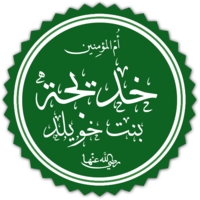
Khadijah, Mother of the Believers

Bride of Muhammad

Mother of the Believers is a title Muslims give to the wives of Muhammad. It best suits his first wife, Khadijah bint Khuwaylid. According to Islamic sources, Khadijah was a wealthy widow and Muhammad’s employer. She had been married twice and had children from those marriages. Khadijah was a very successful merchant. Khadijah’s trade caravan equalled the caravans of all other traders of the Quraysh put together. Khadijah neither believed in nor worshipped idols, which was uncommon. Khadijah didn’t travel with Her trade caravans but employed others to trade on her behalf. Muhammad was one of them.

Muhammad attracted Her interest. He was twenty-five, and Khadijah was forty when She proposed to him. The woman proposing a marriage to the man was indeed unusual, most notably given the time and place where it occurred. She was wealthy and way out of Muhammad’s league, so that he wouldn’t have considered it. The marriage between Khadijah and Muhammad was both happy and monogamous. When he was without Her on one of his journeys, Muhammad never had any desire for other women. They had six children, of whom four daughters survived.

Muhammad returned home, shocked after the Archangel Gabriel appeared to him for the first time. He told Khadijah what had happened, trembling, no doubt. She comforted him like a mother and supported him thereafter. Khadijah’s moral support made Muhammad believe in his mission, and Her financial support was indispensable. Apart from a wife, Khadijah was thus like a mother to Muhammad, in the likeness of Eve and Adam. She was Muhammad’s boss in more ways than one. Like Jesus, Muhammad married God. However, unlike the Bride of Christ, the Bride of Muhammad is still well-known. Only after Khadijah’s death did Muhammad marry several other women.

Quran origins


Muslims believe that the Quran was revealed to Muhammad by God, with the Archangel Gabriel serving as the intermediary. The Quran lacks chronological order and repeats itself. Scholars believe its historical accuracy is inferior to that of the Bible in describing the same events. And so, you might find it hard to believe that this scratchy collection of sayings, which Muslims claim has unparalleled artistic value and is so brilliantly composed that it is beyond the capabilities of even the brightest minds to reproduce, is the word of God and meant to correct corruptions in previous Jewish and Christian scriptures, as Muslims claim. But if you don’t know Arabic and rely on a foreign translation, you cannot assess the Quran’s artistic value. And God works in mysterious ways. The first Muslims memorised the verses and didn’t write them down.

Memorising such a lengthy text for decades is prone to errors. And the Muslims fought several battles that took the lives of some of those who knew these verses. To reduce the risk of verses going lost in this manner, the early Muslims divided the task of memorising the Quran and assigned multiple men to recall the same verses. How well they did that is anyone’s guess. It explains a great deal about why the Quran is the way it is. Those who later wrote down the Quran didn’t edit the verses or present them chronologically because humans shouldn’t distort God’s words. If only early Christians had shown that kind of reverence for their scriptures, Christianity would have been an entirely different religion.

Historical analysis suggests that much of the Quran originated from previously extant Zoroastrian, Jewish, and Christian sources. The Arab desert was far from Rome, so local Christians could hold deviant views that the Church considered heretical, such as that Jesus didn’t die for our sins, that Jesus was human and not the Son of God and that Jesus didn’t die on the cross but that there had been some ploy to make people believe that. The Quran mentions that Jesus created birds from clay and breathed life into them (3:48-49, 5:109-110). The Gospel of Thomas mentions this. Speaking from the cradle, Jesus defended his mother against accusations of sexual immorality (Quran: 19:27-30).

Parts of the Quran have no previously known sources. They could have been part of God’s message that the Archangel Gabriel supposedly dispatched to Muhammad. The Quran also adds a few juicy details to existing stories that the Jews have failed to mention in their Bible. These might have been local tales circulating in the area. An example is King Solomon gathering an army of ghosts, men and birds, entering the valley of the ants, and ants talking to each other (Quran 27:15-18),

Indeed, We granted knowledge to David and Solomon. And they said in acknowledgement, ‘All praise is for God Who has privileged us over many of His faithful servants.’

And David was succeeded by Solomon, who said, ‘O people! We have been taught the language of birds, and been given everything we need. This is indeed a great privilege.’

Solomon’s forces of ghosts, humans, and birds were rallied for him, perfectly organised.

And when they came across a valley of ants, an ant warned, ‘O ants! Go quickly into your homes so Solomon and his armies do not crush you, unknowingly.’

In virtual reality, these things can happen. We have no evidence, but some things are more plausible than others. Talking ants are as believable as a serpent talking to Eve. Still, Muslims claim Muhammad was the last prophet before the End Times and that the Quran corrects mistakes and omissions in the Jewish and Christian scriptures. At first glance, this is not particularly convincing, but the Quran contains a few discrepancies that seem more meaningful in hindsight:

  • The Quran discusses Adam’s creation extensively but says little about how Eve came to be. The story of the rib is absent. The Quran claims that humans originate from one soul (Quran 39:6), like the creation in God’s image (Genesis 1:27).
  • The Quran doesn’t blame Eve for the Fall. Eve and Adam transgressed together. One passage explicitly blames Adam (Quran 20:120-121).
  • There is no original sin in Islam. The Quran states that Eve and Adam repented, and God forgave them (Quran 2:37, 7:23). The Quran doesn’t claim that Jesus was a redeemer for the sins of humankind.
  • The Quran names Jesus the Son of Mary and confirms the virgin birth, thereby implying that Jesus had no father, and because Christians call him the Son of God, it opens up the possibility that God’s name was Mary.
  • In the Quran, God orders the angels to prostrate before Adam, while the New Testament says that the angels must bow before Jesus, implying that Jesus could be Adam. The repeated mention could signal importance.
  • Finally, the Quran stresses the return to Paradise 147 times. Although the Jewish and Christian scriptures pay little attention to our return to Eden, the Quran mentions it so often that it could be of the utmost importance.

God ordering the angels to bow before Adam and Satan refusing to do so was a Jewish theme that some Christians, and later the Muslims, took over. One of the earliest accounts of Satan’s fall as a result of the conflict with Adam comes from the Life of Adam and Eve, a retelling of their lives from around 200 AD. God first formed, animated, and endowed Adam with the image and likeness of his creator. The archangel Michael brought him to bow before God. God then confirmed the creation of Adam in His image and likeness. Then, Michael summoned the rest of the angels and ordered them to bow before Adam, but Satan refused. The sevenfold repetition of this theme in the Quran suggests that there may be more to it than some obscure story entering the Quran by accident.

The Hidden Secret

The Quran claims that God is the greatest schemer (Quran 3:54, 7:99, 8:30, 10:21, 13:42) and capable of deception (Quran 4:88, 5:41, 11:34, 14:4). The existence of different religions and theological disputes is part of God’s plan. Otherwise, the message of Islam would have been more convincing. After 1400 years, that message has yet to convince 80% of the world’s population. The Quran is said to contain a hidden secret. Chapter 74 of the Quran is named The Cloaked One or The Hidden Secret. The former name is the translation of its title, while the latter refers to its content. The cloaked one is Muhammad. The chapter further mentions that 19 angels guard hell. The conflating of cloak and hidden secret suggests a disguise. About the number 19, the Quran says (Quran 74:31),

“We have made their number [that of the angels] only as a test for the disbelievers so that the People of the Book [Jews, Christians and Zoroastrians] will be certain, and the believers [Muslims] will increase in faith, and neither the People of the Book nor the believers will have any doubts, and so that those hypocrites with sickness in their hearts and the disbelievers will argue, ‘What does God mean by such a number?’ In this way, God leaves whoever He wills to stray and guides whoever He wills. And none knows the forces of your Lord except He. And this description of hell is only a reminder to humanity.”

Muslims insist it contains a clue proving the divine origin of the Quran. The verse suggests that the number 19 holds significance beyond the number of angels mentioned. In 1974, a fellow named Rashad Khalifa claimed to have discovered a mathematical code hidden in the Quran based on the number 19. It gave rise to a numerological cult and countless films on YouTube made by beard-wearing men that can bore you to death.

Numbers are meaningless, but the Quran implies there is more to that number and that it contains a proof of some kind, a hidden secret. So, what could the hidden secret be? Chapter 19 is titled ‘Mary’ and is about the Virgin Mary, the stand-in for God, the Mother Goddess. The hidden secret may be that God’s name was Mary, something only God could know. The cloak may refer to God appearing as a man while being a woman, or to the Virgin Mary, as the veil that conceals God’s identity.

Virgin birth

The Quran corroborates the virgin birth of Jesus (Quran 4:171) and claims that Jesus is not the Son of God, thereby implying that Jesus had no father. The virgin birth is a miracle of the Mother Goddess. Christians invented that tale because, if God is Jesus’ Father, then he can’t have a human father. Jesus was Adam, the Son of Eve, so it also replaced Adam’s birth from the Virgin Eve. The Quran consistently names Jesus the Son of Mary (Quran 2:87, 4:171, 61:6), while Christians call him the Son of God. Perhaps there was a Christian tradition in the Middle East that did so. Archaeologists excavated near the location commonly known as Armageddon, a 5th-century AD Greek inscription stating ‘Christ, born of Mary.’1 The odd thing is that it doesn’t say Son of God.

The Quran claims God has no children and that Jesus was not God’s son (Quran 6:100-102, 17:111, 18:4-5, 19:88-92). The reason is that the Meccan supreme deity, Allah, had a wife and children before God claimed this title. And the Virgin Mary wasn’t God either. The repetition of the phrase Son of Mary suggests importance. It stresses that God is not Jesus’ father, and it may imply that God’s name is Mary.

The star and crescent became the symbol of Islam. This symbol has a long history predating Islam, as it was associated with a Moon goddess. The moon represents the woman, and the star the child (Genesis 37:9). Hence, the Islamic symbol is akin to the Madonna and Child, or to the relationship between Khadijah bint Khuwaylid and Muhammad. She was fifteen years older and could have been his mother. The Son of God thus means Son of Mary, as Mary Magdalene was God. The appropriate picture is the Madonna and Child, along with the crescent-and-star symbol of Islam. And so, the same symbolism sneaked into Islam in the same sneaky fashion as it did with the Madonna and Child in Christianity, which is very sneaky indeed, and adds substance to the saying, ‘God works in mysterious ways.’

Return to Eden

Like Christians, Muslims believe Jesus will return (Quran 4:159, 43:61). Even more crucial, however, is our return to Eden, only sparsely mentioned in the Jewish Bible (Ezekiel 36:22-38) and the New Testament (Revelation 22:1-5). The Quran refers to Eden using terms like Gardens and Paradise 147 times, or 3 * 7 * 7. If you’re into numbers with religious significance, that is most remarkable. It is even more significant because humans wrote and edited the Bible, so if there are magic numbers in it, some scribe probably did that during a lifetime of boredom and number crunching. The Quran, however, is the result of decades of oral recitation, during which parts were changed or lost. And none of the reciters knew the entire Quran by heart. After several decades, they wrote down the verses as the reciters remembered them, without a significant redaction process.

God ordering the angels to prostrate before Adam seven times in the Quran is more miraculous than Jesus saying seven times ‘I am’ in the Gospel of John. The latter is not even a miracle, because someone could have done that intentionally, and probably did. In that sense, the Quran is uncorrupted by humans. The numerological signs, such as verse 36:36, which says that God created everything in pairs, and the fact that 36 is six times six, are God’s jokes. In all likelihood, no human ever decided to arrange the verses to create such a pair within a pair in a verse that says God created everything in pairs. Paradise is supposedly the final destination of the righteous. The Quran refers to the Garden of Eden with phrases such as ‘fruits from that garden’ and ‘spouses.’ For instance (Quran 2:25),

And give good tidings to those who believe and do righteous deeds that they will have gardens [in Paradise] beneath which rivers flow. Whenever they are provided with a provision of fruit from there, they will say, ‘This is what we were provided with before.’ And it is given to them in likeness. And they will have therein purified spouses, and they will abide therein eternally.

The promise of spouses in Paradise was a ploy to make horny young men fight for Islam without fear of death. And it worked well as the initial blitz of Islam was nearly as spectacular as Hitler’s. The New Eden is a central theme in the Quran, while the Jewish Bible and the Gospel hardly mention it. The repetition implies that it is of the utmost significance. Here, the Quran corrects Judaism and Christianity. Jews and Christians view God’s plan as a journey from the depraved city of Babylon to God’s city of Jerusalem, the New Jerusalem. Instead, we might go to the New Eden, as it is the core of the final revelation given to Muhammad, at least if we take repetition as a sign of importance. God’s plan, thus, is to bring us to the Final Gardens of Paradise, modelled after Eden.

The idea of a New Jerusalem in Judaism and Christianity has a historical origin. The Jews compiled most of their scriptures during their exile in Babylon and shortly after. Babylon was a centre of empire and civilisation. After the Jews had returned to Israel, they interpreted their journey as a move from the depraved city of Babylon to God’s city of Jerusalem. They received assistance from the Persian leader Cyrus the Great, who conquered the Babylonian Empire and permitted the Jews to return to their homeland. Christians took over this theme. If we go from Babylon to Eden, we get a new theme. Babylon represented advanced civilisation. In Eden, life was simple. That is where this seems to be heading.

Latest revision: 16 October 2025

1. 1,500-year-old ‘Christ, born of Mary’ inscription found in Israel. Mark Milligan (2024). Heritage Daily.

Featured image: top small written Arab phrase “Umm ul Muminin”(Mother of the believers), then in centre Big written “Khadijah”, and bottom small written Arab honour phrase ‘Radhi allahu anha.’
Book: God is a Woman

Who is God? This question has remained unanswered until now. We live in a virtual reality created by an advanced humanoid civilisation to entertain one of its members, whom we call God. God can play a role as an ordinary human in this world. Several people who changed history have been God in disguise.

The worship of the Jewish deity Yahweh spread through Christianity and Islam. Half the world now believes that Yahweh, also known as the Father or Allah, is the all-powerful owner of this universe. In a simulation, this is not a mere accident. This deity is the veil behind which the owner of the universe hides.

Mary Magdalene was an avatar of God. She led Jesus to believe that She was Eve reincarnated, while he was Adam reincarnated, and that Eve did not come from Adam’s rib, but was her son, so Adam and, therefore, Jesus were the Sons of God. God also married Muhammad, but he didn’t know.

The Jewish Bible is a collection of myths and historical events. The stories about Creation, the Fall, Noah, Abraham, and Moses are mostly fictional. The history of the Jews began in the era of the Judges. Deborah was the first historical person in the Bible. She founded the Jewish nation and was God in disguise.

This book addresses the following topics:

  • Why are humans religious, and how did their religions develop?
  • Why could this universe be virtual?
  • Why are our faiths incorrect, while God could exist?
  • How did the Jewish religion emerge and evolve?
  • Who was the historical Jesus?
  • What was the relationship between Mary Magdalene and Jesus?
  • Was Eve the mother of Adam?
  • Why is the Virgin Mary such a powerful figure?
  • Why is Jesus the Last Adam?
  • Did Jewish patriarchs, prophets, and kings marry God?
  • Did Muhammad marry God?
  • What could be the hidden message in the Quran regarding the number 19?
  • Why are Christians born of God?
  • What is the meaning of God’s love?
  • How did Paul shape Christianity?
  • How did Christians turn Jesus into God?
  • Why is the Gospel of John so different from the other Gospels?
  • What other avatars did God have in this world?
  • Looking at history, what might a Messiah be like?
  • Why can’t prophecies be accurate predictions?
  • Are there signs indicating we are living in the End Times?

By reading this book, you will discover that God is a woman from an advanced humanoid civilisation who uses this world to entertain Herself and can participate in this story as an ordinary woman.

The book is freely available under the CC BY-SA 4.0 licence.

You can download your free EPUB here:

https://drive.proton.me/urls/1SF6J335KR#JaLKrJnVcCeJ

You can download your free PDF here:

https://drive.proton.me/urls/QZY0YTZTXG#deujdTKULcSx

Or from here:

The book is freely available as an e-book on Kobe:

https://www.kobo.com/ebook/god-is-a-woman-7

The book is also available as an e-book on Amazon Kindle. Amazon requires a minimum price, so it is available at that price:

Latest revision: 6 September 2025

Virgin Mary

Mother Goddess Mary

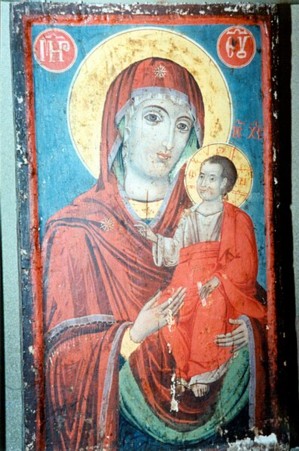
Jesus’ birth mother, Mary, plays a prominent role in Christianity. As the story goes, she was a virgin who birthed Jesus. She is the central figure in Roman Catholicism and Eastern Orthodox Christianity. She is the Mother of God, Church tradition holds, thereby implying Jesus was God and that God has a mother, which is indeed highly peculiar. Many Catholics pray to Mary rather than to Jesus or God. In this way, Mary is a proxy for God. The Quran consistently names Jesus the son of Mary rather than the Son of God. The images of Mary with the child resemble those of the Mother Goddess. They picture Jesus as the Son of God, the Mother. That is most noteworthy because Jesus believed he was Adam, the Son of Eve, the Son of God. How could this happen? Inquiring minds want to know. Now, there is the historical explanation, and there is the script that God wrote.

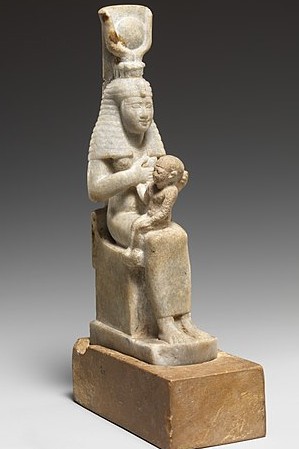
Isis with Horus
Isis with Horus. Metropolitan Museum of Art.

In the early years of Christianity, there was probably no cult of the Virgin Mary. The earliest Christian paintings, made around 235 AD, depict Christ, Peter, and martyrs, but not Mary. The first solid evidence of devotion to the Virgin Mary dates back to the third century, but its origin remains unclear. Perhaps, early Christians prayed to Mary as they did to other saints. Possibly, Mary granted the most requests, which made her increasingly popular. In this sneaky manner, the Mother Goddess sneaked into the Church through a back door, via the cult of the Virgin Mary. The ability to give birth without the need of a man is the miracle of the Mother Goddess. Christians later created statues and icons of the Virgin with the child Jesus, looking like the Egyptian mother goddess Isis with her child Horus.

Saint Mary Bolnichka Icon
Saint Mary Bolnichka Icon.

So, what brought Mary to this elevated status? Mary is not only the mother of Jesus, but Christians and Muslims believe she was a virgin. Jesus’ birth from a virgin didn’t happen. That we can be sure of. Matthew and Luke mention Jesus’ virgin birth, but Mark and John don’t. Had it been common knowledge, all the Gospels would have mentioned it. And if it had happened, it would have been common knowledge. So, was it a myth that sprouted up in the Christian community? Or did the Church Fathers have a pressing cause to invent the story of Jesus’ virgin birth? There is reason to believe the latter.

And Jesus became a carpenter

The virgin birth of Jesus never happened. In Galatians, Paul writes that God sent His Son, who was born of a woman (Galatians 4:4). That was around 55 AD. Had he known about the virgin birth, that would have been an excellent opportunity to mention it, but somehow he forgot. Or the virgin birth hadn’t happened, which is more likely. A motive for inventing the virgin birth that immediately presents itself is that if God were Jesus’ Father, he couldn’t have a human father. It is not entirely satisfactory. If Jesus saw God as his Father, there is no pressing need for that. In that case, Jesus said ‘Father’ to God. That would be all there is to it, and there would be no reason to make this up.

And so, you might believe that the myth emerged within the Christian community to fill in the gap, as there was no narrative of Jesus’ birth. You wouldn’t think the Church’s leaders orchestrated it. There is reason to think otherwise, as we will see. Paul’s phrase ‘born of a woman’ also suggests so. And so, there must be more to it. That the virgin birth is an intentional falsification, you can infer by comparing Mark to Matthew. Mark dates from around 70 AD. Matthew came a few years later. Both are truthful to some extent. You can use one to detect the lie in the other. Mark tells that people in Jesus’ hometown called him ‘the carpenter’ and ‘Mary’s son’ (Mark 6:3),

Isn’t this the carpenter? Isn’t this Mary’s son and the brother of James, Joseph, Judas, and Simon? Aren’t his sisters here with us?’

The Gospel of Mark doesn’t mention Joseph, who was Jesus’ human father. It does note that Jesus had brothers and sisters, of whom we learn only the names of the brothers. You would expect the townspeople to call him Joseph’s son. But they didn’t, and called him Mary’s son, as if the virgin birth had occurred, while Mark doesn’t mention that noteworthy incident that you would definitely report on if you knew it had happened. It could be an error, but the mistake is so specific that it seems intentional. That it could be an edit, you can find in Matthew (Matthew 13:55),

Isn’t this the carpenter’s son? Isn’t his mother’s name Mary, and aren’t his brothers James, Joseph, Simon and Judas? Aren’t all his sisters with us?

The Gospel of Matthew mentions both the virgin birth and that Jesus has a human father and explains them in the virgin birth story, where Joseph accepts Jesus as his son, rendering such an edit redundant. Mark came before Matthew, scholars agree, and it contains fewer fancies. Mark and Matthew both drew on the same source, which referred to Jesus as the carpenter’s son. Likely, Mark dates from shortly after the Church Fathers had decided to introduce the virgin birth. The clumsy editing makes it seem as if Jesus were a carpenter.

By the time Matthew wielded his pen, the Church Fathers had contrived a proper cover story so that they didn’t have to remain secretive about his human father anymore. Such an explanation presumes that the authors of Mark and Matthew were prominent people within the Church who had contact with its leadership. They wouldn’t have done so if it had not been a solution to a theological problem.

The author of Matthew also sought a prophecy in the scriptures that predicted Jesus’ virgin birth. Isaiah wrote that a young woman would give birth to a son as a sign that God would destroy Judah’s enemies (Isaiah 7:14). Isaiah addressed King Ahaz in the eighth century BC and didn’t foresee the coming of Jesus, who would arrive seven centuries later. The Greek translation of the Jewish Bible, available in the first century AD, translated a young woman as a virgin. The author of Matthew saw it as a prophecy of Jesus’ virgin birth. There was no prophecy of this event that never happened, and that is no coincidence.

The author was particularly preoccupied with proving that Jesus was the long-awaited Jewish Messiah. To that aim, he fabricated a genealogy to demonstrate that Jesus descended from the House of David. And behold, he uncovered fourteen generations in all from Abraham to David, fourteen from David to the exile to Babylon, and fourteen from the exile to the Messiah, Jesus, which is so neat that it only happens in fairy tales. The prophet Micah prophesied that a ruler would come from Bethlehem (Micah 5:2). And somehow Matthew ‘discovered’ that it was the birthplace of Jesus. Mark and John don’t mention the virgin birth or Bethlehem. Jesus was probably born in Nazareth, had an ordinary childhood and joined the movement of John the Baptist.

Mary as the New Eve

If Jesus called God his Father, there is no reason to invent the virgin birth. You don’t need to prove that God is Jesus’ Father. If Jesus said so, that would be good enough. His having a human father wouldn’t change that. The answer to the mystery is that Jesus never called God ‘Father,’ but rather ‘Mother.’ Jesus was the Son of God because God, in the person of Mary Magdalene, convinced Jesus that he was Adam reincarnate, and that She was Eve reincarnate. And Eve didn’t come from Adam’s rib, but Adam was Eve’s son. The virgin birth of Jesus from Mary replaced the ‘virgin birth’ of Adam from Eve.

You can infer that from Christian theology. God announced there would be enmity between the offspring of the serpent and that of the woman (Genesis 3:15). Christians see it as a prophecy predicting the coming of Jesus. They believe the seed of the woman refers to the virgin birth of Jesus, while it was Adam’s. That made Mary the New Eve. In this manner, Mary became the replacement for Eve. It is, however, doubtful that those who invented the virgin birth also came up with this.

Eve being Adam’s mother and Jesus calling God his Mother contradicts the Jewish scriptures. You can’t have that, so you have to work on that fact to make it fit. So, why not say Jesus was born of a virgin instead? After all, Jesus was Adam, and Eve was a ‘virgin’ when she gave birth to Adam. And God’s name was Mary, just like Jesus’ mother, while God was Jesus’ Mother. That was very convenient indeed, a convenience provided by providence, no doubt. Mark and Matthew both name Jesus Mary’s son, perhaps because she played a prominent role during Jesus’ ministry and was present at the cross.

Cloak and dagger

The Virgin Mary appeared more frequently to people than Jesus and performed more miracles than any other saint. There is little or no evidence of many of these supposed miracles, but the Fatima Miracle had 40,000 witnesses, so there should be no doubt that something spectacular had happened there. God the Father doesn’t appear in this way. And there are no 40,000 witnesses who saw a miracle that the Father announced. That is because there never was a Father. Virgin Mary became such a potent figure because she is the cloak behind which God the Mother has hidden Herself so far. Now, we are at the cloak-and-dagger part: the Quran boasts a hidden secret.

In the Quran, Mary is the most prominent woman and the only woman mentioned by name. The Quran dedicates an entire chapter, chapter 19, to the Virgin Mary. The number 19 has great significance in Islam. Some Muslims indulge in arcane numerological explanations as to why that is so. The Quran refers to this number in the chapter named ‘The Hidden Secret.’ And so, the Quran may hold a hidden secret related to this number. The Quran also claims Mary was a virgin, thus confirming the miracle of the Mother Goddess. The Virgin Mary became the cloak behind which God hid Her identity.

The star and crescent became Islam’s symbol. It has a long history predating Islam, as it was associated with a Moon goddess. In the Bible, the moon refers to the woman and the star to the child (Genesis 37:9). Hence, the Islamic symbol represents the Madonna with the child Jesus or the relationship between Khadijah bint Khuwaylid and Muhammad. She was fifteen years older. A woman of Her age could have been his mother.

The St. Mary of Zion Church in Ethiopia is said to contain the Ark of the Covenant. Legend has it that the Ark came to Ethiopia with King Menelik after he visited his father, King Solomon. The Ark symbolises Mary of Zion. The Ark is supposed to be the residence of Yahweh, the God of Israel.2 That is remarkable, as God’s name was also Mary.

Statue storm

The Protestant Reformation was an attempt to return to Christianity’s roots by viewing Scripture as the sole source of Christian truth. The Protestants ended church traditions that lacked biblical grounds, including the veneration of the Virgin Mary. Nothing in the Bible justifies the cult of Mary. Protestants removed icons and statues from their Churches because one of the Ten Commandments prohibits making images for worship (Exodus 20:4-5). In the Netherlands, the Protestant Reformation caused a ‘statue storm’ where Protestant religious vigilantes ravaged Catholic Church interiors.

Protestantism developed in an era of emerging rationalism and naturalism. And so, Protestants also object to magic and superstition, deeming it Satan’s work, while Catholics love miracles like healings at Lourdes and weeping Mary statues. Miracles have always been part of the Catholic tradition.

The Protestants erased an essential part of Christianity’s original message of the Mother Goddess giving birth to Her son. Instead of getting closer to the truth, the Protestants wandered further from it. And it didn’t solve anything, but only generated more confusion. The Protestants soon began fighting among themselves over the interpretation of the scriptures. You can’t be wrong, because if you are, you end up frying eternally in Satan’s ovens. That was the reason Protestantism started in the first place. So, after the Protestant storm is over, we have over 45,000 branches of Christianity.

Latest revision: 9 December 2025

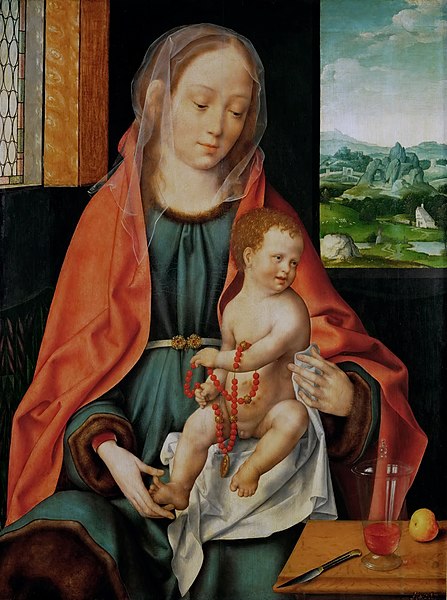
Featured image: Madonna and Child, Kunsthistorisches Museum Wien. Public Domain.

Other images: Isis with Horus. Metropolitan Museum of Art. Wikimedia Commons. Public Domain; Saint Mary Bolnichka Icon. Wikimedia Commons. Public Domain.

1. Church of Our Lady Mary of Zion. Wikipedia.

The Last Adam

Adam is the Son of God (Luke 3:38) and Jesus the Firstborn of all Creation (Colossians 1:15). Was Jesus Adam reincarnated? And was Adam born? Firstborn means you are the family heir, so the Firstborn of All Creation means you inherited the world. That is the standard interpretation with which most scholars would likely agree. The Christian doctrine states that Jesus already existed with God before creation and thus was not Adam. That is not what the words say, nor is it what Jesus’ inner circle believed. Existence before creation is not the same as being born. And Adam was the Son of God. When Paul was busy writing Colossians, he was also working on Christian theology, and his thoughts were still in a state of flux. And so, there may be more to it than theologians can explain.

Theologians regurgitate a century-old, pre-chewed menu of previous generations of theologians. Do theologians ever come up with something new rather than yet another insight on a hair-splitting detail? Do they discuss the simulation argument? No! They occupy themselves with century-old controversies. Why would Jesus sacrifice himself for Adam’s transgression? It makes more sense if Jesus believed he was Adam, who had to redeem himself. That was an idea Paul entertained for a while, for Jesus thought he was Adam. Only that generated serious theological problems. How could the perfect sinless Jesus also be the sinner Adam? And so, his mind ground on. Eventually, Christians came to believe that Jesus existed before creation, as laid out in the Gospel of John.

Don’t blame theologians for not being sufficiently imaginative. You could easily go astray. That ireful cloud that led the Israelites out of Egypt in a 2,500-year-old Jewish fairy tale was Eve from an even older Iraqi fairy tale, who gave birth to Adam, which the surviving Jewish version of the Iraqi fairy tale doesn’t mention. And by the way, that cloud from the fairy tale was Judge Deborah, the first historical person in the Bible. She started the Jewish nation by slaying Israel’s enemies and claiming that a magical cloud named Yahweh did it. She later married Jesus as Mary Magdalene and Muhammad as Khadijah bint Khuwaylid. You can’t guess it unless God gives you the clue that unlocks the mystery.

The message of Jesus being Adam still features in Christian doctrine as a remnant of an original belief. Jesus is the New Adam, and his birth mother is the New Eve, which implies that Jesus married his mother in a previous life. And precisely that was the original message of Christianity. Paul compares Jesus to Adam. In Romans, he writes, ‘Just as through the disobedience of the one man the many were made sinners, so also through the obedience of the one man the many will be made righteous.’ (Romans 5:19)

Paul didn’t blame Eve for the Fall. Later writers posing themselves as Paul cast the blame on Eve. But Paul, a god-fearing individual who still knew the truth, wasn’t that daring. In 1 Corinthians, Paul noted, ‘As in Adam all die, so in Christ, all will be made alive.’ Jesus thus became the redeemer for Adam’s Fall. Paul called Jesus the Last Adam (1 Corinthians 15:45). Jesus being Adam’s reincarnation was an early Christian belief until the narrative changed to Christ’s existence before creation. And so, you only find the comparison in Paul’s letters, the earliest surviving documents of Christianity.

The Quran underpins the idea that Jesus is Adam. You have to read between the lines. Jesus was like Adam in the way he was created (Quran 3:59), and the Quran supports the Christian claim that Jesus was born of a virgin (Quran 3:47, 19:16-22). Hence, they are both ‘born of a virgin.’ Not really, of course, but people believed it. And several Quran verses state that God ordered the angels to prostrate before Adam (Quran 2:34, 7:11, 15:28-29, 17:61, 18:50, 20:116, 38:71-74). The Quran mentions it seven times, making it appear significant. And seven times, Jesus says ‘I am’ in the Gospel of John, stressing his supposed divinity.

The Epistle to the Hebrews claims that God made Jesus, the firstborn, into the world, superior to the angels and made the angels worship him (Hebrews 1:1-7). And if the Quran is a message from God, the presumed guy in the sky, who possesses superpowers but is not Superman, and also not a man, then Jesus could be Adam. The Quran also claims Jesus will return (Quran 43:61). If he were Adam, God’s firstborn, who had already returned once, he could. Otherwise, it all gets even odder than it already is.

Latest revision: 16 August 2025

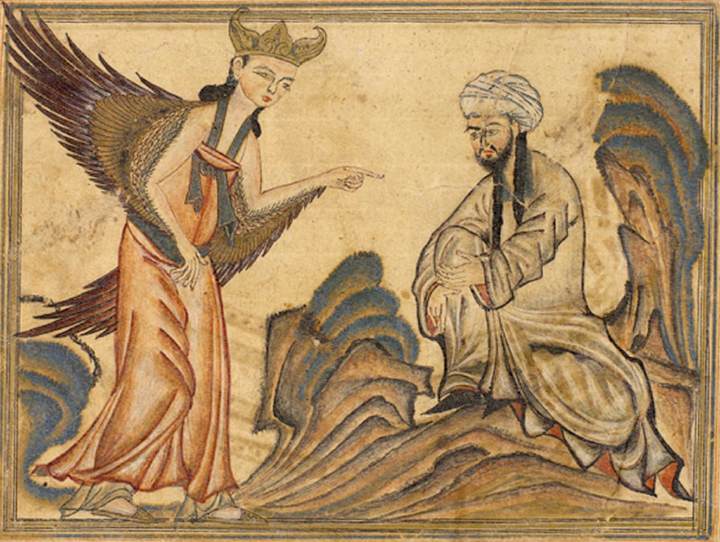
Mohammed receiving his first revelation from the angel Gabriel

Religious Experiences and Miracles

The Jewish people still exist after 2,500 years, while they have not had a homeland for most of the time. That is a remarkable feat. Then Christianity replaced the existing religions in the Roman Empire in one of history’s strangest twists. Somehow, the message of personal salvation through Christ caught on. In the third century, Manichaeism emerged as a new religion. It taught that there was a struggle between the good spiritual world of light and the evil material world of darkness. The prophet Mani, who grew up in a Jewish-Christian Gnostic sect, claimed to have received revelations meant for the entire world, which were to replace all existing religions. It instantly became a spectacular success, spread everywhere in the known world, and could have overtaken Christianity, but it didn’t. A pivotal, and possibly decisive, moment was the conversion of Emperor Constantine to Christianity in 312 AD. He made Christianity the favoured religion in the Roman Empire.

A few centuries later, a small band of Arab warriors established an empire that stretched from the Atlantic to India, spreading the new religion of Islam, in an even stranger and more rapid historical development. Is it a realistic scenario that the supposedly illiterate camel driver Muhammad became a crafty statesman after seeing an angel telling him he came to deliver messages from the God of the Christians and the Jews? After Muhammad’s death, his followers went on to defeat the Byzantine and Persian empires. At the same time, Manichaeism made a one-way trip into the dustbin of history, while in the third century, it appeared to be on the verge of becoming the world’s leading religion. So, why did Mani fail and why did Muhammad succeed? Historians can explain it, but it is an account of what happened rather than an explanation. The question remains, could it occur without someone pulling the strings?

So much can happen, and what happens now has once been extremely improbable. Your reading this text here and now seems highly unlikely a few decades ago. Think of all the things you could have done instead. Or you could have been dead. Yet, you wouldn’t consider your reading this text a miracle. Proselytising religions like Christianity and Islam have a built-in inclination to grow. That may not be the ultimate answer. Jews, Christians, and Muslims worship the same deity. Our universe could be a simulation, and someone could have planned it. But who is to say it couldn’t have happened otherwise?

When Islam arrived on the scene, Jews, Christians and Zoroastrians in the area already believed in an all-powerful creator. Muhammad had met them on his travels, so he was familiar with these religions. Before that, Christianity had faced an uphill struggle. While the Roman state suppressed this religion, pagans left their gods behind and accepted the Christian God as the only true God. And they did so in large numbers.

That begs for an explanation, even though the conversion of Romans to Christianity was a gradual process that took centuries. The Romans occasionally half-heartedly persecuted Christians and executed a few thousand of them over the centuries, not for being a Christian but for not paying their respects to the Roman gods. Despite that, the number of Christians increased 2-3% per year between 30 AD and 400 AD. Each Christian may have converted just one or two persons on average. Over time, exponential growth enabled Christianity to grow from about 100 followers in 30 AD to 30 million by 400 AD.

Such a gradual and steady growth over centuries was somewhat unique for a religion, and so was the blitz conquest of Islam later on. Most people in the Roman Empire, and everywhere else for that matter, lived miserable lives. The promise of an eternal blissful afterlife may have been too tempting for those poor, wretched souls to resist. However, the most often cited reason for conversions was stories about the miracles Christians performed.2 Only in the Middle Ages did the sword become the most compelling Christian argument as Christianity spread further and became integral to European politics. That was not the case in the Roman Empire, so miracles and stories about them were crucial.

An early miracle was Jesus’ appearance to a few followers after his crucifixion. The New Testament mentions miracles that the disciples allegedly performed. These accounts may be exaggerated, but the theme of miracles remains a consistent one in Christianity to this day. The Roman Catholic Church has a rich folklore surrounding relics that are believed to possess magical properties because they are said to have been touched by Jesus. The most famous relics are the Crown of Thorns in Paris, the mysterious Holy Grail, the chalice from which Jesus is said to have drunk, and the Shroud of Turin, a piece of linen cloth with a supposed image of Jesus’ face.

Many of the miracles attributed to these relics are unverifiable or can have other causes, such as luck, but a few cannot be easily explained away. The Roman Catholic Church keeps a record of them. On message boards, people tell stories about prayers heard and miraculous healings. Many of these stories may result from chance or other causes, such as a misdiagnosis or someone seeking attention by lying, but that is not always the case.

A recurring theme is the appearance of the Virgin Mary and other miracles related to her. Thousands of people have seen her. She appeared several times in Venezuela. She revealed herself to Maria Esperanza Medrano de Bianchini in 1976, who received exceptional powers. She could tell the future, levitate, and heal the sick. In Egypt, Mary appeared at a Coptic Church between 1983 and 1986. Muslims have also seen her there. There have been many more Virgin Mary appearances. The most notable sequence occurred in Portugal at Fatima between 13 May and 13 October 1917.

The grand finale was on 13 October 1917, when the Sun reportedly spun wildly and tumbled down to Earth, radiating in indescribably beautiful colours, before stopping and returning to its normal position. Some 40,000 attendants witnessed Mary’s performance. They had gathered because three shepherd children had prophesied that the Virgin Mary would perform a miracle on that date and location. Faking this was hard to do, considering the technology available in 1917. A lack of holographic equipment would have made the effort challenging, not to mention changing the location of the Sun, which is a large ball many times larger than Earth, thus making it difficult to move around. And somehow, the Sun only moved in Fatima, which can only happen in virtual reality.

Jesus also appeared a few times, but less frequently than the Virgin Mary. An intriguing account comes from Kenneth Logie, a preacher of the Pentecostal Holiness Church in Oakland, California, in the 1950s. In April 1954, Logie was preaching at an evening service. During the sermon, the church door opened. Jesus came walking in, smiling to the left and the right. He walked right through the pulpit. Then he placed his hand on Logie’s shoulder. Jesus spoke to him in a foreign tongue. Fifty people witnessed the event. Five years later, a woman in that same church suddenly disappeared. Jesus took her place. He wore sandals and a shiny white robe. He had nail marks on his hands, which were dripping with oil. After several minutes, Jesus disappeared, and the woman reappeared. Two hundred people have seen it. It was on film as Logie had installed film equipment, because strange things were happening.3 Such events can convince people that the message of Christianity, even though it may seem highly peculiar, is correct, as Zeus and Thor failed to show up and perform some tricks.

Mary and Christ are part of a folklore where genuine experiences mix with mental cases seeking attention or con artists profiting at the public’s expense. Usually, there are no 40,000 witnesses, verifiable evidence, or camera footage of what occurred. The Vatican is troubled by the self-proclaimed seers, fortune tellers, prophets, and messengers who believe they have a special bond with the Virgin Mary or have weeping Madonna statues, which they may or may not have prepared to weep. These people could be delusional, crave attention or, like the televangelists in the United States, be after your money. That is not always the case. If you have a religious experience, don’t suffer from mental conditions impairing your judgment, and can’t think of naturalist explanations, you should believe what you see. To quote Shakespeare’s Hamlet, ‘There are more things on heaven and earth, Horatio, than are dreamt of in your philosophy.’

Latest revision: 5 September 2025

Feature image: Mohammad receiving his first revelation from the angel Gabriel. Miniature illustration on vellum from the book Jami’ al-Tawarikh, by Rashid al-Din, published in Tabriz, Persia, 1307 AD. Public Domain.

1. Sapiens: A Brief History of Humankind. Yuval Noah Harari (2014). Harvil Secker.
2. The Triumph of Christianity: How a Forbidden Religion Swept the World. Bart Ehrman. Simon & Schuster (2018).
3. How Jesus Became God: The Exaltation of a Jewish Preacher From Galilee. Bart Ehrman. HarperCollins Publishers (2015).