The Virtual Universe

Some religions claim that God or gods have created this world. In the Bible, God created everything by saying, ‘Be.’ That God uttered ‘Be’ and poof, there are bees, is not a particularly compelling explanation for the existence of bees. So, how could the gods have the magical powers to do that? Until recently, we had no clue, but then Nick Bostrom, known for his dry and incomprehensible employment of words, delivered us the simulation hypothesis, the most profound breakthrough in theology in nearly 2,000 years. We might exist inside a computer simulation run by an advanced humanoid civilisation. Our creators can define a class bee and instruct the computer to create instances of this class. A class has properties, allowing individual instances to be unique.

And so, Genesis might be closer to the truth than the religion sceptics think. Bostrom didn’t say whether or not that is indeed the case or how likely it is. He didn’t speculate on that issue. Otherwise, his critics might have a field day, ridiculing him for opening a back door to the paranormal and religion. That could have been the end of his career. However, it is easy to find out if you venture into areas that scientists anxiously avoid, such as paranormal incidents, religious experiences, meaningful coincidences, people’s memories of past lives, ghost phenomena, and UFO sightings.

Scientists dare not investigate these phenomena, as it could make them a laughing stock in front of their peers. That is groupthink and intellectual cowardice on a grandiose scale. On numerous occasions, multiple credible witnesses have observed events that science can’t explain. Like nearly everyone else, scientists have been proficient at ignoring evidence that contradicts their beliefs, such as unscientific ravings about spirits relaying messages from the other side during seances. Bostrom speculated that this world might be a virtual reality, but didn’t search for proof. As a philosopher, he had better things to do.

The book The Virtual Universe delves into the evidence. You can prove this universe is a virtual reality if you assume scientists have correctly established the laws of nature and that sciences like physics, chemistry and biology are correct. If events transpire that defy these laws of science, such as paranormal incidents, religious miracles, meaningful coincidences, memories of previous lives, ghost phenomena and UFO sightings, breaches in these laws occur. According to science, the Virgin Mary doing a miracle before a crowd of thousands, like in Fatima, is impossible. If science is correct, and it happens nonetheless, this world must be fake. The book The Virtual Universe puts it like this:

  1. If we live in a real universe, we can’t notice. Virtual reality can be realistic and come with authentic laws of reality.
  2. This universe may have fake properties, but we cannot notice that either because we don’t know the properties of a genuine universe.
  3. Breaching the laws of reality is unrealistic in any case. If it happens, we may have evidence of this universe being fake.

It follows from (1) and (2) that we can’t use the universe’s properties, reflected in the laws of nature, to determine whether or not this universe is real. Science can establish the laws of physics or the properties of this universe, but science can’t tell whether they are real or fake. However, if breaches occur, we have evidence suggesting this universe is bogus. The book The Virtual Universe investigates the evidence, which includes stories about paranormal incidents, religious experiences, meaningful coincidences, reincarnation stories, ghost phenomena, and UFO sightings, often with multiple credible witnesses. So yes, aliens can beam you up into their UFO because they are as fake as you are.

Advanced humanoids, often dubbed post-humans, likely share motivations with us because they evolved from humans, likely after some engineering, genetic, or otherwise. These advanced humanoids may run simulations of human civilisations for research or entertainment. Research applications could be about running what-if scenarios. Possible entertainment applications include games or dream worlds where someone’s imagination comes true. These simulations may not be realistic in some aspects, as they reflect the rules of a game or someone’s personal fantasies. In a simulation, you can let Jesus walk over water and make him think that faith alone suffices to do that.

Civilisations are complex. Small changes can derail events that would otherwise occur. Just imagine another sperm had won the race to Adolf Hitler’s mother’s egg. There were millions of sperm in that race. Guaranteeing an outcome, such as letting World War I end on a date referred to by the licence plate number of the car that drove Archduke Franz Ferdinand to his appointment with destiny, requires control over everything that happens. That doesn’t apply to games. Unpredictable developments make games more interesting. Considering how we utilise computing power, mainly for games, sexy pictures and cat videos, the number of simulations for entertainment likely vastly outstrips those run for research purposes. If we live inside a simulation, we should expect its purpose to be entertainment.

The owner or owners may use avatars to play roles in this world and appear like ordinary human beings to us. If you are familiar with computer games, you are familiar with avatars. Once you enter a game, you become a character inside that game, your avatar, and you have an existence apart from your regular life. Inside the game, you are your avatar, not yourself. Alternatively, you could start a virtual world where you are the Creator and bring your dreams to life. In this world, you also become someone else.

That is a lot of assumptions, and without evidence, they remain speculation. Even when there is evidence, it doesn’t necessarily mean the explanation is correct. Suppose you hear the noise of a car starting. That is the evidence. You may think there is an automobile starting. Perhaps a vehicle is firing up its engine. But your husband might be watching his favourite television series, Starting Engines, so you can’t be sure. Nothing you know contradicts your assumption, but you could be wrong. So, is God an individual from an advanced humanoid civilisation who uses us for amusement? It is credible, and perhaps nothing contradicts it. But who is to say it is correct?

Now comes the disagreeable part. We are instances of the class human. When the beings in the simulation think for themselves, that raises ethical questions like whether they have rights that the creators should respect. Considering how humans treat each other, it is not a given that these rights would be respected even when our creators acknowledge them. In the real world, bad things happen to people. In the case of control, the beings inside the simulation don’t think, but are mindless bots following the script. We have no independent will and are toys to our creators. God kills people at will, and a few million casualties more don’t matter. On the bright side, if God wants us to enter Paradise, where there is peace and happiness, nothing can stop that as well. Those who try will surely find themselves on the losing side. So, if the Boss makes a joke, you can better laugh. Perhaps it isn’t easy. But don’t worry. It took me fifteen years to look at the bright side of life.

Latest revision: 6 September 2025

Jesus and Minas Coptic icon dating from 6th or 7th century

From Jesus to Christianity

Did Jesus exist at all?

The Gospel of John tells us that Jesus believed he had eternal life and a bond with God from the beginning of Creation until the end of time. Christians and Muslims expect him to return. Even though Muslims don’t believe Jesus is the Son of God, they also think he will return and that his mother was a virgin. Remarkably, Muhammad and the Jewish prophets didn’t view themselves as the eternally living Son of God, nor do Muslims believe that Jesus is. They both consider that thought a form of idolatry. And so Islam and Judaism have more in common with each other than with Christianity. That makes Jesus the most enigmatic individual in the history of humankind. Some people claim that there is no evidence that Jesus was a real person and that he is a fantasy figure like Spike and Suzy. So, let’s first address the argument that Jesus is a fictional person.

Sources from his era don’t mention him. There is hardly any evidence of Jesus outside the Bible. Jesus was the leader of a small sect, so that is not particularly surprising. The problem with the idea that there never was a Jesus is that it leaves us without a compelling explanation for the existence of Christianity, so that we must seek refuge in more bizarre explanations, like Christianity being a Roman conspiracy to replace Judaism with the Roman emperor cult. The supposed proof is that Jesus Christ shares the initials JC with Julius Caesar and that both died because of a betrayal. That can’t be a coincidence, so the Christ story is just a refurbished Caesar story, the proponents of this ‘theory’ argue.

They are right that it isn’t a coincidence. However, as an explanation for Christianity, it is pretty imaginative. And it fails to explain nearly everything we can read about Jesus in the Gospels. And so, Jesus did live. But what made him unique? Jesus started a religion that has over two billion followers today. Apart from a historical account, an explanation of his beliefs may help us understand him. That includes his relationship with God, the supposed guy in the sky who is far more powerful than Superman, can do more tricks, and is allegedly all-knowing. But Jesus changed world history more than anyone else, so did that sky dude have a hand in that? It would be strange not to ask that question.

What can we know?

Historians and biblical scholars try to reconstruct what Jesus taught and did. They use historical sources such as the Gospels. In many ways, Jesus was a typical first-century Jewish end-time prophet, a product of the culture he lived in, first-century Judaism. Yet, they never ask the question that would be strange not to ask: what made Jesus think he was the Son of God? And so, they fail to clarify Jesus’ supposed close relationship with God or why God was his Father. Decades after Jesus allegedly went missing, a few anonymous authors wrote the Gospels. Mark, Matthew and John haven’t written the Gospels attributed to them. The Gospels provide no clue as to who wrote them. Mark, Matthew and John were peasants who spoke Aramaic, while the authors of the Gospels were educated and spoke Greek. Some scholars argue that Christians initially relied on oral traditions and utilised writings that are no longer extant. Oral recounting is notoriously inaccurate. Stories change when retold. Details get lost, and new details get added. They had good reason to think so. Luke begins, stating precisely that (Luke 1:1-4),

Many have undertaken to draw up an account of the things that have been fulfilled among us, just as they were handed down to us by those who from the first were eyewitnesses and servants of the word. With this in mind, since I myself have carefully investigated everything from the beginning, I too decided to write an orderly account for you, most excellent Theophilus, so that you may know the certainty of the things you have been taught.

Luke was not one of the original Apostles, but a companion of Paul (Philemon 24), who was a physician (Colossians 4:14). And so, he could have written the Gospel attributed to him. But we don’t know. Church tradition also holds that the author of Mark wrote down a testimony of Peter. Peter died years before the author of Mark penned the text, but there are reasons to believe that a testimony of Peter was a source the author used, most notably because Peter has a prominent role in the text. Much of this Gospel is plausible given the time and place in which Jesus lived. Mark also discloses things about Jesus that Christians wouldn’t make up because it is embarrassing, such as Jesus’ family claiming he was insane (Mark 3:21). Mark seems to have had access to a reliable source.

There is also evidence of redactions in the New Testament. What to think of Jesus being the bridegroom and the Bride having gone missing? Jesus was married, but we are not supposed to know that. As a result of the confusion, scholars agree on very little about Jesus of Nazareth, except that he lived and preached shortly after 26 AD. His ministry started after John the Baptist had baptised him. Then there was a lot of action, with mystical and sensational statements, including miracles such as healing the sick and multiplying bread and fish, followed by a betrayal, crucifixion, and resurrection from the dead, and finally, his disappearance. The Gospels agree on a few things:

  • Jesus performed miracles, such as walking over water, healing the sick, multiplying bread and fish, and raising the dead.
  • Jesus made controversial statements that baffled the Pharisees, so they schemed against him, which eventually led to his crucifixion.
  • Jesus did not take Jewish religious law as seriously as other religious zealots. He had a different message of forgiveness of sins.
  • Jesus did not like hypocrites, for who is without sin? He forgave sinners who repented. Still, he claimed there would be judgment.
  • Jesus was respectful of women. And he held unconventional views on marriage. Few men were up to that task. That goes unexplained.
  • Oh yes, and he called God his Father, and he was God’s son. It was a close and loving relationship. Other prophets weren’t like that.

Who was Jesus, what did he do, and what were his teachings? Scholars and historians seek to reconstruct what happened and the beliefs of the earliest Christians by examining the oldest texts and earliest controversies. They have analysed the scriptures for centuries and concluded that you can’t establish much with certainty about Jesus except that he lived and preached. Some things are more plausible than others. And some things are nearly certain. The virgin birth didn’t happen, while the crucifixion did. Some of Jesus’ disciples likely saw him after he died, perhaps in a psychosis. Otherwise, you lack a compelling explanation for the origins of Christianity. Thoughts that scholars dared not entertain were that some of the miracles did happen, or that Jesus did have the gift of prophecy. If you have witnessed paranormal events, which scientists seem to call metanormal events, or know people who have, you may have second thoughts about the scholarly consensus on miracles. The scholar Dale Allison wrote in his book Interpreting Jesus,

What if a historian of the early Jesus movement decides, on empirical, not theological grounds, that sometimes people see the future, that clairvoyance is not uncommon, that additional metanormal claims should be seriously entertained, and even that enigmatic capacities sometimes congregate in exceptional or charismatically gifted individuals, in what Max Weber termed ‘religious virtuosi’?

Allison produces a long list of examples in the Gospels and concludes that his fellow scholars who reject the historicity of Jesus’ clairvoyance suffer from dogmatic incredulity. In other words, the Gospels could be more historically accurate than most scholars claim because their assumptions about the possibility of miracles and clairvoyance are incorrect. Hence, the confidence they have in their claims is unjustified. And the original written sources are older than the Gospels, so oral recounting probably hasn’t affected them. Earlier written records have existed, scholars argue, and they give these supposed writings mysterious names, such as Q and ‘The Signs Gospel’. Mark, Matthew, and Luke are very similar and primarily draw on the same sources. The Gospel of John stands apart. The Gospel of John notes that an eyewitness, the Beloved Disciple, wrote it. And so, an eyewitness account by a disciple could be the basis for this text. Now, John 5:1-3 reads,

Some time later, Jesus went up to Jerusalem for one of the Jewish festivals. Now there is in Jerusalem near the Sheep Gate a pool, which in Aramaic is called Bethesda and which is surrounded by five covered colonnades. Here, a great number of disabled people used to lie — the blind, the lame, the paralysed.

The use of the word ‘is’ implies that the text dates from before the destruction of Jerusalem in 70 AD, thus from before the writing of the Gospel of Mark. The Sheep Gate was still there at the time of writing, the wording suggests. Now it gets more interesting. Peter was Jesus’ favourite disciple, and John may contain his testimony. There is little doubt that the Gospels contain historical evidence, but they also claim that miracles and the resurrection have happened. And so, you have some additional explaining to do, as these events defy the laws of nature, which is impossible had this world been real.

This universe is a virtual reality, so these miracles are possible. On the Holodeck, I can slay platoons of ferocious Klingon warriors alone with my bare hands and some magical powers. At the same time, in real life, elderly ladies overtake me in the swimming pool even when I am giving my best. Conjuring fish out of thin air, reviving the dead, walking on water, and turning water into wine should also be no problem. The same goes for a virgin birth. Whatever you imagine can become true. But it is not proof that it happened because Christians may have invented stories. For the virgin birth at least, that applies.

Explaining the differences

Mark and John are so different because they come from two very different traditions. Jesus had Jewish and Gentile followers. In the Jewish tradition, he was a prophet, and ‘Son of God’ meant ‘King of the Jews.’ To Gentiles, the Son of God had a literal meaning as God’s firstborn child. The Jewish Jesus was a human prophet and perhaps a resistance leader, while the Gentile Jesus was an eternal godlike being, the Firstborn of Creation. Most of the confusion stems from these differences, which reveal a controversy in the early Church that Paul successfully resolved. Mark and John are the best historical sources about Jesus’ life, but they have different perspectives. And the final version of the Gospel of John has undergone several revisions.

Writing a Gospel was an intellectual challenge for talented writers who could combine scraps of information, symbols and signs to compose high-level literature. Without social media, scribes could dedicate their entire lives to such a project. And others could dedicate lifetimes to finding out what those writers meant, so, if we wish to do so, we can read countless commentaries by experts. The Jews and the Muslims also have them. Jesus also contributed to the confusion. Well-known are the parables, stories that Jesus told to convey an underlying message. By saying one thing and meaning another, Jesus often left his audience, including his disciples, confused. Even today, the central question remains: was Jesus merely human, or godlike? In either case, he is enigmatic.

Jesus’ deeds had religious significance, which is why we read that he had twelve disciples. Twelve stands for perfection or authority in government. Jacob had twelve sons who represented the twelve tribes of Israel. Jesus likely didn’t have twelve disciples. And Jesus supposedly spent forty days in the desert. The number forty signifies new life, growth and transformation. The rain of the Great Flood lasted forty days and nights. If Jesus went to the desert, then it was probably not for forty days. According to the Bible, God created the world in six days and rested on the seventh. The number seven also signifies completion and perfection. And Jesus said ‘I am’ seven times in the Gospel of John, supposedly implying he was godlike. If he said it, then he probably didn’t say it seven times. And the scripture tells us that Jesus rose from the dead after three days. This number represents divine wholeness, completeness and perfection. If Jesus had returned from the dead, it would probably not have been after three days.

The biblical authors tweaked and rearranged the facts to fit the religiously significant numbers. Eight disciples would have made a dud. What kind of prophet has eight disciples? That is not a powerful number. You can’t take such a prophet seriously. Paul claimed that Jesus appeared to ‘The Twelve’ (1 Corinthians 15:5) after Judas had already volunteered for meeting the Grim Reaper and had not hesitated to act. That is fishy. The Church wants us to believe that they found another disciple within three days, for that was the available timeframe. Mark, Matthew, and Luke list the names of ‘The Twelve,’ but John does not. He only calls them ‘The Twelve’ like Paul did. If that is indeed the case, Mark must already have seen significant editing, including Jesus predicting his resurrection after three days (Mark 8:31), which might explain why the sources have disappeared and why the latter part of Mark has gone missing, for it didn’t fit the three-day narrative.

Talking about fishy, the experts are still baffled about those 153 fish Simon Peter dragged ashore without tearing his net (John 21:11). What does that number signify? Experts agree that it is not merely a fact. They have written voluminous tracts on the matter. A Wikipedia page deals with this question. There, you find links to the relevant literature. But we still await the book title ‘The Ultimate Guide on the 153 Fishes’ that explains it all. The experts don’t mention that 153 = (12 * 12) + (3 * 3). Both three and twelve have special meanings. It can’t be that simple. Or can it?

As time passed by

There are facts, early beliefs, and later beliefs. What Christians believed changed over time due to circumstances, so early beliefs are likely closer to Jesus’ teachings than later ones. Earlier sources might have fewer distortions and are thus closer to the facts than later ones. To understand Jesus, you must also become familiar with the time and place in which he lived. The Jews were a small nation crushed by major powers and could only hope for God to come to their rescue. At the time of Jesus, many believed the end was near and that God would send a Messiah to kick out the wicked Roman oppressors and restore Israel to its former glory, which it supposedly had when David was king.

Religious zealots prayed, committed terrorist acts, and revolted. Nowadays, the Palestinians follow the same recipe only to get their butts kicked time after time. And they never seem to learn. Back then, the Jews were like the Palestinians today. They were a pain for the Romans. Nowadays, the Jews run the empire in Washington, DC, and let it protect their pet project in the Holy Land. The stage was already set 2,000 years ago. The end times, the arrival of a Messiah, and a final reckoning still define Jewish, Christian, and Islamic thinking. In Jesus’ time, numerous end-time preachers proclaimed that the end was near. Jesus was one of them. He said things like (Mark 13:12-13),

Brother will betray brother to death, and a father his child. Children will rebel against their parents and have them put to death. Everyone will hate you because of me, but the one who stands firm to the end will be saved.

That is pretty scary already. Jesus continues (Mark 13:14-17),

When you see the abomination that causes desolation standing where it does not belong, then let those who are in Judea flee to the mountains. Let no one on the housetop go down or enter the house to take anything out. Let no one in the field go back to get their cloak. How dreadful it will be in those days for pregnant women and nursing mothers!

Now comes his prediction, which the faithful still await to come true (Mark 13:23-27),

So be on your guard. I have told you everything ahead of time. But in those days, following that distress, the sun will be darkened, and the moon will not give its light. The stars will fall from the sky, and the heavenly bodies will be shaken. At that time, people will see the Son of Man coming in clouds with great power and glory. And he will send his angels and gather his elect from the four winds, from the ends of the earth to the ends of the heavens.

Jesus may have seen himself as a Jewish Messiah and didn’t plan to start a world religion. When a non-Jewish woman begged Jesus to drive a demon out of her daughter, he replied, ‘First let the children eat all they want, for it is not right to take the children’s bread and toss it to the dogs.’ He was there for the Jews, and Gentiles were on par with dogs. Only after she replied, ‘Lord, even the dogs under the table eat the children’s crumbs,’ was Jesus willing to grant her request (Mark 7:24-30, Matthew 15:21-28). It is at odds with the Parable of the Good Samaritan (Luke 10:25-37) and the story of the Samaritan woman, in which Jesus asked this woman to give him some water she had drawn from the well, and in which everyone can get salvation (John 4:1-26). John also notes the woman’s surprise as Jews didn’t associate with Gentiles. It was also a point of contention between Peter and Paul (Galatians 2:11-21).

Scholars explain the contradiction by assuming each of the Gospels had an intended audience. Matthew wrote for the Jews and aimed to prove that Jesus was the Jewish Messiah. Gentiles were Luke’s intended audience. John was the product of a community separate from mainstream Pauline Christianity with an anti-Jewish bias. And so, we can’t be sure whether Jesus really compared Gentiles to dogs or whether it merely reflected a widespread Jewish sentiment about Gentiles. Still, all the Gospels agree that Jesus accepted the faith of Gentiles, halfheartedly or not.

Jesus probably saw himself as the eternally living Son of God. Unlike John, Mark doesn’t say it plainly, but notes that he did see himself coming in clouds with great power and glory. Initially, Jesus’ followers expected him to return soon. Jesus may have believed that himself. However, Jesus also said that no one knows the day or hour, not even he, only God (Mark 13:32). It could be a later addition, but there is no evidence to suggest that it is. His disciples probably thought they would live to see it happen. Scholars think Paul believed it also. When things didn’t go according to plan, the Christians had to adapt to this new reality and become less specific about the date of Jesus’ return.

Jesus’ Jewish followers had hoped that he would throw out the Romans. After the Romans levelled the Jewish Temple around 70 AD, that hope crumbled to dust together with the Temple. In the end, with no return of Jesus in sight, Christians turned him into a heavenly ruler who gives you access to eternal life if you follow him. That is how the Gospel of John depicts Jesus. It was the last Gospel written around 95 AD. To understand what happened, it is crucial to view the development of early Christianity as a historical process with actors, where there was a development over time as these actors attempted to address various issues. One actor in particular is of interest, namely Paul. He, rather than Jesus, invented Christianity. The historical order of the New Testament is with approximate dates:

  • Paul’s Epistles (the genuine ones), 55 AD,
  • Gospel of Mark, 70 AD,
  • Gospel of Matthew, 75 AD,
  • Gospel of Luke, 85 AD,
  • Gospel of John, 95 AD.

No one knows who wrote the Gospels. Attributing them to the Apostles was a ploy by the Church to lend them authority. The New Testament also contains epistles signed by Paul and Peter. Nobody knows who wrote them. Now, that does not need to be forgery. The writing process in Paul’s time involved co-authors. 1 Thessalonians starts with (1 Thessalonians 1:1-2),

Paul, Silas and Timothy, To the church of the Thessalonians in God the Father and the Lord Jesus Christ: Grace and peace to you. We always thank God for all of you, mentioning you in our prayers.

The Paul who wrote these letters was not always the individual Paul, but often a team of authors. After Paul’s death, the other team members might still have written letters in his name. They wouldn’t have thought of it as a forgery. Individualism as we know it today didn’t exist at the time, so if you were part of Team Paul, you could still write a letter and sign it in Paul’s name after his death.

The Gospel of John is the latest, so scholars have long considered it the least reliable of the four Gospels. They long held the view that Christians gradually deified Jesus, which could then explain why it is so different. However, Paul already viewed Jesus as God in nature (Philippians 2:6), and that at the name of Jesus, every knee should bow, in heaven, on earth, and under the earth (Philippians 2:10). The latter phrase originally referred to God. Paul applied it to Jesus, viewing him as godlike but not equal to God.

The mystery remains

And so, scholars’ views have shifted, and many now believe that the Gospel of John comes from a separate tradition. To Greeks and others, a human could more easily become godlike than to Jews. The Bible also testifies to this. After Paul healed a lame man in Lystra, the locals concluded that Paul and Barnabas were gods in human form (Acts 14:11). The first three Gospels emerged within Jewish Christianity. In contrast, the Gospel of John originated from a Gentile Christian community. And gradually, the scholars concluded that John could be more historically accurate than previously thought.

Hence, John may reveal details that other Gospels omit. There were disputes about the nature of Jesus and his relationship with God. Was he human or godlike? The compromise ultimately became that he was both. Paul never wrote about what transpired during Jesus’ life. Mark is the oldest Gospel, telling the story of Jesus’ life. It is brief and presents an enigmatic Jesus. Mark 1:27-28 reads,

The people were all so amazed that they asked each other, ‘What is this? A new teaching, and with authority! He even gives orders to impure spirits and they obey him.’ News about him spread quickly over the whole region of Galilee.

The Gospel of Mark initially ended with Mary Magdalene and a few other women discovering that Jesus’ tomb was empty and an angel telling them that Jesus had risen. The remainder is a later addition. Because of that, some scholars doubt the resurrection. Other scholars have suggested that it was an intentional open ending, ‘because everyone knew what happened next.’ That is a bit of a stretch, as it is attributing Hitchcock-like motives to an author who seemed keen to give testimony. Jesus probably appeared to at least some of his followers after his death. Otherwise, there would be no Christianity. And so, the premature ending of Mark raises questions.

That could be as reliable as it can get. Conviction, no matter how strong, is not a fact, but we have no accurate accounts of what had transpired. The Gospels diverge from what Paul writes, so we can’t construct a more precise picture of the events unless we can establish which accounts are the most reliable and what the falsifications are. And so, we can’t get closer to the truth unless we learn more about the relationship between God —that supposed guy in the sky— and Jesus, His alleged son.

Latest revision: 28 March 2026

Featured image: Jesus and Minas Coptic icon dating from the 6th or 7th century. Clio20 (Anonymous). Wikimedia Commons.

1. At what point were there doubts about Mark’s longer ending? r/AcademicBiblical (2025). [link]
2. Did Mark’s gospel really end on a cliffhanger, or is it unfinished? r/AcademicBiblical (2025). [link]

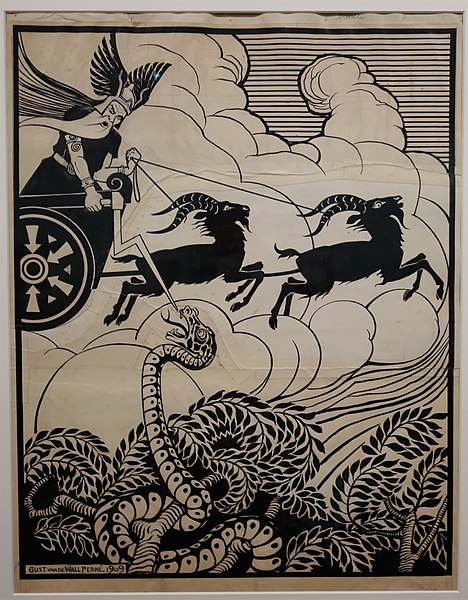
Donar by Gustaaf van de Wall Perné (1911)

Imagined Gods Versus One True Faith

Throughout history, humans have imagined thousands of gods and goddesses. Among them were Zeus of the Greeks, Venus of the Romans, and Thor of the Vikings. And there were countless others. Originally, God was one of the gods from Canaan, so Israel and Palestine, one of the sons of the deities El and Asherah, named Yahweh, thus a minor figure barely above the level of an angry spirit. Apart from Yahweh, the Canaanites worshipped several other local deities. Yet, due to some remarkable course of events, billions of people now believe that this former local nuisance is the all-powerful owner of the universe. And by some other remarkable incident, the Levant, thus Canaan and the surrounding area, is the cradle of civilisation, the birthplace of the Agricultural Revolution. Jericho is thousands of years older than the pyramids and the Sumerian civilisation. So, forget about Mesopotamia, Egypt and China. Our story begins there.

Humans are religious creatures. We are social animals who cooperate in groups. Sharing beliefs helps us do that. If we all believe in the magical powers of the forest spirit, we can establish rituals, such as special dances, to bond the group members. And when we expect the protection of the forest spirit when we go to war, we fight more confidently and have a better chance of winning. If you believe the forest spirit doesn’t protect you, you can easily panic and flee. However, if your belief is strong enough, you may be able to overcome adversity and persevere. Whether there is a forest spirit or not doesn’t matter. If the belief in it helps the faithful survive, it is beneficial in the struggle for survival. It is survival of the fittest rather than survival of the most accurate. The religions we have now have been the fittest in the past.

There is, however, a piece of historical evidence that atheists prefer to ignore, perhaps because they consider it irrelevant even though it is not. Somehow, the worship of the Jewish deity in all its forms survived and grew, so by now, nearly half the people believe that Yahweh, also known as The Father or Allah, is the only true God who rules our world. No one worships Thor anymore, except a few eccentrics who think that choosing a religion is like going to a supermarket and picking a faith you like. You almost hear them think, ‘Look how special I am. I worship Thor.’ A coward like Blaise Pascal, the world-famous guy who invented Pascal’s Wager, would never take up that bet. It is unlikely that Thor exists. And if he does, he must be weaker than the Christian God.

Otherwise, Thor could have prevented the Christian God from taking over his turf. Or better yet, Thor could have expanded his franchise into new regions by sending priests to convert the infidels. Pascal’s Wager is that the risk of not believing in God is eternal damnation instead of eternal bliss, while the risk of believing in God is merely wasting time in church and having no spectacular sex life, without getting a reward for that discomfort. It is thus rational to believe in God and act accordingly because the sacrifice is small compared to the possible gain. That makes Satan worshippers appear stupid. You almost hear them think, ‘Look how naughty I am. I risk eternal damnation by worshipping Satan.’

But then again, I gradually came to think there is no evidence for the existence of God and that the morality of religious people is not better or worse than that of non-believers. Even worse, people betting on God by believing something that makes no sense, only to get a reward, are morally corrupt. And if insincerity would get you in heaven, I preferred to burn in hell with the sincere. That was indeed a careless thought. I didn’t believe God existed, but if He did, He would not appreciate those grovelling worms who merely hoped to cash in their reward. At the time, I still thought of God as a He. Things took an unexpected turn later on, so the latter part of my thought might be correct. In hindsight, I had severely underestimated the risks associated with inverting Pascal’s Wager. Like Blaise Pascal, I am not a hero. If I had thought that believing something nonsensical could protect me from harm, I would have had faith.

To appreciate the long-term historical trend, you can go back 2,500 years, when the insignificant nation of Israel began to develop visions of grandeur and imagined that all the nations would receive blessings through Israel and its special relationship with that local nuisance called Yahweh. Nothing of that kind appeared to be in the making for over 500 years. But then came Paul, who turned the teachings of Jesus of Nazareth, who might otherwise have remained an obscure prophet claiming to be the Son of God, into a religion with universal appeal. Everyone could join and receive salvation, and who doesn’t want that? A suspicious mind might wonder why this unusual religion sprouted from Judaism and has gained over two billion followers 2,000 years later. But then again, God has advised us not to ask too many questions, while Christians think they already know the answer. And thanks to Muhammad, the worship of Israel’s God spread even further.

That wrathful cloud that allegedly led the Israelites out of Egypt, which then went into hiding for over 500 years to supposedly father Jesus, then 600 years later sent an angel to whisper messages in Muhammad’s ear, then waited for another 900 years to give us Martin Luther and even more confusion, and then left us in suspense for another 500 years so we could develop computers and invent the simulation argument to find out that we live inside a virtual reality and merely exist as amusement, has been the veil behind which the owner of this universe is hiding. Perhaps you are unconvinced, but even if you believe in the theory of evolution and the survival of the fittest, you must admit that of all those imagined deities, this one has won the competition by a wide margin. Who knows what the future brings, but if we look at the past, there can be only One, or perhaps none. There are a few atheists who think they are so smart, so when someone says ‘God’, they ask, ‘Which one?’ That is a silly question.

Looking at the trail of confusion, you could also have realised your beliefs were incorrect. Christianity has 45,000 branches, all claiming to be the one true faith. Only they will go to heaven. You might call it Pascal’s Nightmare. You are fuel for Satan’s furnaces forever unless one of those 45,000 is correct, and you happen to have that belief. Place your bets, ladies and gentlemen. Rien ne va plus! Islam is a bit more inclusive and promises that faithful Jews and Christians can join the party in heaven. And the Jews believe they are the chosen people. Israel’s history was one of setbacks, but Israel survived while nearly all the other nations disappeared. Israel had little military power, so the Israelites clung to hope. One day, a Messiah will come, liberate Israel, destroy its enemies, and restore its glory, which it is said it once had when David and Solomon were kings. Jesus was not good enough. He didn’t rout the Romans. And so, they kept on waiting.

Judaism, Christianity, and Islam share an apocalyptic worldview featuring a final battle between good and evil in the Holy Land. Many Christians, adherents of the Religion of Love, support Zionism to make that happen, including the murder and displacement of Palestinians. That infuriates Muslims, followers of the Religion of Peace. They hardly care how many Muslims are slain by other Muslims. To them, the suffering of the Palestinian people at the hands of the Jews is worse than any atrocity in the history of humankind, including the Crusades.

The Book of Revelation raves about 144,000 Jews protected from divine judgment who would convert the other Jews to Christianity and save them. It all has to happen in the Holy Land in the End Times, the Christian Zionists think, so the Jews must move back to Israel and kick out the Palestinians. Some religious Jews would like to blow up the mosque on the Temple Mount and replace it with a proper house of prayer. Perhaps that will kick off the End Times.

So what about that final battle between good and evil? John’s utterings reveal a precise location and suggest it will materialise at a place named Armageddon near the border between Israel and the West Bank, where the armies of the world will gather. Depending on which side you are on and the mushrooms you have consumed, you may see those forces gathering. There have been wars since time immemorial in the area, but since the inception of the state of Israel, the number and intensity of wars in the Holy Land have significantly increased. But why would it be now? If you are neutral, sober or not religious, you may see a bunch of religious crazies fighting for a small patch of land that is not particularly worthwhile. Is this the End Time? Only God knows.

Latest revision: 6 September 2025

Featured image: Donar by Gustaaf van de Wall Perné (1911). Public Domain.

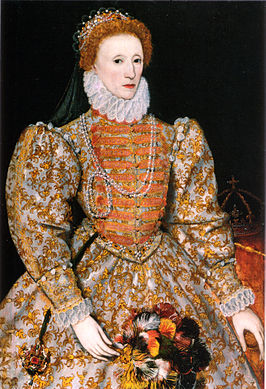
The "Darnley Portrait" of Elizabeth I

History is Her Story, Part 2

God can become an ordinary person to play a role in Her story. Several well-known women in history may have been avatars of God. This is the second episode. The first episode can be found via the following link: History is Her story part 1.

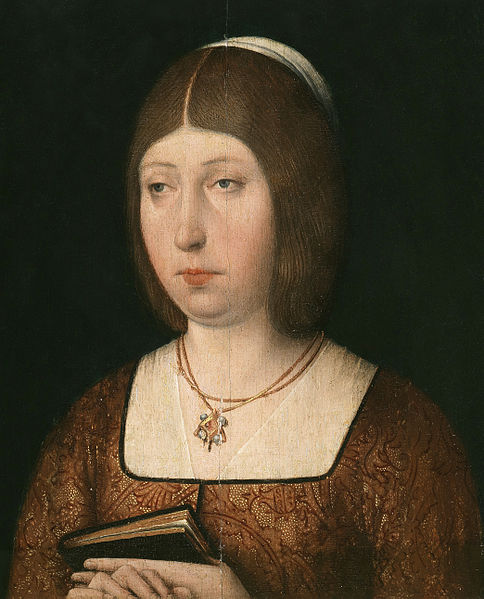
Isabella I Of Castile
Isabella I Of Castile.

Isabella I of Castile

We learned who discovered America, but not the person behind the scenes who financed his mission and made it happen. And by the way, the same person who sent Columbus on his journey also created Spain. Queen Isabella I (1451-1504) was Queen of Castile and one of the most influential historical figures. She was the second child of King John II of Castile. At the time, two countries, Castile and Aragon, dominated the area. Isabella’s half-brother, Henry, was the heir to the throne.

Isabella became a pawn in Henry’s political ambitions. He forced Isabella into several betrothals and attempted to marry Her to King Alfonso V of Portugal. Later, as part of an agreement to restore peace after a rebellion, Isabella was to be betrothed to Pedro Giron, Master of the Military Order of Calatrava. Isabella prayed that the marriage would not take place. Don Pedro suddenly fell ill and died on his way to meet Isabella. That prayer worked better than voodoo.

Henry didn’t have a male heir. Isabella made Henry sign an agreement, making Her his successor to the throne. Henry made another effort to arrange a marriage, but Isabella refused and secretly arranged a wedding with Ferdinand of Aragon. In doing so, Isabella created Spain by uniting both kingdoms. After Isabella secured the throne, She initiated several successful reforms in government, finance, legal code, and policing.

Isabella’s actions had a lasting impact on world history. Her political manoeuvring in dynastic politics created Spain. Isabella sponsored Christopher Columbus’s mission to reach the Indies by sailing west. On his way, Columbus bumped into America. A film about this event is titled 1492: Conquest of Paradise. That is noteworthy for two reasons. First, there is the word Paradise. And second, the number 1492 refers to the initials and possibly the birthday of this peculiar Lady. That might be a clue.

Katharina von Bora

Katharina von Bora (1499-1552) was the wife of Martin Luther, who initiated the Protestant Reformation. Katharina had several suitors, but none of them became Her husband. She told Luther’s friend and fellow reformer, Nikolaus von Amsdorf, that She would be willing to marry only Luther or von Amsdorf. Luther was unsure whether he should marry at all. A woman who wanted him made him change his mind. As Roman Catholic priests were celibate, their marriage set a precedent for Protestant family life and clerical marriage.

Von Bora had been a nun interested in the Protestant Reformation and dissatisfied with cloistered life. Conspiring with several other sisters, Von Bora contacted Luther. They asked for his assistance. Luther sent a merchant who regularly delivered herring to the convent. The nuns escaped by hiding in his covered wagon among the fish barrels.

Von Bora bred and sold cattle and ran a brewery to provide for their family, the numerous students who boarded with them, and her husband’s visitors. During epidemics, she operated a hospital with a staff of nurses. Luther called her ‘Boss of Zulsdorf’ after the farm they owned. Based on Luther’s descriptions, his wife, whom he nicknamed ‘Herr Käthe’, exerted control over his life like a master.

After Martin Luther died in 1546, Von Bora’s fortunes turned sour. Wars destroyed Her property, and She became impoverished. She fled due to war, the Black Death, and crop failures. During Her last flight, she was thrown from her cart into a watery ditch and fell ill. She reportedly said on her deathbed, ‘I will stick to Christ as a burr to cloth.’ Does it mean, ‘See you again in the next life?’

Many Protestants and Germans consider Martin Luther a prophet. And prophets might be married to God. The book The Virtual Universe discusses the assassination of Martin Luther King on 4 April 1968 as part of an elaborate coincidence scheme that includes the Lincoln and Kennedy assassinations. King’s last name might imply that Martin Luther was a king like Jesus, thus a prophet of great importance.

The
The “Darnley Portrait” of Elizabeth I

Elizabeth I

Queen Elizabeth I of England (1533-1603) was one of the most successful monarchs in history. Her reign laid the foundation for the Anglo-Saxon world domination. She depended on trusted advisers like William Cecil. She also established the Church of England, a Protestant Church with Catholic elements, of which She became the supreme governor. Elizabeth was moderate and religiously tolerant.

Great Britain became a great power. Elizabeth was cautious in foreign politics, tried to avoid conflict, and half-heartedly committed to the wars England fought. In 1585, England could no longer avoid war with Spain because it had supported the Dutch in their fight for independence from Spanish rule. In 1588, the English defeated the Spanish Armada, and the remainder of the fleet sank in a storm, marking the end of Spanish dominance over the seas and paving the way for British supremacy.

A curious sequence of events led to Elisabeth becoming Queen of England. Upon hearing of Her accession to the throne, She reportedly quoted the twenty-third line of the 118th Psalm: ‘It is the Lord’s doing, and it is marvellous in our eyes.’ Elizabeth’s unmarried status inspired a cult of virginity. She said She was married to England like God was married to Israel. Some poetry and portraits depicted Elisabeth as a virgin goddess.

Computable article about Armada
Computable article about the Armada

During a walk in 2009, I pondered whether or not Elizabeth had been an avatar of God. When I returned home, there was a copy of the weekly magazine Computable in the letterbox. The front page featured an article about a distributed database system called Armada. That might be another hint.

Françoise d'Aubigné, Marquise de Maintenon
Françoise d’Aubigné, Marquise de Maintenon

Françoise d’Aubigné

Françoise d’Aubigné (1635-1719) was the second wife of King Louis XIV, also known as the Sun King. He was vain and waged numerous wars. His lavish Palace of Versailles had no equal. Louis’ magnificence was over-the-top and equally unparalleled. His reign lasted over 72 years, the longest of any sovereign in recorded history. During his first marriage, he had several mistresses.

Louis was more faithful to his second wife, Françoise d’Aubigné. Françoise never became queen, but She had considerable clout in the royal court. Louis was also pious. He saw himself as the protector of the Catholic Church. He made his devotions daily regardless of where he was. Under Françoise’s influence, Louis became even more religious.

Louis XIV was the epitome of the divine right of kings. This doctrine states that the king is appointed by God and, therefore, not accountable to anyone except God. That doctrine might come in handy for the Messiah in the end times. A quote attributed to Louis is, ‘The state, that is me.’

As a teenager, I was a member of the School Council. The school bureaucrats had lengthy discussions after the Financial Commission had overstepped its bounds. One of them argued that it was a the-state-that-is-me situation. It could be a hint that Louis was God’s husband. I doubted it, and tossed a coin, and Françoise made it to the list. Another toss of a coin eliminated Catherina the Great from the list.

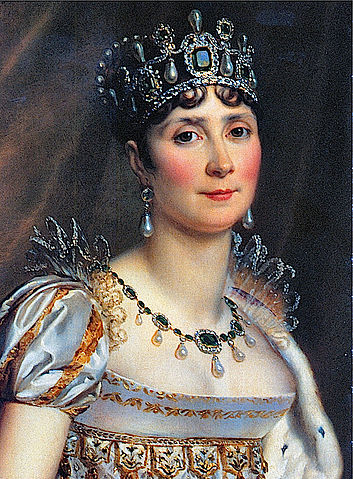
Empress Josephine in Coronation Robes
Empress Josephine in Coronation Robes. François Gérard

Joséphine de Beauharnais

Joséphine de Beauharnais (1763-1814) was the first wife of Napoleon Bonaparte. She was his greatest love. After the execution of Her first husband during the French Revolution, She had affairs with several leading political figures. Napoleon, who was six years younger, fell in love with Her and sent Her many love letters. Napoleon’s love for Joséphine cooled somewhat after discovering She had a lover on the side. He then began affairs with other women but remained in love with Joséphine and married Her.

Napoleon Bonaparte’s lasting legacies include the civil registries with first and last names, the metric system (metres, grammes, and litres), and legal reform, embodied in the Napoleonic Code. The well-structured and accessible law code was a milestone, replacing a patchwork of feudal laws. It has influenced the whole world. The Napoleonic Code is the most widely adopted legal system. About 120 countries use it, but not Great Britain, which also rejected the metric system.

Napoleon was not a favourite of the British, or perhaps it was a British conservative attachment to incoherence and feudal institutions, so they held on to their lords, laws, miles and pints. Unlike the rest of Europe, the British now drive on the wrong side of the road and have left the European Union to rid themselves of David Cameron. He later returned as Minister of Foreign Affairs, so Brexit failed. Napoleon tried to unite Europe, and that project appeared close to succeeding.

Through the children from Her first marriage, Josephine became the grandmother of Napoleon III and the great-grandmother of Swedish and Danish kings and queens. The reigning houses of Belgium, Norway and Luxembourg also descend from Josephine. She, however, didn’t give Napoleon any children. Napoleon believed he needed an heir, so they divorced. Napoleon then married Marie Louise, an Austrian archduchess. It was not love that drove him, but calculation. Marie Louise bore him a son who died at the age of 21. His family line died out, so the divorce proved pointless. Her family line lived on. Napoleon’s last words on his deathbed were, ‘France, the army, the head of the army, Josephine.’

There are some remarkable parallels between Napoleon Bonaparte and Adolf Hitler. Napoleon Bonaparte was born on the island of Corsica, which became part of France. Later, Napoleon Bonaparte became the leader of France. Adolf Hitler was born in Austria, a country that became part of Germany. And Adolf Hitler became the leader of Germany. Both men were involved in a coup on 9 November (9/11 in European notation). Both started a military campaign in Russia that led to their downfall. That emboldened the current leadership in Russia, leading them to think they are safe in Moscow.

Napoleon Bonaparte and Adolf Hitler both came to power by a coup, ending an unstable republic. They both turned Europe into a battlefield. Both ventured into Africa, and both faced defeat in Egypt. They both waged war on two fronts because they attacked Russia after failing to defeat England. These parallels are intriguing as if Hitler were Napoleon’s reincarnation. Their wives were noteworthy as well. Concerning Josephine de Beauharnais, I didn’t receive a hint, but the thought isn’t far-fetched. Informed deduction is impossible anyway, leaving me with guessing the obvious.

Lucretia Garfield
Lucretia Garfield. Library of Congress.

Lucretia Garfield

Lucretia Garfield (1832-1918) was the wife of US President James A. Garfield. A disgruntled public office seeker assassinated him in 1881, shortly after he took office. He lingered in the Twilight Zone for two and a half months before dying. Lucretia stayed at his bedside and received public sympathy, which might be ill-deserved, as it now turns out. They were both 26 when they married on 11 November 1858, referencing 11:11. During the Civil War, James Garfield had an affair as a general.

He later confessed it to his wife, who seemingly forgave him. On 12 January 2010, a previously unknown $10,000 life insurance policy on President Garfield’s life surfaced in a family scrapbook.1 Lucretia Garfield had opened it 45 days before the assassination of Her husband. It is a most notable coincidence that might indicate foreknowledge.

My son was fond of the comic character Garfield. In 2006, a mysterious parcel addressed to him was delivered to us by mail. It contained some Garfield items, including a coffee cup with the lettering ‘It is good to be king.’ The sender of the parcel was unknown. We made several enquiries, but nobody conceded to having sent it. Until today, the sender remains unknown. That might be a clue.

Eurocentrism

This list is Eurocentric. Most people on the list come from Europe. Eurocentrism emphasises European culture or Western ideas and theories without much regard for other cultures. That can offend people from different cultures and the Woke. For the last 500 years, most of the action has centred in Europe, and today’s world is so profoundly affected by European ideas and culture that you might call the world European. Those who oppose Eurocentrism propose eccentric ideas like the knowledge of indigenous peoples being on equal footing with science invented in the West. They suggest that if you have AIDS or cancer, you don’t need to take the treatments invented by science, but you might as well consult your local witch doctor.

As a cultural relativist, I don’t believe Western culture is superior. It set in motion a process that is about to end human civilisation. That is also what the tale of the Fall says. We would have been better off running naked in the jungle. If it had been up to me, the list would have been more diverse, but I don’t make the decisions. After watching the Netflix documentary about Queen Nzinga of Ndongo and Matamba and reading her life story on Wikipedia, I found her to be a worthy candidate for being an avatar of God and better suited than some of the women on the list. Nzinga could fill a gap between Queen Elizabeth I and Françoise d’Aubigné. And I tried to fill in the gaps on the list.

More than filling a hole is required to qualify. Nzinga’s life story didn’t provide clues to work with, like Queen Isabella I, who prayed that her marriage would not come to pass, and then her suitor died. Nor did a noteworthy coincidence happen, like with Queen Elizabeth I, when a magazine featured an article about a database system called Armada. Again, I tossed a coin, which was my favourite way of resolving such matters, but the outcome suggested God didn’t want me to think that Queen Nzinga had been Her avatar. Catherine the Great would also have made a proficient gap filler. She also didn’t make it to the list.

Latest revision: 15 July 2025

Featured image: The “Darnley Portrait” of Elizabeth I. Wikipedia. Public Domain.

1. https://commons.wikimedia.org/wiki/File:Garfieldlifeinsurancepolicyback.jpg

Hadzabe tribespeople

The End Is Near

A broken clock can be right

A broken clock is right twice a day. At least that was so before clocks came with digital displays. Even that truth no longer holds. And so, nothing is certain, not even that. In the same fashion, end-time prophets may be correct, for once at least, because there can be only one end, even though that is not certain either. As for the end-time predictions of varying religions, if your religion is a bagload full of crap to begin with, expect no less from its prophecies. The prophecies in the Bible aren’t much help in picking a date or detailing out the scenario. The Bible doesn’t mention historical events like the discovery of America or the Industrial Revolution, which seem significant to historians but apparently not to the prophets of that time. Or the ancient prophets had no clue, which seems more likely.

Now, if these prophets didn’t know the future, and God likes to joke around, and of both we have evidence, their prophecies may still come true in ways they didn’t anticipate because we live in a world that runs the script of a story. So if the name Bathsheba hints that She was an avatar of God and would return as the Queen of Sheba, then the presidency of Donald Trump may precede the end times, because the noise of trumpets heralds the end times, and the name Trump refers to a trumpeter.

Logic is a strange thing, and humans are emotional creatures that occasionally think. If the end time ever comes, it is now closer than ever, but the longer we have waited, the less likely it might seem that it could be now. In any case, the odds for an apocalypse are higher than ever for the following reasons:

  • We ruin the Earth and turn it into a wasteland. We are creating an apocalyptic environmental disaster that includes, among others, disruptive climate change.
  • As long as there are nation-states, there will be no enduring peace, and weapons of mass destruction can kill billions of people and make the planet uninhabitable.
  • Technology will completely change life as we know it. Eternal life may soon be possible, or artificial intelligence may make humans redundant.
  • Existing religions and ideologies have failed, but we are religious creatures and need something to believe in. Only the truth can save us now.
  • The order is breaking down. We are nearing the end of social progress. The gang is our natural way of cooperating, and we may soon revert to barbarism.
  • We may soon discover that we live inside a virtual reality created by an advanced humanoid civilisation to entertain someone we call God.

If the end is now, it is time to apply some after-the-fact reasoning about how we arrived here. One ingredient in the mix is an obscure Canaanite deity whom the Jews came to revere as their preferred object of adoration and, later, as the Creator of the entire universe. And by a rather peculiar course of events, billions of people came to believe the same. Meanwhile, the Greeks had kicked off a tradition of rational enquiry into reality and moral life, which Europeans later took up. They began to develop science, Enlightenment ideas, capitalism, and social progress. They gradually came to understand that the facts contradicted the Bible and that it was not the absolute truth, not even in moral matters. In hindsight, we can add Georg Wilhelm Friedrich Hegel to the list of greatest prophets of all time, as he envisioned that our quest for knowledge and social progress would ultimately bring us closer to God.

Pop music, the unexpected medium

If the end is near, there may have been signs, and probably not in places people were looking, and not the type of signs they expected. A few Christians found Satanic messages hidden in pop music by playing tracks in reverse. Some of them even believe Satan is in charge of pop music entirely and that this horned fellow has been busy composing the lyrics in his state-of-the-art studio in that hot place called Hell. Few would have guessed that God was the composer and hid secret messages in pop music. That, however, might be the case. Even more surprisingly, you don’t have to play the songs in reverse to hear them. Only that was not for the faithful to guess.

God is a DJ
This is my church

Faithless, God is a DJ

Clearly, God likes to joke around. The song ‘Strange Phenomena’ by Kate Bush suggests that a coincidence with the radio could be a sign of God’s arrival,

A day of coincidence with the radio

G arrives, funny, had a feeling he was on his way.

We raise our hats to the hand a-moulding us
Sure ’nuff, he has the answer

Kate Bush, Strange Phenomena

G might be God, as the song alludes to the hand that moulds us and someone who has all the answers. Does a day of coincidence on the radio herald the arrival of God? For me, it did. Coincidences on the radio prompted me to search for these messages. Like literary criticism, this is not science but speculation. So, can I guess God’s intentions? The following incident suggests so. At secondary school, I did particularly poorly at explaining literature. It is about guessing the motives of book authors. My scores were consistently poor, the poorest in the class. I considered guessing other people’s motives and decoding hidden messages in texts a waste of time. There are so many ways in which you can interpret words. The authors themselves often marvelled at what the literary experts deduced about their intentions from their books.

With the final exams approaching, I began to fret and asked my teacher for additional practice exams. It didn’t help. The grades remained as poor as before. Before the final exam, I prayed and asked God that the grade wouldn’t be too bad. My result was the best of everyone’s, but it was also equalled only by a girl with a striking hairdo, a bit alternative, who dressed in an outspoken way and flaunted her interest in art and literature. That was not only a surprise to me. A classmate wondered how I had managed to pull this one off. I was too ashamed to tell. I didn’t need a higher grade while children were starving. It was a peculiar incident. At the time, there was no reason to think God was behind this, nor did it seem a harbinger of things to come.

Hotel California

Let’s do a text analysis on the famous song Hotel California by the Eagles. What is its meaning? On the Internet, you can find some answers. It could be about the lost Paradise caused by American decadence and burnout, too much money, corruption, drugs and arrogance, and too little humility. Her mind being Tiffany-twisted and owning the expensive car reflects that. The wine being unavailable since 1969 refers to the fact that in 1969, it was no longer legal to drink alcohol while you were in a drug rehab programme. Before that, you couldn’t do drugs, but you were allowed to drink alcohol. The hotel, thus, was a rehab. I see another message, not intended by the songwriters and unseen by the critics.

When She stood in the doorway, the mission bell sounded. He might be meeting God because of the mission bell. And then, he enters Paradise, thinking this might be heaven or hell. God is a spoiled woman who owns the place and is used to getting Her way. Her mind, thus, is Tiffany-twisted. She owns an expensive car. Most people think Paradise is perfect, but it doesn’t agree with human nature. There is a darkness to it. They can’t kill the beast. And you can’t escape. You can check out when you like, but you can’t leave. You can argue against this by pointing to the master’s chambers. If there is a master, she isn’t God. Indeed, seeing meaning is not science, and interpretations are dubious. I knew that already as a teenager, so I won’t argue. With that in mind, we can proceed.

From Almelo via Enschede to Eurovision


Ilse DeLange’s fourth studio album, The Great Escape, contains the most messages. If there had been a meter for hidden messages, it would show an elevated reading when you play this album. If you read between the lines, this album comes with a message from God, Eve reincarnated, to Her husband, Adam reincarnated, to prepare himself. The album contains lyrics with parts that convey such a message. Noteworthy coincidences surround DeLange. DeLange was born on 13 May 1977 in Almelo, a town in the Dutch region of Twente. Almelo was also the hometown of Herman Finkers, a comedian who wrote ‘Kroamschudd’n in Mariaparochie’, a short animated picture about the possibility of Christ coming from Twente.

On 13 May 2000, the 23rd birthday of Ilse Delange, a fireworks plant in Enschede in Twente blew up, killing 23 people. That was exactly 11 years after I moved to Enschede to live on the University of Twente campus. I lived in dormitory 401 for five months, until 13 October 1989, a time lapse that precisely matches the events surrounding the Fatima Miracle of the Sun, which occurred 72 years later. This is the most spectacular religious miracle ever confirmed to have actually happened. And in that dormitory, lived that most peculiar Lady. The recurrence of 23 is also odd. The accident was on the day of the Eurovision Song Contest. Once the seriousness of the situation became manifest, the Dutch broadcast of the Eurovision Song Contest ended.

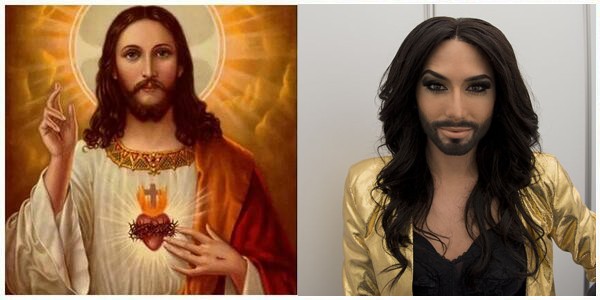
My wife had dreamt about a large fire the night before the fireworks accident. On the day itself, she visited a friend who had just given birth. Some of her other friends were also present. One of them came from Enschede. Just after my wife told this friend from Enschede about her dream, this friend received a text message asking whether she was all right. It was only then that they learned about the fireworks accident. Fourteen years later, Ilse Delange sang in the 2014 Eurovision Song Contest herself with Waylon as The Common Linnets. They came in second place after Conchita Wurst, a transgender Jesus look-alike. That is noteworthy, not only because it links DeLange to Jesus but also because early Christians performed a sex change on God in their scriptures.

Jesus and Conchita Wurst at a Meet & Greet during the Eurovision Song Contest 2014. Albin Olsson (2014). CC BY-SA 3.0. Wikimedia Commons.

The Finnish rock band Turisas dedicated a song named The Great Escape to the Norwegian king Harald Sigurdsson, who played a role in a coincidence scheme related to D-Day. His daughter died in Norway on the same day he perished on the battlefield in England, a noteworthy coincidence. The Great Escape was also the name of the fourth album made by the English rock band Blur, released on 11 September 1994, a remarkable date considering the coincidences surrounding the 11 September 2001 terrorist attacks. The total length of Blur’s album is 56 minutes and 56 seconds. Compressing these numbers results in 11:11 as 5 + 6 = 11. And 56 + 56 = 112, which is also the European emergency telephone number. The lead song of DeLange’s album, The Great Escape, lasts 4:01 minutes. I moved to Enschede to live in room 112 of dormitory 401.

The Great Escape

Ilse DeLange’s album ‘The Great Escape’ contains a message from God, the eternal Eve, asking Her prospective husband, the temporary Adam, to prepare for his task as saviour. That was not DeLange’s intention. Unwittingly, she became the channel for this particular communication. As Finkers already noted, a lot was going on in Almelo, such as traffic lights switching colours. Mediums make misses alongside accurate guesses. The messages blend into the lyrics like the accurate guesses of mediums mixed up with misses. The book ‘The Virtual Universe’ explains how mediums can be precise at times while making many misses. It is not a gift but scripted. It works the same way as meaningful coincidences. So, how can we interpret those songs?

In the first song, ‘Reach For the Light,’ God says She remembers and that everything he knew is lost. That makes sense if he is supposed to be Adam and doesn’t remember,

I know my name, but who’s the same when everything you knew is lost
I’m filled with hope that echoes loud inside a forgotten mind

Ilse DeLange, Reach for the Light

In the second song, ‘The Lonely One’, God claims She used Her powers to make his life disagreeable. Only God can order the sun not to shine and the sky to fall on him. What She says about Herself would even make Louis XIV, the Sun King, blush,

I told the sun not to shine and stay away

I am the only princess, I am indestructible

Asked the sky to fall down on you

Ilse DeLange, The Lonely One

He probably thought his life was not great. The song ‘The Great Escape’ gives the album its name and is the centrepiece. The song says it’s autumn, and some force pulls him into the shadow world. For him, it was scary to be taken in this fashion. But it is a holy land in disguise. She says she comes from heaven,

In this holy land
A desert made of quicksand

Some force pulls you in
The shadow world

I was falling, falling, falling from heaven

Ilse DeLange, The Great Escape


In the next song, Carry Hope, She instructs him to prepare himself. She says the power is in his hands, and he has to make this land his own. She adds that faith calls out his name. In all his vanity, even Louis XIV, the Sun King, would not have said that when he lets go of hope, there is no one left you can follow. There is nothing but the power to believe in Her,

The power is in your hands, the dust will fall to sand
Gotta make this land your own

Faith calls out your name
When I let go of hope, there’s no one left to follow
There’s nothing but the power to believe in me

Ilse DeLange, Carry Hope


It can hardly be more clear than that. The song Was It Love suggests She doesn’t care for religious people. They are locked inside their belief,

And they’re locked inside belief
But they’re not inside of me

Ilse DeLange, Was It Love

You have to cherry-pick lyrics and the lines to get the message, so the critics might point at that. The coincidences relating to DeLange suggest that there is more to these messages than just an accidental slip of the songwriter’s mind. And DeLange comes from the Dutch region of Twente. I lived in Twente, met the Lady there, and She was born there as well. That makes it more remarkable. And then you have Finkers’ animation picture ‘Kroamschudd’n in Mariaparochie’ about the possibility of Christ coming from Twente. That is a bit too much to ignore.

Slippery slope

Lyrics by other performing artists contain messages from God. The song ‘Hotel California’ by the Eagles did get its fair share of literary criticism, as did ‘Gimme the Prize’ by Queen, and ‘God Is a DJ’ by Faithless. To access these messages, you must filter out the noise, thus selectively choosing the parts that fit, which is a very unscientific approach. Literary criticism is about seeing meaning. You can’t prove meaning as it is subjective, so seeing it is an art. And not seeing meaning is the art of being a moron. The song ‘Joga’ by Björk mentions accidents, coincidences and connecting the dots. The coincidences make sense only with one person. So God made these things happen to show him Her love,

All these accidents that happen
Follow the dot, coincidence
Makes sense only with you

This state of emergency
How beautiful to be

All that no one sees, you see
What’s inside of me

Björk, Joga

She adds how beautiful it is to be in an emergency. The emergency services telephone numbers are 112 and 911. When God demonstrates Her love for you by murdering people in accidents and terrorist attacks, that can be intimidating. And you might get the impression that you, like Jesus, have no choice but to go along with God’s plans.

Now the word goes around in certain circles that the song ‘Stairway to Heaven’ by Led Zeppelin contains hidden satanic messages that you can hear by playing the song in reverse, which is something normal people wouldn’t do. There was something there, and the artists said it was a coincidence.1 However, straightforwardly playing that same music, which normal people do, reveals something even more interesting. It mentions a lady we all know. That lady could be God. After all, the song is named ‘Stairway to Heaven’ rather than ‘Highway to Hell,’

With a word she can get what she came for
Ooh, ooh, and she’s buying a stairway to Heaven

There walks a lady we all know
Who shines white light and wants to show
How everything still turns to gold
The tune will come to you at last
When all are one, and one is all

And she’s buying a stairway to Heaven

Led Zeppelin, Stairway to Heaven

It is therefore not a coincidence that the same album, Led Zeppelin IV, which features Stairway To Heaven, also includes the song ‘Going to California.’ It mentions a queen who is a woman who was never born, thus Eve,

Seems that the wrath of the Gods
Got a punch on the nose and it started to flow

To find a queen without a king;
They say she plays guitar and cries and sings.
La la la la
Ride a white mare
in the footsteps of dawn
Trying to find a woman
who’s never, never, never been born.

Led Zeppelin, Going to California

The song The Infant King from the album Adieu Sweet Bahnhof by The Nits is about a boy king on his way to meet his Bride. The world is falling apart. The border is closed. People are packing. Gold can help you if you want to leave. That could be the End Times. But the infant king is on his way,

I tip-toe tip-toe through the sleeping train
An infant king who meets his bride

Two eyes two ears nose uncertain smile
A child reflected thousandfold
Someone said the other day
The border’s closed there’s no way in or out

My mood is changing every mile
Someone said the other day
The world is cracking up it’s plain to see

Two eyes two ears nose uncertain smile
The infant king is on his way

The Nits, The Infant King


On that same album is the song ‘Woman Cactus’, describing a psychotic love affair of an indecent nature. His senses don’t make sense at all. She haunts him as the bar sign repeatedly prints Her name on the wall,

This is not comme il faut
It’s no respectable affair

My heart, my head, my brain
My senses don’t make sense at all
The bar sign prints your name
Over and over on the wall

I know it hurts to touch a woman
With those needles and pins

The Nits, Woman Cactus

There is more, but it is a slippery slope. The farther you go, the more you slip-slide away. For the argument, the presented selection suffices.

Latest revision: 9 May 2026

Featured image: Watchmen cosplay at Comic-Con 2009. Taken on July 24, 2009. Ewen Roberts. CC BY 2.0. Wikimedia Commons.

1. The 10 Wildest Led Zeppelin Legends, Fact-Checked. Rolling Stone (2012). [link]