Doomsday Machine

Forces of nature

How did we get where we are today? Nature’s driving forces are competition and cooperation. This perspective provides a great deal of insight into what happened. Plants and animals cooperate and compete for resources. Cooperation and competition are everywhere. Cooperation increases the available resources. Plants generate the oxygen animals need, while animals produce the carbon dioxide plants need. Still, the available resources are limited. There is only room for one tree on that spot. And so, there is a competition called the struggle for life, where the fittest survive.

Plants and animals are opportunistic, taking advantage of opportunities whenever possible, with the help of both competition and cooperation. Plants and animals have a blueprint, their genes. These genes have the urge to make copies of themselves. It is why we exist and the basis of our will to live and our sexual desires. And so, the biological purpose of plants and animals, including humans, is to spread their genes. That is indeed a most peculiar purpose. The copying of genes is prone to errors. And so changes occur, resulting in variation within species. It is why people vary in appearance and character.

Some changes make individual plants and animals better adapted to their environment, thereby increasing their chances of survival and reproduction, resulting in a rising number of individuals with these features. Environments allow for several species to coexist, most notably when they don’t compete for the same resources. It is why ants and monkeys can live in the same area. The balance in nature is always precarious, as changes in circumstances can favour different species. And so, introducing foreign species in places where they have no natural predators can lead to pests.

Like other social animals, humans operate in groups. Social animals benefit from group cooperation, which enhances their chances of survival. Within the group, competition can arise, resulting in rankings and struggles among members. Cooperating in groups also helps us to compete with other groups, usually in warfare. And groups can form coalitions to compete with coalitions of different groups. Stories enable humans to work together in groups of any size, which then further increases the competition between these groups.

Meet our closest relatives

Chimpanzees are our closest kin. Studying these apes provides us with insights into our nature. Chimpanzees live in small troops of a few dozen individuals. They form friendships, work with reliable group members, and avoid those who are unreliable. Chimpanzees have rules, may cheat on them, and can feel guilty when they do. Within the group, the members have ranks. When there is food available, the highest-status animals eat first. Ranks and rules regulate competition within the troop, reducing conflicts and enabling its members to collaborate more effectively.

Like human leaders, chimpanzee alpha males acquire their status by building coalitions and gaining support. Others show their submission to the alpha male. Like a government, the alpha male strives to maintain social harmony within his group. He takes sought-after pieces of food like a government collects taxes. Within a chimpanzee band, there are subgroups and coalitions. There are close friendships and more distant relationships. They unite as a single fighting force in the event of an external threat.

Coalition members in a chimpanzee band build and maintain close ties through intimate daily contact such as hugging and kissing, and doing each other favours. For the band to function effectively, its members must be aware of what others will do in critical situations. For that, they need to know each other through personal experiences. Unlike humans, chimpanzees have no language to share social information. That limits the size of the group in which chimpanzees can live and work together to about thirty individuals.

Chimpanzees also commit violence in groups. Like humans, they are among the species that commit genocide on their congeners. Humans and chimpanzees are not alone in this. Chickens are known to fight racial wars when they face a lack of food. Groups of chickens may start to kill those with different colours from themselves. And so, racism could be a natural behaviour caused by competition between genes.

The human advantage

Humans have become the dominant species on Earth. We can collaborate flexibly in large numbers. We have mastered fire, which enhances our power and allows us to eat foods we couldn’t otherwise. It allowed us to become the top predator. We use tools and clothing, allowing us to do things other animals can’t and live in inhospitable environments. Compared to other animals, humans employ a rich language. That enables us to express countless meanings and describe situations in precise terms.

We pass on social information, such as who is fit for a particular job. We get information about others in our group without needing personal experience. If someone cheats, you don’t need to learn it the hard way like chimpanzees must, but someone can tell you. That allows us to cooperate more effectively. Most human communication is social information or gossip. We need the group to survive, so we must understand what is happening within our group and the decisions our group needs to make.

Human politics is about cooperating and competing. We must agree on what we should do as a group and on how we divide the spoils of our cooperation. Within the group, we may compete to cooperate. Leadership contests benefit the group when the outcome is better leadership. That isn’t always the case, and infighting can weaken the group. We also cooperate to compete. We organise ourselves in groups to compete with other groups, such as defeating them in warfare.

Early humans lived in bands of up to 150 individuals. The number of individuals with whom we can closely collaborate is one of our natural limitations. We overcame the limit of our natural group size by cooperating based on shared imaginings, such as religions, laws, money, and nation-states. That competitive advantage over other species allowed us to take over this planet and become the ‘killer bug’ that has completely upended nature and has terminated more species than any other species.

Unlike other animals and plants, which adapt to their environment, we have altered our environment to suit us. We have created societies and civilisations and have become immensely powerful collectives to compete with other collectives. However, our civilisations also shield us from the forces of nature, turning us into weak individuals. We have become integrated into the system, and many of us won’t survive a collapse of civilisation. It is crucial to understand that competition drives this process.

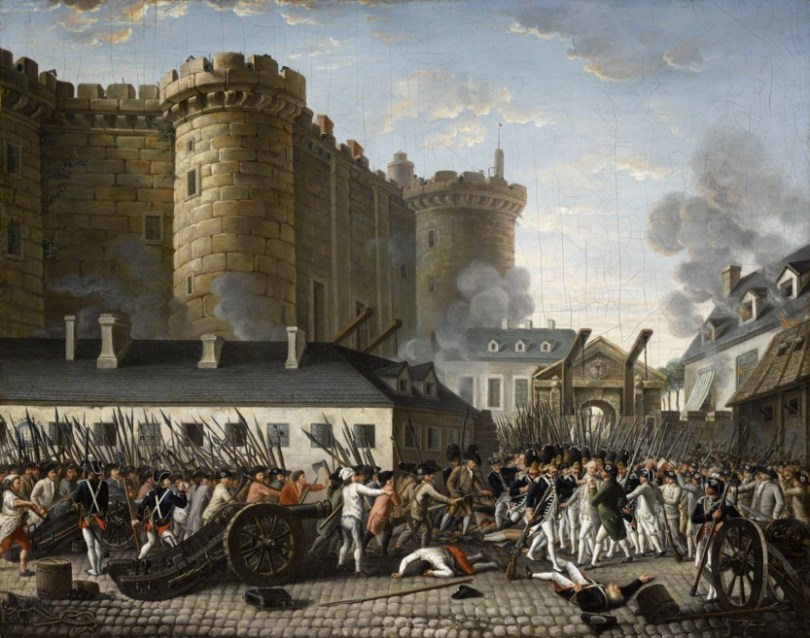
We imagine corporations, laws, money, and nation-states. We believe a law exists, and that is why the law works. It is also why religion works. These shared imaginations allow us to cooperate on any scale for any purpose. We are programmable, with our brains serving as the hardware and our imaginations serving as the software. And we can change the software overnight. During the French Revolution, the French stopped believing in the divine right of kings overnight and began to envision the sovereignty of the people.

Organising to compete

The forces of competition and population density drove humans to organise. There is a competition between groups of humans. Just as there is a competition between species in nature, there is also a competition between human groups. Groups that succeeded in adapting to new circumstances survived those that did not. We are rule-following animals. Once we start to cooperate on a larger scale, we need political institutions that embody the rules of a community or society.

Humans design political institutions while genetic mutations emerge by chance. Still, competition determines which designs survive and become copied. In general, under the pressure of competition, which mainly was warfare, human organisation advanced from bands to tribes to feudalism to states. The experts deem this explanation simplistic and flawed. Still, overall, that trend towards more advanced organisation occurred.

Hunter-gatherers lived in family groups of a few dozen individuals. They had few violent conflicts, probably because they had no property, and population density was low. Hunter-gatherers could move on if a stronger band invaded their territory. Small groups were egalitarian. They often had no permanent leader or hierarchy and decided on their leaders based on group consensus.

The Agricultural Revolution changed that. Farming allows more people to survive. Farmers invest heavily in their cattle and crops, so agricultural societies need property rights and defence forces. Agriculture promoted the transition from bands to tribes. Population density increased, leading to more frequent violent conflicts among people. Tribes are much larger than bands and can muster more men for war, so tribes replaced bands.

Tribes were usually egalitarian, but a separate warrior caste often emerged. The most basic form of political organisation was the lord and his armed vassals, known as feudalism. The lord and his vassals exchange favours. The loyalty of the vassals is crucial, and politics is about these loyalties and betrayals. Tribalism centres around kinship, but also includes feudalist, personal relationships of mutual reciprocity and personal ties.

States yield more power than tribes because they force people to cooperate, while tribes work with voluntary arrangements. As population density increased and people lived closer to each other, the need to regulate conflicts also grew, so some states also provided justice services. Leaders, with their family and friends, led these states. They worked with personal, feudal relationships, thus making deals and returning favours. And so, the transition from tribes to feudalism to states is not a straightforward process.

The first modern, rationally organised states with professional bureaucracies based on merit rather than personal relationships and favours appeared in China. The reason was a centuries-long cut-throat competition of warfare on an unprecedented scale, with states having armies of up to 500,000 men, in the period now known as the Warring States Era. Fielding these armies required professional tax collection, with records of people and their possessions, as well as the provisioning of soldiers in the field.

Once the state of Qin emerged victorious by 200 BC, China became unified, and the competition between the states ended, and China’s modernisation ground to a halt. Even so, China adhered to modern bureaucratic principles and remained the most modern state for 2,000 years, enabling its rulers to govern a vast empire. States remained the most competitive organisational form until Europeans invented capitalism and corporations, which would cause a radical new dynamic of permanent change driven by competition.

Capitalism and corporations

China had a strong centralised state that prevented the merchants from becoming the dominant force in society. In the Middle Ages, Europe had no strong states, so capitalism could gradually emerge in Europe. The rise of merchants and later corporations brought a new economic dynamic and wealth. Corporations are legal entities serving a specific purpose. Invented in Roman times, they included the state, municipalities, political groups, and guilds of artisans or traders.

From the Middle Ages onward, Europeans introduced commercial corporations with shares and stock markets such as the Dutch East Indies Company (VOC). The advent of corporations triggered a new phase in the competitive cycle, further increasing efficiency by specialising in specific tasks. The Europeans combined their entrepreneurship with inquisitiveness, so eventually the profit motive began to drive innovations as well.

The new dynamic intensified competition and innovation, causing permanent economic growth and disruptive change, a process that economists call creative destruction. Capitalism increases available resources via cooperation or the division of labour, but competition is the driving force. As long as that remains so, competition rather than our desires determines what our future will look like.

Currently, China may have the most competitive socio-economic model, potentially outcompeting those of the West. But it will not end well for them either. Artificial intelligence may soon outcompete humans. It may become a ‘killer bug’ that ends humanity. We can’t keep up with artificial intelligence. The future doesn’t need us. We aren’t sufficiently efficient and innovative. Competition is our first and foremost problem. It is our doomsday machine. Competition, insofar as we allow it, should be at the service of cooperation rather than the opposite. If we don’t do that, we are doomed.

Featured image: Tower of Babel by The Tower of Babel (1569). Public Domain.
End of the Liberal Era

The liberal era is coming to an end. We see it happening in Europe and the United States, which have long been the centres of liberalism. The foundations of liberalism are individual freedom and rights, thus the rule of law rather than the ruler’s whims. The liberal steering mechanisms are markets and elections. Liberalism assumes we are all rational individuals who seek to express our preferences in elections and markets, which means that individual freedom works best. Individual freedom began to develop in Western Europe during the Middle Ages, and unlike in other areas, there have always been strong powers countering authoritarian rulers, like nobles and independent cities, and later, the bourgeoisie.

That has long enhanced the West’s might, as economic power translates into military power. Property rights were essential. If your property is safe, you can build your capital and grow stronger economically. The propertied classes ran successful states like the Dutch Republic, Great Britain, and the United States. The emancipation of the masses later turned these countries into liberal democracies. These historical developments were responses to societal issues that arose under the pressure of competition. Universal suffrage gave citizens a stake in their country, which helped prevent revolutions, promote stability, promote economic growth, and make the country more successful.

Our values aren’t necessarily superior, and may fail us when circumstances change. The rise of China suggests that its authoritarian model is more competitive, but this remains uncertain. In the 1930s, while the West suffered from an economic depression, Nazi Germany and the Soviet Union powered ahead. At the time, they seemed to win the race. But liberal democracy has survived both. Liberal democracies are now going under due to wealth inequality and the consequences of mass migration. The fascist parties promise to look after the interests of the native working class. After the Soviet bloc collapsed in 1989, liberals like Francis Fukuyama deluded themselves into thinking we had reached the end of history and liberalism had won. Others were more cautious and warned that tribalism has not died.

The Clash of Civilisations became the response to The End of History. After the terrorist attacks of 11 September 2001, there was no denying that history had not yet ended. Since then, we have seen the rise of a new nationalism and fascism, including messianic leadership cults. It began in the Netherlands with Pim Fortuyn, which is quite remarkable, as the country has led the previous liberal revolution as well on issues like abortion, euthanasia, LGBTQ rights, and the allowance of the use of marijuana. For long, the memory of two devastating world wars has kept nationalism and fascism at bay in Western Europe. After two world wars, Europeans had learned the hard way that nationalism and fascism are excellent ways to destroy their country. That memory has now faded, and the world has changed.

It becomes easier to understand once you see history as a struggle for the survival of groups of people via competing stories. It is rational to believe the stories that help you to survive. That is also why we look for strong leaders in times of uncertainty. Democracy works best when the situation is stable, the rules are clear, everything is functioning smoothly, and everyone is honest and on the same page. But it often required warfare to get people on the same page. If you think immigrants are a threat and ending immigration is a matter of survival, everything is allowed, including spreading fake news. It is not unreasonable to have that fear. Had the Native Americans made up and believed stories about whites being cannibals, eating human bodies and drinking human blood during secret rituals in their churches, and killed them all in a frenzy when they still could, they might have fared better.

The truth matters, but we don’t know the future, no matter how thoroughly we examine the facts, so our choices are a matter of faith. In the hypothetical example, believing the facts that Christians aren’t cannibals would be a death sentence for the Native Americans. And the truth is that lies and fake news can help us survive, most notably sensational stories that depict others as evil. And look at how these whites have culturally enriched the country. The beautiful forests have given way to strips of tarmac surrounded by ugly structures with neon lights. They have completely ruined the land. And look at the people: fatties in funny clothes. The remaining natives now languish in reservations. Those who fear mass migration and believe sensational stories about evil groups conspiring to cull us.

Evolution made us that way. It is survival of the fittest. That made us violent religious creatures who kill each other for our beliefs. Those who believed in lies and killed those who didn’t were the ones who survived. And so, fact-checkers bite the dust. There is often a relation to the facts. Christians have a peculiar ritual in which they eat bread and drink wine and pretend these are the body and blood of Christ. And because of overpopulation, there are efforts to promote birth control. But facts don’t inspire us. We need great stories about good versus evil. These stories help to come into action.

And so, we are religious beings and believe in fairy tales, whether it is the multicultural society or white genocide. So, who is destroying the United States? Is it MAGA cultists trampling on the Constitution, or is it cultural Marxists with their diversity policies who tell us what to think? Take your pick. We also need scapegoats or enemies, and it helps if they have an unusual appearance, so you can poke fun at them. For the leftists, these are neo-Nazi skinheads with their particular tattoos, and for the fascists, it is transgenders. It allows us to cooperate and rally behind causes, which enhances our chances of survival, provided we choose the right stories.

The new fascism is less about racism and more about cultural identity. It is also less about starting wars to enlarge a nation’s territory and more about preserving the country by preventing immigration and sending immigrants back. While Europe’s population is declining, it is growing in Africa. By 2100, there may be four billion people in Africa, eight times as many as in Europe. And that is a concern, because many Africans might come to Europe. South Africa is an example of what can go wrong if descendants of African immigrants replace European natives. It is a worst-case scenario.

Some African countries do well, so it may come to pass, but it is a realistic scenario. Blacks can learn to run successful states because they have done so for over 2,000 years in Ethiopia. Ethiopia has long been ahead of Western Europe. Running a state and building institutions is an ability you acquire by learning. Most of Africa had never had states before the European colonisers came. Africa had to catch up and achieve in a few decades what Europeans took 1,000 years to accomplish. We don’t know the future. That is where the fear comes from. And that can make us go apeshit. Civilisation is just a thin veneer. Underneath, we are all primates.

Several countries, like Hungary, now have fascist governments. In 2023, the nationalist anti-immigration party PVV became the largest in the Netherlands. The tipping point, however, became Donald Trump’s second presidency. During his first presidency, Trump’s cabinet consisted of Republican establishment figures, thus people from the old political order. By 2024, Trump had transformed the party and surrounded himself with yes-men, and he has little regard for the rule of law. The US political order was already corrupt to the core before Trump became president, and the previous Biden Administration also did not uphold the law by doing little against illegal immigration.

Things will not return to what they once were. We have entered unprecedented fascist territory with scenes not seen in the West since the demise of the Third Reich, with raids to round up illegal immigrants, withholding funds from universities for political reasons, and efforts to take away the rights of legal immigrants. But let’s not forget that many activists on the left are also illiberal, don’t tolerate alternative views, and use violence. Dutch politicians who have tried to limit migration know, or at least those who have survived the assassination attempts.

Indeed, force has always been our ultimate argument. Liberals try to solve issues with laws, but laws are also opportunities for abuse. You can ask yourself why babies born in the US should automatically become US citizens. But that was also the law. Laws and litigation don’t make just societies, which has been the most visible in the United States. The rule of law is a century-old pillar of Western civilisation, so liberals are shell-shocked, or as MAGA enthusiasts would point out more colourfully, suffer from Trump Derangement Syndrome and exploding heads.

Laws are fictions we create to make societies work, so you should question the laws when they don’t work. Even the rule of law comes into question when it fails to protect ordinary citizens. We often forget that the first and foremost task of a state is to provide order and prevent gang violence. We often take the state for granted, or even think we can do without it. States have succeeded in reducing violent deaths by over 99%, and if they disappear, the world will become a dangerous place.

In El Salvador, violent crime has gone out of control. Eventually, rounding up suspected gang members and locking them up without due process brought down murders by over 95%. That measure turned El Salvador into one of the safest countries after being one of the most unsafe. But once you go down that road, where does it end? Concentration camps? Conversely, how many murders do you accept to prevent innocent people from going to prison? So, why did liberalism fail? There are several issues:

  • Liberalism is not a story that unites us but one that allows us to merely coexist and do as we please. It only requires us to obey the law. The arrangement works when everyone respects liberal institutions despite their differences.
  • The world has become globalised, but we want to be part of a group and feel a connection to each other. Mass immigration reduces social cohesion, making the lack of stories that unite us a pressing problem.
  • The rule of law has failed us. Authorities often don’t uphold the law. Legal doesn’t mean just. The elites get away with their crimes. Innocent until proven guilty helps criminals. Litigation blocks solutions. Lawyers make money by scamming us.
  • Liberalism centres around individual rights. That blocks solutions to global collection action problems, such as reducing production, consumption, and population, which requires trampling on rights that people imagine they have.
  • Technological development is about to produce a disaster. Many things can go wrong, but artificial intelligence can make us redundant. Countering this threat requires ending the competition, thus ending nation-states and capitalism.

Humans are creatures that cooperate by believing the same stories. To liberals, the myths the fascists believe may seem hilarious, but they forge group cohesion and create an enemy, which can generate the required anger for collective action. Trump supporters stormed the Capitol after Trump claimed he had won the election, and Democrats had committed election fraud. That was after Trump had tried to commit election fraud himself. Accusing others of what you are doing yourself was a successful tactic often employed by fascists. It shifted the attention from the real fraud Trump had tried to commit to the imaginary fraud Democrats supposedly had committed. And the MAGA crowd loved it. No politician lied more than Donald Trump. He gets away with corruption, sexual assault, and countless lies. It makes liberals go apeshit. That is what the MAGA enthusiasts want to see.

Within the MAGA movement, several outlandish ideas circulated. One of the most extreme was Q harping about a paedophile network operating at high levels and Donald Trump leading the fight against them. The reality is that Epstein held parties with underage girls whom Trump also attended. Then there are the suspicious circumstances surrounding Epstein’s death, dubbed a suicide. He had been on suicide watch after he tried to commit suicide. Somehow, the supervision failed due to ‘a perfect storm of screw-ups,’ as the then US attorney general, Bill Barr, called it. One of Epstein’s victims said that Epstein had claimed he was running a Mossad operation. It looks like the plot of a spy novel. Liberals can poke fun at Q, but upon closer examination of the facts, it becomes understandable why some people believe it.

Most MAGA supporters didn’t believe it, yet found it helpful for their cause. Stories help us cooperate. And Qit is a great story: Trump as a gladiator fighting paedophile networks within the elites, even infiltrating them by attending these parties. And Trump is a sexual predator, as 26 women have accused him of sexual misconduct, while he admitted that he grabbed women by the pussy. He uses his presidency for his business interests and those of his family and friends. Trump is a lowlife and makes a good gangster boss, but that is precisely what his followers look for. A gangster boss can win a fight for you in this world full of danger. A bureaucrat or a career politician can’t. They play it by the book or do the bidding of their wealthy donors.

Due to campaign financing and influence buying, which is legal in the United States, the US political system is criminally corrupt according to Dutch law. Outright gangsterism was a logical next step. Why pretend not to be criminals if everyone knows you are? Trump is even more open to bribes than any president in recent history. That is the art of the deal. Indeed, far-right leaders are more often gangsters than not. The Hungarian president is an excellent example. The French far-right leader has also proven to be a swindler. And so are most others. These leaders know to inspire their followers by calling investigations into their corrupt dealings witch hunts. To their followers, they are strongmen or women.

Trump single-handedly built the MAGA movement, took over the Republican Party, won the election, and is now going after the liberal establishment. That is what his vengeful followers hope to see. They don’t care if he is more corrupt than any US president in recent history. When you think Marxists are destroying your country, lying and cheating are okay. The Biden Administration did little to stop the influx of illegal immigrants. If you believed Democrats were destroying the United States, that was good evidence. It wasn’t all bad what Donald Trump tried to achieve. Think of bringing industrial jobs back to the United States and ending the war in Ukraine. Still, Trump and the MAGA movement will likely wreck the United States. MAGA drives on Big Bullshit. It can collapse at any time, leaving the country in shambles.

We can’t oversee the consequences of our actions. Our beliefs and ideologies are models of reality, not reality itself. They are all fictions or stories we tell. And whatever story works best to survive is the most successful. Models have limitations and fail from time to time. Liberalism has been a success for centuries, but mainly in the West, making liberals blind to their faulty assumptions, like the state being a voluntary agreement between individuals. It forged nations like the United States by allowing people from different backgrounds and religions to cooperate.

And immigration has contributed much to the success of the country. Liberalism supposes an individualist culture, making it typically Western. That is where it went wrong. Something similar applies to cultural Marxism, as it builds on the Western tradition, thus the progress of society through the Hegelian dialectic. That societal process mainly took place in the West. Marx already argued that progress builds on previous achievements. A society needs to become bourgeois before it can progress further. Tell Africans or Muslims about LGBTQ rights. They will probably think you are nuts.

Liberals didn’t foresee that the influx of immigrants from different cultures would undermine the very basis of liberalism. They deluded themselves by thinking liberalism is superior because nationalism and fascism have failed even more miserably in two devastating world wars than communism, which has collapsed relatively peacefully. Science has proven religions wrong, making liberals think that liberalism is superior. If your ideology is vastly superior, immigration is no problem, because the immigrants will eventually see the light. You can even invade a country like Iraq, and a liberal democracy will pop up and flourish. Okay, it didn’t work out that way. That should have been a warning sign.

Like many in the MAGA crowd today, the Nazis under Adolf Hitler believed the elites, communists and Jews were destroying Germany. The irony of history is that no one ever did a greater job in ruining Germany than the Nazis. In fact, patriots often did a much better job of destroying their countries than Marxists. Had the Soviet Union still existed, Russia and Ukraine wouldn’t have fought a bloody nationalist war. Had the communists still run Yugoslavia, the civil war wouldn’t have torn the country into pieces. But we live by stories, not facts, and liberalism is also a fairy tale. Liberalism was only very successful. It was the fairy tale that built the West.

Success is about survival, not about getting the facts right, which liberals, impressed by the achievements of science, have forgotten, but that is also a fact and why liberalism collapsed so quickly. If humans commit suicide by science and the rats survive, the rats are more successful as a species. You don’t need science and facts to survive. They might even kill you. It explains seemingly irrational fears, such as those related to vaccines. But the odds of a product of science killing us may well exceed those of natural causes. Only the fictions we create can help us cooperate and survive, and the fiction that we need science and facts has long helped those who believed it. And suddenly, that story fails.

That is where we stand now. Humanity is at a crossroads. Global problems like the coming technological-ecological apocalypse don’t disappear without unprecedented measures unthinkable in a liberal world. You can’t reason from the facts, find definitive proof, and propose solutions respecting individual rights. That is not going to work. We don’t know the future. The choices we make are a matter of faith, and only faith can save us now. Humankind, as we know it, may only survive with an inspiring fairy tale that unites us all. We are about to enter a new chapter in history, which may well be the end of history.

Featured image: AI-generated

Latest revision: 23 August 2025

Amish family, Lyndenville, New York. Public domain.

The Last Day

Imagine there is a lake in a distant forest. On its surface grows a plant. Its leaves darken the water, so all life below it dies. The plant was at first tiny, and it has been there for 1,000 days. But it doubles in size every day. So, here is a question. If the plant blankets half the lake, how many days are left to save the life there? The correct answer is one day. Behold the power of exponential growth. If the plant depends on life in the lake, it will also die.

Behold the power of exponential growth. The plant doubles in size each day. And so, it covers the entire lake tomorrow. It doesn’t matter how long it has been there already. It stops growing once there is no more room. As soon as the lake is fully covered, life in the lake ends. And if the plant depends on that life, it will also die.

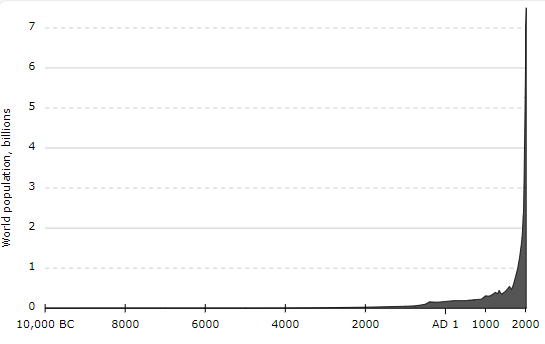
The lake represents the Earth, the plant humanity, and the leaves are people like you and me. The graph above shows the human population numbers over the last 12,000 years. These numbers had been very low for a long time. In 1804, there were one billion people. Since then, the human population has gone berserk. There were two billion humans in 1927, three billion in 1960, four billion in 1974, five billion in 1987, six billion in 1999, seven billion in 2011, and eight billion in 2022.

The experts expect the number to decline in the future. Only, how will that decline occur? That is anyone’s guess. The signs are ominous. Currently, humans use nearly twice as many resources as the Earth can deliver.1 We can do that for a short while, but it will end badly. The lifestyles of the rich are unsustainable, but so are the number of children many people have. Rich people with many children are the worst. Continuing their current lifestyles will lead to an apocalyptic event, and it will happen sooner rather than later.

We live on the proverbial last day before a dramatic trend change in resource consumption. How it will play out is up to us.


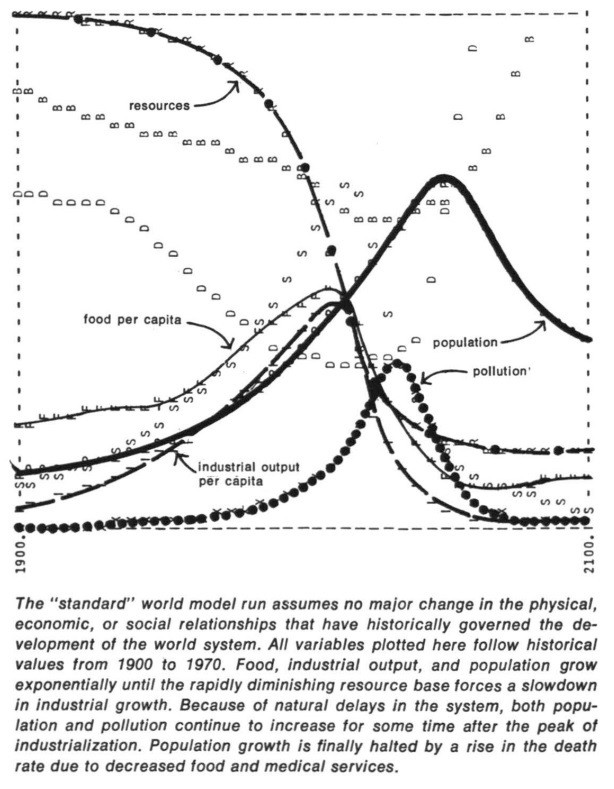
In 1972, a group of scientists known as the Club of Rome ran a computer programme predicting an apocalypse when natural resources would run out shortly after 2000 AD.2 Their computer printed out a scary diagram detailing how, demonstrating we should be very, very afraid. So far, the reckless have had numerous opportunities to point out how foolish the cautious have been, and the ultimate laughing stock is the man with the sign saying, ‘The end is near.’

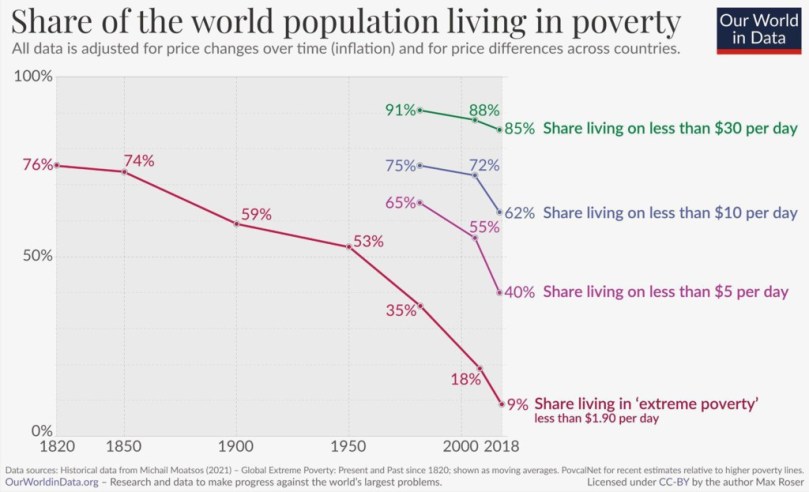
Share of teh world population living in poverty
Share of the world population living in poverty. CC-BY. Max Roser. OurWorldInData.org.

According to the World Bank, extreme poverty dropped from 76% of the world’s population in 1820 to 9% in 2018. Their definition of extreme poverty is dubious, but it is beyond doubt that the percentage of destitute people has declined. The Club of Rome lacked sufficient and precise data, and unanticipated developments affected the outcome. New technologies enable the extraction of more resources and the more efficient use of existing ones. Some oil reserves have become accessible with new or improved extraction methods. And if you use the oil to produce a solar panel, you get several times as much energy during the solar panel’s lifespan as from burning the oil itself.

Essential resources, such as oil and freshwater, are becoming increasingly scarce or may soon be in short supply.3 With current consumption levels, proven oil reserves may last until the 2060s. Total oil reserves are more than twice as large, but pumping the remaining oil could be costly,4 while climate change could prevent us from burning it. PFAS, microplastics, and other pollutants are everywhere and accumulating in our bodies. Brain samples collected in early 2024 measured, on average, about 0.5% plastic.5

Life has never been better for most people. Are we on the verge of the apocalypse? The problem is growth in a limited area. When there is growth, the increases add to the existing total. The plant can’t grow beyond the pond’s size, so once it reaches its limits, for every leaf that grows, another must die. The Earth is stressed. We disrupt the balance in nature, but we can’t predict what will happen and when. We can’t overuse the Earth for long. The day before growth ends could be our best.

Scientists have identified nine processes that regulate the Earth’s stability and resilience. These are climate, biosphere, land use, freshwater, nutrients, ozone, aerosols, and ocean acidity. These processes have boundaries that are unsafe to cross. By exceeding these boundaries, we risk triggering irreversible environmental changes that could lead to catastrophic consequences for both human civilisation and natural ecosystems, these scientists argue. As of 2024, we have breached six of these nine planetary boundaries.

Humankind has gone batshit crazy. We delude ourselves into thinking that economic growth will solve our problems. We are like cancer cells telling each other that our aggressive growth strategy has paid off handsomely so far, so that more cancer will make things better. That is, of course, until the host dies.

Barring an apocalyptic event, such as the planet reaching a tipping point due to climate change, World War III, or a technology like artificial intelligence or genetic engineering going wrong and out of control, doom will likely be piecemeal, occur over decades, and not affect everyone equally. Many might survive and enhance themselves using technology, turning themselves into post-humans. If we compare humanity’s lifespan with 1,000 days, we live on the proverbial last day.

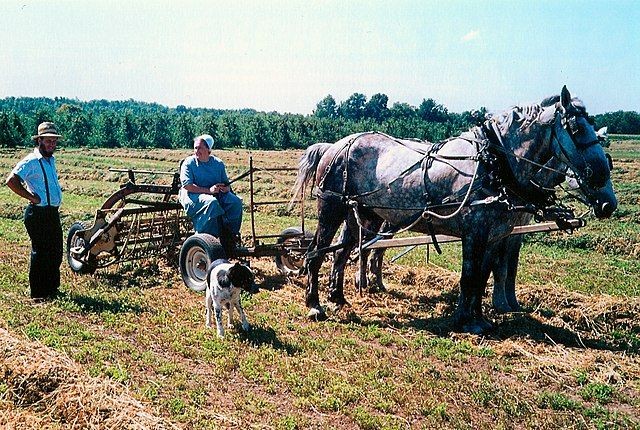
We can step out. The Old Order Amish, also known as Pennsylvania Dutch, live modestly and choose which technologies they use. More and better stuff doesn’t make us happier once we have enough, feel secure, and live in a supportive community. Surveys suggest the Old Order Amish are happier than the average citizen. They show us that we can live simply and don’t need new technologies and products. We don’t have to go that extreme. We can choose the technologies we use and make different choices. And our lifestyles need not be that austere as long as we don’t stress the Earth.

Latest revision: 2 July 2025

Featured image: Amish family, Lyndenville, New York. Public domain.

1. overshoot.footprintnetwork.org
2. The Limits to Growth. Donella H. Meadows, Dennis L. Meadows, Jørgen Randers, William W. Behrens III (1972). Potomac Associates – Universe Books.
3. Theworldcounts.com. Depletion of Natural Resources.
4. Plummeting ‘Energy Return on Investment’ of Oil and the Impact on Global Energy Landscape. Siddharth Misra (2023). Journal of Petroleum Technology.
5. Microplastics are infiltrating brain tissue, studies show: ‘There’s nowhere left untouched’. The Guardian (2024).

Confucius. Gouache on paper (ca 1770)

Fairness Matters

Working in groups and sharing

Humans are social animals that operate in groups. We share the workload and the fruits of our efforts, which might be a band of hunter-gatherers, a corporation or a society. We make agreements on who does what and who gets what. That is the social contract. Otherwise, we can’t work together. It helps if we think the social contract is fair. Violations of fairness provoke strong feelings. What is fair isn’t always straightforward. Some people contribute more to the effort than others, which can be either due to willingness or ability. And some people have more needs than others.

A study demonstrated that monkeys also have an idea of fairness. If one ape received less valuable rewards for the same work than its partner, such as less tasty foods, it could become angry and reject the reward. You can become frustrated if you feel your partner gets a better reward for the same job.1

Children have a sense of fairness early on. Giving one individual more than another without reason can surprise toddlers as young as fifteen months old. Children also wish to see you help those they like and harm those they dislike, such as children who do not share their food preferences. Young children already prefer people similar to them (the in-group) to children who are different (the out-group).1 Many people believe it is perfectly fine when those they dislike receive unfair treatment. As young children already have it, it could be a natural inclination that we can unlearn.

We may believe those who contribute more to a group’s success deserve more, for instance, if a venture’s success hinges on a single person’s skills or efforts. That is the excuse for high pay for CEOs of large corporations. Business is a competitive environment, and a CEO can make a difference while a factory worker can’t. When we cooperate, we are more willing to share, but in a competition, we are more willing to accept inequality. In sports, the winner gets everything. But if a team wins, the members share the prize, even if some talented players decide the outcome.

Innate or learned

The golden rule says you should treat others the way you want them to treat you. But is that rule innate or learned? If our sense of fairness is innate, moral rules apply to everyone. If it is learned behaviour, fairness is a matter of taste. If someone is helpful, we react positively. If someone acts harmfully, we react negatively. Infants already do that. An experiment involving toddlers and two puppets, one friendly and helpful, and the other mean and harmful, demonstrated that toddlers more frequently chose the friendly puppet as their preferred toy.1

Some of our ideas regarding fairness are learned or cultural, and some are innate or natural. Researchers tested children in seven cultures (Canada, India, Mexico, Peru, Senegal, Uganda, and the US). They could get candy by pulling a lever. One child pulled the lever, which could give both children the candy or drop it in a box, so both got nothing. The rewards were unequal, sometimes to the advantage and sometimes to the disadvantage of the lever-pulling child.1

The children always reject deals that are unfavourable for themselves. They might accept receiving more than the other child, but never agree to getting less than the other child. In some cultures, older children also reject unfairly advantageous options for themselves. That happened in some countries but not in others. Refusing a bad deal may be a natural human instinct, but forgoing a good deal that is unfair could be a learned behaviour and a cultural norm.1

The mistakes we make

Are poor people responsible for their choices? And what is the influence of choice? During an experiment with pairs of students who did a task together, one received the pay. It was a random pick. Those who received the pay could choose how much they would give the other. Receiving pay was a matter of luck, and most people believed it was unfair, so they were often willing to share.

Adding a choice, for instance, between getting a small reward or participating in a lottery to get the full reward, changes the picture. The participants were less willing to share. If both participants opted to participate in the lottery, we think it is fair that one of them wins. People often think poverty is a choice, as poor people decide not to get an education or divorce and, as a result, cannot work full-time.1

They made these choices, but what were the alternatives? Possibly, the small reward was not enough to live off, so you had to participate in the lottery to have a chance of paying the bills. Or, the alternative to divorce was living with an abusive spouse. Perhaps a good education was too expensive for you, or you were unqualified. But poor people also have options and can influence their lives.1

If we do not reap the consequences of our choices, choices don’t matter. And that is also unfair. That becomes clearer if two individuals have similar opportunities but make different choices. If one decides to spend his money while the other person saves for retirement, we think it is unfair to tax the latter to pay for the retirement of the former. In this case, it might be better not to have options and a mandatory retirement savings scheme.

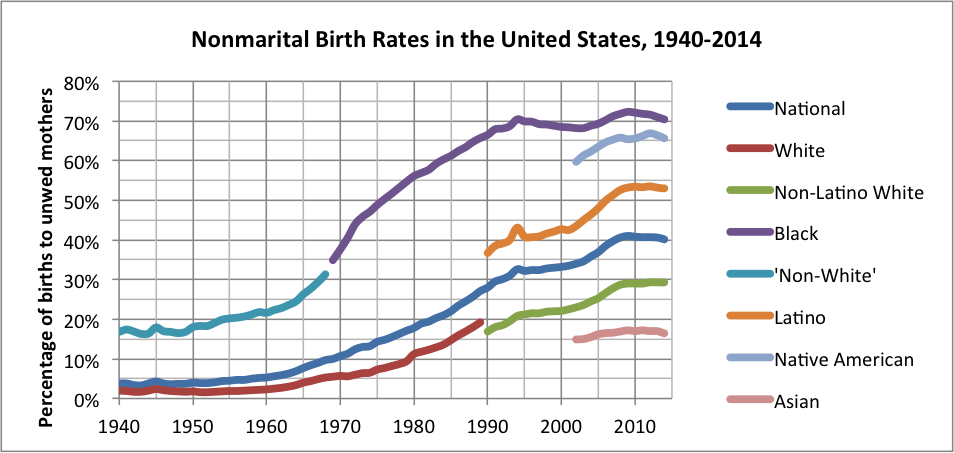
Liberals in the United States focus on equality so different groups get equal outcomes, but ethnic differences in health, education and wealth remain. Some ethnic groups work harder, divorce less and invest more in their children’s education. Conservatives think working hard and making the right choices should make you better off. Some societies invest in equal opportunities, for instance, by investing in the education of underprivileged children, but conservatives do not like to pay taxes for that.

Luck is everywhere

Your place of birth, the upbringing you received, your education, and the opportunities you had in life determine for a large part your success in society. Successful people usually think their brilliance and hard work brought them there. That is half the story. Your efforts matter, but your talents are a matter of luck. Luck conflicts with fairness. There are many other instances of luck. Some live long, some die early, some have love, some are alone, some are healthy, and some are sick. Luck is part of life. Luck is a privilege. And you may only realise that when you are an unlucky person.

If we can eliminate luck, that would be fairer. But not rewarding talent, even when it is the result of luck, can result in bad outcomes. If a group’s success depends on the brave, the hard-working or the talented, we think they deserve an extra reward. It can inspire them to do their utmost. It is why low-skilled labourers receive low wages. Wages above the market price can bankrupt the business if there is intense competition. That is why minimum wages exist to mitigate the unfair consequences of luck.

Fairness connects to cooperation and inclusiveness. Inequality relates to competition, winners and losers. And we need cooperation as well as competition. In a village economy with little outside trade, villagers can distribute the fruits of their endeavours in ways they see fit. They can weigh issues that the market cannot, such as effort. There are exchanges where members can trade goods and services outside the market economy. But people with sought-after skills often get a better deal in the market.

The market as a party pooper

Economics is about competition, collaboration and contributions. We accept unequal pay for different tasks. Scarce talent can determine the success of an enterprise. Talented people have a better bargaining position than the expendable. We also accept that unsuccessful businesses fail if we do not buy their products. And we think workers deserve a minimum wage, regardless of the market value of their contributions.

Fairness connects to cooperation and inclusiveness. Inequality relates to competition, winners and losers. In a village economy with little outside trade, villagers can distribute the fruits of their endeavours in ways they see fit. The community movement has started exchanges where members trade goods and services outside the market economy. But people with sought-after skills usually get a better deal in the market.

Fairness is about rights and how rewards relate to contributions. It is about how we value contributions and support those who contribute little. The market principle is not always fair but can promote efficiency. For instance, if farmers grow too many carrots and too few bananas, the price of carrots drops and of bananas rises, making people eat more carrots and farmers grow more bananas.

Consumers and producers solve the carrot surplus and the banana deficit by rewarding carrot-eating and banana-growing efforts. It ensures that there is enough food, reduces waste and promotes an alignment of production to our needs and preferences. If farmers grow more carrots, poverty is their reward. Choices do have consequences, so we have food on the table. Markets are not the only way to make people reap the consequences of their choices.

Justice and fairness

The past casts a shadow over the present. We live with the consequences of colonialism, slavery and feudalism. Colonialism and exploitation, including the slave and opium trade, helped to make Western countries rich. This wealth accrued with interest as capitalists invested that surplus in new capital. People in Western countries still enjoy some advantages of colonialism and exploitation. Exploitation alone cannot explain wealth differences between countries. And so, the issue of fairness is not straightforward.

The alternative of colonialism could have been an absence of that surplus as it required trade relations with other continents or modern organisation methods. For instance, the surplus of spice trade came from the price Europeans were willing to pay for these spices. Europeans also controlled the trade routes and collected the surplus. Capital and wealth require saving and investing. The colonies had not yet developed capitalism, so they would not have invested in new means of production as European capitalists did.

Organisation and trade contribute to surplus value, but those in control take that surplus. And some trade practices came down to theft. For instance, the British East India Company collected taxes in India and used a portion to purchase Indian goods for British use. Thus, instead of paying for them, British traders acquired these goods for free by buying them from peasants and weavers using money they had taken from them. Through this scheme and other scams, the British stole trillions of dollars from India.2

Had that theft not occurred, the Indian peasants and weavers would have been better off. But if they didn’t have a capitalist mindset like the English merchants, they would not have invested their money into means of production and research and wouldn’t have increased India’s capital base. The wealthy British traders likely invested parts of the proceeds of their thievery on the London Stock Exchange into new ventures like factories running on steam engines.

History advantages some people and disadvantages other people. In India, the caste system determines what jobs you can do. Some women in India have to clean toilets for $ 1,50 per month because of the caste in which they were born.1 The Indian caste system is a relic from the past. Some inherit large estates and think they deserve them because their grandparents wisely invested the money stolen from poor Indian farmers, while others inherit nothing. In all societies, some groups have fewer opportunities than others.

The powerful make the rules

The powerful make the rules. The tax codes are an example. From the 1920s onwards, multinational corporations emerged, and the question became how to distribute the wealth they created. The League of Nations addressed that issue. Powerful nations like Great Britain, France and Germany dominated the discussion and agreed on rules that suited their interests. They did not grant taxing rights to their colonies.1

The United States also played a crucial role. The tax codes allow corporations to pretend that the profits came from a tax haven like Bermuda instead of the countries where the production and the sales occurred. This corrupting situation undermines democracy and the rule of law everywhere. To the rich, different rules apply than to the rest of us. In 2010, wealthy people hid 21 to 32 trillion US dollars in tax havens.

We think it is fair that you can start a business, and if it is successful and contributes to our well-being, you should be able to get rich. But we believe it is unfair that some people inherit large estates or that individuals become billionaires in a winner-takes-all industry. And we think that the wealthy and multinational corporations should pay taxes. And we believe that receiving an income without working for it usually is not good.

The corruption debate is often about petty corruption that contributes to poverty and inequality but ignores the tax havens and the massive white-collar corruption industry surrounding it. Tax haven countries like Great Britain, the Netherlands, Luxembourg and Switzerland help the elites avoid paying taxes. Many people know the system is unjust but believe we can’t change it. But perhaps we can.

From moral philosophy to revolution

Fairness is the primary concern of moral philosophy. The Golden Rule is a fundamental moral rule. It appears in most ancient religions and traditions. Confucius formulated it as what you do not wish for yourself, do not do to others. Starting with Plato, philosophers tried to find a rational foundation for morality. Today, we know that humans are social animals, and moral systems help us to survive. Our nature allows for different cultural values, but our ethical systems share the same ingredients.

Western moral philosophy has two main traditions. A pragmatic school prevalent in Great Britain and the United States claims that ethical rules are an agreement between group members. Moral rules are thus a cultural phenomenon. David Hume was one of its most prominent philosophers. And outcomes might be more important than intent. If you kill two people by accident, that might be worse than murdering one person. In this tradition, freedom means doing as you please.

On the other hand, you have the idealist, notably German, continental European school. It claims that moral rules can be absolute and apply to everyone, thus universal. A prominent philosopher in this tradition was Immanuel Kant, who was a deeply religious person. He tried to find a rational foundation for morality. In this view, intent might be more important than outcomes. Accidentally killing two people might not be as bad as murdering one. Freedom means liberating yourself from depraved impulses and becoming a rational and morally upright person.

It is thus not entirely a coincidence that Adam Smith lived in Great Britain and that Karl Marx and the Marxist Frankfurt School came from Germany. Heteronomy is acting on desires rather than reason. To Kant, that is reprehensible as you do not behave like you should. Karl Marx believed there was heteronomy in legitimising exploitative social relations. Marx claimed history is the outcome of our unenlightened self-interest, such as greed, and our willingness to trust the fantasies of the elites ruling society. Our unwillingness to be rational by ruthlessly reasoning from the evidence and acting upon it blocks a better future. Religion was opium from the masses, Marx claimed, as it prevented people from seeing the truth and taking action.

The French had already tried such ruthless reasoning from the evidence under the banner of liberty, equality, and brotherhood. Taxes in France were low overall compared to Great Britain, but the elites didn’t pay them, so the burden fell on the peasants and the middle class. And so, revolutions are not only about ideals like liberty, equality, and brotherhood. The fairness of taxes often plays a significant role in revolutions. It happened in England during the Glorious Revolution and in the American colonies during the American Revolution. The French Revolution rid the country of the corrupt old regime and improved the quality of the state but at the cost of bloodshed and war.

While the French Revolution and its aftermath occupied Europe, pragmatism prevailed in Great Britain. One of the leading British conservative politicians, Edmund Burke, tried to find out what works in practice. No matter how good your idea might seem, you can be wrong. Burke saw the need for reform but only pushed for it when necessary, as changing the status quo was dangerous. The French Revolution underpinned his point. But, the conditions in Great Britain and France were very different. After the Glorious Revolution, the British state was responsive to the wishes of taxpaying citizens. Gradual reforms were not an option in France as its entrenched elites didn’t allow them. The current state of the world resembles France before the French Revolution.

Featured image: Confucius (possibly the inventor of the Golden Rule)

1. The Price of Fairness (film). Alex Gabbay (2017).
2. Independence Day: How the British pulled off a $45 trillion heist in India. The India Times (2023).

Model Thinking

The limitations of one-dimensional thinking

The Hegelian dialectic is about argument, counterargument and resolution. It locks us up in thinking along a one-dimensional line with two opposites. Perhaps the best solution is outside that line. The debate about capitalism versus socialism dragged on for over a century and has dominated world politics. But markets and states can’t create agreeable societies on their own. Much of politics is theatre rather than reasoning and solving questions. We often think of good versus evil rather than the advantages and disadvantages of alternatives. We might find better solutions if we can meaningfully model humans and their interactions.

The limitations of thinking along a line like capitalism versus socialism become clear once you represent a line in a field. Suppose the grey area reflects the possible solutions, and the red dot is the optimal solution. If you reason along the black line, you only consider solutions on that line. If you design solutions by only thinking about how free markets should be and how much government interference we need, you might never consider the prevailing values in society. Your reasoning ignores human values. Thinking that markets and governments can solve society’s ailments is simplistic.

A line has one dimension. A plane has two dimensions, like the freedom of markets and shared values in society. You can represent three variables in a cube. For instance, you may add the state of technology as an additional variable. You won’t find the best solution if you think along a plane inside a cube. The number of variables can be higher. Freedom of markets and values in society are vague notions you can break down into dozens of more concrete variables. And if you have variables, you need ample data to estimate their impact. That data can be inconclusive. How do you know some other variable you didn’t think of didn’t interfere with the outcome? Despite all the models they used, central banks didn’t foresee the 2008 financial crisis. So yes, models can be wrong.

Still, models can be helpful. Our minds have constraints. We often take a perspective and reason from there. A socialist economist might tell us why capitalism fails but not what is wrong with socialism. There are economic theories that explain specific phenomena under certain conditions. And you might find additional answers in psychology, sociology, or even history. You might want to know what is wrong with your ideas before trying. You can run the idea through those theories. And that might give new insights. You can’t be sure you are right, but you can eliminate errors using models.

Natural Money is a research into an interest-free financial system. It draws from economic theories, monetary economics, banking, psychology and even history. I reviewed that idea with the help of existing theories and historical evidence to investigate how it might work in practice. During the process, issues came to light that I hadn’t thought of. Once interest rates in Europe went below zero, a resistance against negative interest rates manifested. Savers are irrational and prefer 2% interest and 10% inflation over -2% and 0% inflation.

It suggests we measure our gains and losses in our currency rather than purchasing power. And behavioural economics says we give more weight to losses than gains. The 4% loss in interest income impresses us more than the 10% reduction in inflation. These irrational emotions are human nature. It seemed pointless to try to convince savers that they were better off. Once I realised that, I could look for a fix for this awkward human feature by making negative interest rates appear as inflation.

The insights models give

Economic theories are models. Models are simplifications or abstractions. They can be loose and without numbers, like raising interest rates leads to lower economic activity. They can go into detail and include mathematics and predict that raising interest rates by 1% will slow economic growth by 0.5%. Models have limitations. Reality is much more complex than we can comprehend, so a model’s predictions are often off the mark. Still, models require us to use logic to establish which ideas might work under what circumstances by analysing an issue from different perspectives.

Proverbs can disagree with each other. Two heads are better than one, but too many cooks spoil the broth. And he who hesitates is lost while a stitch in time saves nine. Contradictory statements can’t be simultaneously correct, but both can be correct in different situations or times. Hence, we want to know which advice is best in which situation or what combination works best.

Models usually are better than uneducated guesses, and using a combination of models can lead to better outcomes than using a single model. That is why weather forecasters use up to fifty models to make a weather prediction. People who use a single model do poorly at predicting. They may be correct occasionally, just like a clock that has stopped is sometimes accurate, and endlessly tout their few successes while forgetting about their endless list of failures. These people will never learn anything from experience.

Intelligent people use several models and their judgement to determine which models best apply to the situation. Only people using multiple models together make better predictions than mere guessing, but they can be wrong. Models help us think more logically about how the world works and eliminate errors we would make otherwise. They can also give us insights into phenomena we wouldn’t get otherwise. To illustrate that, we can use models to investigate why people of the same ethnicity often live together and why revolutions are difficult to predict.

Sorting and peer effects

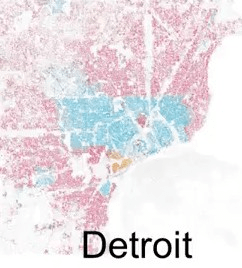
Groups of people who hang out together tend to look alike, think alike and act alike. If you look at the map of Detroit, you see people of the same ethnicity living together. Blue dots represent blacks, and red dots represent whites. We can’t change our skin colour, so if we hang around with people who look like us, that is sorting. We also adapt our behaviour to match that of others around us. When you hang around with smokers, you may start smoking too. Alternatively, if you hang out with people that don’t smoke, you might quit smoking. That is the peer effect. Both sorting and peer effects create groups of similar people who hang out with each other. Models can help us understand how these processes work. The phenomena seem straightforward, but we can model them.1

Schelling’s segregation model gives a possible explanation for how segregation works. Schelling made a model with individuals following simple rules. Suppose everyone lives in a block with eight neighbours. Red boxes represent homes where rich people live, and grey boxes are homes where poor people dwell. The blank box is an empty home. Assume now that everyone has a threshold of similar people who will make them stay.

A rich person might stay as long as at least 30% of his neighbours are rich. Assume a rich person lives at X. In this case, three out of seven or 43% of the neighbours are rich, like the person living at X. If one of the wealthy neighbours moves out, and a poor person takes that place, 29% of the neighbours will be rich, and the person living at X will move.

You can use a computer to simulate how that works out over time. Assume there are 2,000 people; 1,000 are poor, represented by yellow dots, and 1,000 are rich, represented by blue dots. Suppose they are distributed randomly at the start, and everyone wants to live amongst at least 30% similar people. In that case, the average is 50% alike, and only 16% are unhappy because less than 30% of their neighbours are alike. As a result, people start to move, and you will end up with a situation where the average is 72% similar and 0% unhappy.

Even when everyone likes to live in a diverse neighbourhood where only 30% of their neighbours are like them, segregation occurs. Segregation may not be the intention of the individuals involved, as they might be tolerant people requiring only a minority of similar people living in their neighbourhood.1 Whether that is the case is a different question. But if it is so, and if we believe segregation is undesirable, managing the ethnic makeup of neighbourhoods makes sense.

Peer effects cause people to act alike. Contagious phenomena are peer effects. They often start suddenly, seemingly out of nowhere. In uprisings and revolutions, extremists frequently determine what happens, for example, with uprisings such as the French, Bolshevik and Maidan revolutions. In hindsight, several pundits saw it coming, but things could have proceeded differently. It is difficult to predict revolutions. Granovettor’s model gives a possible explanation as to why that is so.

Suppose there is a group of individuals. Each individual has a threshold for participating in an event like an uprising and will join if at least a specific number of others join. If your threshold is 0, you do it anyway. If your threshold is 50, you start if you see 50 participants. The outcome varies depending on the thresholds of other people that might get involved.

Suppose there are five individuals, and the behaviour is wearing a suit. One individual has a threshold of 0, one has a threshold of 1, and three have a threshold of 2. The following will happen: one individual starts wearing a suit because her threshold is 0. The second individual joins because his threshold is 1. Then, the three remaining individuals join in because their threshold is 2.

If the thresholds had been 1, 1, 1, 2, 2, nobody would have worn a suit despite the group, on average, being more open to the idea. If the thresholds had been 0, 1, 2, 3, 4, and 5, everyone would have worn a suit after five turns, even though the group, on average, was less keen on doing this. In this case, extremist suit-wearers determine the outcome.

It indicates collective action is more likely to happen with lower thresholds and more variation. The influence of variation is surprising. It might explain why it is challenging to predict whether or not something like an uprising will happen. Not only do you need to know the average level of discontent, but you must also see the spread of discontent among the population and connections between individuals and groups.1

The proof is in the pudding

Do similar people hang out together because of sorting or the peer effect? That is the identification problem. Sometimes, it is clear. Segregation by race occurs due to sorting. Other situations are less clear. Often, you can’t tell whether it is sorting or peer effect because the outcomes are the same. Happy people hang out with each other, as do unhappy people. Both sorting and peer effects may have caused this.1

Models provide new insights, like why similar people hang out together and why revolutions are difficult to predict. Other models help us investigate what might happen under which circumstances. Thus, models explore the dimensions of complex questions and help us identify the spots where the best solutions dwell. In this way, models can assist us. For instance, if we intend to make everyone contribute to a good cause, we might want to model humans to see how we can do that. But not everyone is the same.

If we see humans as rational beings with good intent, we can convince them with arguments to do the right thing. If we see humans as religious creatures, an inspiring story can make them do it. If we think humans are calculating individuals, incentives and punishments can make them do the right thing. If we see humans as status seekers driven by pride seeking recognition, we might achieve the objective by telling them how great they are. You may get the best result if you use a combined approach.

Model or myth?

You can look at a model in several ways. How well does it explain the facts? How well does the model predict future events? Is the model correct? Is the model useful for a purpose? All models come with limits. They can be simplifications that explain a particular selection of events or predict specific future events. We also have worldviews that are our models of reality. We are creative thinkers and connect the dots in different ways. Our worldviews might be fiction mixed with facts. But a model doesn’t need to be correct to be helpful. Worse, irrational beliefs might save you. Believing is about surviving, not about being right. That is why humans are religious creatures. An example can illustrate that.

The replacement theory alleges that the elites aim to replace white populations with non-whites through mass migration and lowering the birth rate of whites. That can ‘explain’ mass migration and lowering birth rates of whites, and also pro-life activists trying to ban abortion because the abortion rates of whites are lower than those of non-whites. You might even believe there is a sinister anti-white force operating behind the pro-life movement, probably Jews. It explains the facts neatly as long as you ignore evidence to the contrary. The theory is so flimsy that it is hard to believe that rational, intelligent people would think it is correct. Only the rationality of a belief is not in its correctness.

Had the Native Americans believed from the onset that whites were an evil race with nefarious inclinations, not humans, but trolls from a dark place where the Sun never shines who were planning to murder them, so that they had to eliminate these pale abominations at all costs, they might have fared better in the centuries that followed. But there was no reason to believe that when the first starving whites washed ashore. You had to be crazy to think that. And if the natives had eliminated the whites and prospered, critics might later have argued it had been unnecessarily cruel to genocide these pale faces. But in this case, an irrational belief might have saved them from disaster.

Most immigrants have no evil intent and seek a better future for themselves and their children. Business elites may need additional labour or aim for low wages. Immigration is a way to achieve that. Political elites may try to keep the peace by promoting diversity. Western countries signed humanitarian treaties to allow asylum seekers. In recent decades, policies in Europe and the United States aimed to limit immigration. However, immigration continues unabated and has led to a border crisis in the United States, and the theory gives a so-called explanation.

Renaud Camus is the intellectual father of the modern replacement theory. According to Camus, replacement comes from industrialisation, de-spiritualisation and de-culturisation. Materialistic society and globalism have created a replaceable human without national, ethnic, or cultural specificity. Camus argued that the great replacement does not need a definition, as it is not a concept but a phenomenon. Indeed, the predominant liberal ideology in the West is globalist and serves the interests of the capitalists. And if money becomes our primary measure of value, other values lose meaning.

Humans cooperate based on shared myths like religions and ideologies. The replacement theory is a shared myth. It helps bond the group members and prepare them for collective action. That might be limiting migration, sending back migrants, or even a race war. The myth needs not to be correct but helpful for its purpose. If you fear the consequences of mass migration or are living together with far-right people, it is rational to accept the myth. It can generate collective action or make you acceptable within the group.

Critics argue that the replacement theory can be an excuse for right-wing violence. In a similar vein, multiculturalism can be an excuse for left-wing violence. In both cases, there are examples, and the perpetrators often have mental health issues. In 2002, a left-wing extremist assassinated a Dutch anti-immigration politician after another had been permanently handicapped in a previous attack sixteen years earlier. In 2011, a Norwegian right-wing terrorist assassinated 77 people in a bid to prevent a ‘European cultural suicide’. Most of them were whites.

Modern multiculturalism is also a myth. Multicultural societies supposedly have people of different races, ethnicities, and nationalities living together in the same community. In multicultural communities, people retain, pass down, celebrate, and share their unique cultural ways of life, languages, art, traditions, and behaviours, or so we are told. In most cases, it is not a reality. Ethnic groups often live in separate quarters, and cultural differences can cause trouble. But the purpose of the myth is to keep the peace.

Once you accept a myth, it becomes a faith, and you start ignoring evidence to the contrary. That may be why progressives and conservatives drift apart on this issue. It is a survival mechanism. We can’t foresee the future. Maybe multicultural societies will disintegrate and descend into gang violence and civil war. Alternatively, multiculturalism may promote world peace. For both outcomes, plausible scenarios exist. Your future and that of your children are on the balance, so it is natural to have strong feelings about the matter and rally around a myth that can generate the collective action you think is needed.

Latest revision: 13 April 2024

Featured image: Line And Dot On A Grey Rectangle. The artist wishes to remain anonymous because who wants to be as famous as Piet Mondriaan?

1. Model Thinking. Scott Page. Coursera (2014). [link]