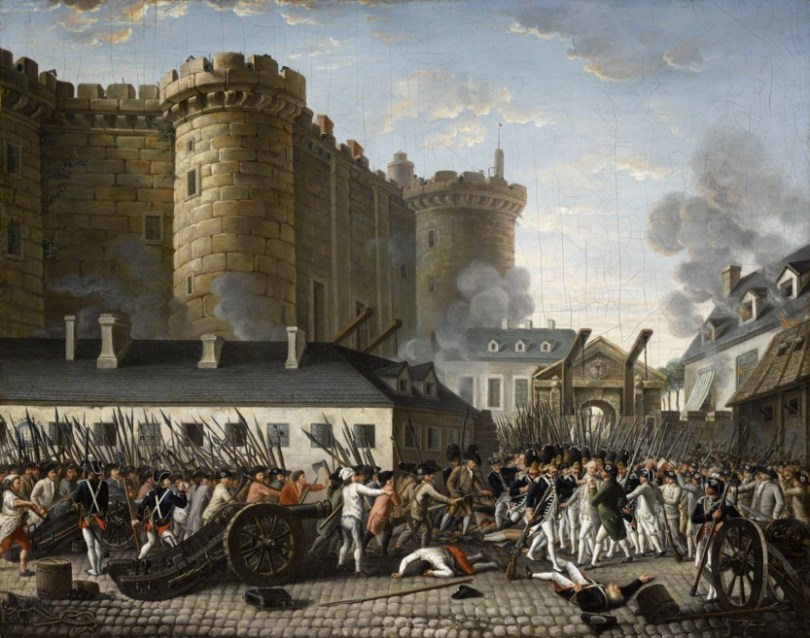
Storming of the Bastille and arrest of the Governor M. de Launay on 14 July 1789.

Liberty, Equality, Brotherhood

Social struggle forever?

The motto of the French Revolution, based on the ideals of the European Enlightenment, was ‘Liberty, equality, and brotherhood.’ It means that we should all be free and equal, as brothers and sisters. That was a tad ambitious back then, and it still is today, because human nature is not particularly forthcoming. There was also some liberty, equality, and brotherhood elsewhere, but developments in the West came to decide the history of the world. The European Enlightenment turned these values into abstract ideals that we could fight wars over. The French Revolution and the subsequent spread of Enlightenment ideas across Europe by French armies led by Napoleon prompted the German philosopher Hegel to formulate his dialectic of progress.

Hegel laid out the ideological conflict between progressives and conservatives that would dominate Western societies over the next two centuries. Better ideas would replace poorer ones in a competition that includes revolution and warfare, he prophesied. One particular branch of progressivism was Marxism. Marx believed that the organisation of societies stem from unenlightened self-interest, thus our willingness to accept the myths of the elites and our unwillingness to accept the facts. We would be better off if we knew the facts. Intellectuals at the time came to agree that much of the Bible was fiction. Add to that that Jesus hadn’t shown up for 1,800 years.

Religion kept people dumb and obedient. Christ taught that the meek would inherit the Earth. Marx taught that the meek should rise against their oppressors to achieve Paradise themselves. In the Soviet Union, communists started a state-run economy. In the West, socialists pressed for labour reforms and higher wages. Once workers in Western societies had come to live the good life, the Marxists moved on to try to liberate other oppressed groups. Critical Theory, also known as Cultural Marxism, examines and criticises society and culture using the social sciences and the humanities. The question remains: what is oppression and what is not? And if liberating requires repression, would the end still justify the means?

Max Horkheimer described Critical Theory as seeking to liberate human beings from the circumstances that enslave them. You can free yourself from thoughts such as believing your job or role is natural or divinely ordained. And you can free yourself and your group from the oppression of another. Critical Theory examines power structures, societal roles, cultures and their alternatives. You can ask yourself why most members of parliament are men. Is it culture, human nature, or power structures? Critical Theory leads nowhere if it tries to liberate us from human nature. Still, culture can greatly affect our conduct. Critical Theory can lead to a new power structure of opinion-makers who tell you what you should think, as the clergy did in the past.

The critical theorists suspect the existence of conspiracies of those in power to keep the oppression going, such as men in positions of power aiming to keep women out of positions of power. There is something like an old boys’ network. Men being in power has consequences for the rules in society. If men are in control, they make the rules and determine what constitutes acceptable conduct in relationships between men and women. Most complaints about improper behaviour come from women complaining about men. What men might consider harmless, women might see as intimidating. And so, women started the MeToo movement. Humans are genetically nearly identical, so differences in behaviour between groups are mostly cultural. To illustrate the point, the ancestors of civilised Danes, Swedes, and Norwegians are raping and pillaging Vikings.

Conservatives object to Critical Theory, claiming it promotes divisions within society. They might claim the order is natural. Are blacks and whites not very different, and does that not explain their success in life? And, men should treat women right, but aren’t gender roles natural? And if you dress like that, should you complain about men making remarks? Do we need political correctness officers who tell us what we should and shouldn’t say? Why do we need a new language? Does replacing the word slave with enslaved person change anything for the better? What people believe is acceptable and reasonable changes over time, and that change often comes from activism. Women have fought for the right to vote. Now most people accept it. Social justice causes have made societies more agreeable. Still, there is a limit to what we can achieve, and when order falls apart, civilisation will prove to be a thin veneer that will be gone before we know it.

The long road to end slavery

One noteworthy example of Hegelian progress is the end of slavery. It was a long struggle as it took more than 1,000 years, at least if you reason from the Western perspective. And it involved political activism and war. Most ancient societies had classes like slaves, serfs, free men, nobility, and priests. We pursue social status, not only for ourselves but also for the groups we belong to. We divide societies into social classes, while conquerors often enslaved the conquered. It helps to explain why ending slavery took so long, or why raising blacks to equality with whites aroused strong negative sentiments among whites. In the past, most people considered slavery normal or natural, but our values and culture have changed. There were also entrenched interests within societies. Slave owners were usually wealthy and powerful. In 1860, they were the elite in the Southern United States.

One of the first efforts to end slavery and serfdom in Western Europe began in the 7th century with Queen Balthild, a former slave, who forbade the sale and trade of Christians within Frankish borders. In 1102, the Council of London banned ‘the infamous business, prevalent in England, of selling men like animals.’ Around 1220, the Sachsenspiegel, a German law code, condemned slavery as ‘a violation of man’s likeness to God.’ The argument for abolishing slavery was a Christian view on human dignity. There was also an economic reason. Cities provided economic opportunities, and serfs flocked to them, prompting lords to compete for labour. It made serfdom in Western Europe untenable.

By 1500 AD, slavery and serfdom were rare in Western Europe, but by then, slavery began to take off in the colonies. Christians could still enslave non-Christians. A similar historical process would unfold, officially ending slavery more than three centuries later. Shortly after 1500, Spain banned the slavery of Native Americans but allowed unpaid forced labour or corvée called Encomienda. It made the natives serfs on paper but slaves in practice as the corvée extended. The natives weren’t sturdy enough for hard physical labour and died of diseases brought by the Europeans.

European plantation owners needed a more sturdy workforce. European traders brought them from Africa by boatloads, crammed them into cargo holds, and chained them, leaving little room to move, to maximise profits by efficient use of available space. Slavery was common in Africa. Tribespeople captured and enslaved members of other tribes. The European slave trade dramatically increased demand for slaves and made it a lucrative business, so hunting people for profit became commonplace. Unhygienic conditions, dehydration, dysentery, and scurvy caused one out of six to die during the voyage. Between 1526 and 1860, slave traders put an estimated 12.5 million Africans on ships in Africa, and 10.7 million survived the trip to the Americas.
The European slave trade was the largest, but it was not only Europeans doing this. And in the same era, North-African Muslim pirates captured and enslaved about 1 million Europeans.

Slave owners didn’t see slaves as humans, but as animals or cargo. On 1 January 1738, the Dutch slave ship De Leusden sank near the coast of Suriname. Over 600 Africans died because the crew had boarded up the hatches on the orders of the captain, thus not even allowing them to swim for their lives. In his diaries published in The Voyage Of The Beagle, Charles Darwin wrote that slaves would regularly receive beatings and torture for insignificant offences, mistakes or for no reason at all. When Darwin wrote these notes, public opinion in Great Britain was shifting, and Britain was about to abolish slavery in its colonies. There was also an economic reason. The Industrial Revolution had taken off, and the British economy no longer depended as much on slave labour as it had in the past.

History of blacks in the United States

The abolition of slavery became the central issue in the 1860-1865 US Civil War. The Northern states had abolished slavery soon after the American Revolution. Their economies didn’t depend on slave labour. That was different in the South. The invention of the cotton gin had turned into a boon to the cotton industry and greatly increased the demand for slave labour. By 1860, slave plantations in the United States produced two-thirds of the global cotton supply. Efficiency improvements came from tracking each person’s output and harshly punishing those who failed to meet their production targets. Slaves who tried to escape faced brutal physical punishments like whippings, branding, or maiming. As the South’s wealth was based on slavery, it wasn’t willing to end it.

A noteworthy figure in the abolition movement was John Brown, a man of religious conviction, who believed he was an instrument of God, raised to strike the death blow to slavery in the United States, his sacred obligation. There was a broader opposition against slavery. Brown became dissatisfied with their pacifism and came to propagate radical action, saying, ‘I, John Brown am now quite certain that the crimes of this guilty land will never be purged away but with blood.’ He led anti-slavery volunteers during a civil war in Kansas about the issue of whether the state would enter the Union as a slave state or a free state, which led to his execution for treason in 1859.

The dispute leading to the Civil War was over whether to allow slavery in the new territories in the West. The controversy came to a head when Abraham Lincoln, who opposed slavery’s expansion, became president, and Southern states seceded. Lincoln, hoping to reunite the country, didn’t plan to abolish slavery in the South at first. That changed when a peace deal remained out of sight, and the North needed soldiers to fight the war. Lincoln then signed the Emancipation Proclamation on 1 January 1863, which freed the slaves and allowed them to enlist in the army. Many slaves escaped and fled to the North to obtain their freedom and to join the Northern Army.

At the time, Frederick Douglass, an influential black writer, complained about the unequal pay of black soldiers, who earned less than white privates. The North’s weak response to the cruel treatment of black prisoners of war by the South also angered him. He forced his way into President Lincoln’s office, and the two men came to know each other. It was a learning experience for both. Lincoln learned how slavery affected the lives of black people, while Douglass came to understand the political reality. Most whites weren’t ready for black emancipation. Not much later, John Wilkes Booth assassinated Lincoln for promising blacks suffrage. That was a bit too much equality for many whites at the time.

After the Civil War, whites regained control in the South. Paramilitary groups, such as the Ku Klux Klan and the White Man’s League, disrupted political campaigning, ran officeholders out of town, lynched black voters, and committed voter fraud. The federal government didn’t stop it. Voting for blacks became more restrictive with literacy requirements combined with the underfunding or closing of black schools. States and counties introduced laws to enforce racial segregation, the so-called Jim Crow laws. Successful blacks faced violence, destruction of their businesses and killing by violent mobs of whites. The most famous example of that is the Tulsa massacre of 1921.

Racial segregation officially ended in the 1960s after the civil rights movement took on the issue. Television made non-violent resistance under the leadership of Martin Luther King a success. Scenes of police violence highlighted the oppression of blacks, and the world could see it. It damaged the credibility of the United States, which was at the time in a propaganda war with the Soviet Union to win the hearts and minds of formerly colonised peoples. That forced President Kennedy to act. And one century after Lincoln signed the Emancipation Declaration, he signed the Civil Rights Act. Both presidents acted for political reasons rather than moral ones. Since then, everyone in the United States has been equal before the law, even though not always in practice.

Something went wrong somewhere

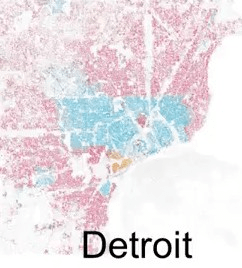
In December 1992, I went on holiday to Florida. My travel agent had strongly advised me not to enter a particular quarter in Miami where blacks lived. Yet, I accidentally drove into that district and tried to book a hotel room there. The lady behind the counter was kind enough to talk me out of it. She said, ‘Folks like you shouldn’t come here, you know.’ Whites weren’t welcome there. And the area seemed okay, as I had also accidentally driven through a real ghetto, where the blacks living there gazed at me, making me think that they saw me as an alien invading their territory. Few whites dared to go there, so it must have been a spectacle for them. That was very unlike the Netherlands, as I was about to move to a neighbourhood where a considerable number of blacks also lived.

A few months earlier, a jury had acquitted four Los Angeles policemen of the beating of Rodney King, a black taxi driver, despite the evidence being clear. Fury erupted, incited by grievances about racial and economic inequality, and the city burned. Something had gone wrong somewhere. The ‘something’ and the ‘somewhere’ are not as straightforward as in the past. Multicultural societies in Europe face similar issues. The success of immigrants often relates to their ethnic background. Education didn’t matter much to enslaved blacks in the United States, and later on, during the Jim Crow years, their education was wilfully neglected. That likely contributed to a culture where education didn’t matter.

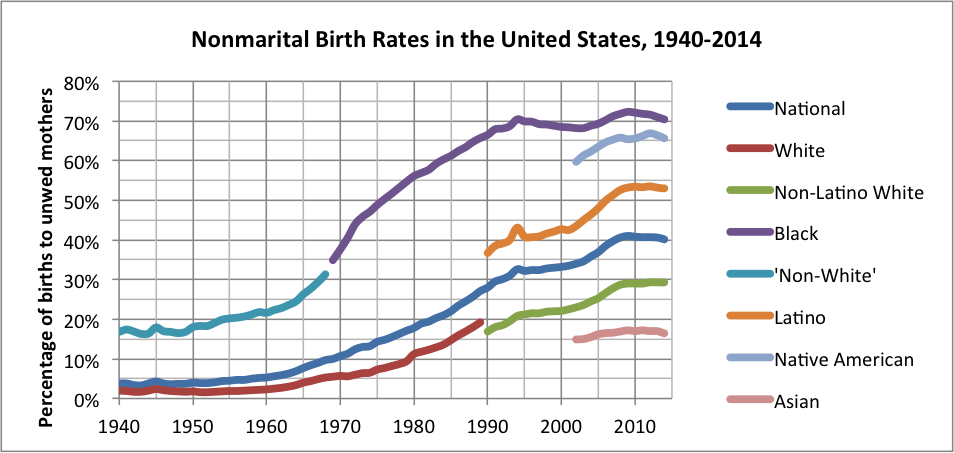
Another factor contributing to the persistence of racial inequality in the United States might have been the disintegration of families from the 1960s onwards, which particularly affected blacks. The disappearance of industrial jobs made the situation worse. In 1965, Senator Daniel Moynihan warned that the rise of out-of-wedlock births among blacks would cause a disaster. He argued that black men couldn’t become good husbands and fathers without jobs, which were the means to support a family. It would cause divorce, child abandonment, out-of-wedlock births, and households headed by women living on welfare. And without a positive role model of a providing father with a job who also looks after his sons, young males are more likely to enter a life of crime.

The report came at a time when the Civil Rights movement was fighting segregation and white racism. Hence, civil rights leaders attacked the report as an example of white patronising, cultural bias, and racism. It was not the right time to discuss the issue, as white racism still hindered the progress of blacks. Blacks weren’t allowed to go to the same schools and universities as whites. The report helped to create the black welfare queen stereotype. The trend is broader, but the disintegration of the family affected blacks more than other groups. Black mothers were more often on welfare, raising kids who were more often committing crimes. Some argue that blacks are no good, but despite these issues, the majority of them do okay. And behavioural issues are mostly cultural. And so, the descendants of raping and pillaging Vikings can be Danes, Swedes, and Norwegians.

There likely is a relationship between the strength of communities and families and success in society. You have an advantage when you grow up in a stable environment with married parents. Married parents can invest more time in raising and providing for their children. It doesn’t explain why Muslims often perform poorly in European societies, as they usually have strong family ties. And so, there is more to the issue. Attitudes towards education and society also matter, and perhaps even more. Blacks and Muslims may feel resentment and think that society is not for them. Blacks may say it is a white man’s world, and the success of the West and the Jews is at odds with the supposed superiority of Islam. And if you believe you aren’t a fully recognised member of society and never will be because you are black or Muslim, you are less likely to participate and contribute.

In 2013, the acquittal of a neighbourhood watch in the fatal shooting of the 17-year-old Trayvon Martin gave rise to the Black Lives Matter movement. Martin had no convictions. The police had once found jewellery in his possession, but couldn’t prove he had stolen it. The death of George Floyd in 2020 is another noteworthy case. A police officer knelt on Floyd’s neck for over nine minutes while Floyd was handcuffed and lying face-down in the street, contributing to his death. Floyd even said that he couldn’t breathe. Floyd allegedly had used a counterfeit twenty-dollar bill. He had served eight jail terms for petty crimes.

The Black Lives Matter movement turned the brutality of American police into a race issue. Had Floyd been white, had the police officer treated him differently? That may well be the case. Get blacks pulled over more often by the police and get mistreated for no other reason than being black? I don’t doubt it. Yet, blacks are three times as likely to be killed by the police as whites, but six times as likely to be convicted of a crime. Relative to the number of violent crime suspects per race, the police killed fewer blacks than whites. And so, it is hard to separate the two issues. There is no excuse for racism, but there is even less excuse for violent crime. Making a race issue out of it, as BLM did by saying that black lives matter, and ignoring the crime levels among blacks in the United States, can make people angry, as does making heroes out of criminals. Floyd wasn’t saving the rainforests or helping out poor people. He was a petty criminal.

On a MAGA-related message board, you find countless instances of misdemeanour by blacks. On the r/BlackPeopleofReddit message board, you find plenty of accounts of whites harassing or scoulding blacks with racist slurs. And that is in the United States, which is not the most racist country by far. Otherwise, Barack Obama wouldn’t have been president. I follow these feeds to understand what people think and experience, and what is happening. You have beliefs, experiences and facts, and our beliefs and experiences affect how we see the facts or which facts we deem important. There is a focus on white racism because of the past. If we aim for equality, the racism of those who have the advantage or are the oppressors is more problematic than the racism of the oppressed or disadvantaged. Yet once the advantage diminishes or disappears, the racism of other groups becomes equally problematic. If a white person can better not check into a hotel in a black neighbourhood, that is bad for business of blacks but also for the black community around it, and it gives whites the impression that they can’t trust blacks.

Still, regardless of their conduct, blacks face more racism than others, except in areas where blacks live. Humans are xenophobic creatures, and the skin colour of blacks stands out. Even language works against them, as the words ‘black’ and ‘dark’ are associated with evil. That is probably why, on the Dutch island of Curacao, where there is racial mingling, lighter skin is often appreciated, or so an island inhabitant told me. And it is also a reason why the MAGA crowd picks on Indians. So, the darker your skin, the more trouble you will likely have in life, unless you live among your peers, and that is a brutal fact that whites mostly don’t understand. I may know it from the evidence, but experiencing it is a different ballgame. Understanding the problem begins with accepting that it is natural human conduct. Fighting against human nature is an uphill battle. Humans are xenophobic creatures and may hate, bully and ostracise others for differences in views, appearance and conduct. And the MAGA bigots dislike liberals and LGBTQ people as well.

There is a bias against blacks in the US justice system, leading to 20% prison time for the same offences compared to whites. Somehow, that issue persists, despite efforts to make the justice system fairer. Likely, the cause is not racism, but comes down to issues like access to better lawyers or the suspect knowing what the judge wishes to hear because of sharing the same culture. And the cause of the high number of black fatalities at the hands of the police is brutality rather than racism. In the United States, police fatalities are 33 per 10 million inhabitants per year, in league with countries like Angola, Colombia, Mali and Sudan, which is 30 times as much as countries like Germany, Portugal, Sweden, and the United Kingdom. It comes with the level of lethal violence Americans accept. In the United States, you can get away with shooting a cleaning lady trying to open the wrong door. In Europe, that would be murder. And in the United States, everyone can carry a gun, so the police are more on edge, making them more inclined to shoot first and ask questions later.

Historical perspective

We view things from today’s perspective and assess the past through today’s values. It doesn’t help to understand history or social changes. Slavery has long been normal in many parts of the world. The Bible does not speak out against it. That Christians gradually came to reject it is a remarkable historical development. Slave owners thus didn’t think they were doing anything wrong. They could be kind people, and still treat their slaves cruelly. Darwin wrote, ‘I was present when a kind-hearted man was on the point of separating forever the men, women, and little children of a large number of families who had long lived together.’ He could only do that if he didn’t view slaves as people. Among the Nazis exterminating Jews in the concentration camps were family men who cared for their wives and children. Most of us are capable of allowing or contributing to atrocities.

Those of us who eat meat contribute to the animal suffering in the meat industry, which is as horrific as the Holocaust, even though it concerns animals rather than humans. Animals don’t differ as much from us as many of us like to imagine. We buy clothes made by children in Bangladesh who work twelve hours six days a week in filthy factories. Many people in Europe and the United States condone the cruel treatment of immigrants because they think there are too many, and that migration undermines their societies, and giving them humane treatment would invite more to come over. And that is correct. The ICE brutality led many illegal immigrants to flee the United States. Future generations may view our conduct as appalling as we view slavery today, but only if we have a better world in the future. If we end up in a Mad Max world ruled by warring gangs, few would care.

Slavery can return at any time if the conditions favour it or if a stronger power re-establishes it. And if so, it will come with a myth that tells us that slavery is the best system for reasons like humans feeling too entitled, and as a result, ruin this planet. Seeing the abolition of slavery as a historical process and acknowledging the limits of our compassion helps us understand why it took so long, and slavery has never fully ended. There were moral beliefs and economic issues involved. Slavery was common in most traditional societies, but had ended in Western Europe by 1,500 AD. Europeans then turned the slavery of blacks into a commercial enterprise of unprecedented scale and brutality, making it a pillar of the European capitalist economy. European Christians engaged in the slave trade, but Christianity also contributed to the end of slavery.

Christianity proclaimed a fundamental equality of human souls. Christian churches approved of slavery and benefited from it, but they also aimed to convert indigenous peoples. These conversions themselves were often brutal, but by doing so, European Christians admitted that indigenous peoples were humans worthy of conversion. And if they were Christians, enslaving them conflicted with the Christian principles Europeans imagined. The Western ideal of equality has its roots in Christendom. Europeans gradually began to apply the principle of equality to people of other races.

Slavery ended once the economic situation allowed it. The Industrial Revolution became the new engine of economic growth, so the slave trade and slavery contributed less to the economy. Factory workers were cheap and often lived on the brink of starvation, so the capitalists’ bottom line didn’t suffer from abolishing slavery, except in the South of the United States, which went to war for slavery, thus proving Marx’s point that economics has a considerable, if not decisive, effect on the class structure in societies. Ending slavery didn’t magically create a better world, nor did ending segregation solve inequality. Racism hasn’t gone away, but today it mixes with complaints about behaviour, such as the crime rate among blacks in the United States. Still, you must separate the two. One wrong doesn’t justify another, so we should treat each other reasonably. That doesn’t make these problems magically go away, but it is the only way forward.

Latest update: 6 June 2026

Featured image: Storming of the Bastille and arrest of Governor M. de Launay on 14 July 1789. Public domain.

Black and white sheep

Cultural Differences and Ethnic Profiling

Marlboro Red

In the 2000s, it struck me that nearly all the empty cigarette packages littering the streets were Marlboro Reds. I began to pay attention. There were one or two Camels and a few others, but almost all were Marlboro Red. Marlboro Red is the most popular brand. Its market share in the Netherlands is nearly 30%. The second-largest brand has a market share of under 10%. But if you had to make a guess based on discarded empty packages, you would think Marlboro Red had a market share of 95%. It was not scientific research, but my observation and my wife’s. We made jokes about it. We didn’t make tallies, but it was like that. Cultural differences are a big issue, as I had already learned as a student. Marlboro Red smokers often dumped their garbage on the spot, while other smokers rarely did. So, if you’re looking for a jerk, check who’s smoking Marlboro Reds.

You might think that littering isn’t that bad if you compare it to the horrors of warfare, dumping chemicals, the abuses in the meat and dairy industries, and the cutting down of rainforests. Still, disrespect for God’s Creation begins with littering. It is a matter of upbringing, hence culture. Some countries are clean, while others are a total mess because people dispose of their garbage wherever they see fit. It’s pretty easy to spot jerks. Those who litter are. Jerkdom is part of a culture of not caring. We buy the products of corporations that dump chemicals in the ocean and then complain about the poisoned fish we eat. There are worse offences. But it starts with littering. Next comes graffiti, which only those who make it consider art. I know art is personal expression, so do it inside your home so that only you can see it. Then comes destroying property. If you want to cause even more harm, you might consider buying the latest fashion.

Now, if 30% of the people dump 95% of the garbage, the remaining 70% is responsible for only 5% of the garbage. And you can calculate that Marlboro Red smokers were 44 times as likely to dump their trash on the street as other smokers ((95/30) / (5/70) = 44), a striking find. The sample was large enough to make the finding statistically significant. The sample may have issues, but these issues can’t fully explain the difference. It is more complicated to do the same investigation today. You still find cigarette packages on the street, but it is hard to identify the brand name among the scary pictures of cancers and other horrible diseases you get from smoking. Marlboro Red smokers differ from other cigarette smokers. You can call it culture. Culture can explain the deviant behaviour of groups of people who share common characteristics, such as smoking Marlboro Red. It is politically incorrect, but culture explains a lot about behavioural differences between groups.

The Marlboro Man embodies careless living in a consumerist society, which apparently includes discarding one’s garbage on the spot. Our brand choices reveal a great deal about our personalities, so marketers have done their jobs very well indeed. A politically correct person would say I am stigmatising Marlboro Red users. There could be something wrong with my sample. The sample may have flaws, as I live near a train station where young people gather, but I have also noticed this elsewhere. The difference is so stark that it can’t merely be an error in the sample. But even if the sample correctly reflects reality, perhaps only 0.1% of smokers discard their cigarette packages on the street, so only a tiny minority of 4.4% of Marlboro Red smokers might do so. Perhaps that is correct, or perhaps not, but 44 times as much is an eye-popping difference.

If you intend to tackle the problem of litter from cigarette packages and have a limited budget, you may target Marlboro Red users to achieve the greatest impact. Otherwise, you are wasting money. And who wants to waste money? Okay, stupid question. People buy cigarettes. I think of Marlboro Red smokers as jerks who don’t care, thus people who might piss through your letter box, or throw fireworks in it. It is what I imagine, and I know that it isn’t true for all of them. Many are people like you and me, who might be friendly, own a dog, have a job, and look after their neighbours. And reality never ceases to surprise me.

If I meet an individual, this person often doesn’t conform to all my prejudices about the groups to which he or she belongs. A group consists of individuals, and although they share common traits on aggregate, each individual is different. There are behaviours like littering that occur more in certain groups than others. Our prejudices about groups often have a basis in reality. Still, our prejudices aren’t reality. If you only see Marlboro Red packages on the ground, you may think that Marlboro Red smokers are all littering jerks, while it might be a small minority of them.

Can I trust my dentist?

How do cultures emerge and develop? History and circumstances go a long way in explaining that, as the following example illustrates. I trust my general practitioner, but not my dentist. That is because of my experiences and those of others. General practitioners and dentists are similar medical professions. In the Netherlands, a general practitioner doesn’t benefit from the advised treatments, while a dentist does. You have to trust medical professionals because your health depends on them, but you can’t trust them in a market. That is why healthcare for profit turns into a scam where doctors prey on desperate people and sell treatments for which there is no scientific proof. That ranges from magic potions to revolutionary cancer treatments. If you buy it, they sell it.

To prevent dental professionals from taking advantage of me too much, I see the dentist once a year rather than twice. So what made me so distrustful? As a child, I had the same dentist for over fifteen years, an old-fashioned one for peasants like me. He didn’t propose treatments unless they were necessary. He once told me that I could wear braces, but added that it wasn’t necessary for my teeth’s health. Not caring about looking perfect, I still live with the consequences that have never bothered me.

After leaving my parental home and moving to Groningen, I selected a new dentist. The first thing he did was take X-ray pictures. He said a cavity was developing underneath one of the fillings. Well, what a coincidence. The other dentist had never seen it. Then the dentist showed me the picture and pointed at a dark spot. There was another filling with a dark area beneath it, and I said, ‘You can see a similar blot here.’ He replied, ‘That is something different.’ I am unqualified to evaluate these X-rays, but both areas were similar, so the dentist lied. Had he not shown me the photograph, I would have believed him. It made me suspicious and very critical of what dentists were doing.

Before he could treat my tooth for the supposed cavity, I came up with a lame excuse and selected another dentist. A few years later, I had a colleague who had married a dentist. She previously had lived in the same neighbourhood. Her husband was in training at the time. And so, she had been seeing another dentist, who happened to be that one. She told me she had had a row with him, so I wasn’t the only one who had smelled a rat there. Her husband was a dentist-in-training, so she probably had valid reasons for quarrelling.

That was a noteworthy coincidence indeed, and there have been many in my life. What are the odds that she had the same dentist, they had an altercation about malpractice, and her husband was a dentist in training, which would provide me with evidence to support my suspicions? Thirty years later, the tooth and the filling were still in place. Later, I moved to Sneek and found an old-fashioned dentist. He was like my first dentist, so I trusted him. He often performed dental cleaning. That usually took 10 minutes and cost €21. After ten years, he joined a practice with some other dentists. Shortly after that, he retired.

My next dentist didn’t perform the dental cleaning. Instead, he sent me to a dental hygienist. That treatment lasted twenty-five minutes and was a lot more expensive. Instead of €21, I paid €62. Standards do change, but I doubted the sudden need for 150% more cleaning. But if my dentist advises the treatment, who am I to disagree? After all, he is the expert. It is best to accept the assessment of medical professionals unless you have proof they are wrong. Otherwise, you endanger your health.

Since then, I have worked harder on brushing and cleaning my teeth, but the cleaning always took 25 minutes, no matter how hard I tried. After eight years, my dentist said my teeth were in good shape and clean. There was a tiny bit of tartar, so he advised me to see the dental hygienist anyway. The dental hygienist could have stopped after ten minutes, but she went on to arrive at twenty-five, so she could bill me for that, or so it seemed. The treatment was always twenty-five minutes, regardless of the condition of the teeth. I found that dubious and looked for another dentist.

It would only get worse, even though not at the beginning. A new guideline stated that dental hygienists could do the periodic dental check-up. The following year, the dental hygienist combined the check-up with dental cleaning, making the most of the allotted time financially. I was there for thirty minutes. She billed me for thirty minutes of dental cleaning and also charged me for the check-up. A decent check-up lasts ten minutes, so you might expect a check-up and twenty minutes of dental cleaning if you are there for thirty minutes. I was surprised and wasn’t sure. Had I checked the clock correctly?

The following year, she did it again. Additionally, she charged me for taking X-rays and evaluating them. How can you do all that in thirty minutes if you already spend thirty minutes on dental cleaning? It doesn’t add up. The dentists had decided to take pictures every 3 years instead of every 5, which means even more money for them. And she was double-charging me. Dental cleaning was €160 per hour at the time, which was nearly what I brought home after a day of work and paying taxes. Many people work longer for that money. To charge that per hour wasn’t enough for her, which is particularly nefarious.

After returning home, I emailed her to request clarification. She didn’t respond, so I filed a complaint with the Dutch Association of Dentists and looked for another dentist. In the complaint letter, I protested against the double-charging and noted that questionable ethics have become customary in dental care. A few decades ago, there were no dental hygienists. My wife once said, ‘The dental hygienist is a new profession created out of thin air.’ She had left a dentist because he required her to see the dental hygienist before examining her teeth to determine whether that was necessary. She went to another, who also began maximising profits at the expense of clients, so she left again. I have heard several stories from others of dentists overcharging or doing unnecessary treatments.

My next dentist also advised dental cleaning. And this time, I was with the dental hygienist for forty minutes, and she billed me accordingly for €119. Over the past fifteen years, the time spent on dental cleaning has increased by 300%, and the cost has risen by 467%. I take much better care of my teeth than I did twenty years ago, and began using toothpicks, but it doesn’t show up in the dental cleaning cost. It can’t be that all these dentists and dental hygienists are lying. My teeth accumulate tartar no matter how well I clean them, so the cleaning is necessary, but the amount remains questionable, to say the least. I put up the ante once again, brushing my teeth three times a day, and it finally showed in a somewhat reduced dental cleaning time in the years that followed.

The parabolic rise in dentist costs is partly due to changing standards. Dental cleaning improves the health of teeth. At some point, the benefits of increased cleaning and more photographs become minimal while the costs escalate. The precise border between higher and scamming will always be elusive, and you can’t prove it from individual cases like mine. Still, we have, without any doubt, entered scamming territory, but no one puts a halt to it. In 2026, a Tubantia newspaper headline said, ‘Eight minutes in the chair, pay 200 euros: more and more patients feel like ‘cash cows’ at the dentist.’ And the article goes on to say, ‘Three minutes of polishing for €480 per hour. Half-cent cotton rolls billed for €10. A €1,600 treatment plan that disappears after a second opinion. Hundreds of readers contact us after reading articles about dental fraud. And research by Zilveren Kruis shows that in six out of ten cases investigated, there was indeed overbilling.’

Again, I have to be politically correct and say that the number of complaints about treatments is less than 1% of the total number of treatments. People only complain if they think something is wrong, so that 60% of complaints are justified doesn’t mean 60% of dentists are overbilling. Undoubtedly, much also goes unnoticed. My wife has switched twice after being scammed, and never filed a complaint. I switched three times and complained only once. And so the percentage of fraudulent dentists is likely significantly higher than 1%, but probably it is a minority, and there is a grey area between changing standards and overtreatment. Still, the consequence is that more and more people can’t afford dental care, and their teeth’s health suffers. So, while the number of treatments increases, the quality of dental healthcare in the Netherlands declines, which seems to be a systemic problem in healthcare-for-profit. General practitioners don’t benefit from the treatments they recommend, leading to better care at lower cost.

The same trend is visible in veterinary practices. Douwe, our late cat, suffered from kidney failure. We had spent hundreds of euros on tests, but the vets found nothing. And we had seen several vets, because we suspected that the other vet was scamming us, but they all did it. We spent hundreds of euros more on special diets sold by these vets, but Douwe’s condition only deteriorated. We finally visited an old-fashioned vet. He examined Douwe by feeling with his hand. He found the kidney failure and euthanised Douwe. That cost us only €30. Modern veterinarians often don’t physically inspect the animals but perform tests, charging over 1000% more. Physical examinations are bad for business.

My father has spent over €5,000 on surgery for the leg of his dog. An old-fashioned vet would have amputated the leg, as the animal could still walk on three legs. But that is, of course, much cheaper and generates far fewer profits. The surgery failed, so the poor animal had to undergo a second surgery. After that, the ailment returned, so a third surgery followed. And it is not that if the treatment fails, you get the next one for free. Not even a discount, unless you are, like my father, insistent on a discount and somewhat unpleasant. The dog didn’t recover. My father had his dog euthanised because it was in pain.

The market works so that unnecessary treatments proliferate because the rich desire them. They would rather spend €10,000 on unnecessary treatments for their dogs than on feeding children in Africa. We are all like that. I don’t give all my money to charities either, so it is a most serious issue that we can only fix with unthinkably brutal measures like taxing the rich. These treatments have become the norm, so the vets sell them to the poor as well, telling them every pet deserves these treatments, even when their owners can’t afford them.

You can’t blame only the vets and dentists for the cost explosion. We view our pets as family members and want the best for them, just as we do for our children. Modern veterinary outfits look like hospitals and make investments that need to bring in a return. And we want perfect teeth, not just healthy ones. Not everyone can afford them, and healthy teeth are more important than perfect teeth. Vets make tons of money. They now retire early, purchase luxury mansions and travel around the world. It has become so lucrative that vulture capitalists are buying up veterinary practices, so scams will proliferate like cancer until the entire sector has become a scam.

Group culture can be a problem. Most veterinary and dental care professionals think they are doing a good job. Dutch politicians are catching up and proposing a law to ban profit maximisation at the expense of pet owners, but, as usual, nothing will change. It reflects the mood in society, where we see greed as good, so that dental care professionals and vets may be unaware of the damage their culture and professional values cause to society. And that is precisely the problem with many other cultures, whether they are professional groups or ethnic groups.

The politically incorrect

It is okay to say that, but once you apply the reasoning to ethnicity, you step into a minefield. But hey, let’s begin with kicking in an open door. White Europeans have caused the most trouble. And now we can move on, and also discuss the problems others cause. These differences can be an excuse for racism and discrimination. Racism is widespread, and discrimination is even more so. Typically, stereotypes are rooted in reality, which complicates the issue. Racism and bigotry are undesirable, but if you have reason to have grudges against specific groups, these grudges might express themselves as racism. You might as well hate Marlboro Red smokers and dentists. The standard politically correct answer is that most people from minorities are good people, just like most Marlboro Red smokers and dentists are. Additionally, the ethnic group to which you belong can also cause trouble for other groups. Whites caused the most trouble in history.

Usually, a minority in that group causes trouble, but that minority can make a neighbourhood unsafe. And people from a group don’t rat out each other, so that they can be part of the problem. There has been growing negativity surrounding immigration recently. That is not only because of the numbers, but also because of the crime. However, the image you get from the evidence you see is not reality itself. If most suspects of burglary have a particular skin colour, you might think they are all criminals, while it is usually a minority. Even when differences are relatively small, the groups in question pose a problem. If the percentage of criminals in the population rises from 1% to 2%, you need twice as many police, courts and prisons. And if you can’t discuss these issues, you also can’t discuss the problems the majority causes.

Usually, a minority in that group causes trouble, but that minority can make a neighbourhood unsafe. And people from a group don’t rat out each other, so that they can be part of the problem. There has been growing negativity surrounding immigration recently. That is not only because of the numbers, but also because of the crime. However, the image you get from the evidence you see is not reality itself. If most suspects of burglary have a particular skin colour, you might think they are all criminals, while it is usually a minority. Even when differences are relatively small, the groups in question pose a problem. If the percentage of criminals in the population rises from 1% to 2%, you need twice as many police, courts and prisons. And if you can’t discuss these issues, you also can’t discuss the problems the majority causes.

It works two ways. Host societies have varying ways of dealing with immigrants. The gang violence among immigrants is worse in Sweden than elsewhere. The Swedes tend to keep to themselves, and it isn’t always easy for foreigners to integrate into Swedish society. Many countries have volunteers who care for asylum seekers and help them settle. It is probably not a coincidence that my worst hitch-hiking experience as a youth occurred in Sweden, where my cousin and I waited for over seven hours for a lift despite the heavy traffic. Nowhere else had I waited for much more than an hour, and I have hitch-hiked in seven countries. Whatever the cause may be, these gangsters commit these crimes, not the Swedes who allowed them into their country. Still, there must be a reason why the gang violence in Sweden among immigrants is worse than elsewhere.

When harmful conduct relates to culture, the politically correct response is often that only a minority is involved in it. Why do mass shootings occur far more often in the United States than elsewhere? The politically correct gun lobby would argue that only a tiny fraction of Americans go on a shooting spree. The image you get is not reality itself. If there are mass shootings in the United States nearly every day, you might think Americans are gun-obsessed nutters, while it is a small minority. Still, there are mass shootings all the time, so it sets the United States apart from other countries. The problem is not gun ownership. Liberals might think that stricter gun laws will solve the problem. More stringent gun laws will never happen because the problem is not gun ownership but gun culture.

When there is no gun culture, gun ownership wouldn’t pose such a problem. European countries, such as Finland and Switzerland, also have widespread gun ownership. Still, random mass shootings are a typical American phenomenon. America has a gun culture and a belief that guns are a preferred way to solve problems. American police are over 60 times as lethal as their British counterparts (33 versus 0.5 fatalities per 10 million inhabitants in 2022), which is an appalling statistic. Still, several countries have far more violent police forces. These numbers relate not only to the amount of violent crime. Compared to films from other countries, American films overflow with excessive violence, including gory details like bullets penetrating bodies and tearing flesh apart, which Americans somehow seem to be particularly interested in. The hidden suggestion is that killing other people is business as usual.

Ethnic groups have cultures. We picture Americans, Chinese, Germans and Arabs like we picture lawyers and construction workers. Our prejudices may accurately identify group characteristics, but will often fail us in individual cases. Suppose all the cookies are gone on Sesame Street, and you must find suspects. Would you not select the big-mouthed, blue-haired ones with a taste for cookies? That is also profiling. But perhaps it was one of Ernie’s pranks. If you did not think of that, you are prejudiced. We base our prejudices on experience and facts, as well as fiction and rumours. Only the facts do not base themselves on our prejudices. We often forget about that. Not all dentists are greedy money-grabbers, likely not even most. Although some minority groups cause more trouble than others, most individuals within these groups probably do well. Still, cultures and societies are Big Things, even though you can’t precisely define or measure them.

Intentions and arguments

In multicultural societies, people from certain ethnic groups often face greater difficulties and cause more problems than others. That undermines the fabric of society as much as racism and discrimination. It is one of the reasons why right-wing populism is on the rise. Culture often coincides with ethnicity, so the resentment can express itself as racism, which allows racists and bigots to have their say. That was the reason for having political correctness. Policymakers have long hoped that maintaining a friendly atmosphere and helping disadvantaged groups would help to reduce these problems over time.

The validity of an argument doesn’t depend on the intentions of the person making it. That said, there is a wide array of possibilities for misrepresenting the facts, so intent usually matters for the quality of the argument. Activists are cherry-picking incidents to present a picture of a group causing trouble. I could have photographed discarded, empty Marlboro Red cigarette packages on the street to illustrate that Marlboro Red smokers are littering jerks. Although there is some truth to it, it is not the truth itself.

Our cultures and values play a crucial role in how we view society. Groups that pose problems often share a belief that the society in which they live is not their own. ‘It is a white man’s world,’ a black man might say. You may become angry or frustrated when you fail in society due to circumstances you believe are outside your control. You may not understand the unwritten rules or know the right people to get ahead. Even when we are equal before the law, we are not in reality. It is not always easy to determine to what degree you can blame society, the individual, or the groups to which individuals belong.

Ethnic profiling

Cultural differences are why authorities engage in ethnic profiling. Culture coincides with ethnicity. In the Netherlands, crime rates vary by ethnic group. Criminals are a minority in every group, but the differences are significant. People of Antillian, Moroccan, Surinamese and Turkish descent are, on average, three times more likely (2.4%) to be crime suspects than native Dutch (0.8%). It has a magnifying effect, as it influences how the native Dutch think of these people. When you see pictures of crime suspects, they often have, as the Dutch call it, a tinted skin, meaning they aren’t white. It can give you the impression non-whites are all criminals, just like you can get the impression that all Americans are gun-wielding nutters or that Marlboro Red smokers are jerks. It can make you distrust people who aren’t white, most notably when you hardly know them.

The relationship between ethnicity and crime can be misleading. There is a coincidence between income and crime. And these minorities have relatively low incomes. A good question is why people from certain ethnic groups have low incomes. That relates to culture, but it is not the only explanation. Many immigrants came to Western Europe for low-paid jobs that required little education. Their parents had little education. Education was not a high priority for them, so their children often ended up with little education. Even when income explains crime rates better than culture, culture still plays a significant role in income, most notably through attitudes towards education and work. It is something we can’t ignore as specific types of conduct relate to particular groups.

Diversity policies, such as hiring persons from disadvantaged groups, can help improve society. However, the result can be that better-qualified people don’t get the job because of their skin colour or gender, which is discrimination. And, if you don’t hire the best people for the job, the quality of your product or service can come under pressure. On the other hand, without diversity policies, talent may go to waste. You can train talented people when they lack education. The Dutch government invested in the education of minorities rather than promoting diversity in hiring. Equalising opportunities with education seems a better approach than lowering standards.

Ethnic profiling is controversial. It has undesirable consequences, as the following example demonstrates. Suppose a country consists of two ethnic groups, which are Group A, 2/3 of the population, and Group B, 1/3. Assume further that people in Groups A and B are each responsible for 50% of Fraud X. Hence, people in Group B are twice as likely to commit Fraud X as people in Group A. To combat fraud effectively, you can only verify individuals from Group B to achieve the maximum result. You could apprehend twice as many fraudsters with the same effort. But now comes the catch. You don’t check on people from Group A, so only people from Group B end up in prison. While responsible for 50% of the fraud, Group B receives 100% of the punishment. That is discrimination.

Some call it racist, but the reason for ethnic profiling can be a risk assessment related to cultural characteristics, not ethnicity. In this hypothetical case, it is the likelihood of committing Fraud X. Also, in that case, ethnic profiling can be racist. People from Group A might dislike those from Group B and elect a leader who allows the authorities to investigate the crimes of Group B while disregarding the crimes of Group A. You can end up with a situation where the authorities prosecute Fraud X and only check on people in Group B, supposedly because they are doing it more frequently while doing nothing about Fraud Y, which members of Group A commit twice as often as those from Group B.

If your job is combating Fraud X, and you dedicate only 50% of your resources to Group B, that seems reasonable because people from Group B are responsible for 50% of Fraud X. In that case, people from Group B are still twice as likely to get punished because Group B is half the size of Group A, but receives the same amount of checking. And because people in Group B are twice as likely to commit Fraud X, people from Group B end up in prison four times as likely as those from Group A. While responsible for 50% of the fraud, Group B accounts for 67% of the prison population. If people from Group B claim that the authorities discriminate against them and punish them more, they are right.

People from ethnic minorities often get harsher punishment for the same crimes. A Dutch study showed that people from other ethnic groups are up to 30% more likely to receive a prison sentence for the same crime than native Dutch. The reason might be discrimination, but more likely, it is cultural. If you share the same culture with the judge, you know what to say to sway the judge’s opinion. Consequently, the judge might think the migrant is a jerk and the Dutchman is reasonable.

If the problem is severe enough, the end may justify the means. Ethnic profiling can undermine the trust of minorities in the authorities, because these groups may feel they are the target of police harassment. Still, if authorities don’t act on culturally related crime, we might end up with lawless ghettos. In several Western European multicultural societies, males of North African descent are overrepresented in the prison populations. In the United States, it is black males. On average, they commit more crimes than the general population. And if the police engage in ethnic profiling, people from these groups receive more punishment for the same crimes than others.

Ethnic profiling to check on people is one thing, but it becomes much worse when you use it to punish people without proof. The Netherlands has benefits with advance payments for medical expenses, rent and childcare. The tax service administers these benefits. These advance payments can bring people into trouble when it later turns out they aren’t qualified and must refund the money received. The rules were complex and prone to errors, as well as to fraud. Most irregularities occurred in areas where poor people lived, often ethnic minorities, so the tax service checked these individuals more closely. It remains unclear whether the tax service did ethnic profiling. Whether these were errors or fraud is often impossible to say, but he tax service didn’t need proof to label you as a fraudster and demand repayment.

Criteria can help identify potential fraud, but they don’t prove that someone committed fraud, nor can they distinguish between honest mistakes and intentional embezzlement. Suppose 5% of the people who used the childcare arrangement committed fraud. Assume also that there were criteria to select the 20% doing 80% of the embezzlement. In that case, 20% of that selection commits fraud, and 80% do not. There was a political climate that promoted harsh treatment of ethnic minorities. A decade later, thousands of people were in financial and emotional ruin. Complex regulations lead to errors and encourage fraud.

Officially, there is no ethnic profiling in the Netherlands, but it does happen. The Dutch government conducts an offensive against ‘undermining crime’ in selected poor neighbourhoods. In Zaandam East, it led to the surveillance of suspicious individuals and manhunts, sometimes based on hunches rather than evidence. The area is known for the window-cleaning gangs that divide up territories and use violence against the competition. It has been hard to crack down on these gangs, and Dutch authorities fear that criminals are undermining Dutch society. Zaandam East is one of the twenty areas targeted by the National Programme for Liveability and Safety, a drastic approach to ‘clean up’ city districts. The people living there are mostly foreigners, often from Bulgaria and Turkey. The methods the authorities use may not always be lawful, and critics ask whether the fraud and crimes committed by native Dutch receive similar scrutiny.1 Still, fighting organised crime requires intrusive methods. Zaandam-East is a crime-infested neighbourhood, but the majority of people living there aren’t criminals. I have known two Turks who lived in Zaandam. They were ordinary people with jobs.

Discrimination everywhere

Municipal officials from ethnic minorities experience discrimination and racism by colleagues, a 2023 survey in the Netherlands revealed. Civil servants participating in the survey reported facing discrimination, such as receiving criticism when another member of their ethnic group misbehaved. Those who spoke out against those remarks faced bullying and exclusion, so others kept their mouths shut out of fear of losing their job or being labelled a problematic case. Many municipal officials from ethnic minorities left their jobs due to racism and also because they had fewer chances of promotion, the report said.

Discrimination is not a trivial issue, but there are two sides. Those who make the remarks may think they are funny and that their jokes are harmless. They don’t think of the consequences. Bullying and exclusion can cause long-lasting trauma. Some complainers might have displayed unacceptable behaviour or taken offence at issues a Dutch person wouldn’t. We have no footage to establish what happened. In many cases, attributing the problem to discrimination based on ethnicity only scratches the surface. Bullying and exclusion happen for many reasons. It has to do with how humans behave in groups.

In workplaces, a pecking order often exists, with leaders, followers, and outcasts. Humans desire to establish social hierarchies. Some want to be the boss. To be a leader, you must demonstrate strength and confidence. A low-risk approach is attacking the weak or those who are different. There is also a group culture that defines how you should behave. Causing problems for the group and not fitting in are reasons for bullying. These issues may relate to skin colour, sexual preference or political views. Angry responses demonstrate your weakness. Reporting incidents makes you a rat.

Workplaces should be safe, but that is not always the case. In a properly functioning group, members respect each other, do not exploit each other’s weaknesses, and resolve their differences. For some reason, people can’t always get along. In a job environment, it can be performance on the job. I have worked in a Java team for over a decade. Due to our responsibilities, we couldn’t afford to have underperforming individuals on our team. There was no bullying, but three people had to leave the team because they weren’t performing adequately. These situations were unpleasant.

It is often difficult to pinpoint the exact reasons why people encounter difficulties at work. They may experience discrimination, but the underlying cause may be something else. What makes the outsiders different is usually the point of attack for the bully, making it appear to be a form of discrimination. Employers seek to select individuals who fit in with the team. They are in business to make money, not to settle disputes. Cultural differences can be a source of trouble, and discrimination is often subtle, as employers may have reasons to discriminate.

Once, I had a colleague from Suriname. He was a temporary hire who worked for a software agency. His uncle was his boss. He also came from Suriname. Out of the blue, he told me that he was the only Surinamese working for the agency. His uncle preferred Dutchmen because he could depend on them. They did as asked and kept their agreements. People from Suriname are more relaxed and often come up with excuses as to why they fail to meet their schedules, he seemed to imply by saying that. Customer satisfaction is key to business success, so it matters who you hire. His uncle was a businessman, not a philanthropist. It might have been better if he had hired a few more Surinamese and taught them to take their jobs more seriously and meet appointments. That would have been a diversity policy that could have helped to reduce the issue.

Minorities also discriminate. We are all human, after all. If people from an ethnic minority discriminate, it may seem less damaging than when the majority does it, as minorities usually have fewer favours to dispense. That is probably why liberals looked the other way. Jews are an exception. They have amassed so much wealth and power that their favouring of Jews has become extremely harmful. But few dare to speak out about Jews. Discrimination by minorities undermines society as much as discrimination by the majority. When I was on holiday in the United States, I once wanted to book a hotel room in a black neighbourhood in Miami. The lady behind the reception was kind enough to advise me not to. But if a white man can’t safely sleep in a hotel room in a black neighbourhood, how can blacks expect whites to stop discriminating against them?

One of the most disgraced minorities in the Netherlands is Moroccans because of the troubles caused by young males from this group. Many of them look down on compatriots who have done well in Dutch society. Had the mayor of Rotterdam, a Muslim of Moroccan descent, wished to run for Prime Minister, he would have stood a good chance. But on the message board for Moroccans I regularly visited, there were no words of praise. Several posters saw him as a defector. Also, the Moroccan lady who made it to the speaker of the house received few regards. They see themselves as ‘us’ and the Dutch as ‘them’. Discrimination works both ways. You will never become part of society if you think like that.

What is the matter with me?

I once asked myself the following question. Suppose I had room to let, and two men applied, one a white man from Bulgaria and the other a black man from Suriname. Both had similar jobs, and both gave a favourable impression. Who would get the room? Probably, I would choose the man for Suriname. Suriname has been a Dutch colony, and most people from Suriname living in the Netherlands are nearly as Dutch as the Dutch themselves. I have a prejudice that Surinamese are relaxed people who seldom cause trouble. About Bulgarians, I know far less, and I have never spoken to one. For the same reason, I would have selected a Dutchman if he had made a similar impression.

So, where did I get the idea from that Surinamese are okay? The people I have met? Television? It is unclear. Knowing I am biased, I would still choose the man from Suriname. Surinamese are culturally closer to the Dutch than Bulgarians, and I know more about them. And here we arrive at the heart of the matter, something overlooked in debates about racism and discrimination. About Bulgarians, I know very little. And Bulgarians differ more from native Dutch than Surinamese. When I rent out a room, I don’t want trouble. Judging native Dutch is hard enough already, let alone people from other cultures.

I discriminate and have prejudices like most people. Otherwise, I wouldn’t have opinions about liberals, conservatives, Muslims, Chinese, Germans, dentists and Marlboro Red smokers. I may not always be aware of my biases, but I am not s racist. Otherwise, I would have selected the white guy. It is better to diagnose my condition as xenophobia. I know more about Suriname and Surinamese. That is not to say there is no racism or that it is not widespread, but the underlying issues are often unfamiliarity and cultural differences. And so, identifying the issue as racism only scratches the surface. If you intend to solve the problem, that kind of simplicity doesn’t get you very far.

Those who are different face exclusion and violence. And I am different, so I know what it means that others pick you out for special treatment for no other reason than who I am. It makes you doubt yourself and ask, ‘What’s the matter with me?’ By the time I had become a student, I had become an emotional wreck, mired in self-doubt. But it is how groups of humans deal with deviant behaviour and press for conformity. Even people who think they are open-minded and cherish diversity do it because they don’t tolerate those who disagree. That is what Woke people do. Cooperating in groups requires conformism, so cultural differences and unfamiliarity cause trouble and uncertainty.

It begins with basic things, such as appointments. That made the Surinamese employer not hire his fellow Surinamese. I had a friend who was always late when we went out. He didn’t do that at work, of course. He married a lady from Africa. When she came with him, they were even later. Their marriage worked well because they shared a view on keeping schedules. It wouldn’t have worked with me. It might seem a minor issue, but a foundation of modern civilisation is maintaining schedules. In a business, it is a matter of survival due to competition. The solution, however, might not be for Africans and Surinamese to join the rat race but rather to end the system that drives us to destruction. That is why we must first identify what the future requires of us before we demand that people fit in.

The requirement of fitting in still allows for diversity in traditions as long as they don’t cause harm to nature or other people. Everything is interconnected, so not only do crimes like shoplifting and selling drugs do damage, but also, when there is no direct causal relationship between actions and consequences, such as dumping garbage or spreading hatred, and dying animals and terrorism. The same is true for discrimination. There may be good reasons to discriminate, but there can also be better reasons not to, or to help individuals from disadvantaged groups. Think of the benefits in the long run and the long-forgotten words of Martin Luther King,

I have a dream that my four little children will one day live in a nation where they will not be judged by the colour of their skin but by the content of their character.

Today, King’s dream seems like a distant memory of the past. We are not there yet. It might testify to the stubbornness of the issue. The recent rise of fascism in the West, however, masks the progress beneath the surface. There may be a lack of willpower, but above all, there is a lack of self-criticism among all those involved, as existing traditions and cultures hinder progress. Perhaps it was too much in the 1960s. The colour of your skin can say something about your character, as there is a relationship between ethnicity and culture. Different cultures pose different problems. Throughout history, multiculturalism has been a tool employed by emperors to manage culturally diverse empires. And so it will be for the coming messiah if he is to unite the world. Multiculturalism is the proverbial One Ring and the road to closer integration. If God’s Paradise endures, cultures will lose significance, and the world will be one.

Latest revision: 18 July 2025

Featured image: Black and white sheep. Jesus Solana (2008). Wikimedia Commons.

The Lady Chapel of Exeter Cathedral

Building Cathedrals

Negative electricity prices

Solar is the cheapest source of energy, but only when it is available. When the Sun doesn’t shine, there is nothing. And there can be more than needed. Electricity prices in the Netherlands go below zero for most of the day during sunny and windy summer weekends. When solar panels and windmills produce the most, it costs their owners money to bring that power to the grid. In 2023, electricity prices reached a negative € 0.40 per kilowatt-hour on a few occasions. Taxes and delivery costs were € 0,15, so people with a dynamic energy contract could make money using electricity in those instances. As one energy expert put it, ‘This is nuts.’1 Since then, shutting down solar and wind farms during peak hours has helped keep prices in check.

The Netherlands has a massive solar and wind capacity, often-changing weather, a lack of battery storage, and a stressed power grid. In 2022, 40% of the Netherlands’ electricity and 15% of its total energy consumption came from renewable sources. It could be just the beginning if the Netherlands intends to become climate-neutral. There are plans for more wind and solar farms. To manage all that, you need large batteries and hydrogen to store electric energy, as well as more nuclear power plants or plants that run on fossil fuels to bridge periods with little sun and wind. It will be costly, which is why investors have second thoughts. The Dutch might be better off becoming climate neutral by curbing their energy use. Only that would be a capital sin in our religion of economic growth.

In the drive to reduce carbon emissions, households are increasingly electrifying their energy consumption, using electric heating and electric cars, resulting in higher electricity demand in the winter and further stress on the grid. There is only so much shifting of energy demand that flexible pricing can achieve. Power outages during peak hours become increasingly likely. Further down the road, the Dutch might end up shutting down energy-intensive industries in times of a lack of renewable energy. Did no one see that coming? Policymakers have ignored this massive problem. In any case, the costs of halting climate change will be staggering, so some say renewable energy is a religion.

Critics had a field day in 2023 when the Dutch Climate Minister said that the proposed measures to combat climate change would cost € 28 billion over seven years, or € 222 per person per year, and reduce global temperatures by only 0.00036 degrees Celsius. ‘This is nuts,’ they said. No one will notice the difference. And in 2025, a new figure emerged to shake the climate plans. The required infrastructure for new wind farms in the North Sea could cost € 88 billion over fifteen years, or € 326 per person per year, leading to significantly higher energy bills for the Dutch. Something has to give. The climate is heating up, but the costs become prohibitive. That is because we believe economic growth should fund them. In other words, we think that the problem is the solution.

Sri Lanka’s Organic Farming Disaster

In the spring of 2021, Sri Lankan farmers went organic overnight. It was not their choice. The government had banned synthetic fertilisers and pesticides, a move intended to save Sri Lanka $ 400 million a year and protect Sri Lankans from the adverse health and environmental impacts of these substances. The savings were the true motive, so the Shri Lankan government planners hadn’t spent much thought on the consequences. The ban led to a 20% fall in rice and tea production. The price of rice rose by 30%, and vegetables like tomatoes and carrots by 400%. It became another blow to an economy at a time when the coronavirus pandemic had devastated the tourism industry. After five months, the government made a U-turn and reduced the restrictions. By mid-2022, the economy had gone into free fall. Inflation was above 50%, with 90% of Sri Lankans missing at least one meal per day.2 It was a total disaster. Some say organic farming is a religion.

Synthetic fertilisers make crops grow faster. Pesticides control insect infestations and diseases that destroy crops. Their adoption since the 1960s, known as the Green Revolution, has helped lift countries like Sri Lanka out of poverty. In Sri Lanka, rice yields tripled. Synthetic fertilisers and pesticides, however, ruin our health and the environment. Soil degradation endangers our food supplies. Still, discontinuing the use of fertilisers and pesticides can lead to famine. So, can organic farming feed the world?

There is also the issue of agricultural subsidies. In developed countries, governments subsidise farmers to purchase fertilisers and fuel their tractors. Of the total energy in maize produced in high-input agriculture, about 70% comes from fossil fuels. The manufacture of chemical fertilisers takes more than 30% of this energy. Cleaning the groundwater from excess fertiliser nitrates may be so costly that it will be impossible.3 When these subsidies disappear, less intensive farming methods become more economical. That will make food more expensive, and poor people can barely afford to pay for food already.

Organic farming requires twice as much land for the same output. There could be ten billion people by 2050, so the world’s farmers may need to increase their production even further. That is, unless we change our diets. Livestock takes up nearly 80% of global agricultural land, while it produces less than 20% of our calories.4 Holy cow! Meat and dairy are also a religion. By reducing our meat and dairy consumption and finding alternative ways to obtain the nutrients found in these foods, we may be able to feed the world through sustainable or organic farming methods.

Goodbye, fossil fuels?


Fossil fuels provide 80% of the world’s energy needs. Perhaps you have heard fairy tales from fantasy land about phasing out fossil fuels, that solar is the cheapest source of energy, and that it will all be nice and dandy with solar and wind. A 2021 International Energy Agency (IEA) projection of future energy use tells a different story. The IEA expects a 30% increase in world energy use between 2020 and 2050. Renewable energy will not even fully cover that increase.5 We don’t hear much about it, but that’s why Big Oil keeps drilling. Saying goodbye to fossil fuels and switching to renewable energy begins with reducing global energy consumption by 30 to 50%, requiring drastic lifestyle changes.

The IEA concludes that the pledges by governments to date—even if fully achieved—fall well short of what is required to bring global energy-related carbon dioxide emissions to net zero by 2050 and give the world a 50% chance of limiting the global temperature rise to 1.5 °C.6 In plain language, we either face doom or are among the survivors of a climate disaster. The IEA presented a plan to achieve net-zero carbon emissions by 2050. It bets on cheaper solar energy and technology to store it. The problem with these plans is that achieving 50% renewable energy usage may be feasible, but beyond that, the costs will likely become prohibitive. And we are about to find out.

A global power grid could make switching to renewable energy feasible when combined with drastic reductions in energy consumption. It is possible because we don’t need most of the things we produce and consume. Long-distance electricity transport incurs limited losses (26% per 10,000 kilometres), and solar is the cheapest energy source. It might become profitable to transport electricity over thousands of kilometres from locations where solar energy is available to places where it is not. It further requires a global government due to the political risks posed by the interests of nation-states.

We may have already surpassed the 1.5 °C global temperature rise, at which point things supposedly become critical. We don’t know that, of course, but it is the best guess scientists can come up with. Scientists have been wrong often, but have been right even more often. Modest lifestyles are the way out. Forget about air travel, cars, central heating, and other luxuries that make our lives comfortable. When we have fewer children, future generations will face fewer stark choices. As long as we have enough, our lives need not be miserable. Still, the change demands sacrifice like a war effort. We don’t know the future, so our choices are a matter of faith.

The future is not ours to see

We are religious creatures who live by stories. These stories help us survive. Our beliefs enable us to collaborate on shared interests. Humans have always lived in groups on territories that they had to defend against other groups. It is how humans have lived for ages, so it is a natural behaviour to allow more strangers in to strengthen our group or to see strangers as a threat. To make us act, we need a fairy tale like the multicultural society being wonderful and its opponents being evil racists or the replacement conspiracy theory that alleges that the evil elites plan to replace white populations with non-whites in Europe and North America through mass migration and lowering the birth rate of whites. The adherents of the replacement theory use terms like ‘white genocide’ and call immigrants ‘invaders who come to rape and pillage.’

The theory is so flimsy that it may seem strange that rational people would believe it. Most immigrants flee from a miserable situation and want to live in peace and have a job. But not everyone succeeds. However, mass migration is not without problems as the immigrants come from areas with different norms and values. There is a proliferation of violent gangs, and more people feel unsafe. The rationality of a belief comes not from its correctness but from our survival. If another tribe entered your territory, it often meant death and destruction, so these feelings are natural. The primary reason for these views to become more common is not racism, which has always been there, but a growing sense of uneasiness about the number of immigrants and the trouble that they can cause.

In most cases, these fears are overdone, but not always. Crime levels among immigrants are higher. Since the 1960s, the ethnic makeup of several Western countries has undergone profound changes. If I look out the front window of my home, I can’t always tell which country I live in by looking at the people walking there. I don’t live in Amsterdam, but in a small regional centre in a rural area. I live close to an asylum seeker centre, but not all those people live there. Migrants risk their lives by leaving their homes to find a better future elsewhere, so I don’t harbour any ill-will towards them. I see people of different ethnicities mixing, mostly in good spirits. That doesn’t happen everywhere, but what I observe indicates that it could be that way.

Most immigrants aren’t asylum seekers, but people who do manual labour the Dutch don’t like to do or those who do jobs in tech corporations the Dutch can’t do. The pace of immigration causes distress among the Dutch, so the anti-immigration party has gained followers. Over the last twenty-five years, approximately 3.5 million people have migrated to the Netherlands. The people who have come to the Netherlands since 1960, along with their descendants, now comprise about 25% of the population.

The underlying problem, however is, and that truth is so politically incorrect, that no one says it, is that many immigrants don’t like live on a sustainable consumption level like they did, but desire to become excessive consumers like the Dutch, whose Earth overshoot day around the first of April, so that the Dutch consume four times as much as is sustainable. Had that not been the case, there wouldn’t have been that much immigration. And many Dutch feel poor already with that excessive lifestyle, so they don’t want to share it with foreigners, nor do they want immigrants, nor do they want to fund development aid.

There is a shortage of homes because the Netherlands has shifted from socialist building projects based on projected needs to a market-driven approach, leading to a significant drop in construction and an explosion in rents. Later, a court ruling halted construction projects because nitrogen emissions were harming the environment. Many Dutch people can’t find a home. And immigration makes it worse. Immigrants also have more children than the indigenous Dutch on average. And so, the replacement is in full progress. If the current trend persists, the descendants of the original Dutch will be a minority in the Netherlands by the end of the century. It can work out fine, but also when it does, mass migration can erode societal cohesion, making people feel less connected to each other.

We usually benefit from peace and cooperation, including migration. We welcome foreigners as they can strengthen our tribe. We also fight tribal wars, so foreigners can become a threat when they become disloyal. We don’t know the future, and it’s better to be safe than sorry. We often act on hunches. We are that way because the genes of those who survived spread. That includes the genes of those who committed genocide. The genes of their victims died out. And so, our choices are a matter of faith, especially on the issue of migration, as it is about who we can trust. Those who don’t worry about mass migration are naive. Science can’t predict tomorrow’s headlines, let alone what happens a few decades from now. And what seems rational depends on the future you expect.

Had the Native North American tribes in 1650 rallied around a strong leader who claimed whites were an evil race with nefarious inclinations, not humans, but subhuman trolls from a dark place where the Sun never shines who were planning to take their land, and united to eliminate these pale abominations, they might have fared better in the following centuries. So, if you see people giving the Hitler salute, think of the fate of Native North Americans. It helps you understand why they do it. Hitler led his people to destruction. And so did the Native American leaders who violently opposed white immigration into their lands. But had the natives succeeded in killing the whites and prospered in the following centuries, critics might later have argued that it had been unnecessarily cruel to genocide these pale-faced ones.

The rear-view mirror pundits are a particularly annoying species. They can predict the past with uncanny precision. And that makes them think they are so smart. We can’t foresee the long-term consequences of migration. It can lead to civil war, but so can divisive politics. In Bosnia, Eastern Orthodox people, Catholics and Muslims have lived relatively peacefully alongside each other for five centuries until the 1990s, when they fought a bloody civil war. The Bosnians shared the same ethnicity, culture, and language, differing only in their religion. Nationalist and religious politics plunged them into war. But had they not lived together, the war would also not have occurred.

Nationalists like to stress what goes wrong, while multiculturalists want to point out what goes right. The replacement theory can incite violence, but so can multiculturalism. In 2002, a left-wing extremist assassinated a Dutch anti-immigration politician after another had been permanently handicapped in a previous attack sixteen years earlier. In 2011, a Norwegian right-wing terrorist assassinated 77 people in a bid to prevent a ‘European cultural suicide’. There are plenty of examples of far-left and far-right violence.

The modern version of multiculturalism is also a myth. Multicultural societies supposedly comprise people of different races, ethnicities, and nationalities living together in the same community, where individuals retain, pass down, celebrate, and share their unique cultural ways of life, languages, art, traditions, and behaviours, or so we are told. It is often not a reality. Ethnic groups frequently reside in separate quarters in large cities. Cultural differences can lead to conflict. Chicago has separate neighbourhoods for whites, Mexicans, blacks, Poles, Koreans, Jews, Indians, Italians, Greeks, and they all have their neighbourhood grocery stores. The purpose of the multicultural fairy tale is to provide a story that maintains the peace long enough for us to work out our differences. Most immigrants find a place in society, so there is as much reason to believe in multiculturalism as in the replacement theory.

The underlying causes of mass migration are political and economic, such as poor governance in low-income countries, and ‘value-adding’ activities in high-income countries that drain the labour pool. If more people make money through lawsuits, advertising beauty products on social media, or trading crypto, you’ll need to bring in people to do the cleaning and work the fields. The current system creates a global competition of everyone against everyone in many essential activities like agriculture, so that it is hard to make a living outside areas with value-added bullshit. You may make more cleaning hotel rooms in Miami than carpentering or working on the land in El Salvador.

It is the social and political arrangement of nation-states and modern capitalism, creating concentrations of ‘value-adding’ nonsense activities that drive migration because that is where the money is. Everywhere else, there is a race to the bottom. Mass migration is undesirable simply because misery drives it. Ending it requires a world government and eliminating competition in essentials, thereby severely limiting global trade in essential items that people can produce locally. Replacing money with barter and solidarity is a way to make that happen, but that would also end civilisation as we know it. Taxing long-distance trade and financial transactions rather than labour is a less radical alternative.

What is our religion?

Once we have accepted a myth, it becomes a matter of faith, and we ignore evidence to the contrary or interpret facts to make them fit our beliefs. In this way, we develop tunnel vision and see only one way out. When the Dutch began electrifying their energy consumption, few foresaw that they might end up needing more power plants rather than fewer, just in case there was no solar and wind energy, which might happen during winter when energy demand is the highest. So far, the consequences have remained limited. The Sri Lankans suffered much more from their sudden switch to organic farming. But we might accept the consequences if we believe these choices are the right ones.

Your future and your children’s are on the line, so making the right choices is a matter of survival. And so, it is natural to have strong feelings about matters like renewable energy, organic farming or migration, and rally around stories that can generate the collective action you think is needed. We believe in stories such as nationalism, multiculturalism, progress, collapse, science, and Christianity. Whether it is the truth or a myth doesn’t always matter. We don’t know the future, so our choices are a matter of faith. Past generations believed in progress and that the future would be better. Still, material wealth and new technologies didn’t bring happiness.

In the Middle Ages, most Europeans were dirt poor. Their houses were mere sheds. Still, they built magnificent cathedrals. Rich people spent their money on cathedrals rather than investing it for profit. God was more important to them. Were they right, or were they wrong? Today, money is our religion. Whether to switch to renewable energy or organic farming has become an economic calculation. But can you serve both God and Mammon? Renewable energy, organic agriculture, and a global multicultural society are choices of faith, but so are the alternatives. They can go wrong as well, and probably will. We can never be sure that we make the right choices. We can only do the best we can using the information we have. And if God has written the script, we can only play our role in it.

Latest revision: 22 August 2025

Featured image: The Lady Chapel of Exeter Cathedral. User Diliff. Wikimedia Commons.

1. ‘This is nuts:’ European power prices go negative as springtime renewables soar. Joshua S Hill (2023). Renew Economy. [link]
2. Sri Lanka’s organic farming disaster, explained. Kenny Torrella (2022). VOX. [link]
3. Can conventional agriculture feed the world? Pablo Tittonell. Wageningen University.
5. How much of the world’s land would we need in order to feed the global population with the average diet of a given country? Hannah Ritchie (2017). Our World In Data. [link]
5. EIA projects nearly 50% increase in world energy use by 2050, led by growth in renewables. EIA (2021). [link]
6. Net Zero by 2050: A Roadmap for the Global Energy Sector. IEA (2021). [link]

Destroyed Russian tank near Mariupol

Road to War

Introduction

In 2022, Vladimir Putin ordered Russian troops to invade Ukraine in a so-called special military operation known as the Ukraine War. It is tempting to see Putin as the sole cause of the war, but there is more to this conflict than the godfather of a mobster government trying to expand his turf. Even Adolf Hitler had good reasons for tearing up the Versailles Peace Treaty and occupying the Rhineland. What he did next was less reasonable, and it culminated in mass murder. After World War II, the Allies realised that without the unreasonable Treaty of Versailles, the war probably wouldn’t have happened. Leaders make mistakes all the time. Western leaders ignored Russian interests by expanding NATO into former Soviet territory and promising NATO membership to Ukraine.

Giving in to Putin’s demands will embolden him to invade other countries. You don’t have to doubt that. Donald Trump, like a veritable peace dove, was willing to give the gangster in the Kremlin what he claimed to desire, but Vlad the Empirebuilder sniffed weakness and now thinks he can win the war. Geopolitics works like gangster warfare. The West operates by the same logic. Iraq didn’t pose a threat to the United States. The businesspeople behind the move hoped to profit from looting the country. China plans to invade Taiwan, and once it has done so, a new objective will undoubtedly pop up in the heads of the imperialists in Beijing. Meanwhile, the madman in the White House has set his eyes on the Panama Canal, Greenland and Canada. So, will there ever be peace?

Blaming the West or Putin for the Ukraine war doesn’t prevent the next war. There are always conflicts brewing, such as those between India and Pakistan, Israel and Iran, and Thailand and Cambodia. There is always something to fight about. The Ukraine conflict has a long history, as do many other conflicts, and the motives of he warring parties always appear honourable. Putin’s case for invading Ukraine is better than the US’s case to invade Iraq. Leaders tell stories about national greatness or the threats posed by other states to send us to war. Had the Soviet Union still existed, a state founded on a story of a brotherhood of peoples that repressed nationalism, the Ukraine War would never have happened. That points to both the cause and the solution. We can end warfare by uniting as one humanity with a single story.

Historical background

Between 800 and 1240 AD, the Ukrainian capital, Kyiv, was the centre of Kievan Rus, a state founded by the Viking traders who sought a land route to the Mediterranean. By 1240, the Mongols overran the area. When Mongol power waned by 1400, a new Russian state emerged around Moscow, while Ukraine became part of Poland. Crimea and the surrounding territories became part of Turkey. As a result, Ukraine became separated from Russia and developed a separate culture and language. Polish and Turkish power declined from the seventeenth century onwards, and Russia filled the void. By 1800, Russia had become a large empire controlling most of Ukraine.

During World War I, the Russian Empire collapsed, and a civil war followed the Bolshevik Revolution of 1917. By 1922, the communists had won and held most of Ukraine. In the late 1920s, the Soviets forcefully collectivised farms. Farmers lost their land and ended up in prison labour camps. Agricultural output dropped, leading to a famine and the deaths of three to five million people. In 1939, Hitler and Stalin made a pact. They divided Poland, and the Soviet Union acquired Estonia, Latvia, Lithuania, and Western Ukraine. When Germany invaded the Soviet Union in 1941, some Ukrainians saw the Germans as liberators, but many more fought in the Red Army. After the Soviet Union collapsed in 1991, Ukraine became independent. Crimea remained strategically important to Russia as it was the home of the Russian Black Sea fleet.

When the Soviet Union retreated from Eastern Europe, NATO leaders promised Mikhail Gorbachev that NATO would not expand into its former sphere of influence.1 Eastern European countries were eager to join NATO. Once liberated from Soviet oppression, they sought security guarantees against their neighbour, Russia, which joining NATO could provide. Several policymakers in the West believed NATO expansion would be a historic mistake. Russia could see it as a violation of the promises made, which could undermine cooperation with Russia.2 NATO expansion proceeded nonetheless. The collapse of the Soviet Union broke the Russian spirit and national pride. Russia had been an empire, and the Soviet Union was a world power. It was all in shambles.

Vladimir Putin worked for the Soviet secret service, the KGB, for sixteen years. After leaving the Secret Service in 1991, he worked for the mayor of Saint Petersburg, where he oversaw the disappearance of precious metals and food, leading to allegations of corruption.3 Later, Putin joined President Boris Yeltsin’s staff. In 1998, Yeltsin appointed him director of the intelligence service FSB, the successor of the KGB. On 9 August 1999, he became Prime Minister.

One month later, a series of terrorist attacks took place inside Russia, which the FSB attributed to Chechen militants, while the evidence indicates that the FSB was behind it. State Duma speaker Gennadiy Seleznyov announced that another bombing had occurred in Volgodonsk, while that bombing had yet to happen. In Ryazan, the local police apprehended FSB agents planting bombs. As Putin had been the FSB’s head until a month before these attacks, the obvious question is whether he had ordered them. His being the kind of guy who would do such a thing doesn’t count as proof, but Putin is the kind of guy who would do such a thing. And so, the conductors of an independent investigation either died mysteriously or ended up in prison.

In any case, Putin seized on the opportunity. He vowed to go after the Chechen terrorists, which made him popular with the Russian people. The terrorist attacks became a pretext for a long and bloody war in Chechnya. A few months later, Yeltsin stepped down and appointed Putin his successor. Putin pledged to restore Russia’s prestige and sphere of influence. He eliminated the oligarchs who opposed him and stripped them of their possessions. His opponents, also those who lived abroad, had a significantly higher death rate than average citizens, attributable to causes like falling out of windows or running into nerve gases. The surviving oligarchs had to pay taxes, which improved the state’s income.

Vlad the Empirebuilder sees the former Soviet territories as a primary interest to Russia and seeks influence or dominance in that area. In 2005, despite corruption, voter intimidation, election fraud and the poisoning of the pro-Western candidate Viktor Yushchenko, Ukraine held free elections due to a popular uprising, much to the dismay of Putin, who had hoped to retain control of the country with the help of his favourite, Viktor Yanukovych. Most other Soviet republics remained within Russia’s sphere of influence, except Georgia, which aspired to EU and NATO membership. Russia then invaded Georgia in 2008.

Prelude

Since its independence from the Soviet Union in 1991, Ukraine has had a multi-party system with numerous corrupt political parties in which oligarchs play a central role. The country became almost evenly split into two political blocs. One sought cooperation with the West, and another aimed for closer ties with Russia. People in the West and the centre of Ukraine favoured the Western-oriented bloc, while people in the East and the South generally favoured the Russia-oriented bloc. That coincided with the languages spoken. People in the East mostly spoke Russian, and people in the West spoke Ukrainian.

Many living in eastern Ukraine spoke Russian, felt a connection to Russia, and desired friendly relationships with Russia. Many living in the West thought they were Ukrainian, felt unrelated to Russia, and hoped to become part of the West and be free from Russian influence. It was a recipe for trouble, which the imperial powers, the United States and Russia, sought to exploit. Samuel Huntington called Ukraine a cleft country as these blocs identify with separate civilisations. Ukraine had plans to join NATO. In 2008, Putin warned Moscow would view that plan as a direct threat to Russia’s security.4

After fair elections, Putin’s favourite, Viktor Yanukovych, became president in 2010. By 2013, there was strong support for an economic treaty with the European Union (EU) in Parliament. After lengthy negotiations, a deal was in the making. Then, Yanukovych decided not to sign a political association and free trade agreement with the EU and to seek closer ties with Russia instead. Russia was Ukraine’s largest trading partner, and Putin had offered loans on favourable conditions while threatening to harm the interests of the Ukrainian oligarchs and politicians if they rejected his proposal.5

Protests erupted, calling for the resignation of the president and the government. The demonstrations were initially peaceful, but President Yanukovych responded with a police crackdown that included the use of snipers. The protestors held out for months and fought back with chains, sticks, stones, petrol bombs, a bulldozer and firearms. At some point, the police could no longer defend themselves from protesters’ attacks. In the end, 108 civilians and 13 police officers had died. The Euromaidan protests led to the ousting of the government, and President Yanukovych fled. Most Ukrainians didn’t want to sever ties with Russia at that point, as Ukraine relied on cheap gas from Russia.5 After the Maidan Revolution, pro-Russian protests and uprisings erupted in Crimea, the Donbas and Odesa.

Pro-democratic groups had started the Maidan Revolution. Most participants were ordinary citizens. However, the violence of the well-organised fascists, which included the use of snipers, probably decided the outcome. The Ukrainian fascists have a long history which traces back to the partisan movement from the 1940s. After the Maidan Revolution, fascists patrolled the streets of Kyiv. They also provided fighters for the war against Russia-backed separatists. Among them was the Azov regiment, a group of 900 fighters with Nazi sympathies.6 Their bravery on the battlefield at a time when the regular army had difficulty defending Ukrainian territory made the far-right more respected in Ukraine.

Russia claims that the Maidan Revolution was a Western-sponsored coup to overthrow a legitimate government. Yanukovych had become President after fair elections. Between 1991 and 2014, the US spent $ 5 billion to support civil society and NGOs aiming at strengthening democracy, anti-corruption efforts, and economic development. These groups had played a central role in starting the protests. Had the far-right not come to their aid, President Yanukovych might have been able to subdue the demonstrations with force.

And so, Putin sees foreign aid money as interference and a threat to Russia. After pro-democratic protests in Russia, he made Russian NGOs receiving money from abroad subject to a foreign agent law and closed their operations in Russia. Since the Orange Revolution in 2004, Putin began investing in increasing Russian influence abroad.7 It included interference with the 2016 US elections.8 After the Maidan Revolution, the Obama administration chose not to antagonise Russia after learning the lessons of Russia’s war with Georgia in 2008. The previous Bush administration had provided Georgia with money and weapons in an attempt to build a strategic bridgehead in the southern Caucasus region, provoking Russia to invade Georgia.7

Ukraine War

Ukraine was drifting away from Russia and aligning itself with the West. Most Ukrainians don’t want to live under Putin’s rule, but they also hoped for a good relationship with neighbouring Russia. That is why they elected Volodymyr Zelensky. A Ukrainian NATO membership would endanger that. Putin believed Ukraine was of crucial interest to Russia. Losing Ukraine would be a damaging geopolitical loss for Putin. The Russian invasion of Crimea and the Donbas insurgency had soured Russian-Ukrainian relations. There had been a truce, but there was regular shelling of civilian areas.9 The Donbas attracted Ukrainian far-right fighters seeking combat experience. Russia-backed separatists have reported terrorist attacks with a total of 1,000 fatalities between 2015 and 2021.10

Zelensky had won the 2019 elections by promising to seek peace with Russia. The far-right blocked these plans by promising there would be riots and that Zelensky might be killed.11 A return of Ukraine to the Russian sphere of influence was not to be expected. The truce with Russia was not more than a truce for both parties, as Ukraine intended to regain its lost territories while Putin hoped to bring Ukraine under Russian influence. Ukraine was building its military and seeking NATO membership. Although NATO considers itself a defensive alliance, it is part of the Western sphere of influence, and Putin sees it as a coalition against Russia that could threaten Russia’s security.

When Russia invaded Ukraine, few expected the Ukrainian army would hold out for more than a few weeks. In the first days of the war, Zelensky rejected an evacuation offer from the United States, saying he needed ammunition, not a ride. Street fighting in Kyiv was about to commence. Zelensky, who had been an actor previously, unified the nation and extracted weapons and other support from his Western allies. He had played the Ukrainian President in a comedy previously. Fiction has become a reality. Or is reality fiction?

There were peace talks during the first months of the war. Both Ukrainian President Volodymyr Zelensky and Russian President Vladimir Putin seemed willing to make concessions. Western powers blocked a peace deal, fearing the agreement would reward the aggressor state, Russia. Western powers also hoped to weaken Russia.12 The discovery of the Bucha massacre in early April, in which Russian troops had murdered over four hundred civilians, was another reason the peace talks failed.13 For three years, the war dragged on. Ukraine needed Western support to keep its army in the field.

It was a stalemate, with Russia making a few territorial gains at the expense of massive losses in military personnel. In 2025, Donald Trump became President of the United States. He initially held a more favourable view of the Russian position and went as far as parroting the Russian propaganda narrative that Ukraine had started the war. The man in the White House took upon himself the role of peace dove and tried to broker a peace deal with Russia by pressuring Ukraine into accepting the loss of territory and giving up NATO membership. The sudden change in American policy left America’s European allies in disarray, prompting them to express their support for Ukraine. Trump soon found out that what his European allies told him was all true, and that the man in the Kremlin wasn’t at all interested in peace.

Clash of civilisations

Geopolitical actors act as gangs, defending and expanding their turf. It is insightful to paint the picture of the Ukraine war as gang warfare, so Putin’s mafia state attacking a state backed by the US mobster state run by neoconservative gangsters and the military-industrial complex, which, amongst others, invaded Iraq to loot its oil. And by the way, far-right thugs in Ukraine, the so-called Nazis, whom Putin was harping about while having Nazi mercenaries from the Wagner Group fighting on the Russian side, have prevented a peace deal with Russia. Meanwhile, Ukraine alleges that China is supporting the Russian war effort, while China claims it can’t accept Russia losing the war.14

After the collapse of the Soviet Union, the Neoconservative view won out, as the United States found itself the hegemon in a unipolar world. It emboldened the Neoconservatives’ aggressive attitude and pursuit of global dominance. US planners aimed to prevent the emergence of a rival power in any part of the world. They hoped to establish a global order, the New World Order, which George H.W. Bush mentioned in his speeches as a peaceful cooperation between nations. This arrangement would allow other countries to pursue their legitimate interests while deterring them from aspiring to a larger regional or global role or challenging US leadership.11

A single world order can bring peace or at least limited warfare. The Romans pacified the Mediterranean. From behind the desks of the geopolitical planners in the United States, it may have seemed a marvellous idea and an excellent business opportunity for the military-industrial complex. It brought the Iraq War, with hundreds of thousands of fatalities. It has always been the prerogative of the hegemon to ignore the subjected people. The Romans never considered how the Gauls felt about Roman occupation. The resentment about the West’s colonial past and military interventions is understandable, but the end of Western dominance will not end warfare. Nothing will unless we have a single world order.

The clash-of-civilisations view doesn’t provide a workable alternative. Ukraine and Russia are Christian Orthodox and Slavic, but most Ukrainians choose the West. The same applies to Taiwan and a few other countries that share China’s Confucianist heritage, such as Japan and South Korea. The Clash of Civilisations predicted that these countries would seek leadership from the leading nations of their respective civilisations, Russia and China. The world has become closely integrated, so separating this globalised world along civilisational lines makes little sense. China’s growing economic and military power makes Neoconservative thinking increasingly risky. China asserts its sovereignty over Taiwan and the South China Sea, using force to back up its claims. If China’s neighbours feel threatened and seek an alliance with the United States, that could be another path to World War III.

Gang warfare

Geopolitical actors act as gangs, defending and expanding their turf. It is insightful to paint the picture of the Ukraine war as gang warfare, so Putin’s mafia state attacking a state backed by the US mobster state run by neoconservative gangsters and the military-industrial complex, which, amongst others, invaded Iraq to loot its oil. And by the way, far-right thugs in Ukraine, the so-called Nazis, whom Putin was harping about while having Nazi mercenaries from the Wagner Group fighting on the Russian side, have prevented a peace deal with Russia. Meanwhile, Ukraine alleges that China is supporting the Russian war effort, while China claims it can’t accept Russia losing the war.15 The major powers are all making their cynical calculations.

Humans operate in groups. It is human nature, so the gang is our default political organisation. This type of establishment dominated most of human history and still exists today in the form of warlords, militia, drug cartels, and street gangs. States have proven to be effective in repressing violence within their borders. If the order breaks down, gangs will run most places.16 Gang leaders see themselves as public benefactors, on par with eminent leaders of states. And so do their followers. As order is retreating, we now witness the rise of far-right gangster governments in the West with leaders who engage in criminal acts. In gangs, peace also works best, but they regularly fight.

In a unipolar world, where one power dominates, most countries fear and respect the hegemonic power. A hegemonic power can provide order, much like a police officer, or it can be a big bully that attacks others. The United States was the hegemon between 1990 and 2020. Other countries didn’t challenge that position. It allowed the United States elites to develop delusions of grandeur and invade Iraq because of a belief in the superiority of Western values. The Neoconservative planners inside the US government thought Iraq would miraculously turn into a liberal democracy after the invasion.17 It was wishful thinking, promoted by delusions of grandeur about the superiority of Western civilisation. Probably, the business case also seemed profitable.

In a world with two major powers, a stable situation can emerge. During the Cold War, there was mutual assured destruction (MAD) in case of a nuclear war. Still, the United States and the Soviet Union were on the brink of nuclear war during the 1962 Cuban Missile Crisis and again in 1983, when Ronald Reagan’s aggressive rhetoric made the Soviet leadership believe the US would attack. They put their nuclear forces on high alert. Both on the Soviet and US sides, warning systems for incoming enemy missiles have malfunctioned and sounded the alarm. The soldiers watching the alarms detected red flags, suggesting these alarms were false. And so, we were lucky to come out of the Cold War alive. In a multipolar world, alliances shift, and a stable situation is less likely to emerge. That is what powers like China and Russia are aiming for.18

On the eve of World War I, Europe was a multipolar continent with five major powers and shifting alliances. The future of the multinational Austrian-Hungarian Empire was in peril as the nationalism of the different peoples living in it gradually undermined it. After a Serbian nationalist assassinated Archduke Franz Ferdinand, the leadership of the Austrian-Hungarian Empire believed it had to eliminate the Serbian threat. Russia felt it had to support its ally Serbia to prevent it from being overrun by the Austrian-Hungarian Empire. Germany felt threatened because its foes, France and Russia, surrounded it. Germany saw no option but to back its ally, the Austrian-Hungarian Empire. France and Great Britain backed Russia because it was their ally, and Germany their foe. And so, a simple assassination plunged Europe into a war that killed over ten million people. We are drifting toward a multipolar world with several major powers, hence, a politically less stable one.

Conspiring for world peace

Before World War I, the socialist movements declared their opposition to war, which meant workers killing each other for their capitalist bosses. Once the war had started, most socialists and trade unions backed their government and supported their country’s war effort. The workers would have been better off if they had united and refused to fight. So, why did they go to war nonetheless? You and the other are better off if you don’t fight. But you don’t know what the other will do. If you don’t fight, the other might kill you. Workers in France were uncertain about the actions of their German counterparts. If the latter had joined the army, but not the French, then Germany would have overrun France. Furthermore, nationalist stories about pride and heritage proved more inspiring than the rational appeal to the self-interest of the international proletariat.

After World War II, the elites of the West tried to prevent future wars by promoting the cooperation of nations in international institutions dominated by Western elites like the United Nations, the World Bank, and the IMF. Nationalists and socialists distrusted the capitalist and internationalist Western elites, who were the primary beneficiaries. Still, a single world order is a requirement for permanent world peace. Nowadays, Western power is in decline. A peaceful world order doesn’t appear to emerge anytime soon, not from peasants and workers of all nations joining hands, nor from the secretive scheming of the elites. Humans have been incapable of bringing permanent peace on their own and probably remain incapable of it in the foreseeable future. Perhaps the survivors of World War III will come to their senses after having seen billions of people die, but there is no guarantee that they will.

Featured image: Destroyed Russian tank near Mariupol. Ministry of Internal Affairs of Ukraine. Wikimedia Commons.

Latest revision: 5 August 2025

1. NATO Expansion: What Gorbachev Heard: Declassified documents show security assurances against NATO expansion to Soviet leaders from Baker, Bush, Genscher, Kohl, Gates, Mitterrand, Thatcher, Hurd, Major, and Woerner. George Washington University (2017). [link]
2. NATO expansion: a policy error of historic importance. Michael MccGWire. Review of International Studies (1998). [link]
3. Putin’s Career Rooted in Russia’s KGB. David Hoffman (2000). Washington Post. [link]
4. Putin warns Nato over expansion. The Guardian (2008).
5. A US-Backed, Far Right–Led Revolution in Ukraine Helped Bring Us to the Brink of War. Jacobin (2022). [link]
6. Profile: Who are Ukraine’s far-right Azov regiment? AlJazeera (2022). [link]
7. Did Uncle Sam buy off the Maidan? Marc Young (2015). Die Zeit. [link]
8. Fact Sheet: What We Know about Russia’s Interference Operations. German Marshall Fund of the United States.
9. UN report on 2014-16 killings in Ukraine highlights ‘rampant impunity’. United Nations (2016). [link]
10. Ukraine-Russia Crisis: Terrorism Briefing. The Institute for Economics & Peace (2022).
11. Why Zelensky won’t be able to negotiate peace himself. Ted Snider (2024). Responsible Statecraft.
12. ‘We want to see Russia weakened’: Defense Secretary Lloyd Austin says he wants Putin’s forces depleted so he cannot repeat what he has done in Ukraine during his Kyiv trip. Daily Mail (2022). [link]
13. The Grinding War in Ukraine Could Have Ended a Long Time Ago. Branko Marcetic. Jacobin (2023). [link]
14. Defense Planning Guidance (1992). George Washington University. [link]
15. China tells EU it can’t accept Russia losing its war against Ukraine, official says. Nick Paton Walsh. CNN (2025) [link]
16. The Origins of Political Order: From Prehuman Times to the French Revolution. Francis Fukuyama (2011). [link]
17. What the Neocons Got Wrong. Max Boot. Foreign Affairs (2023). [link]
18. China-Russia ties strengthen, accelerate multipolar world. Andrew Korybko (2025). GlobalTimes.cn. [link]

1984 and photo of George Orwell. Public domain.

Every Order Needs a Story

George Orwell worked at the British Ministry of Information during World War II. From 1941 to 1943, Orwell worked for the BBC, broadcasting propaganda talks to India. His wife worked in the ministry’s censorship division. It became the model for the Ministry of Truth in Orwell’s world-famous novel Nineteen Eighty-Four.1 The Ministry of Truth’s motto was, ‘Who controls the past controls the future: who controls the present controls the past.’ We learned that the BBC told us the truth, but that was part of the propaganda. The alternatives were Nazi Germany and, later, the Soviet Union. They had their own propaganda. No social order is objectively the best. We cooperate by believing stories, such as religions and ideologies. We can’t do without them. If we stop believing them, our societies fall apart. Every order needs a story that justifies its existence.

The Cold War was a decades-long standoff between the West and the Soviet Bloc. Two opposing myths and corresponding political-economic systems competed for global dominance: businesses aiming for profit, with their funny advertisements selling harmful products like cigarettes, versus the humourless communist cadres who wouldn’t kill us for profit but only for their socialist ideals. The Cold War included a propaganda war. Western propaganda touted our freedom to choose a cigarette brand and flavour as a way to express our personality. Smoking a brand made us feel special. The communists claimed that cigarette manufacturers kill us for profit. People in communist countries had no brands or flavours to choose from, so they didn’t feel special or unique. Yet, they held spectacular military parades every year, in which they flaunted their tanks and missiles.

In those days, Great Britain executed secret black propaganda operations that included forged documents, controlled news agencies, and enlisted journalists to disrupt its enemies and protect its interests. These operations aimed to encourage a reaction, incite violence, or foment racial tensions.2 The BBC cooperated with the UK secret services to prevent people with communist sympathies from entering the staff. In the Netherlands, secret services planted news stories3 or employed experts on the radio and television.4 You can never be sure whether the news you read or hear is fully factual. That is why people increasingly came to distrust the mainstream media.

Still, the mainstream media usually doesn’t spread fake news. They more often omit relevant facts and perspectives, which you might call lying by omission. The Dutch public broadcaster NOS reportedly passed every fact check for five years.4 Most notably, people on the right have criticised the selection of news stories and how the NOS presented them as having a leftist bias. Fascist media like Ongehoord Nederland more often spread fake news, but also report on stories and perspectives other broadcasters don’t. Like MAGA, they challenge the myths underpinning the liberal order and aim to replace them with their own. Revolutions don’t require freedom of opinion or social media. They happened in the past. Orders work as long as most people are happy with them. Orders collapse once people stop believing the myths underpinning them. Yet, every order comes with myths that are, to some degree, false. Nationalism and tribalism cause warfare.

Freedom of opinion exposed the myth of the liberal order being the best. Western leaders have used false flags or invented stories about weapons of mass destruction and spread them via the media. The US started the Vietnam War after falsely claiming the North Vietnamese navy had attacked US ships in the Gulf of Tonkin. The US invaded Iraq after falsely claiming the country had a stash of weapons of mass destruction. The former US Ambassador to the United Nations, Madeleine Albright, once said sanctions on Iraq were worth the deaths of half a million Iraqi children, which was the estimated death toll of the sanctions the West had imposed on Iraq. In the West, people were allowed to criticise their leaders’ actions. That was impossible in the Soviet Union and China. It brought the West closer to the truth that no order is objectively the best.

Had the West not enjoyed military and economic superiority, the liberal order might have collapsed earlier. Life under Soviet, Muslim or Nazi rule would have been quite different. The myths we believe in arise from an interplay of historical forces, in which religions, ideologies, and other myths, such as those of national greatness, compete to organise people. You can call these myths ‘mind bugs’. Their evolutionary purpose is to help our genes survive and spread. The myths we now believe in have survived the competition. These myths are also models of reality, so they are often correct to some extent. The freedom of opinion in the West stems from a belief in objective truth, established through the investigation of facts and the examination of possible explanations. That has been the foundational pillar of the West’s success, as it brought us science.

The weak point of the whole endeavour is that we imagine our realities, which opens a can of worms, as you can connect the dots in infinite ways if you ignore facts that contradict your views, which we are wired to do, since we are creatures who cooperate based on myths. The measure of success is survival, not truth. Yet, in the end, only the truth might save us. And with the rise of connectivity, imaginations can cross-pollinate, leading to an explosive rise in freak thinking. Yet, there is one truth, and we may pinpoint it by eliminating contractions with observed facts. If only the truth can save us, those who deny it are suicidal morons who will drag us down with them. You can’t win debates from morons as we imagine our realities, so making them accept the truth may require force.

Had the Church succeeded in repressing free thinking in the Middle Ages, which included replacing the Christian ethic of modesty with the merchant’s ethic of greed and flaunting wealth, modernisation wouldn’t have happened, and the Western mindset would have looked more like the Islamic worldview in the Middle Ages than the West as it is today. If you believe that objective truth exists, whether you think to know it or seek it, pursuing it brings progress, so you would favour freedom of opinion to spread your message or to find out what the truth is. It gave the West a competitive advantage, so freedom of opinion has become ingrained in Western culture. It became part of a dynamic that never stops, driven by the competition between corporations and between nation-states.

Freedom of opinion is also a myth. Still, a myth has power. Believing a myth can make it work. The euro has value because we believe it has. Once we stop believing that, the euro becomes worthless. The value of the euro is something we imagine. So, there is more freedom of opinion in the West than in most other places. Yet, those who pose a threat to the order know that there are limits to freedom of opinion. Julian Assange founded WikiLeaks, which published documents obtained by hackers, thereby exposing human rights violations by the US secret services. The United States considered these revelations a national security threat. On 1 November 2019, UN Special Rapporteur on torture, Nils Melzer, wrote, ‘While the US Government prosecutes Mr. Assange for publishing information about serious human rights violations, including torture and murder, the officials responsible for these crimes continue to enjoy impunity.’6

Every social-political order comes with a story explaining why it is the best. Without an inspiring myth, we can’t have an order. The foundations of our orders are stories like the founding fathers drawing up a constitution with great wisdom, or a she-wolf raising the founders of the empire, as in ancient Rome. Most of the time, revolutions and civil wars are worse than dealing with the omissions and falsehoods in the stories that hold the existing order together. But not always. That is why revolutions do happen, but are rare. But as long as we don’t believe the same stories, we will fight each other. The orders we have today are the outcome of a competition, not some objective measure of quality. The success of an order depends on the circumstances, and also whether we believe in them.

In today’s globalised world, there are several competing stories. There is a Christian story, an Islamic story, a socialist story, numerous nationalist stories, a story about slavery and the civil rights movement, a conspiracy theorist’s tale, the story of indigenous peoples, a Hindu story, a Chinese story spanning 2,000 years of greatness, and many others. Often, these stories figure into identity politics, so the Chinese like tales about China’s greatness. Finally, there is a liberal story of individual freedom centred on the Magna Carta, the European Enlightenment, the Glorious Revolution, the American and French Revolutions, universal suffrage, and the overcoming of fascism in World War II, in which D-Day, rather than Stalingrad, serves as the hallmark event. Children in the West learned it at school. It is a skewed version of history to explain why the liberal order is the best.

These stories are falling apart in this globalised world. And they can’t unite us, which will lead to more wars and conflicts. The Magna Carta and the Glorious Revolution mean nothing to Chinese, Indians or Africans who look at a colonial past of oppression and exploitation. If you aren’t a Christian or a Muslim, Christianity and Islam strike you as odd. Others show little interest in China’s rich history or the stories of the indigenous peoples of the Americas. The Hindu caste system makes only sense to Hindus. We are imaginative creatures and invent new myths. Some believe them, adding to the confusion. The belief in different stories will ruin us. And so, freedom of opinion is overrated. We need a story that can unite us all and is obviously true. Only The Truth can save us now. And then, we all have to believe it and accept the consequences. Otherwise, we are doomed.

Latest revision: 16 May 2026

Featured image: 1984 and a photo of George Orwell. Public domain.

1. Orwell, 1984 and the Ministry of Information. Dr Marc Patrick Wiggam. School of Advanced Study, University of London (2017). [link]
2. Britain’s secret ‘black propaganda’ operations. John McEvoy (2026). Declassified UK.
3. Nederlandse media drukten artikelen af die waren geschreven door veiligheidsdienst BVD. Bart Funnekotter, Joep Dohmen (2023). NRC.
4. Geheime diensten gebruiken ‘onafhankelijke experts’ om publiek debat te sturen. Sebastiaan Brommersma (2024). Ftm.nl.
5. Mediabiasfactcheck.com. Netherlands Radio and Television Association (NOS) – Bias and Credibility. (2023).
6. UN expert on torture sounds alarm again that Julian Assange’s life may be at risk. United Nations (2019). [link]