The state of human nature

Social animals

In philosophy, the state of nature is about human nature and our natural way of life. We are social animals who operate in groups. What makes us unique is that we can collaborate flexibly on any scale. We employ language and shared imaginations like corporations, nation-states, money and religions. They help us collaborate. In this way, we created an imaginary world, civilisation. We can program ourselves to a significant degree and have different cultures. So, what is our natural way of living? That is hard to tell, but we can say a few things.

We help our family and friends but can also cooperate with strangers. It is not something we learn. It is natural human behaviour. Other social animals also do it, including chimpanzees, our closest relatives. Chimpanzees live in small troops of a few dozen individuals. Like us, they have close friendships, work together with reliable congeners and avoid unreliable ones. They have social rules, may cheat and probably can feel guilty. Like human males, chimpanzee males can be violent and kill each other.

Like human leaders, chimpanzee alpha males acquire their status by building coalitions and gaining support. Others show their submission to the alpha male. He strives to maintain social harmony within his troop, like a king maintaining peaceful relations between his subjects. He takes coveted pieces of food like the government takes taxes. Alpha males gain their position by building a coalition of supporters. Usually, a chimpanzee band has several alliances.

Coalition members in a chimpanzee band build and maintain their ties through intimate daily contact. They hug, touch, kiss, groom and take fleas from each other’s furs. Like humans, they do each other mutual favours. The coalitions in a chimpanzee band have good relations to protect themselves against outside enemies. Within the group, there are friendships and more distant, colder relationships.

There is a limit to the size of a group of chimpanzees. To function as a chimpanzee band, all members must know each other intimately. They must remember how others acted in the past to guess what they will do. Unlike humans, they have no language to share social information. Humans gossip to share information about others. Thus, we can learn someone is unreliable without being cheated upon ourselves. That allows us to collaborate in more sophisticated ways in larger groups.

Chimpanzee groups with more than a few dozen individuals are unstable. Its members do not know each other well enough to establish a hierarchy. Separate groups of chimpanzees seldom cooperate and compete for territory and food. There have been cases of prolonged warfare between groups of chimpanzees, including a few instances of genocide. Early humans lived similar lives but could live in larger and more stable bands of up to 150 individuals. The size of a group with which we can closely cooperate is one of our natural limits. We have overcome that limit with shared imaginations, which might be unnatural and a source of many troubles we have today.

Shared imaginations

We think in terms of cause and effect. We believe clouds cause rainfall. Our imagination also allows us to attribute causes to imaginary things. If the harvest fails, we can think the gods are angry. To deal with that, we can start a ritual like sacrificing a goat in the planting season to please the gods. Rituals also have another role. They bond a community and can outlive the beliefs that created them and lose their meaning. Many atheists still celebrate Christmas and think of eating turkey rather than the birth of Jesus.

Large groups face difficulties acting as a collective. Distinguishing between the contributions of individual members becomes challenging, so cheating and opportunistic behaviour are more common. Money, states, and belief systems like religions and ideologies help us deal with that. Money can keep track of our contributions and usages. States enforce cooperation. Religions and ideologies help us collaborate, for instance, by promising rewards in the afterlife or telling inspiring tales of worker solidarity.

For that, we share our imaginations. We imagine laws, money, property, corporations and nation-states. We think a euro banknote has value, even though it is just a piece of paper. And that is why we can use it for payment. If we believe the banknote is worthless, we cannot accept it or use it for payment. We imagine a law exists and, therefore, it works. Without these shared imaginations, our societies would stop functioning. Our cooperation also requires an inspiring story like a myth about the founders, a religion or an ideology.

Stories are the basis of our large-scale cooperation. We change how we cooperate and build societies by changing the stories. In 1789, the French population switched from the story of the divine right of kings to the sovereignty of the people. That changed the organisation of French society from feudal to modern, an advantage that Napoleon could subsequently exploit on the battlefield. Intelligent animals like monkeys can learn new behaviour but cannot change their organisation because they lack the stories to do so.

Norms and values

We invent rules and follow them. That is also in our nature. The rules differ per group, but all groups have rules. Norms are shared rules and expectations about the behaviour in a group or society. They maintain the social order, define cultural values, and shape social interactions. Norms can be laws, folkways, mores, taboos. Values are beliefs about what is important to us and society. Values can be honesty, respect, fairness and kindness. Norms and values thus reflect our rules.

Our rule-following behaviour is ingrained in our nature and comes with emotions like anger, shame and pride. If we have rules, we can spend less time negotiating about who does what and who gets what. It allows us to cooperate more efficiently and effectively. It also limits our freedom. We cling to our norms and values. Rules make societies stable. But they cause trouble if they have outlived their usefulness and block much-needed change.

Most of our communication is gossip. We need the group to survive. To survive, we must understand what is happening in our group. We talk about other people in our group, for instance, who is cheating or breaking agreements and what we should do about it. Groups enforce their rules by pressuring or ostracising those who do not conform to them. Being evicted from your group is particularly traumatic as it can lead to death.

Our inclination to attach value to mental models and theories promotes social stability. It also makes societies conservative regarding ideas and rules. Rules and institutions emerged to meet a specific challenge and become a burden once they have outlived their usefulness. Social change is often not a process of small steps but of long periods of standstill alternated with sudden dramatic changes.

Violence is often crucial for change. The fear of violent death can motivate us to do things we would not do out of self-interest alone. Those who benefit from the current arrangement hold off changes, so violence or the threat of violence can end the stalemate. That happened in the French Revolution. The human desire for recognition means politics is seldom about mere self-interest. We also judge leaders and the rules in society with our norms and values.

The struggle for recognition

Societies require individual members to play particular roles. Each role has a status and norms based on the values and beliefs of the culture of that society. Socialisation is learning your role in society and the norms and values that come with it. Groups of humans, including societies, have social hierarchies with statuses attached to the roles people play. In organised societies, status differences are more pronounced than in small groups. That is called stratification.

An individual or a group can recognise another person’s or group’s status, including this person’s or group’s beliefs and customs. The struggle for recognition differs from the struggle for material goods. All parties can gain from an economic transaction. You can exchange your fish for bread if you want bread more if someone else has bread and desires fish. But humans imagine social hierarchies. The recognition of one person, group or nation thus comes at the expense of others.

We aspire to social status, and some compete for leadership. Chimpanzee males compete for the status of the alpha male but also cooperate to defeat an enemy. We not only desire recognition for ourselves. We also seek respect for our beliefs and the groups we belong to. Much of our struggle concerns respect for groups such as women, ethnic minorities and homosexuals. There is an economic aspect, such as equal pay for women, but it is primarily about recognition. Pay is also a token of respect.

You cannot enforce recognition. Others must feel you deserve it. Leadership comes from a group acknowledging that a specific person has exceptional courage or wisdom or is impartial in conflicts and a desire from a community to have a leader. Once a society develops, we transfer our recognition to political institutions like parliaments and courts rather than individual leaders. In both cases, the political order requires legitimacy to make people accept the order and adhere to the rules.

Changing our environment

We change our environment. So, if we have a natural environment, we can make it unnatural. The first humans lived as hunter-gatherers in small groups of a few dozen individuals. Everyone in the group knew each other. If that is our natural way of living, city life would be unnatural. Our mental makeup emerged from evolution, so living in large cities could produce psychological problems like stress and alienation. The biblical vision of the state of nature is Eden, where people lived in harmony with nature.

But what does that mean? In the last 400,000 years, humans have become the top predators. That had enormous consequences for what we can eat and do. And it had psychological and social effects. Humans did not evolve but suddenly rose to their new position. Many historical calamities and things about how humans behave towards others and the environment, from the deadly wars to how people treat the ecosystem around them, result from this fast change that our evolution could not match.

Humans like Neanderthals, and later the modern humans, Homo Sapiens, began using fire. It gave them light, warmth, and an effective weapon against dangerous animals like lions and bears. That changed the balance of power between the animal species. The humans came out on top. Humans also used fire to change their environment. They started burning down forests and collected dead animals cooked in the fire to eat them. And cooking allowed them to eat more sorts of food.

The Agricultural Revolution was another dramatic change in human lifestyle. To feed more people, humans began to grow crops and herd animals. With agriculture, more people could survive, but it created new problems. Hunter-gatherers could move on in the case of conflict, but farmers had to protect their land and cattle against thieves and invaders. And so there were more intense conflicts, and people began to organise themselves for larger-scale wars in tribes and states.

Latest revision: 23 December 2023

Featured image: cover of The Origins of Political Order

From: The Origins of Political Order: From Prehuman Times to the French Revolution of Francis Fukuyama.

Liberal democracy

A definition

Democracies are often called liberal democracies. So what is a liberal democracy and why might it be the best way of government? There are no easy answers to these questions nor is there agreement on these matters. Liberalism emphasises the value of individuals while democracy is rule by majority. These two principles can be at odds.

Liberal democracies have elections between multiple political parties, a separation of powers into different branches of government, the rule of law in everyday life, an open society, a market economy with private property, the protection of human rights, civil rights, civil liberties and political freedoms for everyone.1

Liberals believe that individuals and social groups have conflicts of interest. The social order must deal with these conflicts and resolve them in a peaceful manner. To achieve such a feat, all parties must be reasonable and there should be a balance of powers. No party should be able to force its will upon others.2 It is an important reason why liberals stress the importance of individual rights.

Democracy means that government decisions require the consent of the majority of the citizens. In most cases the citizens elect a parliament that does the decision making for them. Sometimes citizens can vote for individual proposals in referendums. In reality many democratic countries aren’t fully democratic because not all government decisions are supported by a majority of the citizens.

Principles

Liberal democracy is based on a social contract, which is an agreement amongst the members of society to cooperate for mutual benefits. For instance, labourers may accept capitalism if they get a share of prosperity. That deal turned out to be more attractive than state ownership of the means of production.

Liberalism has two principles that can be at odds, namely non-interference with people’s lives and realising everyone’s potential. In this vein there are two branches of liberalism:

  • Economic liberalism promotes freedom of the markets as well as free trade and claims that the state should be of minimal size and not interfere with people’s lives.
  • Social liberalism claims that the state should help to realise the potential of people by promoting their freedom to make choices, which includes ending poverty.

Each liberal democracy more or less embraces these values. Liberal democracies come with a market economy and respect for the rights of individual citizens. Governments interfere with the lives of people and try to promote their happiness and to realise their potential. The conflicting nature of both principles makes liberal democracies differ with regard to freedom of markets and government interference.

In the United States liberalism has a different meaning. There it is another word for social liberalism or democratic socialism. In Europe the definition of liberalism is broader and this is also the definition used here. In the 17th century liberal ideas began to emerge in what is called the European Enlightenment. Around the year 1700 the philosopher John Locke came up with the following basic principles for a liberal state:

  • a social contract in which citizens accept the authority of the state in exchange for the protection of their rights and property and maintaining the social order;
  • consent of the governed, which means that state power is only justified when the people agree;
  • separation of church and state, which means that the state doesn’t favour a specific religion and does not require a religious justification.3

Is it the best form of government?

Liberal democracy is part of the European cultural heritage. Proponents claim that it is the best form of government. These universalist claims are sometimes contested on the ground that they are a form of western cultural imperialism. Another argument is that there is no guarantee that liberal democracy leads to better decisions. From a religious perspective people argue that our Creator may prefer a different kind of social order and government, possibly even a theocracy.

The argument in favour of the universalist claims is that liberal democracy emerged out of a historical process that took centuries in which rational arguments played a decisive role. The European Enlightenment challenged existing practices in government on the basis of reason. Ideas that emerged out of the European Enlightenment were tried out in different ways and refined further. Europeans also invested heavily in educating their citizens. This produced a culture of reason and compromise as well as a massive body of practical experience and best practises.

There is also no guarantee that other forms of government lead to better decisions. In an open society better information can be available so well-educated citizens in a culture of reason and compromise may make better decisions. There are a few democracies that live up to these expectations so it can work out that way. And we may not be able to determine what kind of order God desires. If our Creator is all-powerful then the emergence and spread of liberal democracy may not be God’s plan.

One of the biggest problems facing liberal democracy is high expectations. Liberal democracy itself does not guarantee a reliable government that is both efficient and effective nor does it ensure a flourishing economy. This has led to disappointments. A failed and corrupt government can’t simply be turned into a success by allowing elections. Liberal democracy works best with a well-educated population in a culture of reason and compromise that doesn’t allow for corruption and abuse of power.

On the moral front there are a few issues too. Liberal democracy promises equal treatment for all people. In reality people aren’t treated equal nor do they have equal opportunities. There is discrimination based on ethnicity, gender or sexual preferences. And poor people have fewer opportunities than rich people. Still, the goal of equal treatment and equal opportunities can be something to strive for. It may be better to aim for such goals and fail from time to time than not having these goals at all.

If liberalism promotes tolerance then how to deal to intolerant people? Should their intolerance be tolerated? If people do not accept liberal values, should they be educated or should these values be imposed? And are free markets the best way of organising the economy or is government involvement advised? If the economy is served by stability, should dissent that causes instability be suppressed? An excessive or unnecessary use of force can undermine the foundation of liberal democracy as liberal democracy is based on reason and convincing people by argument. And indeed it is possible that liberal democracy can be overturned.

History

The preconditions for liberalism had already emerged in Western Europe during the Middle Ages. There was a larger degree of individualism than elsewhere. Liberalism itself emerged during the sixteenth century. At the time Europe was ravaged by devastating religious wars. After several decades of warfare Europeans grew tired of the conflict and began to tolerate religious differences. Some catholic countries accepted protestant minorities while many protestant countries accepted catholic minorities. Germany was almost equally divided. At the time Germany consisted of small states that had either protestant or catholic rulers.

This religious tolerance was at first more or less an uneasy truce. No party had been able to gain the upper hand. Religious minorities at first didn’t receive equal rights. They were only tolerated. Over time the case for religious tolerance became more widely accepted. It was based on two major arguments.

  • The argument of ignorance which states that only God knows who is on the right path and who is doomed so humans shouldn’t judge others.
  • The argument of perversity which states that cruelty is at odds with Christian values and that religious persecution strengthens the resolve of the persecuted.1

The concept of tolerance expanded into a general concern for the rights of individual citizens. In the 17th century liberal ideas were spreading. The Glorious Revolution of 1688 in England limited the power of the king. The rights of individuals were written down in the Bill of Rights. Parliament became the most powerful political institution based on the principle of consent of the governed. The 1776 Declaration of Independence of the United States was based on liberal principles too. It states that all men are created equal and have certain unalienable rights like life, liberty, and the pursuit of happiness.2

The founding fathers of the United States were also early liberals. The United States Constitution reflects this view. The aim of the United States Constitution is, amongst others, to safeguard the rights of individuals against the state. A large group of Americans believe that individual rights should prevail against democratically elected governments. The widespread support for gun ownership in the United States comes from a distrust of the state as a protector of life, liberty and possessions.

Democracy had not been a seriously considered since classical antiquity. It was believed that democracies are inherently unstable and chaotic due to the changing whims of the people.1 The violence during the French Revolution supported these views. It began as a popular uprising incited by liberal ideas but it soon turned into chaos and bloodshed. Order was restored by a despot ruler named Napoleon Bonaparte who did much to spread liberal reforms throughout Europe by ending the feudal system, emancipating religious minorities and imposing a liberal code of law. The spread of liberal ideas proved to be lasting and democracy was to follow a century later.

The Industrial Revolution started a period of accelerated and constant change that was disastrous for many who found themselves on the losing side. The ruling class changed. Nobility was replaced by a new elite of business people. The position of craftsmen was undermined by factories. And workers in factories laboured under miserable conditions for low wages. There were three major ways of confronting these changes:

  • Conservatives tried to hold on the old order of community, religion and nobility.
  • Socialists tried to overturn the elite of business people by giving power to workers.
  • Liberals tried to manage the change, thereby implicitly supporting the order in which business people were the ruling class.

Liberalism often coincides with the interests of business people. They have possessions and some are rich. They feared that the poor might vote for handing over their possessions to the poor. Socialism became the embodiment of this fear. Liberals were at first inclined to limit the right to vote to people who pay taxes because this excluded poor people from voting. When the threat of socialism became subdued and socialists were willing to compromise, liberals came to accept democracy based on the principle of one person one vote.

In the 19th century European countries held vast colonial empires. These colonies were kept for profit. It was generally believed that the people in these colonies had to be educated before they would be able to govern themselves. The colonial era helped to modernise these countries and most Europeans at the time believed that the oppression and the economic exploitation were justified on these grounds. There were only a few dissenters, for instance the Dutch writer Multatuli.

Liberal democracy faced a few major crises like World War I, the Great Depression and World War II. World War I demonstrated that liberal democracy and free trade weren’t a guarantee for peace and stability. The Great Depression once again challenged liberal democracy as the Soviet Union remained unaffected while Nazi Germany was able to recover and achieve full employment while other countries were still struggling. And during World War II Nazi Germany overran most democratic countries in Europe.

After World War II the European colonies became independent. The Soviet Union came to dominate Eastern Europe and China became a communist country. The United States became the protector of liberal democracy but also a number of dictatorships. This era is called the Cold War and it lasted until the Soviet Union dismantled itself after allowing the peoples of Eastern Europe to make their own choices. Major challengers of liberal democracy nowadays are the one-party system in China and political Islam.

The citizens of Hong Kong and Taiwan don’t like to lose their freedoms. Chinese too probably prefer freedom if they have a choice. And the Islamic State has shown Muslims all around the globe that political Islam can easily turn into a reign of terror. The foundations of liberal democracy may be strong, but a collapse of the global economy may turn be a more serious threat to liberal democracy than the alternatives. Reason can easily disappear once people become fearful of the future.

Reasons for success and limitations

The success of liberal democracy is therefore not a historical necessity. Liberal democracy might never have been invented or dictatorships could have gained the upper hand. That didn’t happen. Communist and fascist dictatorships came and went. Perhaps liberal democracy is a temporary phenomenon but we can’t know that now. Only the future can tell. There are a number of causes that might explain the strength of liberal democracy.

  • Liberal democracy is based on the consent of the governed so it is has the consent of the governed by default while other forms of government do not.
  • Science greatly contributes to the success of states and science is best served with an open debate that liberal democracy provides.
  • The economy greatly contributes to the success of states and the economy is best served with individual rights that liberal democracy provides.

A despot ruler or a ruling party in a one-party system might have the consent of its subjects, but if not, only force remains for the ruler or the party to maintain power. Liberal democracies usually resolve such issues peacefully through elections, making liberal democracy more stable by default. Intellectual freedom is helpful to science while economic freedom is helpful for the economy, so liberal democracy can be a potent force. Only when leadership is required, liberal democracy might not always be adequate.

Liberalism has no higher moral value than the individual, which is peculiar because the individual human is an insignificant part of this universe. And individualism may be at odds with human nature as humans are social animals. Humans are not atomic beings that choose to cooperate for mutual benefit like liberalism supposes. Cooperation is part of human nature and not a choice individuals deliberately make.

It is the success in cooperation that makes a society win out. Liberalism gives a framework for living together in peace as long as all major parties are reasonable and willing to compromise. This makes larger scale cooperation possible and that can make a society successful. For instance, the United States integrated people from different cultural backgrounds, which contributed to the success of the United States as a nation.

It is said that history is written by the victors. Strength may be the reason why liberal democracy prevailed. Liberal philosophers have tried to provide a moral justification for liberal democracy or they may have opposed it or they may have tried to improve it. Liberal democracy emerged out of thought and action, experiment and failure, and it was a process that took centuries. Philosophers like Locke contributed to its success as they set out the goals people could strife for.

Apart from individualism, liberal societies lack a higher purpose. From a scientific viewpoint there is no higher purpose to this universe. The moral codes humans live by are not more than an agreement. Only when this universe is created for a purpose there is a reason for our existence. But moral individualism can be dangerous. The challenges humanity is currently facing, most notably living within the limits of this planet, most likely requires making individuals subject to a higher causes like the survival of humanity and caring for the planet.

1. Liberal democracy. Wikipedia.
2. Liberalism: The Life of an Idea. Edmund Fawcett (2015). Princeton University Press.
3. History of liberalism. Wikipedia.
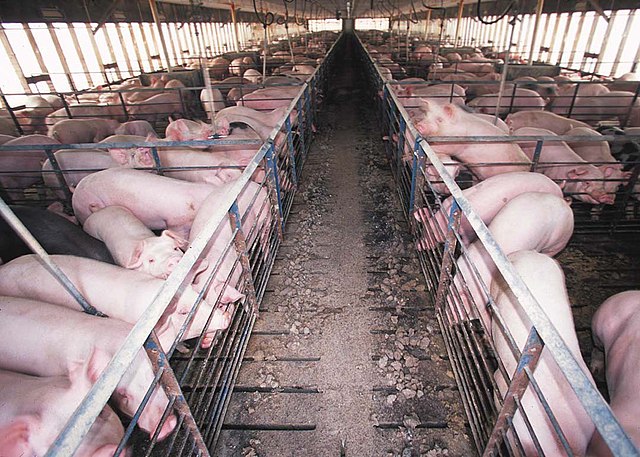

Hog barn interior. Public Domain.

Animal Rights

Evolution theory suggests we are an animal species that evolved from apelike creatures and that chimpanzees are our nearest living relatives. In other words, we are much like the other animals. Indeed, animals can experience joy and suffering like us. A central ethical rule is not to cause unnecessary pain and suffering. So, if ethical considerations apply to our fellow humans, they might as well apply to other animals. Nature does not have ethics, but ethics are part of our nature because we can place ourselves in someone else’s position and feel compassion. Compassion helped us as a species, as did aggression, but in a utopian society, ethics take precedence.

Suffering is something a conscious mind experiences, but consciousness comes in different levels. You can beat a stone, but it does not feel anything. A plant is less aware than an insect if it is aware at all. An insect has less awareness than a fish. And fish are less conscious than mammals. And we may relate more to animals that are more like us. That is why mammals elicit the most sympathy. And so, murdering a cow feels very different from killing an ant.

We care more about people we know than strangers, so we may also care more for our pets than people in faraway countries. The suffering that goes unnoticed does not affect us. Only when we see the misery, for instance, in factory farms and slaughterhouses, do we become aware of it. But once we know, we can react in different ways:

  • Not caring. You may have more urgent problems than animal welfare.
  • Accepting. You could argue that meat is a natural part of our diet.
  • Doing something. You might become a vegan.

Humans have been murdering animals since time immemorial. And our distant forebears drove several animal species to extinction. So, why stop now? Today, humans dominate the planet, and much of the remaining wildlife is under threat. Hence, it may not be a luxury to ask ourselves some questions like should there be animal rights like there are human rights? And if so, what rights should animals have? Animals themselves do not think they have rights. Respecting nature and animal suffering are reasons why we think about animal rights. But those considerations can conflict with each other. So whatever choices we make, they can raise controversy.

Even when we think animals have rights, animals transgress our moral rules, for instance, by murdering each other. After all, predators eat prey, and nature does not care. It is survival of the fittest. Should we stop them from doing that? Some species go extinct because of our actions, while others profit. Rats, cockroaches, and crows do well where humans have disrupted the balance in nature. Should we restore the balance in nature? And, if you own a cat and allow it to go outside, you contribute to a bird massacre. In the Netherlands alone, cats eliminate twenty million birds per year. Should you keep your cat inside or not keep a cat at all? And should we control pests? Probably so because pests threaten us.

And what about eating meat? Meat has been on the human menu since time immemorial. It provides us with some of the nutrients we need. There may soon be artificial meat and replacements with those same nutrients. And so, we might end the suffering of animals in the meat industry. Animals in the meat industry often live under miserable conditions, but in some areas like the European Union, there are regulations regarding the welfare of animals on farms. If animals cannot behave naturally, they experience stress and suffer, for instance, when confined to small spaces.

These European animal-welfare regulations conflict with practical economic considerations. For instance, what to do with a pig that resists stepping into the truck that brings it to the slaughterhouse and gentle prodding does not help? Transport companies and slaughterhouses must make money. Unruly beasts take time and can make the operation unprofitable. Whether animals in the wild always have a better life than those on farms remains to be seen. Wild animals must deal with predators, food shortages, and humans. Still, it is fair to say that ending factory farming promotes animal welfare. And we may need to limit meat consumption to reduce our impact on the planet.

In a caring utopian society, we should not make animals suffer unnecessarily. We can extend that to nature. For instance, if there is not enough food for the deer in a forest, is it not better to shoot the weak and eat their meat than to let them starve? Perhaps, you could introduce wolves, but that might cause even more misery. A deer suffers less from a clean shot from a rifle than a lengthy chase by a pack of wolves. And it gets worse when there are pastures with sheep nearby. Or do sheep lives not matter? Sheep, whether these are black or white, are mostly peaceful creatures who do nothing wrong.

If you prefer the wolves chasing deer, you believe the value of nature takes precedence over the rights of animals and that it justifies animal suffering. But nature itself does not suffer, nor does it care. And humans have profoundly disturbed the ecological balance, so unspoiled nature as it once was, is gone in most places. Letting wildlife coexist with humans can cause problems. For instance, bears are beautiful creatures, but it is better not to let them roam in cities as they are intelligent enough to adapt and may kill people. We can restore the original situation in areas where few people live, stop agricultural and industrial activities, and create large nature reserves. In other areas, we can better manage what remains of nature as a park.

Latest revision: 6 June 2023

Featured image: Hog barn interior. Public Domain.

Can we be happy?

What is the point?

The purpose of our brains is to keep us alive so our genes can copy themselves, not to make us happy. Anxiety keeps us from doing stupid things. And happiness can make us complacent, and that could be fatal. There is a struggle for survival. So what is the point of new ideas, technological development and social struggle? Why do we have agriculture, industry, cities, writing, money, empires, science, property, human rights and democracy? If these things don’t make us happier, what is the point of pursuing them? The historian Yuval Harari asks this question in his book Sapiens: A Brief History of Humankind.1 Things often don’t happen to make us happier.

Our forefathers switched from hunting and gathering to crop planting and animal herding because agriculture feeds more people. It was a success for human genes, as there were more copies of them, and also for the genes of domesticated animals and plants. But it made the lives of humans and animals more miserable. By growing crops or herding animals, people had more food. But more children survived, so they had more mouths to feed and remained as hungry as before. Meanwhile, returning to hunter-gathering had become impossible as it would mean starvation. Compared to hunter-gatherers, farmers worked harder, their diet was less varied, and they had more violent conflicts.1

The competition between businesses and states drives the change. States are the most effective war machines. And writing made it possible to have states. Investors expect to profit from technological advances, or governments see a use for them, for instance, to win a war. And so, scientists fetch budgets for their research and get busy. We have smartphones because investors profit from making them. Your smartphone does not exist to make you feel better but to make you addicted. Many people now think their lives are meaningless without their smartphones.

Social reforms like equal rights for women intend to increase fairness, thereby making people happier. But it doesn’t always work out as planned. If there is a norm, for example, the man being the head of the family, many women might be content with the arrangement. Men might have accepted that women had been in charge if that was the norm. A norm gives clarity, and change brings discomfort. Feminism liberated women, and overall, it probably made women happier, but not always, and the process of changing these norms raised tensions. So what makes us happy? That is not easy to answer. It depends on our characters and circumstances. Several issues influence our happiness:

  • our needs
  • chemical processes in the body
  • money
  • our expectations
  • our desires
  • having a sense of purpose
  • social trust
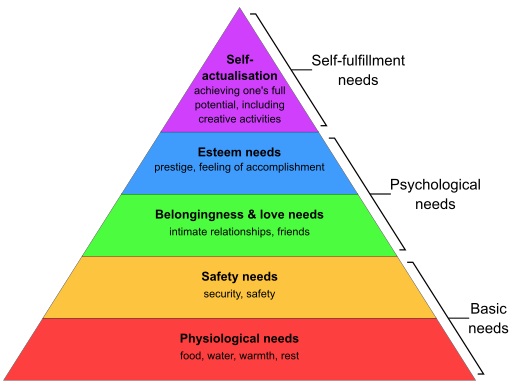
Maslov’s hierarchy of human needs

Hierarchy of human needs

Abraham Maslow thought of a hierarchy of human needs. He claimed that basic needs such as food and shelter are paramount. Once you have them, you desire security. Maslow believed that if you have food and security, you crave love and attention. And if you have all that, you want to be respected and have a sense of purpose in your life. These needs exist but not in such a neat hierarchical order.

Chemical processes in the body

Some people are always cheery despite adversity and misery. Others are always bitter and fret, even when they prosper and have nothing to worry about. That has to do with body chemistry. If cheerfulness comes from chemistry, we can be happier by taking pills. Pharmaceutics can end depression but might also give a false sense of happiness. And do pills make you better, or do you become addicted to them? The difference between prescription drugs and harmful substances like cocaine is not always clear. Nevertheless, more and more people use pills to feel better.

Money

If you are poor, some extra money will make you happier. Poor people worry about making ends meet. And that is why poor people often feel miserable. It becomes less clear once you can buy the things you need and have no financial worries. More money can make you happier, for instance, if you spend it on the right things. What is right is a personal matter. So if you can afford it, you should buy that garden gnome you always craved.

The more you have, the less extra makes you happier. Your first automobile can make you happy. You can go where you want when you want. A second car makes less of a difference. You and your husband can go to different places on the same evening, but that rarely happens. A third and a fourth car probably have no use unless you are a car collector and have a garage where you can spend your days gazing at your automobiles.

Expectations

Suppose I promised you ice cream. If you expected a small cone, but I gave you a medium-sized one, the outcome exceeded your expectations. It can make you happy. But if you anticipated a large cone and got the same medium-sized cone, the result failed to meet your expectations, and that can make you unhappy.

If you anticipated less than what you get, that could make you happy, but if you expected more, it could make you unhappy. We adapt to new situations. After a while, our happiness or sadness is gone. Having low expectations can be a path to happiness. If you expect the day to be miserable, and that does not materialise, it can make you happy.

Similarly, if you are better off than your peers, it can give you satisfaction. Alternatively, being worse off can be displeasing. Your happiness depends on the people to whom you compare yourself. The attention given to celebrities, their riches, and their beautiful husbands and wives can give you the unpleasant feeling that your life is subpar.

That can make you go to the gym or the plastic surgeon, buy things you cannot afford and turn down potential spouses who are not rich or do not look so great. The advertising industry uses this to make us buy more stuff. People in more equal societies are often happier. And we might be happier without the Internet and television.

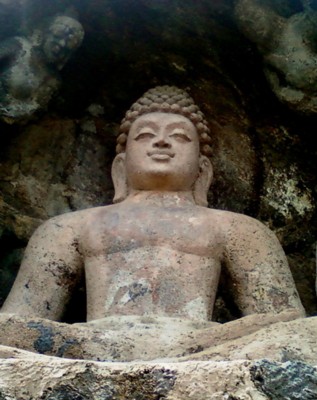
buddha
Rock cut seated Buddha statue, Andhra Pradesh, India

Craving

Gautama Buddha also weighed in on the issue. He lived 2,500 years ago and founded Buddhism. Mr Buddha taught that people crave temporary feelings and things, which causes permanent dissatisfaction. As soon as you have achieved a desired goal, such as love, or acquired a desired object, for example, a car, you will crave something else.

That ties us up in this world so our souls will reincarnate and keep suffering from craving, or so Mr Buddha said. When we stop doing that and disengage ourselves from this world, we disappear into nothingness, a state of eternal peace. So, according to Mr Buddha, happiness is about letting things go. And that became a religion.

Having a sense of purpose

Believing your life has a purpose can make you feel better. If you believe in God, you may think you play a role in God’s cosmic scheme, while atheists may believe their lives have no purpose. The psychologist Daniel Kahneman arrived at a similar conclusion. He interviewed women about their daily activities, which gave them pleasure. He also asked these women what made them happy.

Caring for their children was among the activities that gave them the least pleasure. But when he asked these women what made them the happiest, they answered that their children gave them the most joy. The children gave meaning to their lives. Maybe these women deluded themselves. Similarly, if you think your job is significant, that may give purpose to your life, but that can also be a delusion.1

Social trust

Societies can contribute to our happiness when there is social trust, which means you can trust other people and organisations. There is no social trust when your neighbours steal from you, or you fear that they do, criminal gangs roam the streets, corporations dump their toxic waste, the government spies on you, or you need to carry a knife or a gun to protect yourself. Wouldn’t life be better if you don’t need to worry about criminals, the government, or corporations, and you can go where you please without feeling unsafe?

When people do the right thing spontaneously, there is less need to check on them. And so, moral values matter. Without values, liberty is the road to hell, and Paradise is a dictatorship. Doing the right thing comes from a sense of connectedness. If I do wrong, it adds to the wrongs done, and this world becomes a worse place to live in, even though I may not notice it. That requires empathy and taking responsibility for our actions. That defines what good and evil are in Paradise.

Latest update 14 April 2024

Featured image: Smiley. Public Domain.

Other images: Maslov’s pyramid chart of the hierarchy of needs. Androidmarsexpress (2020). CC BY-SA 4.0. Wikimedia Commons. Rock cut seated Buddha statue, Andhra Pradesh, India CC BY-SA 3.0. Adityamadhav83. Wikimedia Commons.

1. Sapiens: A Brief History of Humankind. Yuval Noah Harari (2014). Harvil Secker.

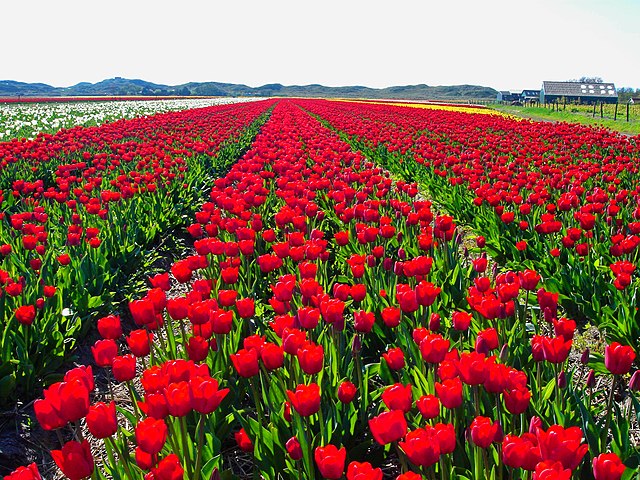
Texel Rommelpot Tulips View West.

Wisdom of Crowds and Mass Delusions

Emergent properties

How well groups make decisions depends on how their members share information and form opinions. In this regard, there are two opposing ideas: the wisdom of crowds versus mass delusions. As a collective, we know far more than any individual, but collectives can act more stupidly than most individuals would alone. You can more easily reason with individuals than with groups. Shared beliefs hold a group together and define its identity. Hence, groups are likelier to stick to their beliefs than individuals when confronted with evidence that they are wrong. Groups know more, but are also less rational than most of their members would be on their own. As the number of individuals in a group increases, their knowledge increases while their wisdom decreases.

Why is that? Groups aren’t merely the sum of their members. Groups have what experts call emergent properties. These are properties that emerge when individuals form a group. These properties seemingly appear out of nowhere. An individual water molecule can’t generate a wave, but billions of water molecules in a lake can. One cell doesn’t make a horse or a rabbit, but billions of cells do. A group of starlings can fly in intriguing patterns, which a single starling can’t. A single neuron can’t produce awareness. These properties emerge from the properties of the individuals. Individuals have properties that determine what they can do in groups, so a group of starlings can fly in intriguing patterns, while a group of humans can’t. And a group of water molecules can’t become a rabbit.

Collective intelligence

Collectives cooperate and achieve much more than individuals. And they can process more information, which the experts call collective intelligence. Their strength lies in their cooperation and in sharing knowledge. Bees and ants demonstrate collective intelligence. They share information about where to find food and use it collectively. Bees build beehives using a sophisticated division of labour, while ants can collectively defeat enemies many times their size.1

It is a natural behaviour of bees and ants. Ants also demonstrate what can go wrong with collective intelligence. They follow each other’s trails. If an ant accidentally walks in a circle, an entire colony might follow it. They could end up walking in circles until they die. In this case, otherwise beneficial behaviour goes wrong with fatal consequences. That is collective stupidity.1 We cooperate based on shared beliefs, which can be incorrect. Usually, our beliefs are beneficial. They strengthen the group’s cohesion, which is often more crucial to our survival than being right.

Groups know more and perform better on quiz questions than individuals because they can share knowledge. In 1906, an Englishman named Francis Galton discovered a phenomenon, later dubbed the ‘wisdom of crowds’. Galton visited a livestock fair where an ox was on display. In a contest, the villagers estimated the animal’s weight. Nearly 800 people participated. No one guessed the weight of 1,198 pounds, but the average of the estimates was 1,207 pounds, thus less than 1% off the mark.

Galton concluded that the finding suggests that democracy is the best form of government. Taking every view into account in Parliament could result in the best possible decisions. At the fair, the contestants independently assessed the ox’s weight. They didn’t arrive at their estimate in a group process, which may explain why it worked so well.2 And so, the term ‘wisdom of crowds’ is deceptive because it is merely the aggregate estimate of independently thinking individuals.

No wisdom of crowds

There is no wisdom of crowds, but the stupidity of groups does exist. A single Jew can make peace with a single Palestinian, but the Jews and the Palestinians as peoples have failed to do so. Groups have collective intelligence, so they process more information than an individual. Humans are social animals rather than rational beings. Crowds can make better estimates on aggregate, but only as independent individuals, so if their members don’t influence each other.

As long as we retain an independent perspective, we can’t develop groupthink and become collectively stupid. When we influence each other, we can go collectively crazy. We desire our peers’ approval, which clouds our judgment. We are social animals who need the group to survive, so we share our group’s beliefs and don’t openly disagree when we don’t. We may share ideas we know are incorrect, so we ignore our knowledge and pass on the group’s views.

We are prone to moral panics, which undermine our rational thinking. A moral panic is a widespread feeling that some evil person or group schemes against our interests and well-being. Often, genuine concerns are causing these feelings, but the claims exaggerate the harm’s seriousness, extent, and certainty. Usually, the panic comes with false claims inciting hatred and fear. The role of moral panics is to promote group cohesion and generate collective action to remove the perceived threat.

Herd behaviour

Information often spreads through herd behaviour. We usually behave the same way.1 YouTube makes use of it. If you come across a video with ten million views, you are more likely to watch it than one with only ten views. Usually, videos with ten views are not worth watching. In most cases, herd behaviour works to our advantage. It allows individuals to survive with less knowledge by depending on collective intelligence. We can’t know everything, so it is usually better to follow the herd. That saves time and energy. Social media is prone to herd behaviour. A cat video can become more popular because it’s already in favour, while a funnier one may go unnoticed.

The same is true for markets. During the Dot-com bubble, investors piled into Internet stocks. Many investors knew these stocks were crap, but they bought them anyway because they kept rising. Groupthink can cause stock market bubbles. In 1841, Charles Mackay wrote about three financial manias: Tulipomania in the Netherlands, John Law’s Mississippi Scheme, and the South Sea Bubble. He argued that greed and fear drive financial markets and can make people act irrationally to the point that people believe a tulip is worth a mansion.3

Confidence game

Information spreads via opinion makers like influencers and can lead to mass delusions. Confident but mistaken people play a crucial role. Self-assured people aren’t always wrong, but when they are, they amplify their errors because they have followers. Most people are insecure and follow the lead of people who appear self-assured. Leaders must be self-assured. Otherwise, no one will follow them. The business of influencers on the Internet is making money out of insecure people by advertising products no one needs.

Confidence is contagious. During the Dot-com bubble, the loudest voices on Internet message boards boasted about their profits in Internet stocks, thereby pulling in more suckers. The quality of group decisions depends on how we aggregate information. To take advantage of collective intelligence, we should try to:

  • make people feel free to come forward with their information and opinions;
  • prevent groupthink or group members from becoming biased by the information or opinions of others;
  • and focus on the underlying causes rather than incidents.

That is difficult in small groups and even harder in societies. It goes against human nature. We follow confident people. And we don’t always like to hear the truth. The most successful politician in Dutch history was Mark Rutte, who became the longest-serving Prime Minister. He is jovial and cheerful. He was also the most prolific liar, and no Dutch politician had ever lied so often and with such confidence. Rutte once admitted that he had no vision, which probably is not a lie. It allowed him to remain pragmatic and make deals.

Rutte’s talents are now coming in handy as he has become the Secretary General of NATO. So far, he has succeeded in keeping the United States on board by praising Donald Trump for being a master strategist. Humans cooperate based on fairy tales, so lying is in our nature. We even learn to believe the lies, so that they become the truth to us. But if our leaders are friendly, visionless, pragmatic deal-makers, who lie to stay in power, we are surely doomed, given the magnitude of the problems humanity faces.

Collective action

Large groups struggle with collective action problems. The larger the group, the less effective it becomes at addressing challenges. Today, humanity faces global collective action problems, most notably the looming technological-ecological apocalypse and the increasing likelihood of another world war. It has become impossible to hide our incompetence in addressing them. The inconvenient truth is:

  • It is unlikely that we can save ourselves, as the wit of a single worm already exceeds the collective wisdom of humankind. You would make better decisions if you were the leader of the world, even if your judgment is subpar.
  • We must agree on what to do. In cases of fundamental disagreements, we fight. We cooperate based on fairy tales. Force rather than reason is our most convincing argument. The ideas that won out often did so by force.
  • Non-contributors benefit from the group effort while enjoying the advantages of not contributing. If they get away with it, the free-loading will spread. It will undermine the group’s morale, and the collective effort will collapse.
  • Most notably, people in the West suffer from the mass delusion that individual freedom and the interplay of personal interests and preferences through markets and elections ensure the best outcome for the general good.

By withdrawing from the Paris Agreement on combating climate change, the United States has demonstrated once again that it is the land of the freeloaders. Along with our pursuit of material wealth, nation-states and individual freedom are means by which we are about to commit suicide. We can’t deal with the responsibilities that come with freedom.

The saying ‘everyone for himself and God for us all’ reveals a profound truth about ourselves. Humans aren’t capable of solving their problems because of collective action problems and mass delusions. And we are better off with a single leader with unlimited authority. Ideally, this person is like a biblical good shepherd or Plato’s philosopher king. Even someone with a mediocre vision would do, as the wit of a single worm already vastly exceeds the collective wisdom of humankind.

If you like this story, you might want to see this video:

Collective Stupidity – How Can We Avoid It? Sabine Hossenfelder.

Featured image: Texel Rommelpot Tulips View West. Txllxt (2009). Wikimedia Commons. CC BY-SA 4.0.

Latest revision: 30 October 2025

1. Collective Stupidity – How Can We Avoid It? Sabine Hossenfelder. YouTube.
2. The Wisdom of Crowds. James Surowiecki (2004). Doubleday, Anchor.
3. Extraordinary Popular Delusions and the Madness of Crowds. Charles Mackay (1841). Richard Bentley, London.