The West and the rest
If you wish to understand why the world is the way it is, you should learn about civilisations and cultures, especially Western civilisation and culture. Someone who lived 2,000 years ago could go forward 500 years or more in time and live a life more or less the same as before. If you lived 500 years ago, you couldn’t. You would enter a completely different world in which living conditions have completely changed due to a phenomenon called modernisation. Modernisation involves the division of labour, industrialisation, urbanisation, social mobilisation, and increased education and wealth. Social mobilisation occurs when groups in society organise themselves politically to advance their interests. Expanding scientific and engineering knowledge allows us to shape our environment like never before. Modernisation was one of the most dramatic changes in the history of humankind. It all began in Europe, and most of it occurred in Europe, until recently.
Western imperialism helped to unify the world while terminating the cultures of countless indigenous peoples. The Chinese speak of one hundred years of national humiliation when referring to the era between 1840 and 1950, when Western powers broke the Chinese Empire and plunged it into civil war. Among Muslims, similar sentiments exist because of Western military interventions in Islamic countries, like bombing Iraq for non-existent weapons of mass destruction or American bases filled with ‘crusaders’ occupying the Islamic holy land. It may not be much of a solace to them, but Westerners have murdered more of their kind than of any other in their wars. Yet, warfare is humanity’s primary path to progress, as humans are barely intelligent and must find out the hard way, allowing Europe to progress the furthest as it has seen the most slaughter.
One might ask what the world would have been like if the Chinese or the Muslims had been the first to modernise. As Karl Marx already surmised, capitalism, hence a bourgeois society, so the pursuit of profit, was key to modernisation, so it wouldn’t have made much of a difference. We live in a bourgeois world rather than a religious one. Moral values don’t drive it, but trade and finance or the ethics of the merchant, which means no ethics at all. If it was deemed profitable to colonise a continent or to let their inhabitants die, it happened. It may all seem like a complex historical process, but if you look under the hood, the engine was competition, and a historical accident made it start in Europe.
The bourgeois values of trade and finance have now spread over the globe. No corner of the Earth has remained unaffected. Some societies adapted more successfully than others. Money has proven to be a highly effective motivator for innovation and efficiency, enhancing success in competition, so that the outcome became a rat race dubbed creative destruction. The West inherited from the Greek and Roman cultures that preceded it, and other cultures have inherited from the West. Today, Europe, where modernisation once started, is starting to look like a backwater.
Modernisation would likely not have materialised in any other way. And so, blaming the West for the course of history doesn’t help us. Furthermore, it amounts to criticising the script’s author. It is not in the way of the wise to do so. It is also pointless to deny that Europe has shaped the world as it is today. As technological progress is about to make us humans obsolete, social progress may be the way out. Europe has progressed the furthest socially because it has made the most mistakes to learn from.
The West is, and never was, morally superior. If you take a cynical stance, you can say, as Samuel Huntington did, that the West won the world not by the superiority of its ideas, values, or religion, but rather by its superiority in applying organised violence. The problem with this reasoning is that force is humanity’s most convincing argument, and that there is more to the West’s prevalence than organising violence. The West came out on top in a competition. Individualism and capitalism, with their lure of riches, made people work harder, be more inquisitive, and take more risks. It was a success. The bourgeois culture hooks upon our inner drivers. And again, if you take a cynical stance, and it is a good idea to do so, for that is how many non-Westerners see Western culture, it has three pillars:
- personal freedom, thus doing as you please,
- capitalism, thus taking what you can,
- imperialism, thus imposing your will upon others.
Capitalism is often not mere plunder. It is the bourgeoisie’s principal argument. Both parties gain from a trade, or believe they do. Still, the rich get richer without working, simply by owning capital and making us work for them. And both parties in a trade might benefit at the expense of others, future generations, or other life on the planet. The myth of capitalism claims that markets will solve our problems. As a result, we have become consumption addicts, with marketers busy creating new problems that markets can solve with new products and services. Still, had the world not modernised in this way, we would still live in shacks and have barely enough food. Thanks to this morally depraved system, we now have the means to live in Paradise. The bourgeois culture didn’t magically pop out of thin air. It is part of Western cultural heritage, which thus merits further investigation.
Future world culture
To have a world civilisation, we need to share a set of values and beliefs, to arrive at a universal culture. It means that existing traditions gradually turn into folklore. That is already happening on a global scale, and cultures mingle, even seemingly incompatible ones like Western liberalism and Islam. Yet, what will our future culture look like? Several issues are worth noting. First, the West drove modernisation, so we may need to figure out what is typically Western about modernisation and what is universal. The scientific method, despite being invented in the West, is universal. Second, modernisation may end in the termination of humanity, so we must halt or reverse it. Third, cultural differences are a source of trouble. Cultures harm one another through their relative advantages. Western culture and Islamic culture cause each other harm, albeit in different ways. Muslims may culturally conquer parts of the West with immigration and births, while the West attacks and bombs Muslim countries.
In the West, Hegel’s dialectic drove social advances. The advancements range from environmentalism to minority rights. Today, countries in East Asia may be more technologically advanced, but the struggle over social ideas in the context of modernity has mainly taken place in Europe. As a result, Europe has the most agreeable societies. And we don’t need more advanced technologies if we are incapable of handling them. We have to advance socially. In that respect, the West is not the best. The Chinese, Japanese, and other East Asian nations are more organised and disciplined, and the West can learn from them, as well as from traditional cultures in Africa, where people are satisfied with having enough. Yet we live in a European world. Even the Chinese government bases its philosophy on European Marxism rather than Chinese Confucianism.
The way out is to define what the future culture should be, which stipulates the norms and values we share, and the diversity we allow. We must do so because our actions have consequences for other people around the globe, so we can only address these issues on a global level. That requires us to live in a single world society based on a global social contract. That requires us to give up our tribal identities and the values and conduct that cause harm. Giving up your identity and culture is like dying spiritually and being born again. It is also surrendering yourself to an uncertain future, like jumping off a cliff. You might only do so when there seems to be no other way out. You can only hope it proves to be the right choice in the end, but you may not see the proof for years to come. It is a harrowing experience. It happened to me as a student.
Western culture
To understand why the modern world is the way it is, we must understand modernisation. It requires us to dig into history to see why the West was the first civilisation to modernise. Samuel Huntington identifies the characteristics of Western civilisation that help explain why the West began the process of modernisation.1 To explain how we got where we are now, the treatise focuses on these features of Western civilisation, and how they emerged, interacted and developed. It is a speculative enterprise, so the explanation is plausible based on the available knowledge but remains a narrative with a perspective and omissions, as it only aims to lay out the bigger picture. According to Huntington, the defining characteristics of Western civilisation are:
- The Classical legacy. The West inherited from the Greek and Roman civilisations. This legacy includes rational Greek philosophy and Roman law. Also, the Islamic and Orthodox cultures inherited from these civilisations, but not as much.
- Western Christendom. Western Christian peoples believe they differ from Muslims, Orthodox Christians and others. The split between Catholicism and Protestantism is relatively recent, and beneath the surface lies a common base.
- Separation of the spiritual and the temporal. Christianity teaches that Jesus’ kingdom is not of this world and that Christians must respect worldly authorities. And so Church and state could be separated.
- The rule of law. It was often a distant ideal, but the idea persisted that a ruler’s power should be constrained. The rule of law is the basis of constitutionalism and the protection of individual human rights.
- Individualism. Individualism and privately owned property already existed in Europe during the Middle Ages. Eventually, individualism led to the promotion of equal human rights for everyone.
- Social pluralism. Europe had diverse autonomous groups not based on kinship, like monasteries, guilds, and other associations. Most Western societies had a powerful aristocracy, a substantial peasantry, and an influential class of merchants.
- Representative bodies. Estates and Parliaments represented the interests of the aristocracy, clergy, merchants and other groups. Local self-government forced nobles to share their power with burghers and, ultimately, to yield it.
The above list is not complete, nor were all those characteristics present in every Western society. Some were also present in non-Western societies. What is even more crucial than these individual features is that they created precarious balances that could be contested, so that the uncertainty drove groups to gain an advantage, and that the setup overall promoted competition, hence innovation. That eventually proved decisive.
Huntington argued that the combination of features makes Western civilisation unique. He further claimed that Western culture is not universal and added that such a belief is a form of arrogance promoted by centuries of Western dominance.1 That is good to remember in a time when the West is in decline. Whether Western culture is universal and to what extent remains a matter of debate. A belief in Western cultural superiority can put the West on a collision course with other civilisations, such as China and Islam, Huntington warned. Yet competition is a dead end, and we are about to find out. We have to halt the race, and once again, Europe is ahead, as it has already dropped out. If the rest of the world doesn’t follow suit, there is no future for humanity.
Universal appeal
Some elements of Western culture have universal appeal. Liberal democracy developed in the West and might be part of the Western cultural inheritance, but it also appeals to people from other civilisations. The experiences from Taiwan and Hong Kong indicate the Chinese may prefer liberal democracy to the enlightened dictatorship of the mainland if they were free to choose. On the other hand, recent developments in the United States and Europe suggest that democracies can lose their legitimacy or fail to address crucial societal issues. The recent rise of fascism relates to feelings of abandonment of the working class by the elites due to globalisation and mass migration. Above all, freedom comes with responsibility, and humans have failed the test. A post-human civilisation replaced them. We live in a simulation. If real humans still exist, they may live in reservations under surveillance to prevent them from messing things up again.
Western culture started as a historical accident and later increasingly became the outcome of a competition. The accident is how these characteristics first emerged. Competition promoted further development. The pursuit of wealth, thus capitalism, took off in Italian merchant towns. Economic power promoted military power. Previous conquerors plundered or extracted tributes from their conquests. After a time, the income from plunder collapsed, and tributes remained stable at best. Europeans, however, turned their conquests into profitable enterprises and increased their profits over time, so the income from their conquests sustained further expansion.
As much of Western culture is the outcome of a competition, it isn’t always clear what is typically Western about it. Bourgeois might often be a better term. Had modernisation started in China, much would have been similar, but not everything. There could have been stock markets and perhaps an equivalent of the Olympics, though that is already doubtful, since the idea came from Greece. Yet Christianity would not have spread. If there will be a world civilisation anytime soon, the world as it is today is the starting point. We don’t know the future, but past events brought us to the present. History shapes the future. We can learn why things are the way they are by investigating the past. It might help us to see where we are heading or which direction we should take. To explain why the West led the modernisation process, we can investigate the characteristics of Western culture, how they interacted, and how they affected the world.
Greek philosophy
Most traditional cultures centre around an idea of wisdom reflected in their beliefs. It does not mean that traditional people were wise, for they held irrational superstitions, but they valued wisdom and experience over theoretical knowledge. Their view was that if you studied the teachings of the ancestors or the great prophets and sages, whether it was Buddha, Confucius, or Christ, or listened to the words of an oracle or a shaman, you knew what you needed to know.2 And if you know what you need to know, you don’t need to know more. Ignorance is bliss. Knowledge doesn’t make you happier. The story of the Fall in the Bible warns us against the pursuit of knowledge.
Greek philosophy was different. The Greeks engaged in a rational and fundamental inquiry into the nature of reality and the truth of their beliefs. It was a quest for knowledge rather than wisdom. It became incorporated into Western culture and the basis of science. Traditional peoples didn’t pursue knowledge for its own sake. They didn’t study gravity to come up with a theory of gravity to calculate a spear’s trajectory. Everyone knew that things fell to the ground, so what is the point of a theory pointing that out? Parents taught their children how to throw a spear. Calculating trajectories doesn’t turn you into a better spear thrower. Europeans had cannons and could make good use of the theory.
Western Christendom
From Christianity, the West inherited a claim to universalism. Christianity, like Islam, claims to represent the only universal truth everyone should accept. Only morons would not accept that truth. That sets Christianity and Islam apart from other religions, including Judaism, from which they originated. Christianity, like Islam, also maintains that all people are equal. Everyone can either embrace or reject the one true religion, so there are only believers, the smart ones, and non-believers, the morons. Non-believers are inferior to believers, but that is due to their own stupidity. Converts accepted Christianity out of free will, and this religion, like Islam, is a brotherhood that unites the believers. The West thus inherited the principles of freedom, equality and brotherhood from Christianity.
During its first centuries, Christianity spread in the Roman Empire through individual conversions, with converts accepting it of their own free will and through persuasion rather than force. In fact, Christians occasionally faced prosecutions by the Romans for not venerating the godlike Roman emperors, which was an act of sedition. This is worth noting. The Jews formed a tribe and inherited their religion from their parents, so that was a done deal. The Muslims were conquerors. They imposed their religion upon infidels, or in the case of Christians, levied higher taxes upon them, so that conversions to Islam were often an economic calculation rather than a genuine conviction.
Jesus never re-established a Jewish state, either because he didn’t try or because he failed, while his followers long remained a minority in the Roman Empire. Muhammad and his successors conquered a large territory, so Christendom could only spread bottom-up by convincing individuals of its message. Miracles and tales about them were of great help. Augustine of Hippo articulated the Christian conceptions of God, the soul, and free will, which became a template for Christian thought. We are born sinners and can convert. Augustine’s life was a spiritual journey. The grace of God made him change his life. This message of personal salvation contributed to individualism in Western Europe and, later, to the rise of Protestantism, which made morality an individual choice.
Christianity’s claim of universalism had a profound impact on other myths that originated in the West, the so-called ideologies like socialism, liberalism, free-market capitalism and fascism. Prescriptions to organise societies promoted by the West, such as human rights, democracy, and free trade, also came with passionate claims to universal truth, such as that they are better or beneficial to humankind. That is how Christianity still profoundly affects Western culture. This kind of missionary zeal is not prevalent in other civilisations, except Islam. China and India don’t demand other nations to copy their economic and social models. They don’t feel compelled to dictate how others should live.
Christianity features a division between the profane and the spiritual, as Jesus said that his kingdom is not of this world (John 18:36). A Christian need not challenge worldly authorities. As Jesus said, ‘You should give back to Caesar what is Caesar’s, and to God what is God’s’ (Mark 12:17), so a Christian should pay Roman taxes. It allowed Christianity to spread within the Roman Empire. So, even though Christians didn’t wish to venerate the godlike Roman emperors, they weren’t much trouble overall. Hence, prosecutions were sparse, as there were more urgent threats, such as barbarian invasions and real rebellions, to deal with. The Romans only killed a few thousand Christians in the course of three centuries. The Jews rebelled, and Roman armies wiped them out, which ended their presence in Canaan as a majority until the foundation of the state of Israel.
Not challenging worldly authorities allowed the Church to establish a vast network of priests, monasteries, and convents, as well as a hierarchy to manage them. As a result of the Investiture Conflict, the Catholic Church gained control over the appointment of bishops and became an independent institution with political influence all over Europe. That contrasts with other civilisations. In Orthodox Christianity, the emperor oversaw the Church. In Islam and Hinduism, priests and religious scholars influenced political affairs, but there was no centralised, independent religious institution like the Catholic Church. In China, established religion never played a prominent role in politics.3
Rule of law and representative bodies
Law consists of the rules of justice in a community. In pre-modern societies, people believed the law came from a higher authority, such as custom, the gods, or nature. It made law independent from rulers, at least in theory and to some extent in practice. Religious law comes from priests explaining holy texts. That is more or less the same in Judaism, Islam and Hinduism. In China, the state provided the rules of justice.3 Only, there never was a Christian religious law like there is Islamic law or Hindu law. In the first three centuries, Christians were a minority in the Roman Empire, and lived under Roman Law. And when the Roman Empire became Christian, Roman Law remained in effect.
In the Middle Ages, the Catholic Church promoted the use of Roman Law in Europe and supported the institution of independent universities to teach law and sciences. Roman Law is the basis of European legal systems and, as a result of colonisation, many nations outside Europe. Roman Law is a civil law that regulates affairs among citizens in a society and is not religious, even though the Roman Empire had many different religions. The involvement of the Catholic Church reflects the Christian separation between spiritual and worldly affairs. In England, another tradition of civil law called Common Law developed.
The rule of law requires that the law be a countervailing power against rulers. Citizens have rights, and rulers should not violate these rights. Feudal Europe lacked centralised states, so the Catholic Church could use its political power to introduce Roman Law. In England, a power struggle between the king and nobility led the king to promote Common Law in the Royal Court to undermine his opponents who administered the local courts.3 The king prevailed but remained checked by the rule of law and a strong aristocracy who forced him to sign a document, the Magna Carta, guaranteeing the rights of the nobility. The Magna Carta is a precursor to modern constitutions.
Human nature sucks, so people often abuse their powers if no one stops them. And so, the rule of law could be a distant ideal rather than a reality. The actual outcome depended on the balance of power between the political actors in a society. In the Middle Ages, these were the king, the aristocracy, and the clergy, and later also independent towns with their craftsmen and merchants. At first, the aristocrats and clergy held the most power. They had representation in the Parliaments, called Estates, that decided on taxes. Gradually, that power shifted to the bourgeoisie in towns. Later, centralised states emerged, with kings seeking absolute power and aspiring to decide on taxes themselves.
A power struggle between the kings and the aristocracy ensued. In Poland and Hungary, the aristocrats prevailed. These states soon collapsed as the aristocrats didn’t wish to pay taxes for the country’s defence. In France and Spain, the king more or less prevailed by bribing the aristocracy with tax exemptions and putting the burden of taxes on peasants and the bourgeoisie, who had no representation in the Estates. This move undermined the state’s tax base. In England, a civil war broke out, ending with the aristocracy and the bourgeoisie, represented in Parliament, deciding over the taxes they paid.3
It legitimised taxation by requiring the consent of those who paid taxes. The aristocracy and bourgeoisie in England had a stake in the state’s success. They profited from the colonies, for instance, via the slave and opium trade, so they were willing to pay taxes if they believed that it was necessary. In this way, England could win out in the colonial wars with France in the century that followed despite having fewer resources. England’s finances were in good shape, so England could borrow more money at lower interest rates to finance these wars than France could. Without a balance between the actors in society, abuse and corruption go unchecked, so the cleanest governments have these checks and balances in place. It also requires a culture that values clean government, which requires people to pay taxes.
Individualism and social pluralism
In traditional societies, male family lines formed the foundation of family organisations called clans. Clans rather than individuals owned property. Family elders decided on marriages and property affairs. In Western Europe, individuals could make these decisions themselves. Western Europeans had substantial individual freedoms in the Middle Ages, including property rights. That development started soon after Germanic tribes had overrun the Roman Empire and converted to Christianity.3 One of the origins of Western European individualism is Christianity’s message of personal salvation.
On top of that, the Catholic Church opposed practices that held clan structures together, such as marriages between close kin, marriages to widows of dead relatives, the adoption of children and divorce. It allowed the Church to inherit property owned by Christians who died without an heir. That is why women could own property too. These individual property rights undermined traditional family structures.3 Later, individual property rights became crucial to the development of modern capitalism, and they remain a central value in Western culture. Yet, they are modern rather than traditional.
This novel arrangement allowed the Catholic Church to finance its large organisation, provide relief to the poor, and become a significant political power. As a result, Western Europeans in the Middle Ages did not trace their descent only through their father’s line, as would be necessary to maintain strict boundaries between families. It became harder to carry out blood feuds as the circle of vengeance was smaller, and many people felt related to both sides.3
It promoted law at the expense of tradition. People didn’t seek revenge but instead went to a court to settle their disputes. It also enabled feudalism to replace kinship as the basis for social solidarity, making social organisation a matter of choice rather than custom. In theory, feudalism was a voluntary submission of one individual to another based on the exchange of protection for service. In practice, this was often not the case, but as the rule of law spread, feudal relationships became legal contracts in which both the lord and the serf had rights and obligations.3
In the Middle Ages, there were no strong states in Western Europe. The aristocracy held most of the power and was responsible for the defence of their realms. In the late Middle Ages, as the economy began to flourish, an influential class of merchants emerged in the cities. Many cities gained independence and became responsible for their governance and defence. Serfs flocked to cities in search of opportunities and freedom, thereby further eroding the feudal lords’ power base. In Northern Italy, feudalism had already ended by 1200 AD and city-states run by wealthy merchants dominated the area. It was the area where the Renaissance would take off.
Kinship as an organising method had largely vanished, making European organisation more flexible and easier to adapt to circumstances, thereby enabling competition via trade and increasing competitive pressures. Europeans organised themselves for a wide array of purposes. In the Middle Ages, there were monasteries, convents, and guilds. There were also military orders, such as the Knights Templars. Later on, societies and corporations emerged. European pluralism was brewing potential, in contrast to the absence of civil society, the weakness of the aristocracy, and the strength of centralised bureaucracies in Russia, China, and the Ottoman Empire.1
Renaissance
The elites in Northern Italy’s merchant towns gradually became less religious. Wealthy merchants spent money on frivolous pursuits such as art, literature, and knowledge. This development is called secularisation. Optimism replaced pessimism. The medieval mindset was reflected in the phrase, ‘memento mori.’ Remember that you are mortal. The new mindset was reflected in the phrase, ‘carpe diem.’ So, enjoy life. Medieval virtues like poverty, contemplation and chastity gave way to new virtues like participating in social life and having fun. Italian cities needed the active participation of wealthy individuals to finance public efforts like defence. The pursuit of wealth became a virtue, which signalled the emergence of modern capitalism.
People in traditional societies, including Medieval Europeans, frowned upon trade and the pursuit of wealth as idle pursuits, evil ven. They believed that the wealthy should share their riches with their community. Such an attitude prevents the buildup of capital, so if wealthy Europeans had still lived by that rule in 1700, the Industrial Revolution wouldn’t have taken off. Building on the existing European tradition of individualism, entrepreneurial individuals came to be cherished. The Italian Renaissance tradition includes individuals such as Michelangelo, known for his unparalleled artistic versatility; Giovanni Giustiniani, a mercenary who organised the defence of Constantinople against the Turks; and Christopher Columbus, who discovered America.
It was a development enabled by Christianity. The separation between the worldly and spiritual realms opened the way to secularisation. The Renaissance started in the cradle of the Roman Empire. Italian merchants sailed the Mediterranean. The legacy of the ancient Greeks and Romans was everywhere around them. It prompted a renewed interest in classical antiquity, including ancient Greek and Latin texts. The works of the Greek philosophers and their rational enquiries into the nature of reality were rediscovered and began to affect European thought. These texts were secular and promoted virtues different from Christian ones.
The organisational dynamism driven by increased flexibility and competition enabled Europe to absorb inventions from elsewhere and further improve them. Printing and gunpowder were Chinese inventions that came to Europe. Around 1450, movable type printing made it possible to print books in large numbers. From then on, new ideas could spread faster. Protestantism was the first heresy to survive the wrath of the Church, after several others had been successfully repressed. The printing press likely played a crucial role in spreading the new ideas. Constantinople, one of the last Christian strongholds in the Eastern Mediterranean, fell into the hands of the Ottoman Turks, blocking traditional trade routes with the Indies. The Portuguese then began seeking new trade routes by sailing around Africa, thereby initiating the era of European exploration of the world.
Double shock
Around 1500, two developments rocked Europe and upset things. The first was the discovery of a previously unknown continent, America. The Bible and other classical writings didn’t mention it. It was the moment when Europeans discovered their ignorance.2 That discovery didn’t shock the average peasant who was aware of his ignorance, but it did affect intellectuals who believed they knew everything and merchants, who smelled opportunity. It spurred a questioning of existing ideas and a drive for knowledge that would lead to modern science. Europe already featured independent universities with academic freedom. And Greek philosophers had laid the groundwork for using observations to produce theories.
The second shock was Protestantism, which challenged the Catholic Church’s authority. The Catholic Church had become corrupted by buying and selling church offices. Martin Luther condemned these practices and taught that salvation is a gift of God, to be received through faith in Jesus Christ. He made faith a matter of personal choice, which agreed with how Christianity initially spread through the Roman Empire. Protestantism also became a quest for original Christianity, so the original teachings without saints and Virgin Mary worship. Luther taught that the Bible is the only source of divine knowledge. He also translated the Bible into German, making it accessible to laypeople.
The Portuguese had found new trade routes to the Indies, and Columbus had discovered a continent that promised unparalleled riches. Small bands of Spaniards with firearms overran existing empires and plundered them. After plunder came exploitation. Colonisation became a profitable enterprise that sustained itself. It generated the revenues to expand the colonies further. Enterprise and investment capital rather than state armies and taxes drove European colonisation. That also explains the European success in sustaining the colonisation. Nobody likes to pay taxes, but everyone loves a profit. The resulting larger markets favoured economies of scale. After the invention of the steam engine, these economies of scale propelled the Industrial Revolution.
A revolutionary mix
In 800 AD, Western Europe was behind the more powerful Islamic, Orthodox Byzantine, and Chinese civilisations. In 1800 AD, China was still a match for England and France, and the Ottoman Empire was a significant power. But the Industrial Revolution was taking off, tilting the balance of power decisively towards the West in the following decades. Europeans had acquired a mindset that made them more curious, enterprising, and flexible. When the gap between industrial and non-industrial nations became clear, Italy, Austria, and Russia jumped on the bandwagon. China, Persia, and the Ottoman Empire did not. It may now be possible to identify the elements of Western culture that were crucial to modernisation and the Western mindset:
- a religion with a message of personal moral choice, equality, missionary zeal and an uncompromising claim on truth;
- individualism promoting flexible organisation for different purposes, combined with entrepreneurial spirit and a drive for profit;
- separation between spiritual and worldly affairs allowing for secular law and secular pursuits like science;
- a quest for knowledge and truth reflected in the scientific method as well as the great ideologies;
- an absence of strong centralised political power, but an uncertain balance between countries and political actors within countries that promoted competition;
- the rule of law, which limits the powers of political actors and guarantees individual freedoms and property rights, making individuals and investments more secure.
The introduction of railroads exemplifies the cultural difference between Europeans and others. The first commercial railroad opened in 1830 in England. By 1850, there were 40,000 kilometres of railroads in Europe. Asia, Africa, and Latin America together had only 4,000 kilometres.2 The first railroad in China was opened only in 1876. It was 24 kilometres long and built by Europeans. The Chinese government destroyed it a year later. In Persia, a Belgian company built the first railroad in 1888. In 1950, the railway network of Persia amounted to only 2,500 kilometres in a country seven times the size of Britain, which had 48,000 kilometres of railroads. The technology of railroads was relatively simple, but the Chinese and the Persians did not catch on. They could not do so because they thought and organised very differently.2
Until 1800, Europe didn’t enjoy an obvious advantage over China, Persia or the Ottoman Empire, but Europe had gradually built a unique potential. It had developed a culture of individualism, curiosity, and enterprise. When the technological inventions of the Industrial Revolution appeared, Europeans were in the best position to use them.2 Europeans were more innovative, motivated by profit, and could organise themselves flexibly for new purposes, such as building and maintaining railroads. It demonstrates the ubiquity of culture and also that cultures can change, as Europe is lagging behind China on these same issues today.
On the back of these advantages, European ideas have spread over the world. Ideologies invented in Europe, like market liberalism and communism, inherited the missionary zeal and uncompromising claim to truth from Christianity. Similar thoughts were formulated elsewhere, for instance, by Chinese philosophers, but not as a coherent ideology. A few Chinese philosophers proposed that theories require empirical support, but they did not develop a scientific method. They lacked the heritage from the Greek philosophers. Science was at the basis of European inventions, and flexible organisation allowed Europeans to implement them. As humans have reached the limits of their flexibility, we are either reaching the end of the innovation push or humanity.
What the future demands of us
As the first civilisation to modernise, the West has led in the culture of modernisation for several centuries. During that time, the West could impose its will on other civilisations and often did so. Western ideas and values have spread over the globe. Societies with different cultures catch up and adopt similar patterns in education, work, wealth, and class structure.1 Some ideas are superior to others in terms of outcomes. Western philosophers and scientists developed the scientific method. To see the scientific method as Western cultural imperialism and look for a better alternative is pointless. The Western tradition long held that social progress follows scientific progress. If you think you have progressed, you believe your ideas are superior to those of those who hold on to traditional ways.
The spread of Enlightenment ideas increased religious tolerance. After a century of intense warfare between Catholics and Protestants, producing one of the greatest massacres of all time, the Thirty Years’ War, with fatalities nearly as many as World War I, which was the first case of large-scale industrial warfare, Europeans became tired of murdering each other over issues of which they lacked sufficient knowledge, also because neither side could win, which probably mattered more. Piles of dead bodies with no victory in sight make the kind of environment that breeds enlightenment. Humans are barely intelligent and learn things the hard way, and then the next generations forget. The great Chinese wisdom expressed in Confucius’ teachings and the Tao Te Ching dates from a similar period of mass slaughter known as the Warring States Era, which saw no equal in history until modern times. The hard-won lessons still live on in European culture and institutions, such as the separation of Church and state.
Hegel saw history as a battleground for ideas where more powerful, better ideas replace weaker ones in a survival-of-the-fittest-like competition. Hegel believed that the French Revolution and the Napoleonic Wars illustrated the point. European Enlightenment ideas drove the French Revolution, which Napoleon’s armies then spread across Europe, prompting a series of reforms based on those ideas. The Marxists later claimed socialism was superior to capitalism, so they also tried to overturn the existing order. If you take the Hegelian view of progress, you could argue that nearly all ideological struggles have taken place in the West, so the prevailing ideas there are superior. That is also what the neocons believed and why they promoted a war in Iraq to spread democracy.
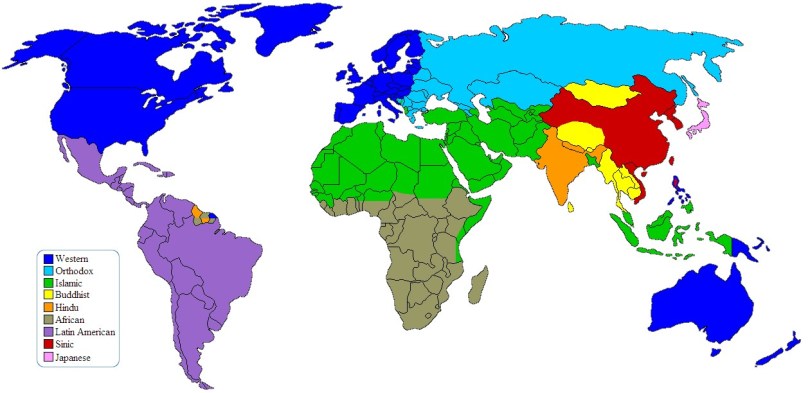
A problem with this reasoning is that these ideas won a competition, and a competition itself is a purposeless, efficiency-driven process, so it is neither good nor bad. Things do not necessarily improve by competition, and often do not. And modernisation is not the same as Westernisation. Japan was the first non-Western country to modernise. Today it is one of the most advanced countries in the world. At the same time, Japan has retained its unique culture and identity. So far, non-Western cultures have been modernising without disappearing. They adapted, and in many ways, Chinese, Islamic, Buddhist or Hindu cultures reassert themselves. That is partly because their identity is precious to people. As the wealth and influence of non-Western societies increase, they are becoming more confident in the merits of their cultural heritage.1 Yet, these are merely feelings, as are ideas about Western cultural superiority.
The West may not be in the best position for the future, as the future likely places different demands on societies than the past did. That China is surpassing the West on many fronts only illustrates the point. There is competition between societies. If China becomes a leading civilisation, others, including the West, may be forced to adapt and take over characteristics of Chinese society. People from different cultures interact. In this way, a global culture may emerge over time. Yet time is running short, as artificial intelligence will soon dwarf human intelligence, and human nature is not particularly accommodating. Humans settle their arguments with force. If history teaches us one lesson, then it is that. And that is why the West won the world by its superiority in applying organised violence.
The West cannot impose its ideas and values upon others anymore as it did in the past, while people from other civilisations can be resentful of the West’s imperialism.1 These are also feelings that stand in the way of eternal world peace. Under normal circumstances, a world civilisation with eternal world peace and a universal culture is unlikely to emerge. It is the stuff of fairy tales, but we live in a fairy-tale world. That is why I am writing about the origins of modernisation, which lie in Western culture. The world is the way it is because that is the story the Creator wrote. And we have to understand modernisation and its cultural origins because the same dynamic behind modernisation ended human civilisation in the real world and produced the post-human civilisation that created us.
Latest revision: 26 October 2026
Featured image: Map from Clash of Civilisations, Wikimedia Commons, User Kyle Cronan and User Olahus, GFDL.
1. The Clash of Civilisations and the remaking of world order. Samuel. P. Huntington (1996).
2. Sapiens: A Brief History Of Humankind. Yuval Noah Harari (2014). Harvill Secker.
3. The Origins of Political Order: From Prehuman Times to the French Revolution. Francis Fukuyama (2011).