China and India are very different countries. Only five decades ago, both were equally poor. In the 1970s, India’s GDP per capita was slightly higher than China’s. Both countries were socialist at the time. In population, the two countries are roughly equal. Today, China’s GDP per capita is five times India’s. How to explain this massive divergence? First of all, China’s market-oriented economic reforms started in 1978, while India liberalised in 1991. In the 1980s, China’s economy grew by 10% annually compared to India’s 6%. At the same time, China’s population grew by 1.5% annually compared to India’s 2.3%, so GDP per capita increased by 5% per year more in China, resulting in an 89% increase over those 13 years. And so, China’s earlier start doesn’t explain the massive difference. China’s development has been government-directed, much like Japan’s, while India liberalised in 1991, with the government intervening little, so its development path looks more like that of the United States. There is more individual liberty in India than in China.
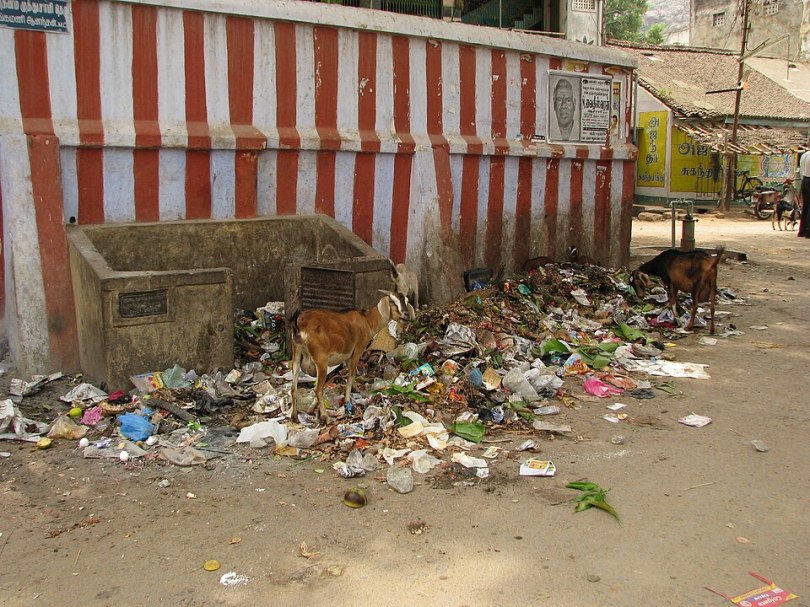
Government policies are essential. Compared to India, China is very organised. If you are a distant observer, you might get the impression that India is messy, with garbage on the streets, and that China is orderly and that the streets are clean. As I have never been to those countries, my impressions come from reading and seeing. India is the largest democracy, or perhaps was, as democracy is in decline worldwide, and that is an enormous achievement, given its ethnic and religious diversity. Mahatma Gandhi came from India, and he is one of the greatest humans in recent history. The Indians had to forge a national identity on the British colonial legacy. The Chinese had it easy, as they already had a strong national identity with a 2,000-year history. That is no small advantage, as European countries also had to forge national identities to industrialise because industrialisation requires markets of scale.
In recent years, India’s economic growth rate outpaces China’s, partly due to population growth, so it is still a long way from overtaking China in GDP per capita. The point of the text is not to praise China for beating the West in the rat race to humanity’s destruction, for that is where it all leads to, but to highlight why India lags China so much. As a picture can say more than a thousand words, so can a description of a situation, such as the editorial ‘Why China Works and India Does Not’ by Jayant Bhandari, which appeared on Lewrockwell.com in 2026,1 which tells us much more than statistics ever will. He writes,
When trying to understand the future of a country, one should not be particularly interested in its elites or exceptionally successful people. They are outliers. […] The essence of a society is better understood in its small towns, isolated communities, workshops, farms, churches, diners, and ordinary households—in the behaviour of people whose names will never appear in a newspaper.
Now, here comes his complaint,
Suppose a piece of equipment malfunctions, and you take it to a technician in India. He will probably tell you to return a few days later. When you do, you can be reasonably certain that it will not have been repaired.
You return a few days later, and then perhaps again and again. On your third, fourth, or fifth visit, the technician may finally hand the equipment back, supposedly repaired. Somewhere during your visits, to escape your pestering, he might have claimed that the work took longer because there were more problems than anticipated, even though you can see that your equipment wasn’t even touched given the dust that had accumulated on it. You will not only have visited repeatedly; you may also be asked to pay more.
When you test the equipment, however, you discover either that the original problem has not been fully corrected or that the repair has created entirely new problems. While you are trying to explain yourself, he is constantly distracted, dealing with several other irate customers like you and confusing your problem with theirs. Everyone grows increasingly impatient, louder, and more exasperated.
You point out what is wrong. To an objective observer, the defect is obvious. Yet the technician may flatly refuse to recognise it—or seemingly fail to understand what you are talking about. He might even suggest that you take the equipment home, let things settle down, and see whether the problem somehow sorts itself out. If you discover the problems after you have taken it away, the technician will pass all the blame to you, calling it newly created.
It is not an exception, he argues, but commonplace in India,
So common is this experience in India that one struggles to think of exceptions. Anyone who has spent enough time there will have his own collection of similar stories. Nor is it merely about technicians. Their customers belong to the same society and are the other side of the same coin. The pattern appears in dealings with government offices, private companies, professionals, contractors, and even friends and family. Life becomes a constant stream of firefighting and brain damage: following up, reminding people, correcting what was supposedly corrected, and keeping track of the never-ending accumulation of unfinished work.
Meanwhile in China, things are very different indeed,
For the last five years, I have owned a cellphone from a Chinese manufacturer. I have taken it several times to the company’s service centres in China for repairs.
The experiences have been almost absurdly inexpensive, and every technician I have dealt with has been thoroughly competent and adroit with his hands. On one occasion, the battery was replaced without charge because the company regarded the problem as a possible manufacturing defect—this despite my telling them that the phone had once fallen into a swimming pool. Broken glass was repaired without charge even when the phone was well outside warranty, and screen protectors have routinely been replaced for free.
Whenever I was told to return in an hour or two, the work was done when I returned, usually better than I had expected. During my most recent visit, however, something went wrong. The repair had created several new problems, probably because something had been connected incorrectly during reassembly.
Of course, mistakes happen. Chinese technicians are not infallible. Chinese bureaucrats can be incompetent. Chinese institutions can malfunction. That is not the distinction I am making. The distinction became apparent when I showed the technician what had gone wrong. […]
She looked at the phone and immediately acknowledged the problems. She did not deny even those that were minor or difficult to demonstrate. She did not pretend that I was imagining them or treat me as an irritating customer who needed to be made to disappear. She accepted reality and took ownership. Her supervisor became involved to understand what had gone wrong. He took over the repair, completely disassembled the phone, and rebuilt it.
Why is this so important? The author argues,
Such incidents may look small, but they are not. They reveal the moral habits on which complex societies depend: ownership of error, pride in workmanship, responsiveness to the customer, and the willingness to correct a problem rather than hide it. These are not merely technical skills. They are civilisational emotions in action.
A complex society depends on millions of people whose work continually intersects with that of others and cannot be individually supervised. Tiny compromises may be invisible and impossible to trace back to the person who made them, but they accumulate and compound. So do tiny acts of conscientiousness. Over time, they determine whether a society works.
He mentions a few other examples, like a Chinese private hospital treating him for a small injury without charging him, and a government-run hospital being prompt on the job and charging a low fee, while at Indian private hospitals trying to scam you, and public hospitals offering no service without bribes. It is due to cultural differences. It is not that there are no scammers in China, nor that there are hard-working people in India, but overall, there is a significant difference. He continues,
The difference is not that China has no bad hospitals or incompetent doctors. It is that, in my experience, the ordinary institutional instinct is far more often directed toward solving the problem placed in front of it. In China today, my experience is increasingly that someone takes ownership of the problem. Often, someone approaches you almost as soon as you enter, finds out what you need, identifies who is responsible, directs you to that person, and tries to move you through the system.
In an Indian government office, the first seemingly impossible task is to discover who is responsible. Then you must discover where he is. He is unlikely to be at his desk. When you eventually find him, you must deal with his arrogance, his god complex, and his need to make you genuflect, beg, and prostrate yourself before him. He sends you somewhere else; that person sends you to another, and you go around in circles.
Eventually, you zero in on someone who might be responsible, his ego now inflated by the realisation that he vaguely holds the power. In India, nobody is ever fully responsible, so one must proceed carefully.
Then the dance around the bribe begins. Paying is not enough; you must strategise. You cannot tell the bureaucrat that you distrust him, even though he knows perfectly well that you should. Trust him too much, and he will take you for a fool. Everything must be wrapped in euphemism and pretence.
Pay the wrong person, and you lose the money. Even paying the right person creates no obligation to complete the work. You must work out who actually has power and what combination of money, deference, persistence, and connections might make the machinery move.
Over time, the scale and shamelessness of bribery in India have increased. In the past, euphemisms were still necessary—the gift for his children, for example. Today, bureaucrats speak openly about their collections. The amount collected can itself become a mark of status, even enhancing one’s value in the marriage market.
I cannot remember dealing with an Indian bureaucracy without paying a bribe. Nor is there any recourse: go higher up, and you encounter a more expensive level of the same system. Those unaccustomed to corruption often fail to appreciate its corrosiveness. It does not merely add another cost to government; it destroys the purpose of whatever institution, law, or scheme it infects.
Well, indeed, if your operation is a scam, then it is not what it pretends to be, such as a hospital or a repair service. Yet, China scores low on the Corruption Perceptions Index, even though it does somewhat better than India. There must be widespread corruption in China as well, mostly in government. One explanation I came across is that Chinese corruption is aimed at getting things done. So if you pay, you get something in return, like a building permit. In India, as the author observes, even paying the right person does not create an obligation to complete the work. In any case, if you are in India, you should expect that people will try to scam you. Corruption is not the core issue here. It’s doing your job, being truthful, and keeping agreements, rather than trying to get away with doing nothing, breaking agreements, and shifting the blame when things go wrong.
China and India were equally poor a few decades ago, and to come this far, the Chinese changed their values and work ethic, so the condition in India may well be a transitional phase. It is only that the Chinese government plays a greater role in directing the modernisation process, and puts a greater effort into education and standards. A good society functions on social trust, which requires moral integrity that a mere liberalisation of markets cannot bring. Competition may improve service, so if some businesses do a better job, they will get more customers at the expense of the scammers. Yet competition drives the rat race to our destruction, so if moral integrity can’t do the trick, we are doomed. If we take no pride in contributing something good, society will not flourish. Culture makes an enormous difference. Moral integrity is hard to measure, but it makes societies work. Cultures change, so India is not lost, nor is any other country.
1. Why China Works and India Does Not. Jayant Bhandari (2026). LewRockwell. [link]
In the 2000s, it struck me that nearly all the empty cigarette packages littering the streets were Marlboro Reds. There were one or two Camels and a few others, but for some reason almost all were Marlboro Red. Marlboro Red is the most popular brand in the Netherlands with a market share of nearly 30%. The second-largest brand has a market share of under 10%. Yet if I had to guess from discarded empty packages, I would have thought Marlboro Red had a 95% market share. We didn’t make tallies, but it was like that. We made jokes about it. So, if you’re looking for a jerk, check who’s smoking Marlboro Reds. That would greatly increase your chance of success. And the finding led me to have prejudices about Marlboro Red smokers being jerks.
Littering isn’t that bad compared to warfare, chemical dumping, abuses in the meat and dairy industries, and the cutting down of rainforests. Still, disrespect begins with littering. It is a matter of upbringing, hence culture. Some countries are clean, while others are a mess because people dispose of their garbage wherever they see fit. Those who litter don’t care about the world they live in. They disrespect the Creator. They shit on God’s work. There are worse offences, but it starts with littering. Next comes graffiti, which only those who make it consider art. Art is personal expression, so do it inside your home where no one else can see it. Then comes destroying property. If you want to cause even more harm, you might consider buying the latest fashion or going on holiday by aeroplane.
If 30% of the people dump 95% of the garbage, the remaining 70% is responsible for only 5% of the mess. You can calculate that Marlboro Red smokers were 44 times as likely to dump their trash on the street as other smokers ((95/30) / (5/70) = 44), a striking finding. The sample was large enough to make the finding statistically significant. The sample may have issues, but these issues can’t fully explain the difference. Today, there are still cigarette packages on the street. Still, it is hard to identify the brand name among the scary pictures of cancers and other horrible diseases you get from smoking. Marlboro Red smokers differ from other cigarette smokers. You can call it culture. Culture explains the deviant behaviour of groups of people who share characteristics.
The Marlboro Man embodies careless living in a consumerist society. Our brand choices reveal a great deal about our personalities, so marketers have done their jobs very well indeed. A politically correct person would say I am stigmatising Marlboro Red users. There could be something wrong with my sample. I live near a train station where young people gather, but I have also noticed this elsewhere. It can’t merely be an error in the sample. But even if the sample correctly reflects reality, perhaps only 0.1% of smokers discard their cigarette packages on the street, so only a tiny minority of 4.4% of Marlboro Red smokers might do so. Perhaps that is correct, or perhaps not, but 44 times as much is an eye-popping difference. It points to a rule, which is:
It is usually one of them doing it. Yet, most of them aren’t like that. The culture within their group makes the conduct more likely.
Jerks may smoke Camel, but they are more likely to smoke Marlboro Red, or there is a Camel culture of not littering that prevents Camel-smoking jerks from littering. In any case, it is an issue within the Marlboro Red smoker community. It is of crucial importance, for culture is so ubiquitous, that so far nearly everyone vastly underestimates that importance. We are a programmable species. Our bodies and brains are the hardware, and our cultures are the software. Different software can make computers behave entirely differently, albeit within the limits of the hardware.
We could solve 95% of the littering problem by locking up all those who smoke Marlboro Red. Yet, 95% of the Marlboro Red smokers might not be part of that problem, so 95% of the people you would round up and imprison would be innocent. The latter is similar to what some fascists propose to do with immigrants to solve the problem of higher crime levels among immigrants. And to solve the problem of criminal immigrants, fascists propose to let fascist criminals run the government and deport the immigrants. The experiments with this idea in the United States have been enlightening.
Patterns give rise to prejudices. Yet, reality regularly surprises me. Individuals often don’t conform to my prejudices about the groups they belong to. Groups consist of individuals. Although these groups differ on aggregate, everyone is different. Behaviours such as littering occur more often in certain groups than in others. Our prejudices about groups tend to have a basis in reality, but they aren’t reality. When there are only Marlboro Red packages on the ground, you might assume that all Marlboro Red smokers are littering jerks, but it could be a small minority. Still, Marlboro Red smokers, on average, litter more often than smokers of other brands. If this littering is a cultural problem. Cultures are usually the product of circumstances and how a group responded to them.
Can I trust my dentist?
How do cultures emerge and develop? Circumstances and how a group respond go a long way in explaining that. I trust my general practitioner but not my dentist. It is the result of my own experiences and those of others. General practitioners and dentists are similar medical professions. In the Netherlands, a general practitioner doesn’t benefit from the advised treatments, while a dentist does. You have to trust medical professionals because your health depends on them, but you can’t trust them in a ‘free’ market. A market is never fully free because some people have more information or leverage than others. In healthcare, that is particularly damaging, as your health is most precious and you depend on expert assessment. Scammers prey on desperate people and sell treatments for which there is no scientific proof. If people buy it, they sell it.
Dental care is an area where dubious practices proliferate. To prevent dental professionals from taking advantage of me too much, I see the dentist once a year rather than twice. So what made me so distrustful? As a child, I had the same dentist for over fifteen years, an old-fashioned one for peasants like me. He didn’t propose treatments unless they were necessary. He once told me that I could wear braces, but added that it wasn’t necessary for my teeth’s health. Not caring about looking perfect, I still live with the consequences that have never bothered me.
After leaving my parental home and moving to Groningen, I selected a new dentist. The first thing he did was take X-ray pictures. Then he said that a cavity was developing underneath one of the fillings. Well, what a coincidence. The other dentist had never seen it. He showed me the picture and pointed at a dark spot. There was another filling with a dark area beneath it, and I said, ‘You can see a similar blot here.’ He replied, ‘That is something different.’ I am unqualified to evaluate these X-rays, but both areas were similar, so the dentist lied. Had he not shown me the photograph, I would have believed him. It made me suspicious and very critical of what dentists were doing.
Before he could treat my tooth for the supposed cavity, I came up with a lame excuse and selected another dentist. Several years later, I had a colleague who had married a dentist. She had previously lived in the same neighbourhood. Her husband was in training at the time, so she had been seeing another dentist, who happened to be that one. She told me she had had a row with him. I wasn’t the only one who had smelled a rat there. Her husband was a dentist-in-training, so she likely had valid reasons for quarrelling.
That was a noteworthy coincidence indeed. What are the odds that she had the same dentist, that they had an altercation over malpractice, and that her husband was a dentist-in-training, which would provide me with evidence to support my suspicions? Thirty years later, the tooth and the filling were still in place. Later, I moved to Sneek and found an old-fashioned dentist. He was like my first dentist, so I trusted him. He often performed dental cleaning. That usually took 10 minutes and cost €21. After ten years, he joined a practice with some other dentists. Shortly after that, he retired.
My next dentist didn’t perform the dental cleaning. Instead, he sent me to a dental hygienist. That treatment lasted 25 minutes and was much more expensive. Instead of €21, I paid €62. Standards do change, but I doubted the sudden need for 150% more cleaning. But if my dentist advises the treatment, who am I to disagree? After all, he is the expert. It is best to accept the assessment of medical professionals unless you have proof they are wrong. Otherwise, you endanger your health.
I have worked harder on brushing and cleaning my teeth, but dental cleaning always took 25 minutes. After eight years, my dentist said my teeth were in good shape and clean. There was only a tiny bit of tartar, negligible even, the dentist said, so he advised me to see the dental hygienist anyway. In hindsight, dental cleaning was probably not required at all. And so, the dental hygienist could have stopped after 10 minutes, but she went on until 25, so she could bill me for that. The treatment was always 25 minutes, regardless of the condition of the teeth. I found it to be a scam and looked for another dentist.
It would only get worse, even though not at the beginning. A new guideline stated that dental hygienists could perform periodic dental check-ups. The following year, the dental hygienist combined the check-up with dental cleaning, making the most of the allotted time financially. I was there for thirty minutes. She billed me for thirty minutes of dental cleaning and also charged me for the check-up. A decent check-up lasts ten minutes, so you might expect a check-up and twenty minutes of dental cleaning if you are there for thirty minutes. I was surprised and wasn’t sure. Had I checked the clock correctly?
The following year, she did it again. Additionally, she charged me for taking X-rays and evaluating them. How can you do all that in thirty minutes if you already spend thirty minutes on dental cleaning? It doesn’t add up. The dentists had decided to take pictures every 3 years instead of every 5, which means even more money for them. And she was double-charging me. Dental cleaning was €160 per hour at the time (yet their prices keep rising faster than wages), which was nearly what I brought home after a day of work and paying taxes. Many people work longer for that money. To charge that per hour wasn’t enough for her. That made it particularly nefarious.
After returning home, I emailed her to request clarification. She didn’t respond, so I filed a complaint with the Dutch Association of Dentists and looked for another dentist. In the complaint letter, I protested the double-charging and noted that questionable ethics have become the norm in dental care. A few decades ago, there were no dental hygienists. My wife once said, ‘The dental hygienist is a new profession created out of thin air.’ She had left a dentist because he required her to see the dental hygienist before he would examine her teeth to determine whether that was necessary. She went to another, who also began maximising profits at the expense of clients, so she left again. I have heard several stories from others of dentists overcharging or doing unnecessary treatments.
My next dentist also advised dental cleaning. And this time, I was with the dental hygienist for 40 minutes, and she billed me €119. Over the past fifteen years, the time spent on dental cleaning has increased by 300%, and the cost has risen by 467%. I take much better care of my teeth than I did twenty years ago, and I began using toothpicks, but it doesn’t show up in the cost of the dental cleaning. It can’t be that all these dentists and dental hygienists are lying. My teeth accumulate tartar no matter how well I clean them, so cleaning is necessary, but the extent of it remains questionable, to say the least.
I suspect that 10 minutes would suffice. Think of the 80/20 rule. Generally, 80% of the outcome requires 20% of the time. Polishing and other add-ons only increase the bill. I put up the ante once again by brushing my teeth three times a day, and it finally showed in a somewhat reduced dental-cleaning time in the years that followed. The parabolic rise in dentist costs is partly due to changing standards. Dental cleaning improves dental health. At some point, the benefits of increased cleaning and more photographs become minimal while the costs escalate. The precise border between higher and scamming will always be elusive, and you can’t prove it from individual cases like mine.
Still, we have, without any doubt, entered scamming territory, but no one puts a halt to it. In 2026, a Tubantia newspaper headline said, ‘Eight minutes in the chair, pay 200 euros: more and more patients feel like cash cows at the dentist.’ And the article goes on to say, ‘Three minutes of polishing for €480 per hour. Half-cent cotton rolls billed for €10. A €1,600 treatment plan that disappears after a second opinion. Hundreds of readers contact us after reading articles about dental care fraud. And research by Zilveren Kruis shows that in six out of ten cases investigated, there was indeed overbilling.1 Many people take out insurance and don’t care, allowing dentists to exploit the situation.
Again, I have to be politically correct and say that the number of complaints about treatments is less than 1% of all treatments. People only complain if they think something is wrong, so that 60% of complaints being justified doesn’t mean that 60% of dentists are overbilling. Still, much goes unnoticed. My wife has switched twice after being scammed, and never filed a complaint. I switched three times and complained only once. Two of those switches were due to scams, and the third to dubious practices. And so the percentage of fraudulent dentists is higher than 1%, but it could be a minority. And there is a grey area between changing standards and overtreatment. Still, more and more people can’t afford dental care, and their dental health suffers. So, as the number of treatments increases, the quality of dental healthcare in the Netherlands declines, which seems to be a systemic problem in for-profit healthcare. General practitioners don’t benefit from the treatments they recommend, leading to better care at lower cost.
The same trend is visible in veterinary practices. Douwe, our late cat, suffered from kidney failure. We had spent hundreds of euros on tests, but the vets found nothing. And we had seen several vets, because we suspected that the other vet was scamming us, but they all did it. We spent hundreds of euros more on special diets sold by these vets, but Douwe’s condition only deteriorated. We finally visited an old-fashioned vet. He examined Douwe by feeling with his hand. He found the kidney failure and euthanised Douwe. That cost us only €30. Modern veterinarians often don’t physically inspect the animals but perform tests, charging over 1000% more. Physical examinations are bad for business.
My father has spent over €5,000 on surgery for the leg of his dog. An old-fashioned vet would have amputated the leg, as the animal could still walk on three legs. But that is, of course, much cheaper and generates far fewer profits. The surgery failed, so the poor animal had to undergo a second surgery. After that, the ailment returned, so a third surgery followed. And if the treatment fails, you don’t get the next one for free. Not even a discount, unless you are, like my father, insistent on a discount and act somewhat unpleasantly. The dog didn’t recover. My father had his dog euthanised because it was in pain.
The market works such that unnecessary treatments proliferate because the rich desire them. They would rather spend €10,000 on unnecessary treatments for their dogs than spend €1,000 on feeding children in Africa. We are all like that. I don’t give all my money to charities either, so it is a most serious issue that we can only fix with unthinkably brutal measures like taxing the rich. These treatments have become the norm, so the vets sell them to the poor as well, telling them every pet deserves these treatments, even when their owners can’t afford them.
You can’t blame only the vets and dentists for the cost explosion. We view our pets as family members and want the best for them, just as we do for our children. Modern veterinary outfits look like hospitals and make investments that need to bring in a return. And we want perfect teeth, not just healthy ones. Not everyone can afford them, and healthy teeth are more important than perfect teeth. Vets make tons of money. They now retire early, purchase luxury mansions and travel around the world. It has become so lucrative that vulture capitalists are buying up veterinary practices, and scams will proliferate like cancer until the entire sector has become a scam.
Group culture is a problem. Most veterinary and dental care professionals think they are doing a good job, even though they have become a bunch of scammers. Dutch politicians are catching up and proposing a law to ban profit maximisation at the expense of pet owners, but, as usual, nothing will change. It reflects the societal mood, where we see greed as good, so dental care professionals and vets may be unaware of the damage their culture and values cause. That is precisely the problem with many cultures, whether they are professional or ethnic. So, there we are, at the greatest obstacle to the peaceful unification of humankind.
The politically incorrect
It is okay to say that something is wrong with dentists and vets, but once you do the same with an ethnic group, you’ve long stepped into a minefield. Today, you can say anything, but there was once a time of political correctness. Let’s begin with kicking in an open door. White Europeans have caused the most trouble by spreading a suicidal money-worshipping culture that is the greatest cultural problem of all. And in the elite of that culture, which places money above moral values, you find Jews more often than their share of the population would suggest. There is no point in denying that, but we should move on and fix these issues before the savages burn down civilisation. Blaming people for having grown up in a particular culture won’t solve anything. It is better to focus on what the future requires of us. And so, we have to address the harm caused by cultural differences. That is going to be harsh on everyone, as is the required change.
Stereotypes are often rooted in reality. The man on a scooter with tan skin has become a household name in the Netherlands, and the Dutch associate him with street crimes like mugging and improper behaviour towards women. If you see one, you may think of the stereotype, even when he is delivering a pizza. When a black youngster on a fatbike nearly ran me over in a park near my home, that confirmed existing prejudices. But then he excused himself like a gentleman. Not all youngsters would do that. The level of variation is usually larger than the difference between the averages.
It is hard to avoid having prejudices and acting on them because there are often underlying patterns. We are wired to fear the unknown and to react to perceived patterns. That is why we discriminate. Discrimination is undesirable, but you also can’t force people to befriend people they don’t like. If you think that Marlboro Red smokers are no good, you probably would ignore signs to the contrary, unless you know a few people belonging to the group. If you look on the street, you may see only Marlboro Red casings and fail to notice others, so you may think it is always Marlboro Red smokers doing this, even though they may be a small minority in that group.
A minority can nonetheless be quite large or cause serious trouble. Ethnic minorities may distrust the police and not rat each other out. Still, the image you get from the evidence you see is not reality itself. Yet, seemingly small differences can have a significant impact on society. If the percentage of criminals in the population rises from 2% to 4% due to the arrival of poorly adapted immigrants, you have twice as many crimes and need twice as many police, courts and prisons. As a result, a group can be a problem to society, even when a small minority within it causes the problem.
Why do mass shootings occur more often in the United States than elsewhere? The gun lobby would argue that only a tiny fraction of Americans go on a shooting spree. The image you get is not reality itself. If there are mass shootings in the United States nearly every day, you might think that Americans are gun-obsessed nutters. Only a negligible percentage of Americans go on a murder spree. Nevertheless, the number of mass shootings sets the United States apart from other countries. Conservatives don’t see it as a problem. Liberals think that stricter gun laws will solve the issue. However, the underlying causes may be gun culture, American views on the use of lethal violence, and the dog-eat-dog nature of American society, not gun ownership itself. Finland and Sweden also have widespread gun ownership without that many mass shootings.
Groups that share characteristics often share cultures. We picture Americans, Chinese, Germans, Jews and Arabs like we picture lawyers, students and construction workers. Our prejudices may identify characteristics that distinguish the group, but they will often fail us in individual cases. We may base our prejudices on experience and facts, but the facts do not base themselves on our prejudices. And the biggest problem may not be conduct, but loyalty and belief systems. We are loyal to family, friends, tribe, and nation, so if your loyalties differ, we head towards conflict. Culture is a major issue, even though it can be hard to measure. All existing cultures are problematic because different behaviours and expectations are a source of trouble. A resolution requires, on the behavioural side, ending harmful conduct and aligning behaviour where differences cause harm, and, on the expectation side, greater tolerance for differences that do not cause harm.
Is the trend your friend?
In multicultural societies, people from particular ethnic groups face greater difficulties and, as a result, cause more trouble than others. If you follow social media feeds in the Netherlands in 2026, you will remain informed about violent incidents caused by asylum seekers and particular ethnic groups, giving you the impression that they generate a massive violent crime wave that is overwhelming the Netherlands. Yet, in the statistics, you don’t see that, and violent crime numbers have gone down in recent decades. Murders are at an all-time low. Statistics can be manipulated for political or bureaucratic ends, but surveys show that the Dutch feel safer than 25 years ago and trust the police more.2 And murder statistics are hard to meddle with. Yet, drug deals and frauds don’t contribute to feelings of unsafety, nor do they show up in the statistics if no one reports them. And some criminals have switched to fraud as it’s easy money with little risk.
Also, in fraud cases, particular ethnic groups are overrepresented. The relationship between ethnicity and crime is a reason why fascism is on the rise. Policymakers have long hoped that maintaining a friendly atmosphere and supporting disadvantaged groups will reduce these problems over time. That is indeed the case, but with new immigrants arriving, new troubles arise. And differences in crime levels can have a profound impact on society. Within some groups, the sentiment is that society is not theirs. Blacks may think they live in a white man’s world. Muslims have trouble accepting the values of liberal Western societies. Whatever the reasons, and often they are just excuses because criminals don’t like to toil and prefer easy money, we are running out of excuses.
Criminals are a minority in every group, but the differences between groups are significant. People of Antillian, Moroccan, Surinamese and Turkish descent are, on average, four times more likely (2.5%) to be crime suspects than native Dutch (0.6%). The same is true for several other groups. About 70% of the prison population in the Netherlands consists of people of non-Dutch descent, while they make up 28% of the population. The relationship between ethnicity and crime can be misleading, as crime also relates to income. People from minority groups often have low incomes. A good question is why that is so. Circumstances play a role here, like growing up in a particular neighbourhood, and also culture. Culture, despite being hard to measure, is a factor with great explanatory power. The great thing is about culture is that it is programming, so it can change.
Ethnic profiling
Ethnic profiling is controversial. It has undesirable consequences, as the following example demonstrates. Suppose a country consists of two ethnic groups: Group A (2/3 of the population) and Group B (1/3). Assume further that people in Groups A and B are each responsible for 50% of Fraud X. Hence, people in Group B are twice as likely to commit Fraud X as people in Group A. To combat fraud effectively, you can only check on individuals from Group B to achieve the maximum result. You could apprehend twice as many fraudsters with the same effort. But now comes the catch. You don’t check on people from Group A, so only people from Group B end up in prison. While responsible for 50% of the fraud, Group B receives 100% of the punishment. That is the problem with ethnic profiling in a nutshell. But then again, people in Group B are doing it more often, so there is also a reason to engage in ethnic profiling.
Some call it racist, but the reason for ethnic profiling can be a risk assessment related to cultural characteristics, not ethnicity. In this hypothetical case, it is the likelihood of committing Fraud X. Also, in that case, ethnic profiling can be racist. People from Group A might dislike those from Group B and elect a leader who allows authorities to investigate Group B’s crimes while disregarding Group A’s. You can end up with a situation where the authorities prosecute Fraud X and only check on people in Group B, supposedly because they commit it more frequently, while doing nothing about Fraud Y, which members of Group A commit twice as often as those in Group B.
If your job is combating Fraud X, and you dedicate only 50% of your resources to Group B, that seems reasonable because people from Group B are responsible for 50% of Fraud X. In that case, people from Group B are still twice as likely to get punished because Group B is half the size of Group A, but receives the same amount of checking. And because people in Group B are twice as likely to commit Fraud X, people from Group B end up in prison four times as likely as those from Group A. While responsible for 50% of the fraud, Group B accounts for 67% of the prison population. So, if people from Group B claim that the authorities discriminate against them and punish them more, they are right.
People from ethnic minorities often get harsher punishment for the same crimes. A Dutch study showed that people from other ethnic groups are up to 30% more likely to receive a prison sentence for the same crime than native Dutch. The cause is likely not willful discrimination, but cultural differences, the investigators concluded. If you share the judge’s culture, you know what to say to sway the judge’s opinion. And showing remorse greatly helps your case. People from some ethnic groups have difficulty showing remorse, which might make a judge think the person is a jerk. Repenting is a Christian concept that affects Western culture, where pride is a sin, so Muslims and some other groups may show no remorse, perhaps out of pride, or they keep denying despite the evidence against them, leading to a longer prison sentence.
Because of the undesirable consequences of unequal punishment, ethnic profiling should be used with great care. It can be justified to check on people if the problem is serious and the profiling is based on evidence. If you intend to administer a multicultural society, you must take cultural differences and their consequences into account. Otherwise, it is hard to get a grip on cultural issues plaguing society. In the case of fraud detection, one could randomly check people. If it turns out that fraudsters often share characteristics, it is legitimate to use these characteristics to check people from certain groups more often.
Officially, there is no ethnic profiling in the Netherlands, but it happens nonetheless. The Dutch government conducts an offensive against ‘undermining crime’ in selected poor neighbourhoods. In Zaandam East, it led to the surveillance of suspicious individuals, sometimes based on hunches rather than evidence. The area is known for the window-cleaning gangs that divide up territories and use violence against the competition. It has been hard to crack down on these gangs, and Dutch authorities fear that they are undermining society. Zaandam East is one of the twenty areas targeted by the National Programme for Liveability and Safety, an approach to ‘clean up’ city districts. The window-cleaning ‘gangsters’ are often Bulgarians and Turks.1 Critics ask whether frauds and crimes committed by native Dutch receive similar scrutiny.
Diversity politics
If we allow ethnic profiling, which is negative discrimination, we should also allow diversity policies, which are positive discrimination. These policies can benefit not only the group itself but also society. For businesses, it can help to have a workforce that represents the surrounding community. It can attract more customers, and if the money flows back into the community, the business will benefit from the increased purchasing power of local residents. Yet, diversity shouldn’t come at the expense of quality. Still, in situations where multiple candidates qualify, it can be good to aim for diversity in hiring. And perhaps, we shouldn’t overstate the quality issues. In the United States, white men are still dropping out of the workforce, despite the end of diversity politics.
Many Dutch advertisements feature people from ethnic minorities. Ethnic minorities also buy products, so they are a part of the market, which is a valid reason to feature minority groups in advertisements. These diversity politics have crept into other issues as well. If you wish to get your story published in the subsidised artistic sector, be sure to add someone wearing a headscarf. It can also be helpful for police forces. If the police patrol a neighbourhood, it helps when they understand the people living there, so being a member of a particular minority group can make you better suited to the job. Yet, police officers of ethnic minorities often face discrimination. Another issue is that police officers from ethnic minorities are more often found to be corrupt.
Discrimination everywhere
Municipal officials from ethnic minorities say they experience discrimination by colleagues, a 2023 survey in the Netherlands revealed. Civil servants participating in the survey reported experiencing discrimination, such as criticism when another member of their ethnic group misbehaved. Those who spoke out faced bullying and exclusion. Municipal officials from ethnic minorities left their jobs due to these issues, and because they had fewer chances of promotion, the report further said. Discrimination is not a trivial issue, but there are two sides to the issue. Some might have displayed deviant behaviour or taken offence at issues a Dutch person wouldn’t. Whether the complainers are overly sensitive or discriminated against isn’t always clear. Bullying and exclusion can cause long-lasting trauma, and in the most extreme cases, psychosis after nearly two decades. Whatever the problem is, it is serious but not straightforward.
It has to do with how humans behave in groups. You either fit in, or you don’t. That is where it all boils down to. In several workplaces, a pecking order exists, with leaders, followers, and outcasts. Humans desire to establish social hierarchies. Some want to be the boss. To be a leader, you must demonstrate strength and confidence. A low-risk approach is attacking the weak or those who are different. There is a group culture that defines not precisely how you should behave, but the norms of acceptable conduct. Causing problems for the group and not fitting in are reasons for bullying and exclusion. These issues may relate to skin colour, sexual preference, or political views, and often involve divergent behaviour. Vexed responses demonstrate your weakness, and reporting incidents makes you a rat.
Workplaces should be safe, but that is not always the case. In a properly functioning group, everyone contributes to its success, members respect each other, don’t exploit each other’s weaknesses, and resolve their differences. Yet people can’t always get along, and external factors, such as overly ambitious targets or failing management, can also cause conflicts. When things go wrong, we seek scapegoats. Even if the work environment is safe, job performance can still cause trouble within teams. I have worked in a Java team for over a decade. Given the nature of our operations, failures could have devastating consequences, so we couldn’t afford to have underperforming team members. Over the course of that decade, three people had to leave. These were unpleasant situations.
That makes it difficult to pinpoint why people encounter difficulties at work. Humans make up stories, and in these stories they are never to blame. They may call it discrimination, or white men may blame diversity politics, but the underlying cause may be something else. It can be poor performance or deviant conduct. What makes you different is the attack point of bullies. If you are from a minority, they use it against you. Cultural differences cause misunderstanding, and as a result, conflicts. It is a vastly underestimated issue. It is why employers seek to select individuals who fit in with the team. They are in business to make money, not to settle disputes. In critical situations, you depend on each other, so everyone must be on the same page, and understanding reduces the need for rules.
We all discriminate, either on purpose or unconsciously. The reason why there has been a focus on white discrimination is because of a power structure in which whites held the power. This power structure still exists, but as societies grow increasingly multicultural, discrimination by others becomes increasingly problematic. As the West has long been dominant, there has been ample room for introspection, since self-criticism has long not endangered its leading position. As that changes, the call to cast away doubt and focus on pride grows stronger. It is a fatal mistake leading to hilarious clown shows like MAGA, which speed up the collapse of Western civilisation.
If people from an ethnic minority discriminate, it may seem less damaging than when the majority does it, as minorities usually have fewer favours to dispense. The Jews are an exception. They have amassed so much wealth and power that their favouring of fellow Jews has become a dire threat to global economic and political stability. Discrimination by minorities undermines society as much as discrimination by the majority. When I was on holiday in the United States, I once attempted to book a hotel room in a black neighbourhood in Miami. The lady behind the reception was kind enough to talk me out of it. Yet if there is no guest room available for a white man in a black neighbourhood, how can blacks expect whites to stop discriminating against them? Ideally, everyone should stop discriminating. But how do you achieve that?
What is the matter with me?
Once, I asked myself the following question. Suppose I had a room to let, and two men applied, one a white man from Bulgaria and the other a black man from Suriname. Both had similar jobs, and both gave a favourable impression. Who would get the room? Probably, I would choose the man from Suriname. Suriname has been a Dutch colony, and most people from Suriname living in the Netherlands are nearly as Dutch as the Dutch themselves. I have a prejudice that Surinamese are relaxed people who seldom cause trouble. About Bulgarians, I know far less, and I have never spoken to one. Yet, if it had been an option, I would have chosen a Dutchman if he had made a similar impression.
So, where did I get the idea from that Surinamese are okay? The people I have met? Television? It is unclear. Knowing I am biased, I would still choose the man from Suriname. Surinamese are culturally closer to the Dutch than Bulgarians, and I know more about them. And here we arrive at the heart of the matter, something overlooked in debates about racism and discrimination. I know very little about Bulgarians. And Bulgarians differ more from native Dutch speakers than Surinamese do. I don’t want trouble. Judging native Dutch is hard enough already, let alone people from other cultures.
Like most people, I discriminate and have prejudices. Otherwise, I wouldn’t have opinions about liberals, conservatives, Muslims, Chinese, Germans, dentists and Marlboro Red smokers. I may not always be aware of my biases, but I am not a racist. Otherwise, I would have selected the white guy in the hypothetical case. The diagnosis is xenophobia. I know more about Suriname and Surinamese. That is not to say there is no racism or that it is not widespread, but the underlying issues are often unfamiliarity and cultural differences. Identifying the issue as racism only scratches the surface. If you intend to solve the problem, that kind of simplicity doesn’t get you very far.
People who are different face exclusion and violence. I know what it means when others pick you out for special treatment for no reason other than being different. It makes you doubt yourself and ask, ‘What’s wrong with me?’ By the time I had become a student, I was an emotional wreck, mired in self-doubt. It is how groups of humans deal with deviant behaviour and press for conformity. Even people who think they are open-minded and cherish diversity don’t tolerate those who disagree. That is what Woke people do by cancelling people with deviant opinions. Cooperating in groups requires conformism. Cultural differences and unfamiliarity cause trouble and uncertainty, and lead to the failure of the cooperation.
It begins with basic things, such as appointments. Keeping agreements is critical in doing business. It made the Surinamese employer not hire his fellow Surinamese. I had a friend who was always late. He didn’t do that at work, but in private appointments, he was never on time. He married a lady from Africa. Their shared relaxed view of schedules helped make their marriage work. It wouldn’t have worked with me. It might seem like a minor issue, but maintaining schedules is a foundation of modern civilisation. Europe had that same relaxed view on schedules in the Middle Ages. It changed with the Industrial Revolution, the start of the rat race to our destruction, for which Africans are not to blame. Let’s go back in history to Martin Luther King, who once said,
I have a dream that my four little children will one day live in a nation where they will not be judged by the colour of their skin but by the content of their character.
The problem is that, through culture, the colour of your skin says something about the content of your character. How you are brought up, the circumstances you have lived in, the people you have met, and how others have treated you greatly affect who you become, which is why the world is still not a wonderful, multicultural society where life is good. But think of the great future that lies ahead if that becomes reality.
Latest revision: 10 October 2026
1. Acht minuten in de stoel, 200 euro afrekenen: steeds meer patiënten voelen zich ‘melkkoe’ bij tandarts. Peter Ullenbroeck (2026). Tubantia.nl. 2. Factcheck: de vier dubieuze claims waarmee de politie telkens honderden miljoenen lospeutert. Tim Verlaan (2026) FTM.nl.
Featured image: Black-and-white sheep. Jesús Solana (2008). Wikimedia Commons.
If you wish to understand why the world is the way it is, you should learn about civilisations and cultures, especially Western civilisation and culture. Someone who lived 2,000 years ago could go forward 500 years or more in time and live a life more or less the same as before. If you lived 500 years ago, you couldn’t. You would enter a completely different world in which living conditions have totally changed due to a phenomenon the experts call modernisation. Modernisation involves the division of labour, industrialisation, urbanisation, social mobilisation, and increased education and wealth. Social mobilisation occurs when groups in society organise themselves politically to advance their interests. Expanding scientific and engineering knowledge allows us to shape our environment like never before. Modernisation was one the most dramatic changes in the history of humankind. It all began in Europe, and most of it occurred in Europe, until recently.
Western imperialism helped to unify the worldm terminating the livestyles of countless indigenous peoples. The Chinese speak of one hundred years of national humiliation when referring to the era between 1840 and 1950, when Western powers broke the Chinese Empire and plunged it into civil war. That all began with British drug dealers lobbying with their government to start a war in the name of free trade after the Chinese government tried to stop them. Among Muslims, similar sentiments exist because of Western military interventions in Islamic countries, like bombing Iraq for non-existent weapons of mass destruction or occupying the Islamic holy land with bases filled with American crusaders. It may not be much of a solace to them, but Westerners murdered more of their kind than of any other with World War I and II and the Thirty Years’ War.
One might ask what the world would have been like if the Chinese or the Muslims had been the first to modernise. As Karl Marx surmised, capitalism, hence a bourgeois society, so the pursuit of profit, was key to modernisation, so that it wouldn’t have made much of a difference. We live in a bourgeois world rather than a religious one. Moral values don’t drive it, but trade and finance or the ethics of the merchant, which means no ethics at all. If it was deemed profitable to colonise a continent or to let their inhabitants die, it happened. It may all seem like a complex historical process, but if you look under the hood, the engine was competition, and a historical accident made it start in Europe.
The bourgeois culture of trade and finance has now spread over the globe. No corner of the Earth has remained unaffected. Some societies adapted more successfully than others. History is a bitch. For a few centuries, white males have invented nearly everything, which fills some white males entitled because of achievements they took no part in. Many of these achievements were the outcome of people chasing money. The West inherited from the Greek and Roman cultures that preceded it, and other cultures have inherited from the West. Today, Europe, where modernisation once started, is starting to look a backwater, but that is only appearance.
Blaming the West for the course of history doesn’t help us. Furthermore, it amounts to criticising the script’s author. It is not in the way of the wise to do so. It is also pointless to deny that Europe has shaped the world as it is today. As technological progress is about to make us humans obsolete, social progress may be the only way out. That requires wisdom, and a holy war against the morons. And indeed Europe has progressed the furthest in the social realm, because it has made the most terrible mistakes, causing tens of millions of fatalities, giving it the wonderful opportunity to learn the most from history. And, like Chief Inspector Jacques Clouseau, Europe bumbled towards the final solution for humankind: a single union with a single currency, where life is good.
That would never have been the outcome of any realistic scenario, as competition is the driving force of history. So praise be if it is to materialise. People chasing money create an unstoppable destructive force that eventually devours us all. Modernisation would not have materialised any other way, for you must keep a carrot before a donkey to make it run in search of new opportunities and new riches. We are the donkey, by the way. And so, the West is, and never was, morally superior. If you take a cynical stance, you may summarise that this carrot, or the bourgeois culture, hooks upon our inner drivers, and has three pillars:
personal freedom, thus doing as you please,
capitalism, thus taking what you can,
imperialism, thus imposing your will upon others.
Wouldn’t we all like to do as we please, take what we can, make others do what we want, and force others to accept that we are doing good? Capitalism is often not plunder, which is the bourgeoisie’s principal argument in favour of this arrangement. Both parties gain from a trade, or believe they do. Equally often, it is plunder, as the rich get richer without working, simply by owning capital and making us work for them. And both parties in a trade might benefit at the expense of others, future generations, or other life on the planet. If you believe the myth, markets will solve our problems if only the government doesn’t interfere.
As a result, we have become consumption addicts. Drug dealers and addicts to opioids also think they benefit, and a tool salesman and a logger both profit from trading a chainsaw to cut down the rainforest. Still, had the world not modernised, we would still live in shacks and have barely enough food. Thanks to this morally depraved system, we now have the means to live in Paradise, which is the good that came out of the evil, at least if we succeed in overcoming that evil. That would be a miracle, something that only happens in fairy tales. That bourgeois culture didn’t magically pop out of thin air. It is part of Western cultural heritage and thus merits further investigation.
Western culture
To have a world civilisation, we need to share a set of values and beliefs, so as to create a universal culture. Existing traditions turn into folklore. Something similar has already occurred within nation-states. Also, internationally, we have made significant progress in that direction. Yet, what will our future culture look like? Several issues are worth noting. First, the West drove modernisation, so we need to figure out what is typically Western and what is universal. The scientific method, despite being invented in the West, is universal. Science created the simulation we live in. Second, modernisation may end in the termination of humanity. Third, cultural differences are a source of trouble. Cultures harm one another through their relative advantages. Western culture and Islamic culture cause each other harm, albeit in different ways. Muslims may culturally conquer parts of the West with immigration and births, while the West attacks and bombs Muslim countries.
Most other cultures are less socially advanced than Western cultures, particularly in areas that lacked social advancement grounded in rational principles. Countries in East Asia may be more technologically advanced, but the struggle over social ideas in the context of modernity has mainly taken place in Europe. And we do not need more technological advancements. Humans are a failed species, so they have to advance socially. Otherwise, they will use technology to commit suicide. The Chinese, Japanese, and other East Asian nations are more organised and disciplined, and the West might have to learn from them in that regard. Yet we live in a European world. Even the Chinese government bases its philosophy on European Marxism rather than Chinese Confucianism.
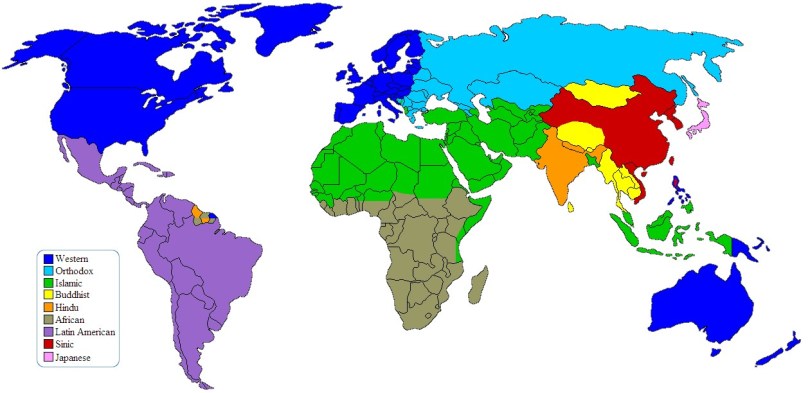
Hence, we might need a world civilisation and perhaps even a universal culture, as there is a limit to the diversity we can handle. You can’t allow harmful activities to continue, so all cultures need scrutiny. The West was the first civilisation to modernise. But why? Samuel Huntington mentions the characteristics of Western civilisation he believed crucial for modernisation.1 Modernisation affects everyone, so, researching how a future global civilisation and culture will look, might include investigating which elements of Western culture are universal rather than typically Western. And to explain how we got here, we could focus on the features of Western civilisation and how they emerged and developed. According to Huntington, the defining characteristics of Western civilisation are:
The Classical legacy. The West inherited from previous civilisations, most notably Classical civilisation. This legacy includes Greek philosophy and rationalism, Roman law, and Christianity. The Islamic and Orthodox cultures also inherited from Classical civilisation, but not as much as the West.
Western Christendom, Catholicism and Protestantism. Western Christian peoples believe they differ from Muslims, Orthodox Christians and others. The rift between Catholicism and Protestantism did not change that.
Separation of the spiritual and the temporal. Jesus taught that his kingdom was not of this world and that his followers should respect worldly authorities, even pagan ones like the Roman Empire. And so church and state could become separate authorities.
The rule of law. It was often a distant ideal, but the idea persisted that power should be constrained. The rule of law is the basis of constitutionalism and the protection of human rights.
Individualism. Individualism gradually developed during the Middle Ages. Eventually, people began to promote equal rights for everyone.
Social pluralism. The West had diverse autonomous groups not based on kinship or marriage, like monasteries and guilds, and later other associations and societies. Most Western societies had a powerful aristocracy, a substantial peasantry, and an influential class of merchants. The strength of the feudal aristocracy helped to check absolutism.
Representative bodies. Social pluralism gave rise to Estates and Parliaments to represent the interests of the aristocracy, clergy, merchants and other groups. Local self-government forced nobles to share their power with burghers, and in the end, yield it. Representation at the national level supplemented autonomy at the local level.
The above list is not complete, nor were all those characteristics always present in every Western society. Some of these characteristics were also present in non-Western societies. It is the combination of features that makes Western civilisation unique. Huntington claimed that Western culture is not universal and added that such a belief is a form of arrogance promoted by centuries of Western dominance.1
That view is not beyond dispute. For instance, liberal democracy has at least some appeal to people from other civilisations. The experiences from Taiwan and Hong Kong indicate that the Chinese may prefer liberal democracy too if they are free to choose. On the other hand, recent developments in the United States and Europe suggest that the legitimacy of democracy can still be contested. Most people would prefer food and security to political influence. So, if a dictator promises to address a real or perceived threat, he might even become popular. In any case, the West has seen an unprecedented amount of social experiments, and in the process, the West may have uncovered elements of universal culture.
The list above does not tell us why the West came to dominate the world for so long. Western culture is a product of a historical accident, but not entirely so, and therein lies the issue. The accident may be about how these characteristics emerged. Their interaction may be a different story. Presumably, there is competition between societies, and the most successful tend to win out. This process involves trying ideas and discarding less successful ones. Conquest usually comes with imposing ideas on others. And you cannot go back in time, so once successful ideas have spread, there is no going back. It is, therefore, not always clear what is typically Western about Western culture.
There are reasons to believe that the future will be entirely different from the past. Humanity is using far more resources than the planet can provide. Something has to give. If humans succeed in dealing with this issue in a civilised manner, then the world may change to the point that the present cultures have lost most of their meaning. The future is unknown, but the past is not. To explain where we are now and why Western civilisation has led the modernisation process, we can investigate the characteristics of Western culture and how they interact.
Greek philosophy
Traditional cultures centre around an idea of wisdom reflected in belief. Wisdom was a greater good than knowledge. If you studied the teachings of the great ancient prophets and philosophers, whether it was Buddha, Confucius, or Christ, you know all you need to know.2 Traditional cultures do not pursue new knowledge for the sake of it, for instance, by studying gravity to come up with a theory of gravity. Greek philosophy was different. Greek philosophers engaged in a rational and fundamental inquiry into the nature of reality and our knowledge and beliefs. It was a quest for knowledge rather than wisdom.
Western Christendom
From Christianity, the West inherited a claim to universalism. Christianity, like Islam, claims to represent the only universal truth everyone should accept. Only morons would not accept that truth. That sets Christianity and Islam apart from all the other religions, including Judaism, from which they originated. Christianity, like Islam, also maintains that all people are equal. Everyone can either embrace or reject the one true religion, so there are only believers, the smart ones, and non-believers, the morons. Non-believers are inferior to believers, but that is due to their own stupidity. Converts accepted Christianity out of free will, and this religion, like Islam, is a brotherhood that unites the believers. The West thus inherited the principles of freedom, equality and brotherhood from Christianity.
During its first centuries, Christianity spread in the Roman Empire through individual conversions, so converts accepted Christianity out of free will and persuasion rather than force. In fact, Christians occasionally faced prosecutions by the Romans for not venerating the godlike Roman emperors, which was an act of sedition. This is worth noting. The Jews formed a tribe and inherited their religion from their parents, so that was a done deal. The Muslims were conquerors. They imposed their religion upon infidels, or in the case of Christians, levied higher taxes upon them, so that conversions to Islam were often an economic calculation rather than a genuine conviction.
Jesus never tried or never succeeded in re-establishing a Jewish state, while Muhammad and his successors conquered a large territory, so Christendom could only spread bottom-up by convincing individuals of its message. Miracles and tales about them were of great help. Augustine of Hippo worked out the Christian conceptions of God, the soul and free will, which became a template for Christian thinking. We are born sinners and can convert. Augustine’s life was a spiritual journey. The grace of God made him change his life. This message of personal salvation contributed to individualism in Western Europe, and later, the rise of Protestantism, which made morality an individual choice.
Christianity’s claim of universalism had a profound impact on other myths that originated in the West, the so-called ideologies like socialism, liberalism, free-market capitalism and fascism. Prescriptions to organise societies promoted by the West, like human rights, democracy, and free trade, also came with passionate claims on universal truth, like this is better or for the benefit of humankind. This kind of missionary zeal is not prevalent in other civilisations, except Islam. China and India don’t demand other nations to copy their economic and social models. They don’t feel compelled to dictate to others how they should live, as Westerners did and Muslims try.
Christianity features a division between the profane and the spiritual. Jesus allegedly has said that his kingdom is not of this world (John 18:36). Hence a Christian does not need to challenge worldly authorities. And you should give back to Caesar what is Caesar’s, and to God what is God’s (Mark12:17). A Christian could pay Roman taxes. That made it possible to separate church and state so that, in modern Western societies, religions can be equal before the law. And, Christianity came with a powerful message of mercifulness and equality that appealed to the masses.
And it allowed Christianity to spread within the Roman Empire without causing wars and uprisings. As a result, Roman authorities did not consistently view the new religion as the most urgent threat to the empire as there were barbarian invasions and rebellions to deal with. Periods of persecution thus alternated with periods of relative peace for the Christians. Christians believed the Creator to be a higher authority than the emperor, and they renounced the Roman gods, but they did not challenge Roman rule. The Jews did resist, and so Roman armies practically wiped them out.
Not challenging worldly authorities allowed the Catholic Church to establish a vast network of priests, monasteries, and convents and a hierarchy to manage them. As a result of the Investiture Conflict, the Catholic Church gained control over the appointment of bishops and thus became an independent institution with political influence all over Europe. That contrasts with other civilisations. In Orthodox Christianity, the emperor oversaw the church. In Islam and Hinduism, priests and religious scholars could have considerable influence on political affairs. Only, these civilisations had no centralised independent religious institution like the Catholic Church. In China, established religion did not play a prominent role in politics.3
Rule of law and representative bodies
Law consists of the rules of justice in a community. In pre-modern societies, the law was often believed to be fixed by a higher authority, for instance, custom, a divine authority or nature. It made law independent from rulers, at least in theory, and to some extent also in practice. Religious law is administered by priests explaining holy texts. That applies to Judaism, Islam and Hinduism. In China, the state provided the law.3 There never was a Christian law like there is Islamic law, so Christians accepted worldly authorities and their laws.
The Catholic Church embarked on a project of introducing Roman Law throughout Europe. Consequently, Roman Law is nowadays the basis of the laws of most European nations and many nations outside Europe. Roman Law is a civil law meant to regulate affairs between citizens in a society and is not religious. The involvement of the Catholic Church in this project reflects the Christian separation between spiritual and worldly affairs. In England, another tradition of civil law called Common Law emerged.
The rule of law requires the law to be a countervailing power to worldly rulers. Feudal Europe did not have centralised states, so the Catholic Church could use its political power to introduce Roman Law. In England, a power struggle between king and nobility led the king to promote Common Law in the Royal Court to undermine his opponents who administrated the local courts.3 The king prevailed but remained checked by the rule of law and a strong aristocracy who forced him to sign a document, the Magna Carta, that guaranteed the rights of the nobility. The Magna Carta is a precursor to modern constitutions.
The rule of law often was a distant ideal rather than a reality. The outcome depended on the balance of power between the political actors in each society. These were the king, the aristocracy, and the clergy. Traditionally, the aristocrats and clergy were powerful. They had a representation in the Parliaments called Estates that decided over taxes. After the Middle Ages, centralised states began to emerge with kings trying to acquire absolute power and aspiring to decide on their own over taxes.
A power struggle between the kings and the aristocracy ensued. In Poland and Hungary, the aristocrats prevailed. These states soon collapsed because the aristocrats did not want to pay taxes for the defence of the country. In France and Spain, the king more or less prevailed by bribing the aristocracy with tax exemptions and putting the burden of taxes on peasants and the bourgeoisie, who had no representation in the Estates. This move undermined the tax base of the state. In England, a civil war broke out that ended with the arrangement that the aristocracy and the bourgeoisie represented in Parliament decided over the taxes they paid.3
It made taxation legitimate as it required the consent of those who paid taxes. The aristocracy and bourgeoisie in England had a stake in the success of the state. They profited from the colonies, for instance, via the slave and opium trade, so they were willing to pay taxes if they believed that it was necessary. In this way, England could win out in the colonial wars with France in the century that followed despite having fewer resources. England’s finances were in good shape, so England could borrow more money at lower interest rates to finance these wars than France could.
Individualism and social pluralism
In traditional societies, male family lines were the basis of the organisation of families. Families rather than individuals owned property. Family elders made important decisions. In Western Europe, individuals could make important decisions about marriage and property themselves. They already had substantial freedoms in the Middle Ages. This development started soon after Germanic tribes had overrun the Roman Empire and converted to Christianity.3 Christianity comes with an individualistic message of personal salvation.
The Catholic Church took a strong stance against practices that held family structures together, such as marriages between close kin, marriages to widows of dead relatives, the adoption of children and divorce. It allowed the church to benefit from property-owning Christians who died without an heir. For that reason, women could own property too. These individual property rights undermined family structures.3 Individual property rights later became crucial for the development of modern capitalism.
As a result, the Catholic Church could finance its large organisation, provide relief to the poor, and become a significant power. Western Europeans in the Middle Ages did not trace their descent only through the family line of their father, which would be necessary to maintain strict boundaries between families. In this way, it became harder to carry out blood feuds as the circle of vengeance was smaller, and many people felt related to both sides.3
It allowed feudalism to replace kinship as a basis for social solidarity so that social organisation could become a matter of choice rather than custom. In theory, feudalism was a voluntary submission of one individual to another based on the exchange of protection for service. In practice, this was often not the case, but with the spread of the rule of law, feudal relationships turned into legal contracts in which both the lord and serf had rights and obligations.3
In the Middle Ages, there were no strong states in Western Europe. The aristocracy was powerful and responsible for the defence of their realms. As the economy began to flourish, an influential class of merchants emerged in the cities. Many cities gained independence and became responsible for their governance and defence. Serfs flocked to cities in search of opportunities and freedom, thereby further undermining the power of feudal lords. In Northern Italy, feudalism had already ended by 1200 AD and cities run by wealthy merchants came to dominate the area.
Kinship as an organising method had largely vanished. Europeans could organise themselves for a wide array of purposes. In the Middle Ages, there were monasteries, convents, and guilds. There were also military orders, such as the Knights Templars. Later on, societies and corporations emerged. This European pluralism contrasted with the absence of civil society, the weakness of the aristocracy, and the strength of centralised bureaucracies in Russia, China, and the Ottoman Empire.1
The Renaissance
The Renaissance began in the merchant towns of Northern Italy. The elites of Northern Italy became less religious. This process is called secularisation. Wealthy merchants had money to spend on frivolous pursuits like art and literary works. Optimism replaced pessimism. Medieval virtues like poverty, contemplation and chastity came to be replaced by new virtues like participating in social life and enjoying life. The Italian cities needed the active participation of wealthy individuals to finance public efforts like defence.
The pursuit of wealth became seen as a virtue, which signalled the emergence of modern capitalism. People in traditional societies and Medieval Europe frowned upon trade and the pursuit of wealth. They believed that wealthy people must share their riches with their community. Trade often comes with questionable ethics and was seen as a necessary evil.
Building on the existing European tradition of individualism, entrepreneurial individuals came to be cherished. The Italian Renaissance tradition includes individuals like Michelangelo, who was known for his unparalleled artistic versatility, and Giovanni Giustiniani, a mercenary who organised the defence of Constantinople against the Turks and Christopher Columbus, who discovered America.
The separation between the worldly and spiritual realms reduced the obstacles to secularisation. The Renaissance started in the cradle of the Roman Empire. Italian merchants sailed the Mediterranean. The legacy of the ancient Greeks and Romans was everywhere around them. It prompted a renewed interest in classical antiquity, including ancient Greek and Latin texts. The works of the Greek philosophers and their rational enquiries into the nature of reality were rediscovered and began to affect European thought. These texts were secular and promoted virtues different from Christian virtues.
Printing and gunpowder were Chinese inventions that came to Europe. Around 1450, the first movable type printing system was introduced in Europe, making it possible to print books in large numbers. From then on, new ideas could spread faster. Constantinople, the last Christian stronghold in the Eastern Mediterranean, fell into the hands of the Ottoman Turks, blocking traditional trade routes with the Indies. The Portuguese then began to look for new trade routes by sailing around Africa, starting the European exploration of the world.
Double shock
Around 1500, two developments rocked Europe. The first was the discovery of a previously unknown continent, America. It uprooted the belief in traditional knowledge as Europeans discovered their ignorance. It spurred a fundamental questioning of existing ideas and a drive for knowledge2 that would lead to modern science that uses observations to produce general theories. The works of the Greek philosophers turned out to be helpful in this respect.
The second was Protestantism challenging the moral authority of the Catholic Church. The Catholic Church had become corrupted by the buying and selling of church offices. Martin Luther taught that salvation is a gift of God that you might receive through faith in Jesus Christ. In line with European individualism, he made faith a matter of personal choice rather than tradition. Luther taught that the Bible is the only source of divine knowledge, thereby challenging the authority of the Catholic Church. He translated the Bible into German, making it accessible to laypeople.
The Portuguese had found new trade routes to the Indies, and Columbus had discovered a continent that promised unparalleled riches. Small bands of Spaniards with firearms overran existing empires and plundered them. After plunder came exploitation. Colonisation was a profitable enterprise that could sustain itself. It generated sufficient revenues to expand the colonies further. Enterprise and investment capital rather than state armies and taxes drove European colonisation. The resulting larger markets favoured economies of scale. After the invention of the steam engine, these economies of scale propelled the Industrial Revolution.
A revolutionary mix
In 800 AD Western Europe was backward compared to the more powerful Islamic, Orthodox Byzantine, and Chinese civilisations. By 1800 AD, China was still a match for England and France, and the Ottoman Empire was a significant power. But the Industrial Revolution was taking off, tilting the balance of power decisively towards the West in the following decades. Europeans had acquired a mindset that made them more curious, enterprising, and flexible. When the gap between industrial and non-industrial nations became clear, Italy, Austria, and Russia started industrialising too. China, Persia, and the Ottoman Empire did not. It may now be possible to identify the elements of Western culture that were crucial to modernisation and shape the ways how Westerners behave:
a religion with a message of equality, missionary zeal and an uncompromising claim on the truth;
individualism promoting flexible organisation for different purposes;
a separation between spiritual and worldly affairs allowing for secular law and secular pursuits;
a quest for knowledge and truth, for instance, reflected in science and the scientific method;
an absence of a strong centralised political power, but instead, an uncertain balance between countries and political actors within countries that promoted competition;
a rule of law that limited the powers of political actors and guaranteed individual property rights so that investments were more secure;
entrepreneurial spirit and a drive for profit.
The introduction of railroads exemplifies this trend. The first commercial railroad opened in 1830 in England. By 1850 there were already 40,000 kilometres of railroads in Europe. Asia, Africa, and Latin America together had only 4,000 kilometres.2 The first railroad in China was opened only in 1876. It was 24 kilometres long and built by Europeans. The Chinese government destroyed it a year later. In Persia, the first railroad was built in 1888 by a Belgian company. In 1950 the railway network of Persia amounted to only 2,500 kilometres in a country seven times the size of Britain which had 48,000 kilometres of railroads. The technology of railroads was relatively simple, but the Chinese and the Persians did not catch on. They could not do so because they thought and organised very differently.2
Until 1800, Europe did not enjoy an obvious advantage over China, Persia or the Ottoman Empire, but Europe had gradually built a unique potential. It had developed a culture of individualism, curiosity, and enterprise. When the technological inventions of the Industrial Revolution appeared, Europeans were in the best position to use them.2 They were more innovative, motivated by profit, and organised themselves flexibly for new purposes like building and maintaining railroads.
On the back of these advantages, European ideas spread over the world. Ideologies invented in Europe like capitalism and communism inherited the missionary zeal and uncompromising claim on the truth from Christianity. Similar thoughts were formulated elsewhere, for instance, by Chinese philosophers, but not as a coherent ideology. A few Chinese philosophers proposed that theories require the support of empirical evidence, but they did not develop a scientific method. Science was at the basis of European inventions. Science produced results, which promoted European power and fostered European superiority thinking.
The culture of the future
As the first civilisation to modernise, the West has led in the culture of modernity for several centuries. During that time, the West could impose its will on other civilisations and often did so. Western ideas and values have spread over the globe. As other societies are catching up and acquiring similar patterns for education, work, wealth, and class structure, there may be a universal culture in the future.1 It is by no means certain, but it is possible, most notably if some ideas are superior to others or work better, but that is the same.
Hegelian dialectic sees history as a battleground for ideas. Revolutions like the French Revolution illustrate this point. The old order tried to undo its achievements but failed in the end. Indeed, the French Revolution was why Hegel came up with his concept in the first place. It suggests that more powerful ideas replace weaker ones in a survival-of-the-fittest-like competition. Nearly all the ideological struggle has taken place in the West so the surviving ideas from the West could be superior. It might explain why liberal democracy is a success, to varying degrees at least, in countries with different cultures, for instance, Japan, India, Botswana, Turkey, Taiwan, Costa Rica, Pakistan, Thailand, Uruguay, South Africa, Ukraine, Indonesia and Hong Kong.
The future may be different from the past, so existing cultures may not last. Humanity must face issues like the limits of the planet and poverty as one civilisation. And modernisation does not have to mean Westernisation. Japan was the first non-Western country to modernise. Today it is one of the most advanced countries in the world, and also, a liberal democracy. At the same time, Japan has retained its unique culture and identity. So far, non-Western cultures have been modernising without disappearing. In many ways, Chinese, Islamic, Buddhist or Hindu cultures reassert themselves. As the wealth and influence of non-Western societies is increasing, they are becoming more confident about the merits of their cultural heritage and may be less likely to Westernise.1
Furthermore, the West may not be in the best position for the future as the future could put different demands on societies than the past. There still is competition between countries. Other countries, for instance, China, may now be better positioned to deal with future challenges so that other civilisations, including the West, may have to adapt to China, most notably with issues regarding government effectiveness. That does not necessarily imply dictatorship, but other nations may increasingly copy features from Confucian societies. For the West, it may mean that individualism and individual rights will be reversed to some extent. And charging interest on money and debts may promote wealth inequality, financial instability, excessive government interference in the economy, and short-term thinking so other societies may have to adapt to the Islamic civilisation and abolish interest on money and debts.
People from different cultures interact more often, so a global culture may emerge in the longer term. In any case, the West cannot impose its ideas and values upon others in the future. Often people from other civilisations are resentful of the West’s imperialism.1 The Chinese speak of one hundred years of national humiliation when referring to the period between 1850 and 1950 in which Western powers broke the Chinese Empire and plunged it into civil war. Among Muslims, similar sentiments exist. The West’s recent military interventions in Islamic countries stirred up these sentiments.
These feelings may subside over time, and non-Western peoples may develop a neutral stance towards the West and its past. In the process, they may discover that at least some elements of Western culture have universal appeal. Societies from different civilisations have much in common because human nature does not depend on culture. There may be concepts, for instance, democracy, that can work in other civilisations. The West has tried out more ideas than other civilisations, so it more likely has uncovered elements of a possible universal culture in the process than other civilisations.
Barring a collective challenge coinciding with the emergence of a universal religion that inspires people from all backgrounds, global culture is unlikely to emerge anytime soon. A universal religion has not yet arrived, but this universe could be a virtual reality created by an advanced humanoid civilisation for the personal entertainment of someone we can call God. And so, the advent of a new religion is a realistic possibility. This religion could provide a plausible explanation for our existence, promote a shared destiny, and allow for a greater degree of diversity than currently existing religions and ideologies.
Featured image: Map from Clash of Civilisations, Wikimedia Commons, User Kyle Cronan and User Olahus, GFDL.
1. The Clash of Civilisations and the remaking of world order. Samuel. P. Huntington (1996). 2. Sapiens: A Brief History Of Humankind. Yuval Noah Harari (2014). Harvil Secker. 3. The Origins of Political Order: From Prehuman Times to the French Revolution. Francis Fukuyama (2011).
We, humans, rule the Earth because we collaborate flexibly in large numbers. Social animals, such as monkeys and dolphins, work together flexibly but only in small groups. Ants and bees cooperate in large numbers but only in fixed ways. Language enables our large-scale, flexible collaboration. Some animals use signs and calls or give each other names, but we use far more words.1 That allows us to cooperate in more ways and for a wide range of purposes. Language allows us to make and communicate agreements. And we can describe things in detail. We can write, ‘Please read these safety instructions carefully before using model T92.’ Then follow many pages of instructions. Butterflies don’t follow a written list of safety instructions before leaving their cocoons, unlike NASA when launching a spacecraft. That is why butterflies have never landed on the Moon.
We are also imaginative creatures. We imagine things into existence. We envision laws, money, property, corporations, social classes and states. We imagine that there is a law, and that is how the law works. In other words, we envision the law, and lo and behold, it exists. The same is true for money and corporations. We humans say, ‘Let there be corporations.’ And lo and behold, there are corporations. Only humans do that. No other species envisions money and corporations. I can’t give a dog a debit card to go to the supermarket to buy dog food. A dog lacks the imagination for that. A dog can’t think of money, laws and corporations. And so, you can’t make dogs work together in a corporation to produce dog food by paying them money. Our fancifulness existed long before civilisations emerged. Archaeologists uncovered a 32,000-year-old sculpture of a lion’s head upon a human body. These lion-men existed only in the human imagination.
And we imagine gods. We are religious creatures. We cooperate using myths. People of the same religion can go on a holy war together. Faith can also motivate people to engage in charitable work and provide for the poor. Religions promote social stability by justifying the social order and promising rewards in the afterlife for those who support it. As societies grew more stratified, the elites, such as kings and priests, tried to justify their existence and lavish lifestyles, and to explain why peasants had to toil. And so, creation myths emerged, explaining that the gods created humans to work the ground. Established religions were often schemes to exploit peasants. It only works with humans. You can’t let a dog submit to you by saying obedient hounds will go to heaven and enjoy everlasting bliss after they die, and unruly canines will be fried forever in a tormenting fire. A dog lacks the imagination to think of it, let alone believe it. We make up stories and believe in them. We are social beings and need a group to survive. Beliefs hold groups of humans together, so it was a matter of survival to believe our own imagination.
Small bands of people cooperate because their members know one another and can see what everyone contributes. In larger groups, that becomes more difficult as people can cheat. That is where states, money, and religions come in. They facilitate collaboration between strangers, allowing us to operate on a larger scale. States do so by coercion, money by trade, and faith by inspiration. As there has always been a survival-of-the-fittest-like competition between societies, those who cooperated most effectively survived and subjugated others. Religions forge bonds and help maintain peace within a group, or inspire group members to go to war. Religions played a crucial role in human survival. If believing means surviving, it is rational to have faith, regardless of how curious the belief may be. It is in our nature to be religious, and usefulness rather than correctness is the essence of religion. And so, it is better to view a religion not as a set of lies, but as something people agree on to believe in, which helps them to cooperate and survive.
We make up stories and believe them. Hollywood films featured reptiles disguised as humans. Since then, some people have claimed that reptiles live among us disguised as humans. You can see how we can go collectively crazy in this way. When we retell stories, they change. We forget parts of a tale, add new elements or alter their meaning. And so beliefs and religions evolve. The evolution of religions has been a process in which ideas emerged and interacted. Early humans were hunter-gatherers who believed that places, animals, and plants possessed awareness, feelings, and emotions. They asked them for favours, like ‘Please, river, give me some fish.’ Hunter-gatherers felt they were more or less on an equal footing with the plants and animals around them.1Animism is the name for these beliefs. These beliefs were local and concerned visible objects like a tree or a mountain. Over time, people began to imagine invisible entities like fairies and spirits. A crucial step in the development of religions was the practice of ancestor veneration.
The first humans lived in small bands based on family ties. Their ancestors bound them together. And so, they began to venerate the dead. It was a small step to imagine that the spirits of the dead are still with us and that our actions require the approval of our late ancestors. Ancestor veneration made it possible to envision a larger-scale relatedness in the form of tribes. A tribe is much larger than a band. The belief that its members share common ancestors holds a tribe together. Tribes are too large to identify their common ancestors, so tribespeople imagined their ancestors, and the stories about them are myths. The Romans started as a tribe. They had a myth about their founders, Romulus and Remus. As the tale goes, a she-wolf raised them. Tribes are much larger and can muster more men for war. That is why tribes replaced bands. It helps when people attribute magical powers to their ancestors and fear the consequences of angering them. In this way, ancestor veneration turned into the worship of gods. The previous beliefs didn’t disappear completely. Many people still believe in ghosts.
Hunter-gatherers can move on in the event of conflict, but farmers invest heavily in their fields, crops, and livestock. Losing their land, animals, or harvest meant starvation. With the arrival of agriculture, property and territorial defence became paramount. States defend their territory and can afford larger militaries. Kinship is an obstacle, as states enlist people within their realms, regardless of family ties. States thus needed a new source of authority, and the worship of gods replaced ancestor veneration. When humans subjugated plants and animals for their use, they needed to justify this new arrangement. Myths emerged in which the gods created this world and ordained that humans rule the plants and animals. In Genesis, God says, ‘Rule over the fish in the sea and the birds in the sky and over every living creature that moves on the ground.’ (Genesis 1:28) Most of the world’s major religions originated in agricultural societies.
Religions emerged from ancestor worship. And so, gods could be like mothers and fathers. People gave devotion to several ancestors. Each ancestor had a specific admirable quality. Consequently, early religions featured multiple gods and goddesses, each with a distinct role. That is called polytheism, which is the belief in several gods. Henotheistic religions emerged later when people became emotionally attached to a particular deity. Henotheism is the belief that multiple gods exist, but that we should worship only one of them. Even polytheists can believe there is a supreme being or principle. However, that supreme being is indifferent to our concerns, so it doesn’t make sense to direct prayers to it in the hope of receiving help. The gods, being on a lower level, have desires, so we can befriend them by making offerings, polytheists believed.1
The next step is monotheism, the belief that there is only one God. Monotheists believe that there is only one God who rules the universe. Monotheistic religions were successful because monotheists, most notably Christians and Muslims, have missionary zeal. They believe that God craves our worship. Converting others is an act of mercy, as unbelievers will end up in hell. The worship of other deities is an offence to monotheists. After all, it contradicts their belief that there is only one God worthy of infinite adoration. Failing to take action against the unbelievers could anger God. Polytheists are less likely to feel offended when some choose to worship just one of the many deities or invent a new one.
In the first centuries AD, Christianity replaced the worship of local deities. To help pagans accept Christianity, the Church replaced these deities with saints, who often had the same purpose, and took over existing holidays. Each saint had specific qualities, just like the previous deity. In Ireland, St. Brigid of Kildare replaced a Celtic goddess with the same name. Both occupy themselves with healing, poetry, and smithcraft, and their feast day, 1 February, is the same, which is not a coincidence. And so, polytheism didn’t disappear entirely, as Christians continued to pray to saints. The Church also took over the Roman holiday commemorating the winter solstice, which was on 25 December. It turned pagan rites to celebrate the rebirth of the Sun into a Christian feast commemorating the birth of Christ.
Monotheism comes with a few logical difficulties. We hope that God cares for us and answers our prayers. However, prayers often remain unanswered, and bad things happen. So, how can an almighty, benevolent Creator allow this? The obvious answer is that there is no god, or God doesn’t care. That is not what we want to hear. And so people imagined Satan, God’s evil adversary, who makes all these bad things happen.1 And we hope that the people we hate receive punishment, if not now, then in the afterlife or a final reckoning on Judgement Day. Religions cater for our sentiments, a psychologist might say.
A religion need not be about gods. There are godless religions or moral philosophies. The most well-known are Confucianism and Buddhism. Confucianists and Buddhists may believe in gods, but their religions don’t centre on them. They may think that the gods don’t interfere with our lives, or they may worship them on the side. A Buddhist may also bring offerings to a deity. What moral philosophies and religions have in common is that they tell us how to live. The sage Gautama Buddha claimed that craving makes us discontent and causes our suffering. Fulfilling our desires doesn’t help, as new desires will replace them, and the suffering continues. The solution is not to have desires. Confucianism centres around family and good manners. It teaches respect for parents and elders, as well as social harmony through virtues such as benevolence, propriety, and righteousness. It values loyalty, reciprocity, and education.
In modern times, Europeans developed ideologies such as liberalism, socialism, and fascism that, like moral philosophies, describe how we should live. These ideologies are much like religions. They have prophets, holy books, missionary zeal, and preachers. The prophets of communism were Marx and Lenin. They had theologians who explained their writings. The communists had public holidays, such as 1 May, and heresies like Trotskyism. The Soviet army units had chaplains to oversee the troops’ faithfulness, although the Soviets referred to them as people’s commissars. The communists further expected an end time, the proletarian revolution, after which they would enter Paradise, world communism. A fanatic missionary zeal further characterised Soviet communism.1 And so, communism is much like a religion. The foundations of liberalism and socialism are the Christian values of freedom and equality. Fascism developed from nationalism, and the struggle for survival in nature inspired Nazism, which helped to make it especially cruel.
After the Middle Ages, educated Europeans began to doubt their religion. The contradictions in the Scriptures started to attract the attention of the most critical minds. And then came the party pooper, Charles Darwin, who wrote On the Origin of Species. Plant and animal species are the outcome of a struggle for survival. Despite the frantic efforts of religious people to fiddle with the facts, the evidence continued to mount. Religions exist because we invent stories to promote cooperation, and that contributes to our success, not because there is an invisible fellow in the sky. But human imagination reigns supreme. We may soon have the technology to create gods that build virtual-reality universes for themselves. That already happened. We live in a universe created by an advanced post-human civilisation to entertain someone we call God.
Latest revision: 23 September 2026
Featured image: Lion-headed figurine from Stadel in the Hohlenstein cave in Germany. J. Duckeck (2011). Wikimedia Commons.
1. A Brief History Of Humankind. Yuval Noah Harari (2014). Harvill Secker.