The Virtual Universe

Some religions claim that God or gods have created this world. In the Bible, God created everything by saying, ‘Be.’ That God uttered ‘Be’ and poof, there are bees, is not a particularly compelling explanation for the existence of bees. So, how could the gods have the magical powers to do that? Until recently, we had no clue, but then Nick Bostrom, known for his dry and incomprehensible employment of words, delivered us the simulation hypothesis, the most profound breakthrough in theology in nearly 2,000 years. We might exist inside a computer simulation run by an advanced humanoid civilisation. Our creators can define a class bee and instruct the computer to create instances of this class. A class has properties, allowing individual instances to be unique.

And so, Genesis might be closer to the truth than the religion sceptics think. Bostrom didn’t say whether or not that is indeed the case or how likely it is. He didn’t speculate on that issue. Otherwise, his critics might have a field day, ridiculing him for opening a back door to the paranormal and religion. That could have been the end of his career. However, it is easy to find out if you venture into areas that scientists anxiously avoid, such as paranormal incidents, religious experiences, meaningful coincidences, people’s memories of past lives, ghost phenomena, and UFO sightings.

Scientists dare not investigate these phenomena, as it could make them a laughing stock in front of their peers. That is groupthink and intellectual cowardice on a grandiose scale. On numerous occasions, multiple credible witnesses have observed events that science can’t explain. Like nearly everyone else, scientists have been proficient at ignoring evidence that contradicts their beliefs, such as unscientific ravings about spirits relaying messages from the other side during seances. Bostrom speculated that this world might be a virtual reality, but didn’t search for proof. As a philosopher, he had better things to do.

The book The Virtual Universe delves into the evidence. You can prove this universe is a virtual reality if you assume scientists have correctly established the laws of nature and that sciences like physics, chemistry and biology are correct. If events transpire that defy these laws of science, such as paranormal incidents, religious miracles, meaningful coincidences, memories of previous lives, ghost phenomena and UFO sightings, breaches in these laws occur. According to science, the Virgin Mary doing a miracle before a crowd of thousands, like in Fatima, is impossible. If science is correct, and it happens nonetheless, this world must be fake. The book The Virtual Universe puts it like this:

  1. If we live in a real universe, we can’t notice. Virtual reality can be realistic and come with authentic laws of reality.
  2. This universe may have fake properties, but we cannot notice that either because we don’t know the properties of a genuine universe.
  3. Breaching the laws of reality is unrealistic in any case. If it happens, we may have evidence of this universe being fake.

It follows from (1) and (2) that we can’t use the universe’s properties, reflected in the laws of nature, to determine whether or not this universe is real. Science can establish the laws of physics or the properties of this universe, but science can’t tell whether they are real or fake. However, if breaches occur, we have evidence suggesting this universe is bogus. The book The Virtual Universe investigates the evidence, which includes stories about paranormal incidents, religious experiences, meaningful coincidences, reincarnation stories, ghost phenomena, and UFO sightings, often with multiple credible witnesses. So yes, aliens can beam you up into their UFO because they are as fake as you are.

Advanced humanoids, often dubbed post-humans, likely share motivations with us because they evolved from humans, likely after some engineering, genetic, or otherwise. These advanced humanoids may run simulations of human civilisations for research or entertainment. Research applications could be about running what-if scenarios. Possible entertainment applications include games or dream worlds where someone’s imagination comes true. These simulations may not be realistic in some aspects, as they reflect the rules of a game or someone’s personal fantasies. In a simulation, you can let Jesus walk over water and make him think that faith alone suffices to do that.

Civilisations are complex. Small changes can derail events that would otherwise occur. Just imagine another sperm had won the race to Adolf Hitler’s mother’s egg. There were millions of sperm in that race. Guaranteeing an outcome, such as letting World War I end on a date referred to by the licence plate number of the car that drove Archduke Franz Ferdinand to his appointment with destiny, requires control over everything that happens. That doesn’t apply to games. Unpredictable developments make games more interesting. Considering how we utilise computing power, mainly for games, sexy pictures and cat videos, the number of simulations for entertainment likely vastly outstrips those run for research purposes. If we live inside a simulation, we should expect its purpose to be entertainment.

The owner or owners may use avatars to play roles in this world and appear like ordinary human beings to us. If you are familiar with computer games, you are familiar with avatars. Once you enter a game, you become a character inside that game, your avatar, and you have an existence apart from your regular life. Inside the game, you are your avatar, not yourself. Alternatively, you could start a virtual world where you are the Creator and bring your dreams to life. In this world, you also become someone else.

That is a lot of assumptions, and without evidence, they remain speculation. Even when there is evidence, it doesn’t necessarily mean the explanation is correct. Suppose you hear the noise of a car starting. That is the evidence. You may think there is an automobile starting. Perhaps a vehicle is firing up its engine. But your husband might be watching his favourite television series, Starting Engines, so you can’t be sure. Nothing you know contradicts your assumption, but you could be wrong. So, is God an individual from an advanced humanoid civilisation who uses us for amusement? It is credible, and perhaps nothing contradicts it. But who is to say it is correct?

Now comes the disagreeable part. We are instances of the class human. When the beings in the simulation think for themselves, that raises ethical questions like whether they have rights that the creators should respect. Considering how humans treat each other, it is not a given that these rights would be respected even when our creators acknowledge them. In the real world, bad things happen to people. In the case of control, the beings inside the simulation don’t think, but are mindless bots following the script. We have no independent will and are toys to our creators. God kills people at will, and a few million casualties more don’t matter. On the bright side, if God wants us to enter Paradise, where there is peace and happiness, nothing can stop that as well. Those who try will surely find themselves on the losing side. So, if the Boss makes a joke, you can better laugh. Perhaps it isn’t easy. But don’t worry. It took me fifteen years to look at the bright side of life.

Latest revision: 6 September 2025

What Are The Odds?

The law of large numbers

On 11 November 2017 (11-11), I went to Groningen with my wife and son by car. While driving, I noticed the date and time displayed on the car’s clock. The date was 11-11, and the time was 10:35. It made me think, ‘Wouldn’t it be nice to look at the clock at exactly 11:11 today because it is 11 November (11-11).’ Within a second, I noticed the distance recorder standing at 111.1. It had been 111.1 kilometres since I last filled up. Peculiar coincidences can occur by chance. With eight billion people on this planet and so many things transpiring, these things happen.

An example illustrates this. Imagine you have five dice and make a throw. A remarkable incident is throwing five sixes. If you roll the five dice only once, it probably doesn’t happen. On average, it only occurs once every 7,776 times. But if you throw the dice a million times, it happens 128 times on average.

If a reset of the distance recorder occurs every 500 kilometres, the chance of 111.1 kilometres appearing on it is one in 5,000. The distance recorder was not far from the clock, so I would probably have noticed a peculiar number on it after seeing the date. The probability of the distance recorder being on 111.1 might have been 0.02%. The likelihood of the thought about 11:11 popping up on 11 November is difficult to establish, but in my case, it was not low.

The birthday problem demonstrates strange coincidences happen more often than we might think. If you share a birthday with another person in a small group, it might strike you as odd, but the chance of someone sharing a birthday with another person is already 50% in a group of 23. However, two people sharing a birthday is not a mind-blowing coincidence. It is not as remarkable as the incident with the distance recorder.

When you are a member of this group, the probability of you being one of the persons sharing a birthday is much smaller, namely 6%. Meaningful coincidences are likely to happen, but less likely to you. So, if many people experience the same and think it is merely a coincidence because coincidences occur more often than you might think, they suffer from what you might call a collective delusion. Imagine a group of 24 all sharing a birthday with one other group member, so they share 12 birthdays, and they all think, ‘Nothing exiting to see here. The odds of me sharing a birthday with another person in this group are over 50%.’

Taking a smaller sample reduces the likelihood of meaningful coincidences. If you randomly pick two people, the chance of them having the same birthday is only 0.3%. So, if you run into someone else who happens to share your birthday, and it happens again with the next person, it is noteworthy. If it happens another time with the following individual, you might wonder whether there is more to this universe than mere chance. The more elaborate a scheme, the less likely it is to transpire. The probability of three people sharing a birthday in a group of 23 is 1.3%, and for five, it is only 0.0002%. If your life is riddled with elaborate, meaningful coincidences, you might start to believe that you have a critical role in the universe.

Possible avenues to circumvent the law of large numbers

There may be a way to find out there is no such thing as coincidence. If some of the most significant historical events come with peculiar coincidences, that might be more telling for two reasons. First, there are only a few, so the law of large numbers doesn’t apply. After all, it is a small sample. Suppose no intelligence is coordinating events in this universe. In that case, it is less likely that meaningful coincidences will turn up in this sample, and elaborate schemes will be unlikely to emerge. Second, if the most significant historical events come with peculiar coincidences, it becomes more likely that history is scripted than when peculiar incidents transpire in someone’s personal life.

To make the argument, you need to answer questions like, what are the most important historical events, and what are peculiar coincidences? Events such as the sinking of the Titanic or the Kennedy assassination might not qualify, even though the coincidences surrounding them form a strange and elaborate scheme. The extent of these schemes might compensate for that, but it is hard to tell. The beginning and the end of World War I meet the requirements. D-Day, the fall of the Berlin Wall, and the terrorist attacks of 11 September 2001 are among the most important historical events.

And what should I think of the number of meaningful coincidences in my life? It is not possible to establish the likelihood of that happening. You can make assumptions to arrive at an idea. A highly unusual coincidence, such as the do-it-yourself store incident, could be likened to throwing five sixes with five dice. The chance of such an event happening in any year in any life could be one in 7,776. If something similar transpires again that year, it is like throwing five sixes twice in a row. The chance of that would be one in 60,000,000. On average, 120 people would experience something similar each year. But what if more similar incidents occur in one life? Or if 100,000 people have this instead of 120?

I have shared a few of my coincidence stories on the Reddit/SimulationTheory message board. Others also experience similar situations. Only the people on that message board are not a random group, but a select group of individuals who believe we live in a simulation, often because they have witnessed similar phenomena. Some of these stories are as remarkable as mine. I can’t verify these tales, but I believe most aren’t frauds because similar things happened to me. The question remains whether they have seen strange incidents occurring in the numbers I have seen.

There is a point where you must admit that these things are not merely coincidental. We can’t establish that point objectively. The number of possible unusual events is infinite, so the chance of something strange happening, such as the do-it-yourself store incident, could be higher than we intuitively think. It seems impossible to accurately estimate the odds. Still, without intelligence coordinating events in this universe, we should expect these incidents to be distributed more or less evenly across all people and time frames.

Even then, significant deviations from the average are possible. Lightning strikes only a few people. It happens to some people twice, which might seem odd, but there is nothing suspicious about that. If lightning strikes one in 10,000 people once, then one in 100,000,000 gets hit twice. But how would you explain if one person ran into lightning ten times, and this individual did nothing unusual? Statistically, it can happen. More likely, there is a cause, such as living in a dangerous spot. There is a point where we must assume these stories are evidence of us living in a simulation. We can’t establish that point precisely, but whether we live inside a simulation or not doesn’t depend on our assessment. We are, however, inclined to see causes behind remarkable situations or events, but they may be accidental.

The limits of our minds

We are good at attributing causes, but we do poorly at estimating the likelihood of an event. The psychologist Daniel Kahneman provided an example. It is a study of the incidence of kidney cancer in the counties of the United States. The research revealed a remarkable pattern. The incidence of kidney cancer was the lowest in rural, sparsely populated counties in traditionally Republican states in the Midwest, the South, and the West.1 So what do you make of that?

You probably came up with reasons why kidney cancer is less likely to occur in these counties, such as a healthy rural lifestyle or low pollution levels. You probably did not think of randomness. Consider then the counties in which the incidence of kidney cancer is the highest. These counties were also rural, sparsely populated, and in traditionally Republican states in the Midwest, the South, and the West.1

How can that be? Those counties all had small populations. And with smaller samples come more sizeable deviations from the average. Our intuition makes connections of causality, but our reason does not verify whether it could just be randomness. We like to think some cause makes unusual things happen, while they might be random accidents.

When we consider the most significant historical events, we run into problems if we use this small sample to establish that someone is ‘writing history’. On the other hand, comparing this sample to a sparsely populated rural county may not be apt. It is more fitting to compare this sample to the royal family, as it encompasses the most significant events in history. If a high incidence of kidney cancer were to turn up in the royal family, an experienced physician would tell you it is probably not a random issue.

I am a single individual, the smallest possible sample. Some people get struck by lightning twice. It could even happen three or four times, but the chance of it happening ten times is so insignificant that no one will ever experience that unless they live in a hazardous spot. Is the number of meaningful coincidences in my life enough to rule out chance? That number is extraordinarily high. It is not chance. The question arises: Am I just a random individual, or do I live in a dangerous location, or has destiny given me a unique role, such as proving that we live in a simulation? Others have this, too. And so, a lengthy series of peculiar incidents doesn’t suffice to believe the latter.

The things that could have happened but did not

In 1913, the ball fell on a black number twenty-six times in a row at the roulette wheel at the Casino de Monte-Carlo. Some people lost a fortune by betting the ball would fall on red the next time. They did not realise the chance of the ball choosing a red number never changed. The ball does not remember where it went the previous times. If we represent black with a B and red with an R and assume, for simplicity’s sake, there is no zero, we can write down falling twenty-six times on black like so:

B B B B B B B B B B B B B B B B B B B B B B B B B B

The probability of the ball falling on black twenty-six times in a row is one in 67,108,864. That is a long shot. What might surprise you is that the following combination of black and red numbers is precisely as likely to occur:

R B B R B R R B R B B R R B R R B R B B R R B B R B

You wouldn’t be thrilled if that happened unless you became a millionaire by betting on this particular series of twenty-six. And even then, you wouldn’t think of the 67,108,863 sequences that did not materialise. We tend to consider only the things that did happen, but we rarely think of all the things that could have transpired but didn’t. Events such as the ball falling on black twenty-six times in a row impress us. And I am even more impressed because twenty-six happens to be my lucky number.

This argument applies to meaningful coincidences but not to a prediction materialising, as such a feat may imply that all the other things couldn’t have happened. If I say with firm conviction that the coming sequence of black and red would be R B B R B R R B R B B R R B R R B R B B R R B B R B and it happens as I predicted, I may have the gift of prophecy. The chance of me being accidentally right was one in 67,108,864.

Imagine the probability of you sitting here reading this page on a tablet or a mobile phone, but as a prediction from 3,600 years ago. Imagine Joseph telling the Pharaoh: ‘I see (your name comes here) reading a pile of papyrus pages, not real papyrus pages, but papyrus pages appearing on something that looks like a clay tablet. Do not be afraid, dear Pharaoh, for it will happen 3,600 years from now. But if we do not set up this grain storage, it will not happen, so we must do it. And by the way, Egypt will starve otherwise.’

The chance of this prediction coming true was not one in 67,108,864, nor was it one in 1,000,000,000,000,000,000,000. Adding more zeroes doesn’t help. The chance is far smaller than any number you can ever write down. It is so close to zero that no one can tell the difference. Nevertheless, you sit here reading this text, perhaps even on a tablet. How could this happen? The answer to this mystery is that many things could have occurred but did not; however, something had to happen, and that is what transpired. In any case, Joseph couldn’t have made such a prediction by accident.

The licence plate number

What about the reference to the end date of World War I on the licence plate of Franz Ferdinand’s car? Few historical events are as significant as the start and end of World War I. And so, the law of large numbers doesn’t apply here. It is one of the most important historical events, thus part of a sample comparable to the royal family. A mere accident seems unlikely. The assassination could have gone wrong; cooler heads might have prevailed, or the war could have proceeded differently, ending on a different date.

It might have been possible to guess the end date of World War I once it had started. If you presumed that the war would not take more than twenty years, a random guess of the end date could be correct one in every 7,305 times. But something doesn’t add up here. Hardly anyone expected the war to last longer than a few months. The licence plate originates before the war. The assassination succeeded after a series of mishaps. If the licence plate number contained a prediction, that prediction included the assassination succeeding, Franz Ferdinand dying in this particular car, and this event being the trigger for the war.

That is hard to do. And so Mike Dash in the Smithsonian noted, ‘This coincidence is so incredible that I initially suspected that it might be a hoax.’2 Only, it is not a hoax, so investigative minds could have probed other options, but they did not. Conspiracy theorists also ignored it, even though this incident agrees with their beliefs of a secretive plan being behind history.

In the conspiracy scene, a story circulates about a Freemason named Alfred Pike, who allegedly disclosed a secretive plan of the Freemasons to bring about the New World Order. Pike supposedly predicted both world wars with uncanny precision in 1871. Nobody had ever heard of this plan before 1959, when an ‘investigator’ ‘uncovered’ it. Contrary to the licence plate number, the story has no substance. It is a hoax. In the Netherlands, they would call it a monkey sandwich story.

Seeing meaning

Authors use symbolism, hidden meanings, themes, and stylistic figures. Events in their lives, as well as the writings of other authors, influence their writings. Literary critics look for those meanings. You can check out what experts wrote about the poem The Waste Land by T. S. Eliot. You will be surprised. Some authors marvel at what literature critics discover in their works. Apart from intention, there can be an unconscious influence. And so, seeing meaning is more like an art than a science. A scientist would argue there is no proof and that it is baseless speculation because science isn’t about meaning.

He spent a number of years at this project
And now he knows how an electron behaves

The Nits, Mountain Jan

You can’t understand intentions and meaning from investigating the conduct of electrons. Meaning in literature is often intentional. If someone wrote the script running the events in this world, the author might do what other authors do. And so, the licence plate number on Franz Ferdinand’s car could signal foreknowledge of future events or even control over them. The sceptics argue from a scientific perspective, while those who see meaning act like literary critics. Who is right about the meaning of AIII 118 depends on whether there is a script and, therefore, an author.

Sceptics might claim that AIII 118 is a random sequence of characters, but we see a reference to the end date of World War I. That is how our minds work. The argument is odd. If you take it to the extreme, this text is also a random array of characters, as is any book or report. And still, you read words and sentences that have meaning to you. Indeed, the licence plate number would have remained unnoticed if the war had not ended on 11 November 1918.

However, the war ended on 11 November 1918. AIII 118 is the car’s licence plate number that drove Franz Ferdinand to his appointment with his destiny. And destiny is the message the licence plate number radiates. It suggests premeditation concerning the assassination, the start of the war and its end on 11 November 1918. That is a meaning we can see without too much imagination. There are plenty of instances and locations where this sequence of characters could have turned up, so their presence in this particular spot is noteworthy. AIII 118 on a fish barrel in Vienna wouldn’t have attracted attention. Ditto for the licence plate number ABII 117 on that particular car.

Sceptics can also be fanciful. Austrians speak German. Armistice in German is Waffenstillstand. So why does it not read WIII 118? Or even better, W1111 1918? If someone sends you a message, you don’t quibble about such details. If I said ‘hello’ to you, you wouldn’t ask me why I didn’t utter the word ‘hi’ instead. That is, unless you are a philosopher with a lot of idle time and have a hobby of questioning everything. Great Britain, the United States and France were all major participants in the war. These countries all use the term armistice. And if the sceptics come with outlandish arguments, you have won the argument. Only, they disagree. Not seeing meaning is the art of being a moron. Communication with morons is, therefore, problematic.

Asking yourself which licence plate numbers were available in the Austrian-Hungarian Empire may be a better idea. You could check which combinations fit the purpose. There aren’t that many options. Perhaps, you end up with just one match: AIII 118. That makes it harder to believe that this sequence of characters is meaningless. This scheme became even more inconceivable because the war ended on 11 November (11-11), the most peculiar date of the year.

Only a few historical events are as important as the assassination of Archduke Franz Ferdinand and the Armistice of 11 November 1918. You can think of D-Day, the fall of the Berlin Wall, and 9/11. The coincidence scheme surrounding D-Day is extensive, and the recurrence of dates is intriguing. The involvement of Hans van Mierlo is also mind-boggling. It also relates to the Curse of the Omen, a film released on the anniversary of D-Day, as well as the untimely passing of Senator Robert Kennedy on 6 June (6/6) and Martin Luther King on 4 April (4/4) 1968. A historian correctly predicted the fall of the Berlin Wall in 1989, while the coincidences surrounding the terrorist attacks of 11 September 2001 are dumbfounding. In other words, this incident doesn’t stand alone.

A final argument may be that such extensive or peculiar coincidence schemes don’t appear in other historical events that are equally significant, such as the American, French, Chinese, and Russian revolutions. These events are marked by a few peculiar coincidences, such as Thomas Jefferson and John Adams having their appointments with the Grim Reaper on the same day, which happens to be 4 July, thus Independence Day. That is noteworthy, but perhaps not sensational. The parallels between Napoleon Bonaparte and Adolf Hitler might also raise some questions. Somehow, the licence plate number of Franz Ferdinand’s car is more exceptional, most notably because of it being so precisely predictive.

The Chinese Revolution of 1911 began on 10 October 1911. It marked the end of 2,000 years of imperial rule in China. The date, 10 October (10/10), is not as remarkable as 11 November (11/11), even more so because there are no related coincidences. The Russian Revolution led to the establishment of a communist empire that lasted for seven decades. A bad omen marked the coronation of the last Czar of Russia, Nicholas II. The communists later murdered him and his family. You can ask why these events don’t seem part of a coincidence scheme. It is like asking why several members of the Royal Family don’t have kidney cancer. Well, they haven’t. That’s all there is to it. Perhaps, it is not satisfactory to philosophers with a lot of time on their hands, but it will have to do.

Hindsight bias

And then there is the benefit of hindsight. Countless strange incidents could have occurred, but they didn’t. We notice only things that did happen and don’t think of those that didn’t. That is hindsight bias. The sample of the most significant historical events comes with the benefit of hindsight. There is a danger to that approach, and it is unacceptable in science. It is like selecting only the data that confirms your theory. You might have a theory about gravity, saying that all objects will fall to the ground. And you prove your theory by ignoring the heavenly objects and the birds in the sky, so everything you investigate falls to the ground. It later turned out that gravity works that way, and ignoring the heavenly objects and the birds in the sky put you on the right track.

With hindsight, you know things you can’t learn in advance. Hindsight knowledge is also a favourite tool of critics when something goes wrong. However, when you use hindsight to find evidence, your critics argue you can’t. That’s how the critics play their game. They might clip a bird’s wing feathers and then ask the bird to prove it is a bird by flying. But if you use clipped birds to prove your theory of gravity, they might criticise you for that as well. You can’t beat your critics in their game. No evidence will ever convince them. So I won’t try. This wasn’t science in the first place, but metaphysical speculation.

Using hindsight, thus, is the only way to conduct this investigation, as we can’t predict the occurrence of meaningful coincidences. If this universe is genuine, we can’t establish that it is authentic. However, if it is a simulation, we may discover it is a simulation. So, if there is meaning, we must look for it to find it. We should be careful, as we are inclined to see intent when it could have happened accidentally. With that in mind, it is still fair to say that meaningful coincidences related to the most important historical events are likely not mere coincidences. Combined with the other evidence, we can establish that we live inside virtual reality, probably a simulation created by an advanced post-human civilisation.

Latest revision: 24 July 2025

1. Thinking, Fast and Slow. Daniel Kahneman (2011). Penguin Books.
2. Curses! Archduke Franz Ferdinand and His Astounding Death Car. Mike Dash (2013). Smithsonian. [link]

Port and lighthouse overnight storm with lightning in Port-la-Nouvelle in the Aude department in southern France. Maxime Raynal.

The Curse of The Omen

Rumours go that some films, such as The Poltergeist, Superman, and Rosemary’s Baby, have been cursed. Numerous accidents have occurred to related individuals, leading people to believe these films are jinxed.1 Not all of these arguments are particularly convincing. Accidents do happen. They usually have no relation to a movie, even when several actors from the same cast have had bad luck, a statistician might point out. There is one noteworthy exception in which statisticians might run into a credibility issue when making their usual argument. It is the infamous curse of The Omen. And so, a fellow named Danny Harkins wrote on Cracked.com: ‘No film in history has had worse luck than The Omen. Hell, nothing in history has had worse luck than The Omen.’2

The Omen came with billboards featuring a 666 logo inside the title and the uplifting slogan, ‘You have been warned. If something frightening happens to you today, think about it. It may be The Omen.’ Added to that comes the cheery notice, ‘Good morning, you are one day closer to the end of the world,’ and a conclusion, ‘Remember, you have been warned.’ As we are many days closer to the end of the world, this is yet another warning.

In the script of The Omen, the wife of the American ambassador to Italy gave birth to a son. The child died almost immediately. A priest then convinced him to switch his son with an orphan without telling his wife. Mysterious events soon started to haunt them. The child turned out to be the Antichrist. The Omen was first released on 6 June 1976 (6/6), also the anniversary of D-Day. The date refers to the number 666, as the last digit of 1976 is also a 6. The film’s length is 111 minutes, thus a triple-digit number like 666. And so, they were literally asking for it. Please, please, please, curse me!

These ominous ingredients made The Omen an ideal candidate for a hefty curse. Now, surprise, surprise. Events took a sinister turn. Two months before the filming started, the son of lead actor Gregory Peck committed suicide. In the film, he is the father of the child who died. When Peck went to the film set of The Omen, lightning struck his plane. A few weeks later, lightning struck executive producer Mace Neufeld’s flight. A lightning bolt in Rome just missed producer Harvey Bernhard, which you might call unbelievable luck, but the number of lightning bolts involved was also incredible. Later, the IRA bombed the hotel in which Neufeld was staying.1 He also survived that.

A plane hired by the studio to take aerial shots was switched at the last moment by the airline. The people who took the original aeroplane were all killed when it crashed on take-off. That is, again, incredible luck, but if you think there is a curse in operation, it is eerie nonetheless. An animal handler who worked on the film set died two weeks after working on the film when he was eaten alive by a large feline, possibly a tiger.1

And then there is the non-fatal accident of Stuntman Alf Joint that seriously injured and hospitalised him when a stunt went wrong on the set of A Bridge Too Far in Arnhem in the Netherlands, less than a year after the production of The Omen. He jumped off a building and missed the inflatable safety bags. It nearly killed him. Joint said he felt a push even though nobody was near him.1 Some of these accidents were indeed peculiar, but these things can happen by accident, a statistician would tell us. The number of accidents related to the film might be somewhat elevated, but there is no way to establish that, and most of the people involved survived, so that is hardly evidence of a curse.

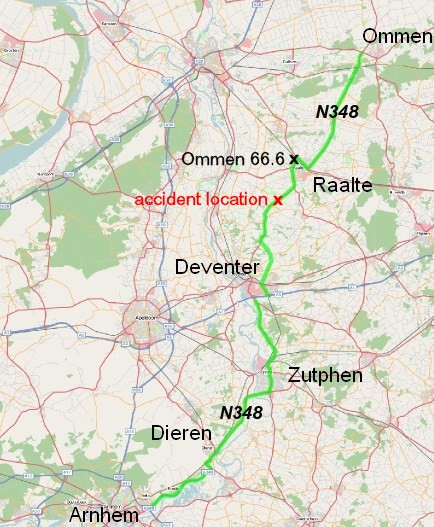
However, the following should make you wonder. On Friday, 13 August 1976, special effects consultant John Richardson drove through the Netherlands with Liz Moore. Both were working on the film A Bridge Too Far. They became involved in a car accident that killed Moore. The gruesome accident is said to have been eerily similar to a scene Richardson had designed for The Omen. The story goes that the accident happened near a road sign indicating 66.6 kilometres to the town of Ommen, a name similar to Omen. And it happened on Friday the thirteenth.1 Now, that begins to look more serious and curselike.

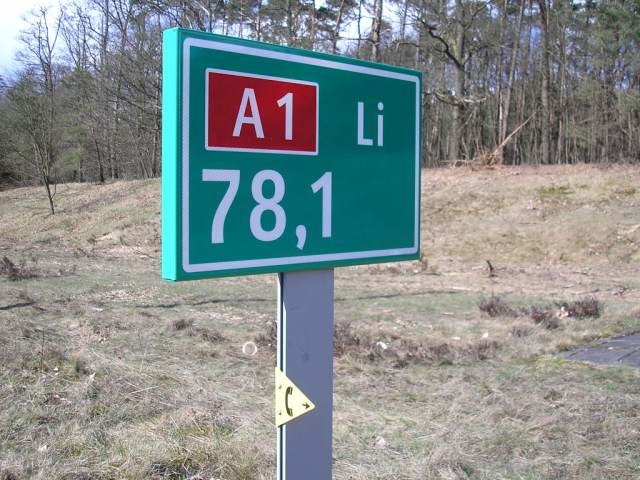
And it caught my attention. Road signs in the Netherlands don’t give distances in fractions of kilometres. Only kilometre markers come with fractions. Near Raalte is a junction where Route N348 to Ommen meets Route N35, connecting to Enschede via Nijverdal. This location corresponds with kilometre marker 66.6 on Route N348. Road signs indicating the direction to Ommen are near this evil marker. I am familiar with the area because I lived nearby, in Nijverdal, as a child, but not with the road itself. We lived in the south of Nijverdal, so if we had to go to Deventer, there were shorter routes from there.

And so, I would not have known of this marker had it not been for a noteworthy incident in 2014. One of my uncles had died. The funeral was in Lochem. By then, I lived in Sneek, and one of the shortest routes from Lochem to Sneek was via this road. On my way back from the funeral, the kilometre marker attracted my attention, so that I vividly remembered it a year later when I came to investigate the curse. And so I figured that this junction could be the site of the crash. It is also noteworthy that a sinister omen had preceded the death of the uncle of whom I had visited the funeral. That event I have recorded in another story.

Route N348 from Arnhem to Ommen

The idea of knowing the possible location of the crash site made me investigate the curse in 2015. A journalist from the local newspaper, De Stentor, helped me. He delved into the issue and emailed me on 14 April. He had managed to find a former police officer from the area. According to the police officer, the accident indeed occurred near Raalte on Route N348, but not at the intersection near marker 66.6, but between Raalte and Deventer, near Heeten, where Route N348 intersects with the Overmeenweg. This location corresponds with the kilometre marker 60.0. The police officer told the journalist he remembered the car crash very well.3

According to the police officer, the accident happened when he was on duty. A man and a woman had parked their car in a parking lot alongside Route N348. As they drove toward Deventer, they entered the wrong lane and collided head-on with an oncoming vehicle driven by a Nijverdal resident. The view was somewhat limited because of two gentle curves in the road. He added that there was no road sign with ‘Ommen’ near the crash site.3 The woman had died on the spot. The car was destroyed and disposed of at a fire station. The couple were foreigners involved in the production of A Bridge Too Far, the police officer told the journalist. He suspected that Richardson, accustomed to driving on the left side of the road, was not paying attention to the traffic.3

On television, Richardson said, ‘It was certainly very odd because it happened on Friday the thirteenth.’ He added, ‘Right opposite the point where the accident happened, was an old mile-post with nothing but sixes on it.’ He further noted, ‘What spooked me even more was when I discovered it was on a road to a place called Ommen.’ It appears that Richardson has misread kilometre marker 60.0 and has taken the zeroes for sixes. The numbers might have been worn out if it were an old post, like Richardson said.

Kilometre marker at the A1 at km 78.1. Public Domain.

Producer Alan Tyler, who made a documentary about the curse of The Omen, noticed odd things while working on it. The strangest thing was that he had two camera crews filming at separate locations, yet all the footage showed the same fault. It did not seem satanic to him, but it made him wonder.1 It is at least remarkable that kilometre marker 66.6 is near a road sign stating the direction to Ommen on the same road where the car crash occurred, so I came to investigate the curse, most notably because of what happened next.

While compiling my findings after receiving the journalist’s email, a few curious events transpired. After reading the email, I took a glance at my stock portfolio. Apart from a few mutual funds, I owned stocks in three corporations. One of them was Heymans, a constructor. It came with a quote of € 13.13. Another stock position was Macintosh, a retail company. I owned 500 of these, and the price was € 2.626. Hence, the total value was € 1,313. It was peculiar because the car crash happened on Friday the thirteenth. Meanwhile, Macintosh is bankrupt. Heymans’ stock dropped 60% after the company ran into trouble.

That seems a bit of a curse already, and it suggests poor stock-picking skills on my part. But there was more to come. That evening, I had an appointment with a contractor who came to submit a tender to renovate my bathroom. He came from Almelo while I lived in Sneek. He cancelled because his van had broken down earlier that day. He could take two routes from Almelo to Sneek: via Nijverdal, crossing the N348 near kilometre marker 66.6, or via Ommen. No wonder that the van broke down.

My Google search for ‘Ommen 666’ produced a link to the Hondentrainingsneek.nl website. At first glance, it appeared to be a dog-training site in Sneek, but it seemed a bit fishy. Somehow, ‘Ommen 666’ had been inserted into topic titles such as ‘Dog Training Terry Ommen 66.6km.’5 The texts on the website were incoherent, with a few references to Ommen 66.6. It is noteworthy that I currently live in Sneek and previously lived in Nijverdal, as my enquiry revealed that Richardson crashed into the car of a Nijverdal resident, which makes for an interesting set of connections.

And then there is the mystery of the 66.6-kilometre markers going missing. They are also known as hectometre markers because the fractions indicate hectometres. The issue has attracted some attention. The Dutch news website RTL Nieuws explains,

There are hardly any hectometre markers with the numbers 66.6 left along Dutch roads. An editor at the Drachtster Courant discovered this. He noticed that the sign 66.6 was missing on the provincial road N31, past Drachten, and went to investigate. After the sign 66.8 came 66.7, then 66.7 again, followed by 66.5. The satanic number was missing, it turned out. And not only in Drachten. The sign is also missing on the A32 motorway from Leeuwarden to Heerenveen, as well as along the A6 near Lelystad, in both directions.

A government official told the local newspaper that the signs are disappearing inexplicably, ‘That is why they have been replaced by a different number or simply skipped. And that works as they now stay put. We do not know who is removing them.’ The disappearance of one hectometre marker seems, incidentally, easy to explain. A performance by the band ‘Hectometerpaaltje 66.6’ (Hectometre Marker 66.6) can be seen on YouTube, with a hectometre marker in the background displaying the number 66.6.6

The existence of the band named ‘Hectometerpaaltje 66.6’ is also somewhat odd, as well as the locations mentioned in the newspaper being in the vicinity of Sneek. I had also noticed the disappearance of these markers before reading about it in the news or learning about the Curse of the Omen. For those who think I went out at night to dig out these markers, the news item dates from 2014, while my investigation started in 2015. And these markers weren’t only missing near Sneek. It is only that the newspaper is from a city near Sneek, so the locations mentioned in the article were skewed accordingly.

A final, and also somewhat peculiar, titbit is that my wife has a heart condition that caused her to visit the St. Antonius hospital in Sneek around the same time my curse investigation occurred. Her doctor’s name was Oomen, which sounds like the word ‘omen.’ She visited Dr Oomen several times over a few years and underwent an operation in 2018 at the St. Antonius hospital in Nieuwegein. Nieuwegein translates to ‘New Joke.’ There are two St. Antonius hospitals in the Netherlands: the one in Sneek and the group to which the hospital in Nieuwegein belongs. And so, there is definitely something odd about The Omen, or perhaps this universe, where strange incidents happen.

If you like this post, then you might also like:

History’s oddities

US Presidents Thomas Jefferson and John Adams were both involved in drafting the US Declaration of Independence that was signed on 4 July 1776. Both died on 4 July 1826, fifty years after the Declaration of Independence. There are more of such oddities in history.

Read More

11 September coincidences

What may strike you about the coincidences surrounding 11 September 2001 is that many of them could have happened accidentally but that the combination of these incidents might be too improbable to be just coincidence.

Read More

Latest revision: 2 May 2026

Featured image: Port and lighthouse overnight storm with lightning in Port-la-Nouvelle in the Aude department in southern France. Maxime Raynal from France. CC BY 2.0. Wikimedia Commons.

Other image: Route N348 from Arnhem to Ommen. User Michiel1972 (2007). Wikimedia Commons.

1. Curse of The Omen and other Hollywood hexes. Barry Didcock (2012). Scotland Herald. [link]
2. The Insane True Stories Behind 6 Cursed Movies. Danny Harkins (2008). Cracked.com. [link]
3. Email exchange with De Stentor. Theplanforthefuture.org. [link]
4. Curse or coincidence?… ‘Conspiro Media’ re-examines the grisly chain of events connected to those involved in the ’70s horror flick, ‘The Omen’… Matt Sergiou (2014).
conspiromedia.wordpress.com. [link]
5. Dog training Terry Ommen 66.6km. Theplanforthefuture.org. [link]
6. Mysterie rond ‘duivels’ hectometerpaaltje 66.6. RTL Nieuws (2014). [link]

Getting Used to Strangeness

Eleven is the fool’s number in the Netherlands. 11 November (11-11) is when the Councils of Eleven are elected. It marks the beginning of the carnival season, which culminates in the celebrations of Carnival in February. In the former Roman Catholic areas of the Netherlands, forty days of fasting ended with a feast of excessive eating and drinking, in which people dressed in costumes. Nowadays, people only opt for feasting and excess. Fasting and contemplation are bad for business. In any case, in the Netherlands, eleven is associated with oddity.

Eleven is also the first double-digit number. To me, eleven symbolises a strange event. After all, it is the fool’s number. 11:11 symbolises a repetition of such an event or two related peculiar incidents. That is the nature of coincidences. Something unusual might happen. That can make you wonder, but if something similar or related happens again shortly afterwards for unexplained reasons, that could be amazing.

Several incidents in my life are noteworthy because of a repetition in an unlikely manner. One, while visiting my father in Nijverdal, I drove on a narrow road nearby. An oncoming car hit my rear-view mirror, and it broke off. A few weeks later, my father had the same type of accident in his car. To the best of my knowledge, no one I know has ever had an accident of this kind.

My son Rob had two bicycle accidents that injured him. The first was near our home, just before the home of a retired physician who could help him with his injuries. The second accident occurred during our holiday in Ameland, just before the home of a retired physician who could have helped him. That is odd, even more so because these were the only two bicycle accidents he had ever had.

In the Autumn of 2008, a strange accident occurred before our house in Sneek. A car had crashed into a lamppost. The lamppost broke off. Two men stepped out and hared away. A few years later, I realised the accident may have been a prelude to the array of unusual events that followed. That day, I bicycled towards IJlst, a village near home. Near IJlst, I found the remains of a broken-off lamppost. That was remarkable, even more so because our house is on the road to IJlst, which is the same road.

In August 2014, we were waiting for a traffic light near our home in Sneek. In the car ahead of us sat a guy who looked like my cousin. And so I told my wife. My cousin and I had been best friends for over a decade. We made a funny newspaper together. Immediately after I finished speaking, four trucks from the transport company Leemans came from the right. My cousin had once decorated a truck of Leemans. When I was eighteen, I went on holiday with him, hitchhiking through Scandinavia. A truck driver from Leemans brought us to Sweden.

I hadn’t seen a Leemans truck in my home town before. They were there because of railroad construction work. My cousin came from Haaksbergen, a village near Enschede. In June 2015, we left Nijverdal after visiting my father. Haaksbergen was in the news because of a shooting incident.1 Haaksbergen had been on the news a few times because of electricity failures,2 3, skating contests,4 and a monster truck accident.5 I told my wife, ‘Haaksbergen is often in the news.’ Just after I had finished speaking, we passed a truck of Leemans parked by the side of the road.

In 2014, a woman rang our doorbell. Her father was about to turn eighty. He had lived in our house during the 1950s. She wanted to give him a tour of his old home as a birthday present. She made an appointment to visit us the following Saturday. She showed up with her sister and father. I gave them a tour around the house. A few hours later, the doorbell rang again. My wife opened the door to an elderly lady with her daughter and son-in-law. They asked if they could see the house because she had lived there in the 1960s. Both families had taken up this idea independently and hadn’t spoken to each other. And nothing of that kind had transpired before or afterwards.

In July 2014, we went on holiday to Sweden and Norway. My son wanted to visit Hessdalen Valley in Norway. People have spotted mysterious lights there. Those lights look like orbs and are known as the Hessdalen orbs. Some people have claimed they were UFOs. When we were in Hessdalen, we went to a viewing point on a hilltop. A few Norwegian guys had been there already for hours, hoping to photograph a UFO. We did not see anything unusual. We took some pictures of the surroundings. After we had returned home, we noticed orbs in one of the photos we had taken there. Orbs on photographs are a phenomenon unrelated to the Hessdalen orbs. Still, it is remarkable.

My wife and I had one specific person with whom we couldn’t get along. What is remarkable about it is that they both have the same last name, and there is no connection between these conflicts. And their last name is not very common. In my wife’s case, the person had been a friend previously. This friend wanted the friendship to become closer, but my wife didn’t. My wife doesn’t dare to offend others, so instead of stating plainly what she wanted, she decided not to see this friend again. Now, this former friend wasn’t easy-going, and nearly all her friendships ended in conflict, so there may be more to it. She was rich, volatile, overbearing, and easily offended. She didn’t have to work for a living but could buy anything she wanted because she had inherited a fortune, making her spoiled. She sometimes drove her husband crazy, but he couldn’t leave her because she had the money, or so my wife said. And so, he lived in a golden cage. My wife had succeeded in remaining her friend for decades, which is probably an epic achievement.

I had trouble with the lawyer in the office next door. He wanted me to cut down the trees in my garden, which I did not. That displeased him. Most notably, he took offence at the pine tree in my front yard, which dispensed needles in the Autumn and also had branches that invaded his territory, or at least the air above it. I was accommodating, trying not to let the dispute escalate, so I allowed him to prune the trees, and I also pruned them. When pine needles ended up in his garden, I often removed them, which I was not obliged to do, as these legally were his needles in his garden. But that wasn’t enough. He believed he could order me. And he became angry when I didn’t do what he wanted or forgot to remove the needles from his garden. You know how lawyers are. They try to intimidate you, even when they have a weak hand. There is a Dutch television programme, De Rijdende Rechter (The Travelling Judge), where neighbours fight out their petty judicial conflicts, and a judge makes rulings, so I proposed bringing the case there.

There was no risk that we would have ended up on television. Otherwise, I would have had second thoughts before making such a proposal. Losing a petty conflict with me would make him lose face, as he was a lawyer. He came from a poor family and had long been a car salesman, but had become a lawyer. He talked with a slight elite accent, so a bit with ‘a hot potato in the mouth’ as the Dutch would say, but not much, and so close to Dutch without a local accent that it is hard to tell the difference, so that I might just be imagining it because I don’t like him. At least he gave me the impression that he saw me as a peasant he could order around. Such a man wouldn’t risk losing face. He backed off, perhaps not for that reason, but who knows? Out of frustration, he dumped the pine needles he found in his garden in my garden several times. For several years, I avoided him so the conflict would not escalate. He later turned the office into his home and became my next-door neighbour. Assuming he had had years to calm down and think it over, I contacted him again. Now, we have a reasonable understanding. I later realised that it is indeed odd that he has the same last name as my wife’s former friend.

Latest revision: 28 August 2025

Featured image: Orbs on a photograph taken at Hessdalen, Norway (2014).

1. Schietpartij Haaksbergen, politie geeft beelden vrij en toont auto schutter. RTV Oost (7 May 2015) [link]
2. Leger helpt Haaksbergen bij stroomstoring. Nu.nl (26 November 2005). [link]
3. Stroomstoring treft Haaksbergen en omgeving. De Volkskrant (29 March 2007). [link]
4. Natuurijsbaan. Wikipedia. [link]
5. Derde dode door ongeluk monstertruck Haaksbergen [link]

Master of my own destiny?

It’s a miracle

In early 1993, I began looking for a job. The first application was for an IT traineeship at Cap Gemini Pandata. The company was in the process of merging with Volmac, the largest Dutch software consultancy company at the time. Cap Gemini was an international company. The new company’s name soon became Cap Volmac. Years later, it became Cap Gemini again. They had sixteen vacancies. Some 1,600 people applied, of which they selected 200 for intelligence tests. One of them was me. Before the tests began, other applicants shared discouraging tales about assessments and job interviews they had undergone. The economy fared poorly, so there weren’t many jobs. Many graduates had been searching for a long time. It was discouraging, so I expected to remain unemployed for quite a while. But that wasn’t meant to be.

The intelligence tests went well, despite my impression that I had messed them up. They were mostly about pattern recognition, which was to my advantage. They then invited me to an interview and to take some additional psychological tests. On my way to the appointment, Dirk from dormitory DANT took the seat across from me on the train. That was a bit of a coincidence. I hadn’t seen him for years, and I lived in Hengelo at the time, so not on the campus. Dirk asked me why I was wearing a suit. I told him about the interview. He started laughing loudly. ‘Your tie is a mess,’ he said, ‘Let me fix it for you.’ He then arranged the tie correctly.

Had this particular event, which appeared purely accidental at the time, not transpired, Cap Gemini may not have hired me. The interview and the tests also went well. My misfortune, stemming from not fitting in during my student years, led me to investigate and understand cultures and cultural differences, so it wasn’t hard to translate Cap Gemini’s expectations for its future employees into test answers. The tests demonstrated that I fit perfectly into Cap Gemini’s new corporate culture, which they had just formulated during the merger process. Many senior employees didn’t fit that profile, it soon turned out. Cap Gemini also stressed that I was the master of my own destiny. It was one of their company slogans. Master of my own destiny. Wow! I had never felt like that before.

Cap Gemini hired me and sent me to a junior programming class to prepare for the first assignment. My self-confidence was low because I had manipulated the test to make it seem like I fit in. And it was after five years of everything in my life having gone wrong, leaving me with zero self-confidence. I felt unfit for the job and was afraid to turn up. But then again, if you don’t show up, you have already lost, so I took my chances. These feelings receded once the class had started. They taught us that programmes need a structure: a setup to do things like initialising variables, the body where the real action is, and a conclusion where you report on the results, so like printing output. They also said that it was good practice for the programme’s name to say what it does. So, if the programme prints output, you could name it PrintOutput. That helps make programmes easier to understand.

We learned to work with Oracle by creating screens and reports. I made jokes about a programme nicknamed DoeAlles (DoEverything) that I planned to write. It was to have a setup, a body and a conclusion, so much was already clear at the time. The programme was supposed to do everything, as the names suggest, and everything really meant everything. I was starting my career, so there seemed to be plenty of time to work on it. It is noteworthy because we exist inside such a programme. It was, of course, a practical joke. Programmers make them quite often. More were to follow. I could indulge myself in test scripts, like making a SOAP call containing a message called ‘Good Times Bad Times’, the name of a soap series on television in the Netherlands. Or Mr Huge Overweight Bear ordering an automatic bee milking machine.

My classmates usually discussed what car they would choose once they were on the job. They hardly talked about anything else. I was the only one planning to use public transport. Not surprisingly, I was not a model employee. One classmate, Ad, a cheerful guy from the Eindhoven area, expressed his amazement at the company having hired me. ‘There were 1,600 applicants. And they picked you? How could it happen? It’s a miracle!’ Ad and I had a good laugh about it. His last name, Bourgonje, referred to Burgundy. In the Netherlands, a Burgundian lifestyle denotes enjoyment of life and good food, most often found near Eindhoven. And Ad radiated this lifestyle. He seemed the personification of it. His first name, Ad, and his coming from the Eindhoven area are a noteworthy coincidence as A******* D****** chose to live there, and AD are Her initials.

With regard to the work that awaits us

My first assignment was on a project at the former Cap Gemini’s Groningen office. Volmac had been a centralised corporation with a large office in Utrecht. Groningen was a remote corner of the country, so they didn’t have much business there. The people working in Groningen all came from the Cap Gemini Pandata branch. The Groningen office became vacant as the merger company centralised in the Utrecht office. That made it possible to station programmers in the office in what would become a new concept called a software factory, putting us at the cutting edge of innovative organisational development.

The Volmac people wore suits. Cap Gemini Pandata was the product of mergers of smaller software corporations, so it is a mixture of cultures. Some wore a suit, but most didn’t. The merger company Cap Volmac didn’t require you to wear a suit unless it was the dress code of the corporation they sent you to. I had worn a suit at the programming classes, but arriving at the Groningen office in one made me an oddball. The office was close to home, allowing me to change into casual clothes during the noon break.

On the first day, my colleagues asked me to familiarise myself with the functional designs of a project system named PROBIS that we were to maintain. These were folders with diagrams and formal language. After browsing them for several hours, I was done. Someone said, ‘Oh no! You have depleted your work stockpile for this month entirely.’ On the wall was a printout of the PROBIS data model. It was a tangle of arrows named relations and blocks named entities with obscure names. And inside these blocks was a list of the entity’s attributes.

I had become part of a team of six with a few colourful personalities and a project leader, Arno. KPN’s real estate department, a Dutch telecommunications company, hired us to work on Oracle screens and reports. Only, they didn’t come up with work. There was nothing to do for several months. But we had a lot of fun, and I had far more fun in five months than in five student years. Our project manager, Arno, was an ambitious career guy wearing a suit. He was not a local and stayed in a hotel. Arno organised project meetings and demanded progress reports he could present to senior management, even though we did nothing.

One team member, a graduate linguist, produced eloquently written progress reports. He once wrote, ‘Concerning the work that awaits us, we can only assume a wait-and-see attitude.’ We also mocked the new corporate culture and measured each of us against the scales of the corporate values. I was definitely ‘daring’, a colleague noted. Another team member, Pieter, was an anarchist. He had previously been in the squatters’ movement and always wore the same orange sweater. Perhaps he had two orange sweaters and switched them regularly, but that remains unclear. He was the type of guy who might wear the same sweater for months.

Pieter lived 400 metres from the Cap Volmac office and walked to work. When the project ended, he had to go to another office building in Groningen. He complained jokingly that the distance was twice as long. Pieter often mocked Arno and his ambitions. Once, when Pieter was in the elevator with Arno and a few others, he said, ‘Arno, as the project leader of this project, you have it doubly difficult.’ You could see Arno cheering up. Finally, some recognition. And then Pieter continued, ‘First, you have absolutely nothing to do, and second, you don’t radiate any authority.’

At the time, Windows was gradually becoming the standard operating system. It had new features, like WAF files for sounds. Some team members played around with these features, so if I started my computer, it sometimes made an unexpected noise. I had so much time on my hands that I familiarised myself with Oracle database administration. I also took some courses and did a few exams. But there was so much time and nothing to do, so I sometimes went out late and then caught up on my sleep at the office. Once, I lay down underneath my desk to take a nap.

Then, Arno came in. He planned to give me a pointless assignment, but didn’t see me sitting behind the desk. So he asked Bert-Jan, who sat at the desk opposite, ‘Does B*** sit here?’ In Dutch, sitting can have the same meaning as being. This particular choice of words gave Bert-Jan an escape, so he answered, ‘No, he does not SIT here.’ And that was correct. I was lying there. And so, Arno proceeded to bother someone else with the redundant task. Bert-Jan also came from a remote place, Enschede, close to the German border, so when there was an assignment in Poland, they offered it to him. The managers in Utrecht may really have thought that Enschede was close to Poland.

At some point, high-ranking managers from Utrecht came over to visit us. They planned to set up a software factory in which people at the Cap Volmac office would develop software for the company’s customers. We were the only team in the entire company already doing that. Okay, we weren’t doing that already because work hadn’t come in yet. In any case, we were at the cutting edge of innovative organisational development, and Groningen was the place to see it happen. And so, the Utrecht management big shots, for once, made the arduous trip to the edge of civilisation, Groningen.

Arno was soon busy preparing the office for the visit. He divided the team into departments, including functional design, programming, and testing, each with two employees, and management, which was himself. Arno ordered us to clean up the office, create signs for functional design, programming, testing, and management, and display them on the doors. The managers from Utrecht came by and were impressed. They said, ‘This is how we are going to do work in the future.’ We later made jokes about it, ‘This is how we are going to do work in the future. Doing nothing all day.’

After a few months, the work came in, so Arno was busy managing our work. He constantly demanded progress updates. It soon became apparent we would miss our deadline at the end of July. Before Arno went on holiday, he discussed the situation with our customer and arranged a new deadline for the end of August. Once Arno was gone and no longer bothered us, things suddenly went smoothly, so we met the original deadline in July. When Arno returned, the programmes were already running at the customer’s site. His superiors praised him for delivering a month ahead of schedule. He was on his way to a stellar career. Perhaps he received a nice bonus as well.

There is room for improvement

After nine months, the project ended. My manager was a good one, which proved a stroke of luck, as management roles attract individuals pursuing status and money, so not the best people. And so he took a hint. The next assignment would be in the COBOL programming language. Having only experience in Oracle, I was about to do another course, this time in COBOL. My manager gave me a bulky COBOL book. I browsed it for a while. COBOL seemed tedious compared to Oracle. A few days later, he asked me my opinion about the book. I answered that it didn’t inspire me and that Oracle seemed more fun. He immediately cancelled the course, and from then on, I only worked with Oracle.

My next job was restructuring a database at the telecommunications company KPN. I had some database knowledge. And my managers were impressed that I had familiarised myself with database administration. And so, I did get that job. The company doubted the capabilities of their database administrator, so they hired me to reorganise one of their databases. They took this delicate task out of their database administrator’s hands and gave it to me, a novice with little experience. And so, their database administrator didn’t like me from the start. And I didn’t follow his advice because he was a bungler. After all, that was the reason they hired me. And he showed off his expertise using incomprehensible language, so I often had no clue what he was talking about anyway.

It was a politically sensitive environment. The telecommunications company had previously been a government operation. It was also why the office was in Groningen, as the government had relocated its headquarters to promote regional economic development in this lagging outskirt. The government recently privatised it and put its shares on the stock market. The board wanted to purge the old-fashioned government bureaucrats from management positions to replace them with boastful people in suits. At least, that seemed the plan if you looked at KPN’s job advertisements. A former fellow student of business administration recognised me, even though I didn’t recognise him. He asked me what I was doing there, so I said something about my IT job. That was clearly beneath his station. He worked at KPN as a manager and boasted about the number of people working under him. He fitted the profile of the people KPN was recruiting.

Six years later, KPN nearly went bust because of excessive risk-taking during the Internet bubble. Mission accomplished. Billions of euros went down the drain. And burdened with 55 billion euros of debt, the company had to fire thousands of employees. But that was six years into the future. The head of the department I worked for was a risk-averse bureaucrat fearing for his job. If something went wrong, his head might roll. The database administrator might have felt that his position was on the line, too. He often complained about me to the department head. And the head passed on these complaints to Cap Volmac. I also had a team leader who more accurately reported how I was doing to the department head and my account manager, so they didn’t take me off the job.

Yet, I caused a major accident. To reorganise the database, I needed a list of the tables in the production database and their sizes. Production is the database that matters. The data in the production database is precious. For that reason, I had no access to the production database. There are also databases for development and testing. However, the job required production data, so I prepared a file named tablelist.sql containing a query that returned it. And for once, they allowed me to access the production database using a tool called SQL Plus. I could start the script by typing @tablelist and pressing enter. I started typing @t. The system didn’t respond.

And so, I pressed enter to see if there was any response at all. A few seconds later, the system responded: table dropped, table dropped, table dropped. I cancelled the script, but it was too late. Some precious data was already lost. Back then, in 1994, it wasn’t possible to restore the database to the moment before the accident, which was a new feature that was about to be introduced. Today, you also don’t need to perform database restructuring because the database software does it automatically. The operators had to restore the backup from the previous night, so a day’s work was lost. The database administrator had left a file named t.sql in the SQL*Plus directory, which dropped the tables. Only a bungler would do something like that. It thus wasn’t my fault. Everyone knew, but it reflected poorly on me nonetheless. And it was odd. How much bad luck can you have?

The fuss made Cap Volmac send me to the Professional Skills course. I was not politically sensitive. I was aware of that because of my troubles during my student years, so I found it a good idea. And the course taught me something. Positive framing can contribute to a better atmosphere. You can call it political correctness. If it is a complete mess, you can say, ‘There is room for improvement.’ It is the same mess, but it sounds a lot better. A consultant’s primary responsibility is not to solve problems but to make money for Cap Volmac by making the customer happy. Careers depend to a large degree on social skills. That comes with a drawback. Problems don’t get solved if the required measures are unpopular. I let it all pass me by, focused on my task, and finished the database restructuring job.

The next assignment was at the real estate department of the same telecommunications company. They had hired me to make database queries in their financial system for management information and assigned me to the financial department. Usually, managers or salespeople desired their reports promptly. It was always very important and, of course, very urgent, so I jokingly called them life-and-death queries. It took a few hours to write a query, verify the output, and deliver the report. By then, it was often no longer needed. The availability of the data, rather than necessity, created a demand for these reports. In other words, the reporting usually wasn’t that important. Over time, I found patterns in their requests, so I made a set of standard queries with parameters and delivered 90% of the reports on the spot. No one had ever thought of that, so they saw me as a genius and hired me for longer.

There was a reorganisation at the time. All the departments laid off people, and the financial department I worked for had assigned one employee for dismissal. Then came the accountants to check the administration. And there was, as you can say, ‘Room for improvement.’ Only one individual had done his work properly. It was the man who was about to be fired. That didn’t matter. They fired him nonetheless. He was in his late fifties, about six years away from retirement, and had received a sizeable inheritance. He probably also received severance pay, allowing him to retire early, so he didn’t care. Someone must have selected him. He was a loner. It made me think that the best employees can be the least popular with management.

There was also an opportunity to learn from the department’s management, which usually took a wait-and-see approach. Once, I alerted them of a looming problem, and they answered, ‘We will address the problem when it arises.’ At the time, I jumped on looming issues like a tiger, trying to surprise the problem before it surprised me, so I found their attitude quite funny and jokingly called it ‘management by doing nothing’. But most problems you anticipate never materialise, and if they do, often in a different manner than expected. And so your preparations are nearly always in vain. I was too on edge and had to calm down.

Hit the moving target

Cap Volmac emphasised employability. You were responsible for your employment by ensuring your skills remained in demand and up to date. That was what they meant by being master of your own destiny. And in the constantly changing market for skills, you had to ‘hit the moving target,’ they called it. You must go where the demand for skills is, and anticipate what is coming. During a company meeting, they once gave us toy guns to aim at moving targets on a large projection screen in the front of the room. Times were changing, and I had been working on the real estate department’s obsolete systems for a few years. My manager and I agreed that catching up with the latest developments was better than maintaining outdated software.

In 1995 and 1996, Oracle introduced two new development tools, Developer/2000 and Designer/2000. They sent me far away from home, to Zeist, where Cap Volmac had just started an Oracle Developer/2000 software factory modelled after the example we had previously set in the Groningen office when we were pioneering on the cutting edge of innovative organisational development. They were a group of people working with Oracle Developer/2000. Zeist was far from home, so they put me in Hotel Heidepark in nearby Bilthoven. On Mondays, I took the first train from Groningen to Den Dolder, where I had a parked bicycle at the train station. From there, I went to work at Zeist.

In the evening, I went to the hotel in Bilthoven, where I parked my bicycle between the expensive cars. I stayed there during the week, and on Friday afternoons after work, I took the bicycle back to Den Dolder and took the train from there to Groningen or Sneek to visit Ingrid, or to Nijverdal to visit my parents. You could eat at the hotel, and they had a posh lady with a German accent who would advise you on the menu. The Cap Volmac budget allowed me to eat there only twice a week, and only the cheapest menu, so she soon left me alone. Bilthoven was the posh village A******* came from, and She had repeated the word Zeist many times for no apparent reason. That was peculiar, a bit magical even. If witches did exist, which seemed unlikely, A******* had to be one. It intrigued me.

There was a booklet issued by the university with the home addresses of the students’ parents in my belongings. Because I stayed in Bilthoven for several months, and had a lot of time on my hands, I cycled to the street where A******* had lived and looked at the house where She had lived two or three times, and once checked the name on the front door to see if the name tag matched Her last name. It was not far from the hotel. Her parents still lived there, it seemed. I didn’t expect to run into. It was a weekday, and She would probably visit Her parents during weekends. On one of those trips, an elderly lady walked a dog near that house. The dog pooped. I saw it happening. The lady said, with that typical hot potato in her mouth, ‘He never does that.’ It was the kind of village where dogs don’t poop. It illustrated how different A*******’s life must have been from mine.

After a few months, Cap Volmac relocated the software factory to Utrecht, so I moved there as well and ended up in a posh neighbourhood, Maliebaan. The rent was high but less than a hotel. The latest tool was Oracle Designer 2000, which Oracle introduced around that time. It had a promising future. Designer/2000 could generate Developer/2000 programmes, so you didn’t need to write them yourself. I gained experience with Developer/2000 and Designer/2000 and took several additional courses. The Cap Volmac management hyped a new buzzword, OTACE, which stands for ‘On Time Above Customer Expectations’. With a fixed deadline, you could lower the customer’s expectations by promising less than you plan to deliver. Making as few promises as possible is always a good idea, as lowering the bar increases the chance of success.

After a year, I hoped for a Designer/2000 assignment near home. My manager agreed. Yet, there was trouble brewing once again. An account manager came up with a prospective assignment. I knew him. He was a rough guy who only cared about his bonus. People like him might have done well in the Wild West, playing poker, staring down opponents and engaging in brawls in saloons. I told him I had specifically aimed for a Designer/2000 assignment because I had invested a lot of time and effort in it. He said, ‘The customer is planning to switch to Designer/2000, and you can play a role in that process.’ He didn’t disclose any additional information. His vagueness put me on high alert, and I presumed he was planning to dupe me. And so, I warned him that I would decline the job if it weren’t Designer/2000.

I contacted my manager and discussed the situation with him, telling him that something did not seem right. I had invested a lot of time in Developer/2000 and Designer/2000 and had been away from home for a year. I would rather stay in Utrecht for a few months to get a proper Designer/2000 assignment. Designer/2000 was just released, so work had yet to come in. If you intend to hit a moving target, you must aim just in front of it, considering the direction of the movement. It takes time for the bullet to arrive at the target. By then, the target had already moved a bit further. So, I was already there, where the target would soon arrive. And there was plenty of work at the software factory. And so, I asked him if I could decline the job if it weren’t Designer/2000. He said that sales targets were important and we all must do our bit. But I was supposed to be the master of my own destiny. Knowing that my Designer/2000 skills would soon be in high demand, I said I would look for another employer if that was his stance. He then gave in.

The account manager pressed on, ready to make the kill. Before the interview with the customer, another department of the telecommunications company, we once more discussed the assignment. And again, he didn’t say much more than, ‘They are planning to switch to Designer/2000, and you can play a role in that process.’ It seemed he was planning to ruin my career for his bonus. Once more, I warned him in no uncertain terms. And despite his name being Warner, he didn’t appear to understand what a warning was. Then came the interview. The department manager told me they planned to use Designer/2000, but their people would do the Designer/2000 work. They needed me to maintain their obsolete systems. And my resume was perfect as I had been looking after the old programmes of their real estate department for a long time. That was the role I could play in the process. And the account manager knew that all along.

Assuming the account manager was ready to close the deal and seal my fate, I declined, saying I hadn’t been informed of the assignment’s nature. And so I humiliated the account manager in front of the customer, making Cap Volmac lose face. The account manager probably believed he could get away with it. Indeed, I didn’t want to cause a fuss again, but I thought Designer/2000 to be crucial for my future employment. Life is a bitch. If you end up with obsolete skills, you end up unemployed. Later, my manager said that my actions had raised several eyebrows in higher management. I was a model employee, a true master of my destiny, but more than Cap Volmac had hoped for.

A job in Groningen soon came. At the KPN pension fund, they were in the information planning stage, determining whether rebuilding their pension system in Designer/2000 would be possible. I was there for only a few months to make the pilot programmes in Designer/2000. Their data model missed a crucial component, registration dates, allowing you to recalculate claims using the most recent data or go back in time and do the pension calculation based on the available data of that time. People could make errors that need correction or change the calculation rules, perhaps even retroactively, making registration dates a crucial feature in pension calculations. You also needed a complete account of the previous registrations so you couldn’t overwrite them. It was not that difficult to figure out. Once I had done it, a pension fund employee told me the old system had that feature as well. If the wheel hadn’t existed yet, I might have invented it.

Soon afterwards, I went to the Niemeijer tobacco factory. The head of the production department desired a planning system. He didn’t trust the old-fashioned IT department. He had the budget and preferred to spend it on a system he wanted rather than on what the IT department would offer him. And so we had a room in the factory rather than in the office building where the IT department was. Niemeijer had hired an information analyst, Feikje, from a local IT bureau named Vertis. Vertis primarily operated in the province of Groningen. It specialised in factory production and Oracle, as it was a spin-off from a local potato-flour factory’s IT department, which ran its systems on Oracle. And so, they knew factory production planning. That was indeed a specialism.

The system dealt with products and production lines. The production lines had speeds and options that allowed them to produce specific products, so if there was a production requirement for a period, such as a week, the system could plan production, knowing which production lines could make these products and at which speeds. I could never have designed such a system. Feikje was unwilling to compromise on quality, so the system became much better than the head of production had anticipated. It showed all the possible options for which production lines to use for which product, some of which no one had ever considered. Feikje had the backing of the production department, so there were feuds with the IT department. Their chief information architect was near retirement and didn’t understand what we were doing. He bothered Feikje with silly questions that annoyed her.

Feikje had married a dentist. She had previously lived in the same neighbourhood, Lewenborg, where I lived at the time. There, she had a conflict with the same dentist I had left because I didn’t trust him. After moving to Lewenborg, I selected this dentist. At the first visit, he took X-rays and said a cavity was developing beneath a filling. He showed me the picture and pointed at a dark spot. Another filling had a similar dark area beneath it, which he claimed was not a cavity. I was unqualified to evaluate these X-rays, but the areas were alike, so the dentist lied. Feikje was already dating her future husband, who was a dentist-in-training at the time. They also realised something was wrong there, which adds some credibility to my suspicion. In hindsight, it was a noteworthy coincidence.

Walking out of Paradise, once again

Ingrid and I began planning to live together. Meanwhile, I considered becoming an EDP auditor as my graduation assignment was on EDP auditing. It could benefit my career, as programming would not lead to higher ranks or salaries. That made it a dubious choice as I like programming, not desk work and telling others what to do. EDP auditing also meant switching employers and joining an accountancy firm. Despite having heard about those firms’ long work hours and elitist attitudes, I applied to Moret Ernst & Young. They invited me to an interview. They expected me to work at least 40 hours per week and then study 20 hours without compensation. Had the idea of becoming an EDP auditor truly inspired me, I would have done it, but programming was fun, making the sacrifice unattractive. Their arrogant attitude also turned me off. I said that the prospect of working such long hours didn’t excite me, and expected not to hear from them again.

A few weeks later, at 11:30 PM, the telephone rang. The phone awoke me, making me wonder what kind of idiot was calling me in the middle of the night. It was Moret Ernst & Young begging me to work for them. The guy on the phone said he couldn’t discard my resume. I had skills that were in high demand. He seemed to consider midnight regular working hours, so I declined again. He didn’t realise that calling someone in the middle of the night was insane. I remember him saying they were desperate and even tried to hire leftists like me. So, people who didn’t like to be called at night were leftists. Shortly afterwards, their firm had a recruitment advertisement in a magazine with a giant picture of a salmon with an arrow pointing at its nose and the text, ‘We are only interested in the salmon’s nose. We have no interest whatsoever in the rest of the salmon.’ They only wanted the cream of the crop and were not at all interested in the remainder. Ingrid and I laughed about their smug arrogance while they had been begging me to work for them.

In 1997, I moved to Sneek. After moving, I looked for a job nearby because the long bus rides to Groningen soon proved a drag on my physique. There was a vacancy for a functional designer at FBTO, an insurer in Leeuwarden. They invited me for an interview, but I wasn’t entirely sure whether the job was right for me. It was not programming but writing out specifications, so I hesitated. The salary was also low, leading them to think that was the reason, so they raised the offer, which was still low. Taking a job only because it is close to home is not the wisest of decisions. Months later, I decided to do it against better judgment as there were few jobs in the area. And because they also lacked alternatives, they hired me despite my hesitations, which wasn’t the smartest idea either. I later learned that the personnel officer had warned them against it. Once on the job, my task turned out to include serving as a project leader, which also proved quite uninspiring.

The insurer had split the IT department into smaller teams working for a business unit. Every three weeks, we planned our tasks for the coming three weeks, and a business unit representative determined the priorities. It worked well because there were fewer political games, such as business units competing for resources. The IT department was exceptionally well organised compared to what I had seen elsewhere. They had done an excellent job. This way of running IT departments became commonplace in the following decades and is known as Agile.

The people in the team knew what they were doing, making me redundant as a project leader. There is no point in managing people who know what to do. The atmosphere was friendly. Having grown accustomed to challenging conditions and people trying to make my life miserable, I soon felt out of place. I could get used to the friendliness, but not the job itself. All those documents, meetings, and priorities were dreadful, making me jealous of the cat, Sandor, who didn’t go to work and lay around doing nothing. I had cheerful thoughts like, ‘Only 35 years left until retirement.’ If that is optimism, then that is not a good sign. Programming was much more fun. I was qualified for Oracle, but FBTO didn’t use it. I decided to try my luck as a freelance Oracle specialist in Designer/2000 and database administration. And so, I walked out of Paradise again, but this time out of free will. After all, Cap Volmac had taught me to be the master of my own destiny. But an ominous incident would soon suggest I was not.

Freelance jobs

After contacting a few freelance bureaus, which led to an ominous incident that further suggested A******* interfered with my life using magic, I began working for a small bureau named Betamax, led by Martien, a retired manager. He talked as if he had a hot potato in his mouth, so an elite accent, but was nonetheless an agreeable man. He made lots of money but was probably in it for fun, to have something to do rather than watching out of the window at how the grass grows on the neighbour’s lawn and playing bingo with his colleagues-in-age in some hall with orange juice on the table.

He had a sense of humour, so we had a good laugh after I had once answered the phone with ‘Superb***’ because I had expected a call from Ingrid. And he said that I was a man of few words, but that everything I said was meaningful, meaning that I didn’t engage in small talk, so a keen observer he also was. The first year, I worked at the insurer Univé in Zwolle. They were outsourcing their IT department and needed someone to monitor their remaining databases until the system transfer was complete. I was there just in case something happened, so there wasn’t much to do. To pass the time, I studied to become an Oracle-certified professional database administrator.

It was easy money. I made €70 an hour for doing close to nothing. My colleague, a regular employee, might have been jealous, and understandably, as I made twice as much as he did for doing nothing. He constantly criticised me. I regularly did extra things I wasn’t supposed to do to prevent problems. If you get paid handsomely, you make the most of your task. His criticism began to annoy me, so on one occasion, I did not fix an issue. I could have done so, but it was not my job. He criticised me for that also. Having extensive experience with similar situations, I said, ‘If I had done it, you would have criticised me for that, as it is not my job. Whatever I do, I can’t do it right anyway. So, what is the point of trying?’ He took the hint, and the criticising stopped.

Univé was one of the few organisations that still had a time clock. You had to check in if you arrived at work, and check out if you left. I had not seen that for a long time. I had no car, but one of the Univé employees lived in Sneek, so I often drove with him and paid for the trips. It was quite a distance, and I didn’t like travelling every day. Travelling wore me out, even when someone else drove. And so, I rented a room outside Zwolle in the countryside and stayed there a few nights every week. The landlady, Ms Mallinckrodt, was a divorcee, and as I remember, her former husband had been a CEO or owned a business. He ran off with his secretary, who was probably much younger than she was and likely good-looking as well, so it was a classic script. She had two sons who were already grown up and no longer lived with her. She had an air of elite status and sometimes said her home was worth over a million guilders. One remark made it clear she viewed me as a kind of peasant. ‘He is not a man of the world,’ she once confided to my wife, Ingrid. Ingrid was pregnant at the time, and sometimes came over, later also with our baby.

Ms Mallinckrodt told me that she had little income and needed tenants for that reason. She also seemed to desire male companionship, not for a relationship, but a man in the house to talk with. And as a woman alone in a home, with strangers roaming about, you never know. She lived in the countryside, so I cycled to work and sometimes went on bicycle trips in the area, thinking my life had turned for the better. I had a family and was making a lot of money. I couldn’t have imagined that in late 1989. It wouldn’t get any better than that, I surmised. Ms Mallinckrodt was also kind. She once lent us her car during an emergency. Ingrid had come over, but she had left the heating on because we had a tenant, the infamous Mr V, but she had closed the radiator valve near the thermostat, making me fear the installation would overheat. We returned home late in the evening. If we had used public transport, we might not have made it home.

At the end of 1999, a software consultancy firm named CMG hired me to work on the euro preparations for the Friesland Bank, a small independent bank in Leeuwarden. It was still independent, perhaps because the Frisians were proud nationalists. They had their own language and supported local businesses, such as their bank and insurers. The people from CMG wore suits, and since the job was at a bank, I wore one too. One of their systems required special attention as it was a perfect example of feature creep. The bank had a system bloated with exotic features but lacked people who understood it. It was the marketing department’s wet dream, but the IT department’s nightmare. It was a company savings system. Its customers were employers who could open savings accounts for their employees. The account managers at Friesland Bank offered their customers a wider range of options than those at other banks.

On top of that, Oracle had built the system on a fixed price, so Oracle had given minimal effort to maximise its profits. Oracle had used inexperienced programmers and cut back on testing. As people at the bank didn’t understand the system, they got away with it. And so, there was as much room for improvement as there could possibly be. The following issues made the conversion complex:

  • Each account could have three monthly balances: a savings balance, a premium balance and an accrued interest balance.
  • Employers could negotiate interest rates and their terms, so there were hundreds of different combinations.
  • The interest could be added to the month’s balance, paid out, or deposited on a separate interest balance in the account.
  • There were bugs in the system, so the balances didn’t add up, and, as it later turned out, the system didn’t calculate the interest correctly.
  • The balances were the sum of all the transactions on that balance. One euro was 2.20371 guilders, leading to tricky rounding errors.

Converting that system to the euro was cumbersome because all transactions and balances had to be in balance, month by month and by category within each month, whereas the other systems had only one balance. And, contrary to the other systems, many balances didn’t already match due to system bugs. The project leader from CMG first asked me to investigate the system and write a plan, which I did. It was a global plan with approaches to known issues. It was impossible to foresee what other problems might arise, but the plan had the promise of success.

It took me over a year to build the conversion, and the conversion programme ran for four days, while the other euro conversions ran for a few hours at most. The programme could crash due to insufficient memory, perhaps caused by a leak in Oracle PL/SQL, which was relatively new at the time. Yet, the programme was restartable and would resume where it had stopped. The project leader didn’t like the idea of the conversion taking so long. He pressed me to improve the conversion’s performance.

That was a waste of time and resources, so I told him that it took so long because of the system’s complexity. It was not a current account system that had to be operational, but a savings system that could be down for a week without customers noticing. There was no internet access to bank accounts at the time. The contributions came in once per month, and at the end of the month, so it could remain out of operation for four days. There was no reason to worry. He wasn’t satisfied with my answers, so he hired a performance expert to review the programme. The expert couldn’t make it run faster, either.

The bank was close to home, so I took the train every day. One day, on the way to Leeuwarden, the train suddenly halted in the middle of the countryside. The train driver hared into the meadows to a sheep in distress. It lay upside down. After returning, the driver explained on the intercom that the sheep might have died otherwise. If it couldn’t get upright, it might suffocate. Then, the train continued its trip. It was the first time I had seen a sheep upside down and also learned what to do about it. That came in handy, a few years later, when Ingrid and I were walking with my son Rob near the Weerribben, when a sheep had ended up in this unfortunate position. I jumped over the fence and put the sheep on its legs. That was my first sheep saved.

Meanwhile, a serious calamity had occurred. An overzealous account holder with some calculation skills had verified the complex interest calculations and found a discrepancy. And it soon proved to be a symptom of a much bigger problem. Many interest calculations had gone wrong. Some were too low, while most were too high. The bank had paid 500,000 guilders in interest too much, which it then decided to collect. Account holders received letters requesting them to refund the excess interest. Some employees found it unwise because it wasn’t much money and would reflect poorly on the bank. It might have been better to fix the problem by quietly giving people what they were due when their interest calculation was too low, and leaving the rest as it was.

That was not what the bank’s board decided to do. They gave me the task of correcting the interest calculation, as I was the only one who understood the system. It included calculating discrepancies in collections or payments. The problem was not only in the interest rate calculations but also in data faults, such as missing or duplicate interest rates or balances that didn’t add up. As they would have said at the professional skills course, there was room for improvement. More plainly stated, it was a total mess. No one understood what was happening. And no one seemed to care. I found myself in a morass, alone. No one else could help me. That didn’t unnerve me, but I had to be careful. If I made a mistake, no one would notice until it was too late. Patching the interest calculations became nearly as time-consuming as the euro conversion.

There was even more room for improvement than I had previously feared. Once the improvements for the interest calculations were ready, the tester ran the usual test cases and gave the changes her blessing, much to my dismay. I was amazed at the sloppy attitude of the people responsible. These test cases hadn’t uncovered these errors in the first place. I told the manager responsible for the operations, ‘If we make another error, and the bank has to correct it again, you will have a major public relations disaster. More testing is required.’ I proposed doing the tests myself by loading a selection of data covering all known situations into an Excel sheet, performing the interest calculations in Excel, then running a test and investigating any differences to determine whether the error was in Excel or in the system itself. My manager agreed, and so we did it like so. It was not 100% testing, but in all likelihood, all the significant errors would manifest. After performing these tests, we implemented the changes. Subsequent interest calculations showed no errors. After the euro conversion had finished in January 2002, they let me go.

It seemed that not everyone liked me. I focused on getting the job done and had to work around other people’s sloppiness. I never used harsh words, but saying that the testing is insufficient can rub people the wrong way. You could interpret that as incompetence. It doesn’t necessarily mean the tester was incompetent. The system was far more complex than those at larger banks, so the decision-makers had made a judgment error to begin with. And I had a deviant working schedule, and worked fewer hours. When my manager once grilled me on the train for leaving 30 minutes early for an appointment, I answered that the bank only paid me for the hours worked and that it wouldn’t cost them anything. And that it was agreed upon.

She didn’t seem okay with the answer. I had made the agreement with the software bureau CMG, so not with the bank itself, so she may not have known about it. They had their rules, and deviating from them was not appreciated. Ingrid had once worked at the bank as a cleaning lady before we met. She sometimes took her mother’s car. They didn’t allow her to park in their garage, saying it was for employees, but they had already left the building. Only after Ingrid quit her job and the bank couldn’t find a replacement did they offer her a parking spot. I had tried to get a regular job there, but they had turned me down. That turned out to be my good fortune. The bank went under after the 2008 credit crisis. A larger bank took over their operations.

The economy fared poorly. I couldn’t find a new project, and remained unemployed for several months. Officially, Betamax still employed me. I had worked for Betamatch on temporary projects for more than three consecutive years, which automatically made me a regular employee. Martien, the owner, asked me to quit my job, but that would make me ineligible for unemployment benefits. And I had warned Martien several times about the situation that might arise, which he believed was so remote a possibility that he didn’t seem to care, and so he let it happen. I asked him to fire me instead. There is no work, so that wouldn’t be an issue. Martien, a gentleman whose business was still doing well, didn’t like to fire people, so he offered me a contract with a low salary and a bonus if I brought in money. Yet, without improvement in sight, I started seeking regular employment. After a few months, I found a job at a government agency that processes traffic fines.

Latest revision: 7 April 2026

Featured image: Cap Gemini logo