The reason for writing this is that I might have encountered God in a dormitory during my student years in 1989. She was one of the students living there, an overbearing figure who dominated the group. My life until then had been a bit of a struggle, not that bad, but still the dormitory seemed like a paradise to me. She soon began to make my life miserable, forcing me to leave the dormitory. Her excuse was that I didn’t fit in the group, was rude and didn’t show my feelings. There was something off about Her, undefinable at the time. She connected with me like no one else ever had. She also seemed not to care about what would happen to me, as if I were nothing. A student from another dormitory who was in a similar position had committed suicide around the same time.
I didn’t fit into Her little Paradise. I was barely aware of the consequences of my actions. Something was wrong with me, so it wasn’t hard to make me feel at fault. I was a simple rural guy with little life experience, and unfit for a place like that where people discussed art, literature, and feelings. Afterwards, I had fallen in love with Her, which made me feel even more miserable. I consoled myself thinking that it was better to live as a free man in hell than as a slave in paradise, but that wasn’t true. It turned out to be a life-changing event. My aim became to be as wise as a serpent and as harmless as a dove. Even though I couldn’t help myself, I felt there were no excuses for doing wrong.
Since then, I have never seen her again, found a wife, and had a son. Over the years, a few strange events transpired, reminding me of Her. Nineteen years later, in 2008, I had a psychosis, in which She appeared to make telepathic contact and had a message for me: ‘I am Eve, and you are Adam, and together we will recreate Paradise.’ That suggested that She has a romantic interest in me, making me figure that Jesus had something similar with Mary Magdalene. She had made him believe that Adam was Eve’s son. And suddenly, it all made sense: God being love, Jesus being the bridegroom, and believing himself to be the Son of God. Yet, I didn’t want to be mistaken, because messiah claimants are mostly delusional, so I checked whether it could be true. Whether it is true, time will tell.
In the years that followed, She didn’t come for me, so I continued with my life, while trying to figure out what to do if it were serious. I once emailed Her, asking Her whether She had something to do with these events and if She was God. She denied. Whatever the truth may be, my discovery seemed significant, making me proceed with this research. This world seems a joke. If I am the messiah, I am just an actor in this play. You might save yourself with my guidance, but only if that is the story’s plot. The better my preparation, the fewer errors I might make, heightening the chance of success.
Paradise will be what God desires, not what we want. In Eden, Eve and Adam lived simple lives in harmony with nature. Our lives in the New Eden will be reminiscent of that. You either fit in, or you don’t. Jesus already said that there is only a place for sheep in God’s kingdom. You can either be a slave in paradise or be free in hell. That is because humans are a failed species. That could become the New Religion for those who embrace these tidings about what God might have in store for us. It probably is not that great. So, before you get carried away by the idea of entering God’s kingdom, picture life in Eden. The Talking Heads already did,
Here we stand Like an Adam and an Eve Waterfalls The Garden of Eden Two fools in love … There was a shopping mall Now it’s all covered with flowers … If this is paradise I wish I had a lawnmower … We used to microwave Now we just eat nuts and berries You got it, you got it … Don’t leave me stranded here I can’t get used to this lifestyle
Talking Heads, (Nothing but) Flowers
Latest update: 1 October 2026
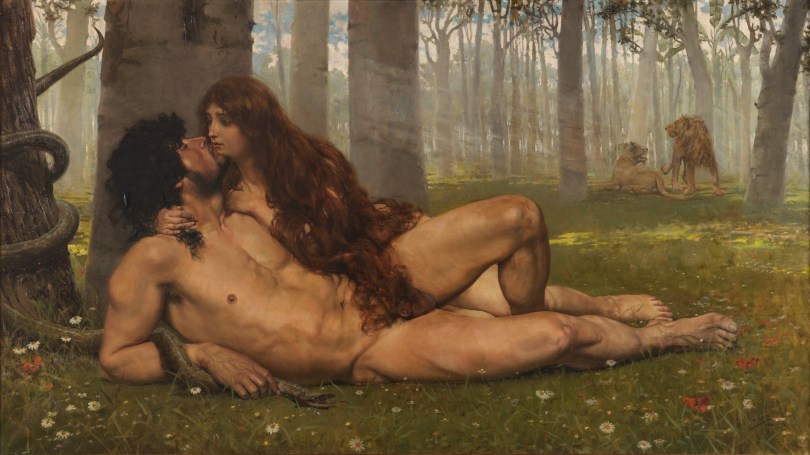
Featured image: The First Kiss of Adam and Eve. Salvador Viniegra (1891). Public Domain.
During archaeological excavations, female figurines have been found. They could depict mother goddesses. The most famous example is the Venus of Willendorf, dating back to around 23,000 BC. In ancient cultures, mother goddesses represented fertility. The ability of women to bear offspring may have been central to Mother Goddess worship. Women give birth, and early humans may not have understood that men were the fathers. They may have thought men had no reproductive use and existed to please the women. Consequently, the Mother Goddess can give birth as a virgin, which is the miracle of the Mother Goddess. One of the best-known Mother Goddesses was Isis.
Women can be sure that their children are their own, but men can’t. When the fathers of children are unknown, families are often matrilineal, meaning that family lines run through mothers. The goddess worship may have disappeared because men desired to control women and their sexuality. The transition from hunting and gathering to agriculture may have played a crucial role in this development.
Hunter-gatherers were wanderers. They had fewer territorial conflicts. Population density was low, and they had no property, so it was easier to move on if a stronger group invaded a band’s territory.1 That changed with the advent of agriculture. Farmers had to defend their property and families against thieves and invaders. It became a matter of life and death, so warfare became more common and deadly. Giving up territory would mean starvation. Men are willing to protect women and children they consider their own. And they can walk out when they doubt their fatherhood. That gave them a position of power, allowing patriarchy to emerge.
Male dominance is almost universal among humans, with only a few exceptions, so it is something more than merely a cultural phenomenon. Our closest relatives, the chimpanzees, live in groups led by males, while the bonobos live in groups dominated by females. And so it is a natural human inclination.1As humans are programmable and have diverse cultures, they can overcome their natural inclinations and choose female leaders, or make female leadership the standard in their societies, and invent myths to justify the arrangement, such as stories about the Goddess creating men as companions for women.
As we have no written records, we know little about the lives of hunter-gatherers, their leaders and their family structures. Still, we do know that there must have been enormous cultural diversity, as they lived in small groups with little or no contact with one another. The lifestyle of hunter-gatherers was more favourable to female leadership and matrilineal families than in farming communities, so these were likely more common before the Agricultural Revolution. Peaceful conditions and a belief that men have no reproductive role, thus only exist to please women, could produce female-centred societies.
In her book, When God Was a Woman, historian Merlin Stone claims that goddess worship was the earliest religion in the Near and Middle East. The Creator was a woman before men rewrote history. Stone bases her claim on the discovery of female figurines in archaeological finds. In a 7,000-year-old settlement in Turkey, where archaeologists also found these figurines, families were matrilineal.2
The Garden of Eden features in an ancient Mesopotamian myth, the Epic of Gilgamesh. The garden was near the Tigris and Euphrates rivers. The Jews lived in exile in Babylon when their priests compiled their holy scriptures. The first chapters of Genesis take place in Mesopotamia. Jewish scribes tailored Mesopotamian myths to their needs and incorporated them into the Jewish Bible.
In the Epic of Gilgamesh, the gods created a man from clay, much like in Genesis. Adam means ‘he who came from the ground’. In another creation myth, a goddess gave birth to humanity. Eve means ‘living one’ or ‘life-giver’. The Biblical account might be a merger of these two stories. Eve, having been Adam’s mother, makes more sense than Eve coming from Adam’s rib. She is the Mother of All the Living (Genesis 3:20), and we are the woman’s offspring (seed) (Genesis 3:15). Elsewhere in the Bible, a child is the father’s offspring, which is a noteworthy difference. It implies that we come from women and that men have no reproductive role. That perspective sheds a new light on what Eve said about giving birth to Cain (Genesis 4:1),
Adam made love to his wife Eve, and she became pregnant and gave birth to Cain. She said, ‘With the help of the Lord I have brought forth a man.’
It wasn’t making love to Adam that made Eve give birth, but the Lord’s help. That is remarkable because we are the woman’s offspring (seed). Eve didn’t need Adam to have a child. Yet, there is another twist to this. Long before the Jews went into exile in Babylon and picked up the story about the Garden of Eden, Asherah was the wife of El. They together were the supreme gods of the Canaanite divine council.3 Perhaps they, together, not only brought forth lesser deities like Yahweh, but also the humans, starting with Cain and Abel, making Asherah the Mother of All the Living.4
There was likely no strict division between the human and divine realms in the Canaanite belief system at first, so there was intercourse between ‘sons of God’ and humans (Genesis 6:1-4). It seems out of place because that context is now lost. Later on, the Jews grew particularly attached to Yahweh, so Yahweh became their supreme deity, replacing El. It was a gradual process that unfolded over centuries, during which Yahweh also adopted some of the features of his main competitor, Baal, a storm deity.5 Asherah then became Yahweh’s wife.
When the Jews were in exile in Babylon, they drew on local myths to revise their creation account, making it a mixture of Jewish and Babylonian myths. They combined a story in which the first woman gave birth to the first man with one in which God made the first man from clay. In the process of glueing it all together, they may have merged the goddess Asherah into the woman Eve. And so, Adam came late for the first man. Asherah then went out of the window, as the Jews turned monotheist. That is speculation, and few have dared to go there, for the evidence to draw such a conclusion is sparse. Yet, it is plausible and explains a few enigmas quite neatly, but it likely is not precisely what happened.
In the original Mesopotamian tale, Eve gave birth to Adam without prior sexual intercourse. The miracle of the Mother Goddess is the virgin birth. Jesus supposedly was born of a virgin. Since God was supposedly Jesus’ Father, he couldn’t have had a human father. That is the reason we know about. However, it originally alluded to Adam’s birth. Jesus was God’s son because he was Adam reincarnated, the son of Eve, who was God, or so Mary Magdalene made Jesus believe, for the only evidence is that Eve became the Mother of All the Living by taking over Asherah’s role, who was the original Mother Goddess and possibly the mother of humanity. Yet, Asherah was married to El, so only by confounding these two stories might you arrive at such a conclusion.
In scriptural religions, inventing a new story is preferable to contradicting an existing one, as that would imply that the scriptures are corrupt. And you can’t have that, most notably when Paul was around. The virgin birth was a substitute for the facts, as God was to become Jesus’ father, as it reflected God being Jesus’ mother, as God’s name was also Mary. It miraculously solved a serious impediment to unity within the Church, prompting early Christians to agree on this compromise.
The Bible claims that God created a man from the dust of the ground (Genesis 2:7) to work in the garden (Genesis 2:15) and made a woman as a companion for the man (Genesis 2:18). This reflects a merging with another creation myth. Mesopotamia had several creation myths, including one where the gods fashioned a man from clay to do the work. The Bible has two creation stories as well. In Genesis 1, God creates all that is, and then in Genesis 2, God repeats some of that work. Also, there has been some patching here and there to glue these two stories together. In fact, the entire Jewish Bible is a patchwork of stories glued together.
In the original story of Eve and Adam, the man’s purpose was to be the woman’s mate. A reason to think so is that Genesis mentions the woman’s desire for her husband rather than the man’s desire for his wife (Genesis 3:16). If you live in a modern society that has undergone several waves of feminism, you may not realise how odd noting a woman’s desire for a man truly is. The Bible is a product of a patriarchal society. In a patriarchal society, a woman is often a man’s possession, and her desires are of no consequence. The original tale thus had a woman’s perspective. Eve was the leading character. She discussed eating the fruit with the serpent and made Adam eat from it (Genesis 3:1-6). And it was Eve who commented on Cain’s birth, not Adam (Genesis 4:1).
Also noteworthy is that a man left his father and mother to be with his wife (Genesis 2:24). This was how life was in Eden. In patrilineal societies, family groups centre on fathers, while in matrilineal societies, they centre on mothers. Women join their husbands’ families in patrilineal societies. The man leaving his father and mother thus suggests that family groups in Eden were matrilineal. Experts still debate whether hunter-gatherers lived in patrilineal or matrilineal groups. The limited interest among men in childcare suggests that matrilineal groups may have been the norm as long as there were no compelling reasons to do otherwise. These reasons emerged with the advent of agriculture. The title Mother of All the Living may also refer to the Mother Goddess.6 Ashera was the Mother Goddess in Canaan, and one of the deities of the Jews before they became monotheists. Eve also resembles Namma, the primordial mother in the story of Enki and Ninmah.
The story of the Fall is about the curse of knowledge. The Bible tells us it is the knowledge of good and evil, but that is the twist that the Jews gave to the story. You can infer that from what followed. They ate from the tree and realised that they were naked. In other words, they came to know, and there is nothing evil about being naked if that was how life was in Paradise. More knowledge doesn’t make your life better, and God knew.
Knowledge of agriculture enabled the switch from hunting and gathering to agriculture, thereby condemning humankind to a life of toil. The life of hunter-gatherers was more agreeable than the plight of farmers. They had a more varied diet, worked fewer hours, and spent their time doing more exciting things. Additionally, they were less likely to face starvation, disease, and warfare. The Agricultural Revolution did increase the total amount of available food. Yet, this extra food didn’t lead to a better life. It only allowed more people to survive, including elites such as kings and priests, who ate the extra food. The peasants worked harder than the foragers before them and got a poorer life in return.1
The Garden of Eden provided for everything. It was the supposed ideal state of humans, in which they tended and oversaw God’s garden. Eve and Adam were nude (Genesis 2:25), as hunter-gatherers in the jungle today are, so they lived simple lives. They may have been vegetarians, as God only gave them permission to eat plants (Genesis 1:28-30),
God blessed them and said to them, ‘Be fruitful and increase in number; fill the earth and subdue it. Rule over the fish in the sea and the birds in the sky and over every living creature that moves on the ground.’ Then God said, ‘I give you every seed-bearing plant on the face of the whole earth and every tree that has fruit with seed in it. They will be yours for food. And to all the beasts of the earth and all the birds in the sky and all the creatures that move along the ground—everything that has the breath of life in it—I give every green plant for food.’ And it was so.
God once again commanded the man that he was free to eat from any tree in the garden (Genesis 2:16), but did not mention animals. Ruling the animals is not the same as eating them. Eden is the ideal state of Paradise, where we can eat every plant. Meat is a natural part of our diet, so its omission is noteworthy. Yet, it is an idealistic state. God didn’t intend animals to eat meat, either, which obviously is not reality as it is.
As for later verses allowing us to eat animals, it is the same as it is for divorce. Jesus said that it was a concession to our hardness of heart rather than God’s intent. It is where idealism meets a reality check. If a marriage is unhappy, divorce may be the best option. And we may need to eat meat to get the required nutrients. Still, the ruling suggests that eating more meat than necessary, mistreating animals, or killing animals for fun is a sin.
After the Fall, working the land became a life of toil (Genesis 3:17-19), the curse of the Agricultural Revolution. The original tale was also about the downfall of women. Women had to obey their husbands from then on (Genesis 3:16). So, when Jesus said that Moses permitted men to divorce their wives because their hearts were hard, but that it was not this way from the beginning (Matthew 19:18), he could have said the same about slaughtering and eating animals.
In ancient cultures, people venerated snakes for their wisdom so that a snake could provide advice. The snake being evil might be a later-added twist. The tree of knowledge, in the original story, thus may have provided knowledge as such, and that knowledge being about good and evil may also be a later addition. The reason to think so is that after eating from it, Eve and Adam discovered their nakedness rather than found out about good and evil. The theme relates to the sacred tree, which may explain why eating from it was forbidden. Eve’s deed may reflect women’s role in the start of the Agricultural Revolution. Farmers must protect their crops from thieves. Otherwise, they face starvation. It condemned men to a life of warfare. It started with Cain and Abel.
The Abrahamic religions disagree with our Creator being a woman. The Jewish deity Yahweh and the Arabian deity Allah were male, even though many people now think God has no gender. Yahweh and Allah had wives and children before monotheism took over. Allah was at first the supreme deity of Mecca. Later, the owner of the universe appropriated this title. To address the confusion this act generated, the Quran stresses that God has no partner or children. Unlike Christians, Jews and Muslims don’t see God as a Father. Yet Christians are born of God, a most remarkable wording.
The Quran extensively mentions the creation of Adam but says little about the origin of Eve. The Quran doesn’t claim that Eve came from Adam’s rib but that men and women come from one soul (Quran 4:1, 7:189). It relates to Genesis 1:27, in which God created males and females in His image, so that the soul could be God. The Quran further claims that God created Jesus like Adam from dust (Quran 3:59). The Quran also corroborates the virgin birth story of Jesus (Quran 3:47, 66:12). Christians understand the virgin birth story in the context of God being Jesus’ Father, so that he can’t have a human father. However, the Quran makes it clear that God is not Jesus’ Father. And so, being created from dust could refer to birth from a virgin, so Eve could have been Adam’s mother.
The account of the Fall in the Quran differs from that in Genesis in several noteworthy respects. The Quran features no serpent, and Eve didn’t make Adam eat from the tree. The Quran holds both Eve and Adam responsible for the Fall (Quran 7:19-23). Another fragment only blames Adam,
But Satan whispered to him, saying, ‘O Adam! Shall I show you the Tree of Immortality and a kingdom that does not fade away?’ So they both [Eve and Adam]] ate from the tree and then their nakedness was exposed to them, prompting them to cover themselves with leaves from Paradise. So Adam disobeyed his Lord, and so he lost his way.
(Quran 20:120-121)
The historical context of the original story, the curse of the Agricultural Revolution, and the role of women in it have been lost in the Quran. The first Christians believed that Eve was God, the Mother of all the Living, who gave birth to Adam, that Mary Magdalene was Eve, and Jesus was Adam. So Adam and, therefore, Jesus were the Son of God. Humanity descends from Eve, so we are not only God’s children, but also Jesus’ children.
Humans are religious creatures who fight over the myths they believe in, and we will continue to do so until the very end, with increasingly sophisticated means, until humans have terminated themselves. Hence, we need to unite behind a single myth to live in peace. That only happens in fairy-tale worlds where myths can become reality. It may be why Christianity and Islam have been so intolerant towards infidels. Tribal people feel a connection to one another because they believe they share common ancestors. The stories about these common ancestors are myths, such as the tale about Eve and Adam. Eve and Adam came alive again as Mary Magdalene and Jesus. A myth of shared ancestors can turn humanity into a single tribe. And so, Paul may have realised that the good news of Jesus concerns humankind rather than just the Jews.
Latest revision: 28 August 2026
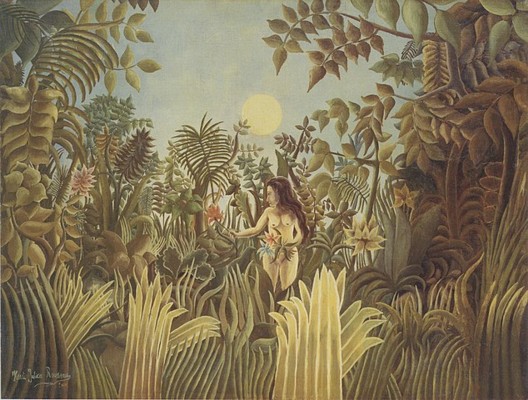
Featured image: Eve in the Garden of Eden. Henri Rousseau (1906-1910). Public Domain. Wikimedia Commons.
Other images: Venus of Willendorf. Don Hitchcock (2008). Wikimedia Commons.
1. A Brief History Of Humankind. Yuval Noah Harari (2014). Harvill Secker. 2. Ancient ‘female-centered’ society thrived 9,000 years ago in a proto-city in Turkey. Kristina Killgrove (2025). Livescience. 3. Daniel O. McClellan, Deity and Divine Agency in the Hebrew Bible: Cognitive Perspectives (PhD diss., University of Exeter, 2020), 327 4. Eve as a goddess/consort of Yahweh? r/AskBibleScholars (2024). [link] 5. The Early History of God: Yahweh and the Other Deities in Ancient Israel. Mark. S. Smith (2002). William B. Eerdmans Publishing Co. 6. Asherah – Wikipedia [link]: Some scholars have found an early link between Asherah and Eve, based upon the coincidence of their common title as “the mother of all living” in Genesis 3:20 through the identification with the Hurrian mother goddess Hebat. Asherah was also given the title Chawat, from which the Aramaic name Hawwah and the biblical name Eve are derived.