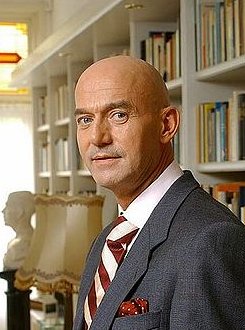
Pim Fortuyn on 4 May 2002, two days before his assassination

Troubles in the Multicultural Society

Balls on the ground

The Netherlands has been one of the most liberal countries in the world. The country has a long tradition of tolerance dating back to the Dutch Republic. It was also a fairy-tale society, with Van Kooten and De Bie seeking the nuance. Their characters represented the so-called conservative, ignorant and xenophobic undercurrent in Dutch society, and also hustlers, such as Jacobse and Van Es, infiltrating politics with their corrupt schemes and dubious deals. That undercurrent didn’t go away. Instead, it grew stronger, as immigrants continued to arrive, causing increasing unease. The progressive values many Dutch cherished didn’t agree with the conservative worldviews of many immigrants, most notably Muslims. These feelings needed a catalyst to give the discontent a voice. The existing political parties had become complacent and didn’t see what was coming. Nor had I.

After the terrorist attacks of 11 September 2001, a maverick politician, Pim Fortuyn, rose to prominence with his strong views on immigration and Islam. Fortuyn claimed that leftists were to blame for immigration. He called them the Leftist Church for their moral superiority claims, who would call you a racist if you opposed immigration. There is a lot of racism, but it was not the reason why the movement gained strength. Many Dutch people desired to limit immigration, most notably of people who had trouble adapting. Only, no politician raised the issue the way Fortuyn did. The others were careful not to promote division. Most immigrants did okay, so inciting hatred wouldn’t improve things. Keeping a good society is not a simple affair. It is like juggling several balls in the air. Fortuyn didn’t seem to care and sought personal fame. And he believed that allowing immigration to continue would make it harder to maintain an agreeable society.

Fortuyn attacked the fairy tale of the multicultural society, and called it a failure. I had believed in it or wanted to believe in it. If there is ever to be world peace, the world must unite and become one multicultural society. Living with people from different cultures isn’t easy and could easily go wrong, and I knew that because of what had happened to me as a student. Culture can be an unbridgeable gap. Some Fortuyn supporters seemed to anticipate civil war and hoped that it would start sooner rather than later, when the authentic white Dutch were still a majority. The atmosphere quickly turned grim. Under the guise of free speech, the sewers opened, and the rivers of hatred flooded freely into the open. Fortuyn’s rise made headlines in the international press as it represented a clear break with the past, occurring in what many believed was the world’s most liberal country.

Having lived in neighbourhoods with ethnic minorities myself, the picture the fascists presented differed from my personal experiences. So, my initial belief was that it was mostly bigotry, racism and hatred. Perhaps people would calm down over time, and reason would prevail. A leftist poster with the avatar Kingie launched a new website, BeursKings (MarketKings), with help from Danger Money, who programmed it. A small group left IEX and joined the new message board, including me. BeursKings remained in operation for several years. Kingie once posted photographs of himself. That was a shock. He looked like my double. In hindsight, that is remarkable because of his avatar name. Others who remained on IEX also joined the BeursKings message board. I was part of the so-called Leftist Church and had tried to rein in the bigotry. One of the IEX posters once called me ‘vicar’ for my moralising.

Somehow, I had come into his crosshairs. A spectacular profit he had made on a semiconductor stock might have made him think he was a genius. He was not the only one. The Dot-Com bubble led some people to believe, for a while, that they were stock-market legends, beating investment gurus like Warren Buffett, until the bubble imploded. My investment returns have never justified those kinds of ideas, but I could write stories people liked to read. This guy was a physicist working in a laboratory, or so he once wrote, and a Czech, a relative of Franz Kafka, he further confided on the message board. He thought that his excellent investment results came from ‘observing the herd and anticipating where it would go next’ rather than from luck in picking a winning stock. He was eager to pick on me, but when I returned years later to IEX, he praised me for identifying interest charges on money and debts as a root cause of financial collapse.

Shortly before the 2002 elections, a left-wing loner assassinated Fortuyn. Fortuyn had hinted at that possibility. If something were to happen to him, he claimed, it would be because establishment politicians had demonised him. The socialist-in-name-only Marcel van Dam, who lived in a luxurious mansion far away from multicultural neighbourhoods, and who had always been eager to take the moral high ground, once called Fortuyn an ‘exceptionally inferior human.’ And so, you may ask yourself, who of the two was the most superb Nazi? Fortuyn gave a presentable at-your-service salute that might go well in some fascist circles, but his ‘inferior human’ remark gave Van Dam an edge.

Others called Fortuyn ‘extreme’ or ‘demolishing society’ because he was stirring up public sentiment. Fortuyn was a man of theatre, hyping the wrongs others did to him while being a jerk himself. The Netherlands is not a violent country. It was the first political assassination in 400 years, so no one saw it coming. The civil war didn’t arrive, but death threats to politicians have become common. The attitudes toward immigrants and Islam have also changed. Fifteen years later, the United States saw the rise of a similar leader, and they are more alike than most people think.

Fortuyn’s assassin, Volkert van der Graaf, was diagnosed with Asperger’s syndrome. He was someone like me. To him, Fortuyn may have been a new Hitler on the rise. He feared Fortuyn would tear down Dutch society so that the weak, such as the poor and refugees, would suffer, and also animals, as he had been an animal rights activist. Van der Graaf drew a logical conclusion from the facts, or so he believed. The problem with this kind of thinking is that we don’t know the future. Mass immigration can destabilise a country. Van der Graaf had good intentions, but Fortuyn also believed he was serving the Netherlands. Yet, there was something evil about Fortuyn. I am not a trained psychologist, but Fortuyn was someone who wanted to be the centre of attention and wield power, and didn’t care about the consequences of his actions, much like Donald Trump.

Harry Mens, a Dutch real estate tycoon whom you might call the Dutch Donald Trump, had promoted Fortuyn on his television show, Business Class. So, like Trump, Mens had a television show. Fortuyn’s appearance on his show foreshadowed a new type of politics, common in the United States but not in the Netherlands, in which wealthy money men fund the politicians. I found Mr Mens to be a questionable character, boasting and flaunting his wealth. At the time, I didn’t think of Trump, but there are parallels. His programme was about investments with people in suits and dresses promoting their investment services. A few advertisers on his show turned out to be frauds, such as Palm Invest.

I see Pim Fortuyn and Donald Trump as narcissistic psychopaths. These are not official diagnoses, but personal impressions. However, I am not alone. Some psychoanalysts concluded that Fortuyn was a narcissist, possibly because of feelings of inferiority that he needed to compensate for with praise. It was all about him, and other people were just utensils. His neurotic disturbances and unresolved personality flaws made Pim Fortuyn such a powerful force. One psychoanalyst said, ‘Imagine if he had to go on a state visit to US President Bush. He would exhibit Sun King-like behaviour.’1 To Fortuyn, the US President would have been a mere extra in the Pim Fortuyn show. Even though the psychoanalysts didn’t raise that particular issue, Pim Fortuyn seemed to enjoy hurting other people’s feelings, making me think he was a psychopath as well.

If you consider the characteristics of narcissistic psychopaths, you might discover they are the opposite of Asperger’s syndrome. I name a few: (1) thriving on chaos versus thriving in order, (2) desiring to be the centre of attention versus not wanting attention or praise, (3) manipulative and lying versus honest and forthright and (4) charming versus impolite. At first glance, Fortuyn and Trump seemed impolite rather than charming. That needs further explanation. First, you don’t have to check all the boxes to be autistic or a psychopath. And second, the impoliteness of the autistic person comes from being honest. By being rude, Fortuyn and Trump catered to the fear and anger of their supporters. They told them what they wanted to hear. Still, I think that Fortuyn and Trump both believed that what they were doing was necessary. What can make psychopaths successful as leaders is that they are willing to hurt people, which may be required to do what is necessary. With these words, I conclude my psychoanalysis session.

Life went on

Beurkings also attracted a few posters who remained on IEX, and they were the most colourful ones. One of them, Xzorro, didn’t believe the 9/11 conspiracy theories and thought that the success of the attacks was due to the incompetence of the American authorities. Yet, his conspiracy thinking went in another direction. He believed the allegations that a high-ranking Dutch Prosecution official, Joris Demmink, had had sex with underage male prostitutes and that there was a conspiracy within the Dutch government to cover it up. An investigative journalist and conspiracy theorist, Micha Kat, had pursued the matter relentlessly for years. In the 1990s, there had been a police investigation into possible child abuse by four high-ranking government officials.

The investigation had collapsed after someone had leaked information. During raids, the police found no incriminating evidence on the suspects. Fred Teeven, who had led the investigation, later stated that Demmink had not been a person of interest in that investigation. The Dutch newspaper AD later claimed that Demmink had contact in the 1980s with a pimp of underage boys. Kat was onto something, but he was also a nutcase. Kat later claimed that children buried in a Bodegraven cemetery were victims of Satanic child abusers, which was nonsense and easy to disprove. And Kat had a conviction for making death threats to a fellow journalist.

Another noteworthy poster on BeursKings, Gung Ho, who lived in the Dutch countryside, favoured traditional US conservatism and posted lengthy pieces copied from American conservative websites, including some claiming that US Neoconservatives were Leninist agitators. He enthusiastically promoted a penny stock, Clifton Mining, and believed that colloidal silver was a cure against many diseases. That made him the subject of mockery, most notably by Amoricano, an American of Dutch origin who long had been on IEX. Gung Ho might have been in the military and had friends in the American military, or so his sparse remarks about his personal life suggested.

Gung Ho posted comments about the Neoconservatives in the Bush Administration being chicken hawks, so cowards who send others to war while having done no military service themselves. His use of language was odd, which made his lengthy texts amusing. The connection he made between Neoconservatism and Leninism seemed obscure to me at the time. Still, like the Leninists, the Neoconservatives use Hegel’s dialectic to promote social progress via revolutions and wars. The conflict between the West and Islam was their latest project, founded on the clash-of-civilisations ideology, and the Iraq War was one of its consequences. Traditional conservatives like Gung Ho opposed these methods.

There was also a psychiatrist on BeursKings. He had quit his job and tried to make a living by day trading. He posted under the name Kindval, a soccer player from the 1970s. He didn’t seem to like me. When someone attacked me personally or for my political views, he consistently upvoted these comments. He was usually a bit edgy and irritable, making me think that his life as a parasite didn’t work out so well for him, and he would have to work for a living again. I didn’t make those kinds of comments, so that was not why he disliked me. Once, Gung Ho went loose on him by suggesting he had psychological issues. I upvoted that comment. It was a rare occasion for me to upvote a negative comment. Kindval became agitated about Gung Ho’s comment, but even more so about my upvote, which was particularly odd, as he had done the same to me several times before, never missing a single opportunity. That made me think that he was, as Gung Ho implied, on his way to a nervous breakdown, thereby confirming the prejudice of psychiatrists choosing their profession because of having mental issues themselves.

Fortuyn’s rise had made me curious about the troubles in the multicultural society. The fallout of my student years of not fitting in had made me interested in cultural differences. And I believed that the multicultural society had to work because the existence of nation-states and tribes causes warfare. So, what stands in the way of success? Is the gap between Islamic and Western culture unbridgeable? It kindled my interest in Muslims and their beliefs. And why is there trouble? That made me join the message board Maroc.nl for people with a Moroccan background in 2004. They are a disregarded minority. Most notably, young Moroccan men cause trouble. Some other minority groups also have issues, but Moroccans receive the most negative attention. Indeed, they have a serious likeability problem. When the nationalist politician Geert Wilders singled out one minority for deportation, he chose the Moroccans in his infamous ‘fewer Moroccans’ quote, ‘Fewer Moroccans. Let us take care of that.’

Historical causes have contributed to the issue. The Netherlands had selected poorly educated country dwellers from the Rif Mountains to work in Dutch factories. They were Berbers who call themselves Imazighen, meaning ‘free people.’ Their culture comes with a deep distrust of government. In Morocco, they have long been secondary citizens in a country dominated by Arab culture. That came with brutal repression in the past. Today, the Moroccan government recognises their culture and language. The Dutch expected them to return home, so they didn’t invest in their integration at first. Most didn’t return, also because they had stayed for a long time and had raised families in the Netherlands. And because they felt like outsiders and disrespected by the Dutch, many youngsters found their way into gang culture. Their culture of disrespect for authorities adds to the problems. It is mostly youths who misbehave. Many change their ways as adults, but by then, a new generation of troublemakers has replaced them.

No gain without pain

The issues Moroccans in the Netherlands face, and how they relate to society, compare to those of blacks in the United States, even though the blacks in the United States do identify as Americans. The message board was open. Everyone could join. It featured discussions about religion and social issues. Various people shared their opinions and discussed them with one another. People came and went on the message board over the years. I have been on it for two decades, not every day, but regularly. Occasionally, there were heated exchanges, with Moroccans complaining about the racism of the Dutch and Dutch complaining about the misconduct of the Moroccans. What they call racism is often discrimination. Cultural groups favour each other, which makes the issue harder to solve, except by reducing differences, so that people mix more easily. Muslims generally do not mix well with non-Muslims.

A Dutchman sometimes asked why Moroccans don’t openly distance themselves from fellow Moroccans who misbehave. A Moroccan would argue that he is not responsible for the conduct of others, and there is no reason to make excuses for what others do. He also doesn’t ask the Dutch to excuse themselves for the misconduct of fellow Dutch. It is a fair point, but that attitude causes problems. Pride and honour mean less to the Dutch than to Moroccans. On a Dutch message board, I found the following observation: ‘Moroccan youths have a macho attitude and a short fuse. They see criticism as a personal attack, and if they don’t aggressively go against it, their friends will see them as sissies.’ That goes a long way in explaining the issue. A psychologist might call it an inferiority complex. Like Pim Fortuyn, they act out hysterically. Yet, if you are a bit self-critical and less hostile, others will like you much better.

There were a few agitators from both sides, so Moroccans and Dutch, but overall, the discussions were insightful, thanks to the diversity of posters expressing their opinions. On the board, the moderators sometimes discriminated against the Dutch, who received bans for lighter offences than Moroccans did. As far as discrimination goes, Moroccans are no better than the Dutch. Still, it was an open message board nonetheless, and in most cases, misconduct preceded a ban. Likely, the message board had received a grant and was obliged to keep it a safe space for a variety of opinions. There were Christians, Jews, Muslims, former Fortuyn supporters, and leftists. There were also gays seeking to counter the hatred of LGBTQ people because of street violence against them.

Violence against LGBTQ people is one of the issues at play, and also Jews. Some posters on the message board argued that native Dutch commit more hate crimes against LGBTQ people, which is correct because there are far more native Dutch. Likewise, you can point at soccer hooligans or drunk Dutch causing trouble abroad at holiday destinations. It is how you can twist the numbers, as the sophists did in ancient Greece. For problem-solving, this tactic isn’t helpful. If you do that, you make people angry. The sophists were unpopular, and it wouldn’t surprise me if angry peasants had hanged a few. Statisticians look at percentages of the population, which makes more sense. The message board had a diversity of opinions and an exchange of views. It allowed me to learn by watching them dispute and considering the merits of their opinions.

Some Dutch have complained about annoying individuals who demand respect up front before they accept you, whereas you normally take a neutral stance toward new people you meet and give respect when you think someone deserves it. One poster acted like a complete jerk to me for a considerable time, and for no obvious reason, so the only reason could have been that I was Dutch, until I upvoted one of his comments. From then on, he saw me as his best friend. To be fair, I have had a fair share of people acting like jerks to me for no reason, but unlike this particular fellow, they weren’t looking for respect. Again, a psychologist might attribute it to an inferiority complex. He may have presupposed that I didn’t respect him based on the assumption that every Dutchman hates him, which becomes a self-fulfilling prophecy if that belief leads him to act like a jerk.

Traditional Muslims are strict on religion, much like conservative Christians. They have more in common with each other than with liberals. So, why many liberals like Muslims, and conservative Christians dislike them, is quite an enigma if you reason from their beliefs alone. Terrorists usually are young men who seek meaning in life and find it in Islam, and then fall prey to extremist preachers. There aren’t that many, but a few hundred can already be a serious threat. During the first year, there was uproar over the Dutch publicist Theo van Gogh, who was indeed kin to the famous Dutch painter. Under the guise of freedom of speech, he called Muslims ‘goat fuckers’ and Muhammad ‘a pimp’. The people on the message board didn’t care much about being called ‘goat fuckers,’ but insulting Muhammad was a red line that genuinely upset them.

Several posters also expressed fury about the Somali lady Ayaan Hirsi Ali, who had left Islam for a liberal lifestyle, and had, together with Van Gogh, made the short film Submission about the suppression and mistreatment of women by Muslims. To Muslims, the film was blasphemous as it showed the bodies of abused women with Quran verses on them that the filmmakers claimed Muslims use to justify mistreating women. Hirsi Ali also had called Muhammad a ‘pervert.’ She faced death threats. The anti-immigration and anti-Islam politician Geert Wilders also faced death threats and requires security to this day.

Hirsi Ali had escaped an arranged marriage. The Dutch police prevented her family from abducting her from an asylum seeker centre in Almelo. She later moved to the United States to work for the neoconservative think tank. Van Gogh paid for his Islam-insulting binge with his life. A youngster of Moroccan descent slit his throat, precisely 911 days after the Fortuyn assassination. That was on 2 November, which refers to the European emergency services telephone number 112, the European equivalent of 911. So, in the first year, the atmosphere on the message board was tense.

Western interventions in the Middle East and Western support for Israel also angered quite a few people, and that goes a long way in explaining violent incidents against Jews. Islam itself, like Christianity, is not hostile against Jews, but Muslims and Christians can be, and Jews can be hostile to Muslims and Christians where they are the majority, like in Israel. Israel illegally occupied Palestinian land, and Palestinians kept on committing acts of terrorism. It has proven to be an irresolvable conflict. Several posters on the message board viewed the West, including the Netherlands, as anti-Islamic.

Some Dutch have argued that they are ungrateful, as the Netherlands provided them with a good life and freedom of religion. If it was so bad over here, why don’t they move to an Islamic country where life is better? I tried not to offend people with my opinions. At first, I was making up my mind anyhow. It is a conflict between two worldviews, each with its own logic and merit. As a Hegelian dialectic indicates, there is an underlying truth, whatever that may be. In any case, the West was not morally superior. In the first years, the American gangster heist called the Iraq War was still in progress. For me, the Iraq War became an unexpected mental dip. The Americans had tricked me into believing that Saddam Hussein had a stash of WMDs, so that I hadn’t opposed that war.

Once I saw live on CNN how the bombs fell on Baghdad and how gung-ho Americans ran over the country’s defences, and murdered the defenceless Iraqis, with the Iraqi Information Minister vehemently claiming until the very end that there were no Americans in Baghdad, and that all American forces had been obliterated, my mood suddenly swung to dim. And then there were no WMDs. That was the year before I joined the message board. They had bombed a country into ruins and killed thousands for no good reason.

The Netherlands has been a major contributor to the American war effort in Iraq as well as Afghanistan. It doesn’t seem like a coincidence that the Dutch Prime Minister Balkenende had praised the Dutch VOC mentality of the former Dutch colonial enterprise that had invaded and looted the Indies under the guise of trade. The United States had merely copied that proud Dutch tradition of the looting oligarchic merchant republic of the Netherlands. The United States now has the VOC mentality. Shell was a Dutch company, so the Dutch had to be in on the action, or so Mr Balkenende may have reasoned.

That, and Dutch liberal values, explain, to some extent, the negative views about the West and the Netherlands among the Moroccans on the message board. Some may have used these issues as an excuse for their misconduct and crimes that they would have committed anyway. Some could get angry at you simply for being Dutch because they think they know what you think. That may also be because some Dutch came to the message board only to lecture the Moroccans about the backwardness of Islam or the misconduct of Moroccan youngsters. That didn’t work out so well. You also wouldn’t change your mind when someone you have never met before came out of the blue to tell you how stupid your religion is and that your community is a bunch of criminals. As for the Israeli-Palestinian conflict, some Dutch would say that Palestinians keep on committing acts of terrorism, thereby challenging a much stronger adversary, and then whine about losing the fight. There was also a private messaging system. Over the years, two ladies contacted me as they preferred a Dutch husband and hoped that I was a Muslim.

Three posters once wrote that they had been in prison. One even posted from jail, so he had access to the Internet or a smartphone. They were discussing the Dutch police. Some were racist, they claimed, but others were professional. There had been hundreds of posters on that message board over the years, so that says little, but not everyone would openly write about having been in prison, and it is illustrative of the prejudices many Dutch have. If, as the statistics suggest, crime levels in their community are three times those of native Dutch. Some have argued that you bear no blame for other people’s faults, which is what the law says. Still, if a group’s culture contributes to these issues, the group itself has a problem. One is that the Dutch dislike Moroccans more than any other ethnic minority.

As the most-hated child of the entire school, I have been there. It was not entirely my fault, but I was part of the problem, and the only one I could fix was myself, not the others. Some other minorities face similar issues, but Moroccans, more than other minorities, seem to have an attitude problem of not acknowledging their own faults and blaming Dutch society. There is a lot of negative sentiment festering among the population that the mainstream media hardly reports on. Negativity makes matters worse for those who do well, but it is hard to change opinions among the Dutch as long as there is a problem.

The Moroccans on the message board hardly expressed pride about fellow Moroccans who did well in the Netherlands, such as Ahmed Aboutaleb, the mayor of Rotterdam, who was popular among the Dutch and would have had a good chance of becoming Prime Minister if he had demonstrated that ambition, or Khadijah Arib, who became Speaker of the House. Some called them bounty, so brown on the outside, but white on the inside, hence traitors of their Moroccan identity by siding with the Dutch or accepting their values.

Bounty politics means that the Dutch accept diversity as long as the migrants accept Dutch values. The Dutch question the allegiance of someone with a Moroccan or Turkish background more than that of someone from Sweden or France, due to the greater cultural distance, so they would ask Moroccans questions they wouldn’t ask someone from Sweden or France. And whites in New Zealand wouldn’t ask such questions of the Maori because the Maori were there before the whites came. It touches the core issue with diversity. It works better if we identify as one nation and believe in a common destiny.

The majority of Moroccans do all right, but the minority that causes trouble is large and problematic enough to drag down the group’s image. That well-known guy with a tainted skin on a scooter, who regularly features as a suspect in crime reports, ranging from street intimidation, robbery, and harassing women, often comes from that particular ethnic group. The most notorious ‘Dutch’ criminal, Ridouan T, is of Moroccan descent. And the pimps luring or forcing vulnerable girls into prostitution are also often has a Moroccan or Turkish heritage. That is not due to neglect of Dutch government. As a result of investments made in opportunities for minorities, some of the best Dutch schools are Islamic. There is not much more that the Dutch government could have done to help them.

Another issue causing upheaval in the Dutch multicultural society was the tradition of Saint Nicholas, in which a long-bearded, centuries-old white man from Spain arrived with a group of black servants to deliver presents to children. For long, that was fine as it was an old tradition and there had not been slavery of blacks in the Low Countries itself, so the Dutch didn’t associate the helpers with enslavement of blacks. As a child, I believed their faces were black because they went down chimneys to deliver the presents. Americans who saw it were appalled as the tradition involved blackfacing. A black American woman working at the United Nations raised the issue, and black activists in the Netherlands began protesting. The issue remained contentious for over a decade.

The compromise gradually became the soot-stain helper, a helper with soot-stain marks from going into chimneys. For the remainder, nothing changed. Yet a significant group of Dutch didn’t like black people telling them to change the tradition, which they claimed was part of Dutch cultural heritage. There had been some agitated encounters with the activists. The black activists had a point, but it was mainly a pissing contest between white egos and black egos. Whites could have accepted that the tradition had racist elements and that the soot-stain helper didn’t meaningfully change it, while the black activists could have understood that it was a quaint relic of the past, and that altering it wouldn’t change the lives of blacks in the Netherlands. And there are far more serious issues, some apocalyptical even, making the conflict resemble a fight on the deck of the sinking Titanic.

Finally, there is the question of allegiance. Moroccans can’t renounce their nationality, and their children born in the Netherlands automatically become Moroccans. Morocco is firmly in the Western camp, so the consequences so far have been limited, with a few instances of Moroccans spying for their country. Yet, we don’t know what the future brings. The same goes for Turks, with many taking their orders from the fascist Erdogan, who called the Netherlands a fascist country after the Dutch government had prevented a Turkish minister from politically campaigning in the Netherlands for a referendum in Turkey to give more power to Erdogan.

Some ethnic groups cause more trouble than others. The underlying issue is usually cultural differences. And it works two ways. Western culture is also problematic. The multicultural troubles weren’t constantly on my mind, but I couldn’t let the issue go. I remained on the Maroc.nl message board for two decades. In 2024, after twenty years, shortly after the Gaza War had started, the message board went offline permanently after being filled with anti-Israel messages. That was very suspicious indeed if you believe that the Jews are running this world. By then, I had arrived at some conclusions. People aren’t willing to change. They always have their reasons. Moroccan malcontents may believe that they have it bad in the Netherlands and that they are not to blame for their misconduct. Yet, few places in the world are better. As for discrimination, it only stops once we have become one people. There will be no gain without pain, which I experienced firsthand as a student. For those who cause trouble and don’t change their ways, the consequences will, at some point, be brutal, like it was for me.

Latest revision: 4 May 2026

Featured image: Pim Fortuyn on 4 May 2002, two days before his assassination. Roy Beusker (2002). CC BY 3.0. Wikimedia Commons.

1. Een heel vervelend geval. Joris van Casteren (2002). Groene Amsterdammer.

The Twilight That Could Be Dawn

The sudden collapse of liberalism

In 2016, Trump supporters took over the GodlikeProductions.com message board. The mood turned grim, much as it had fifteen years earlier, when Fortuyn fans flooded the IEX message board. It was like being thrown back 15 years to 2001. This time, I stayed as I had missed something important. Given my possible future job, not understanding fascism was no excuse. I familiarised myself with the MAGA crowd, as I had done with the Moroccan minority in the Netherlands. Hanging out with people helps you to understand them. And it served as a reality check. Living together with people of different cultures comes with issues, some of them serious. If you look at it through the lens of the Hegelian dialectic, you can see multiculturalism as the thesis, the revival of fascism as the antithesis, and a brutal truth exercise as the synthesis, which might become the basis of the global social contract. GodlikeProductions.com had the annoying feature of banning you for no apparent reason, only to let you back in after some time. It made me switch to Reddit, where you can hang out with other groups as well, like a fly on the wall.

That made me switch to Reddit, where you can hang out with other groups as well, like a fly on the wall. Flies on walls like Georg Wilhelm Friedrich Hegel can arrive at great insights. Hegel had somehow figured out how history would unfold over the next 200 years and how we would arrive in Paradise through a struggle between ideas that would lead to social progress. Hegel guessed it by observing what happened around him, looking back at history, and reasoning from there. In hindsight, he was one of the greatest prophets of all time. It now appears that 200 years of social progress have come to an end, and it may be up to me to figure out what to do next, outline a global society for the future, and chart the path towards it. If God is willing, that is possible. As a former liberal, I may have issues with MAGA as I had with the Moroccan minority, but people have reasons for their beliefs and actions, and I am not always right, but I aim to be. The first Trump presidency was not a clean break with the past, as his cabinet featured several Republican establishment figures. They kept The Donald in check.

The second Trump administration became a different ballgame. Trump went unhinged after he had surrounded himself with sycophants. As there is no limit to Trump’s ego, his erratic and spiteful caprices became a spectacle so hilarious that even Monty Python couldn’t have made it up, with Trump naming buildings after himself, declaring his birthday a public holiday, and numerous other self-aggrandising acts such as building a giant Arc de Trump. As he overreacted to events, it was hard to see a plan behind his actions, prompting his followers to praise his brilliance for keeping his plans secret and taking his opponents off guard. His economic policies were like raising tariffs on Swiss imports because he didn’t like the way the Swiss leader spoke to him. And let’s not forget his brazen lies, his self-enrichment and that of his family members by abusing his office, eclipsing all previous corruption by US presidents, his pardoning of criminals, and his divisive Christmas message, ‘Merry Christmas to all, including the radical left scum that is doing everything possible to destroy our country, but are failing badly.’

Also noteworthy were Trump’s war threats against Denmark, for, among other reasons, not receiving the Nobel Peace Prize, which he blamed on Norway. Add to that his going to war with Iran. At the same time, negotiations were still ongoing for enriching uranium after he had torpedoed the nuclear agreement with Iran because Bibi Netanyahu told him it was a bad deal for Israel. When Iran kept resisting and blocked oil exports from neighbouring countries, he asked for European help after having been hostile to Europe, which included threatening to invade Danish territory, pressing Ukraine to surrender territory to Russia, and making Europe pay for the American weapons sent to Ukraine. As Europe did little to help him in his war efforts in Iran, Trump revived his idea of leaving NATO, while leaving the rest of the world to pay for the disaster that war caused. Meanwhile, Mr Trump was already eying an invasion of Cuba. As a Swedish newspaper put it, ‘This is the problem with having a giant baby in charge of the free world.’

No doubt that the second Trump administration will go down in history as the greatest joke in the history of government, and that it will be remembered as a lasting monument of God’s sense of humour. And it may herald a new era, the one his supporters hoped would come if they elected him. The name Trump means trumpeteer, which is noteworthy as the loud noise of trumpets would herald the end times. MAGA defiled Jesus’ legacy more than any other blasphemers ever did, including Monty Python. Trump sold his followers $3 made-in-China Trump Bibles for $60, which was one of his schemes to cash in on his presidency at his followers’ expense. After the Pope criticised Trump for threatening to wipe out an entire civilisation, Trump lashed out at the Pope and then posted on social media an image portraying himself as Christ healing the sick. Also, on the GodlikeProductions.com message board, I was cautious about expressing my opinions. The mood among conservatives changed, and three groups emerged: those who regretted voting for Trump, those who saw Trump as a failure but believed the alternative was worse, and those who still backed Trump, the main reason being that he halted the flood of immigrants.

By 1 January 2025, it was clear that the second Trump administration would be different from the first. Trump had ousted the people who might rein him in, so that his erratic conduct could destabilise the world. The world adapted, but with no one to check the orange madman, things could easily spiral out of control. MAGA may be a clown show like the related fascist parties in the Netherlands, but their success comes from the failure of the liberal order. The new fascism may be a quick collapse, but the alternative could be a slow death. A crisis could prompt us to act, while a gradual deterioration could keep us passive. My preparations were not yet complete, but seemed good enough had the time come, and close to the finish line, the moment when additional preparation would make little sense. I figured it would be around 1 April 2027. I further surmised that the job would start before Trump’s second term ended. My new deadline became 1 January 2029. I promised myself to stop by then if nothing had come out of it, but would I? So, is this going somewhere, or would I be setting deadlines until the Grim Reaper arrives?

Things will not return to what they were before. The liberal world order has ended. Liberal states have long had an edge because of capitalism and science. When the Soviet Union collapsed, liberalism seemed to have won. Yet, it is better to say that our consumption addiction has won. The communists had given up on their project because they had promised their workers more stuff, while everyone knew that workers in capitalist countries had more stuff. The modern consumer is not much unlike a drug addict busy committing suicide by overdosing, wanting his dealer to bring on more. He has no survival skills and is hooked on a system he can’t survive without. The merchants of death, selling us that merchandise, are like drug dealers selling opioids. Liberalism was yet another fairy tale. It has just collapsed in front of us, but liberals have yet to catch on.

We are at a turning point in history. A pillar of Western civilisation, social progress, is collapsing. That is due not only to migration but also to ecological destruction, resource depletion, the replacement of humans by artificial intelligence, and the threat of World War III. The threat is complex, and we like to think in terms of good and evil. We have reached the limits of human nature. Civilisation is just a thin veneer to keep the beast within us in check. Liberalism was an attempt to achieve a good society through a social contract, giving all groups in society a suitable place based on the idea of a fundamental equality of all individuals. With the arrival of people from illiberal and disorganised areas, maintaining the liberal order became increasingly difficult. That is why fear is on the rise, the beast in us awakes, order collapses, the rule of law begins to look like a luxury we can’t afford, and gangsters like Donald Trump take over. Time is drawing close. The balls are falling to the ground. We are at the end of Hegel’s ride. We may either see the end of civilisation or the completion of our journey to Paradise, but the latter only happens in fairy tales.

Mediocre vision

Humanity’s lack of collective intelligence sets the bar for a world leader rather low. Someone with mediocre vision will already do better, provided this individual has unlimited authority like a messiah. And that is the point of having a messiah. If you happen to be that person, for some particular reason only God knows, and you can only guess with your limited wits, you must do what you think is best, regardless of what others think, because God appointed you, and what needs to be done requires trampling on the rights people believe they have. You must avoid errors, as your mistakes can have dire consequences. And if that fails, you have to depend on God to make things turn out all right, if needed by some miraculous turn of events. For the job that may await me, I needed answers, and so I tried. That is where I stand now, with several answers and still questions.

Let’s start with a warning. It is the truth as I see it, but it might be the truth that can save you. It is no accident that I live in the Netherlands, the most progressive country on issues like dealing with the limits of growth, LGBTQ rights, animal welfare, balancing work and private life, opportunities for ethnic minorities, and the right to decide to terminate one’s own life. The Dutch culture of the late 20th and early 21st centuries formed me, just as first-century Jewish culture shaped Jesus. Social progress has reached the end of the line. We face fundamental disagreements about the direction we should take, leading to an authority crisis and a moral crisis. As Judgement Day could be approaching, it seems not a coincidence that the International Court of Justice is in The Hague, the Netherlands.

If the world is to become one society, it will be multicultural, but people from different cultures may live separately. As cultural differences cause trouble. Yet we should picture what the future requires of us and define what constitutes acceptable conduct and what does not. And cultural problems can be fixed. To illustrate the point, the Danes descend from the raping and pillaging Vikings. Yet, we must deal with the people who don’t fit in. Multicultural societies work best when the state is more powerful than the tribes living within it, and when everyone shares the idea of a common destiny. The problem is not only with people from cultures who have trouble integrating into modern societies, but also the suicidal nature of modern culture, which is ‘creatively destroying’ itself in the pursuit of money. Only a brutal truth exercise that spares no one can save us now. I know first-hand that it can be excruciating. Coming from a family of farmers, I am not afraid of shit. These are shitty issues, and you can’t fix them without getting your hands dirty.

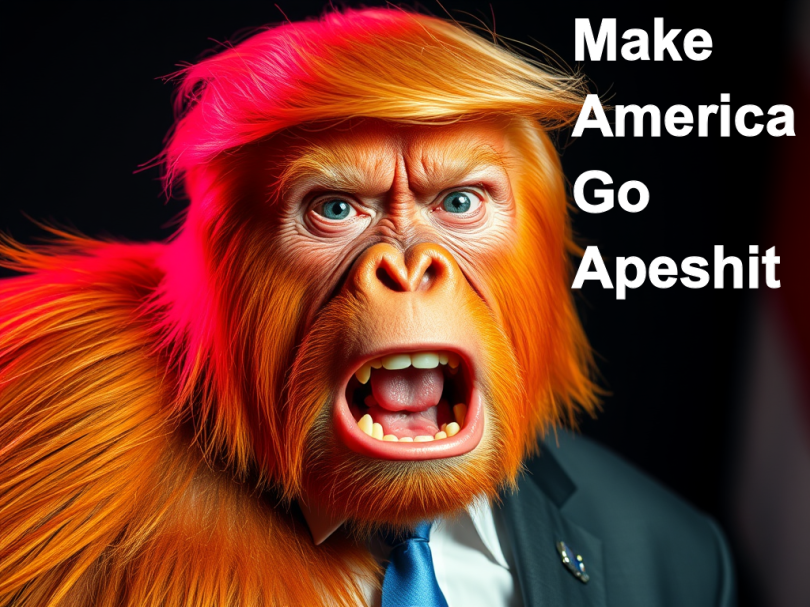
Make America Go Apeshit

If you are a liberal living in Europe, you may think that a large swath of Americans is pretty crazy. That is because they believe very different myths. A 2013 poll indicated 26% of Americans believed that Obama is the Antichrist or might be.1 Most of these people later voted for Trump. Racism plays a role here, but it is not the entire story by any means. The introduction of public healthcare insurance has infuriated conservatives. Some believe that public healthcare is a communist scheme promoted by a Satanic influence. Countries with public healthcare provide better healthcare at lower costs. Some claimed he was Muslim. Barack Obama once gave the following Easter message, ‘Michelle and I wish you a joyful holiday filled with the enduring power of faith and hope.’ And Donald Trump, ‘Open the fucking strait you crazy bastards, or you’ll be living in hell. Praise be to Allah.’ How people came to think that Obama is an evil genius, and a Muslim, while the Allah-praising Donald Trump is the best possible choice for Christians, remains a mystery for people who don’t know American culture.

The hatred of progressive presidents has a long history. John F. Kennedy faced the John Birch Society’s Wanted for Treason campaign. The John Birch Society had found that Kennedy was a communist and that communists had infiltrated the highest ranks of the US government, and were conspiring to create a totalitarian one-world government run by communists. The supposed proof for that was the US administration’s attempt to prevent the spread of John Birch Society propaganda, which seemed like dangerous extremism to government bureaucrats, but violated the freedom of speech. To American conservatives, the expansion of government, government meddling, or international cooperation like the United Nations smells like communism. These things run counter to their ideal of self-determination. And communists oppose and repress religion, so it is Satan’s work as well, in their view at least. That goes a long way in explaining these sentiments.

If he had them, Kennedy did an excellent job of hiding his communist sympathies. After, like a true puppet of the Military Industrial Complex, having grilled his opponent, Eisenhower, during the election campaign for neglecting America’s defences, making Eisenhower warn of the influence of the Military Industrial Complex at his farewell speech, he risked World War III with the Soviet Union during the Cuban Missile Crisis. Those geniuses at the John Birch Society saw through all that and found Eisenhower to be an even more dangerous radical leftist lunatic extremist. While conspiracy theorists, with their eyeballs glued to their computer screens, were busy analysing every move by every secret society and imagining countless others, the John Birch Society has taken over the United States, with a little help from Russia’s secret services, by making people believe these conspiracy theories. If that was the plot to destroy America, it has succeeded marvellously.

By now, large groups of liberals and conservatives hate each other’s guts. To illustrate the point, there is a post I made on Reddit on 31 December 2025. Someone reposted a RealDonaldTrump social media post headlined ‘Windmills are killing all of our beautiful Bald Eagles!’ It featured a photograph of a dead bird, not a bald eagle, near a windmill in Israel, so not the United States. I reacted jokingly, ‘At least, Donald Trump was real.’ These were unmistakably his words, and he posted them under the name RealDonaldTrump. That was the gist of the joke. The post wasn’t offensive, or at least by any reasonable standard, yet it became one of the most downvoted I’ve ever written on Reddit. Praising or bashing Trump may draw ire, but this? It is hard to guess whether Trump haters or Trump lovers did it, but there is something wrong with the sense of humour of those who found it offensive. At least, most people see that the system is broken and that existing solutions fail. Yet, if there were a solution, few would accept it willingly.

Conspiracy thinking is more widespread in the United States than in the Netherlands. Acquaintances of mine who have regularly visited the United States and have spoken to Americans confirmed it. I could see it for myself on message boards. The conspiracy theories range from aliens, faked moon landings, who killed Kennedy, 9/11, vaccinations, Jews running the world, and the elites being a network of paedophiles. The Epstein files give us an insight into how the elites are interconnected and engaged in various questionable dealings, of which abusing underage girls is only one, and most of those visiting these parties probably had no knowledge of that.

Conspiracy theories often relate to the facts, but if you investigate them, much would be unproven, inaccurate or wrong. Conspiracy theorists don’t mind. Pizzagate may be a fabrication, but they claim the Epstein files prove it. That kind of logic appals the fact-checkers, but if you call conspiracy theories hunches rather than facts, they make more sense. Humans are political animals. They scheme all the time. We gossip and fabricate stories to hurt our opponents, so Pizzagate itself is also a conspiracy. We don’t know what’s going on, so getting the direction right is already a success. Yet, the conspiracy theorists aren’t paranoid enough because these secret dealings, as well as conspiracy theories, seem part of the ultimate psyop: God’s scheme to undermine trust in US society to make America go insane and ready for the messiah. It made me think that MAGA stands for ‘Make America Go Apeshit’.

Culture: selling versus convincing

Corruption in the United States is a cultural issue, not just a political one. It fits the American tradition of moral pragmatism, in contrast to Europe’s idealism. A bit of corruption greases the wheels of industry. There are more corrupt countries than the United States, so the comparison is with North-West Europe. You convince Europeans, but sell to Americans. The difference is not just in the wording. It reflects a cultural divide. I have heard Brits use the phrase, but in a negative sense, meaning getting scammed. It is more common in the United States, where it has a more neutral meaning of becoming convinced. The United States is a nation of salespeople. If an American likes your argument, he buys it as if it were a product. It is a different idea of truth, and a corrupt one. It sheds some light on why religion and climate change denial are more widespread in the United States than in Western Europe. It is part of the American success story. Money is power, and bullshit sells, as we are religious beings who need myths to believe in.

You may not buy the science of climate change because you don’t like taking public transport or eating less meat. And so, you buy into climate change denial. That makes you morally corrupt, but no problem, you can buy the story that Jesus died for your sins, and believing that will get you into heaven. That Jesus died for our sins is pretty unbelievable, and if you had been honest and truthful, you would have questioned your faith, which Western Europeans do more than Americans. Many Americans now genuinely believe that climate change is a hoax made up by governments to raise taxes, but that is because they believe what they want to believe, not because it is the truth.

Moral corruption affects some denominations of Protestantism, most notably Evangelicalism. History and culture go a long way in explaining that. Catholic doctrine holds that faith and good works can save you. Catholics can perform good works, such as giving money to the Church, to atone for their sins. That promoted corruption within the Catholic Church through the sale of indulgences. Protestants objected to this moral corruption and took moral integrity very seriously. They made morality a matter of personal choice. Catholics are more morally flexible, so Catholic countries in Europe tend to be more corrupt than Protestant ones. Protestants should think for themselves, while Catholics merely follow the Church’s lead.

And so, despite the presence of a sizeable Roman Catholic minority, the moral conflict defining Dutch culture, the vicar versus the merchant, is ‘dominee versus koopman’ rather than ‘pastoor versus koopman.’ It was the Protestant vicar, not the Roman Catholic priest, who objected to the merchant’s wicked deeds. The merchant was also a Protestant. This dualism still profoundly affects the Dutch, making the Netherlands a nation of merchants and vicars. For a vicar, money can never be the highest good, while successful merchants are morally depraved, as greed drives them. The merchant usually prevailed, so the Netherlands became the wealthiest nation before the Industrial Revolution started.

Roman Catholics didn’t suffer from that kind of gut-wrenching ethical dualism. It made Protestants seem sanctimonious and sneaky to them. They would take the moral high ground and lecture Catholics on trivial matters of the scripture while acting as greedy merchants. That is also a caricature. Many Protestants take ethical matters very seriously. Otherwise, you wouldn’t have had idealists like Kant and Hegel seeking absolute truth and absolute morality, which would eventually make people question the Bible itself, as it is a historical document from a particular culture. And this ethical culture also affected Roman Catholics in the Netherlands, making the Dutch Catholics against Rome after the Church reversed progressive reforms and turning the 1985 Pope visit to the Netherlands into an epic disaster. There is a profound difference between most Protestant vicars, also in the United States, and televangelists, who are the personification of America’s religious corruption. So, what is the origin of the Protestant moral corruption?

The Protestant doctrine also holds that faith alone suffices. And Protestants take the scriptures more seriously than Roman Catholics, which opened the door to a different form of moral corruption, more prevalent in the United States. What the Bible says is right and wrong is not always objectively so. Paul condemned homosexual acts in no uncertain terms. We don’t know Jesus’ opinion on this matter, but he said not to judge and that he who is without sin should cast the first stone.

Yet, there is no objective moral reason to condemn gays and lesbians or deny them the right to marry. It became a problematic issue among Protestants, who take both scripture and moral conscience seriously. When you follow the scriptures on this matter, you shut down your moral conscience and cause harm. And if only faith can save you, you don’t have to do good works to compensate for your misdeeds. That is evil. Catholics merely followed the Church’s lead, and Catholics must do good works to compensate for their sins, so that gets them off the hook.

This morally perverse Protestantism didn’t prevail in North-West Europe. Many of the least corrupt countries are there, while LGBTQ rights in these countries remain uncontested. Meanwhile, Catholic priests lived the good life, which the Dutch call ‘het Roomse leven’ or the Burgundian lifestyle. Jews, as Karl Marx observed, are amoral merchants, and this, rather than racism or religious bigotry, stands at the root of today’s anti-Semitism. Jews are often the merchants and usurers who buy the American politicians. It makes moral corruption in the United States a sensitive issue, most notably because anti-Semitism has led to the Holocaust. Now we are at the bottom of the manure pit.

Idealism and realism

A society has rules, but to arrive at a good society, you need social trust. Social trust means that you can trust strangers, and everyone knows. There are always people trying to take advantage of others, but when there are few of them, most people keep their end of the bargain, and social trust is high. If you believe that others are as trustworthy as you are, and you are trustworthy, you are more willing to contribute to the common good. Yet, if we believe that others are only interested in the best deal for themselves or are untrustworthy, we are more likely to assume the same attitude, so that degenerate morals become a self-fulfilling prophecy. A system of rewards and punishments can help to make people obey the rules and keep the group focused on the common good. It is why we have prisons and fines. As we are nearing an apocalypse, we face a global collective action problem. We can only save humanity if we do it together.

That is why we may be incredibly lucky to be simulations, with God controlling the script. Otherwise, we wouldn’t stand a chance. Even when most people are good, the outcome is terrible, driving us toward the apocalypse. Only one of the disciples betrayed Jesus. That already proved fatal. Judas must have seen for himself that Jesus was the messiah and had witnessed God’s power, but even then, he betrayed Jesus, either out of patriotism or greed. He may have hoped that Jesus would oust the Romans to establish a Jewish state, and grew disillusioned, or the lure of money proved stronger than his fear of God. Most Christians talk about Jesus, but are after the money, or they think their tribe is superior. Only one Indian patriot sufficed to murder Mahatma Gandhi. Since then, India and Pakistan have been one step away from a great patriotic war with nukes. So, without God controlling the script, being a messiah is a losing proposition of 100% certainty, not worth entertaining for any rational individual.

Muslims are no better. Money also turns their religion into a hollow custom. Most of them are poor, but where the oil money flows, the rich flaunt their excessive lifestyles, outdoing the excessive consumption in places like the United States, while leaving their less fortunate Muslim brothers to toil in misery. A few generously donate money to religious charities helping the poor or funding nutters who blow up things and randomly murder people in the name of Islam. They are, however, more interested in building the largest skyscrapers. And Jews? We don’t even have to discuss the Jews. So, what about the Dutch? Yeah, what about whataboutisms? It takes one to know one. So, if economic growth and competition are the problem, trade is the problem, and if that is what brings us down, trade is the greatest of all evils.

It doesn’t mean most merchants are evil. It is the system we work in. How to deal with that problem comes next, but solving it begins with acknowledging the true cause. It seems we can’t do without trade and money, so the odds of religion defeating money in a realistic scenario are zero at best. There is enough for everybody’s need, but not for everybody’s greed. The privileged never have enough. And those who have the money decide what happens. Greed will prevail unless brute force ends it. That force must be truly brutal, as even the communists weren’t up to that task. The salespeople are just too cheeky. You must be willing to murder billions of people and have the means to do so, like God, to frighten us to the point that we stop listening to the merchants.

Moral pragmatism is getting by and hoping that God will save the day. Moral idealism is not waiting for God and trying to create Paradise on Earth. A sizeable group of Christians holds the latter view, but also atheist progressives, ranging from communists to liberals. The cynical view is more prevalent among conservatives. Whether we try to prevent it or not, human nature makes the apocalypse a done deal. As Christianity points out, we are all sinners and need a saviour. Human nature is so depraved that a messiah wouldn’t be enough. God needs to control the script. That is indeed the case, so we can try to leave our cynicism behind and care for others and nature, while understanding that everything is interconnected do that our actions affect others and nature, and that transgressions like usury that disturb the balance in Paradise are the most heinous crimes.

Muslims are no better. Money also turns their religion into a hollow custom. Most of them are poor, but where the oil money flows, the rich flaunt their excessive lifestyles, outdoing the excessive consumption in places like the United States, while leaving their less fortunate Muslim brothers to toil in misery. A few generously donate money to religious charities helping the poor or funding nutters who blow up things and randomly murder people in the name of Islam. They are, however, more interested in building the largest skyscrapers. And Jews? We don’t even have to discuss the Jews. So, what about the Dutch? Yeah, what about whataboutisms? It takes one to know one. So, if economic growth and competition are the problem, trade is the problem, and if that is what brings us down, trade is the greatest of all evils.

It doesn’t mean most merchants are evil. It is the system we work in. How to deal with that problem comes next, but solving it begins with acknowledging the true cause. It seems we can’t do without trade and money, so the odds of religion defeating money in a realistic scenario are zero at best. There is enough for everybody’s need, but not for everybody’s greed. The privileged never have enough. And those who have the money decide what happens. Greed will prevail unless brute force ends it. That force must be truly brutal, as even the communists weren’t up to that task. The salespeople are just too cheeky. You must be willing to murder billions of people and have the means to do so, like God, to frighten us to the point that we stop listening to the merchants.

Moral pragmatism is getting by and hoping that God will save the day. Moral idealism is not waiting for God and trying to create Paradise on Earth. A sizeable group of Christians holds the latter view, but also atheist progressives, ranging from communists to liberals. The cynical view is more prevalent among conservatives. Whether we try to prevent it or not, human nature makes the apocalypse a done deal. As Christianity points out, we are all sinners and need a saviour. Human nature is so depraved that a messiah wouldn’t be enough. God needs to control the script. That is indeed the case, so we can try to leave our cynicism behind and care for others and nature, while understanding that everything is interconnected do that our actions affect others and nature, and that transgressions like usury that disturb the balance in Paradise are the most heinous crimes.

The pragmatic view is that trade, finance, and money are invincible until God intervenes. And that is correct. It has built the European empires, ranging from the Spanish to the Dutch and the British. And it has made America strong. There may be more graft in the United States than in Western Europe, but most countries are more corrupt than the United States. And the Hegelian dialectic is the way God sees social progress. The West has progressed the furthest on that path and must lead the way. My reason for focusing on the United States is not only that America has become an evil empire and the world’s gravest problem, but also that Americans are more pragmatic, get things done, and, above all, are the most eager to receive the messiah.

Europeans lack their pragmatic attitude and religious fervour. And so, the coming world revolution will probably start there. Compromising with the old, corrupt order is a dead end. We need a spiritual rebirth and must break away from the system run by merchants and usurers, and ground our society in ethical principles and make humankind part of nature rather than above it. Europe will probably be next, and the rest of the world will follow. So, don’t worry about the Muslims. They fear God and also expect Jesus to return. And don’t worry about the Chinese. It is their state’s official goal to run the Hegelian dialectic to its completion and abandon the market economy once the workers’ paradise arrives. That is my guess for now. Things hardly ever go the way I foresee. Yet, they go precisely according to God’s plan.

As for the question I asked myself as a teenager, ‘Is it possible that communists had good intentions?’ If you know how deep the problem runs, you can only appreciate their effort. If there is no God, we, the little people, are on our own, against the superior force of money and tribalism, and there is no chance at all that we will succeed. The elites will play us out by sowing divisions with religious and nationalist fairy tales. They make others toil for them so they get rich without working, and it will end in destruction, albeit creative destruction, economists tell us, so that our suicide will go down in memory as a form of concept art. The elites fund think tanks that tell us fairy tales about individual freedom, so that we will not question the order in which they are our masters, and we are their serfs. And we, the gullible people, need myths to believe in. The communists faced that brutal truth and tried to stamp out nationalism and religion. Maybe for that reason, they named their newspapers ‘The Truth’. Only, communism doesn’t change human nature, so new class societies arose in communist societies with elites and perks.

If this happens, you will have to deal with the consequences. Central planning of every detail doesn’t work. If we try that, it will become a disaster 100 times worse than the Great Leap Forward. Software engineers who have learned from their mistakes design, build, test, start small to see if it works, correct errors, scale up, and fix bugs until the system operates smoothly. That is, unless changes are required. Then, you have to do it all over again. And small changes can have a dramatic, unexpected impact. It is why the absence of further changes is the single most crucial success factor in this endeavour to build a world society for the coming 1,000 years. Future generations will have to resist pressures to make improvements if things were okay to begin with. Things were okay in Eden, and all that happened since then made matters worse.

Kicking off the revolution

A society has rules, but to arrive at a good society, you need social trust. Social trust means that you can trust strangers, and everyone knows. There are always people trying to take advantage of others, but when there are few of them, most people keep their end of the bargain, and social trust is high. If you believe that others are as trustworthy as you are, and you are trustworthy, you are more willing to contribute to the common good. Yet, if we believe that others are only interested in the best deal for themselves or are untrustworthy, we are more likely to assume the same attitude, so that degenerate morals become a self-fulfilling prophecy. A system of rewards and punishments can help to make people obey the rules and keep the group focused on the common good. It is why we have prisons and fines. As we are nearing an apocalypse, we face a global collective action problem. We can only save humanity if we do it together.

That is why we may be incredibly lucky to be simulations, with God controlling the script. Otherwise, there is no chance of success. Even when most people are good, the outcome is terrible, because in competition, the most unscrupulous win out. Only one of the disciples betrayed Jesus. That already proved fatal. Judas must have witnessed God’s power, yet he still betrayed Jesus, either out of patriotism or greed. He may have hoped that Jesus would oust the Romans to establish a Jewish state, and grew disillusioned, or the lure of money proved stronger than his fear of God. And only one Indian patriot sufficed to murder Mahatma Gandhi. Since then, India and Pakistan have been one step away from a great patriotic war with nukes. Without God controlling the script, being a messiah is a losing proposition, not worth entertaining for rational individuals.

Muslims are no better. Money turns their religion into a hollow custom. Most Muslims are poor, but where the oil money flows, the rich flaunt their excessive lifestyles, leaving their less fortunate Muslim brothers to toil in misery. A few might generously donate money to religious charities helping the poor or funding nutters who blow up things and randomly murder people in the name of God. Yet, they are more interested in building the largest skyscrapers. And Jews? We don’t even have to discuss the Jews. So, what about the Dutch? Yeah, what about whataboutisms? It takes one to know one. So, if economic growth and competition are the problem, trade is the problem, and if that is what brings us down, trade is the greatest of all evils.

It doesn’t mean merchants are evil people. Many are not. It is the system we work in. How to deal with that problem comes next, but solving it begins with acknowledging the true cause. It seems we can’t do without trade and money, so the odds of religion defeating money in a realistic scenario are zero at best. There is enough for everybody’s need, but not for everybody’s greed. The privileged never have enough. And those who have the money decide what happens. Greed will prevail unless brute force ends it. That force must be truly brutal, as even the communists weren’t up to that task. The salespeople are just too cheeky. You must be willing to murder billions of people and have the means to do so, like God, to frighten us to the point that we stop listening to the merchants.

Moral pragmatism is getting by and hoping that God will save the day. Moral idealism is not waiting for God and trying to create Paradise on Earth. A sizeable group of Christians holds the latter view, but also atheist progressives, ranging from communists to liberals. The cynical view is more prevalent among conservatives. Whether we try to make the world a better place or not, human nature makes the apocalypse a done deal. As Christianity points out, we are all sinners and need a saviour. We must leave our cynicism behind and care about other people and nature, while understanding that everything is interconnected, so that our actions affect others and nature, and that transgressions that disturb the balance in Paradise are the most heinous crimes.

As Hegelian dialectic is the way God sees social progress, and the West has progressed the furthest on that path, the West must lead the way. My reason for focusing on the United States is not only that America has become an evil empire and the world’s gravest problem, but also that Americans are more pragmatic, get things done, and are the most eager to receive the messiah. Many are literally begging for the Second Coming and are willing to perform the craziest acts to make it happen. Now, I am not going to criticise it, for only God can save us and God wrote the script.

It makes the United States the best place to start the coming world revolution. Europeans lack the religious fervour, but also the pragmatic attitude of Americans. Compromising with the old, corrupt order is a dead end. We need a spiritual rebirth and must break away from the system run by merchants and usurers, and ground our society in ethical principles and make humankind part of nature rather than above it. Europe will probably be next, and the rest of the world will follow. That is my guess for now. Things hardly ever go the way I foresee. Yet, they go precisely according to God’s plan.

As for the question I asked myself as a teenager, ‘Is it possible that communists had good intentions?’ If you know how deep the problem runs, you can only appreciate their effort. If there is no God, we, the little people, are on our own, against the superior force of money and tribalism, and there is no chance at all that we will succeed. The elites will play us out by sowing divisions with religious and nationalist fairy tales. They make others toil for them so they get rich without working, and it will end in destruction, albeit creative destruction, economists tell us, so that our suicide will go down in memory as a form of concept art.

The elites fund think tanks that tell us fairy tales about individual freedom and make us fear collectivism, so that we will not unite and overturn the order in which they are our masters, and we are their serfs. And we, the gullible people, need myths to believe in. The communists faced that brutal truth and tried to stamp out nationalism and religion. Maybe for that reason, they named their newspapers ‘The Truth’. Only, communism doesn’t change human nature, so their economic system performed poorly while a new class society with an elite of party bureaucrats arose.

Kicking off a revolution

Jesus said, ‘I am the way, the truth and the life.’ You can save yourself by following me, accepting that what I say is the truth, and that is how you survive. We need a fairy tale and a leader to believe in who tells us what the truth is. That is how we can save ourselves. Otherwise, we will continue to fight over our fair tales and not do what we must. The idea of being the messiah is an uneasy predicament for any sensible person. It also made me question my views. I have been proven wrong countless times. Progress comes from being proven wrong and learning from it. Minor oversights can have dramatic consequences. Preventing mistakes is better than correcting them afterwards. And correcting them sooner is better than correcting them later. Changes in society and its institutions have unexpected consequences. Still, God wrote the script, so we can only do our best, like Boy Scouts, and expect God to do the rest, like an Akela.

Many, perhaps most, US politicians are corrupt, but Donald Trump is Mr Graft himself. Between 2024 and 2026, his net worth nearly tripled from $2.3 billion to $6.5 billion, thereby outdoing the most brazen grifters in US politics. Unlike ordinary politicians who accept bribes to finance their campaigns, Trump and his entourage exploit the office for personal gain.2 It seems to include insider trading preceding Trump’s social media posts.3 So much for draining the swamp and ridding US politics of corruption. By his own admission, Trump is a pussy grabber who would ‘do’ his daughter had she not been his daughter. At least 26 women have accused him of sexual misconduct.4

The United States today resembles France before the French Revolution. The system is broken. Reform is impossible. Cleaning the slate is all that remains. Dutch television once aired a fragment, probably because it was hilarious, of a preacher standing in front of Donald Trump, with Trump putting up his best sanctimonious face. The preacher thanked Trump for ‘saving America from Satan.’ Then my wife, Ingrid, said, ‘Look! There you have him! That’s Satan!’ She meant Donald Trump. She was joking, but that joke can only be funny if there is some truth to it.

My wife doesn’t dislike Trump and tends to look on the bright side of what he is doing. Forcing Ukraine to accept a bad deal? That’s fine with her if it stops the killing. Taking out Maduro? Things were bad in Venezuela already. And he ended the Gaza war. Invading Greenland? She didn’t express an opinion. Bombing Iran back to the Stone Age? They shouldn’t have a nuclear bomb. And so, my wife’s feelings didn’t get in the way of forming that opinion. At the very least, the orange madman is impulsive, vindictive and unwilling to listen to people with wisdom and experience. When I later recalled the moment, she said the preacher had said ‘Antichrist’ rather than ‘Satan.’

Donald Trump doesn’t seem to fall into the category of Hitler, Stalin and Mao. Pol Pot from Cambodia murdered a quarter of the Cambodians. Had he run Russia or China, he might have outdone Hitler, Stalin and Mao. Still, we shouldn’t be too sure. Trump is a savage constrained by the United States’ political and judicial institutions. Had he free rein, things would probably have been much worse. And as far as the supposed qualities of the Antichrist go, few people qualify for all of them. Still, his lambasting of the pope’s peace efforts, while portraying himself as Jesus, and the religious display of Donald Trump and his circle of evil in the Oval Office, give him a great shot at the title of Antichrist. Is pride not the gravest sin, and is MAGA not all about pride? Not to mention money and patriotism, the likely reasons for Judas betraying Jesus. And what to think of all the hatred, while Christianity is about love. MAGA is the opposite of what Christianity stands for.

It shows that American conservatives are willing to let Satan run their country. Trump being a jerk is why people voted for him. It is natural human behaviour. When order falls apart, we revert to gangsterism and choose gangsters as our leaders. There might have been no second Trump term had there been no immigration surge during Biden’s tenure. It became the issue that decided the election. The Democrats let Biden run for a second term, and when that fell apart, let Harris, who was part of Biden’s government, take over.

Cultural differences divide us, but none of today’s cultures is fit for the future. The outcome of all we do is a total disaster. We should define how we should live and seek those willing to go along with it. And because we will never agree, we need a messiah to tell us. We will have to separate the good people from the bad people. We must try to rehabilitate troublemakers, if necessary, in prison labour camps. It would be the end of human rights as we know it. And we cannot accept alternative myths because people fight and murder over them, so everyone needs to accept the same fairy tales. That is a great leap for a former liberal, but I need to think ahead. If I am indeed the messiah, I should aim to have a plan that works for the coming 1,000 years. I can’t foresee what will happen, but there is a script, so God is in full control, so that worrying is pointless.

Humans are a failed species. Christians would say that we are sinners, not worthy of God’s grace and in dire need of a saviour. Order can only come from the top down, and by force. I might be the only one who can guide humanity to the future, not because I am a genius, but because it is the script of the story. And so, it will be a role I play, nothing more. It is up to you to do miracles. If you don’t get it, you are a moron. And you are either on my side or on the side of the morons. And we need a holy war against the morons.

On 15 May 2025, exactly 8647 days after the terrorist attacks of 11 September 2001, former FBI director James Comey posted a photo of seashells on social media spelling ‘8647’, a code for removing Trump from office. That generated some media attention and drew the ire of the Trump administration after the MAGA movement had previously sold hats with ‘8646’ on them, calling for Biden’s removal from office. There is no evidence that Comey aimed to create that 8647-day interval, but it could be. Yet the incident is also part of the 11 September 2001 coincidence scheme, which is beyond the capabilities of human conspirators to organise. My home was formerly owned by the Tromp family, which is the Dutch equivalent of Trump, so that is quite odd given the situation at hand. The meaning of the name is ‘trumpeter,’ and according to prophecies, trumpets would herald the end times. Removing Trump from office and me taking his place could be part of God’s plan for the End Times. That is by no means certain, but it is a cryptic message that you can see in these coincidences. And until it is disproven, it is something to consider.

Donald Trump should face trial in The Hague, Netherlands. The United States can’t give him a fair trial. Liberals may want to hang him, while conservatives might want to give him a pass. Whether trying to overthrow a legitimate election result constitutes treason may remain a matter of contention between liberals and conservatives, but that Donald Trump and his pal Bibi Netanyahu have violated international law and committed crimes against humanity by starting the Iran war cannot be in doubt. The ultimate expert on murders committed in cynical violation of all norms of human morality and international law, Vladimir Putin, called the assassination of Ayatollah Khamenei a murder committed in cynical violation of all norms of human morality and international law.

How to bring the orange madman down? That hadn’t been on my mind, but in April 2025, I dreamed of being part of a crowd in The Hague during the NATO summit scheduled for that summer. The leaders of the NATO member states were all there. When Trump passed by in his car, I began to scold him in Dutch, ‘Hij is een hondenlul (He is a dog dick).’ It is an offensive slur that soccer fans sing when disagreeing with the referee’s decision. There was absolute silence. Bystanders were shocked, making me fear that the police would round me up. But then the crowd joined in, and the singing grew louder until it became a thundering chant. It made the news worldwide. From then on, no one called him President Trump anymore. Everyone called him dog dick. I don’t know the future, but I have to work with assumptions. Play time is over. Adults should run the world. As Adam reincarnate, I am 6,000 years old. There may be no one else left to save you.

Latest revision: 5 May 2026

Featured image: AI-generated

1. One in four Americans think Obama may be the Antichrist, survey says. The Guardian (2013).
2. The Corruption Chronicles: Donald Trump’s profiteering from public service, by the numbers. Kei Chin, Michael Beckel, and Oliver Ni (2025). Issue One.
3. The insider trading suspicions looming over Trump’s presidency. Nick Marsh (2026). BBC.
4. The 26 women who have accused Trump of sexual misconduct. Eliza Relman and Azmi Haroun (2017). Business Insider.

Liberal democracy

A definition

Democracies are often called liberal democracies. So what is a liberal democracy and why might it be the best way of government? There are no easy answers to these questions nor is there agreement on these matters. Liberalism emphasises the value of individuals while democracy is rule by majority. These two principles can be at odds.

Liberal democracies have elections between multiple political parties, a separation of powers into different branches of government, the rule of law in everyday life, an open society, a market economy with private property, the protection of human rights, civil rights, civil liberties and political freedoms for everyone.1

Liberals believe that individuals and social groups have conflicts of interest. The social order must deal with these conflicts and resolve them in a peaceful manner. To achieve such a feat, all parties must be reasonable and there should be a balance of powers. No party should be able to force its will upon others.2 It is an important reason why liberals stress the importance of individual rights.

Democracy means that government decisions require the consent of the majority of the citizens. In most cases the citizens elect a parliament that does the decision making for them. Sometimes citizens can vote for individual proposals in referendums. In reality many democratic countries aren’t fully democratic because not all government decisions are supported by a majority of the citizens.

Principles

Liberal democracy is based on a social contract, which is an agreement amongst the members of society to cooperate for mutual benefits. For instance, labourers may accept capitalism if they get a share of prosperity. That deal turned out to be more attractive than state ownership of the means of production.

Liberalism has two principles that can be at odds, namely non-interference with people’s lives and realising everyone’s potential. In this vein there are two branches of liberalism:

  • Economic liberalism promotes freedom of the markets as well as free trade and claims that the state should be of minimal size and not interfere with people’s lives.
  • Social liberalism claims that the state should help to realise the potential of people by promoting their freedom to make choices, which includes ending poverty.

Each liberal democracy more or less embraces these values. Liberal democracies come with a market economy and respect for the rights of individual citizens. Governments interfere with the lives of people and try to promote their happiness and to realise their potential. The conflicting nature of both principles makes liberal democracies differ with regard to freedom of markets and government interference.

In the United States liberalism has a different meaning. There it is another word for social liberalism or democratic socialism. In Europe the definition of liberalism is broader and this is also the definition used here. In the 17th century liberal ideas began to emerge in what is called the European Enlightenment. Around the year 1700 the philosopher John Locke came up with the following basic principles for a liberal state:

  • a social contract in which citizens accept the authority of the state in exchange for the protection of their rights and property and maintaining the social order;
  • consent of the governed, which means that state power is only justified when the people agree;
  • separation of church and state, which means that the state doesn’t favour a specific religion and does not require a religious justification.3

Is it the best form of government?

Liberal democracy is part of the European cultural heritage. Proponents claim that it is the best form of government. These universalist claims are sometimes contested on the ground that they are a form of western cultural imperialism. Another argument is that there is no guarantee that liberal democracy leads to better decisions. From a religious perspective people argue that our Creator may prefer a different kind of social order and government, possibly even a theocracy.

The argument in favour of the universalist claims is that liberal democracy emerged out of a historical process that took centuries in which rational arguments played a decisive role. The European Enlightenment challenged existing practices in government on the basis of reason. Ideas that emerged out of the European Enlightenment were tried out in different ways and refined further. Europeans also invested heavily in educating their citizens. This produced a culture of reason and compromise as well as a massive body of practical experience and best practises.

There is also no guarantee that other forms of government lead to better decisions. In an open society better information can be available so well-educated citizens in a culture of reason and compromise may make better decisions. There are a few democracies that live up to these expectations so it can work out that way. And we may not be able to determine what kind of order God desires. If our Creator is all-powerful then the emergence and spread of liberal democracy may not be God’s plan.

One of the biggest problems facing liberal democracy is high expectations. Liberal democracy itself does not guarantee a reliable government that is both efficient and effective nor does it ensure a flourishing economy. This has led to disappointments. A failed and corrupt government can’t simply be turned into a success by allowing elections. Liberal democracy works best with a well-educated population in a culture of reason and compromise that doesn’t allow for corruption and abuse of power.

On the moral front there are a few issues too. Liberal democracy promises equal treatment for all people. In reality people aren’t treated equal nor do they have equal opportunities. There is discrimination based on ethnicity, gender or sexual preferences. And poor people have fewer opportunities than rich people. Still, the goal of equal treatment and equal opportunities can be something to strive for. It may be better to aim for such goals and fail from time to time than not having these goals at all.

If liberalism promotes tolerance then how to deal to intolerant people? Should their intolerance be tolerated? If people do not accept liberal values, should they be educated or should these values be imposed? And are free markets the best way of organising the economy or is government involvement advised? If the economy is served by stability, should dissent that causes instability be suppressed? An excessive or unnecessary use of force can undermine the foundation of liberal democracy as liberal democracy is based on reason and convincing people by argument. And indeed it is possible that liberal democracy can be overturned.

History

The preconditions for liberalism had already emerged in Western Europe during the Middle Ages. There was a larger degree of individualism than elsewhere. Liberalism itself emerged during the sixteenth century. At the time Europe was ravaged by devastating religious wars. After several decades of warfare Europeans grew tired of the conflict and began to tolerate religious differences. Some catholic countries accepted protestant minorities while many protestant countries accepted catholic minorities. Germany was almost equally divided. At the time Germany consisted of small states that had either protestant or catholic rulers.

This religious tolerance was at first more or less an uneasy truce. No party had been able to gain the upper hand. Religious minorities at first didn’t receive equal rights. They were only tolerated. Over time the case for religious tolerance became more widely accepted. It was based on two major arguments.

  • The argument of ignorance which states that only God knows who is on the right path and who is doomed so humans shouldn’t judge others.
  • The argument of perversity which states that cruelty is at odds with Christian values and that religious persecution strengthens the resolve of the persecuted.1

The concept of tolerance expanded into a general concern for the rights of individual citizens. In the 17th century liberal ideas were spreading. The Glorious Revolution of 1688 in England limited the power of the king. The rights of individuals were written down in the Bill of Rights. Parliament became the most powerful political institution based on the principle of consent of the governed. The 1776 Declaration of Independence of the United States was based on liberal principles too. It states that all men are created equal and have certain unalienable rights like life, liberty, and the pursuit of happiness.2

The founding fathers of the United States were also early liberals. The United States Constitution reflects this view. The aim of the United States Constitution is, amongst others, to safeguard the rights of individuals against the state. A large group of Americans believe that individual rights should prevail against democratically elected governments. The widespread support for gun ownership in the United States comes from a distrust of the state as a protector of life, liberty and possessions.

Democracy had not been a seriously considered since classical antiquity. It was believed that democracies are inherently unstable and chaotic due to the changing whims of the people.1 The violence during the French Revolution supported these views. It began as a popular uprising incited by liberal ideas but it soon turned into chaos and bloodshed. Order was restored by a despot ruler named Napoleon Bonaparte who did much to spread liberal reforms throughout Europe by ending the feudal system, emancipating religious minorities and imposing a liberal code of law. The spread of liberal ideas proved to be lasting and democracy was to follow a century later.

The Industrial Revolution started a period of accelerated and constant change that was disastrous for many who found themselves on the losing side. The ruling class changed. Nobility was replaced by a new elite of business people. The position of craftsmen was undermined by factories. And workers in factories laboured under miserable conditions for low wages. There were three major ways of confronting these changes:

  • Conservatives tried to hold on the old order of community, religion and nobility.
  • Socialists tried to overturn the elite of business people by giving power to workers.
  • Liberals tried to manage the change, thereby implicitly supporting the order in which business people were the ruling class.

Liberalism often coincides with the interests of business people. They have possessions and some are rich. They feared that the poor might vote for handing over their possessions to the poor. Socialism became the embodiment of this fear. Liberals were at first inclined to limit the right to vote to people who pay taxes because this excluded poor people from voting. When the threat of socialism became subdued and socialists were willing to compromise, liberals came to accept democracy based on the principle of one person one vote.

In the 19th century European countries held vast colonial empires. These colonies were kept for profit. It was generally believed that the people in these colonies had to be educated before they would be able to govern themselves. The colonial era helped to modernise these countries and most Europeans at the time believed that the oppression and the economic exploitation were justified on these grounds. There were only a few dissenters, for instance the Dutch writer Multatuli.

Liberal democracy faced a few major crises like World War I, the Great Depression and World War II. World War I demonstrated that liberal democracy and free trade weren’t a guarantee for peace and stability. The Great Depression once again challenged liberal democracy as the Soviet Union remained unaffected while Nazi Germany was able to recover and achieve full employment while other countries were still struggling. And during World War II Nazi Germany overran most democratic countries in Europe.

After World War II the European colonies became independent. The Soviet Union came to dominate Eastern Europe and China became a communist country. The United States became the protector of liberal democracy but also a number of dictatorships. This era is called the Cold War and it lasted until the Soviet Union dismantled itself after allowing the peoples of Eastern Europe to make their own choices. Major challengers of liberal democracy nowadays are the one-party system in China and political Islam.

The citizens of Hong Kong and Taiwan don’t like to lose their freedoms. Chinese too probably prefer freedom if they have a choice. And the Islamic State has shown Muslims all around the globe that political Islam can easily turn into a reign of terror. The foundations of liberal democracy may be strong, but a collapse of the global economy may turn be a more serious threat to liberal democracy than the alternatives. Reason can easily disappear once people become fearful of the future.

Reasons for success and limitations

The success of liberal democracy is therefore not a historical necessity. Liberal democracy might never have been invented or dictatorships could have gained the upper hand. That didn’t happen. Communist and fascist dictatorships came and went. Perhaps liberal democracy is a temporary phenomenon but we can’t know that now. Only the future can tell. There are a number of causes that might explain the strength of liberal democracy.

  • Liberal democracy is based on the consent of the governed so it is has the consent of the governed by default while other forms of government do not.
  • Science greatly contributes to the success of states and science is best served with an open debate that liberal democracy provides.
  • The economy greatly contributes to the success of states and the economy is best served with individual rights that liberal democracy provides.

A despot ruler or a ruling party in a one-party system might have the consent of its subjects, but if not, only force remains for the ruler or the party to maintain power. Liberal democracies usually resolve such issues peacefully through elections, making liberal democracy more stable by default. Intellectual freedom is helpful to science while economic freedom is helpful for the economy, so liberal democracy can be a potent force. Only when leadership is required, liberal democracy might not always be adequate.

Liberalism has no higher moral value than the individual, which is peculiar because the individual human is an insignificant part of this universe. And individualism may be at odds with human nature as humans are social animals. Humans are not atomic beings that choose to cooperate for mutual benefit like liberalism supposes. Cooperation is part of human nature and not a choice individuals deliberately make.

It is the success in cooperation that makes a society win out. Liberalism gives a framework for living together in peace as long as all major parties are reasonable and willing to compromise. This makes larger scale cooperation possible and that can make a society successful. For instance, the United States integrated people from different cultural backgrounds, which contributed to the success of the United States as a nation.

It is said that history is written by the victors. Strength may be the reason why liberal democracy prevailed. Liberal philosophers have tried to provide a moral justification for liberal democracy or they may have opposed it or they may have tried to improve it. Liberal democracy emerged out of thought and action, experiment and failure, and it was a process that took centuries. Philosophers like Locke contributed to its success as they set out the goals people could strife for.

Apart from individualism, liberal societies lack a higher purpose. From a scientific viewpoint there is no higher purpose to this universe. The moral codes humans live by are not more than an agreement. Only when this universe is created for a purpose there is a reason for our existence. But moral individualism can be dangerous. The challenges humanity is currently facing, most notably living within the limits of this planet, most likely requires making individuals subject to a higher causes like the survival of humanity and caring for the planet.

1. Liberal democracy. Wikipedia.
2. Liberalism: The Life of an Idea. Edmund Fawcett (2015). Princeton University Press.
3. History of liberalism. Wikipedia.