
Humans are animals. Other animals experience joy and suffering as we do. So, if we are considerate of our fellow humans, we might also consider being less cruel to other animals. Of course, humans are cruel to each other as well, but that may change. So, let us imagine that it will happen someday, perhaps not that far in the future. We can place ourselves in someone else’s position and feel compassion. Other social animals can also do that, as it promotes cooperation. Nature doesn’t have ethics, but ethics are part of our nature. In nature, plants and animals cooperate for mutual benefit or compete for resources, and compassion is closely tied to cooperation. Yet, humans can invent rules and believe they have rights. Animals can’t. Animal rights, like human rights, exist only in our imagination, not in objective reality.
A conscious mind experiences suffering, but consciousness comes in different levels. You can beat a stone, but it doesn’t feel anything. A plant is less aware than an insect. An insect has less awareness than a fish. Fish might be less conscious than mammals. And we relate more to animals like us, so mammals elicit the most sympathy, most notably the cute ones, and being furry may enhance their cuteness. Killing a dog or a cow feels different from squashing an ant or a mosquito, at least for most people. We can relate better to a dog because they are more like us.
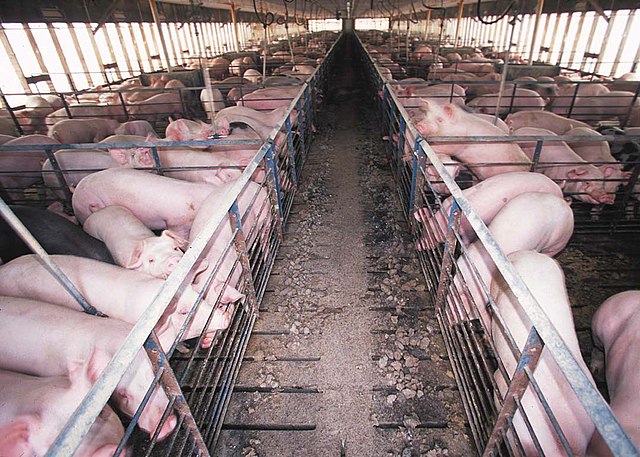
And we care more about the people we know than about strangers, which makes us care more about our pets than about other humans in faraway countries. The suffering that goes unnoticed doesn’t affect us as much as the misery we see. That is why the meat industry hides the unpleasant reality from us: animals crammed in confined spaces or mistreated in slaughterhouses. There is an animal holocaust going on that dwarfs Hitler’s extermination campaign during World War II by a wide margin, except that it concerns animals, not humans. It is millions of times the size of the Holocaust because it affects billions of animals each year. When we become aware of it, we react in different ways:
- Not caring. You may have more urgent problems than animal welfare.
- Accepting. You could argue that meat is a natural part of our diet.
- Doing something. You might become a vegan.
Humans have slaughtered animals since time immemorial. Our distant forebears have already driven animal species to extinction. Why stop now? Humans now dominate the planet entirely, and much of the remaining wildlife may soon go extinct. Hence, it may be time to ask ourselves questions, such as, should there be animal rights? And if so, what rights should animals have? Respecting nature and concern for animal suffering are reasons to consider animal rights. Those considerations can conflict with each other. You may protect the wolf out of respect for nature or shoot it to protect the sheep.
Even when we think animals have rights, the animals themselves transgress our moral rules. Predators hunt prey. We can’t order an eagle to eat grass. Some species go extinct because of our actions, while others profit. Rats, cockroaches, and seagulls thrive where humans have disrupted the balance of nature. Should we restore that balance? For instance, humans introduced diseases that eliminated the rabbit population, which had been on the foxes’ menu. The foxes survived by preying on other animals that don’t reproduce as quickly as rabbits, causing their populations to decline. Hunting foxes could prevent that. And if you let your cat go outside, you contribute to a bird genocide. In the Netherlands alone, house cats kill 20 million birds per year. Cat owners seem not to care. Why can’t they keep their murderous beasts inside?
Industrial farms are inconsiderate of farm animals and do not respect nature. If you believe Creation is sacred, factory farms are an abomination. Animals are crammed into small spaces and processed in slaughterhouses. It’s efficient. Producing meat in an animal-friendly manner is costly and can be less environmentally friendly. Excrement produces greenhouse gases, and you may get more excrement per unit of meat. The European Union has regulations concerning the welfare of farm animals, so European industrial farm animals are slightly better off. The measure for animal well-being is that farm animals can behave naturally. If they can’t, they may experience stress and suffering. The question remains whether an animal would prefer to live in the wild if it had a choice. Being hunted by predators also causes anxiety and pain.
What about eating meat? Meat has been on our menu since immemorial, providing us with the necessary nutrients. There may soon be artificial meat and replacements that contain the same nutrients. And so, we might end animal farming and stop making animals suffer unnecessarily. That could be our goal, not ending meat consumption. If there is not enough food for the deer in a forest, shooting the weak and eating them could be better for their well-being than letting them starve. Introducing wolves might achieve the same, but it also increases deer suffering, and wolves may prefer sheep because they are easier prey. In any case, a deer might prefer a clean shot to a lengthy chase by a pack of wolves before being devoured alive.
If you choose the wolves chasing deer, you aren’t a deer and believe the value of nature takes precedence over the rights of deer. Nature itself does not suffer, nor does it care. Humans have profoundly disturbed the ecological balance, so unspoiled nature, as it once was, is gone in most places. And so, we may be left managing wildlife as if the world were a park. Other events disrupt the balance in nature as well. The dinosaurs went extinct after a meteor struck Earth, causing a sudden change in the climate. Letting wildlife coexist with humans can also cause problems. You can’t let pests destroy our crops or spread diseases. The Sacredness of Creation is a religious dogma, and even if you adhere to it, you don’t always get clear-cut answers.
Latest revision: 14 October 2026
Featured image: Hog barn interior. Public Domain.

