
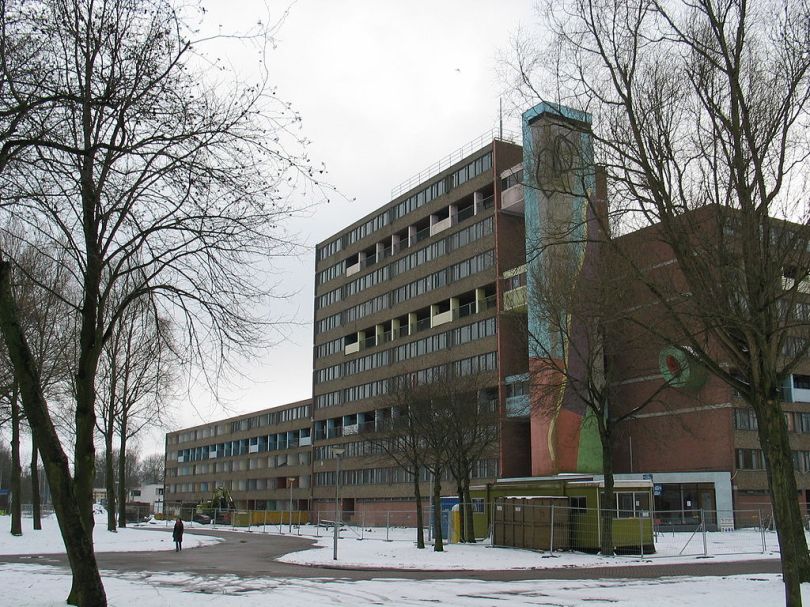
In 1993, I moved to Groningen and rented a small apartment in Kraaienest, Lewenborg, a multicultural neighbourhood on the outskirts of town. Bus line 3 brought you there from the central station, which featured a statue of a horse named ‘Peerd from Ome Loeks’ and was opposite a colourful construct named Groninger Museum, designed by a famous architect. Also making up the local skyline were office buildings of the national telecom provider KPN. As for the central station, I was there often, as the train was my way of getting somewhere else. There, I once witnessed a dove challenging a bus by not flying or walking away as the bus was about to run over it. I saw and heard the dove get flattened with a juicy plash. Doves are pretty dumb, my father explained. Their nests consist of a few loose twigs that can barely hold the eggs. A little bit of wind, and the eggs or chicks fall on the ground. Despite all that, there are plenty of doves.
The Lewenborg quarter featured apartment blocks mixed with family homes. When telling my colleagues at work that I lived there, they felt sorry for me. ‘You live in Lewenborg. Oh… poor thing.’ It was not particularly upscale, indeed. Lewenborg had a questionable reputation, but that was grossly exaggerated. Those who didn’t live there didn’t know what life was like there. I had lived there for four years and never felt unsafe. Yet, if you look for ‘Kraaienest Groningen’ in a search engine, you may find that someone died there in 2014 as a result of a violent incident of a rather particular nature. There was drug dealing going on in the area, or so I had heard. I often wandered around, but never noticed it, probably because I didn’t know where to go. Likely, it was inside a home, and not on the street.
It was an ordinary neighbourhood. There were families with children, but if you had better options, you might go somewhere else. There was a shopping mall nearby, and in the first years I had to hurry to get my groceries in time, as the shops closed at 6 PM. I only knew my next-door neighbours vaguely. Next to me lived an elderly couple who had retired and sold their home. They had a German Shepherd dog that could make a lot of noise and did so regularly. I visited them a few times. On the other side lived a good-looking lady my age, but she showed no interest in me. She soon had a fancy man, or may already have had him. He must have seen my name tag, because at some point he accosted me, asking about my father, his employer, and his job.
And so, I told him that my father was a board member at a road construction company called Roelofs. It turned out that his father was also a board member of Roelofs and held a higher rank than my father, which he was rather keen to point out to me. That is also why my last name had attracted his attention. In hindsight, it was a noteworthy coincidence as Roelofs didn’t have that many board members. As the bedrooms were adjacent, I once overheard the couple having steamy sex. After some time, she moved out to live with him, but not much later, she returned to the Kraaienest and took another apartment. The neighbour who lived opposite me seemed to want to befriend me first. She had been ensnared in an American multi-tier marketing scheme selling ‘environmentally friendly’ cleaning products to enrich those at the top of the pyramid. She viewed me as a sales prospect. After hearing out her sales presentation, I bought something out of politeness.
A group of about thirty black males with dreadlocks often hung out near the shopping mall, in what the Dutch call a coffee shop, but which was, despite the name, a place to buy and smoke cannabis. At first glance, they seemed intimidating because there were so many, but as far as I could see, they did nothing more than hang around and smoke weed. I suspect their hanging around contributed to the neighbourhood’s bad reputation because there wasn’t much else going on. If you passed by, they were friendly. ‘Live and let live,’ was the Dutch stance on cannabis, which was officially banned, but no enforcement of that ban was the official policy of ‘tolerance’ concerning soft drugs. For those who think that hard drugs might be for sale there, too. I have never seen anything suggesting it or overheard anyone saying it. And I didn’t go inside to check out.
As a teenager, I had imagined there would one day be a giant Rastafari party in Nijverdal, likely because the river passing through Nijverdal is named Regge, which sounds like reggae. The party would be on the banks of the river, and the Rastafari from all over the world would come to Nijverdal. In hindsight, this is a coincidence worth noting. Rastafari is an Abrahamic messianic religion like Judaism, Christianity and Islam. Rastafarians see Haile Selassie I, the former Emperor of Ethiopia, as a reincarnation of Jesus. Significant dates in the Rastafarian religion are 11 September (9/11 American notation), the Ethiopian New Year, and 2 November (11/2 American notation), which correspond to emergency services numbers in the United States and the European Union. And there, they were hanging around in droves, near my home.
Life had turned for the better. I had a job and, more importantly, a place of my own. It was not marvellous, but not as bad as it had been. And if your life turns from miserable to not-so-great, you can be content. Your well-being greatly depends on things exceeding expectations, making me appreciate Garfield’s ‘If you don’t succeed, lower your standards’ quote. I went out often alone, hoping for the love that might come while dancing all night to rock music. Yet, the past still cast a dark shadow over the present,
Sometimes I feel
Like I don’t have a partner
Sometimes I feel
Like my only friend
Is the city I live in
…
I don’t ever want to feel
Like I did that dayRed Hot Chili Peppers, Under The Bridge
That day was 13 October 1989 when I left the dormitory. The city was Groningen, where I lived alone and without a partner. I started collecting Garfield comics. Garfield is a cat well-known for its fatness and cynicism. Garfield’s owner, Jon Arbuckle, could make cynical remarks about Garfield’s figure or laziness, which Garfield would then counter with even more cynical remarks on Arbuckle’s conduct or success in life. Arbuckle was an out-of-style country guy like me who had ended up in a city without a love life. Jon Arbuckle. That was the kind of guy I could relate to. And I didn’t even have a cat.
Women have become economically independent, and men, on average, crave women more, or perhaps sex, than women desire men, so more men than women end up involuntarily single. And women can be more picky because they don’t need a man to provide for them anymore. This problem didn’t exist in the past because men were the providers and women had fewer rights. Feminism solved a few problems but also created new ones, and this problem might have remained under the radar. Men don’t talk about their problems, so women’s issues get the most attention.
Once, I met a lady in Groningen. She had travelled a lot and seen much of the world, whereas I hadn’t. She immediately concluded, and these were her exact words, ‘I hadn’t much to offer her.’ I was a provincial, and there was no point in getting to know me. I agreed. There was no point in getting to know her. Her attitude was like,
I’ve known a few guys who thought they were pretty smart
But you’ve got being right down to an art
You think you’re a genius, you drive me up the wall
You’re a regular original, a know-it-allOh-oh, you think you’re special
Oh-oh, you think you’re something else
Okay, so you’re a rocket scientistThat don’t impress me much
…
Okay, so what do you think, you’re Elvis or something?
Whatever
That don’t impress meShania Twain, That don’t impress me much
And who do you think you are? Can you stop time? You can’t even handle the English language correctly. ‘That don’t impress me much.’ Women had long lists of requirements a man should meet. Men also have their wishes. They want hot supermodels, even if they’re not rich or good-looking, but they are more likely to compromise on their demands. Yet, with men and women being like that, hookers have a lot of business. Prostitution is the oldest profession for good reason. I never considered visiting a prostitute. It would have been a disappointment anyhow, or so I figured.
Some of my friends never found a wife. They would have made good husbands, much better than the jerks many women select. My friends weren’t particularly adventurous or glamorous. Every market has winners and losers, as does the market for spouses. Once, in a pub, an Asian woman approached me out of the blue. She asked me if I was willing to die for her. My reply was frank and prompt: ‘No.’ I wasn’t that desperate. And so, she moved on. In hindsight, the incident was yet another noteworthy coincidence. What was wrong with women? Did they think that men merely exist to please them? Not all women were like that, but those still on the market often were. And women had only brought me misery with nothing good to show for it. Women weren’t worth the effort, so apathy was setting in. Not that I entirely gave up trying.
A friend from my student years came over to Groningen. We went to a pub with a dance floor. A short but muscular man suddenly demanded that I leave. He seemed angry. In hindsight, I probably hit his face with my elbow while dancing, since he was close behind me, but I was unaware of it and didn’t realise there was a problem. I also didn’t recognise him as the pub’s bouncer, so I continued dancing. He then gave me a terrible beating and threw me out of the pub, severely injuring me so that I couldn’t work for two weeks. I filed a report with the police. I didn’t hear from them, so after a week, I called.
The police officer responsible for the case wasn’t in, so the police asked me to call again on another day. That happened a few times until, after a month, I managed to get hold of him. They weren’t going to do anything. It was a low-priority matter. And he began lecturing about police priorities. Justice was served nonetheless. About six months later, a local newspaper mentioned that the police had apprehended the guy for beating up an immigrant for no reason. It became treated as a case of racism, and at the time, racism had a high priority with the police.
We also visited Nijverdal. I had hoped to surprise my mother, but she wasn’t at home. From there, we went to Enschede. I showed Princess the university campus. We also went to the German border near Enschede, at Glanerbrug. At the frontier, Princess attracted the attention of some locals in a pub. When Princess went to the toilet, one of them came after her and offered her money for sex. It was at least one hundred guilders, as Princess described his offer as a pile of banknotes with a one-hundred-guilder note on top. And the guy became pushy, even though not threatening. He offered to drive us to Enschede or wherever we wanted to go several times. We had come to Enschede by train and, from there, by bus to Glanerbrug.
Princess didn’t see any problem with stepping into his car. She was sturdy enough to handle the guy, but I smelled trouble and insisted on taking the next bus out. She was genuinely surprised. On the bus back to Enschede, she asked me, ‘Why do you allow me to chat with guys in the pubs in Groningen but don’t allow him to bring us back?’ Princess seemed to think I was possessive. I said to her, ‘He is an asshole.’ Then she suddenly turned thankful for me being protective. And it dawned upon her that the whole situation wasn’t quite right. That showed the conditions of the ghetto where she had grown up. She later married a German guy. We later changed addresses and lost contact by 1997. Around 2013, she found me on LinkedIn and reached out to me again. She worked for the US Army in Germany and was still married to him. They had a son together.
Princess didn’t see any problem with stepping into his car. She was sturdy enough to handle the guy, but I smelled trouble and insisted on taking the next bus out. She was genuinely surprised. On the bus back to Enschede, she asked me, ‘Why do you allow me to chat with guys in the pubs in Groningen but don’t allow him to bring us back?’ Princess seemed to think I was possessive. I said to her, ‘He is an asshole.’ Then she suddenly turned thankful for me being protective. And it dawned upon her that the whole situation wasn’t quite right. That showed the conditions of the ghetto where she had grown up. She later married a German guy. We later changed addresses and lost contact by 1997. Around 2013, she found me on LinkedIn and reached out to me again. She worked for the US Army in Germany and was still married to him. They had a son together.
In 1994, I received an invitation to a singles party on a boat in Amsterdam. They had invited me because I had put in a personal advertisement the year before. On my way there on the train, I accidentally bumped into two guys from Almelo who were also going there. Nijverdal is close to Almelo, so we came from the same region, Twente. That created a bond and a mutual understanding. The guys from Almelo were discussing the disappointment they were about to get. One of them said, ‘The great thing about these events is the anticipation.’
After a decade of disappointments, there was hardly any anticipation on my part. And the previous five years had counted as twenty. When I moved to the university campus, I was twenty but immature, like a fifteen-year-old boy. Five years later, I had grown mature like a thirty-five-year-old. The intense memories still hung over me like a shadow. A clear division had emerged between life before and life after meeting A******* in the dormitory. These were two entirely different lives. When in Enschede, I sometimes returned to the campus to take a walk in the nearby forest and think about all that had happened.
Latest revision: 9 April 2026
Featured image: Kombuisflat in Lewenborg. H. de Vegt (2005). CC BY-SA 3.0. Wikimedia Commons.

