The Climbing Rose was my primary school. It was a Roman Catholic school, as we were Roman Catholics. We went to Church every Sunday at first, but when I was nine, we stopped attending Mass. My parents weren’t particularly religious and went to Church out of custom. In that Church, I had once made an altar boy laugh by pulling funny faces when he looked in my direction. At some point, he couldn’t control his laughing and fell from his chair. Everyone saw it. When we stopped going to Church, that was a relief. At school, I was a loner, which made me face regular harassment. But I was there to finish school, so I never considered staying at home to avoid the bullying. Instead, I handled the situation by looking at the bright side, with thoughts like, ‘Standing with my back against the wall isn’t so bad, because they can’t attack you from behind,’ or ‘Humiliation is bearable, for most people forget it after a week or so.’ In hindsight, these were most peculiar thoughts that you would not expect of a child.
Sometimes, other children blamed me for things I didn’t do. At kindergarten, a few boys had dug a tunnel in the sandbox, which subsequently collapsed due to the loose nature of the playing sand, which only has limited cohesion when moist. I was nearby, watching the inevitable happen, so they blamed it on me, not on their stupidity. At primary school, there was once a fight between two boys. One boy’s glasses fell on the ground and broke. I was one of the bystanders. Someone might have accidentally stood on them. Everyone said it was me. Only, I had seen these glasses lying there, and they hadn’t been near my feet. Only, no one would believe me, so I didn’t argue. People make things up and then believe their lies. It became an insurance affair, and the insurers agreed it wasn’t my fault as the glasses were already on the ground.
Doing poorly at sports was another disadvantage. Sports at school was a year of discomfort ending on a high note. Before the summer holidays, the last lesson was monkey cage, a freestyle adventure and great fun. The teacher frequently made the children choose teams. I was always the last one remaining. No one wanted me in their team. No one. We had school swimming for a year. Nearly all the children got their swimming diplomas, except me and two others. The following year, my mother made me go to the swimming pool alone to take morning swimming lessons before school. And so, I got the first diploma, A, and the year after, even the second, B. The year after that, my teacher, Mr B*****, once sent me on an errand to another class led by Mr H*********. When I came in, some kid yelled, ‘B*** can’t swim.’ Mr H********* then whispered in my ear, ‘What diploma do you have?’ I whispered, ‘B.’ And then he asked the kid, ‘What diploma do you have?’ He said, ‘A.’ ‘B*** has B,’ Mr H********* said. And then the joke was on him.
My lucky number was twenty-six. You immediately see why it is the most beautiful number of all. That requires no further explanation. My date of birth, 26 November, only played a minor role in my conclusion. It was more like a clue that revealed a profound truth the world has yet to learn. Green was my favourite colour, also for obvious reasons. Everyone can see that other colours aren’t as green. Green is also the colour of success, while red is the colour of failure. If something goes well, you see a green check mark. If something goes wrong, you see a red cross. Even more importantly, it is the colour of trees, except in the autumn when the leaves get different colours, and also not in the winter when there are no leaves. And I love trees. Once, I dedicated a little poem to the number twenty-six. It may go down in history as one of the best poems about the number twenty-six ever written, but that may be due to a lack of competition. The English translation is,
Twenty-six letters in the alphabet,
Twenty-six weeks make half a year
Two litres of mercury weigh close to twenty-six kilogrammes
And oh, how heavy that is.
The poem comes with a bit of fact-fudging with the mercury thing, as two kilogrammes of that liquid weighs 27 kilogrammes, but that is all. And the phrasing was ‘close to’ (zo’n), so it was not a lie. Near the entrance, a sign was attached to the fence. On it was the company’s name that had installed it. On its back, so the side you would see if you left school, someone had written, ‘B*** K**** I**** is crazy.’ The text remained there for years. Everyone could see it as they passed the gate. It was hard to miss. It reminded me of what others thought of me every day. Yet, it hardly mattered because of the wall around me. One day, a teacher gave me a chore near the school entrance and some tools, which allowed me to remove the sign I proved unable to resist.
Throughout my primary school years, I had two friends, Marc and Hugo. They were classmates. Hugo came first. I ran into him while wandering past his home. He invited me in. And so, we became friends. Hugo’s mother had a board position in the Roman Catholic Church. His father was a manager. Marc came somewhat later. His father was a sales agent for a Swedish firm. They had a Volvo. Marc had a room for sleeping in the attic with his younger brother, filled with Legos and other toys. The Swedish firm sold sewing threads, so we had plenty of wire to play with. And there was a radio. They also had a dog, a boxer named Boris. Marc sometimes claimed that boxers had excellent noses and could track anything, so once we were in the forest with Boris, we decided to test this claim by playing hide-and-seek. So, once Boris was lagging, we hid. Then Boris went missing, and we couldn’t find him despite calling his name loudly. That evening, Marc’s parents could retrieve Boris from the animal asylum. Someone had brought him in.
We started a few clubs. I was the instigator. The Inventions Club came first. We raised money to buy technical items and Legos, and experimented with a broken television my mother had left in the attic. We opened its back end, inspected its interior, removed some parts, and put it back together. Marc warned me about the capacitor, which he believed was inside because it had an electrical charge, and we joked about what might happen if we hit it. The television began working again without us understanding how it happened.
Later came the Germinate Club. And the Antiques Club, which was more of an excavations club. We found pottery pieces in the ground and stored them in the shed. That was what the Antiques Club was about. Marc, Hugo and I once buried a tube with a document in the forest. It contained our names, signatures, a date and an explanation, and we hoped someone would uncover it after 1,000 years. Marc and I shared a passion for the radio programme Dik Voormekaar Show, with its funny voices, noises, and everything going wrong, a brainchild of the comedian André van Duin. I truly enjoyed everything he did. Van Duin also made songs and sketches together with Corrie van Gorp. It was hilarious.
Marc was fond of gadgets. These were the 1970s. Japanese digital watches were the thing. They were expensive at first, costing as much as 300 guilders, but Marc soon had one. These watches had features such as a stopwatch, time zones, or a calculator. Hugo was a bragger. The things he or his parents owned were always better. When his father bought a Hyundai, Hugo claimed it was the best car in the world, even though a Hyundai didn’t come close to a Volvo. Japan was catching up, but its cars weren’t yet on par with Volvos in the 1970s. We had a Peugeot and no reason to boast.
One day, when I arrived at school, the children were waiting for me on the path from the gate to the schoolyard. They stood on both sides while I passed, scolding me, ‘B*** K**** I****, fiddle with the willy’. At the time, I had poorly fitting underwear, and my willy was often somewhere in between the underwear and the trousers, which gave an unpleasant sensation, making me regularly put it back in order. And that gave my enemies, and there were plenty as it appeared, a noble cause to rally around. They had all agreed on it and organised the event. Otherwise, there wouldn’t be enough kids to fill the entire stretch on both sides. There were at least 50, but it could have been 100.
The school had some 200 pupils, so that might have been half of them standing there. And they never organised anything. Yet this particular cause was so important that they could muster that number. That is how humans are. And I know firsthand, as the most hated child in the entire school, by far. Marc walked at my side like a true friend, but Hugo was among the kids scolding me. Hugo once explained his friendship as a kind of charity. He said that his mother had told him it was a good deed to befriend sorry kids like me. His mother was a high-ranking figure in the Catholic Church, and Catholics believe that good deeds help you earn a place in heaven. To be fair, Hugo may have been my friend, but I didn’t particularly like him either. But beggars can’t be choosers.
Then there was that strange incident with the plum. Once, shortly after we had befriended each other, I told Hugo that there were two plum trees in our backyard. Hugo insisted that it was impossible, ‘Plums grow on bushes, not on trees.’ There was no way of convincing Hugo. He was sure. We had two plum trees, and it was late autumn or early winter, so the trees were bare, and it was impossible to show him plums hanging in a tree. After the argument, we went to the fallow land behind the shed, which would later become my tree garden. There was also a plum tree, one I hadn’t thought of, and there, high up, hung one shrivelled plum in that tree, which was otherwise completely bare. And I pointed at the plum, saying, ‘There you see a plum hanging in that tree.’ That finally convinced Hugo.
In hindsight, it was most peculiar that there was a plum. One sole plum was hanging there. The birds had not eaten it. The wind hadn’t blown it out. You could almost think someone had left it there hanging for me to prove Hugo wrong. Later, I once talked Hugo out of trying to build a perpetual motion machine, which took considerable effort like the plum. I had just seen a children’s television programme explaining why it would never work. They had demonstrated an electric bicycle powered by the dynamo on the front wheel. It seemed to work, but they had hidden a battery. They explained that without the battery, it wouldn’t have run at all because of a magical force called friction, which we learned about several years later in secondary school physics class. Hadn’t I watched that programme, I wouldn’t have talked Hugo out of the idea, and we might have had such a machine today.
When someone complimented me, I believed they were mocking me or trying to get something from me. Two boys sometimes praised my calculating skills, but they were jeering. In sixth grade, we had mental arithmetic so that we couldn’t use paper for calculations. Once, the teacher, Mr Ruhof, asked us to calculate the average of 1/3 and 1/5. Mr Ruhof then said the answer was 1/4. Everybody had that answer except me, as it was 4/15. I laid out the proper calculation, which we all had learned, loudly in the class. It wasn’t that hard, so it may well be that a few others had it right as well but didn’t say so. More than three decades later, my wife once went shopping with my mother in Nijverdal. Someone discovered she was my mother’s daughter-in-law and asked her, ‘So, you married Mr Headstrong?’ If you are right and they are wrong, they call you stubborn.
I don’t remember my father giving me compliments, except when he said, ‘You are so good at tuning the radio. Can you please do that for me?’ He followed courses named Management Labour New Style. To inspire workers, you praise them and tell them how great they are, so they do what you want. It made me wonder, ‘Does he really think I am that stupid?’ It all gave me the impression that whatever I did, it was wrong or not good enough. My grades were good, but not exceptional. Some children were as intelligent as I was. Hugo was among them. And some might have been smarter. A girl named Madelon comes to my mind. It was the combination of being good at school, a strange loner and doing poorly at sports that made me the subject of pestering.
After initially being timid, I grew more courageous over time. And I liked a good joke. Once, I prepared a smoking device and lit it near the paper storage next to the bicycle shed, making it appear as if the papers had caught fire. The smoke caused quite a disturbance, with teachers and pupils hurrying to the spot. I did it again, but the teachers caught me. At age eleven, I had become the tallest boy at school. I settled some scores and intimidated those who stood in my way. Once, there was an incident with fountain pen refills. We had fountain pens. They had refill cartridges, which some kids, including me, collected to make rings or other objects. Some kids played with them in class, so the teacher took the cartridges from them and put them in the bin. I took them out on my way to the toilets, and they saw me. They demanded them back and threatened me, but I didn’t give them up.
Another noteworthy incident occurred at a school camp. We were bicycling when another kid tried to push me off the road. I didn’t budge and crashed into him, which severely damaged my bicycle’s wheel. It folded, so that it turned into a bicycle wheel equivalent of a Pizza Calzone. The teachers made a school camp newspaper with jokes about my damaged bicycle wheel. I gave the perpetrator a bloody nose, not during the school camp. Only, I don’t remember now whether it was before or after. There were a few similar incidents. The final year’s school report went blank because Mr Beemer used a different ink that didn’t stand the test of time, but I remember him expressing concern about my assertiveness and clashes with other children. Yet, I was a sensitive kid. Once, I accidentally hit a girl or broke one of her belongings. Willemien was her name. She kept complaining about the incident, making me feel miserable because I had wronged her. I could buy her off with a guilder. That settled the matter.
In later years, I felt less hated and was no longer an outcast. During breaks, I was often out with some other boys, doing adventurous things like sneaking off the schoolyard and making plans to do something about classmates we disliked. Twenty-five years later, we had a primary school reunion. My former schoolmates gave me a hero’s welcome. They all cheered when I came in. It felt like an Olympic gold medallist returning to his home village after the games. One of them said that they appreciated my coming. They believed they had made my life so miserable that they expected that I wouldn’t come. All the other black sheep hadn’t shown up. Only, the thought of not coming had never crossed my mind.
Latest revision: 2 May 2026
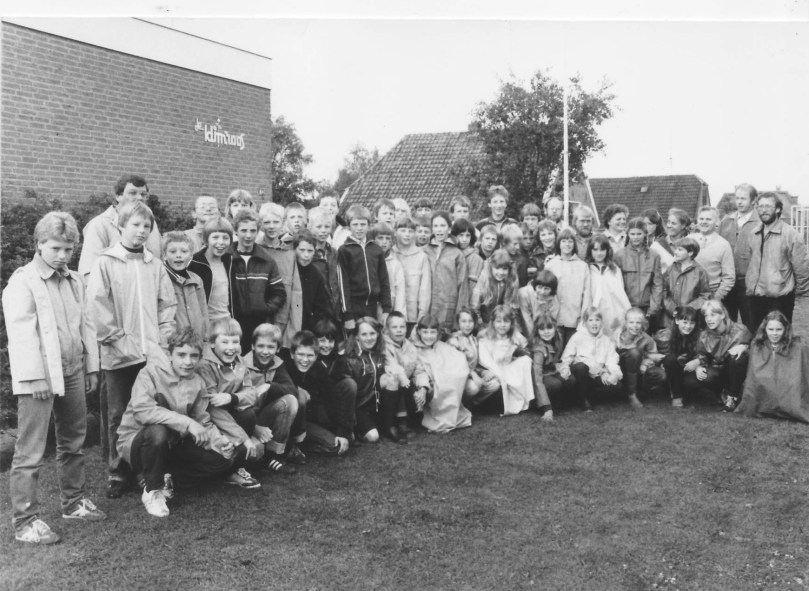
Featured image: my primary school class