Minimising surprise
A model is a simplified representation of reality, not reality itself. For example, a map is not the territory itself. The same goes for our language. The word tree is not a tree. Now, if there is a tree on the map, it says little about the scenery, except that there is probably a tree at the location designated by the map. What we think of as reality is also a model. Our brain doesn’t register reality itself but merely processes it. The outside world generates inputs via our senses, such as seeing, hearing, and touching, which the brain integrates with our memories and emotions. It is what we call consciousness. What we experience as reality is a model. A dog experiences that same reality very differently, and the dog’s experience centres more around smell. We may see a couch and notice its colour, while a dog smells that a cat has been lying on it recently.
The brain generates our perception of reality, and our consciousness is an integrated experience shaped by that brain, informed by its own expectations and the senses. The brain works with an expectation and adapts it when the senses disagree. We imagine reality, and correct it if contradicting information emerges. It is efficient because it greatly reduces the need for information processing. The brain aims to minimise surprise by having the best possible representation of reality. If our brain fails, for instance, when we are sleep-deprived, the world begins to look unreal. And so, intense stress can cause psychosis. During dreaming, the integrated experience of consciousness remains active, except that the information may not come from the senses but from the brain itself.
We employ models of reality to explain the world. Together, they form our worldview. We try to minimise surprises because we depend on our worldview to survive. Models are imaginations. We may believe that X causes Y because after X occurs, Y happens. We infer our models of reality from our observations and thoughts, as well as those of others. Scientific models are more formal and, if the scientific method is properly applied, have passed some formal checks. Models have a wide array of uses, including weather and economic models. Using multiple models can help us to reduce surprise, because different models have different strengths and weaknesses. It is, however, crucial to understand that models are not true or false but aim to minimise surprise. And that is because we cannot know the truth. Yet, we can minimise surprise, which helps us to survive.
Your model of reality may say that all swans are white, perhaps because you base it on the swans you have seen. Once you see a black one, you may change your view to minimise future surprises. That seems a rather straightforward case. You can also reduce surprise by ignoring evidence, as we have trouble handling complexity and contradictions. We may also do that because we are group animals who cooperate and survive based on shared fantasies. Faced with an unknown future and an uncertain role, my aim in conducting research was also to minimise future surprises by looking for evidence that contradicted my views and seeking better explanations, so that my guidance would at least be in the right direction. That is already ambitious.
Often, I wrote down my views on relevant subjects. Every time new information came to light, I adapted my texts accordingly. The more accurate the direction is, the more straightforward the execution becomes. It made me focus on demonstrating that this universe is a virtual reality, that God is an artificial intelligence that may present itself as a woman, that we can have a global usury-free financial system, and that we need to socially engineer the future world society to be the most socially advanced. That requires fine-tuning, but if the direction is incorrect, we will end up in the wrong place. And so, this model of reality has undergone over 17 years of work, with numerous revisions, and is far from complete. As minimising surprise seems essential for our survival, this supports the case for simplicity and stability. This finding is a crucial element in my model of reality.
Limitations of simplicity
Proverbs state contradictory things. One proverb says that two heads are better than one, while another says that too many cooks spoil the broth. How can both be right at the same time? In this case, the answer is that there is an optimal number of people working on a project. It is a simplistic view, but these proverbs were drawn up in a time when life was simple and predictable, so that they worked better then. Today, building teams has become an expert affair. The qualities of the individuals working on the project also matter, as do the available tools and countless other factors. It can be hard to get it right. Headcount is just one of many variables you need to manage if you run a business or a government. If you decide on these matters, you don’t open up a book with proverbs for guidance. Life has become complex and unpredictable.
A one-dimensional spectrum, so a line, with two opposites, ranging from one participant to a large number, can make you fail to see the solution. Perhaps it lies outside that line, so this way of thinking keeps us from seeing it. Maybe the project isn’t worth undertaking in the first place, or perhaps success depends on the right tools. The number of people working on the project may still matter, so you have to consider that also. The debate about capitalism versus socialism has dragged on for over a century and has dominated world politics during the Cold War. So, do we need more or less state interference in markets? Yet, markets and states don’t create agreeable societies on their own.
That is also why economic models include multiple variables, such as employment, inflation, consumption, business investment, and government spending. You can add more, such as workforce education, market flexibility, foreign competition, and regulations. There are countless variables to consider. If you have identified variables, you need data to estimate their impact. The available economic data is usually insufficient to achieve certainty, as changes can have multiple causes. How do you know that some other variable didn’t interfere with the outcome? Despite all the models central banks used, they didn’t foresee the 2008 financial crisis. Models can fail, and often do. Are they wrong? The financial models did get countless other things right, but missing one crucial variable can already produce an epic surprise. Chaos theory might explain why.
Here we run into the issue of planning errors. We make our plans based on the available information and our models of reality that give that information meaning. We all plan because we must make important decisions, like investments which tie us up for a long period. If you own a business, you must recoup your investments. Otherwise, you will go bankrupt. Yet that may take years, and conditions may change, such as costs, consumer preferences, or regulations. You have to adapt your plans along the way. Still, some investments may turn out worthless. We all plan for futures that don’t materialise. You may buy a home with your spouse, and then you divorce because something unexpected happened, such as infidelity. It is also the problem with models. Surprises remain.
Still, models can be helpful. The more models we use, the more surprises we can eliminate, but even then, we may still miss something crucial. Our minds have constraints. We often take a perspective and reason from there. A socialist economist might be good at pinpointing why capitalism fails but may not see what is wrong with socialism. Economic theories explain specific phenomena under certain conditions. You might find additional explanations in psychology, sociology, or even history. You might want to check your ideas before trying. You can run the idea through several economic theories. That might give new insights. You can’t be sure you are right, but models help you eliminate errors.
That was also my approach to designing a usury-free financial system. Natural Money draws on economic theory, monetary economics, banking, psychology, and history. There was not much to go on, so I reviewed that idea using existing theories and historical evidence to investigate how it might work in practice. During a real-life experiment, unforeseen issues came to light. Once interest rates in Europe fell below zero, resistance to negative interest rates emerged. Savers are irrational. They prefer 2% interest and 10% inflation over -2% and 0% inflation, it turned out. That is normal human behaviour, so humans are not, as standard economics may suggest, rationally calculating individuals.
We measure our gains and losses in currency units rather than purchasing power. And behavioural economics says we give more weight to losses than gains. It is why inflation and money printing meet little resistance, while negative interest rates make people go berserk. A 4% loss in interest income impresses us more than the 10% reduction in inflation because we count our money units. Emotions can be intense and lead us to act irrationally. It is pointless to try to convince savers that they are better off by appealing to their rational thinking, which was obviously absent. Once that became apparent, I could look for a fix by making negative interest rates appear as inflation.
Insights models give
The use of models yields fewer surprises than uneducated guesses, and combining several models yields fewer unexpected outcomes than using a single model. Models tie us to a mast of logic so that we are not carried away by our thoughts and can figure out which ideas are useful to us under what circumstances. Using data, we can calibrate our models, so if our model is wrong, we can investigate why and correct the error. Scientific disciplines such as economics, sociology, linguistics, and biology use models. According to a leading expert on the matter, Scott Page, models share the following characteristics:
- They simplify by omitting irrelevant details and focusing on the essentials. Models abstract from reality.
- They formalise by making precise definitions and providing a framework for logical thinking to explain and predict.
- They are somewhat wrong because they simplify and omit details. Using multiple models can reduce errors arising from that.
Weather models make calculations, such as predicting that the maximum temperature in Amsterdam will be 26°C in 8 days. That is a precise calculation, but it is likely inaccurate. Yet, most likely, the temperature will be between 22°C and 30°C. Weather forecasters use up to fifty models to reduce surprise outcomes. The average of these models is more reliable than the individual models. People who use a single model do poorly at predicting. They may be correct occasionally, just like a clock that has stopped is sometimes accurate, and then tout their few successes while forgetting about their impressive list of epic failures. Experts know that their models have limitations. When constructing a model, we can choose from the following approaches:
- Aiming for realism by describing relevant parts and relationships. Climate models work with CO2 levels and their effects on temperatures.
- Using an analogy by describing a process as similar to another. You can compare the ruinous growth of human activities with a cancer.
- Exploring possibilities if limits change. You can explore what will happen when unlimited energy becomes available at no cost.
When devising a plan for humanity that lasts a thousand years or more, numbers and mathematics become meaningless, and we have to do it with words. We can’t measure culture, but it is a central ingredient in human conduct. And still, we must try to pin down things by modelling humans to predict what we can do and how it might work. And then we must get it right for eternity. That forces us to dig deeper even. We then arrive at observations like religion can save us because humans are imaginative creatures who cooperate based on myths. This is a precise and meaningful statement without any mathematics. Still, it has seen no failures in the entire history of humankind. And so, it might help us when working on a plan for the future.
Two examples from Scott Page’s Model Thinking course on Coursera illustrate the use of models. They investigate why people of the same ethnicity often live together, and why revolutions are difficult to predict.
Sorting and peer effects
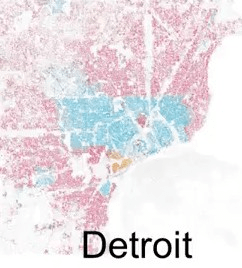
Groups of people who hang out together tend to look alike, think alike and act alike. If you look at the map of Detroit, you see people of the same ethnicity living together. Blue dots represent black people, and red dots represent white people. We can’t change our skin colour, so if we hang around with people who look like us, that is sorting. We also adapt our behaviour to match that of others around us. When you hang around with smokers, you may start smoking too. Alternatively, if you hang out with people who don’t smoke, you might quit smoking. That is the peer effect. Both sorting and peer effects create groups of similar people who hang out with each other. Models can help us understand how these processes work by modelling them.1
Schelling’s segregation model offers insight into the segregation process. It says nothing about why people move. That we seek out people who are like us is an observation. Why would people move? That is an interesting question, most notably if it points to problems. If we believe that skin colour shouldn’t matter, then why does it matter? Maybe income plays a role. Yet, the model doesn’t say anything about that. So, that is a limitation. Schelling developed a model in which individuals follow simple rules. Suppose income is the segregation criterion, and that everyone lives in a block with eight neighbours. Red boxes represent homes where rich people live, and grey boxes are homes where poor people dwell. The blank box is an empty home. Assume now that everyone has a threshold of similar people who will make them stay.

A wealthy individual might stay as long as at least 30% of his neighbours are rich. Assume a rich person lives at X. In this case, three out of seven or 43%, of the neighbours are rich, like the person living at X. If one of the wealthy neighbours moves out, and a poor person takes that place, 29% of the neighbours will be rich, and the person living at X will move.
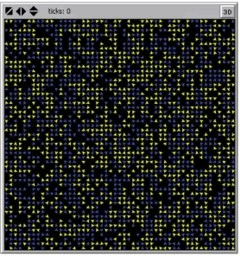
A computer can simulate how that works out over time. Assume there are 2,000 people. Of them, 1,000 are poor, represented by yellow dots, and 1,000 are rich, represented by blue dots, while black spots are vacant homes. Suppose that rich and poor people are randomly distributed at the start, and everyone wants to live among at least 30% similar people. In that case, the average is 50% alike, and only 16% are unhappy because less than 30% of their neighbours are alike. As a result, the unhappy people start moving. Yet their relocation makes some others unhappy, as the number of similar people falls below the threshold. And so, relocations continue until everyone is happy, and you end up with an average similarity of 72%.
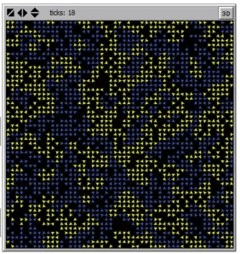
Even when everyone likes to live in a diverse neighbourhood where only 30% of their neighbours are like them, segregation occurs. Segregation may not be the intention of the individuals involved, as they might be tolerant people requiring only a minority of similar people living in their neighbourhood.1 Whether that is indeed the case remains to be seen, and the issue is not always intolerance. It can also be conduct. Now, wealthy people may not like scoulding and men drinking beer in the front garden. But if the assumption is correct, and if we believe segregation is undesirable, socially engineering the ethnic or wealth characteristics of neighbourhoods by mixing homes for different income groups makes sense. Some countries plan neighbourhoods that way to prevent the emergence of ghettos without economic opportunities.
Peer effects cause people to act alike. Contagious phenomena are peer effects. They often start suddenly, seemingly out of nowhere. In uprisings and revolutions, extremists frequently determine the course of events, as seen in the American, French, Bolshevik, and Maidan revolutions. History could have proceeded differently. It is difficult to predict revolutions. Usually, a revolution requires widespread discontent. Yet reasonable people don’t storm buildings and set them on fire. And so, the question remains: when do extremists get the upper hand? The answer is that we can’t predict it.
Granovetter’s model offers possible insight into why that is so. Suppose there is a group of individuals. Each individual has a threshold for participating in an event like an uprising and will join if at least a specific number of others join. If your threshold is 0, you do it anyway. If your threshold is 50, you start if you see 50 participants. The outcome varies depending on the thresholds of other people who might get involved.
Suppose there are five individuals, and the behaviour is wearing a suit. One individual has a threshold of 0, one has a threshold of 1, and three have a threshold of 2. The following will happen: one extremist starts wearing a suit because her threshold is 0. The second individual joins because his threshold is 1. Then, the three remaining individuals join in because their threshold is 2.
If the thresholds had been 1, 1, 1, 2, 2, nobody would have worn a suit despite the group, on average, being more open to the idea. If the thresholds had been 0, 1, 2, 3, 4, and 5, everyone would have worn a suit after five turns, even though the group, on average, was less keen to do so. And so, the model suggests that revolutions come by surprise. And so, it should not surprise us that they do. Otherwise, we might end up surprised, and to achieve that outcome, we might as well have employed no model at all.
Peer effects cause people to act alike. Contagious phenomena are peer effects. They may start suddenly, seemingly out of nowhere. In uprisings and revolutions, extremists often determine the course of events, as in the American, French, Bolshevik, and Maidan revolutions. Things could have proceeded differently. It is difficult to predict revolutions. Granovetter’s model might offer an insight into why that is so.1
Yet what motivates people to join a movement greatly determines the thresholds, and the model offers no insight into it. Is it hardship? Is it beliefs? Is it political agitators? The British Tea Tax, which sparked the outrage that led the Americans to declare independence, was actually a good deal for the Americans, as it would lower tea prices. The Americans had a good life, only no influence on British policies. They didn’t suffer as the Russian labourers, soldiers and farmers who supported the Bolshevik Revolution did. Yet many risked life and limb for independence and ideals, such as the right to pursue happiness, in the American War of Independence.
Proof in the pudding
Do similar people hang out together because of sorting or the peer effect? That is the identification problem. Sometimes, it is clear. Segregation by race occurs through sorting, since you can’t change your skin colour. Other situations are less clear, and you can’t tell whether it is sorting or peer effects, since the outcomes are the same. Happy people hang out with each other, as do unhappy people. Both sorting and peer effects may have caused this.1 Happy people may seek each other’s company because they don’t like to hear the whining of unhappy people. That would be sorting. Alternatively, the company of happy people could make you happier. That would be a peer effect.
Models can provide insights as to why similar people hang out together and why revolutions are difficult to predict. Yet, they don’t tell the whole story. Other models help us investigate what might happen under which circumstances. Thus, models explore the dimensions of complex questions and help us identify the spots where the best solutions hang out. These best solutions tend to hang out in spots where humans don’t look. Models can assist us in finding them. If we intend to get people to contribute to a cause, we might want to model human behaviour to see how we can do that. We are conditioned into thinking in particular fixed patterns. Burdened by these patterns and hampered by limited imagination, I spent decades on the theory of Natural Money. At the same time, an artificial intelligence might have figured it out in a matter of seconds.
If we envision humans as rational beings, we may try to convince them with arguments to do the right thing. If we see humans as myth-believing creatures, an inspiring fairy tale about their country’s greatness can prompt them to act. If we think humans are calculating individuals, incentives and punishments can make them do the right thing. If we see humans as social animals seeking recognition, we might achieve the objective by telling them how great they are. And if you believe that money motivates people, bribing them might be an approach you may entertain. You may get the best results by employing a combined approach with multiple models. Not everyone is the same, so the effects of the listed approaches may vary per individual and cultural group.
Latest revision: 16 October 2026
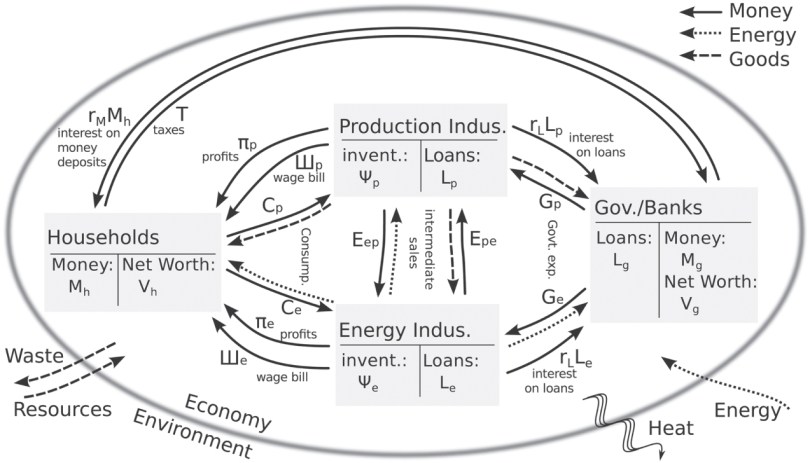
Featured image: Sector stocks and a flowchart of money, energy, and materials in a Stock-Flow Consistent Input–Output Model. Matthew Berg, Brian Hartley, Oliver Richters. CC BY 3.0.
1. Model Thinking. Scott Page. Coursera (2014).