My Guide Plausibility

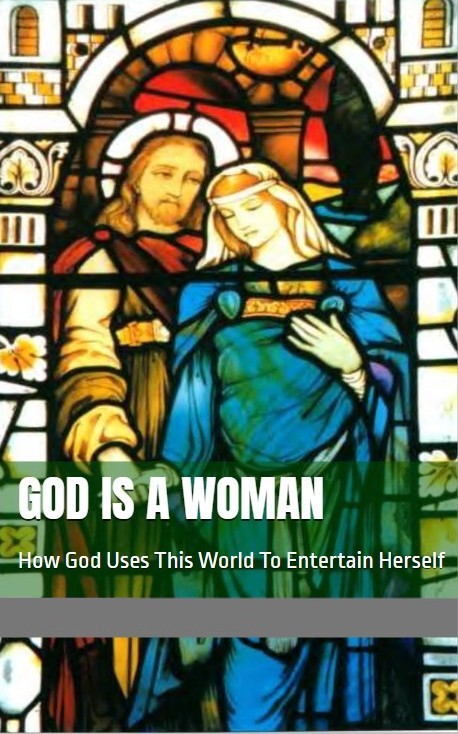
Plausible means that it can be true, but what we think is plausible depends on what we believe, and that often depends on the information we have. Humans are imaginative beings who invent stories, such as religions, but there is only one truth. The truth doesn’t depend on what you or I believe. An advanced post-human civilisation may have created us for the personal amusement of one of its members, who is God to us. That has remained hidden behind some of the world’s religions. The evidence suggests that God is a woman who assumes the role of an ordinary human in this world to pass the time.

You can speculate too wildly or fail to see the bigger picture if you only accept what can be proven. I have tried to avoid those pitfalls. This account leaves no significant questions concerning the reason for our existence unanswered. It is a plausible overall explanation, but it doesn’t answer many of the irrelevant questions scholars are debating. And there is still the Great Unknown. We are inside the simulation and don’t know what’s outside, just like a Holodeck character doesn’t know it’s on the Starship Enterprise.

We all connect the dots in different ways. We can easily get lost as we are religious creatures who make up stories and believe them. The quest for truth is different. Using the available information, we can rule out options. Information affects probabilities, but the quality of information matters. The Bible is doubtful evidence. With the help of scholars’ work, we may make guesses about what happened, but it remains a leap to arrive at an account that explains it all. That still requires a clue. Apart from God being a woman from an advanced humanoid civilisation, there are other possibilities, such as:

  • This world is like a Big Brother house. Our creators entertain themselves with us. Mary Magdalene wasn’t God, but something made Jesus believe it.
  • There are no humans left. Artificial intelligence has completely taken over. It runs this script to keep itself busy. The AI may think of itself as a woman.
  • Or, I am the post-human who wrote this script for myself to become the hero who found it all out and finds the perfect love. I don’t think so, but it is possible.

These alternatives make sense. For one thing, if you walk around in a story you wrote, you have no freedom. You can’t do things you aren’t supposed to do, as that would derail the script. At best, you have a limited decision space that the AI can work around by isolating the consequences of your actions and managing them. So, if you are God, these limits might pin you down for thousands of years. And so, our situation looks like living inside a box, trying to guess what is outside based on the information we find inside.

The evidence ‘inside the box’ suggests God is a woman from an advanced humanoid civilisation. Each piece of evidence is insufficient on its own. Their validity lies in the combination. The findings answer several questions without resorting to religious dogma. To name a few. Why is Christianity about love? Why does this religion have such baffling teachings that differ from Judaism and Islam? Why did the Jewish God gather so many worshippers via Christianity and Islam? Why was Jesus the Son of God? Why was he the Bridegroom? And was Muhammad a prophet of God? We now have answers.

Latest revision: 10 April 2026

Eibergen

Near Enschede, in the east of the Netherlands, is a village called Eibergen. I was born there in Iepenstraat (Elm Street). Elm Street. Do I have your attention? Here we go. The assassination of US President Kennedy happened on Elm Street, and that event is part of a web of remarkable coincidences. A Nightmare on Elm Street is a horror film first released in the United States on 9 November 1984 (11/9) and in the Netherlands on 11 September 1986 (9/11), with 9/11 referring to the terrorist attacks of 11 September 2001, yet another event marked by a remarkable array of coincidences. Here begins a tale riddled with coincidences and a story inside a story.

Eibergen means egg mountains, a possible cryptic reference to fallopian tubes. The initials of my last name, KI, make the Dutch abbreviation for artificial insemination, a way to make a virgin give birth. It is also the Dutch abbreviation for artificial intelligence, and this world is likely AI-generated. The name of the nearby city, Enschede, is found to be referencing the female reproductive organ. And Vagina, you could make of it. The initials of my first and middle names, BH, make the Dutch abbreviation for a bra. The song ‘A Boy Named Sue’ by Johnny Cash is about names of this kind and the strong character they build. But Sue had it easy. His funny name was the only thing he had to deal with.

Until age four, I lived in Eibergen and recall a little of that time. Nothing unusual happened. You might expect more if you know the remainder of this story, but to my knowledge, there were no spectacular omens of any kind. Often, I went out on a tricycle to feed the sheep in the pasture at the end of the street. The clock on television instilled anxiety. If it appeared, I took cover behind the sofa until it was gone. Unlike the clock in the living room of the renowned traditional pendulum type with the well-known ‘Nu Elck Syn Sin’ (Now, let everyone have it their own way) lettering, that one had a second hand, which made it particularly intimidating. Time was ticking. Tic toc tic toc. That was most frightening indeed. I remember my mother being pregnant. She was ironing. My sister Anne Marie was born in 1971. I sang songs for the baby in the baby room while my mother changed nappies.

Our home was on a block of similar houses. Next door lived an elderly lady, probably in her sixties. She came from the former Dutch Indies and had a fish tank in the living room. On the other side was a young family with children like us. They had a daughter of my age and a younger son. I remember playing together with them. They told me that rabbits eat grass. I tried it as well, but not being a rabbit, I didn’t appreciate the taste. And I once electrocuted myself by putting the chain of the stopper of the kitchen sink into a wall outlet. Others later said I had used scissors, but I am sure it was the stopper’s chain, which my mother confirmed. It suggests most of my memories are of good quality.

My father usually went to work around 6 AM and returned around 9 PM. He loved his job. On Saturdays, he went out hunting with his friends. And so, I hardly saw him. At home, he caught up on his sleep on the couch to wake up when sports started on television. So, at age three, I once said to my mother, probably jokingly, ‘Who is that man sleeping on the couch?’ That is what my mother later told me. My father probably took the hint, as he all of a sudden took me out of bed every morning before he went to work and played with me for a few minutes for a few weeks, which I do remember.

At the age of three, I once fell on my teeth on the wooden table in the living room in a most brutal smash. A piece of the wood broke off. My front teeth turned black shortly after, until my permanent teeth came in, making me an ugly duckling for years to come. We also had a bicycle accident. My mother was bicycling, Anne Marie was in the front, I was in the back, and my mother had trouble handling the bags full of groceries on the handlebars. And then the bicycle fell over. In early 1973, we moved to Nijverdal, which means ‘industrious valley’. It suggests we left the mountains for a life in a valley, but the Dutch mountains are imaginary, and the name of a song by my favourite band, The Nits. The music you love may reveal your character. And that might be correct in my case.

I was standing in the valley of rock
Up to my belly in an early fog
I was looking for the road to a green painted house
In the Dutch mountains
Mountains

I met a woman in the valley of stone
She was painting roses on the walls of her home
And the moon is a coin with the head of the queen
Of the Dutch mountains
Mountains

The Nits, In the Dutch Mountains

Latest revision: 20 April 2026

Featured image: my mother, my younger sister, and I (in the foreground)

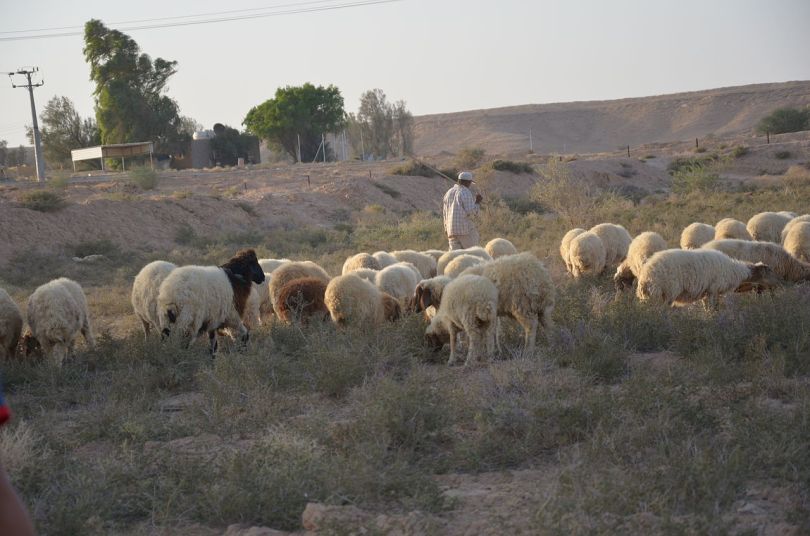
Shepherd and sheep in Saudi Arabia

Scheme of History

The Abrahamic religions, Judaism, Christianity and Islam contradict each other on several issues, most of them minor, with the most important one being whether Jesus is merely human or the Son of God. In hindsight, it is possible to summarise the grand scheme of God’s plan via Biblical themes or historical developments.

Creation: God created the world and assigned humans as its caretakers. Humans are created in the image of God. Hence, God is somewhat like us, which aligns with us being simulations created by an advanced post-human civilisation.

Fall: Humanity’s disobedience brought evil into the world. Humans wished to know the truth themselves and become like God. Ambitions are humanity’s main problem. The Tower of Babel represents the collapse of advanced civilisation.

Covenant and Kingdom: God made covenants with Abraham, Moses, David, and also with Muhammad to establish Her people and rule. The spread of the Abrahamic religions is a prerequisite for the establishment of the Kingdom of God.

Messiah: By the Fall, humans set the path to the apocalypse in motion by acquiring knowledge. Averting it is a global collective-action problem that requires everyone to adhere to the same social contract. By his sacrifice, Jesus laid the groundwork.

Exile and Return: Israel’s exile to Babylon symbolises humanity’s exile from Eden, with the messiah providing the way back home. The simple life in Eden is the opposite of the advanced civilisation of Babylon, so Paradise is a return to nature.

Restoration: The final chapter of the biblical story promises a new heaven and a new earth, where God restores creation and dwells with Her people in the New Eden. The Quran stresses this particular interpretation.

Apart from these Biblical themes, there is a historical scheme. In short, it is:

  • Creating a tradition of monotheism out of Judaism with the help of Zoroastrianism.
  • Creating a tradition of reason and objective enquiry, starting with Greek philosophy.
  • God revealing Herself to Jesus, thereby contradicting the Jewish religion.
  • Resolving that confusion, turning Christianity into a baffling religion.
  • Making monotheism uncompromising and spreading it via Christianity and Islam.
  • Letting the Greek tradition of reason and objective enquiry revive in Europe.
  • That tradition came to include science and ideas of social progress.
  • It included ideologies and social experiments, giving us insights to build on.
  • The uncovering of the plot in which religion meets reason and objective enquiry.
  • Building a utopian society in which humanity survives with the help of a messiah.
  • Quite possibly, humankind lives happily ever after, like in a fairy tale.

Latest update: 15 May 2026

The Virtual Universe

Some religions claim that God or gods have created this world. In the Bible, God created everything by saying, ‘Be.’ That God uttered ‘Be’ and poof, there are bees, is not a particularly compelling explanation for the existence of bees. So, how could the gods have the magical powers to do that? Until recently, we had no clue, but then Nick Bostrom, known for his dry and incomprehensible employment of words, delivered us the simulation hypothesis, the most profound breakthrough in theology in nearly 2,000 years. We might exist inside a computer simulation run by an advanced humanoid civilisation. Our creators can define a class bee and instruct the computer to create instances of this class. A class has properties, allowing individual instances to be unique.

And so, Genesis might be closer to the truth than the religion sceptics think. Bostrom didn’t say whether or not that is indeed the case or how likely it is. He didn’t speculate on that issue. Otherwise, his critics might have a field day, ridiculing him for opening a back door to the paranormal and religion. That could have been the end of his career. However, it is easy to find out if you venture into areas that scientists anxiously avoid, such as paranormal incidents, religious experiences, meaningful coincidences, people’s memories of past lives, ghost phenomena, and UFO sightings.

Scientists dare not investigate these phenomena, as it could make them a laughing stock in front of their peers. That is groupthink and intellectual cowardice on a grandiose scale. On numerous occasions, multiple credible witnesses have observed events that science can’t explain. Like nearly everyone else, scientists have been proficient at ignoring evidence that contradicts their beliefs, such as unscientific ravings about spirits relaying messages from the other side during seances. Bostrom speculated that this world might be a virtual reality, but didn’t search for proof. As a philosopher, he had better things to do.

The book The Virtual Universe delves into the evidence. You can prove this universe is a virtual reality if you assume scientists have correctly established the laws of nature and that sciences like physics, chemistry and biology are correct. If events transpire that defy these laws of science, such as paranormal incidents, religious miracles, meaningful coincidences, memories of previous lives, ghost phenomena and UFO sightings, breaches in these laws occur. According to science, the Virgin Mary doing a miracle before a crowd of thousands, like in Fatima, is impossible. If science is correct, and it happens nonetheless, this world must be fake. The book The Virtual Universe puts it like this:

  1. If we live in a real universe, we can’t notice. Virtual reality can be realistic and come with authentic laws of reality.
  2. This universe may have fake properties, but we cannot notice that either because we don’t know the properties of a genuine universe.
  3. Breaching the laws of reality is unrealistic in any case. If it happens, we may have evidence of this universe being fake.

It follows from (1) and (2) that we can’t use the universe’s properties, reflected in the laws of nature, to determine whether or not this universe is real. Science can establish the laws of physics or the properties of this universe, but science can’t tell whether they are real or fake. However, if breaches occur, we have evidence suggesting this universe is bogus. The book The Virtual Universe investigates the evidence, which includes stories about paranormal incidents, religious experiences, meaningful coincidences, reincarnation stories, ghost phenomena, and UFO sightings, often with multiple credible witnesses. So yes, aliens can beam you up into their UFO because they are as fake as you are.

Advanced humanoids, often dubbed post-humans, likely share motivations with us because they evolved from humans, likely after some engineering, genetic, or otherwise. These advanced humanoids may run simulations of human civilisations for research or entertainment. Research applications could be about running what-if scenarios. Possible entertainment applications include games or dream worlds where someone’s imagination comes true. These simulations may not be realistic in some aspects, as they reflect the rules of a game or someone’s personal fantasies. In a simulation, you can let Jesus walk over water and make him think that faith alone suffices to do that.

Civilisations are complex. Small changes can derail events that would otherwise occur. Just imagine another sperm had won the race to Adolf Hitler’s mother’s egg. There were millions of sperm in that race. Guaranteeing an outcome, such as letting World War I end on a date referred to by the licence plate number of the car that drove Archduke Franz Ferdinand to his appointment with destiny, requires control over everything that happens. That doesn’t apply to games. Unpredictable developments make games more interesting. Considering how we utilise computing power, mainly for games, sexy pictures and cat videos, the number of simulations for entertainment likely vastly outstrips those run for research purposes. If we live inside a simulation, we should expect its purpose to be entertainment.

The owner or owners may use avatars to play roles in this world and appear like ordinary human beings to us. If you are familiar with computer games, you are familiar with avatars. Once you enter a game, you become a character inside that game, your avatar, and you have an existence apart from your regular life. Inside the game, you are your avatar, not yourself. Alternatively, you could start a virtual world where you are the Creator and bring your dreams to life. In this world, you also become someone else.

That is a lot of assumptions, and without evidence, they remain speculation. Even when there is evidence, it doesn’t necessarily mean the explanation is correct. Suppose you hear the noise of a car starting. That is the evidence. You may think there is an automobile starting. Perhaps a vehicle is firing up its engine. But your husband might be watching his favourite television series, Starting Engines, so you can’t be sure. Nothing you know contradicts your assumption, but you could be wrong. So, is God an individual from an advanced humanoid civilisation who uses us for amusement? It is credible, and perhaps nothing contradicts it. But who is to say it is correct?

Now comes the disagreeable part. We are instances of the class human. When the beings in the simulation think for themselves, that raises ethical questions like whether they have rights that the creators should respect. Considering how humans treat each other, it is not a given that these rights would be respected even when our creators acknowledge them. In the real world, bad things happen to people. In the case of control, the beings inside the simulation don’t think, but are mindless bots following the script. We have no independent will and are toys to our creators. God kills people at will, and a few million casualties more don’t matter. On the bright side, if God wants us to enter Paradise, where there is peace and happiness, nothing can stop that as well. Those who try will surely find themselves on the losing side. So, if the Boss makes a joke, you can better laugh. Perhaps it isn’t easy. But don’t worry. It took me fifteen years to look at the bright side of life.

Latest revision: 6 September 2025

What Are The Odds?

The law of large numbers

On 11 November 2017 (11-11), I went to Groningen with my wife and son by car. While driving, I noticed the date and time displayed on the car’s clock. The date was 11-11, and the time was 10:35. It made me think, ‘Wouldn’t it be nice to look at the clock at exactly 11:11 today because it is 11 November (11-11).’ Within a second, I noticed the distance recorder standing at 111.1. It had been 111.1 kilometres since I last filled up. Peculiar coincidences can occur by chance. With eight billion people on this planet and so many things transpiring, these things happen.

An example illustrates this. Imagine you have five dice and make a throw. A remarkable incident is throwing five sixes. If you roll the five dice only once, it probably doesn’t happen. On average, it only occurs once every 7,776 times. But if you throw the dice a million times, it happens 128 times on average.

If a reset of the distance recorder occurs every 500 kilometres, the chance of 111.1 kilometres appearing on it is one in 5,000. The distance recorder was not far from the clock, so I would probably have noticed a peculiar number on it after seeing the date. The probability of the distance recorder being on 111.1 might have been 0.02%. The likelihood of the thought about 11:11 popping up on 11 November is difficult to establish, but in my case, it was not low.

The birthday problem demonstrates strange coincidences happen more often than we might think. If you share a birthday with another person in a small group, it might strike you as odd, but the chance of someone sharing a birthday with another person is already 50% in a group of 23. However, two people sharing a birthday is not a mind-blowing coincidence. It is not as remarkable as the incident with the distance recorder.

When you are a member of this group, the probability of you being one of the persons sharing a birthday is much smaller, namely 6%. Meaningful coincidences are likely to happen, but less likely to you. So, if many people experience the same and think it is merely a coincidence because coincidences occur more often than you might think, they suffer from what you might call a collective delusion. Imagine a group of 24 all sharing a birthday with one other group member, so they share 12 birthdays, and they all think, ‘Nothing exiting to see here. The odds of me sharing a birthday with another person in this group are over 50%.’

Taking a smaller sample reduces the likelihood of meaningful coincidences. If you randomly pick two people, the chance of them having the same birthday is only 0.3%. So, if you run into someone else who happens to share your birthday, and it happens again with the next person, it is noteworthy. If it happens another time with the following individual, you might wonder whether there is more to this universe than mere chance. The more elaborate a scheme, the less likely it is to transpire. The probability of three people sharing a birthday in a group of 23 is 1.3%, and for five, it is only 0.0002%. If your life is riddled with elaborate, meaningful coincidences, you might start to believe that you have a critical role in the universe.

Possible avenues to circumvent the law of large numbers

There may be a way to find out there is no such thing as coincidence. If some of the most significant historical events come with peculiar coincidences, that might be more telling for two reasons. First, there are only a few, so the law of large numbers doesn’t apply. After all, it is a small sample. Suppose no intelligence is coordinating events in this universe. In that case, it is less likely that meaningful coincidences will turn up in this sample, and elaborate schemes will be unlikely to emerge. Second, if the most significant historical events come with peculiar coincidences, it becomes more likely that history is scripted than when peculiar incidents transpire in someone’s personal life.

To make the argument, you need to answer questions like, what are the most important historical events, and what are peculiar coincidences? Events such as the sinking of the Titanic or the Kennedy assassination might not qualify, even though the coincidences surrounding them form a strange and elaborate scheme. The extent of these schemes might compensate for that, but it is hard to tell. The beginning and the end of World War I meet the requirements. D-Day, the fall of the Berlin Wall, and the terrorist attacks of 11 September 2001 are among the most important historical events.

And what should I think of the number of meaningful coincidences in my life? It is not possible to establish the likelihood of that happening. You can make assumptions to arrive at an idea. A highly unusual coincidence, such as the do-it-yourself store incident, could be likened to throwing five sixes with five dice. The chance of such an event happening in any year in any life could be one in 7,776. If something similar transpires again that year, it is like throwing five sixes twice in a row. The chance of that would be one in 60,000,000. On average, 120 people would experience something similar each year. But what if more similar incidents occur in one life? Or if 100,000 people have this instead of 120?

I have shared a few of my coincidence stories on the Reddit/SimulationTheory message board. Others also experience similar situations. Only the people on that message board are not a random group, but a select group of individuals who believe we live in a simulation, often because they have witnessed similar phenomena. Some of these stories are as remarkable as mine. I can’t verify these tales, but I believe most aren’t frauds because similar things happened to me. The question remains whether they have seen strange incidents occurring in the numbers I have seen.

There is a point where you must admit that these things are not merely coincidental. We can’t establish that point objectively. The number of possible unusual events is infinite, so the chance of something strange happening, such as the do-it-yourself store incident, could be higher than we intuitively think. It seems impossible to accurately estimate the odds. Still, without intelligence coordinating events in this universe, we should expect these incidents to be distributed more or less evenly across all people and time frames.

Even then, significant deviations from the average are possible. Lightning strikes only a few people. It happens to some people twice, which might seem odd, but there is nothing suspicious about that. If lightning strikes one in 10,000 people once, then one in 100,000,000 gets hit twice. But how would you explain if one person ran into lightning ten times, and this individual did nothing unusual? Statistically, it can happen. More likely, there is a cause, such as living in a dangerous spot. There is a point where we must assume these stories are evidence of us living in a simulation. We can’t establish that point precisely, but whether we live inside a simulation or not doesn’t depend on our assessment. We are, however, inclined to see causes behind remarkable situations or events, but they may be accidental.

The limits of our minds

We are good at attributing causes, but we do poorly at estimating the likelihood of an event. The psychologist Daniel Kahneman provided an example. It is a study of the incidence of kidney cancer in the counties of the United States. The research revealed a remarkable pattern. The incidence of kidney cancer was the lowest in rural, sparsely populated counties in traditionally Republican states in the Midwest, the South, and the West.1 So what do you make of that?

You probably came up with reasons why kidney cancer is less likely to occur in these counties, such as a healthy rural lifestyle or low pollution levels. You probably did not think of randomness. Consider then the counties in which the incidence of kidney cancer is the highest. These counties were also rural, sparsely populated, and in traditionally Republican states in the Midwest, the South, and the West.1

How can that be? Those counties all had small populations. And with smaller samples come more sizeable deviations from the average. Our intuition makes connections of causality, but our reason does not verify whether it could just be randomness. We like to think some cause makes unusual things happen, while they might be random accidents.

When we consider the most significant historical events, we run into problems if we use this small sample to establish that someone is ‘writing history’. On the other hand, comparing this sample to a sparsely populated rural county may not be apt. It is more fitting to compare this sample to the royal family, as it encompasses the most significant events in history. If a high incidence of kidney cancer were to turn up in the royal family, an experienced physician would tell you it is probably not a random issue.

I am a single individual, the smallest possible sample. Some people get struck by lightning twice. It could even happen three or four times, but the chance of it happening ten times is so insignificant that no one will ever experience that unless they live in a hazardous spot. Is the number of meaningful coincidences in my life enough to rule out chance? That number is extraordinarily high. It is not chance. The question arises: Am I just a random individual, or do I live in a dangerous location, or has destiny given me a unique role, such as proving that we live in a simulation? Others have this, too. And so, a lengthy series of peculiar incidents doesn’t suffice to believe the latter.

The things that could have happened but did not

In 1913, the ball fell on a black number twenty-six times in a row at the roulette wheel at the Casino de Monte-Carlo. Some people lost a fortune by betting the ball would fall on red the next time. They did not realise the chance of the ball choosing a red number never changed. The ball does not remember where it went the previous times. If we represent black with a B and red with an R and assume, for simplicity’s sake, there is no zero, we can write down falling twenty-six times on black like so:

B B B B B B B B B B B B B B B B B B B B B B B B B B

The probability of the ball falling on black twenty-six times in a row is one in 67,108,864. That is a long shot. What might surprise you is that the following combination of black and red numbers is precisely as likely to occur:

R B B R B R R B R B B R R B R R B R B B R R B B R B

You wouldn’t be thrilled if that happened unless you became a millionaire by betting on this particular series of twenty-six. And even then, you wouldn’t think of the 67,108,863 sequences that did not materialise. We tend to consider only the things that did happen, but we rarely think of all the things that could have transpired but didn’t. Events such as the ball falling on black twenty-six times in a row impress us. And I am even more impressed because twenty-six happens to be my lucky number.

This argument applies to meaningful coincidences but not to a prediction materialising, as such a feat may imply that all the other things couldn’t have happened. If I say with firm conviction that the coming sequence of black and red would be R B B R B R R B R B B R R B R R B R B B R R B B R B and it happens as I predicted, I may have the gift of prophecy. The chance of me being accidentally right was one in 67,108,864.

Imagine the probability of you sitting here reading this page on a tablet or a mobile phone, but as a prediction from 3,600 years ago. Imagine Joseph telling the Pharaoh: ‘I see (your name comes here) reading a pile of papyrus pages, not real papyrus pages, but papyrus pages appearing on something that looks like a clay tablet. Do not be afraid, dear Pharaoh, for it will happen 3,600 years from now. But if we do not set up this grain storage, it will not happen, so we must do it. And by the way, Egypt will starve otherwise.’

The chance of this prediction coming true was not one in 67,108,864, nor was it one in 1,000,000,000,000,000,000,000. Adding more zeroes doesn’t help. The chance is far smaller than any number you can ever write down. It is so close to zero that no one can tell the difference. Nevertheless, you sit here reading this text, perhaps even on a tablet. How could this happen? The answer to this mystery is that many things could have occurred but did not; however, something had to happen, and that is what transpired. In any case, Joseph couldn’t have made such a prediction by accident.

The licence plate number

What about the reference to the end date of World War I on the licence plate of Franz Ferdinand’s car? Few historical events are as significant as the start and end of World War I. And so, the law of large numbers doesn’t apply here. It is one of the most important historical events, thus part of a sample comparable to the royal family. A mere accident seems unlikely. The assassination could have gone wrong; cooler heads might have prevailed, or the war could have proceeded differently, ending on a different date.

It might have been possible to guess the end date of World War I once it had started. If you presumed that the war would not take more than twenty years, a random guess of the end date could be correct one in every 7,305 times. But something doesn’t add up here. Hardly anyone expected the war to last longer than a few months. The licence plate originates before the war. The assassination succeeded after a series of mishaps. If the licence plate number contained a prediction, that prediction included the assassination succeeding, Franz Ferdinand dying in this particular car, and this event being the trigger for the war.

That is hard to do. And so Mike Dash in the Smithsonian noted, ‘This coincidence is so incredible that I initially suspected that it might be a hoax.’2 Only, it is not a hoax, so investigative minds could have probed other options, but they did not. Conspiracy theorists also ignored it, even though this incident agrees with their beliefs of a secretive plan being behind history.

In the conspiracy scene, a story circulates about a Freemason named Alfred Pike, who allegedly disclosed a secretive plan of the Freemasons to bring about the New World Order. Pike supposedly predicted both world wars with uncanny precision in 1871. Nobody had ever heard of this plan before 1959, when an ‘investigator’ ‘uncovered’ it. Contrary to the licence plate number, the story has no substance. It is a hoax. In the Netherlands, they would call it a monkey sandwich story.

Seeing meaning

Authors use symbolism, hidden meanings, themes, and stylistic figures. Events in their lives, as well as the writings of other authors, influence their writings. Literary critics look for those meanings. You can check out what experts wrote about the poem The Waste Land by T. S. Eliot. You will be surprised. Some authors marvel at what literature critics discover in their works. Apart from intention, there can be an unconscious influence. And so, seeing meaning is more like an art than a science. A scientist would argue there is no proof and that it is baseless speculation because science isn’t about meaning.

He spent a number of years at this project
And now he knows how an electron behaves

The Nits, Mountain Jan

You can’t understand intentions and meaning from investigating the conduct of electrons. Meaning in literature is often intentional. If someone wrote the script running the events in this world, the author might do what other authors do. And so, the licence plate number on Franz Ferdinand’s car could signal foreknowledge of future events or even control over them. The sceptics argue from a scientific perspective, while those who see meaning act like literary critics. Who is right about the meaning of AIII 118 depends on whether there is a script and, therefore, an author.

Sceptics might claim that AIII 118 is a random sequence of characters, but we see a reference to the end date of World War I. That is how our minds work. The argument is odd. If you take it to the extreme, this text is also a random array of characters, as is any book or report. And still, you read words and sentences that have meaning to you. Indeed, the licence plate number would have remained unnoticed if the war had not ended on 11 November 1918.

However, the war ended on 11 November 1918. AIII 118 is the car’s licence plate number that drove Franz Ferdinand to his appointment with his destiny. And destiny is the message the licence plate number radiates. It suggests premeditation concerning the assassination, the start of the war and its end on 11 November 1918. That is a meaning we can see without too much imagination. There are plenty of instances and locations where this sequence of characters could have turned up, so their presence in this particular spot is noteworthy. AIII 118 on a fish barrel in Vienna wouldn’t have attracted attention. Ditto for the licence plate number ABII 117 on that particular car.

Sceptics can also be fanciful. Austrians speak German. Armistice in German is Waffenstillstand. So why does it not read WIII 118? Or even better, W1111 1918? If someone sends you a message, you don’t quibble about such details. If I said ‘hello’ to you, you wouldn’t ask me why I didn’t utter the word ‘hi’ instead. That is, unless you are a philosopher with a lot of idle time and have a hobby of questioning everything. Great Britain, the United States and France were all major participants in the war. These countries all use the term armistice. And if the sceptics come with outlandish arguments, you have won the argument. Only, they disagree. Not seeing meaning is the art of being a moron. Communication with morons is, therefore, problematic.

Asking yourself which licence plate numbers were available in the Austrian-Hungarian Empire may be a better idea. You could check which combinations fit the purpose. There aren’t that many options. Perhaps, you end up with just one match: AIII 118. That makes it harder to believe that this sequence of characters is meaningless. This scheme became even more inconceivable because the war ended on 11 November (11-11), the most peculiar date of the year.

Only a few historical events are as important as the assassination of Archduke Franz Ferdinand and the Armistice of 11 November 1918. You can think of D-Day, the fall of the Berlin Wall, and 9/11. The coincidence scheme surrounding D-Day is extensive, and the recurrence of dates is intriguing. The involvement of Hans van Mierlo is also mind-boggling. It also relates to the Curse of the Omen, a film released on the anniversary of D-Day, as well as the untimely passing of Senator Robert Kennedy on 6 June (6/6) and Martin Luther King on 4 April (4/4) 1968. A historian correctly predicted the fall of the Berlin Wall in 1989, while the coincidences surrounding the terrorist attacks of 11 September 2001 are dumbfounding. In other words, this incident doesn’t stand alone.

A final argument may be that such extensive or peculiar coincidence schemes don’t appear in other historical events that are equally significant, such as the American, French, Chinese, and Russian revolutions. These events are marked by a few peculiar coincidences, such as Thomas Jefferson and John Adams having their appointments with the Grim Reaper on the same day, which happens to be 4 July, thus Independence Day. That is noteworthy, but perhaps not sensational. The parallels between Napoleon Bonaparte and Adolf Hitler might also raise some questions. Somehow, the licence plate number of Franz Ferdinand’s car is more exceptional, most notably because of it being so precisely predictive.

The Chinese Revolution of 1911 began on 10 October 1911. It marked the end of 2,000 years of imperial rule in China. The date, 10 October (10/10), is not as remarkable as 11 November (11/11), even more so because there are no related coincidences. The Russian Revolution led to the establishment of a communist empire that lasted for seven decades. A bad omen marked the coronation of the last Czar of Russia, Nicholas II. The communists later murdered him and his family. You can ask why these events don’t seem part of a coincidence scheme. It is like asking why several members of the Royal Family don’t have kidney cancer. Well, they haven’t. That’s all there is to it. Perhaps, it is not satisfactory to philosophers with a lot of time on their hands, but it will have to do.

Hindsight bias

And then there is the benefit of hindsight. Countless strange incidents could have occurred, but they didn’t. We notice only things that did happen and don’t think of those that didn’t. That is hindsight bias. The sample of the most significant historical events comes with the benefit of hindsight. There is a danger to that approach, and it is unacceptable in science. It is like selecting only the data that confirms your theory. You might have a theory about gravity, saying that all objects will fall to the ground. And you prove your theory by ignoring the heavenly objects and the birds in the sky, so everything you investigate falls to the ground. It later turned out that gravity works that way, and ignoring the heavenly objects and the birds in the sky put you on the right track.

With hindsight, you know things you can’t learn in advance. Hindsight knowledge is also a favourite tool of critics when something goes wrong. However, when you use hindsight to find evidence, your critics argue you can’t. That’s how the critics play their game. They might clip a bird’s wing feathers and then ask the bird to prove it is a bird by flying. But if you use clipped birds to prove your theory of gravity, they might criticise you for that as well. You can’t beat your critics in their game. No evidence will ever convince them. So I won’t try. This wasn’t science in the first place, but metaphysical speculation.

Using hindsight, thus, is the only way to conduct this investigation, as we can’t predict the occurrence of meaningful coincidences. If this universe is genuine, we can’t establish that it is authentic. However, if it is a simulation, we may discover it is a simulation. So, if there is meaning, we must look for it to find it. We should be careful, as we are inclined to see intent when it could have happened accidentally. With that in mind, it is still fair to say that meaningful coincidences related to the most important historical events are likely not mere coincidences. Combined with the other evidence, we can establish that we live inside virtual reality, probably a simulation created by an advanced post-human civilisation.

Latest revision: 24 July 2025

1. Thinking, Fast and Slow. Daniel Kahneman (2011). Penguin Books.
2. Curses! Archduke Franz Ferdinand and His Astounding Death Car. Mike Dash (2013). Smithsonian. [link]