The Great Reset

During the coronavirus pandemic, the World Economic Forum (WEF) launched a plan, The Great Reset. It aims to rebuild the world economy more intelligently, fairer and sustainably while adhering to the United Nations Sustainable Development Goals (SDG). These SDGs include ending poverty, improving health and well-being, better education, equality, clean water and sanitation, affordable and clean energy, jobs and economic growth. That sounds great, but is it a reset? It would be up to so-called responsible corporations and international non-governmental organisations (NGOs) to implement the agenda before 2030. Not everyone thinks that is a great idea.

The change is supposed to be powered by the Fourth Industrial Revolution, a fusion of technologies in fields such as artificial intelligence, robotics, the Internet of Things, autonomous vehicles, 3-D printing, nanotechnology, biotechnology, materials science, energy storage and quantum computing. I get an uneasy feeling when I read that. It looks like an excuse for technology addicts to play with our future. Is it because I am against progress, or is it because of a rational fear that something is about to go seriously wrong even though I don’t know exactly what?

Under the umbrella of the Great Reset, so-called young global leaders of the WEF came up with new ideas. For instance, new technologies can make products like cars and houses cheaply available as a service, ending the need to own these items. A young global leader wrote an article titled, ‘Welcome to 2030. I own nothing, have no privacy, and life has never been better.’1 She hoped to start a discussion, and the article produced a slogan that also became an Internet meme, ‘You’ll own nothing, and you’ll be happy.’ There certainly is an economic rationale for sharing items like cars, most notably if they become more expensive to keep because of technological innovation.

Property, for instance, a home, can give you economic freedom. If you own a home, you don’t have to pay rent. And you own some capital when you retire. Some people think the WEF is a sinister elite club scheming to achieve a secret agenda where the elites own everything, and the rest of us ends up with nothing. And that might happen anyway if current trends continue because that is how capitalism works. Capital accumulates and ends up in the hands of a few because of interest. It is not a secret since Karl Marx figured that out. And it leads to a crisis when the impoverished masses can’t buy the things that capital produces. With negative interest rates, there is no need for that.

Property rights have become a semi-religious value in Western culture. That prevents us from taking the property of the elites and ending their stranglehold on our political economy. Marx advised that workers or the state would take over corporations. That might not be a good idea because workers and governments often do poorly at running corporations. Markets and private enterprises can efficiently provide goods and services, but it comes with wealth inequality and happens at the expense of future generations. Our societies must find the right balance. At some point, the disadvantages of the current political economy start to outweigh the advantages.

We use far more resources than the planet can provide, and wealth inequality is now so extreme that we might need a genuine Great Reset. Taking the wealth from the elites and discontinuing enterprises that don’t provide for our essentials is not communism, as long as there are markets and private property. People should prosper if their work benefits society and enterprises often do better at providing for our needs. But we don’t benefit from the corrupting influence of oligarchs. Their wealth comes from inheritance, criminal and shady activities, and, most notably, accumulated interest on their capital. That arrangement may have suited us in the past, but not now.

Economists believe property rights are essential for economic growth, and that business owners should be able to do as they please. For instance, Elon Musk has the right to ruin Twitter because he owns the company. Should employees and others suffer from the irrational behaviour of their owners? In the Netherlands, a series of interesting trials took place, where corporations tried to escape the influence of their majority shareholder Gerard Sanderink, who allegedly didn’t act rationally in the interest of these companies.2 Limited property rights and a collectivist attitude have not prevented China from becoming a large and advanced economy surpassing the United States and may have contributed to China’s success.

The degree of individualism currently existing in the West may do more harm than good. They promote political fights and litigation and prevent us from doing what we should do. And perhaps, less privacy can go a long way in reducing crime. Property rights and individualism were crucial to start capitalism and made the West dominate the world for centuries. And so, we have learned to see them as necessary, inevitable or even desirable. But once the European imperialist capitalist engine ran, these features became less important than economic stability. If you start a business, you must be able to estimate your returns, but you can lease everything and own nothing.

Individualism and property rights also play a positive role in society. The cultural heritage of the West is extensive compared to other cultures, for instance, if you express it in the number of books written or discoveries made. Self-interest and personal responsibility can inspire us to work harder and do a better job. The Soviet Union failed to produce enough food for its citizens while there was enough arable land. In the Soviet Union, farmers had to work on collective enterprises where they could not do as they saw fit and didn’t share in the profits. The tragedy of the commons is that we don’t care for public spaces as much as our possessions. Homeowners usually take better care of their houses than tenants. The same is true for car owners.

As they are now, property rights protect the elites. And the WEF plan is just a fart in the wind, not a Great Reset. We face unprecedented worldwide challenges while wealth inequality is at extreme levels, so individualism and property rights need limits. And we need a proper Great Reset, or a switch from economic to political control of the world’s resources if we intend to live in a humane world society that respects our planet. It is what a corporation named Patagonia did in 2022.3 We can do that on a global scale.

It begins with seizing the wealth of oligarchs and criminals and all hidden wealth in offshore tax havens, including their so-called charities, placing them in sovereign wealth funds, and setting a limit on what individuals can own or earn. And perhaps, we need to build our future on values rather than balance sheets. And everyone should contribute. Capital accumulates by interest, and people who live off interest don’t work for a living. That might be as bad as being on the dole while you can work. And peddling unnecessary products that harm life on Earth could be as bad as being a criminal.

Laws should prevent people and corporations from doing wrong, but they often fail to do that. Corporations pollute the environment or exploit employees to make a profit. But consumers desire excellence for rock-bottom prices. It is profitable to break the law if you can get away with it or when the gain is higher than the fine. And if there are loopholes, they become exploited. The anonymity provided by money, large corporations and markets turn us into uncaring calculating creatures. That is why big pharma, the military-industrial complex, the financial industry, and the Internet giants threaten us. If corporations do right out of their own, many laws and regulations become redundant. If moral values can replace the law, it could be better.

Less efficiency, poorer service and a smaller choice of products can be preferable if that doesn’t lead to deprivation and starvation. For instance, why must you get your meal from a takeaway restaurant instead of preparing it yourself? Or why do you need to dress up in the latest fashion if you have ample wearable clothing? And you must work to pay for these things, so if you don’t buy them, you have time to prepare your meal or mend your clothes. We don’t want to give up these things, so in a democracy, we can’t fix this problem. Perhaps we might accept the change if God sends a Messiah who tells us this is for the best.

That might be wishful thinking, but what else can make it happen if it is not religion? Do you believe we will come to our senses, become one humanity, and do right on our own? That is wishful thinking. God is our only hope. As we are heading for the Great Collapse in one way or another, the End Times could be now. We might live inside a simulation run by an advanced humanoid civilisation.4 Hence, God might own this world, and you might soon discover that you own nothing and be happy. God’s kingdom might be a utopian society as early Christians lived like communists (Acts 4:32-35).

So what can we achieve by taking political control of the world’s resources and means of production by seizing the elite’s wealth and placing it in sovereign wealth funds? You can think of the following:

  • We can direct our means to the goals of a humane society, be respectful of this planet, and plan long-term.
  • We can dismantle harmful corporations or give them a new purpose without starting an economic crisis with mass unemployment.
  • We can make corporations employ people in developing countries and give them an education and decent salaries.
  • We can fund essential government services in developing countries and eliminate corruption insofar as it is due to insufficient pay of government employees.
  • We can make corporations produce sustainably and pass on the cost to consumers.
  • We can determine the pay of executives.
  • We can halt developments like artificial intelligence, genetic engineering, and nuclear energy if we believe they are undesirable.
  • We can end the incentive to produce and consume more and stop the advertising industry from tracking us.
  • We can end stress in the workplace if we axe bullshit jobs and redirect workers to the needs of society. A twenty-hour working week might be enough.

Interest stands in the way of a better future. The economy ‘must’ grow to pay for the interest. We ‘must’ work harder in bullshit jobs to pay for the interest. Corporations ‘must’ sell harmful products to pay for the interest. Corporations ‘must’ pay low wages or move production to low-wage countries to pay for the interest. And because of interest, money disappears from where it is needed most and piles up where it is needed least. Interest is our tribute to the wealthy. If we hope to live in a humane world society that respects creation, ending interest might be imperative. That is where Natural Money comes in.

Latest revision: 28 April 2023

Featured image: You’ll own nothing and you’ll be happy. WEF.

1. Welcome To 2030: I Own Nothing, Have No Privacy And Life Has Never Been Better. Ida Auken. World Economic Forum (2016).
2. Zakenman Gerard Sanderink tierend in rechtszaal: ‘Deze rechtbank deugt voor geen meter!’ AD.nl (2023).
3. Patagonia’s Next Chapter: Earth is Now Our Only Shareholder. Patagonia (2022).
4. Are You Living In a Computer Simulation? Nick Bostrom. Philosophical Quarterly, 2003, Vol. 53, No. 211, pp. 243-255.

What Is the Point of Politics?

‘Politics is not worth a lightning bolt to me. Throw it to the sharks,’ sang the Dutch band Normaal in the 1980s. Many people feel disillusioned with the government and politicians. Is there something wrong with politics? Is it the system? Are our expectations too high? Do politicians interfere with matters that should require expert knowledge? Do we not elect the right people? Is the political system not democratic enough? There are no simple answers, but some countries do better than others. Francis Fukuyama wrote two books about political order. Good government is an uphill struggle that never stops.

And democracy often has frustrated the establishment of good government. So, there is reason to think, ‘What is the point of politics?’ Over the centuries, there might have been some progress in political institutions, which are customs, laws, government organisations, and other arrangements. Human nature does not change, so politicians have not evolved to a higher standard. People in the past devised institutions to provide stability and make governments work better. In recent decades, globalisation has made several institutions dysfunctional, most notably, the nation-state.

The basics

So, what is the point of politics? We organise ourselves economically and politically with the use of ideas. Among those ideas are money, states, and religions or ideologies. That made us successful as a species. We have languages to describe situations and the things we can do. And we discuss other people and what they are doing and thinking. That gives us information about other people, for instance, who can do a particular job best and who are reliable and who are not. We use that information to cooperate.1

Politics deals with questions like: what should we do as a group, what must our rules be, and who shall lead us? What we are going to do, is decided by ideas like sowing crops in the spring, doing a rain dance in the summer to please the rain fairy, and harvesting in the autumn. And we may have a priest who leads the rain dance. We do the rain dance we believe in the rain fairy. If rain does not come, we might try to please the fairy by electing another priest. But beliefs can be wrong.

This short tale already tells a lot about politics. There is a belief system. There are rules. And there is authority. Villagers believe the performance of the priest influences the rainfall. Political leaders influence what happens, but in many cases, they must deal with circumstances over which they have little control. Leaders might revert to public display, like ordering more elaborate rain dances to show us they are working on the problem. Things can go wrong because of our beliefs.

The big man

We are social animals, and politics is in our nature. We discuss plans, who should do what, which rules we must follow, and who should lead. Traditional societies also have politicians. For example, the big man leads a family group in Papua New Guinea. He earns his status by gaining the community’s trust, usually by solving conflicts and distributing resources to the members of his tribe. The big man can lose his position, and someone else can take his place.2

The big man is a politician, like the alpha male of a chimpanzee band. Much of politics comes down to solving conflicts in the group and distributing resources and favours. To become the leader, the big man forges a coalition of followers. His followers benefit from his leadership. He can also take actions that benefit the entire community and gain widespread respect. Not much has changed since then. Politicians look after the interests of their followers and can work in the public interest.

The role of institutions

Politicians are like big men in Papua New Guinea or priests of the rain fairy. And they can disappoint us by giving us fewer favours than we expected or not bringing rain. In democracies, we elect our leaders, so why do we not select better ones? Perhaps the problem is not politicians but how we conduct politics and organise societies. The programmatic political parties of Western Europe may have been an apex in the development of politics. They promoted general policies in the interest of their constituency or the public interest. But these parties have lost their lustre.

Today’s world differs from the world where they emerged and flourished. If you were born in a socialist or Roman Catholic family in the Netherlands in 1900, you remained a socialist or a Roman Catholic for the rest of your life. Dutch society was stable, and politicians did not need to compete for attention. The ideologies and religions of these parties have not passed the test of time. They have no answers to the questions of today. Many voters think traditional parties do not represent interests. In the absence of new ideas, politics becomes about identities and personalities.

Institutions can raise politics beyond the level of individuals and their interests, emotions and weaknesses. Traditional societies already have them. The rule of electing a new priest when rain fails to come is an institution. It tells us what we should do when rain doesn’t come. Otherwise, villagers might disagree and start a bloody conflict. The harvest is of the utmost importance. If you do not have faith in the measures taken, you feel obliged to protect yourself and your family from the stupidity of others. Institutions like rain dances can keep the peace but do not guarantee good outcomes.

Political development

The first humans were hunter-gatherers who lived in small bands. They had no property. In times of conflict, they often relocated. Later on, bands coalesced into tribes. Tribes could arrange more men for warfare. A reason to do so was the Agricultural Revolution, causing a switch to crop planting and cattle herding. Crops and livestock that needed defence from thievery and pillaging.

People living in tribes could have a lot of freedom. Tribes were loosely connected, and tribal leaders had limited authority. They might settle disputes, but only if parties agreed on them being the referee. Tribal leaders usually did not give orders. Another political development was the lord with his armed vassals. In Europe, this was called feudalism. Similar arrangements existed elsewhere in the form of warlords and gangs.

The requirements of warfare promoted the development of states. There was intense competition between states in China during the warring states era. Chinese states had armies of up to 500,000 men. They rationalised their organisation and tax systems. As a result, the first modern states appeared in China, and China remained the most advanced state for nearly 2,000 years.

States have the authority to order people. After humans switched to crop planting and cattle herding, there was more food, and more people could live in the same area. And more people could create more sizeable production surpluses to maintain states. States provided more security than tribes as they had police and standing armies, so the inhabitants could benefit from the defence and political stability that states could provide.

The modern state

Modern states have a rationally organised administration with merit-based recruitment and promotion. That happened in China first. Chinese emperors did not have to pass an exam. They inherited the title or came out on top during a power struggle. Emperors had unchecked powers, and there was no guarantee that only good emperors made it to the throne.2 Institutions can protect the country from poor rulers. This problem does not go away if we elect our leaders. That is why democratic states also have institutions, most notably, the separation of powers.

The separation of powers aims to split the state into three independent branches, which are the administration (the executive), the parliaments (the legislative) and the courts (the judiciary). Each has its responsibilities, and the branches should not interfere with each other’s tasks. Parliaments make the laws, the administration executes them, and the courts verify whether they are applied correctly. Ideally, the administration has no power over the parliaments and the courts. For instance, the administration should not nominate or appoint candidates for the parliaments and the courts, and the courts should stay out of political affairs, which is the domain of parliaments.

As political leaders change and can raise controversy, many nations have a ceremonial head of state to provide a sense of stability and continuity in the form of a person. Some countries hold on to their royal families, while others have presidents to perform that role. Usually, ceremonial presidents are highly respected individuals who do not interfere with political affairs. Royals can also provide a stable sense of nationhood, but kingship is a birthright. Kings do not need to have particular qualities, so they may lose the respect of their nation, while a ceremonial president has earned the nation’s respect and, therefore, is less likely to lose it.

Our predicament

Improvements in democratic political systems are possible, but our current predicament is not so much the result of a lack of democracy. Our belief systems are at stake, for instance, nationalism, socialism and liberalism, but also cultures, religions and traditions. And we have made money the prime mover of our decisions. Wealth inequality has increased in recent decades, creating a self-reinforcing trend in which an oligarchy has all the wealth and power. Identity conflicts and pride also block progress.

You can analyse the economy from a socialist or a capitalist perspective. The results are very different, and neither is the analysis entirely wrong or right. The proponents of ideologies and religions tend to have an explanation for everything. Within the confines of their models, their arguments make sense. If you believe in the rain fairy, it makes sense to think she is angry when rainfall does not come. Many of our belief systems are models of reality with merits and drawbacks, and we should treat them like so.

Our political institutions are the result of ideas from the past. They still have merits but grow increasingly problematic. Clinging to obsolete thoughts is like doing rain dances to prevent harvest failures when the cause is climate change. If existing ideas stop working, people become frustrated and lose faith. If crops continue to fail, some villagers may realise that electing a new priest does not solve the problem. They may worship the weather spirit instead and start a violent conflict with followers of the rain fairy.

The issues we now face come primarily from failing ideas and institutions rather than politicians. Existing religions and ideologies have no answers to the issues of today as many are global collective action problems, while centralised complex systems are ineffective in dealing with them. If the collapse is at hand, we may need to find common ground about what we should do and delegate practical decision-making about how to do it to the local level when possible.

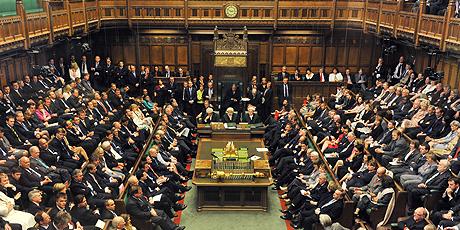
Featured image: House Of Commons in the United Kingdom. Parliament.uk. [link]

1. Sapiens: A Brief History Of Humankind. Yuval Noah Harari (2014). Harvil Secker.
2. The Origins of Political Order: From Prehuman Times to the French Revolution. Francis Fukuyama (2011).
The New Religion

Perhaps you think, ‘How did I find out?’ It seems that I once encountered God in a dormitory during my student years in 1989. She was one of the students living there, an overbearing figure who dominated the group. She made my life miserable and forced me to leave the dormitory. She told me that I didn’t fit in the group, was rude and didn’t show my feelings. There was something off about Her. And She connected with me like no one else ever has. It also seemed that She didn’t care what would happen to me, as if I were nothing in Her eyes. A student from another dormitory who was in a similar position had committed suicide around the same time.

She cast me out as I didn’t fit in in Her little Paradise. I was autistic and hardly aware of the consequences of my actions, but I felt that something was wrong with me. And so, it wasn’t hard to make me feel at fault. It didn’t help that I was a simple rural guy with little life experience. I didn’t fit in an intellectual environment where people discussed art, literature, and feelings. Afterwards, I realised I had fallen in love with Her, which made me feel even more miserable. It turned out to be a life-changing event that helped me resolve my issues and become a better person. Only that took years.

Since then, I never saw Her again, found a wife and had a son. Over the years, a few strange coincidences occurred, reminding me of Her. Nineteen years later, in 2008, I had a psychosis, in which She appeared to make telepathic contact and appeared to be God. She had a message for me: ‘I am Eve, and you are Adam, and together we will recreate Paradise.’ That suggested that She has a romantic interest in me. I figured that Jesus had a similar connection with Mary Magdalene, and that She had made him believe that Adam was Eve’s son. I didn’t want to be mistaken, because most messiah claimants were delusional, so I checked whether it could be true. This book is the result of that effort.

I can’t rule it out. But nothing happened. I continued with my life, living with my wife, while trying to figure out what to do if it were true. After all, I hadn’t asked for this, so if God wanted me for Herself, She could come and get me, which She hasn’t done yet. I once emailed Her, asking Her what this was about, but She denied being God or having anything to do with the events in my life. But God has fooled us for thousands of years. Whatever the truth may be, my discovery could be meaningful, so I proceeded with this research. This world seems a joke, and we exist to amuse God. If it is all true, you might save yourself with my guidance, not because I am a genius or can do miracles, but because it is the plot of the story.

Paradise will be what God desires, not what we want. I am an actor in this play, so I play the role of guessing which way things will go and helping you find a way out. The future will likely be different from what I anticipate, but I may be right about the direction. Time will tell. Knowing the consequences of your actions and doing no harm are the keys to a better future. I felt I had no excuses when I was a student, even though I didn’t know I was causing harm. But I should have known. That also applies to you. There are no excuses. You should have known. And you should do whatever it takes.

Only from a Western perspective do things seem to fall apart. If you live elsewhere, you probably see things differently. If these are not the end times, it is the end of 500 years of Western dominance. What many in the West see as social progress, such as human rights, may soon regress. The West has shaped the world as it is today. If Hegel was right, and social progress coming from a dialectic duel between progressivism and conservatism will lead us to Paradise, we have arrived at the end of the line. Even the Chinese Communist Party has built its vision on Hegel’s ideas. There is either social progress and a coming Paradise, or there is no point to history. It seems we are about to find out.

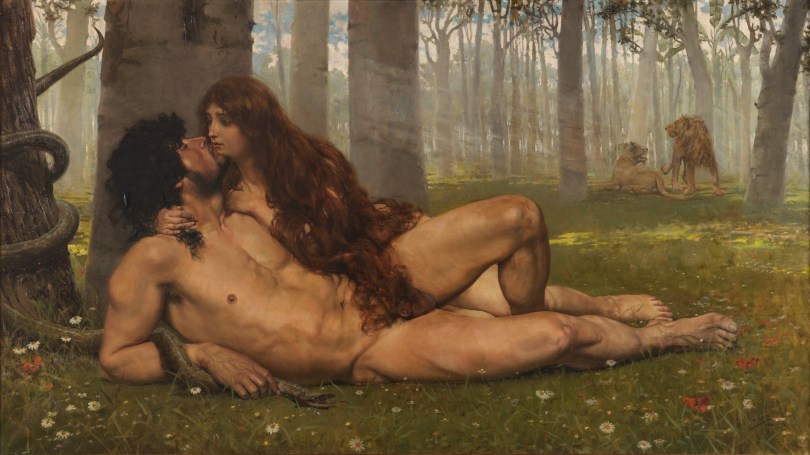
In Eden, Eve and Adam lived simple lives in harmony with nature. That may also lie ahead for us. That will be the New Religion, at least if we all embrace these wonderful tidings. Overall, it can be good, but that doesn’t mean it will all be nice and dandy. And so, before you get carried away by the idea of entering God’s kingdom, picture life in Eden. The Talking Heads already did,

Here we stand
Like an Adam and an Eve
Waterfalls
The Garden of Eden
Two fools in love

There was a shopping mall
Now it’s all covered with flowers

If this is paradise
I wish I had a lawnmower

We used to microwave
Now we just eat nuts and berries
You got it, you got it

Don’t leave me stranded here
I can’t get used to this lifestyle

Talking Heads, (Nothing but) Flowers

Latest update: 28 November 2025

Featured image: The First Kiss of Adam and Eve. Salvador Viniegra (1891). Public Domain.

Rational debates and progress

Knowledge or wisdom?

Ancient cultures had religious traditions and wisdom. Chief Seattle’s speech reflects the beliefs of traditional peoples who live in nature as hunter-gatherers. It is an idealised version as traditional peoples like the Native Americans also drove species into extinction. They didn’t have the means to destroy nature as much as we do. Modern people may think these so-called primitives and their ways of knowing are irrational. Knowledge and rationality aren’t wisdom. It is the theme of the biblical story of The Fall. Instead of listening to God, who knew better, Eve and Adam wanted to learn the truth themselves. We would not have been in this mess today if they followed God’s command.

The Chinese have their own tradition and wisdom. Confucius was their best-known philosopher. He lived 2,500 years ago and is still influential today. His teachings comprise moral rules, correct social relationships, justice, kindness, and sincerity. Chinese tradition and beliefs like loyalty to the family, ancestor veneration, and respect for elders were the basis of Confucius’ teachings. Confucius argued that family should also be central to government policies. The Chinese Tao is the natural order of the universe. You can only grasp it intuitively. You can’t understand it with reason, let alone quantify it. The Tao path to wisdom is understanding the whole by experiencing it. One of the greatest poems ever written is the Tao Te Ching, attributed to the sage Laozi. It begins like this,

The Tao that can be told is not the eternal Tao.
The name that can be named is not the eternal name.

When you try to express the natural order in words or give it a name, you are astray already, or so says the Tao. It disconnects you from the whole of Creation. The Buddha is another source of ancient wisdom. Our desires trap us in this world of suffering, he taught. Once you have what you desire, you desire something else, so you will never be happy. You can escape that and achieve enlightenment with the help of meditation, physical labour and good behaviour. The end of craving is the end of suffering. The capitalist consumerist system aims at the opposite, which is creating new desires, and if needed for that, making us unhappy.

The Western tradition is one of expressing things in words and quantifying them. Wisdom in Greek refers to knowledge and insight and its practical application in life. In Greek philosophy, wisdom was the highest good a human could aspire to. We can develop this virtue through study, reflection and experience. The Greeks believed wisdom comes from knowledge. In hindsight, that was a mistake.

Socrates was a Greek philosopher who lived around 400 BC. He is a founder of the practice of rational debate. Socratic debates are discussions between people with different viewpoints who wish to establish the truth using reasoned arguments. In his dialogues, Socrates acted as if he was ignorant. Admitting your ignorance is the first step in acquiring knowledge. The Greek philosophers began a quest for knowledge. European philosophers and scientists continued it nearly 2,000 later.

Is there progress, or can there be?

When we think of progress, we think of things getting better. But are they getting better? One invention can cure a disease, but another can kill us. Undoubtedly, our knowledge has increased. But is that progress? And can there be progress if we are less happy than our grandparents were? So, is there such a thing as progress? And if so, can we achieve progress through rational debates and persuasion? Or does it come by force because of the competition between groups of people?

We see progress as moving towards a goal, for instance, well-being. According to science, we do not have a purpose. Some religions, like Christianity, see history moving towards God’s aim. We enter Paradise one day, and all that occurs is necessary to get there. That is a peculiar view, but it implies progress and a type of progress that eludes the understanding of mere mortals like us. Did Jesus have to die? Was the Holocaust necessary? Was there no other way?

If we have a purpose, and you can get your hands on a time machine, there is a fellow you might want to meet, Georg Wilhelm Friedrich Hegel. He believed that spirit drives history through ideas and that history progresses towards a goal. Hegel lived before Charles Darwin published On The Origin Of Species, and it shows. The evolution theory completely upset our thinking about the purpose of humanity. Most intellectuals eventually considered it silly to think we exist for a reason.

Around 1800 AD, when Hegel was alive, scientific discoveries began to affect the lives of ordinary people, and the Industrial Revolution took off. At the same time, enlightenment ideas started to affect societies. The American Revolution followed the Glorious Revolution in England. Then came the French Revolution, which ended the old aristocratic regime and mobilised the masses for the first time. A few years later, the armies of Napoleon spread enlightenment ideas over Europe.

Hegel was there to witness it, and he was impressed. He learned to see history as a struggle towards progress where more powerful ideas replace weaker ones. He made a daring attempt to explain history, and as a result, his thinking greatly affected history. Marxism and the Soviet Union would not have existed without him. The conflict between capitalism and socialism dominated global politics for most of the twentieth century. His thinking inspired others, for instance, the Neoconservatives.

Hegel’s dialectic


Hegel was a philosopher of progress. He believed things would get better and we would, one day, live in a utopia. We increase our knowledge over time. By reflecting on our thoughts, we can challenge them. Or something might happen that changes your mind. You might believe all swans are white until a black one comes along. From then on, you think most swans are white while some are black. Hegel came up with a three-stage scheme for progress in thought:

  1. You believe all swans are white. That is your thesis.
  2. There comes a shocker. You see a black swan, the antithesis.
  3. Then you think most swans are white, and some are black. It is the synthesis.

And that is progress. Hegelian dialectic is this elegant three-stage scheme with thesis, antithesis, and synthesis. You can see why people liked it so much. It is wonderfully simplistic, and it explains so much, or so it appears. The synthesis is incorrect if there are red swans, but it is better than the thesis. The prediction that the next swan I see will be black or white is more often correct than that the next swan will be white. And even though the synthesis may still be incorrect, it better predicts future events. You can also apply it to Socratic dialogues, where people with different viewpoints wish to establish the truth using reasoned arguments. Our viewpoints are imperfect, and exchanging ideas can bring progress, which we can discover using Hegel’s dialectic.

Suppose we have a time machine and fetch Adam Smith from 1770 and Karl Marx from 1870 and bring them to the present so they can meet. They first study each other’s books, and then we let them start an argument. Smith sets out the thesis. He says capitalism and free markets work best at raising the general living standard because self-interest makes people do a good job, and increases in scale improve efficiency. Then, Marx comes up with the antithesis. He argues that the living conditions for workers are miserable, and capitalism distributes its benefits unfairly as factory owners and traders are wealthy. They agree on minimum wages, as they have good intentions.


Ideas may look great in theory but usually work out differently in practice. Experiments can help to find out. There was a capitalist experiment in the United States and a communist one in the Soviet Union. Perhaps Marx would be disappointed when the time machine brought him to the Soviet Union in the 1980s. The workers in Western capitalist societies were better off. And maybe Smith will be disappointed when he sees the United States today. And both may say, ‘This is not how it is supposed to be.’ They may not blame the plan but the execution. It is always someone else’s fault. That is the standard excuse of planners who have seen their plans fail.

We play a small part in a greater whole of humanity. Hegel says our consciousnesses are part of a general consciousness called spirit. Spirit reflects the ideas in society and how they change. Our ideas about slavery are an example. Today, most people believe slavery is wrong, but in the past, most people didn’t think so. The spirit requires individual freedom of thought and the ability to be part of society with a spirit containing these ideas. In dialectic terms, the individual is the thesis, our society the antithesis, and to take part in that society is the synthesis. We have our individual thoughts and desires. But we live in a society. By engaging ourselves, we become part of that spirit.

We aren’t free and subject to outside forces, but we can cut ourselves off from the outside world, turn inward, and experience freedom of thought. That makes us unhappy because we desire unity with the eternal absolute truth, God or the universe, Hegel claims. We express this desire in religion. We feel insignificant towards that absolute and want to be part of it. Our reason is the alternative absolute. We can imagine a relationship between the particular, which are objects like cows and the universal ideas. So, a cow participates in the universal concept of cowness that all cows share. We exist in unity with the universal, and with reason, we can conquer the world. Thus, knowledge is power.

Hegel claims reason conquers the world. And now we get back at Napoleon. Hegel saw Napoleon as the embodiment of Enlightenment ideas conquering the world. Napoleon did so by military force. He was impressed by the French successes. He learned to see history as a struggle towards progress where more powerful ideas replace weaker ones. It is good to know that Hegel believed there is an absolute truth, so reasonable people might, or should, not compromise with unreasonable people and overcome them by force. And that belief has had a significant impact on history. It became the model for ideological conflict. Leaders may fight for power, but ideological conflicts are about ideas.

Hegel and history

The most well-known is the conflict between communism and capitalism. Hegel’s dialectic affected Marx’s thinking and that of the communist revolutionaries. Hegel believed the direction of human history is progress towards greater rationality. Hegel was an idealist, which means his philosophy was concerned with ideas. Marx, on the other hand, was a materialist who believed historical changes have material causes. Change doesn’t come from ideas but from circumstances in the world around us. Often, these are economic. So, Hegel might argue that slavery would end because people consider it wrong, while Marx might say slavery will stop when other forms of labour are economically more efficient.

Marx claimed we work in relations like master-slave or employer-employee, not because we want to, but because it is the most appropriate way of production in a given stage of our economic development. These relations form the structure of a society, the foundation on which a legal and political system arises, and that shapes our social consciousness. So, in a capitalist society, the legal system might centre around property rights, and labour rights might be non-existent. And it was like so in the 19th century. Not our consciousness directs our social existence, but our social existence determines our consciousness. So, serfdom in Europe didn’t end because serfs wanted to be free; it was because new forms of labour organisation had become more efficient.

Change comes from contradictions between the underlying material reality and the social superstructure. You can see that in Hegelian terms. There was serfdom in Western Europe because it suited economic conditions (thesis). It ended because serfs flocked to cities to earn more as craftspeople. It undermined the social superstructure of serfdom (antithesis). Lords of manors had to provide an attractive alternative to keep their peasants. Serfs became free (synthesis), which best suited the new conditions. Marx believed humans were free at first and lived as communists (thesis). As the economic reality changed (antithesis), societies became slave states (synthesis). In the following sequence of thesis-antithesis-synthesis, slave states developed into feudal societies. Those societies became capitalist states because of economies of scale and capital requirements. The thesis-antithesis-synthesis may seem contrived, but the status quo changes due to forces that undermine it, creating a new status quo.

Marx prophesied that in the next round of thesis-antithesis-synthesis, the working class would overthrow the capitalist states and start socialism. Marx believed it was a historical necessity. After all, the Hegelian dialectic works behind it, so communists were more advanced, reasonable people who sought to overthrow the backward capitalist order. Marx was a prophet as he prophesied what would happen and had a vision of paradise. Humans first lived in a state of nature, the simple communism of the group, Marx’s Eden and we will return to communism, Marx’s paradise. Marx called religion opium for the masses, but Marxism resembles a religion. Like Christianity, Marxists think history has a purpose and an end times in which we enter the worker’s paradise. Ideologies come with prophets and holy books. The Capital of Karl Marx was the sacred book of Marxism.

Ideas require power to change the world. Marx claimed the exploited masses, the employees, should rise against their employers because their profits come from paying workers less than they are worth. All the workers across the world had to unite in a revolution. Capitalists disagreed. They argued that wages are the market price of labour, and the capitalist sells his products at the market price. The profits and the losses are for him. An entrepreneur seeks to employ the means of production, including labour, in the most efficient way, so the market value of an employee might increase due to the capitalist production organisation. Workers in socialist countries often had lower wages than workers in Western market economies. The communists and the capitalists believed they were reasonable, that their ideas were better, and that you shouldn’t compromise with unreasonable people, causing a stand-off between two ideological blocks, the Cold War.

In a Hegelian sense, capitalism seems better because it won out. However, capitalist societies introduced reforms like minimum wages and welfare. Agreeable societies have mixed economies, a mixture of capitalist and socialist elements, thus a market economy and an active government that intervenes in markets with regulations or money transfers like welfare. That could be the synthesis of capitalism and socialism. Capitalism is now the thesis of a new Hegelian question. The antithesis is that our production and consumption are about to cause an ecological or technological catastrophe. We need a different political economy. Hegelian thinking has limitations. It stylises questions as choices between two opposites. So, it is either capitalism or socialism or a mixture of both. Experts often use models to deal with complex problems. The use of models requires expertise or even wisdom. We have to learn how the parts interact and contribute to the whole.

Featured image: Portrait of Georg Wilhelm Friedrich Hegel. Jakob Schlesinger (1831). Public Domain.

one ring to rule them all

Multiculturalism

An astounding success

You may think multiculturalism is a failure when large numbers of immigrants arrive in your country, fail to adapt properly, and cause trouble. Usually, problems attract attention, not the things that turn out right. We live today and hardly think of how the world will be in a hundred years. Our time horizon, if we think ahead at all, is perhaps a few years or maybe decades, not centuries. Overall, multiculturalism has been one of the greatest successes in history. Today, in only a handful of countries, more than 85% of the population belongs to a single ethnic group. The alternative to making multiculturalism work is civil war and the displacement of people.

Successful empires in the past allowed people from diverse cultures to coexist peacefully under a single government. These were multicultural states. Cultures don’t change overnight, so for an empire to achieve political stability, it had to allow subjugated peoples to retain their customs and religions as long as they didn’t threaten the political and social order. Multiculturalism is thus a tool of the emperor, and like the One Ring to Rule Them All from The Lord of the Rings. A successful multicultural emperor was Cyrus the Great, who ruled around 550 BC and respected various faiths and traditions in his empire. He helped the Jews return to their homeland and rebuild the temple in Jerusalem.

If the empire lasted long enough, the nations in it integrated into a common culture. The Roman Empire is a good example. Conquered peoples could keep their gods, languages and customs as long as they respected the Roman authorities. Greek culture spread in the east, and Roman culture spread in the west. Several later Roman emperors came from the provinces such as France, Africa or Arabia. After the empire collapsed, the conquered peoples, like the Gauls, didn’t reappear as independent nations.1 The Chinese standardised their writing using pictures, allowing people to read each other’s writings despite having different languages. That helped to form a lasting national identity.

The case of Bosnia exemplifies the strengths and vulnerabilities of multiculturalism. For over 500 years, Roman Catholics, Muslims, and Orthodox Christians lived relatively peacefully together in three successive multicultural states: the Ottoman Empire, Austria, and Yugoslavia. In the 1990s, identity politics turned them into Croats, Bosnian Muslims and Serbs, and they began murdering each other in a civil war. Religion became the divisive factor, as they shared an ethnicity, history, culture and language. Any distinction can divide us and lead to civil war. The Soviet Union was also a multicultural empire, but it didn’t last. After it collapsed, a series of nationalist wars broke out.

Multicultural empires, such as the Roman Empire, allowed for gradual assimilation. It led towards greater unity. Over time, the number of cultures declined as smaller groups merged into larger ones. There have been temporary reversions as empires collapsed. Still, the long-term trend is unmistakable. The world gradually became more integrated. Nowadays, the world is closely interconnected, and a global culture may emerge. There will still be subcultures, thus regional differences and groups of people sharing common interests, such as pop artists, soccer clubs, or costumes and dances.

Identity politics changed multiculturalism. Rather than peaceful coexistence under one administration and acceptance of the social order, modern multiculturalism is about respect for other cultures and accommodating them. That slows down the unification process. And closed groups that don’t integrate into society pose a problem. In the past, the Jews were often that group. Today, it is often the Muslims. Muslims and Christians may learn to live together like Protestants and Catholics learned to do, but the latter only came to agree on that issue after centuries of religious wars. So if people in Western Europe think that it is better not to have Muslims around, they have a reason for that.

Us and them

Us and them
And after all, we’re only ordinary men
Me and you

Pink Floyd, Us and them

We divide humanity between us and them. We are the good people, while the others are the evil ones who act oddly, look different, have funny accents and wear peculiar outfits. People differ in skin colour, religion, sexual preferences, or other qualities. We find it taxing to deal with these differences. Even when you think you are open-minded, you hate those narrow-minded bigots and racists who are not like you. Welcome to human nature. We are xenophobic creatures. Evolution did that to us. Fear of the unknown can protect us from harm, such as diseases or eating poisonous plants. It can be a powerful emotion because human violence has always been one of the top causes of death. However, having peace with others comes with tremendous windfalls, allowing us to overcome these feelings.

Discrimination doesn’t always come from xenophobia. We are social animals who cooperate in groups. That requires a shared understanding of our rules and methods for handling various situations. That is our culture. These things make the group work. Otherwise, there is confusion, discomfort and conflict. Imagine you like to barbecue in a neighbourhood with militant animal rights activists. That is a recipe for trouble. And so, we prefer the company of like-minded individuals. Those who do not fit in can tell personal stories about bullying, physical violence and exclusion.

If your culture is dominant, you enjoy advantages you may not realise you have. Societies in Western Europe and the United States may be multicultural, but Western culture is dominant. Western culture has had such a profound impact on the world that it has become the dominant culture. We live in a European world, and if you doubt it, even the proud nationalist Chinese base their nation on European Marxism rather than Chinese Confucianism. The scientific method is a superior way of gaining knowledge, but sadly, there is no such method to gain wisdom. White privilege is growing up inside the dominant culture. It is often not about discrimination but having the proper upbringing to succeed.

Similar privileges exist everywhere for members of the dominant cultures. Being Chinese is an advantage in China. In Western multicultural societies, everyone is equal before the law, at least in theory. People from other ethnic groups also have opportunities. Jews and Asians do relatively well, often outperforming whites. It suggests that white privilege is less critical than upbringing and support from your family and community.

Our civilisation is on the verge of collapse due to excessive resource consumption and unchecked technology. The West has long led in science and capitalism. Blaming the West is not helpful. Competition drove this development. It is an iron law that those with greater means and better technology tend to prevail. Without capitalist greed, we wouldn’t have seen this dramatic change. Had the Chinese or the Africans started this, history would have been equally brutal and unfair, and we would still have ended up where we are now.

Competition is a mindless process that ultimately leads to destruction. Being anti-West, anti-capitalist, or anti-science doesn’t address that underlying issue. The most effective and efficient will win until the ecological or technological catastrophe materialises. Even then, they will win unless we end that competition. There is competition between businesses and between states, which goes hand in hand. Ending it means establishing a single world order where business decisions are subject to political choices. As long as we are at the mercy of the merchants, they determine what happens. And as long as we have no single government, there will be wars. And even when economic efficiency doesn’t drive our choices, there can be enough for everyone.

The world is interconnected

In September 2023, a flood killed over 10,000 people in Libya. Global warming may have contributed to this disaster. So did the overthrow of the Libyan regime with the help of NATO in 2011. During the ensuing civil war, critical infrastructure, such as dams, became neglected. No one voted for this intervention. Who is to blame? To some degree, it is you and I driving cars. On the day Tripoli fell, the New York Times headlined ‘The Scramble for Access to Libya’s Oil Wealth Begins.’ And exhaust gases contribute to global warming. Everything is interconnected, so change doesn’t come easily. And there are unintended consequences, so when you try to improve things, you might make them worse.

That also applies to multicultural societies. Those who promoted them were often quite naive. Cultural differences are a source of trouble, and identity politics can lead to civil war. However, it will be impossible to halt the further integration of the world. Cultural exchange is a two-way process. Chinese, Muslims, Native Americans and others are probably not thrilled by the cultural enrichment the West has brought them, either. To a Muslim, a mosque looks much better than a McDonald’s restaurant. Culture is not always related to ethnicity. In many countries, a growing divide emerges between urban and rural populations.

With colonisation came slavery and exploitation. And others are proud of their heritage. However, the multicultural societies that have emerged in the West may be the closest to what the future world society will look like. These societies provide a learning experience. The institutions developed in the West often emerged under the pressure of competition. One of the reasons the Industrial Revolution began in England was its well-developed financial markets, which included a central bank. Nearly every country has a central bank. It is a historical accident that modernisation started in Europe, and then competition began to drive innovation and the copying and improving of inventions. It allowed Europe to conquer the world and drag the world into this process.

We are stuck with each other, for better or worse. Border walls and pushbacks are not permanent solutions. And exchanging platitudes about diversity or the greatness of our cultural heritages will not help us to meet the challenges we face. The process that Europe initiated, which could have started elsewhere but did not, has grown out of control and is about to consume us. We need a new set of values, and we can only accept diversity as long as it doesn’t cause harm to others. There are tough, politically incorrect conclusions to draw. To begin with, working hard to get ahead often comes down to stealing scarce resources from the poor and future generations.

The consumerist culture promoted by capitalism is one of the world’s most pressing problems. It doesn’t help to criticise Western culture for it, as the future requires a global society with shared values. And environmentalism hardly exists outside the West. It is a paradox. Environmentalism developed as a reaction to capitalist consumerism in a Hegelian dialectic. If you go to Asian countries like Thailand or Vietnam, you find massive amounts of plastic dumped in nature. Pundits attribute it to the phase of development, as these countries are not yet high-income countries. But there is no lack of excuses disguised as explanations. Instead of looking for causes, we should recognise our contribution to these issues and help solve them.

Change begins with our attitudes. It is better to define what our values and conduct should be and reason from there before demanding that minorities adapt. You don’t want people to adapt to a death cult centred around the ethics of the merchant, which is no ethics at all. All our precious values come into question, and everything we once believed in may crumble to dust. We need to adapt. It can be harsh and painful, a cultural identity crisis, which could be like dying spiritually and being born again. And then, there will be a new dawn, and life will be better than it otherwise would have been. Like Jesus said, there is only a place for sheep in God’s kingdom. Goats are unruly, and you can’t herd eight billion of them. I can’t promise you bliss, but you may soon find yourself living in God’s paradise.

Latest revision: 5 July 2025

Featured image: One Ring to Rule Them All. Xander (2007). Public Domain.

1. A Brief History Of Humankind. Yuval Noah Harari (2014). Harvil Secker.